NEOCLASSICISM AND
ROMANTICISM
Famous Painters and their Artworks
Neoclassicism and Romanticism were the movements that spread in Western
Neoclassicism and Romanticism were the
movements that spread in Western Europe
and the United States during the Rococo era,
lasting roughly from the late 18th to the 19th
centuries.
Europe and the United States during the
Rococo era, lasting roughly from the late
18th to the 19th centuries.
.
Neoclassicism, 1780-1840
In decorative and visual arts, the Western trend that became
popular from 1780 to 1840 was called Neoclassicism. It also
refers to literature, theater, music and architecture which
were inspired by Ancient Greece and Rome’s classical art
and culture. This is also known as the Age of Enlightenment.
The revived interest in Greek and Roman classics has brought
on the art form in this time period.
Neoclassical works of art such as paintings, sculptures and
architecture typically depicted Roman history that exalted
the ancient heroes.
Romanticism, 1800-1810s
Romanticism was a trend that emphasized both
the delicate and stormy presentation of
sentiments or emotions and individualism. The
subjects or art works promoted a variety of
distinguishing concepts, such as historical
ambition, supernatural elements, social justice
and nature, with a preference for the medieval
over the classical.
Landscape painting was also made more
popular because of the romantic
adoration of nature by the inhabitants.
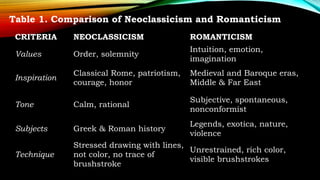
Neoclassical and Romantic styles differ
greatly from one another. Table 1 shows
their differences based on various
criteria:
CRITERIA NEOCLASSICISM ROMANTICISM
Values Order, solemnity
Intuition, emotion,
imagination
Inspiration
Classical Rome, patriotism,
courage, honor
Medieval and Baroque eras,
Middle & Far East
Tone Calm, rational
Subjective, spontaneous,
nonconformist
Subjects Greek & Roman history
Legends, exotica, nature,
violence
Technique
Stressed drawing with lines,
not color, no trace of
brushstroke
Unrestrained, rich color,
visible brushstrokes
Table 1. Comparison of Neoclassicism and Romanticism
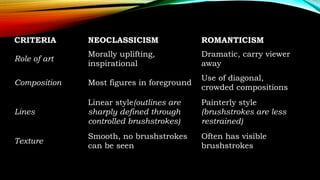
CRITERIA NEOCLASSICISM ROMANTICISM
Role of art
Morally uplifting,
inspirational
Dramatic, carry viewer
away
Composition Most figures in foreground
Use of diagonal,
crowded compositions
Lines
Linear style(outlines are
sharply defined through
controlled brushstrokes)
Painterly style
(brushstrokes are less
restrained)
Texture
Smooth, no brushstrokes
can be seen
Often has visible
brushstrokes
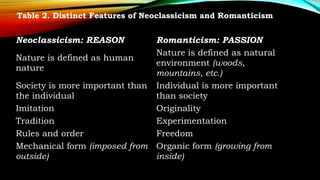
Neoclassicism: REASON Romanticism: PASSION
Nature is defined as human
nature
Nature is defined as natural
environment (woods,
mountains, etc.)
Society is more important than
the individual
Individual is more important
than society
Imitation Originality
Tradition Experimentation
Rules and order Freedom
Mechanical form (imposed from
outside)
Organic form (growing from
inside)
Table 2. Distinct Features of Neoclassicism and Romanticism
Logic Intuition
Reason Imagination, emotion
Attempted objectivity Accepted subjectivity
Town or cultivated
landscape
Country, preferably
untouched nature
Constraint Spontaneity
Conformity Independence, Rebellion
Cultivated, formal, social
The primitive become
focus
NEOCLASICAL PERIOD
ARTISTS AND THEIR WORKS
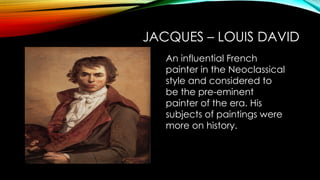
JACQUES – LOUIS DAVID
An influential French
painter in the Neoclassical
style and considered to
be the pre-eminent
painter of the era. His
subjects of paintings were
more on history.
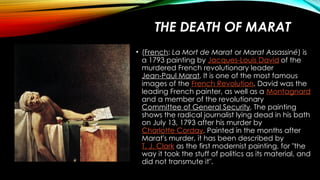
THE DEATH OF MARAT
• (French: La Mort de Marat or Marat Assassiné) is
a 1793 painting by Jacques-Louis David of the
murdered French revolutionary leader
Jean-Paul Marat. It is one of the most famous
images of the French Revolution. David was the
leading French painter, as well as a Montagnard
and a member of the revolutionary
Committee of General Security. The painting
shows the radical journalist lying dead in his bath
on July 13, 1793 after his murder by
Charlotte Corday. Painted in the months after
Marat's murder, it has been described by
T. J. Clark as the first modernist painting, for "the
way it took the stuff of politics as its material, and
did not transmute it".
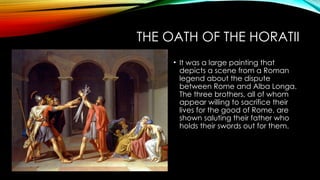
THE OATH OF THE HORATII
• It was a large painting that
depicts a scene from a Roman
legend about the dispute
between Rome and Alba Longa.
The three brothers, all of whom
appear willing to sacrifice their
lives for the good of Rome, are
shown saluting their father who
holds their swords out for them.
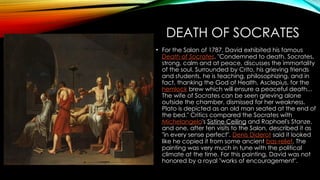
DEATH OF SOCRATES
• For the Salon of 1787, David exhibited his famous
Death of Socrates. "Condemned to death, Socrates,
strong, calm and at peace, discusses the immortality
of the soul. Surrounded by Crito, his grieving friends
and students, he is teaching, philosophizing, and in
fact, thanking the God of Health, Asclepius, for the
hemlock brew which will ensure a peaceful death...
The wife of Socrates can be seen grieving alone
outside the chamber, dismissed for her weakness.
Plato is depicted as an old man seated at the end of
the bed." Critics compared the Socrates with
Michelangelo's Sistine Ceiling and Raphael's Stanze,
and one, after ten visits to the Salon, described it as
"in every sense perfect". Denis Diderot said it looked
like he copied it from some ancient bas-relief. The
painting was very much in tune with the political
climate at the time. For this painting, David was not
honored by a royal "works of encouragement".
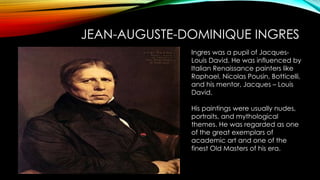
JEAN-AUGUSTE-DOMINIQUE INGRES
Ingres was a pupil of Jacques-
Louis David. He was influenced by
Italian Renaissance painters like
Raphael, Nicolas Pousin, Botticelli,
and his mentor, Jacques – Louis
David.
His paintings were usually nudes,
portraits, and mythological
themes. He was regarded as one
of the great exemplars of
academic art and one of the
finest Old Masters of his era.
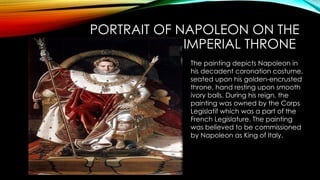
PORTRAIT OF NAPOLEON ON THE
IMPERIAL THRONE
The painting depicts Napoleon in
his decadent coronation costume,
seated upon his golden-encrusted
throne, hand resting upon smooth
ivory balls. During his reign, the
painting was owned by the Corps
Legislatif which was a part of the
French Legislature. The painting
was believed to be commissioned
by Napoleon as King of Italy.
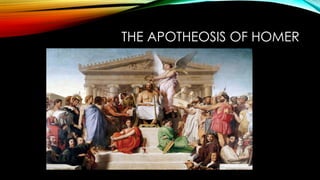
THE APOTHEOSIS OF HOMER
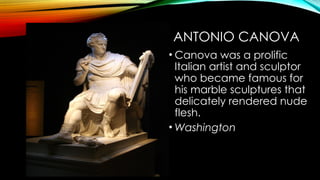
ANTONIO CANOVA
• Canova was a prolific
Italian artist and sculptor
who became famous for
his marble sculptures that
delicately rendered nude
flesh.
• Washington
PSYCHE AWAKENED BY CUPID’S KISS
• was commissioned in 1787 by
Colonel John Campbell.[27]
It is
regarded as a masterpiece of
Neoclassical sculpture, but
shows the mythological lovers at
a moment of great emotion,
characteristic of the emerging
movement of Romanticism. It
represents the god Cupid in the
height of love and tenderness,
immediately after awakening
the lifeless Psyche with a kiss.
BERTEL THORVALDSEN
• (Danish: [bæ dl
ɐ
̯ ̩ ˈt val sn
ɒː ˀ ]
̩ ; 19
November 1770 – 24 March 1844) was a
Danish sculptor of international fame
and medallist,[1]
who spent most of his
life (1797–1838) in Italy. Thorvaldsen was
born in Copenhagen into a
Danish/Icelandic family of humble
means, and was accepted to the
Royal Danish Academy of Art when he
was eleven years old. Working part-time
with his father, who was a wood carver,
Thorvaldsen won many honors and
medals at the academy. He was
awarded a stipend to travel to Rome
and continue his education.
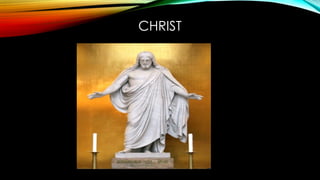
CHRIST
LION OF LUCERNE
JEAN LOUIS THEODORE GERICAULT
THE RAFT OF MEDUSA
THE CHARGING CHASSEUR
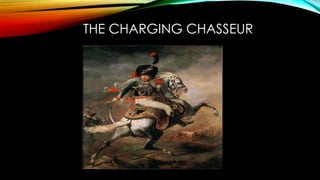
Géricault's first major work, The Charging Chasseur, exhibited at the
Paris Salon of 1812, revealed the influence of the style of Rubens and an
interest in the depiction of contemporary subject matter. This youthful
success, ambitious and monumental, was followed by a change in
direction: for the next several years Géricault produced a series of small
studies of horses and cavalrymen.[3]
He exhibited Wounded Cuirassier at the Salon in 1814, a work more
labored and less well received.[3]
Géricault in a fit of disappointment
entered the army and served for a time in the garrison of Versailles.[2]
In
the nearly two years that followed the 1814 Salon, he also underwent a
self-imposed study of figure construction and composition, all the while
evidencing a personal predilection for drama and expressive force.[
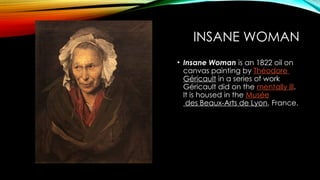
INSANE WOMAN
• Insane Woman is an 1822 oil on
canvas painting by Théodore
Géricault in a series of work
Géricault did on the mentally ill.
It is housed in the Musée
des Beaux-Arts de Lyon, France.
EUGENE DELACROIX
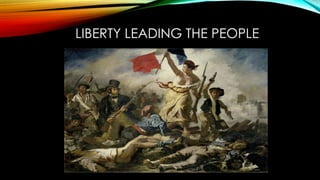
LIBERTY LEADING THE PEOPLE
• Liberty Leading the People (French: La Liberté guidant le
peuple [la lib te
ɛʁ id
ɡ ɑ̃ lə pœpl]) is a painting by Eugène
Delacroix commemorating the July Revolution of 1830,
which toppled King Charles X of France. A woman of the
people with a phrygian cap personifying the concept of
Liberty leads the people forward over a barricade and the
bodies of the fallen, holding the flag of the
French Revolution – the tricolour, which again became
France's national flag after these events – in one hand and
brandishing a bayonetted musket with the other. The figure
of Liberty is also viewed as a symbol of France and the
French Republic known as Marianne.
FRANCISCO GOYA
• Francisco José de Goya y Lucientes (/ˈ
ɡɔɪə/; Spanish: [f an θisko
ɾ ˈ xo se
ˈ ðe ˈ o a
ɣ ʝ i
lu θjentes
ˈ ]; 30 March 1746 – 16 April 1828)
was a Spanish romantic painter and
printmaker. He is considered the most
important Spanish artist of the late 18th
and early 19th centuries and throughout
his long career was a commentator and
chronicler of his era. Immensely successful
in his lifetime, Goya is often referred to as
both the last of the Old Masters and the
first of the moderns. He was also one of
the great contemporary portraitists.[1]
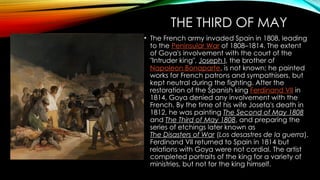
THE THIRD OF MAY
• The French army invaded Spain in 1808, leading
to the Peninsular War of 1808–1814. The extent
of Goya's involvement with the court of the
"Intruder king", Joseph I, the brother of
Napoleon Bonaparte, is not known; he painted
works for French patrons and sympathisers, but
kept neutral during the fighting. After the
restoration of the Spanish king Ferdinand VII in
1814, Goya denied any involvement with the
French. By the time of his wife Josefa's death in
1812, he was painting The Second of May 1808
and The Third of May 1808, and preparing the
series of etchings later known as
The Disasters of War (Los desastres de la guerra).
Ferdinand VII returned to Spain in 1814 but
relations with Goya were not cordial. The artist
completed portraits of the king for a variety of
ministries, but not for the king himself.
SATURN DEVOURING
HIS SON
• Saturn Devouring His Son is the name
given to a painting by Spanish artist
Francisco Goya. According to the
traditional interpretation, it depicts the
Greek myth of the Titan Cronus (in the title
Romanized to Saturn), who, fearing that
he would be overthrown by one of his
children,[1]
ate each one upon their birth.
The work is one of the 14 Black Paintings
that Goya painted directly onto the walls
of his house sometime between 1819 and
1823. It was transferred to canvas after
Goya's death and has since been held in
the Museo del Prado in Madrid.
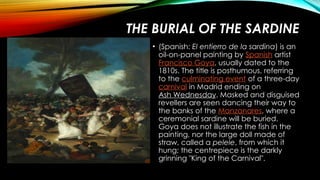
THE BURIAL OF THE SARDINE
• (Spanish: El entierro de la sardina) is an
oil-on-panel painting by Spanish artist
Francisco Goya, usually dated to the
1810s. The title is posthumous, referring
to the culminating event of a three-day
carnival in Madrid ending on
Ash Wednesday. Masked and disguised
revellers are seen dancing their way to
the banks of the Manzanares, where a
ceremonial sardine will be buried.
Goya does not illustrate the fish in the
painting, nor the large doll made of
straw, called a pelele, from which it
hung; the centrepiece is the darkly
grinning "King of the Carnival".
Neo-Classical and Romantic Period PowerPoint Presentation

Neo-Classical and Romantic Period PowerPoint Presentation

  • 1.
  • 2.
    Neoclassicism and Romanticismwere the movements that spread in Western Neoclassicism and Romanticism were the movements that spread in Western Europe and the United States during the Rococo era, lasting roughly from the late 18th to the 19th centuries. Europe and the United States during the Rococo era, lasting roughly from the late 18th to the 19th centuries.
  • 3.
    . Neoclassicism, 1780-1840 In decorativeand visual arts, the Western trend that became popular from 1780 to 1840 was called Neoclassicism. It also refers to literature, theater, music and architecture which were inspired by Ancient Greece and Rome’s classical art and culture. This is also known as the Age of Enlightenment. The revived interest in Greek and Roman classics has brought on the art form in this time period. Neoclassical works of art such as paintings, sculptures and architecture typically depicted Roman history that exalted the ancient heroes.
  • 4.
    Romanticism, 1800-1810s Romanticism wasa trend that emphasized both the delicate and stormy presentation of sentiments or emotions and individualism. The subjects or art works promoted a variety of distinguishing concepts, such as historical ambition, supernatural elements, social justice and nature, with a preference for the medieval over the classical.
  • 5.
    Landscape painting wasalso made more popular because of the romantic adoration of nature by the inhabitants. Neoclassical and Romantic styles differ greatly from one another. Table 1 shows their differences based on various criteria:
  • 6.
    CRITERIA NEOCLASSICISM ROMANTICISM ValuesOrder, solemnity Intuition, emotion, imagination Inspiration Classical Rome, patriotism, courage, honor Medieval and Baroque eras, Middle & Far East Tone Calm, rational Subjective, spontaneous, nonconformist Subjects Greek & Roman history Legends, exotica, nature, violence Technique Stressed drawing with lines, not color, no trace of brushstroke Unrestrained, rich color, visible brushstrokes Table 1. Comparison of Neoclassicism and Romanticism
  • 7.
    CRITERIA NEOCLASSICISM ROMANTICISM Roleof art Morally uplifting, inspirational Dramatic, carry viewer away Composition Most figures in foreground Use of diagonal, crowded compositions Lines Linear style(outlines are sharply defined through controlled brushstrokes) Painterly style (brushstrokes are less restrained) Texture Smooth, no brushstrokes can be seen Often has visible brushstrokes
  • 8.
    Neoclassicism: REASON Romanticism:PASSION Nature is defined as human nature Nature is defined as natural environment (woods, mountains, etc.) Society is more important than the individual Individual is more important than society Imitation Originality Tradition Experimentation Rules and order Freedom Mechanical form (imposed from outside) Organic form (growing from inside) Table 2. Distinct Features of Neoclassicism and Romanticism
  • 9.
    Logic Intuition Reason Imagination,emotion Attempted objectivity Accepted subjectivity Town or cultivated landscape Country, preferably untouched nature Constraint Spontaneity Conformity Independence, Rebellion Cultivated, formal, social The primitive become focus
  • 10.
  • 11.
    JACQUES – LOUISDAVID An influential French painter in the Neoclassical style and considered to be the pre-eminent painter of the era. His subjects of paintings were more on history.
  • 12.
    THE DEATH OFMARAT • (French: La Mort de Marat or Marat Assassiné) is a 1793 painting by Jacques-Louis David of the murdered French revolutionary leader Jean-Paul Marat. It is one of the most famous images of the French Revolution. David was the leading French painter, as well as a Montagnard and a member of the revolutionary Committee of General Security. The painting shows the radical journalist lying dead in his bath on July 13, 1793 after his murder by Charlotte Corday. Painted in the months after Marat's murder, it has been described by T. J. Clark as the first modernist painting, for "the way it took the stuff of politics as its material, and did not transmute it".
  • 13.
    THE OATH OFTHE HORATII • It was a large painting that depicts a scene from a Roman legend about the dispute between Rome and Alba Longa. The three brothers, all of whom appear willing to sacrifice their lives for the good of Rome, are shown saluting their father who holds their swords out for them.
  • 14.
    DEATH OF SOCRATES •For the Salon of 1787, David exhibited his famous Death of Socrates. "Condemned to death, Socrates, strong, calm and at peace, discusses the immortality of the soul. Surrounded by Crito, his grieving friends and students, he is teaching, philosophizing, and in fact, thanking the God of Health, Asclepius, for the hemlock brew which will ensure a peaceful death... The wife of Socrates can be seen grieving alone outside the chamber, dismissed for her weakness. Plato is depicted as an old man seated at the end of the bed." Critics compared the Socrates with Michelangelo's Sistine Ceiling and Raphael's Stanze, and one, after ten visits to the Salon, described it as "in every sense perfect". Denis Diderot said it looked like he copied it from some ancient bas-relief. The painting was very much in tune with the political climate at the time. For this painting, David was not honored by a royal "works of encouragement".
  • 15.
    JEAN-AUGUSTE-DOMINIQUE INGRES Ingres wasa pupil of Jacques- Louis David. He was influenced by Italian Renaissance painters like Raphael, Nicolas Pousin, Botticelli, and his mentor, Jacques – Louis David. His paintings were usually nudes, portraits, and mythological themes. He was regarded as one of the great exemplars of academic art and one of the finest Old Masters of his era.
  • 16.
    PORTRAIT OF NAPOLEONON THE IMPERIAL THRONE The painting depicts Napoleon in his decadent coronation costume, seated upon his golden-encrusted throne, hand resting upon smooth ivory balls. During his reign, the painting was owned by the Corps Legislatif which was a part of the French Legislature. The painting was believed to be commissioned by Napoleon as King of Italy.
  • 17.
  • 18.
    ANTONIO CANOVA • Canovawas a prolific Italian artist and sculptor who became famous for his marble sculptures that delicately rendered nude flesh. • Washington
  • 19.
    PSYCHE AWAKENED BYCUPID’S KISS • was commissioned in 1787 by Colonel John Campbell.[27] It is regarded as a masterpiece of Neoclassical sculpture, but shows the mythological lovers at a moment of great emotion, characteristic of the emerging movement of Romanticism. It represents the god Cupid in the height of love and tenderness, immediately after awakening the lifeless Psyche with a kiss.
  • 20.
    BERTEL THORVALDSEN • (Danish:[bæ dl ɐ ̯ ̩ ˈt val sn ɒː ˀ ] ̩ ; 19 November 1770 – 24 March 1844) was a Danish sculptor of international fame and medallist,[1] who spent most of his life (1797–1838) in Italy. Thorvaldsen was born in Copenhagen into a Danish/Icelandic family of humble means, and was accepted to the Royal Danish Academy of Art when he was eleven years old. Working part-time with his father, who was a wood carver, Thorvaldsen won many honors and medals at the academy. He was awarded a stipend to travel to Rome and continue his education.
  • 21.
  • 22.
  • 23.
  • 24.
  • 25.
  • 26.
    Géricault's first majorwork, The Charging Chasseur, exhibited at the Paris Salon of 1812, revealed the influence of the style of Rubens and an interest in the depiction of contemporary subject matter. This youthful success, ambitious and monumental, was followed by a change in direction: for the next several years Géricault produced a series of small studies of horses and cavalrymen.[3] He exhibited Wounded Cuirassier at the Salon in 1814, a work more labored and less well received.[3] Géricault in a fit of disappointment entered the army and served for a time in the garrison of Versailles.[2] In the nearly two years that followed the 1814 Salon, he also underwent a self-imposed study of figure construction and composition, all the while evidencing a personal predilection for drama and expressive force.[
  • 27.
    INSANE WOMAN • InsaneWoman is an 1822 oil on canvas painting by Théodore Géricault in a series of work Géricault did on the mentally ill. It is housed in the Musée des Beaux-Arts de Lyon, France.
  • 28.
  • 29.
  • 30.
    • Liberty Leadingthe People (French: La Liberté guidant le peuple [la lib te ɛʁ id ɡ ɑ̃ lə pœpl]) is a painting by Eugène Delacroix commemorating the July Revolution of 1830, which toppled King Charles X of France. A woman of the people with a phrygian cap personifying the concept of Liberty leads the people forward over a barricade and the bodies of the fallen, holding the flag of the French Revolution – the tricolour, which again became France's national flag after these events – in one hand and brandishing a bayonetted musket with the other. The figure of Liberty is also viewed as a symbol of France and the French Republic known as Marianne.
  • 31.
    FRANCISCO GOYA • FranciscoJosé de Goya y Lucientes (/ˈ ɡɔɪə/; Spanish: [f an θisko ɾ ˈ xo se ˈ ðe ˈ o a ɣ ʝ i lu θjentes ˈ ]; 30 March 1746 – 16 April 1828) was a Spanish romantic painter and printmaker. He is considered the most important Spanish artist of the late 18th and early 19th centuries and throughout his long career was a commentator and chronicler of his era. Immensely successful in his lifetime, Goya is often referred to as both the last of the Old Masters and the first of the moderns. He was also one of the great contemporary portraitists.[1]
  • 32.
    THE THIRD OFMAY • The French army invaded Spain in 1808, leading to the Peninsular War of 1808–1814. The extent of Goya's involvement with the court of the "Intruder king", Joseph I, the brother of Napoleon Bonaparte, is not known; he painted works for French patrons and sympathisers, but kept neutral during the fighting. After the restoration of the Spanish king Ferdinand VII in 1814, Goya denied any involvement with the French. By the time of his wife Josefa's death in 1812, he was painting The Second of May 1808 and The Third of May 1808, and preparing the series of etchings later known as The Disasters of War (Los desastres de la guerra). Ferdinand VII returned to Spain in 1814 but relations with Goya were not cordial. The artist completed portraits of the king for a variety of ministries, but not for the king himself.
  • 33.
    SATURN DEVOURING HIS SON •Saturn Devouring His Son is the name given to a painting by Spanish artist Francisco Goya. According to the traditional interpretation, it depicts the Greek myth of the Titan Cronus (in the title Romanized to Saturn), who, fearing that he would be overthrown by one of his children,[1] ate each one upon their birth. The work is one of the 14 Black Paintings that Goya painted directly onto the walls of his house sometime between 1819 and 1823. It was transferred to canvas after Goya's death and has since been held in the Museo del Prado in Madrid.
  • 34.
    THE BURIAL OFTHE SARDINE • (Spanish: El entierro de la sardina) is an oil-on-panel painting by Spanish artist Francisco Goya, usually dated to the 1810s. The title is posthumous, referring to the culminating event of a three-day carnival in Madrid ending on Ash Wednesday. Masked and disguised revellers are seen dancing their way to the banks of the Manzanares, where a ceremonial sardine will be buried. Goya does not illustrate the fish in the painting, nor the large doll made of straw, called a pelele, from which it hung; the centrepiece is the darkly grinning "King of the Carnival".