Felicia Linch
Agenda
 • Explore why does effective communication make
   a difference?
 • Review the Communication Model and obstacles
   to effective communication
 • Identify 3 Techniques of Effective Communication
 • Present useful guidelines for effective
   presentations
Company Confidential – no elements of this presentation may be
reproduced without the express permission of Kitch Consulting.
Communication
                                                               is key to
                                                             achieving all
                                                             our goals as
                                                              Managers

Company Confidential – no elements of this presentation may be
reproduced without the express permission of Kitch Consulting.
• In Groups take 5 minutes to discuss whether you
      agree/disagree with the statement

    • Explain why you agree/disagree

    • Give 2 examples to support your view point

    • Be prepared to share your views with the wider
      group
Company Confidential – no elements of this presentation may be
reproduced without the express permission of Kitch Consulting.
5 key factors to raise
   productivity :
 • Effective leadership                                            Can any of these be
 • Establishment of a high                                           achieved without
   performance culture                                                   effective
                                                                     communication?
 • Employee engagement
   practices
                                                                 i4CP, Productivity Report
 • Training and development
Company Confidential – no elements of this presentation may be
reproduced without the express permission of Kitch Consulting.
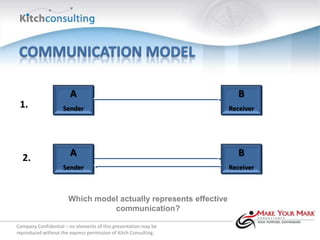
A                                             B
 1.                 Sender                                        Receiver


  2.                   A                                             B
                    Sender                                        Receiver


                      Which model actually represents effective
                                communication?

Company Confidential – no elements of this presentation may be
reproduced without the express permission of Kitch Consulting.
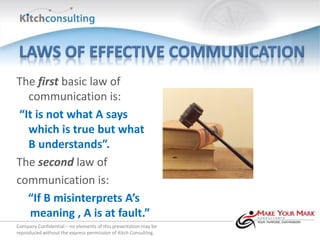
The first basic law of
   communication is:
 “It is not what A says
   which is true but what
   B understands”.
The second law of
communication is:
   “If B misinterprets A’s
   meaning , A is at fault.”
Company Confidential – no elements of this presentation may be
reproduced without the express permission of Kitch Consulting.
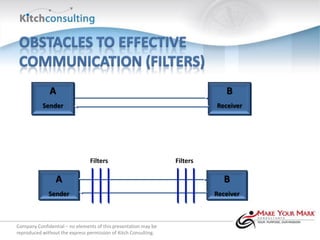
A                                                               B
           Sender                                                          Receiver


                                Filters                          Filters

                 A                                                            B
              Sender                                                       Receiver


Company Confidential – no elements of this presentation may be
reproduced without the express permission of Kitch Consulting.
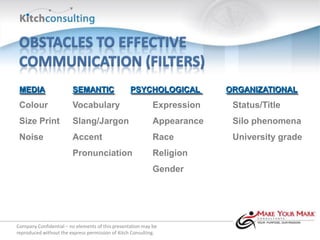
MEDIA                  SEMANTIC                  PSYCHOLOGICAL          ORGANIZATIONAL
 Colour                 Vocabulary                          Expression    Status/Title
 Size Print             Slang/Jargon                        Appearance    Silo phenomena
 Noise                  Accent                              Race          University grade
                        Pronunciation                       Religion
                                                            Gender


Company Confidential – no elements of this presentation may be
reproduced without the express permission of Kitch Consulting.
Company Confidential – no elements of this presentation may be
reproduced without the express permission of Kitch Consulting.
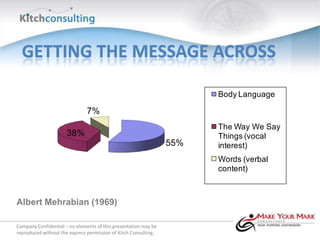
GETTING THE MESSAGE ACROSS

                                                                       Body Language

                               7%
                                                                       The Way We Say
                      38%                                              Things (vocal
                                                                 55%   interest)
                                                                       Words (verbal
                                                                       content)


Albert Mehrabian (1969))

Company Confidential – no elements of this presentation may be
reproduced without the express permission of Kitch Consulting.
Three techniques of effective communication:

 • Intuitive Listening

 • Powerful Questioning

 • Being Authentic
Company Confidential – no elements of this presentation may be
reproduced without the express permission of Kitch Consulting.
3 levels of listening:
 • Self-centered listening - “What does this
   mean to me?”

 • Other-centered listening - “What does this
   mean to this person?”

 • Intuitive listening - “What does this really
   mean?”
 Source: LifeForming Leadership Coaching
Company Confidential – no elements of this presentation may be
reproduced without the express permission of Kitch Consulting.
Powerful questions can be remembered using
   the formula:
 •    Direct
 •    Open
 •    Ownership
 •    Revealing
  Source: LifeForming Leadership Coaching
Company Confidential – no elements of this presentation may be
reproduced without the express permission of Kitch Consulting.
• Accepts others for who they are- knowing we
   all fail/make mistakes
 • Willingness to be vulnerable, i.e.
   acknowledging ones own mistakes/short
   comings
 • Focus is on building transparent relationship
   to be of benefit to the other person

Company Confidential – no elements of this presentation may be
reproduced without the express permission of Kitch Consulting.
How do the 3 techniques of effective communication apply to
   presentation skills?
 • Powerful questions – Engage your audience by asking them
   questions

 • Intuitive listening – listen to audience, do you need to change
   pace, direction or the focus of your presentation.

 • Be Authentic – Use examples from your own life/experience
   where possible to illustrate the points you are presenting.


Company Confidential – no elements of this presentation may be
reproduced without the express permission of Kitch Consulting.
Prepare, Prepare, Prepare


Company Confidential – no elements of this presentation may be
reproduced without the express permission of Kitch Consulting.
“I keep six honest serving-men
                 They taught me all I knew
        Their names are What and Why and When
              and How and Where and Who”

  Rudyard Kipling, (1902) ‘Just So Stories: the ‘Elephant
    Child/How the elephant got its trunk’.
Company Confidential – no elements of this presentation may be
reproduced without the express permission of Kitch Consulting.
•    Why ? – What’s My Objective?
 •    Who? – Who will the audience be?
 •    Where - Venue
 •    When - Timing
 •    What – Content/Structure
 •    How – Delivery methods


Company Confidential – no elements of this presentation may be
reproduced without the express permission of Kitch Consulting.
In short effective communicators have high
   Emotional Intelligence, i.e.
 •    Have high self-awareness
 •    Have the ability to control their own emotions
 •    Are self-motivated to achieve goals
 •    Recognise emotions of others – empathy
 •    Can manage emotions in others – because they have
      authentic relationships with them

Company Confidential – no elements of this presentation may be
reproduced without the express permission of Kitch Consulting.
“The single biggest problem in
      communication is the illusion
         that it has taken place”

 George Bernard Shaw

Company Confidential – no elements of this presentation may be
reproduced without the express permission of Kitch Consulting.

Effective presentation and communication skills.f.linch 23.04.13

  • 1.
  • 2.
    Agenda • Explorewhy does effective communication make a difference? • Review the Communication Model and obstacles to effective communication • Identify 3 Techniques of Effective Communication • Present useful guidelines for effective presentations Company Confidential – no elements of this presentation may be reproduced without the express permission of Kitch Consulting.
  • 3.
    Communication is key to achieving all our goals as Managers Company Confidential – no elements of this presentation may be reproduced without the express permission of Kitch Consulting.
  • 4.
    • In Groupstake 5 minutes to discuss whether you agree/disagree with the statement • Explain why you agree/disagree • Give 2 examples to support your view point • Be prepared to share your views with the wider group Company Confidential – no elements of this presentation may be reproduced without the express permission of Kitch Consulting.
  • 5.
    5 key factorsto raise productivity : • Effective leadership Can any of these be • Establishment of a high achieved without performance culture effective communication? • Employee engagement practices i4CP, Productivity Report • Training and development Company Confidential – no elements of this presentation may be reproduced without the express permission of Kitch Consulting.
  • 6.
    A B 1. Sender Receiver 2. A B Sender Receiver Which model actually represents effective communication? Company Confidential – no elements of this presentation may be reproduced without the express permission of Kitch Consulting.
  • 7.
    The first basiclaw of communication is: “It is not what A says which is true but what B understands”. The second law of communication is: “If B misinterprets A’s meaning , A is at fault.” Company Confidential – no elements of this presentation may be reproduced without the express permission of Kitch Consulting.
  • 8.
    A B Sender Receiver Filters Filters A B Sender Receiver Company Confidential – no elements of this presentation may be reproduced without the express permission of Kitch Consulting.
  • 9.
    MEDIA SEMANTIC PSYCHOLOGICAL ORGANIZATIONAL Colour Vocabulary Expression Status/Title Size Print Slang/Jargon Appearance Silo phenomena Noise Accent Race University grade Pronunciation Religion Gender Company Confidential – no elements of this presentation may be reproduced without the express permission of Kitch Consulting.
  • 10.
    Company Confidential –no elements of this presentation may be reproduced without the express permission of Kitch Consulting.
  • 11.
    GETTING THE MESSAGEACROSS Body Language 7% The Way We Say 38% Things (vocal 55% interest) Words (verbal content) Albert Mehrabian (1969)) Company Confidential – no elements of this presentation may be reproduced without the express permission of Kitch Consulting.
  • 12.
    Three techniques ofeffective communication: • Intuitive Listening • Powerful Questioning • Being Authentic Company Confidential – no elements of this presentation may be reproduced without the express permission of Kitch Consulting.
  • 13.
    3 levels oflistening: • Self-centered listening - “What does this mean to me?” • Other-centered listening - “What does this mean to this person?” • Intuitive listening - “What does this really mean?” Source: LifeForming Leadership Coaching Company Confidential – no elements of this presentation may be reproduced without the express permission of Kitch Consulting.
  • 14.
    Powerful questions canbe remembered using the formula: • Direct • Open • Ownership • Revealing Source: LifeForming Leadership Coaching Company Confidential – no elements of this presentation may be reproduced without the express permission of Kitch Consulting.
  • 15.
    • Accepts othersfor who they are- knowing we all fail/make mistakes • Willingness to be vulnerable, i.e. acknowledging ones own mistakes/short comings • Focus is on building transparent relationship to be of benefit to the other person Company Confidential – no elements of this presentation may be reproduced without the express permission of Kitch Consulting.
  • 16.
    How do the3 techniques of effective communication apply to presentation skills? • Powerful questions – Engage your audience by asking them questions • Intuitive listening – listen to audience, do you need to change pace, direction or the focus of your presentation. • Be Authentic – Use examples from your own life/experience where possible to illustrate the points you are presenting. Company Confidential – no elements of this presentation may be reproduced without the express permission of Kitch Consulting.
  • 17.
    Prepare, Prepare, Prepare CompanyConfidential – no elements of this presentation may be reproduced without the express permission of Kitch Consulting.
  • 18.
    “I keep sixhonest serving-men They taught me all I knew Their names are What and Why and When and How and Where and Who” Rudyard Kipling, (1902) ‘Just So Stories: the ‘Elephant Child/How the elephant got its trunk’. Company Confidential – no elements of this presentation may be reproduced without the express permission of Kitch Consulting.
  • 19.
    Why ? – What’s My Objective? • Who? – Who will the audience be? • Where - Venue • When - Timing • What – Content/Structure • How – Delivery methods Company Confidential – no elements of this presentation may be reproduced without the express permission of Kitch Consulting.
  • 20.
    In short effectivecommunicators have high Emotional Intelligence, i.e. • Have high self-awareness • Have the ability to control their own emotions • Are self-motivated to achieve goals • Recognise emotions of others – empathy • Can manage emotions in others – because they have authentic relationships with them Company Confidential – no elements of this presentation may be reproduced without the express permission of Kitch Consulting.
  • 21.
    “The single biggestproblem in communication is the illusion that it has taken place” George Bernard Shaw Company Confidential – no elements of this presentation may be reproduced without the express permission of Kitch Consulting.