Business Succession:
The ESOP Model
PETER E. JONES, PARTNER, ESOP PLUS®: SCHATZ BROWN GLASSMAN LLP
PJONES@ESOPPLUS.COM OR 614.344.7604
What Are We Going to Discuss Today?
1. Why Business Succession Planning
2. The Key Elements of Business Succession Planning
3. How an ESOP Can Transfer Ownership of the Business in a
Tax Efficient Manner
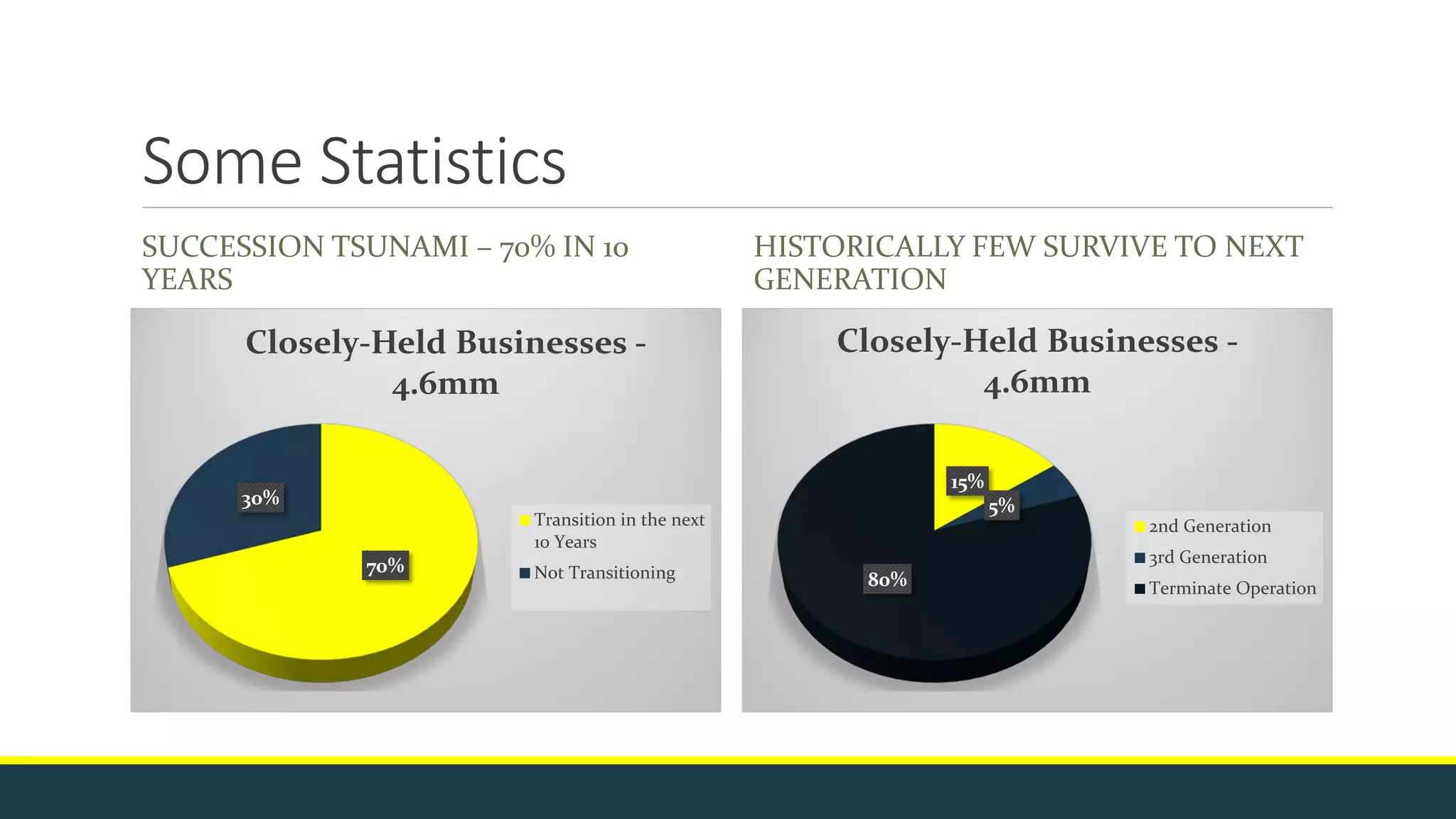
Some Statistics
SUCCESSION TSUNAMI – 70% IN 10
YEARS
70%
30%
Closely-Held Businesses -
4.6mm
Transition in the next
10 Years
Not Transitioning
HISTORICALLY FEW SURVIVE TO NEXT
GENERATION
15%
5%
80%
Closely-Held Businesses -
4.6mm
2nd Generation
3rd Generation
Terminate Operation
More Statistics
With
20%
Without
80%
Business Succession Plan
With
Without
Worst Case Scenario
• Business Ceases Operations
• Family loses investment
• Employees lose jobs
• Communities lose tax base
• Quality of Life and Services Suffer
• Domino Effect
Business Succession Planning is
Strategic planning for the future ofthe business and the
owner
Business Succession: The Bridge to the
Future
A complete business
succession plan addresses
three important
components:
• Ownership Transfer
• Management Succession
• Legacy Planning
Ownership Transfer: Who Buys The
Company?
Third Party
5%
Internal
95%
Businesses Sold
Third Party
Internal
Internal Transactions
• Buy-Sell among Partners
• Family Succession
• Management Buyout
• ESOP
Typical Internal Management Buyout
Company
Borrows
Money
Company
loan to
Managers
Management
Pays
Shareholder
Company
Distributes
Cash to
Management
Management
Pays
Company to
Repay Loan
1. Company Borrows Cash
2. Company Loans Money to Management
3. Management pays Shareholder – Cash plus
Note
4. Company distributes profits after tax to
Management.
5. Management repays Company Loan and
Shareholder Note.
6. Company pays Loan.
7. No deduction for principal loan payments.
An ESOP Transaction
Company
Borrows
Money
Company
loan to
ESOP
ESOP Pays
Shareholder
Company
contributes
Cash to
ESOP
ESOP Pays
Company to
Repay Loan
1. Company Borrows Cash
2. Company Loans Money to ESOP
3. ESOP pays Shareholder – Cash plus Note
4. Company contributes cash to ESOP pre-tax
– Deductible compensation expense.
5. ESOP repays Company Loan and
Shareholder Note.
6. Company pays Loan.
7. Cleansed through an ESOP – receive
deduction for principal loan payments.
Business Succession: The ESOP Model
Ownership Transfer – in an ESOP, the owner transfers shares to a trust that
holds the shares for the benefit of the employees
Management Succession – the ESOP serves either as an incentive and reward
for current successor management to grow the business or lures future successor
management with an opportunity to receive the benefit of growing the business
Legacy Planning – an ESOP can be a tax efficient legacy plan and can always
serve to preserve the independence of the business
What is an
ESOP?
• A qualified retirement plan
• Invests primarily in Employer Securities
• Broad-based equity ownership
• A Business Model
Must satisfy the requirements of the Internal
Revenue Code and the Employee Retirement Income
Security Act (“ERISA”) of 1974
An ESOP is the only retirement plan that is allowed
to borrow money to purchase company stock
Employee Stock Ownership Plan
Establishing an ESOP
Company Board of Directors establishes Trust (“ESOT”)
Methods for ESOT to get stock
• Company contributes stock or cash to ESOT; if cash, ESOT purchases stock
from existing shareholder(s) (non-leveraged)
• Company loans money to ESOT, ESOT purchases stock from existing
shareholder(s) (leveraged)
• Existing shareholder(s) sell stock to ESOT in exchange for a promissory note
(leveraged)
Benefits of an ESOP
1. Tax Benefits to Company, Shareholders, and Participants
2. ESOP’s tax-advantage can finance growth
3. An ESOP provides employees with a stake in the profitability of the
company
4. Retirement Benefit to Employees/Management Incentive
Tax Benefits
Shareholder may be able to defer gains on sale
of C corporation stock to ESOP via 1042
Company contributions to ESOP are tax-
deductible
C corporation can deduct dividends paid on
ESOP owned stock, whether used to repay
money borrowed to purchase stock or otherwise
S corporation can obtain partial or full
“exemption” from U.S. and most state income
tax
Participants defer taxes on benefits until
distribution
For the Company, the Shareholder
and the Participant
Business Growth
ESOP companies see average yearly improvement in Return on Assets of +2.7%
ESOP companies increased sales per employee between 2.3%-3.4% as compared to pre-ESOP
S Corp ESOP benefit – a snapshot from 2008
17
S Corp ESOP Peer
Jobs + 1.9% - 2.8%
Wages +5.9% + 3.2%
Revenues +15.1% - 3.4%
Retirement Contr. + 18.6% + 2.8%
Employee Stake Drives Growth
As beneficial owners through the ESOP Trust, employees benefit from the capital
growth of the Company
Over recent 10-year period, ESOPs have 25% higher job growth than comparable
non-ESOP companies
Employee-owners were 4x less likely to be laid off during the recent recession
Source: NCEO’s The State of Broad Based Employee Ownerships Plans, 2013
Retirement Benefit
ESOP retirement benefit is contributed by the Company only
Employees at ESOP companies have, on average, 2.5x greater retirement accounts
than non-ESOP retirement plans
ESOPs more likely to offer a second defined contribution plan than other
retirement plans (401(k) elective deferral plan + ESOP = KSOP)
ESOP companies contribute, on average, 75% more to their ESOPs than other
companies contribute to their primary defined contribution plan
Management Incentive
Under ESOP, Management
1. “Own” all or part of the employer; and
2. Participate in the growth and success of the employer
Management can be incentivized further with nonqualified equity-
based compensation (phantom stock, stock appreciation rights, stock
options)
Who Manages an ESOP Company?
• The Board of Directors provide vision and direction
• Appointed Management manage day to day operations
21
Sole Proprietor ESOP Participant Public Co. Stock
• Put up own money
• Owns everything
• Manages everything
• Controls everything
• Impacts the business
• Receives the carrot
and stick of
ownership
• Company money
• Beneficial interest
• Direct Trustee on
some issues
• Manager likely a
Participant
• Impacts the business
• Receives the carrot
only
• Put up own money
• Own shares
• Vote under state law
• No participation in
management or
control
• No impact on
business
• Receives the carrot
and stick
Participant Rights
•Receive Summary Plan Description and Access to Plan Documents
•Receive Annual Account Statements
•At a minimum, permitted to direct the Trustee on the following (if state law
requires shareholder approval):
• Corporate merger
• Recapitalization
• Reclassification
• Liquidation or dissolution
• Sale of substantially all of the assets
22
Other Key Features of ESOPs
1. Diversification
2. Stock Distributions
3. Repurchase Obligation
Diversification
• Participants age 55 and older who have participated in the Plan for
10 years must be permitted to “diversify” 25% of the balance
credited to his account (6 year period)
• After the first five years of the diversification period, may diversity
up to 50% (only in year 6)
• Three investment options to be provided
• Alternatives to Investment Options: distribute the stock/cash to the
Participant, permit transfer to 401(k) plan with three investment
options
24
Distributions
• Right to demand company stock unless
• Plan sponsor is an S Corp
• Articles of incorporation or by-laws restrict ownership to
employees or trust
• Put Option
• Unless stock publicly traded, may require repurchase by
Company
25
Repurchase Obligation
• If the Company stock is not readily tradable on an established
market, the Company has an obligation to purchase stock distributed
to Participants.
• Two 60 day put option periods must be provided to participants who
have received a distribution of Company Stock
How Does the ESOP Process Start?
• Engage Trustee who in turn engages Independent Appraiser
o Company can engage preliminary appraiser but creates
conflict if it later works for Trustee
• Trustee makes an offer to purchase shares of “Target” Company
based on Fair Market Value determination of Independent
Appraiser
• Sellers determine whether to proceed with deal based on offer
A Word About Fair Market Value
• Generally, a sale or exchange of property between a plan and party
in interest is a prohibited transaction
• Statutory exemption for acquisition or sale by ESOP if price is not
less favorable to the plan than “adequate consideration” and no
commission is charged to the Plan.
• FMV is the price at which an asset would change hands between a
willing buyer and a willing seller with neither under threat or
compulsion
• ESOP Buyer is a financial buyer not a strategic buyer
Advantages of Leveraged ESOP
LEVERAGED ESOP
•Seller can obtain deferral of capital gain
taxation under 1042 to be discussed
•ESOP principal is tax-deductible
•S Corp advantage – no income tax to the
Company
LBO MANAGEMENT BUYOUT
•No deferral of capital gain
•Only interest expense of loan deductible
•S corp Distributions to Management to repay
loan are taxed
Potential Downsides to an ESOP
DOWNSIDE
If selling shareholder elects Sec. 1042 tax
benefits, he and his family are excluded from
participation in the ESOP
Tax benefits may improve debt-service but
repurchase obligation can drain cash
ESOP can pay only fair market value for stock
and may not pay strategic premium
Ownership culture requires effort – mere fact of
profit based incentives does not create the
ownership culture effect
RESOLUTION
Synthetic equity in the form of Phantom Stock to
family members in the business in amounts to
replace 1042 stock
Proper planning and plan design can address
repurchase obligation
Tax benefits can offset perceived loss in value
The effort to develop a culture is rewarding and pays
off with greater profits
Legacy Planning
Stockholder’s estate may consist almost entirely of illiquid privately-held company stock
An ESOP can
1. Create shareholder liquidity;
2. Diversify shareholder’s wealth;
3. Create estate liquidity;
4. Permit equalization of inheritances; and
5. Maximize gifts to family members
Section 1042 and the Estate
Under Section 1042, a selling shareholder (SS) that sells stock to an ESOP may defer capital gains if
the following requirements are met:
1. ESOP owns 30% or more of the issued and outstanding stock of the Company or 30% of the
total value of all outstanding stock of the Company;
2. Within 1 year of the close of the sale, the SS (i) makes Election and (ii) purchases Qualified
Replacement Property (QRP);
3. Gain is deferred until disposition of the QRP
Qualified Replacement Property is any security issued by domestic operating company which:
1. Did not have passive investment income in excess of 25% of gross receipts of the
corporation; and
2. Is not Company stock
Estate Planning Example
Post-transaction, the equity value of the Company reduces due to transaction
indebtedness on books of Company, and thereby benefits sellers that retain
company stock by providing excellent gift and estate planning opportunities.
For example: Mr. Big sells 55% controlling interest in C-Corporation to ESOP for
$5.5mm (assuming $10mm equity value on control basis). Mr. Big retains 45% of
C-Corporation and gifts that stock to his two sons. Even assuming pre-transaction
equity value, that 45% is a non-control interest and thereby permits application
of discounts for (1) lack of control (inverse of control premium – let’s say 25%)
and (2) lack of marketability (anywhere from 35 to 50%). In brief, that 45% is now
likely worth somewhere around $2.025mm on a good day.
Ideal ESOP Candidates
Business with consistent annual profits (including Owner
Compensation) of $700K or more
15+ employees
Solid management
Non-highly leveraged balance sheet
ESOP Plus®: An Introduction
ESOP Plus®: Schatz Brown Glassman LLP is a boutique law firm focusing on business succession for
middle market companies with niche expertise in employee stock ownership plans (ESOPs).
Founded in 2011, the attorneys at ESOP Plus combined their collective experience, including several
attorneys with more than 30 years experience in the field, to provide the most comprehensive ESOP
services available.
Services:
Succession Transactions Regulatory Compliance Mergers & Acquisitions
Plan Design Executive Compensation Corporate Restructuring
Fiduciary Advisory Employee Benefit Plans Corporate Finance
Litigation Audit Defense Legacy Planning
Peter E. Jones
Peter E. Jones represents ESOP companies from the initial transaction to maturity and
beyond. At ESOP Plus®, Peter structures ESOP transactions, designs ESOP plans, and advises
ESOP companies with their continuing regulatory compliance as they begin their journey
into employee ownership. Peter also develops executive compensation plans to attract and
retain successor management and aids selling business owners with legacy planning.
Peter is a graduate of Bradley University (B.A.) and was the valedictorian at Capital
University Law School (J.D.) when he graduated in 2007. He is admitted to the bar of Ohio
as well as the U.S. Court of Appeals for the Sixth Circuit, the U.S. District Courts for the
Northern and Southern Districts of Ohio and the U.S. Bankruptcy Court for the Southern
District of Ohio.
He is a professional member of the ESOPAssociation and National Center for Employee
Ownership and an adjunct professor at the Moritz College of Law at The Ohio State
University.

Business Succession: The ESOP Model

  • 1.
    Business Succession: The ESOPModel PETER E. JONES, PARTNER, ESOP PLUS®: SCHATZ BROWN GLASSMAN LLP PJONES@ESOPPLUS.COM OR 614.344.7604
  • 2.
    What Are WeGoing to Discuss Today? 1. Why Business Succession Planning 2. The Key Elements of Business Succession Planning 3. How an ESOP Can Transfer Ownership of the Business in a Tax Efficient Manner
  • 3.
    Some Statistics SUCCESSION TSUNAMI– 70% IN 10 YEARS 70% 30% Closely-Held Businesses - 4.6mm Transition in the next 10 Years Not Transitioning HISTORICALLY FEW SURVIVE TO NEXT GENERATION 15% 5% 80% Closely-Held Businesses - 4.6mm 2nd Generation 3rd Generation Terminate Operation
  • 4.
  • 5.
    Worst Case Scenario •Business Ceases Operations • Family loses investment • Employees lose jobs • Communities lose tax base • Quality of Life and Services Suffer • Domino Effect
  • 6.
    Business Succession Planningis Strategic planning for the future ofthe business and the owner
  • 7.
    Business Succession: TheBridge to the Future A complete business succession plan addresses three important components: • Ownership Transfer • Management Succession • Legacy Planning
  • 8.
    Ownership Transfer: WhoBuys The Company? Third Party 5% Internal 95% Businesses Sold Third Party Internal
  • 9.
    Internal Transactions • Buy-Sellamong Partners • Family Succession • Management Buyout • ESOP
  • 10.
    Typical Internal ManagementBuyout Company Borrows Money Company loan to Managers Management Pays Shareholder Company Distributes Cash to Management Management Pays Company to Repay Loan 1. Company Borrows Cash 2. Company Loans Money to Management 3. Management pays Shareholder – Cash plus Note 4. Company distributes profits after tax to Management. 5. Management repays Company Loan and Shareholder Note. 6. Company pays Loan. 7. No deduction for principal loan payments.
  • 11.
    An ESOP Transaction Company Borrows Money Company loanto ESOP ESOP Pays Shareholder Company contributes Cash to ESOP ESOP Pays Company to Repay Loan 1. Company Borrows Cash 2. Company Loans Money to ESOP 3. ESOP pays Shareholder – Cash plus Note 4. Company contributes cash to ESOP pre-tax – Deductible compensation expense. 5. ESOP repays Company Loan and Shareholder Note. 6. Company pays Loan. 7. Cleansed through an ESOP – receive deduction for principal loan payments.
  • 12.
    Business Succession: TheESOP Model Ownership Transfer – in an ESOP, the owner transfers shares to a trust that holds the shares for the benefit of the employees Management Succession – the ESOP serves either as an incentive and reward for current successor management to grow the business or lures future successor management with an opportunity to receive the benefit of growing the business Legacy Planning – an ESOP can be a tax efficient legacy plan and can always serve to preserve the independence of the business
  • 13.
    What is an ESOP? •A qualified retirement plan • Invests primarily in Employer Securities • Broad-based equity ownership • A Business Model Must satisfy the requirements of the Internal Revenue Code and the Employee Retirement Income Security Act (“ERISA”) of 1974 An ESOP is the only retirement plan that is allowed to borrow money to purchase company stock Employee Stock Ownership Plan
  • 14.
    Establishing an ESOP CompanyBoard of Directors establishes Trust (“ESOT”) Methods for ESOT to get stock • Company contributes stock or cash to ESOT; if cash, ESOT purchases stock from existing shareholder(s) (non-leveraged) • Company loans money to ESOT, ESOT purchases stock from existing shareholder(s) (leveraged) • Existing shareholder(s) sell stock to ESOT in exchange for a promissory note (leveraged)
  • 15.
    Benefits of anESOP 1. Tax Benefits to Company, Shareholders, and Participants 2. ESOP’s tax-advantage can finance growth 3. An ESOP provides employees with a stake in the profitability of the company 4. Retirement Benefit to Employees/Management Incentive
  • 16.
    Tax Benefits Shareholder maybe able to defer gains on sale of C corporation stock to ESOP via 1042 Company contributions to ESOP are tax- deductible C corporation can deduct dividends paid on ESOP owned stock, whether used to repay money borrowed to purchase stock or otherwise S corporation can obtain partial or full “exemption” from U.S. and most state income tax Participants defer taxes on benefits until distribution For the Company, the Shareholder and the Participant
  • 17.
    Business Growth ESOP companiessee average yearly improvement in Return on Assets of +2.7% ESOP companies increased sales per employee between 2.3%-3.4% as compared to pre-ESOP S Corp ESOP benefit – a snapshot from 2008 17 S Corp ESOP Peer Jobs + 1.9% - 2.8% Wages +5.9% + 3.2% Revenues +15.1% - 3.4% Retirement Contr. + 18.6% + 2.8%
  • 18.
    Employee Stake DrivesGrowth As beneficial owners through the ESOP Trust, employees benefit from the capital growth of the Company Over recent 10-year period, ESOPs have 25% higher job growth than comparable non-ESOP companies Employee-owners were 4x less likely to be laid off during the recent recession Source: NCEO’s The State of Broad Based Employee Ownerships Plans, 2013
  • 19.
    Retirement Benefit ESOP retirementbenefit is contributed by the Company only Employees at ESOP companies have, on average, 2.5x greater retirement accounts than non-ESOP retirement plans ESOPs more likely to offer a second defined contribution plan than other retirement plans (401(k) elective deferral plan + ESOP = KSOP) ESOP companies contribute, on average, 75% more to their ESOPs than other companies contribute to their primary defined contribution plan
  • 20.
    Management Incentive Under ESOP,Management 1. “Own” all or part of the employer; and 2. Participate in the growth and success of the employer Management can be incentivized further with nonqualified equity- based compensation (phantom stock, stock appreciation rights, stock options)
  • 21.
    Who Manages anESOP Company? • The Board of Directors provide vision and direction • Appointed Management manage day to day operations 21 Sole Proprietor ESOP Participant Public Co. Stock • Put up own money • Owns everything • Manages everything • Controls everything • Impacts the business • Receives the carrot and stick of ownership • Company money • Beneficial interest • Direct Trustee on some issues • Manager likely a Participant • Impacts the business • Receives the carrot only • Put up own money • Own shares • Vote under state law • No participation in management or control • No impact on business • Receives the carrot and stick
  • 22.
    Participant Rights •Receive SummaryPlan Description and Access to Plan Documents •Receive Annual Account Statements •At a minimum, permitted to direct the Trustee on the following (if state law requires shareholder approval): • Corporate merger • Recapitalization • Reclassification • Liquidation or dissolution • Sale of substantially all of the assets 22
  • 23.
    Other Key Featuresof ESOPs 1. Diversification 2. Stock Distributions 3. Repurchase Obligation
  • 24.
    Diversification • Participants age55 and older who have participated in the Plan for 10 years must be permitted to “diversify” 25% of the balance credited to his account (6 year period) • After the first five years of the diversification period, may diversity up to 50% (only in year 6) • Three investment options to be provided • Alternatives to Investment Options: distribute the stock/cash to the Participant, permit transfer to 401(k) plan with three investment options 24
  • 25.
    Distributions • Right todemand company stock unless • Plan sponsor is an S Corp • Articles of incorporation or by-laws restrict ownership to employees or trust • Put Option • Unless stock publicly traded, may require repurchase by Company 25
  • 26.
    Repurchase Obligation • Ifthe Company stock is not readily tradable on an established market, the Company has an obligation to purchase stock distributed to Participants. • Two 60 day put option periods must be provided to participants who have received a distribution of Company Stock
  • 27.
    How Does theESOP Process Start? • Engage Trustee who in turn engages Independent Appraiser o Company can engage preliminary appraiser but creates conflict if it later works for Trustee • Trustee makes an offer to purchase shares of “Target” Company based on Fair Market Value determination of Independent Appraiser • Sellers determine whether to proceed with deal based on offer
  • 28.
    A Word AboutFair Market Value • Generally, a sale or exchange of property between a plan and party in interest is a prohibited transaction • Statutory exemption for acquisition or sale by ESOP if price is not less favorable to the plan than “adequate consideration” and no commission is charged to the Plan. • FMV is the price at which an asset would change hands between a willing buyer and a willing seller with neither under threat or compulsion • ESOP Buyer is a financial buyer not a strategic buyer
  • 29.
    Advantages of LeveragedESOP LEVERAGED ESOP •Seller can obtain deferral of capital gain taxation under 1042 to be discussed •ESOP principal is tax-deductible •S Corp advantage – no income tax to the Company LBO MANAGEMENT BUYOUT •No deferral of capital gain •Only interest expense of loan deductible •S corp Distributions to Management to repay loan are taxed
  • 30.
    Potential Downsides toan ESOP DOWNSIDE If selling shareholder elects Sec. 1042 tax benefits, he and his family are excluded from participation in the ESOP Tax benefits may improve debt-service but repurchase obligation can drain cash ESOP can pay only fair market value for stock and may not pay strategic premium Ownership culture requires effort – mere fact of profit based incentives does not create the ownership culture effect RESOLUTION Synthetic equity in the form of Phantom Stock to family members in the business in amounts to replace 1042 stock Proper planning and plan design can address repurchase obligation Tax benefits can offset perceived loss in value The effort to develop a culture is rewarding and pays off with greater profits
  • 31.
    Legacy Planning Stockholder’s estatemay consist almost entirely of illiquid privately-held company stock An ESOP can 1. Create shareholder liquidity; 2. Diversify shareholder’s wealth; 3. Create estate liquidity; 4. Permit equalization of inheritances; and 5. Maximize gifts to family members
  • 32.
    Section 1042 andthe Estate Under Section 1042, a selling shareholder (SS) that sells stock to an ESOP may defer capital gains if the following requirements are met: 1. ESOP owns 30% or more of the issued and outstanding stock of the Company or 30% of the total value of all outstanding stock of the Company; 2. Within 1 year of the close of the sale, the SS (i) makes Election and (ii) purchases Qualified Replacement Property (QRP); 3. Gain is deferred until disposition of the QRP Qualified Replacement Property is any security issued by domestic operating company which: 1. Did not have passive investment income in excess of 25% of gross receipts of the corporation; and 2. Is not Company stock
  • 33.
    Estate Planning Example Post-transaction,the equity value of the Company reduces due to transaction indebtedness on books of Company, and thereby benefits sellers that retain company stock by providing excellent gift and estate planning opportunities. For example: Mr. Big sells 55% controlling interest in C-Corporation to ESOP for $5.5mm (assuming $10mm equity value on control basis). Mr. Big retains 45% of C-Corporation and gifts that stock to his two sons. Even assuming pre-transaction equity value, that 45% is a non-control interest and thereby permits application of discounts for (1) lack of control (inverse of control premium – let’s say 25%) and (2) lack of marketability (anywhere from 35 to 50%). In brief, that 45% is now likely worth somewhere around $2.025mm on a good day.
  • 34.
    Ideal ESOP Candidates Businesswith consistent annual profits (including Owner Compensation) of $700K or more 15+ employees Solid management Non-highly leveraged balance sheet
  • 35.
    ESOP Plus®: AnIntroduction ESOP Plus®: Schatz Brown Glassman LLP is a boutique law firm focusing on business succession for middle market companies with niche expertise in employee stock ownership plans (ESOPs). Founded in 2011, the attorneys at ESOP Plus combined their collective experience, including several attorneys with more than 30 years experience in the field, to provide the most comprehensive ESOP services available. Services: Succession Transactions Regulatory Compliance Mergers & Acquisitions Plan Design Executive Compensation Corporate Restructuring Fiduciary Advisory Employee Benefit Plans Corporate Finance Litigation Audit Defense Legacy Planning
  • 36.
    Peter E. Jones PeterE. Jones represents ESOP companies from the initial transaction to maturity and beyond. At ESOP Plus®, Peter structures ESOP transactions, designs ESOP plans, and advises ESOP companies with their continuing regulatory compliance as they begin their journey into employee ownership. Peter also develops executive compensation plans to attract and retain successor management and aids selling business owners with legacy planning. Peter is a graduate of Bradley University (B.A.) and was the valedictorian at Capital University Law School (J.D.) when he graduated in 2007. He is admitted to the bar of Ohio as well as the U.S. Court of Appeals for the Sixth Circuit, the U.S. District Courts for the Northern and Southern Districts of Ohio and the U.S. Bankruptcy Court for the Southern District of Ohio. He is a professional member of the ESOPAssociation and National Center for Employee Ownership and an adjunct professor at the Moritz College of Law at The Ohio State University.