Download as PDF, PPTX

![Results
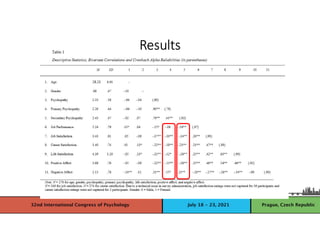
• Analysis: SPSS Hierarchical Linear Regression (Controlling for age and gender)
• Partial support for H1 and H2
• Primary psychopathy associates negatively with only job satisfaction
(β = -.19, SE=.12, p < .01, 95% CI [-.59, -.10])
• Secondary psychopathy negatively relates to job performance and well being:
• job performance (β = -.20, SE =.11, p < .01, 95% CI [-.55, -.12])
• job satisfaction (β = -.26, SE =.12, p < .01, 95% CI [-.70, -.23])
• career satisfaction (β = -.18, SE =.10, p < .01, 95% CI [-.48, -.09])
• positive affect (β = -.23, SE =.10, p < .01, 95% CI [-.58, -.17])
• life satisfaction (β = -.27, SE =.16, p < .01, 95% CI [-1.00, -.36])
• and positively so with negative affect (β = .19, SE =.10, p < .01, 95% CI [.10, .50])](https://image.slidesharecdn.com/icpppt-pdfemployeepsychopathyeffects-210720163104/85/Employee-Psychopathy-Effects-on-Job-Performance-and-Well-being-14-320.jpg)
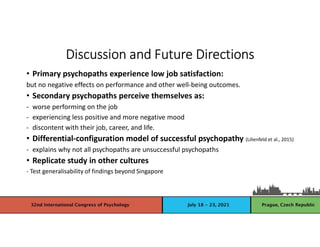

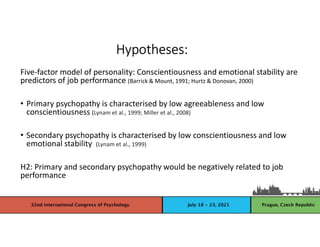
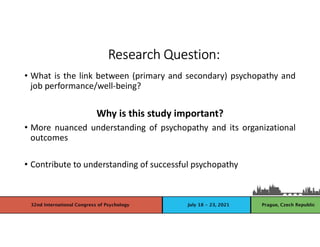
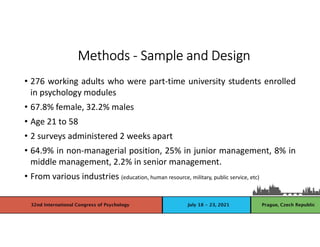
This document explores the relationship between psychopathy, job performance, and well-being through the analysis of 276 working adults, highlighting that primary psychopathy negatively impacts job satisfaction but not job performance, while secondary psychopathy adversely affects both job performance and overall well-being. It underscores the need for nuanced understanding of psychopathy's organizational outcomes and hints at the concept of 'successful psychopathy.' The study's findings provide a basis for future research on psychopathy across diverse cultural contexts.


