What Is Innovation, And How To Classify Its
Various Aspects
A practical approach for using the right vocabulary in a competitive
environment that comes with cost and time restraints.
Public Talk At www.IP-Lawyer-Tools.com on 24 December 2021
by Martin Schweiger
www.IP-Lawyer-Tools.com
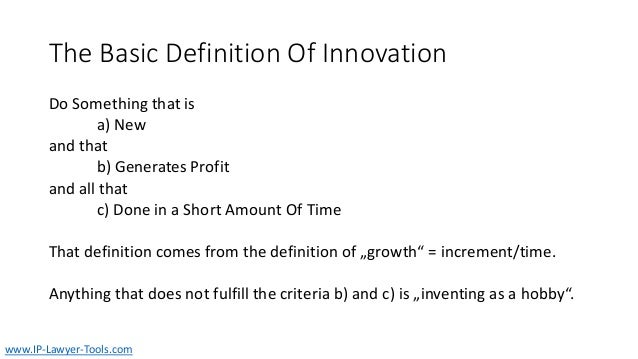
The Basic Definition Of Innovation
Do Something that is
a) New
and that
b) Generates Profit
and all that
c) Done in a Short Amount Of Time
That definition comes from the definition of „growth“ = increment/time.
Anything that does not fulfill the criteria b) and c) is „inventing as a hobby“.
www.IP-Lawyer-Tools.com
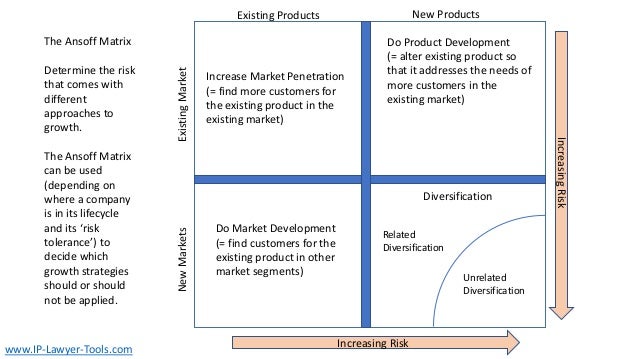
Existing Products New Products
Existing
Market
New
Markets
Increasing Risk
Increasing
Risk
Increase Market Penetration
(= find more customers for
the existing product in the
existing market)
Do Market Development
(= find customers for the
existing product in other
market segments)
Do Product Development
(= alter existing product so
that it addresses the needs of
more customers in the
existing market)
Diversification
The Ansoff Matrix
Determine the risk
that comes with
different
approaches to
growth.
The Ansoff Matrix
can be used
(depending on
where a company
is in its lifecycle
and its ‘risk
tolerance’) to
decide which
growth strategies
should or should
not be applied.
www.IP-Lawyer-Tools.com
Related
Diversification
Unrelated
Diversification
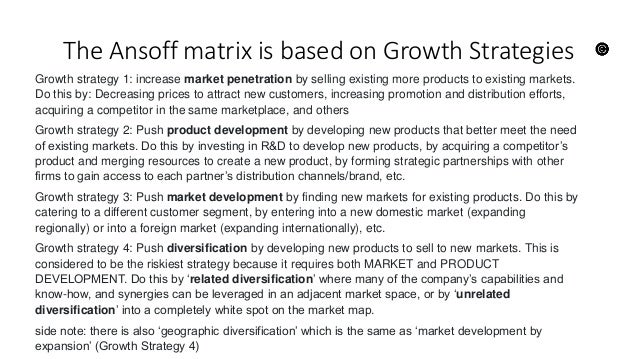
The Ansoff matrix is based on Growth Strategies
Growth strategy 1: increase market penetration by selling existing more products to existing markets.
Do this by: Decreasing prices to attract new customers, increasing promotion and distribution efforts,
acquiring a competitor in the same marketplace, and others
Growth strategy 2: Push product development by developing new products that better meet the need
of existing markets. Do this by investing in R&D to develop new products, by acquiring a competitor’s
product and merging resources to create a new product, by forming strategic partnerships with other
firms to gain access to each partner’s distribution channels/brand, etc.
Growth strategy 3: Push market development by finding new markets for existing products. Do this by
catering to a different customer segment, by entering into a new domestic market (expanding
regionally) or into a foreign market (expanding internationally), etc.
Growth strategy 4: Push diversification by developing new products to sell to new markets. This is
considered to be the riskiest strategy because it requires both MARKET and PRODUCT
DEVELOPMENT. Do this by ‘related diversification’ where many of the company’s capabilities and
know-how, and synergies can be leveraged in an adjacent market space, or by ‘unrelated
diversification’ into a completely white spot on the market map.
side note: there is also ‘geographic diversification’ which is the same as ‘market development by
expansion’ (Growth Strategy 4)
Existing Products New Products
Existing
Market
New
Markets
Increasing Risk
Increasing
Risk
Increase Market Penetration
(= find more customers for
the existing product in the
existing market)
Do Market Development
(= find customers for the
existing product in other
markets)
Do Product Development
(= alter existing product so
that it addresses the needs of
more customers in the
existing market)
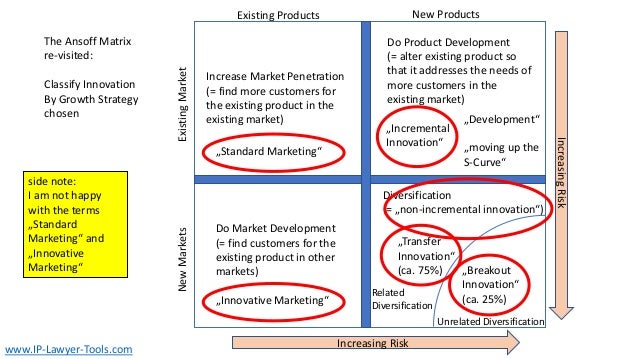
„Development“
„Incremental
Innovation“
Diversification
(= „non-incremental innovation“)
„Transfer
Innovation“
(ca. 75%) „Breakout
Innovation“
(ca. 25%)
The Ansoff Matrix
re-visited:
Classify Innovation
By Growth Strategy
chosen
„moving up the
S-Curve“
www.IP-Lawyer-Tools.com
Related
Diversification
Unrelated Diversification
„Innovative Marketing“
„Standard Marketing“
side note:
I am not happy
with the terms
„Standard
Marketing“ and
„Innovative
Marketing“
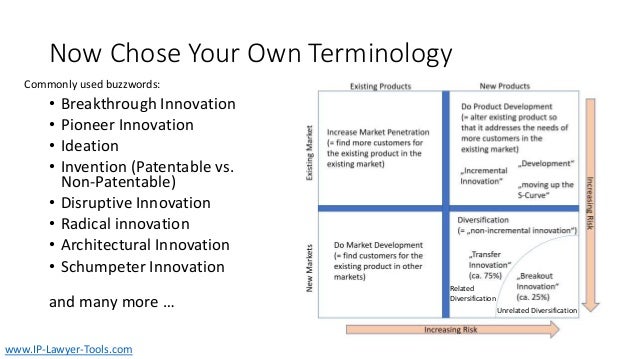
Now Chose Your Own Terminology
• Breakthrough Innovation
• Pioneer Innovation
• Ideation
• Invention (Patentable vs.
Non-Patentable)
• Disruptive Innovation
• Radical innovation
• Architectural Innovation
• Schumpeter Innovation
and many more …
www.IP-Lawyer-Tools.com
Related
Diversification
Unrelated Diversification
Commonly used buzzwords:
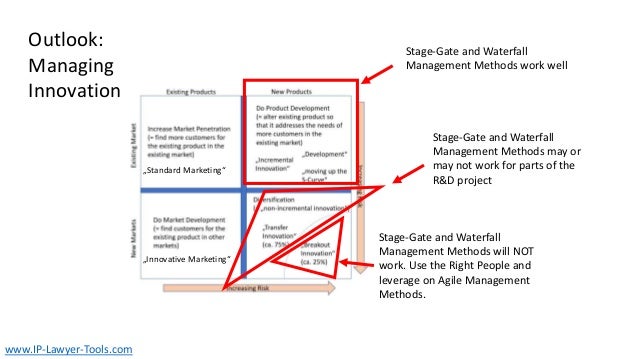
Outlook:
Managing
Innovation
Stage-Gate and Waterfall
Management Methods work well
Stage-Gate and Waterfall
Management Methods may or
may not work for parts of the
R&D project
Stage-Gate and Waterfall
Management Methods will NOT
work. Use the Right People and
leverage on Agile Management
Methods.
www.IP-Lawyer-Tools.com
„Innovative Marketing“
„Standard Marketing“
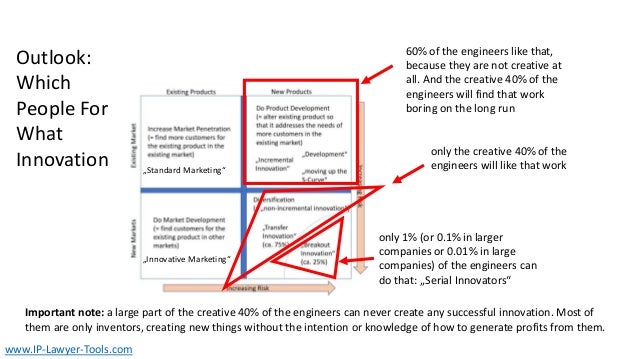
Outlook:
Which
People For
What
Innovation
60% of the engineers like that,
because they are not creative at
all. And the creative 40% of the
engineers will find that work
boring on the long run
only the creative 40% of the
engineers will like that work
only 1% (or 0.1% in larger
companies or 0.01% in large
companies) of the engineers can
do that: „Serial Innovators“
Important note: a large part of the creative 40% of the engineers can never create any successful innovation. Most of
them are only inventors, creating new things without the intention or knowledge of how to generate profits from them.
www.IP-Lawyer-Tools.com
„Innovative Marketing“
„Standard Marketing“
Outlook:
Which
People For
What
Innovation
60% of the engineers like that,
because they are not creative at
all. And the creative 40% of the
engineers will find that work
boring on the long run
only the creative 40% of the
engineers will like that work
only 1% (or 0.1% in larger
companies or 0.01% in large
companies) of the engineers can
do that: „Serial Innovators“
Important note: a large part of the creative 40% of the engineers can never create any successful innovation. Most of
them are only inventors, creating new things without the intention or knowledge of how to generate profits from them.
www.IP-Lawyer-Tools.com
„Innovative Marketing“
„Standard Marketing“
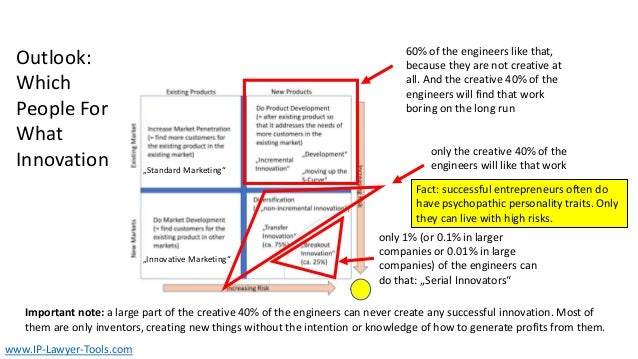
Fact: successful entrepreneurs often do
have psychopathic personality traits. Only
they can live with high risks.
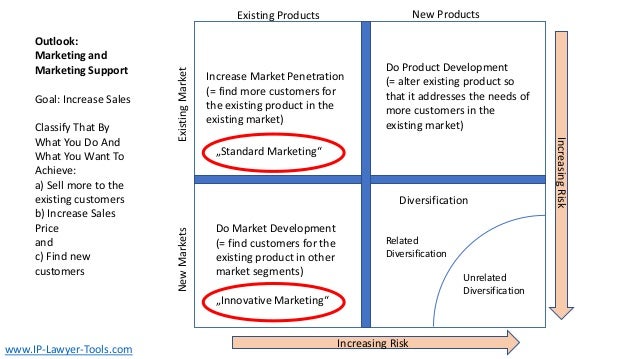
Outlook:
Marketing and
Marketing Support
Goal: Increase Sales
Classify That By
What You Do And
What You Want To
Achieve:
a) Sell more to the
existing customers
b) Increase Sales
Price
and
c) Find new
customers
www.IP-Lawyer-Tools.com
Existing Products New Products
Existing
Market
New
Markets
Increasing Risk
Increasing
Risk
Increase Market Penetration
(= find more customers for
the existing product in the
existing market)
Do Market Development
(= find customers for the
existing product in other
market segments)
Do Product Development
(= alter existing product so
that it addresses the needs of
more customers in the
existing market)
Diversification
www.IP-Lawyer-Tools.com
„Innovative Marketing“
„Standard Marketing“
Related
Diversification
Unrelated
Diversification
Outlook:
Marketing and
Marketing Support
Goal: Increase Sales
Classify That By
What You Do And
What You Want To
Achieve:
a) Sell more to the
existing customers
b) Increase Sales
Price
and
c) Find new
customers
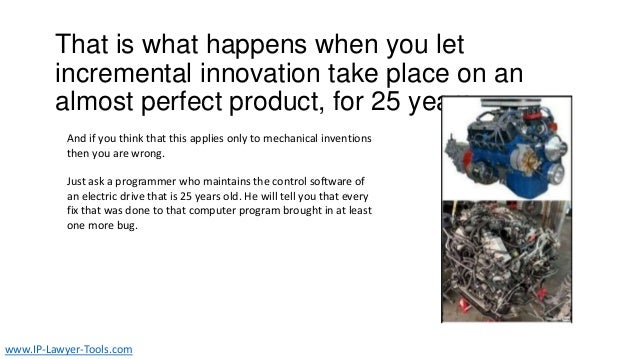
That is what happens when you let
incremental innovation take place on an
almost perfect product, for 25 years.
And if you think that this applies only to mechanical inventions
then you are wrong.
Just ask a programmer who maintains the control software of
an electric drive that is 25 years old. He will tell you that every
fix that was done to that computer program brought in at least
one more bug.
www.IP-Lawyer-Tools.com
My Favorite Example For Non-Related
Diversification: Mannesmann Mobilfunk
• German steel pipe company Mannesmann decided in 1989 to
erect a 2G mobile phone network that competes with the
government's planned 2G mobile phone network
• This activity was applying a completely new technology to a
completely new market: virtually nobody in Germany had a
mobile phone in 1989
• The product has later been sold to Vodafone
Conclusions
How to find a translation sheet for different terminologies when it comes to innovation, both in R&D
and in Marketing
Match the 4 (+2) different growth strategies of the Ansoff matrix with the two opposed sets of
innovation terminology
Applied to 4x4 Innovation terminology
Market Penetration: “No innovation needed”
Product Development: “Incremental Innovation”
Market Development: “Innovative Marketing”
Diversification: “Non-incremental Innovation”
related diversification : “transfer innovation”
unrelated diversification: “breakout innovation”
www.IP-Lawyer-Tools.com
Check out my website
www.IP-Lawyer-Tools.com
Subscription and all Course Fees come with
a 1-month 100% no question asked money
back guarantee!

Innovation and how to classify V1.1

  • 2.
    What Is Innovation,And How To Classify Its Various Aspects A practical approach for using the right vocabulary in a competitive environment that comes with cost and time restraints. Public Talk At www.IP-Lawyer-Tools.com on 24 December 2021 by Martin Schweiger www.IP-Lawyer-Tools.com
  • 3.
    The Basic DefinitionOf Innovation Do Something that is a) New and that b) Generates Profit and all that c) Done in a Short Amount Of Time That definition comes from the definition of „growth“ = increment/time. Anything that does not fulfill the criteria b) and c) is „inventing as a hobby“. www.IP-Lawyer-Tools.com
  • 4.
    Existing Products NewProducts Existing Market New Markets Increasing Risk Increasing Risk Increase Market Penetration (= find more customers for the existing product in the existing market) Do Market Development (= find customers for the existing product in other market segments) Do Product Development (= alter existing product so that it addresses the needs of more customers in the existing market) Diversification The Ansoff Matrix Determine the risk that comes with different approaches to growth. The Ansoff Matrix can be used (depending on where a company is in its lifecycle and its ‘risk tolerance’) to decide which growth strategies should or should not be applied. www.IP-Lawyer-Tools.com Related Diversification Unrelated Diversification
  • 5.
    The Ansoff matrixis based on Growth Strategies Growth strategy 1: increase market penetration by selling existing more products to existing markets. Do this by: Decreasing prices to attract new customers, increasing promotion and distribution efforts, acquiring a competitor in the same marketplace, and others Growth strategy 2: Push product development by developing new products that better meet the need of existing markets. Do this by investing in R&D to develop new products, by acquiring a competitor’s product and merging resources to create a new product, by forming strategic partnerships with other firms to gain access to each partner’s distribution channels/brand, etc. Growth strategy 3: Push market development by finding new markets for existing products. Do this by catering to a different customer segment, by entering into a new domestic market (expanding regionally) or into a foreign market (expanding internationally), etc. Growth strategy 4: Push diversification by developing new products to sell to new markets. This is considered to be the riskiest strategy because it requires both MARKET and PRODUCT DEVELOPMENT. Do this by ‘related diversification’ where many of the company’s capabilities and know-how, and synergies can be leveraged in an adjacent market space, or by ‘unrelated diversification’ into a completely white spot on the market map. side note: there is also ‘geographic diversification’ which is the same as ‘market development by expansion’ (Growth Strategy 4)
  • 6.
    Existing Products NewProducts Existing Market New Markets Increasing Risk Increasing Risk Increase Market Penetration (= find more customers for the existing product in the existing market) Do Market Development (= find customers for the existing product in other markets) Do Product Development (= alter existing product so that it addresses the needs of more customers in the existing market) „Development“ „Incremental Innovation“ Diversification (= „non-incremental innovation“) „Transfer Innovation“ (ca. 75%) „Breakout Innovation“ (ca. 25%) The Ansoff Matrix re-visited: Classify Innovation By Growth Strategy chosen „moving up the S-Curve“ www.IP-Lawyer-Tools.com Related Diversification Unrelated Diversification „Innovative Marketing“ „Standard Marketing“ side note: I am not happy with the terms „Standard Marketing“ and „Innovative Marketing“
  • 7.
    Now Chose YourOwn Terminology • Breakthrough Innovation • Pioneer Innovation • Ideation • Invention (Patentable vs. Non-Patentable) • Disruptive Innovation • Radical innovation • Architectural Innovation • Schumpeter Innovation and many more … www.IP-Lawyer-Tools.com Related Diversification Unrelated Diversification Commonly used buzzwords:
  • 8.
    Outlook: Managing Innovation Stage-Gate and Waterfall ManagementMethods work well Stage-Gate and Waterfall Management Methods may or may not work for parts of the R&D project Stage-Gate and Waterfall Management Methods will NOT work. Use the Right People and leverage on Agile Management Methods. www.IP-Lawyer-Tools.com „Innovative Marketing“ „Standard Marketing“
  • 9.
    Outlook: Which People For What Innovation 60% ofthe engineers like that, because they are not creative at all. And the creative 40% of the engineers will find that work boring on the long run only the creative 40% of the engineers will like that work only 1% (or 0.1% in larger companies or 0.01% in large companies) of the engineers can do that: „Serial Innovators“ Important note: a large part of the creative 40% of the engineers can never create any successful innovation. Most of them are only inventors, creating new things without the intention or knowledge of how to generate profits from them. www.IP-Lawyer-Tools.com „Innovative Marketing“ „Standard Marketing“
  • 10.
    Outlook: Which People For What Innovation 60% ofthe engineers like that, because they are not creative at all. And the creative 40% of the engineers will find that work boring on the long run only the creative 40% of the engineers will like that work only 1% (or 0.1% in larger companies or 0.01% in large companies) of the engineers can do that: „Serial Innovators“ Important note: a large part of the creative 40% of the engineers can never create any successful innovation. Most of them are only inventors, creating new things without the intention or knowledge of how to generate profits from them. www.IP-Lawyer-Tools.com „Innovative Marketing“ „Standard Marketing“ Fact: successful entrepreneurs often do have psychopathic personality traits. Only they can live with high risks.
  • 11.
    Outlook: Marketing and Marketing Support Goal:Increase Sales Classify That By What You Do And What You Want To Achieve: a) Sell more to the existing customers b) Increase Sales Price and c) Find new customers www.IP-Lawyer-Tools.com
  • 12.
    Existing Products NewProducts Existing Market New Markets Increasing Risk Increasing Risk Increase Market Penetration (= find more customers for the existing product in the existing market) Do Market Development (= find customers for the existing product in other market segments) Do Product Development (= alter existing product so that it addresses the needs of more customers in the existing market) Diversification www.IP-Lawyer-Tools.com „Innovative Marketing“ „Standard Marketing“ Related Diversification Unrelated Diversification Outlook: Marketing and Marketing Support Goal: Increase Sales Classify That By What You Do And What You Want To Achieve: a) Sell more to the existing customers b) Increase Sales Price and c) Find new customers
  • 13.
    That is whathappens when you let incremental innovation take place on an almost perfect product, for 25 years. And if you think that this applies only to mechanical inventions then you are wrong. Just ask a programmer who maintains the control software of an electric drive that is 25 years old. He will tell you that every fix that was done to that computer program brought in at least one more bug. www.IP-Lawyer-Tools.com
  • 14.
    My Favorite ExampleFor Non-Related Diversification: Mannesmann Mobilfunk • German steel pipe company Mannesmann decided in 1989 to erect a 2G mobile phone network that competes with the government's planned 2G mobile phone network • This activity was applying a completely new technology to a completely new market: virtually nobody in Germany had a mobile phone in 1989 • The product has later been sold to Vodafone
  • 15.
    Conclusions How to finda translation sheet for different terminologies when it comes to innovation, both in R&D and in Marketing Match the 4 (+2) different growth strategies of the Ansoff matrix with the two opposed sets of innovation terminology Applied to 4x4 Innovation terminology Market Penetration: “No innovation needed” Product Development: “Incremental Innovation” Market Development: “Innovative Marketing” Diversification: “Non-incremental Innovation” related diversification : “transfer innovation” unrelated diversification: “breakout innovation” www.IP-Lawyer-Tools.com
  • 16.
    Check out mywebsite www.IP-Lawyer-Tools.com Subscription and all Course Fees come with a 1-month 100% no question asked money back guarantee!