Workshop Culture for a
Better Workplace
Alison Coward
@alisoncoward
bracketcreative.co.uk
www.bracketcreative.co.uk
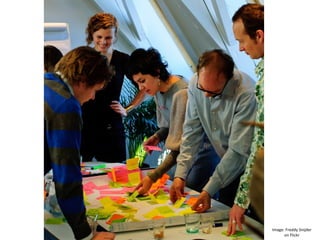
Image: Freddy Snijder
on Flickr
What’s wrong with meetings?
Brief discussion!
Typical meeting
Typical meeting
Known facts or decisions to be
communicated
Typical meeting
Known facts or decisions to be
communicated
Power dynamic of the loudest, or
most senior people in the room
Typical meeting
Known facts or decisions to be
communicated
Power dynamic of the loudest, or
most senior people in the room
Passive attendees
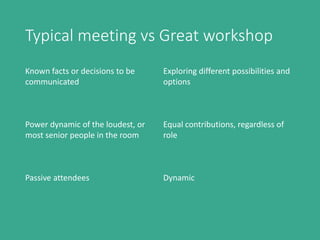
Typical meeting vs Great workshop
Known facts or decisions to be
communicated
Power dynamic of the loudest, or
most senior people in the room
Passive attendees
Exploring different possibilities and
options
Equal contributions, regardless of
role
Dynamic
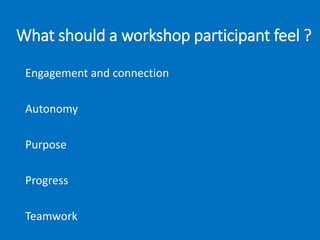
What should a workshop participant feel ?
Engagement and connection
What should a workshop participant feel ?
Engagement and connection
Autonomy
What should a workshop participant feel ?
Engagement and connection
Autonomy
Purpose
What should a workshop participant feel ?
Engagement and connection
Autonomy
Purpose
Progress
What should a workshop participant feel ?
Engagement and connection
Autonomy
Purpose
Progress
Teamwork
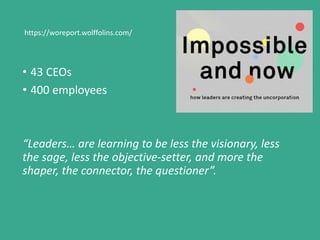
• 43 CEOs
• 400 employees
“Leaders… are learning to be less the visionary, less
the sage, less the objective-setter, and more the
shaper, the connector, the questioner”.
https://woreport.wolffolins.com/
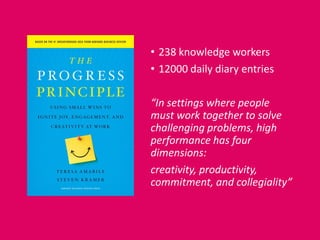
• 238 knowledge workers
• 12000 daily diary entries
“In settings where people
must work together to solve
challenging problems, high
performance has four
dimensions:
creativity, productivity,
commitment, and collegiality”
“Ideational Facilitation Leadership”
Abraham Carmeli, Paul Paulus
• 500 organisations
“leadership behaviour that cultivates
openness, exchange of ideas and
effective discussion for creative
thinking”
CEO Ideational Facilitation Leadership and Team Creativity: The Mediating
Role of Knowledge Sharing, 2014
Image: Andres Nietos
Porras on Flickr
Where do you start?
Rule #1
Rule #1
Do not participate and
facilitate at the same time!
Rule #2
Rule #2
You don’t have all
(or any of) the answers!
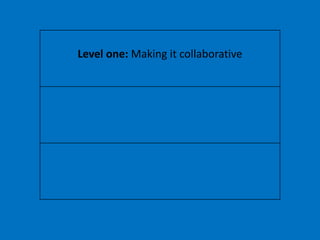
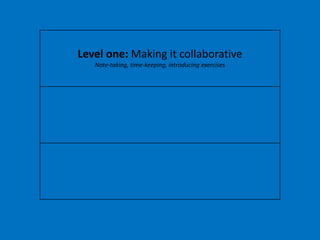
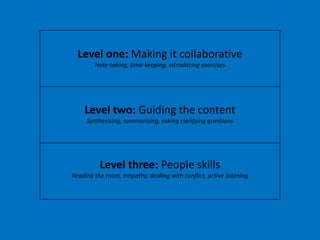
Level one: Making it collaborative
Note-taking, time-keeping, introducing exercises
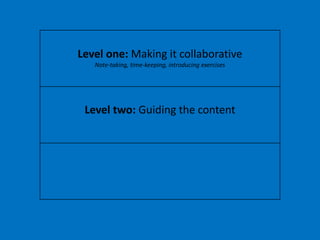
Level one: Making it collaborative
Note-taking, time-keeping, introducing exercises
Level two: Guiding the content
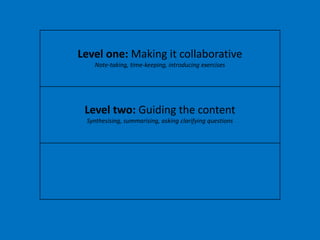
Level one: Making it collaborative
Note-taking, time-keeping, introducing exercises
Level two: Guiding the content
Synthesising, summarising, asking clarifying questions
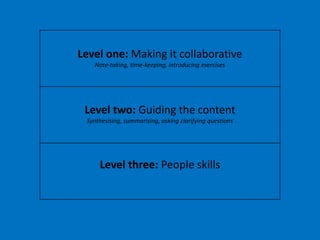
Level one: Making it collaborative
Note-taking, time-keeping, introducing exercises
Level two: Guiding the content
Synthesising, summarising, asking clarifying questions
Level three: People skills
Level one: Making it collaborative
Note-taking, time-keeping, introducing exercises
Level two: Guiding the content
Synthesising, summarising, asking clarifying questions
Level three: People skills
Reading the room, empathy, dealing with conflict, active listening
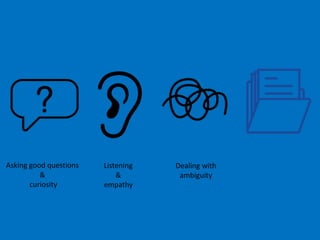
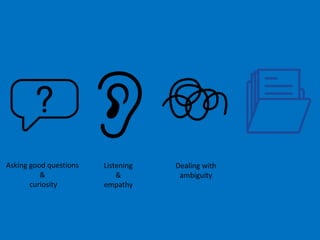
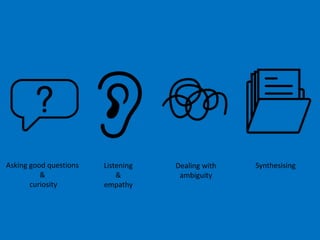
Four key skills for workshop facilitation
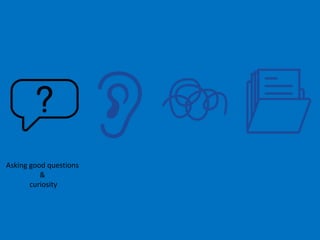
Asking good questions
&
curiosity
Asking good questions
&
curiosity
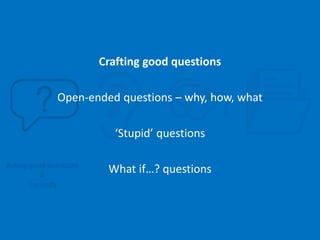
Crafting good questions
Open-ended questions – why, how, what
‘Stupid’ questions
What if…? questions
Think of a challenge you’re facing.
Write down 3 open-ended questions you
could ask your colleagues.
Asking good questions
&
curiosity
Asking good questions
&
curiosity
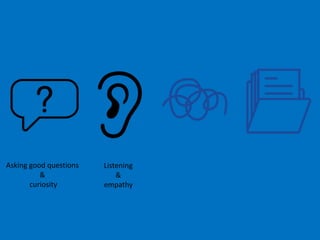
Listening
&
empathy
Asking good questions
&
curiosity
Listening
&
empathy
Dealing with
ambiguity
Asking good questions
&
curiosity
Listening
&
empathy
Dealing with
ambiguity
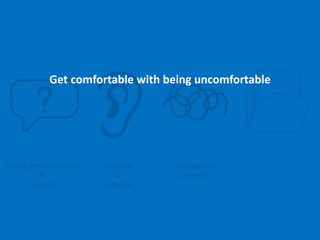
Get comfortable with being uncomfortable
Asking good questions
&
curiosity
Listening
&
empathy
Dealing with
ambiguity
Listening
&
empathy
Asking good questions
&
curiosity
SynthesisingDealing with
ambiguity
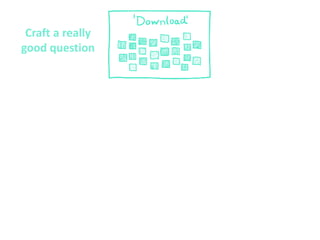
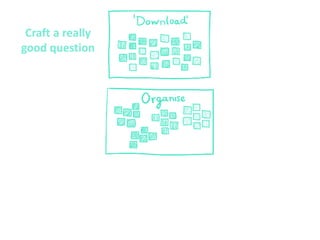
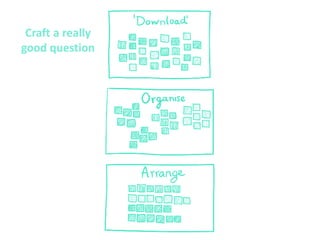
A simple technique
Craft a really
good question
Craft a really
good question
Craft a really
good question
Craft a really
good question
• Start small
• Start small
• Start small
• Practice the four skills: questions, listening, dealing
with ambiguity, synthesising
• Start small
• Practice the four skills: questions, listening, dealing
with ambiguity, synthesising
• Get out of the way!
THANK YOU
Alison Coward
www.bracketcreative.co.uk
Icons: The Noun Project – TMD, Nicolas Morand, Emily Haasch, Oliviu Stolan, BenPixels, Christoph Robausch, Kevin Augustine,
iconsmind.com
Illustrations: Gabija Jankauskaite

Workshop culture for a better workplace