Empire, War, & Colonial Rebellion Kagan Ch 16
18th Century Empires European countries during the 18th century used empires to promote mercantilism, and improve their economic status. Trade rivalries developed causing great strain among the European powers. Boundaries of empires established in the Treaty of Utrecht in 1713.
Mercantilist Goals Gain a favorable trade balance of gold and silver. (exports exceed imports) Colonies established to provide raw materials for growing industries and also to provide markets for finished products. National monopolies over colonies restricting trade to home country.
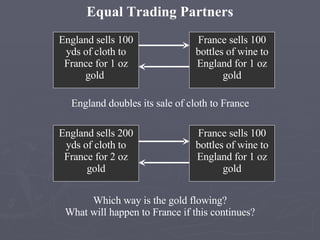
Equal Trading Partners England doubles its sale of cloth to France Which way is the gold flowing? What will happen to France if this continues? England sells 100 yds of cloth to France for 1 oz gold  France sells 100 bottles of wine to England for 1 oz gold England sells 200 yds of cloth to France for 2 oz gold France sells 100 bottles of wine to England for 1 oz gold
Problems with Mercantilism Many practices proved impractical. Colonial and home markets didn’t mesh. Spain unable to produce enough finished products for colonies. Americans factories competed against British factories. Colonists and different countries wished to trade with each other.
French & British Rivalry North America was a major source of conflict between France and Britain. Competition among colonists Conflict over fishing rights and fur trade. Competition among each other to gain alliances with Native American tribes. India was another source of conflict. Competition for trade between the British East India Company and the French  Compangie des Indes .
Rivalry in India The government of India was weakening during the 18th century. France and Britain both saw it as an opportunity to expand their control of the region. Both countries attempted to gain control of the government in India. Joseph Dupleix of France Robert Clive of England Each country attempted to stop the other from government control of India.
Spanish Colonial System Spanish society in the New World was based on classes as in Europe. Viceroys: European born, high government officials and upper clergy. (peninsulares) Creoles: Colonial born whites. Resented the rule of the viceroys Owned large farm estates and mines Well-educated Lower clergy were also the Creoles. Mestizos: People of mixed white and Indian blood farm laborers for the most part Slaves: Indians, Negroes or a mixture of the two.
Importance of the Church The Roman Catholic Church as an important force in Latin American society. Supported by the government. Used to spread European civilization in the New World. Promoted education. First universities founded in the New World Brought the first printing press to American Due to this spread of culture, Latin American cities enjoyed a higher level of civilization than those of other North American cities.
The Economy Spain’s most important source of revenue from the New World came in the form of gold and silver. Eventually agriculture will replace gold and silver as its major source of revenue. Sugar cane and citrus fruits (Imported) Tobacco and Cacao (Native) Cattle (Imported)
The Plantation System The basic unit of colonial Latin America was a self-sufficient farming estate. Most were granted as royal charters. Charters included the right of encomiendas. The right to demand labor from Natives. Due to harsh treatment and disease, many of these people died. Death rate in Peruvian mines as high as 90% Due to the need for increased labor supplies, the slave trade began during the 1500s. More suitable to the hard work needed.
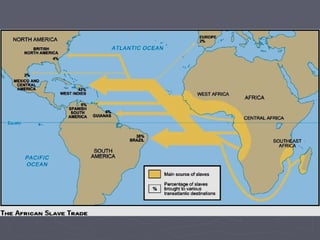
The Slave Experience It is estimated that over 9 million Africans were transported to the New World. Passage to the New World was devastating. Many ships lost over 40% of their slaves in passage Cheaper than trying to raise slave children to adulthood. Due to the high mortality rate as workers, there was a constant need for more slaves from Africa. Especially high in the West Indies
 
Life Conditions Differed from colony to colony. Portuguese treated their slaves the worst In Spanish colonies the Church protected the slaves somewhat but spent more effort in protecting the Native Indians. British and French colonies provided some protection but was rarely enforced. Laws passed to maintain order fear of a slave revolt laws favored the masters over the slaves in all situations.
Emancipation Movements The abolitionist movement began in Britain and France during the Enlightenment. Abolished in the French colonies in  1794. Britain abolished slave trading in 1807. The Latin American wars for independence during the early 1800s brought an end to slavery in many countries. Began in Haiti with a revolution against France lead by Toussaint L’Ouverture Series of revolutions throughout South and Central America American “Emancipation Proclamation” of 1863.
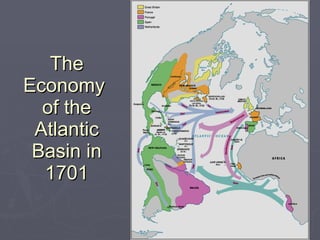
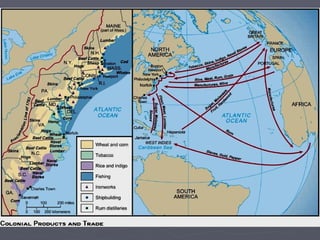
The Economy  of the Atlantic Basin in 1701
 
Mid 18th C Wars
War of Jenkins Ear: 1739-43 War that helped illuminate the rising conflict over trade among the European powers. Under the Treaty of Utrecht, Britain received the right (asiento) to provide Spain with slaves for a period of thirty years. Britain also allowed to send one ship to Portobello in the Caribbean. Ship was resupplied nightly by other British ships One of these ships was boarded by the Spanish Capt. Robert Jenkins’ ear was cut off by the Spanish.
“Eventually escalates into a…” Event (1731) eventually escalates into a war between the two countries (1739). British merchants put pressure on Parliament. Prime Minister Walpole forced to engage in war. May have been only a minor conflict. War sputtered out due to lack of troops to continue. Conflict in the W Indies dovetailed into the War of the Austrian Succession.
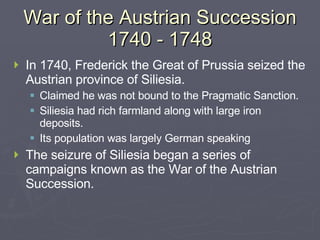
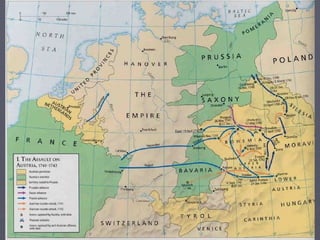
War of the Austrian Succession 1740 - 1748 In 1740, Frederick the Great of Prussia seized the Austrian province of Siliesia. Claimed he was not bound to the Pragmatic Sanction. Siliesia had rich farmland along with large iron deposits. Its population was largely German speaking The seizure of Siliesia began a series of campaigns known as the War of the Austrian Succession.
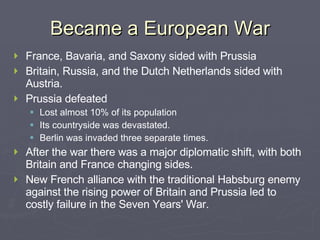
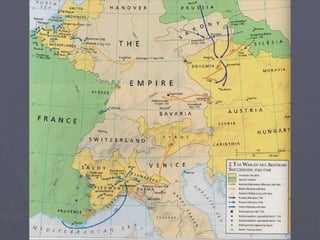
Became a European War France, Bavaria, and Saxony sided with Prussia Britain, Russia, and the Dutch Netherlands sided with Austria. Prussia defeated Lost almost 10% of its population Its countryside was devastated. Berlin was invaded three separate times. After the war there was a major diplomatic shift, with both Britain and France changing sides. New French alliance with the traditional Habsburg enemy against the rising power of Britain and Prussia led to costly failure in the Seven Years' War.
 
 
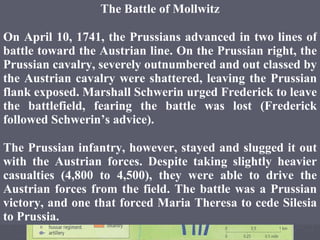
The Battle of Mollwitz On April 10, 1741, the Prussians advanced in two lines of battle toward the Austrian line. On the Prussian right, the Prussian cavalry, severely outnumbered and out classed by the Austrian cavalry were shattered, leaving the Prussian flank exposed. Marshall Schwerin urged Frederick to leave the battlefield, fearing the battle was lost (Frederick followed Schwerin’s advice). The Prussian infantry, however, stayed and slugged it out with the Austrian forces. Despite taking slightly heavier casualties (4,800 to 4,500), they were able to drive the Austrian forces from the field. The battle was a Prussian victory, and one that forced Maria Theresa to cede Silesia to Prussia.
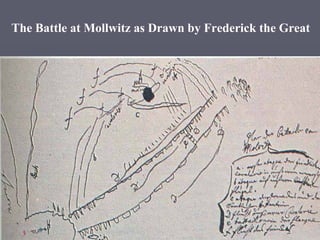
The Battle at Mollwitz as Drawn by Frederick the Great
The Seven Years War   1756-1763 Involved almost every European country. Fought not only in Europe but also India and the Americas. The French and Indian Wars At one time, Prussia was surrounded by enemies in Europe. With British aid, Frederick was able to hold off invasion. Complexion of war changed when Russia changed sides and joined Prussia. Treaty of Hubertusburg ended the war. Prussia allowed to keep Siliesia.
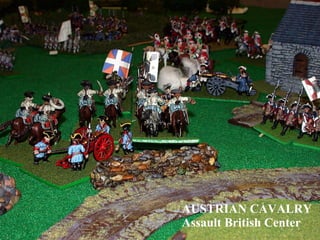
AUSTRIAN CAVALRY Assault British Center
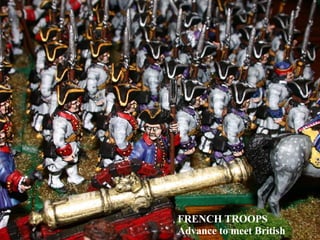
FRENCH TROOPS Advance to meet British
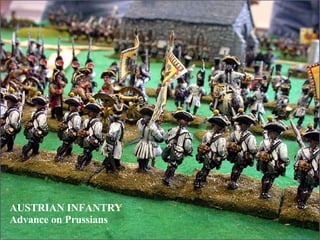
AUSTRIAN INFANTRY Advance on Prussians
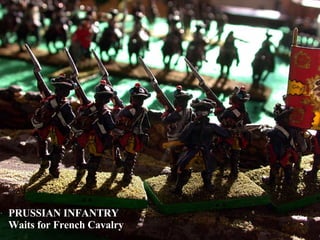
PRUSSIAN INFANTRY Waits for French Cavalry
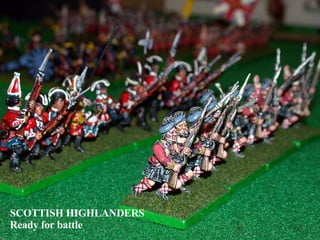
SCOTTISH HIGHLANDERS Ready for battle
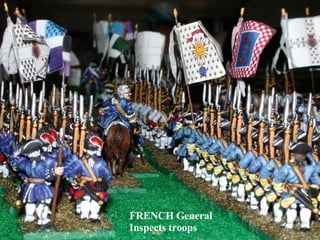
FRENCH General Inspects troops
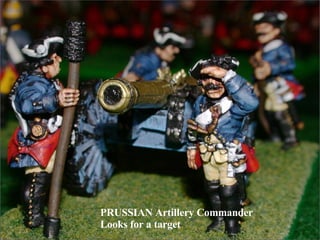
PRUSSIAN Artillery Commander Looks for a target
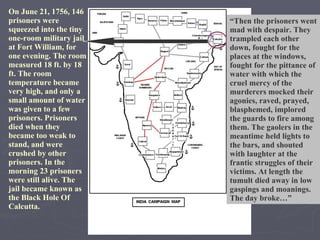
On June 21, 1756, 146 prisoners were squeezed into the tiny one-room military jail at Fort William, for one evening. The room measured 18 ft. by 18 ft. The room temperature became very high, and only a small amount of water was given to a few prisoners. Prisoners died when they became too weak to stand, and were crushed by other prisoners. In the morning 23 prisoners were still alive. The jail became known as the Black Hole Of Calcutta. “ Then the prisoners went mad with despair. They trampled each other down, fought for the places at the windows, fought for the pittance of water with which the cruel mercy of the murderers mocked their agonies, raved, prayed, blasphemed, implored the guards to fire among them. The gaolers in the meantime held lights to the bars, and shouted with laughter at the frantic struggles of their victims. At length the tumult died away in low gaspings and moanings. The day broke…”
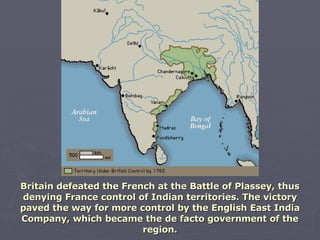
Britain defeated the French at the Battle of Plassey, thus denying France control of Indian territories. The victory paved the way for more control by the English East India Company, which became the de facto government of the region.
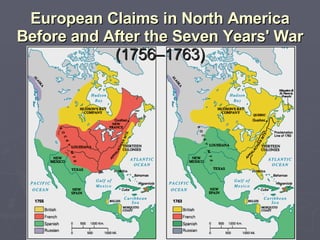
Importance of the War 1)  Britain conquered Canada.  The American colonists no longer needed protection from Britain, and the attempt by Parliament to tax the colonists to pay for the war sparked the American Revolution.   2)  France and Spain embarked upon a major naval buildup.  Stronger Bourbon navies made possible American victory in the Revolutionary War.   3)  The debts France incurred in this war and in the American Revolution helped cause the French Revolution.  The humiliation of the army led to reforms and innovations which were later used with great success by Napoleon.
Importance of the War 4)  Prussia survived the war despite enormous odds and confirmed its place as an important European power.  In 1870, Prussia united Germany.   5)  Russia showed itself to be a major power capable of enormous influence.   6)  By its lack of participation, The Netherlands showed itself to be in relative decline.  Smaller states like The Netherlands and Saxony were becoming increasingly vulnerable.     7)  Britain confirmed itself as the world's dominant naval and economic power and a force to be reckoned with in the European balance of power.  Britain became the dominant European power in India.  Eventually, Britain conquered all of India and used its resources to further expand the empire.  Some non-"Eurocentric" historians believe British control of India made the Industrial Revolution possible.
European Claims in North America Before and After the Seven Years' War  (1756–1763)

Empire, War, & Colonial Rebellion

  • 1.
    Empire, War, &Colonial Rebellion Kagan Ch 16
  • 2.
    18th Century EmpiresEuropean countries during the 18th century used empires to promote mercantilism, and improve their economic status. Trade rivalries developed causing great strain among the European powers. Boundaries of empires established in the Treaty of Utrecht in 1713.
  • 3.
    Mercantilist Goals Gaina favorable trade balance of gold and silver. (exports exceed imports) Colonies established to provide raw materials for growing industries and also to provide markets for finished products. National monopolies over colonies restricting trade to home country.
  • 4.
    Equal Trading PartnersEngland doubles its sale of cloth to France Which way is the gold flowing? What will happen to France if this continues? England sells 100 yds of cloth to France for 1 oz gold France sells 100 bottles of wine to England for 1 oz gold England sells 200 yds of cloth to France for 2 oz gold France sells 100 bottles of wine to England for 1 oz gold
  • 5.
    Problems with MercantilismMany practices proved impractical. Colonial and home markets didn’t mesh. Spain unable to produce enough finished products for colonies. Americans factories competed against British factories. Colonists and different countries wished to trade with each other.
  • 6.
    French & BritishRivalry North America was a major source of conflict between France and Britain. Competition among colonists Conflict over fishing rights and fur trade. Competition among each other to gain alliances with Native American tribes. India was another source of conflict. Competition for trade between the British East India Company and the French Compangie des Indes .
  • 7.
    Rivalry in IndiaThe government of India was weakening during the 18th century. France and Britain both saw it as an opportunity to expand their control of the region. Both countries attempted to gain control of the government in India. Joseph Dupleix of France Robert Clive of England Each country attempted to stop the other from government control of India.
  • 8.
    Spanish Colonial SystemSpanish society in the New World was based on classes as in Europe. Viceroys: European born, high government officials and upper clergy. (peninsulares) Creoles: Colonial born whites. Resented the rule of the viceroys Owned large farm estates and mines Well-educated Lower clergy were also the Creoles. Mestizos: People of mixed white and Indian blood farm laborers for the most part Slaves: Indians, Negroes or a mixture of the two.
  • 9.
    Importance of theChurch The Roman Catholic Church as an important force in Latin American society. Supported by the government. Used to spread European civilization in the New World. Promoted education. First universities founded in the New World Brought the first printing press to American Due to this spread of culture, Latin American cities enjoyed a higher level of civilization than those of other North American cities.
  • 10.
    The Economy Spain’smost important source of revenue from the New World came in the form of gold and silver. Eventually agriculture will replace gold and silver as its major source of revenue. Sugar cane and citrus fruits (Imported) Tobacco and Cacao (Native) Cattle (Imported)
  • 11.
    The Plantation SystemThe basic unit of colonial Latin America was a self-sufficient farming estate. Most were granted as royal charters. Charters included the right of encomiendas. The right to demand labor from Natives. Due to harsh treatment and disease, many of these people died. Death rate in Peruvian mines as high as 90% Due to the need for increased labor supplies, the slave trade began during the 1500s. More suitable to the hard work needed.
  • 12.
    The Slave ExperienceIt is estimated that over 9 million Africans were transported to the New World. Passage to the New World was devastating. Many ships lost over 40% of their slaves in passage Cheaper than trying to raise slave children to adulthood. Due to the high mortality rate as workers, there was a constant need for more slaves from Africa. Especially high in the West Indies
  • 13.
  • 14.
    Life Conditions Differedfrom colony to colony. Portuguese treated their slaves the worst In Spanish colonies the Church protected the slaves somewhat but spent more effort in protecting the Native Indians. British and French colonies provided some protection but was rarely enforced. Laws passed to maintain order fear of a slave revolt laws favored the masters over the slaves in all situations.
  • 15.
    Emancipation Movements Theabolitionist movement began in Britain and France during the Enlightenment. Abolished in the French colonies in  1794. Britain abolished slave trading in 1807. The Latin American wars for independence during the early 1800s brought an end to slavery in many countries. Began in Haiti with a revolution against France lead by Toussaint L’Ouverture Series of revolutions throughout South and Central America American “Emancipation Proclamation” of 1863.
  • 16.
    The Economy of the Atlantic Basin in 1701
  • 17.
  • 18.
  • 19.
    War of JenkinsEar: 1739-43 War that helped illuminate the rising conflict over trade among the European powers. Under the Treaty of Utrecht, Britain received the right (asiento) to provide Spain with slaves for a period of thirty years. Britain also allowed to send one ship to Portobello in the Caribbean. Ship was resupplied nightly by other British ships One of these ships was boarded by the Spanish Capt. Robert Jenkins’ ear was cut off by the Spanish.
  • 20.
    “Eventually escalates intoa…” Event (1731) eventually escalates into a war between the two countries (1739). British merchants put pressure on Parliament. Prime Minister Walpole forced to engage in war. May have been only a minor conflict. War sputtered out due to lack of troops to continue. Conflict in the W Indies dovetailed into the War of the Austrian Succession.
  • 21.
    War of theAustrian Succession 1740 - 1748 In 1740, Frederick the Great of Prussia seized the Austrian province of Siliesia. Claimed he was not bound to the Pragmatic Sanction. Siliesia had rich farmland along with large iron deposits. Its population was largely German speaking The seizure of Siliesia began a series of campaigns known as the War of the Austrian Succession.
  • 22.
    Became a EuropeanWar France, Bavaria, and Saxony sided with Prussia Britain, Russia, and the Dutch Netherlands sided with Austria. Prussia defeated Lost almost 10% of its population Its countryside was devastated. Berlin was invaded three separate times. After the war there was a major diplomatic shift, with both Britain and France changing sides. New French alliance with the traditional Habsburg enemy against the rising power of Britain and Prussia led to costly failure in the Seven Years' War.
  • 23.
  • 24.
  • 25.
    The Battle ofMollwitz On April 10, 1741, the Prussians advanced in two lines of battle toward the Austrian line. On the Prussian right, the Prussian cavalry, severely outnumbered and out classed by the Austrian cavalry were shattered, leaving the Prussian flank exposed. Marshall Schwerin urged Frederick to leave the battlefield, fearing the battle was lost (Frederick followed Schwerin’s advice). The Prussian infantry, however, stayed and slugged it out with the Austrian forces. Despite taking slightly heavier casualties (4,800 to 4,500), they were able to drive the Austrian forces from the field. The battle was a Prussian victory, and one that forced Maria Theresa to cede Silesia to Prussia.
  • 26.
    The Battle atMollwitz as Drawn by Frederick the Great
  • 27.
    The Seven YearsWar 1756-1763 Involved almost every European country. Fought not only in Europe but also India and the Americas. The French and Indian Wars At one time, Prussia was surrounded by enemies in Europe. With British aid, Frederick was able to hold off invasion. Complexion of war changed when Russia changed sides and joined Prussia. Treaty of Hubertusburg ended the war. Prussia allowed to keep Siliesia.
  • 28.
  • 29.
    FRENCH TROOPS Advanceto meet British
  • 30.
  • 31.
    PRUSSIAN INFANTRY Waitsfor French Cavalry
  • 32.
  • 33.
  • 34.
    PRUSSIAN Artillery CommanderLooks for a target
  • 35.
    On June 21,1756, 146 prisoners were squeezed into the tiny one-room military jail at Fort William, for one evening. The room measured 18 ft. by 18 ft. The room temperature became very high, and only a small amount of water was given to a few prisoners. Prisoners died when they became too weak to stand, and were crushed by other prisoners. In the morning 23 prisoners were still alive. The jail became known as the Black Hole Of Calcutta. “ Then the prisoners went mad with despair. They trampled each other down, fought for the places at the windows, fought for the pittance of water with which the cruel mercy of the murderers mocked their agonies, raved, prayed, blasphemed, implored the guards to fire among them. The gaolers in the meantime held lights to the bars, and shouted with laughter at the frantic struggles of their victims. At length the tumult died away in low gaspings and moanings. The day broke…”
  • 36.
    Britain defeated theFrench at the Battle of Plassey, thus denying France control of Indian territories. The victory paved the way for more control by the English East India Company, which became the de facto government of the region.
  • 37.
    Importance of theWar 1)  Britain conquered Canada.  The American colonists no longer needed protection from Britain, and the attempt by Parliament to tax the colonists to pay for the war sparked the American Revolution. 2)  France and Spain embarked upon a major naval buildup.  Stronger Bourbon navies made possible American victory in the Revolutionary War. 3)  The debts France incurred in this war and in the American Revolution helped cause the French Revolution.  The humiliation of the army led to reforms and innovations which were later used with great success by Napoleon.
  • 38.
    Importance of theWar 4)  Prussia survived the war despite enormous odds and confirmed its place as an important European power.  In 1870, Prussia united Germany. 5)  Russia showed itself to be a major power capable of enormous influence. 6)  By its lack of participation, The Netherlands showed itself to be in relative decline.  Smaller states like The Netherlands and Saxony were becoming increasingly vulnerable.   7)  Britain confirmed itself as the world's dominant naval and economic power and a force to be reckoned with in the European balance of power.  Britain became the dominant European power in India.  Eventually, Britain conquered all of India and used its resources to further expand the empire.  Some non-"Eurocentric" historians believe British control of India made the Industrial Revolution possible.
  • 39.
    European Claims inNorth America Before and After the Seven Years' War (1756–1763)