“Emotional Intelligence:
Respectfully Communicating My
Feelings”
Presenter: Rev’d Ardith Conway
What is Emotional Intelligence?
Emotional intelligence is the ability to
understand, use, and manage our
emotions.
Emotional intelligence is sometimes called
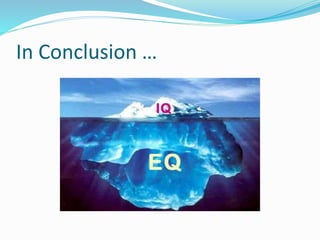
EQ (or EI) for short. Just as a high IQ can
predict top test scores, a high EQ can predict
success in social and emotional situations. EQ
helps us build strong relationships, make
good decisions, and deal with difficult
situations.
One way to think about EQ is that it's part of
being people-smart. Understanding and getting along
with people helps us be successful in almost any area of
life. In fact, some studies show that EQ is more
important than IQ when it comes to doing well in school
or being successful at work.
Some people have naturally good EQ skills. Others need
to work on them. The good news is that everyone can get
better. Unlike IQ, people can actually improve their
emotional intelligence — if they know what to do.
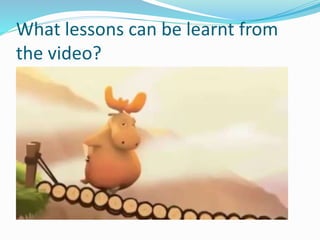
What lessons can be learnt from
the video?
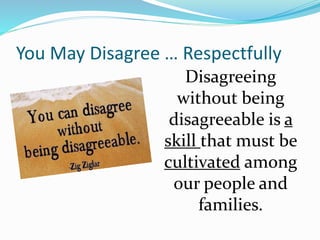
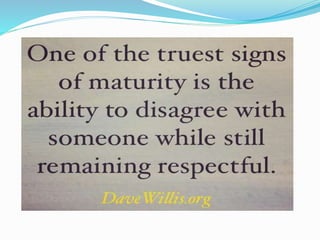
You May Disagree … Respectfully
Disagreeing
without being
disagreeable is a
skill that must be
cultivated among
our people and
families.
Manifestations of Dis-respectful
Disagreement
Poor choice of words to express a different point of
view
Poor social skills of not listening, and interrupting
when others are speaking
Shouting and name-calling rather than expressing
a point calmly
Non-verbal subtleties such as rolling your eyes,
clenching or pouting your face/mouth,
Staring at the ceiling instead of looking at
the person
Shaking your head from side to side
Clenching your fists and tapping your feet
MORE ….
SAD … BUT TRUE IS THE FACT THAT:
More than a few persons purposely disagree dis-
respectfully because of the power they feel when
they attack others with words or actions.
While it is impossible to know all of the reasons,
there is no doubt that learning to lis ten to someone
with a different point of view and then responding in
a manner that respects the person is an important
life skill
Ways to (Respectfully) Disagree
Don't make it personal.
If you get upset, it can help to remember
you're mad at the idea or concept your
parent (or friend, coach, coworker, etc.)
is raising, not the person
Ways to (Respectfully) Disagree
Avoid putting down the other person's ideas and
beliefs.
If you've ever been on the receiving end of someone's
tirade or put-downs, you know how valuable using
respectful language and behavior can be. So instead of
saying what you might be thinking ("That's a stupid
idea!"), try: "I don't agree, and here's why." Resist the
temptation to yell, use sarcasm, or make derogatory
comments and you'll have a much better chance of
getting your point across.
Ways to (Respectfully) DisagreeUse "I" statements to communicate how you feel,
what you think, and what you want or need.
Using "you" statements can sound argumentative. For
example, telling your mom or dad, "You always remind
me about my chores on Wednesdays when you know I
have a lot of homework" has a very different tone from
"I'm feeling pressured because I have a lot of homework
tonight. Can I do those chores tomorrow?"
Ways to (Respectfully) Disagree
Listen to the other point of view.
Being a good listener is a way of showing that you
respect and understand the other person's perspective.
That makes it more likely he or she will do the same for
you. When the other person is talking, try to stop
yourself from thinking about why you disagree or what
you'll say next.
Instead, focus on what's being said. When it's your turn
to talk, repeat any key points the other person made to
show you listened and heard what was said. Then calmly
present your case and why you disagree.
Ways to (Respectfully) Disagree
Stay calm.
This is the most important thing you can do to keep a
conversation on track. Of course, it's a huge challenge to
stay calm and rational when you feel angry or passionate
about something — especially if the person you're
talking to gets heated. You may need to be the mature
one who manages the conversation, even if the other
person is a parent or someone who should know better.
Ways to (Respectfully) Disagree
These principles should also be
applied in your ONLINE
INTERACTIONS
In Conclusion …

Emotional Intelligence - Respectful Disagreement

  • 1.
    “Emotional Intelligence: Respectfully CommunicatingMy Feelings” Presenter: Rev’d Ardith Conway
  • 2.
    What is EmotionalIntelligence? Emotional intelligence is the ability to understand, use, and manage our emotions. Emotional intelligence is sometimes called EQ (or EI) for short. Just as a high IQ can predict top test scores, a high EQ can predict success in social and emotional situations. EQ helps us build strong relationships, make good decisions, and deal with difficult situations.
  • 3.
    One way tothink about EQ is that it's part of being people-smart. Understanding and getting along with people helps us be successful in almost any area of life. In fact, some studies show that EQ is more important than IQ when it comes to doing well in school or being successful at work. Some people have naturally good EQ skills. Others need to work on them. The good news is that everyone can get better. Unlike IQ, people can actually improve their emotional intelligence — if they know what to do.
  • 4.
    What lessons canbe learnt from the video?
  • 5.
    You May Disagree… Respectfully Disagreeing without being disagreeable is a skill that must be cultivated among our people and families.
  • 6.
    Manifestations of Dis-respectful Disagreement Poorchoice of words to express a different point of view Poor social skills of not listening, and interrupting when others are speaking Shouting and name-calling rather than expressing a point calmly Non-verbal subtleties such as rolling your eyes, clenching or pouting your face/mouth,
  • 7.
    Staring at theceiling instead of looking at the person Shaking your head from side to side Clenching your fists and tapping your feet MORE ….
  • 8.
    SAD … BUTTRUE IS THE FACT THAT: More than a few persons purposely disagree dis- respectfully because of the power they feel when they attack others with words or actions. While it is impossible to know all of the reasons, there is no doubt that learning to lis ten to someone with a different point of view and then responding in a manner that respects the person is an important life skill
  • 9.
    Ways to (Respectfully)Disagree Don't make it personal. If you get upset, it can help to remember you're mad at the idea or concept your parent (or friend, coach, coworker, etc.) is raising, not the person
  • 10.
    Ways to (Respectfully)Disagree Avoid putting down the other person's ideas and beliefs. If you've ever been on the receiving end of someone's tirade or put-downs, you know how valuable using respectful language and behavior can be. So instead of saying what you might be thinking ("That's a stupid idea!"), try: "I don't agree, and here's why." Resist the temptation to yell, use sarcasm, or make derogatory comments and you'll have a much better chance of getting your point across.
  • 11.
    Ways to (Respectfully)DisagreeUse "I" statements to communicate how you feel, what you think, and what you want or need. Using "you" statements can sound argumentative. For example, telling your mom or dad, "You always remind me about my chores on Wednesdays when you know I have a lot of homework" has a very different tone from "I'm feeling pressured because I have a lot of homework tonight. Can I do those chores tomorrow?"
  • 12.
    Ways to (Respectfully)Disagree Listen to the other point of view. Being a good listener is a way of showing that you respect and understand the other person's perspective. That makes it more likely he or she will do the same for you. When the other person is talking, try to stop yourself from thinking about why you disagree or what you'll say next. Instead, focus on what's being said. When it's your turn to talk, repeat any key points the other person made to show you listened and heard what was said. Then calmly present your case and why you disagree.
  • 13.
    Ways to (Respectfully)Disagree Stay calm. This is the most important thing you can do to keep a conversation on track. Of course, it's a huge challenge to stay calm and rational when you feel angry or passionate about something — especially if the person you're talking to gets heated. You may need to be the mature one who manages the conversation, even if the other person is a parent or someone who should know better.
  • 14.
    Ways to (Respectfully)Disagree These principles should also be applied in your ONLINE INTERACTIONS
  • 16.