Brain: Parts, Processes,
and Functions
Understanding the
Brain's Role in Thoughts,
Behavior, and Feelings
What You Will Learn
1. Brain Parts: Cerebrum, Cerebellum,
Brainstem
2. Processes: Sensory processing,
memory, emotions
3. Functions: Movement, decision-
making, survival functions
The brain is the
most complex
organ in the
human body.
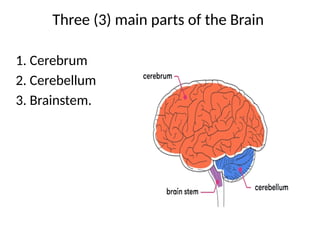
Three (3) main parts of the Brain
1. Cerebrum
2. Cerebellum
3. Brainstem.
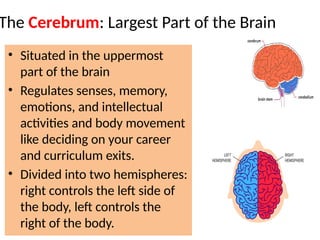
The Cerebrum: Largest Part of the Brain
• Situated in the uppermost
part of the brain
• Regulates senses, memory,
emotions, and intellectual
activities and body movement
like deciding on your career
and curriculum exits.
• Divided into two hemispheres:
right controls the left side of
the body, left controls the
right of the body.
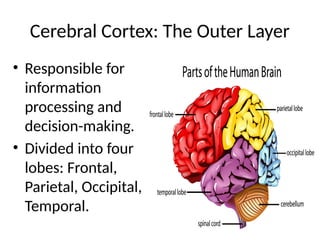
Cerebral Cortex: The Outer Layer
• Responsible for
information
processing and
decision-making.
• Divided into four
lobes: Frontal,
Parietal, Occipital,
Temporal.
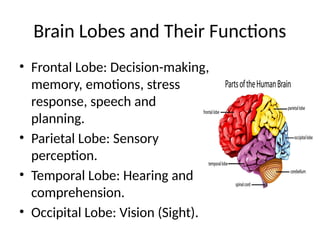
Brain Lobes and Their Functions
• Frontal Lobe: Decision-making,
memory, emotions, stress
response, speech and
planning.
• Parietal Lobe: Sensory
perception.
• Temporal Lobe: Hearing and
comprehension.
• Occipital Lobe: Vision (Sight).
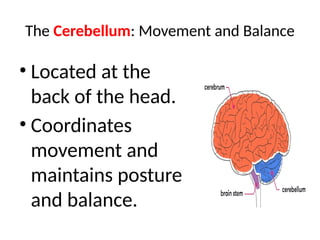
The Cerebellum: Movement and Balance
• Located at the
back of the head.
• Coordinates
movement and
maintains posture
and balance.
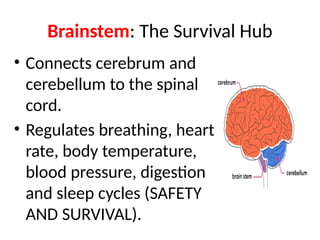
Brainstem: The Survival Hub
• Connects cerebrum and
cerebellum to the spinal
cord.
• Regulates breathing, heart
rate, body temperature,
blood pressure, digestion
and sleep cycles (SAFETY
AND SURVIVAL).
How the Brain Processes Sensory Information
• Eyes (sight): Occipital Lobe.
• Ears (hearing): Temporal Lobe.
• Nose (smell): Frontal and
Temporal Lobes.
• Tongue (taste): Parietal Lobe.
• Skin (touch): Parietal Lobe.
Limbic System: Emotions and Memory
• composes parts of the cerebral
cortex and hypothalamus
• Regulates emotions and memory.
• Interacts with the hypothalamus
for body function regulation.
• cerebrum and cortex-ability to think.
• limbic system- feelings
• Brainstem- behaving safely to survive.
Key Takeaways
• The brain is composed of parts
that regulate thoughts, behavior,
and body functions.
• Each lobe and region has specific
roles in processing information
and responding.
Questions or
Clarifications
Questions or
Clarifications
COLOR
Ways to Improve your Brain Function for
Personal Development
1. Exercise- benefits brain health and cognition, improves your
memory, and even protects your brain from degeneration.
Aerobic exercise is good for the brain. Activities that keep your
blood pumping are good for your heart and great for your
brain.
2. Meditate- taking 10-15 minutes of meditation a day could help
to extend your cognitive longevity.
3. Sleep – getting enough sleep at night for 7 to 9 hours is enough
to consolidate memory learning. This is important in resetting the
brain, allow it to heal and restore.
Ways to Improve your Brain Function for
Personal Development
4. Food Intake- just as the body needs fuel, so does the brain. Eat a
brain boosting diet such as food rich in omega-3, antioxidants, amino
acids, and vitamin E. Eat more vegetables, limit calorie, and saturated
fat intake. Drink green tea and wine or grape juice in moderation.
5. Sunlight- 15 to 30 minutes of morning sunlight and exercise can
sometimes go hand in hand however, getting too little sunlight is not
healthy for your brain. Higher levels of vitamin D in your system allow
you to perform better and slow down the aging of your brain.
6. Good Relationship- make time for friends. Building a strong
support system around you will enable you to stay healthy mentally
and psychologically over the long term. This is called the ultimate
brain booster.
7. Do not smoke- smoking can cause brain disorder called
dementia. Those people who smoked more than two packs of
cigarettes a day had twice the rate of dementia when they
were older.
8. Be creative – engaging in activities that will boost one’s
creativity like arts and crafts, writing poem, choreograph a
dance performance and the like are good for enhancing brain
functions.
9. Classical music- listening to calm music can improve brain
functions.
10. Drink coffee- drinking coffee in moderation increases your
brain performance and speed and will even boost your
intelligence, including your reaction time and reasoning.
Ways to Improve your Brain Function for
Personal Development
How to Improve your mental focus?
1. Assessment
2. Eliminate
3. Limit focus
4. Live in the moment
5. Practice mindfulness
6. Take a short break
7. Build your mental focus
8. Brainstorm

PERSONAL DEVELOPMENT MODULE 11-BRAIN PARTS.pptx

  • 1.
    Brain: Parts, Processes, andFunctions Understanding the Brain's Role in Thoughts, Behavior, and Feelings
  • 2.
    What You WillLearn 1. Brain Parts: Cerebrum, Cerebellum, Brainstem 2. Processes: Sensory processing, memory, emotions 3. Functions: Movement, decision- making, survival functions
  • 3.
    The brain isthe most complex organ in the human body.
  • 4.
    Three (3) mainparts of the Brain 1. Cerebrum 2. Cerebellum 3. Brainstem.
  • 5.
    The Cerebrum: LargestPart of the Brain • Situated in the uppermost part of the brain • Regulates senses, memory, emotions, and intellectual activities and body movement like deciding on your career and curriculum exits. • Divided into two hemispheres: right controls the left side of the body, left controls the right of the body.
  • 6.
    Cerebral Cortex: TheOuter Layer • Responsible for information processing and decision-making. • Divided into four lobes: Frontal, Parietal, Occipital, Temporal.
  • 7.
    Brain Lobes andTheir Functions • Frontal Lobe: Decision-making, memory, emotions, stress response, speech and planning. • Parietal Lobe: Sensory perception. • Temporal Lobe: Hearing and comprehension. • Occipital Lobe: Vision (Sight).
  • 8.
    The Cerebellum: Movementand Balance • Located at the back of the head. • Coordinates movement and maintains posture and balance.
  • 9.
    Brainstem: The SurvivalHub • Connects cerebrum and cerebellum to the spinal cord. • Regulates breathing, heart rate, body temperature, blood pressure, digestion and sleep cycles (SAFETY AND SURVIVAL).
  • 10.
    How the BrainProcesses Sensory Information • Eyes (sight): Occipital Lobe. • Ears (hearing): Temporal Lobe. • Nose (smell): Frontal and Temporal Lobes. • Tongue (taste): Parietal Lobe. • Skin (touch): Parietal Lobe.
  • 11.
    Limbic System: Emotionsand Memory • composes parts of the cerebral cortex and hypothalamus • Regulates emotions and memory. • Interacts with the hypothalamus for body function regulation.
  • 12.
    • cerebrum andcortex-ability to think. • limbic system- feelings • Brainstem- behaving safely to survive.
  • 13.
    Key Takeaways • Thebrain is composed of parts that regulate thoughts, behavior, and body functions. • Each lobe and region has specific roles in processing information and responding.
  • 14.
  • 16.
  • 17.
  • 18.
    Ways to Improveyour Brain Function for Personal Development 1. Exercise- benefits brain health and cognition, improves your memory, and even protects your brain from degeneration. Aerobic exercise is good for the brain. Activities that keep your blood pumping are good for your heart and great for your brain. 2. Meditate- taking 10-15 minutes of meditation a day could help to extend your cognitive longevity. 3. Sleep – getting enough sleep at night for 7 to 9 hours is enough to consolidate memory learning. This is important in resetting the brain, allow it to heal and restore.
  • 19.
    Ways to Improveyour Brain Function for Personal Development 4. Food Intake- just as the body needs fuel, so does the brain. Eat a brain boosting diet such as food rich in omega-3, antioxidants, amino acids, and vitamin E. Eat more vegetables, limit calorie, and saturated fat intake. Drink green tea and wine or grape juice in moderation. 5. Sunlight- 15 to 30 minutes of morning sunlight and exercise can sometimes go hand in hand however, getting too little sunlight is not healthy for your brain. Higher levels of vitamin D in your system allow you to perform better and slow down the aging of your brain. 6. Good Relationship- make time for friends. Building a strong support system around you will enable you to stay healthy mentally and psychologically over the long term. This is called the ultimate brain booster.
  • 20.
    7. Do notsmoke- smoking can cause brain disorder called dementia. Those people who smoked more than two packs of cigarettes a day had twice the rate of dementia when they were older. 8. Be creative – engaging in activities that will boost one’s creativity like arts and crafts, writing poem, choreograph a dance performance and the like are good for enhancing brain functions. 9. Classical music- listening to calm music can improve brain functions. 10. Drink coffee- drinking coffee in moderation increases your brain performance and speed and will even boost your intelligence, including your reaction time and reasoning. Ways to Improve your Brain Function for Personal Development
  • 21.
    How to Improveyour mental focus? 1. Assessment 2. Eliminate 3. Limit focus 4. Live in the moment 5. Practice mindfulness 6. Take a short break 7. Build your mental focus 8. Brainstorm

Editor's Notes

  • #10 The brain receives sensory information from these five senses. This sensory information was received, processed, and interpreted by the brain resulting for you to give a response in alternative manner such as to react assertively or aggressively, to act impulsively or carefully, to respond positively or negatively to the daily changes and challenges of your life.