
Data Center Cooling Design
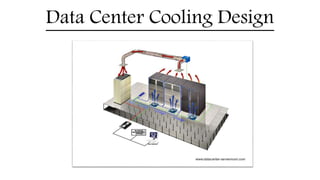
Keep your data center cool and healthy with our smart data center cooling design
which makes sure your data centers never get exhausted and work efficiently.
Introduction to Server Room Cooling:
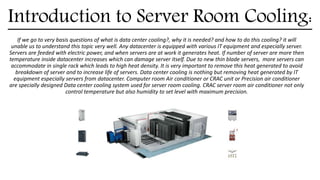
If we go to very basis questions of what is data center cooling?, why it is needed? and how to do this cooling? it will
unable us to understand this topic very well. Any datacenter is equipped with various IT equipment and especially server.
Servers are feeded with electric power, and when servers are at work it generates heat. If number of server are more then
temperature inside datacenter increases which can damage server itself. Due to new thin blade servers, more servers can
accommodate in single rack which leads to high heat density. It is very important to remove this heat generated to avoid
breakdown of server and to increase life of servers. Data center cooling is nothing but removing heat generated by IT
equipment especially servers from datacenter. Computer room Air conditioner or CRAC unit or Precision air conditioner
are specially designed Data center cooling system used for server room cooling. CRAC server room air conditioner not only
control temperature but also humidity to set level with maximum precision.
Room Cooling
This is conventional method of datacenter
cooling in which CRAC unit capacity selected
to server total heat load in room. CRAC unit
has free supply of cold air and free return
path. There is no Ducting, dampers or vent in
air distribution. Due to this, cold air might
return to CRAC without removing heat from IT
load. Hence CRAC unit not get utilized to its
full capacity. However this issue can be solve
with help Hot Aisle and Cold Aisle
containment. In Datacenter having raised floor
with down flow CRAC unit, Cold aisle
containment is recommended to direct flow of
cold air in front of racks. While for datacenter
without raised floor, hot aisle containment is
recommended to direct return hot air to CRAC
without mixing with cold air. Room cooling
design depends on size & shape, ceiling
height, rack layout & hence any alteration in
might effect performance.
Row Cooling
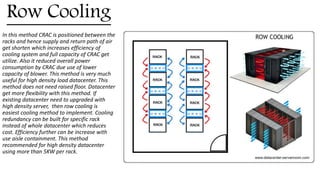
In this method CRAC is positioned between the
racks and hence supply and return path of air
get shorten which increases efficiency of
cooling system and full capacity of CRAC get
utilize. Also it reduced overall power
consumption by CRAC due use of lower
capacity of blower. This method is very much
useful for high density load datacenter. This
method does not need raised floor. Datacenter
get more flexibility with this method. If
existing datacenter need to upgraded with
high density server, then row cooling is
easiest cooling method to implement. Cooling
redundancy can be built for specific rack
instead of whole datacenter which reduces
cost. Efficiency further can be increase with
use aisle containment. This method
recommended for high density datacenter
using more than 5KW per rack.
For More Information
Please Visit:
http://www.datacenter-serverroom.com/
Thanks For Visiting

Data Center Cooling Design - Datacenter-serverroom

  • 1.
  • 2.
    Keep your datacenter cool and healthy with our smart data center cooling design which makes sure your data centers never get exhausted and work efficiently.
  • 3.
    Introduction to ServerRoom Cooling: If we go to very basis questions of what is data center cooling?, why it is needed? and how to do this cooling? it will unable us to understand this topic very well. Any datacenter is equipped with various IT equipment and especially server. Servers are feeded with electric power, and when servers are at work it generates heat. If number of server are more then temperature inside datacenter increases which can damage server itself. Due to new thin blade servers, more servers can accommodate in single rack which leads to high heat density. It is very important to remove this heat generated to avoid breakdown of server and to increase life of servers. Data center cooling is nothing but removing heat generated by IT equipment especially servers from datacenter. Computer room Air conditioner or CRAC unit or Precision air conditioner are specially designed Data center cooling system used for server room cooling. CRAC server room air conditioner not only control temperature but also humidity to set level with maximum precision.
  • 4.
    Room Cooling This isconventional method of datacenter cooling in which CRAC unit capacity selected to server total heat load in room. CRAC unit has free supply of cold air and free return path. There is no Ducting, dampers or vent in air distribution. Due to this, cold air might return to CRAC without removing heat from IT load. Hence CRAC unit not get utilized to its full capacity. However this issue can be solve with help Hot Aisle and Cold Aisle containment. In Datacenter having raised floor with down flow CRAC unit, Cold aisle containment is recommended to direct flow of cold air in front of racks. While for datacenter without raised floor, hot aisle containment is recommended to direct return hot air to CRAC without mixing with cold air. Room cooling design depends on size & shape, ceiling height, rack layout & hence any alteration in might effect performance.
  • 5.
    Row Cooling In thismethod CRAC is positioned between the racks and hence supply and return path of air get shorten which increases efficiency of cooling system and full capacity of CRAC get utilize. Also it reduced overall power consumption by CRAC due use of lower capacity of blower. This method is very much useful for high density load datacenter. This method does not need raised floor. Datacenter get more flexibility with this method. If existing datacenter need to upgraded with high density server, then row cooling is easiest cooling method to implement. Cooling redundancy can be built for specific rack instead of whole datacenter which reduces cost. Efficiency further can be increase with use aisle containment. This method recommended for high density datacenter using more than 5KW per rack.
  • 6.
    For More Information PleaseVisit: http://www.datacenter-serverroom.com/
  • 7.