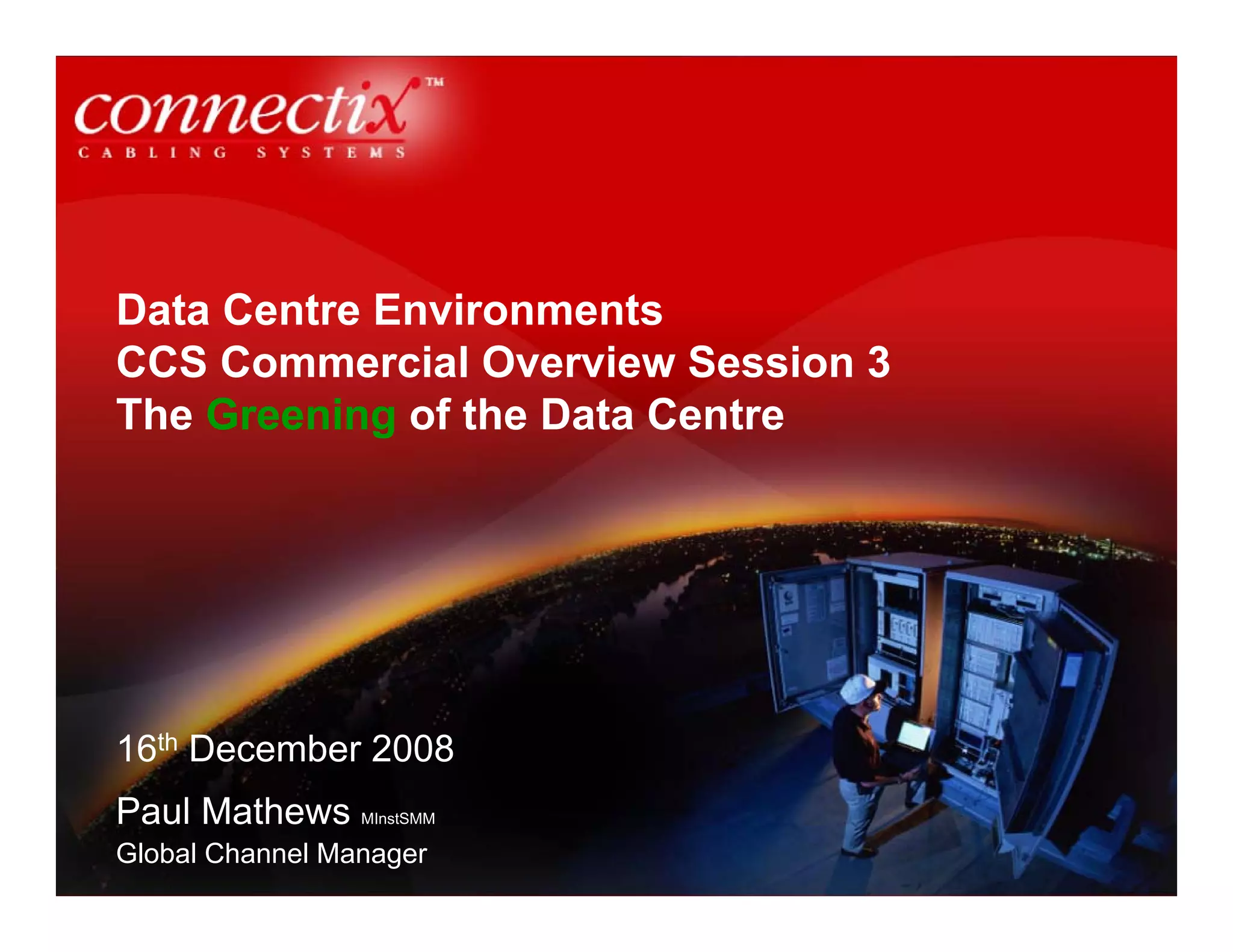
Data Centre Environments
CCS Commercial Overview Session 3
The Greening of the Data Centre
16th December 2008
Paul Mathews MInstSMM
Global Channel Manager
• The heartbeat of any business, designed to manage the flow, processing and
storage of information
• Must be reliable, secure and flexible to enable growth and reconfiguration
• A data centre can support small singular businesses through to thousands of
clients ecommerce facilities
• “A building or portion of a building whose primary function is to house a
computer room and its support areas,” according to TIA 942
Introduction to Data Centres
Energy usage in Data Centres
• Average 200 sq m computer room in a data centre uses 52 more times
electricity than an office LAN
• An average of 7500 kW hours per sq m / pa
• Present day servers generate around 2.5 kW of heat per sq m – this is
expected to rise to 10 kW as CPUs become densely populated
• A floor tile emits an average of 1.2 tonnes of carbon omissions pa
• Based on costs of £450.00 per sq m would result in savings over £9000 if
efficiency was improved by 10%
Energy wastage in Data Centres
• Huge financial industry burden and public policy environmental issue
• If a Data Centre could be 100% efficient, all electrical power would need to
reach the IT loads
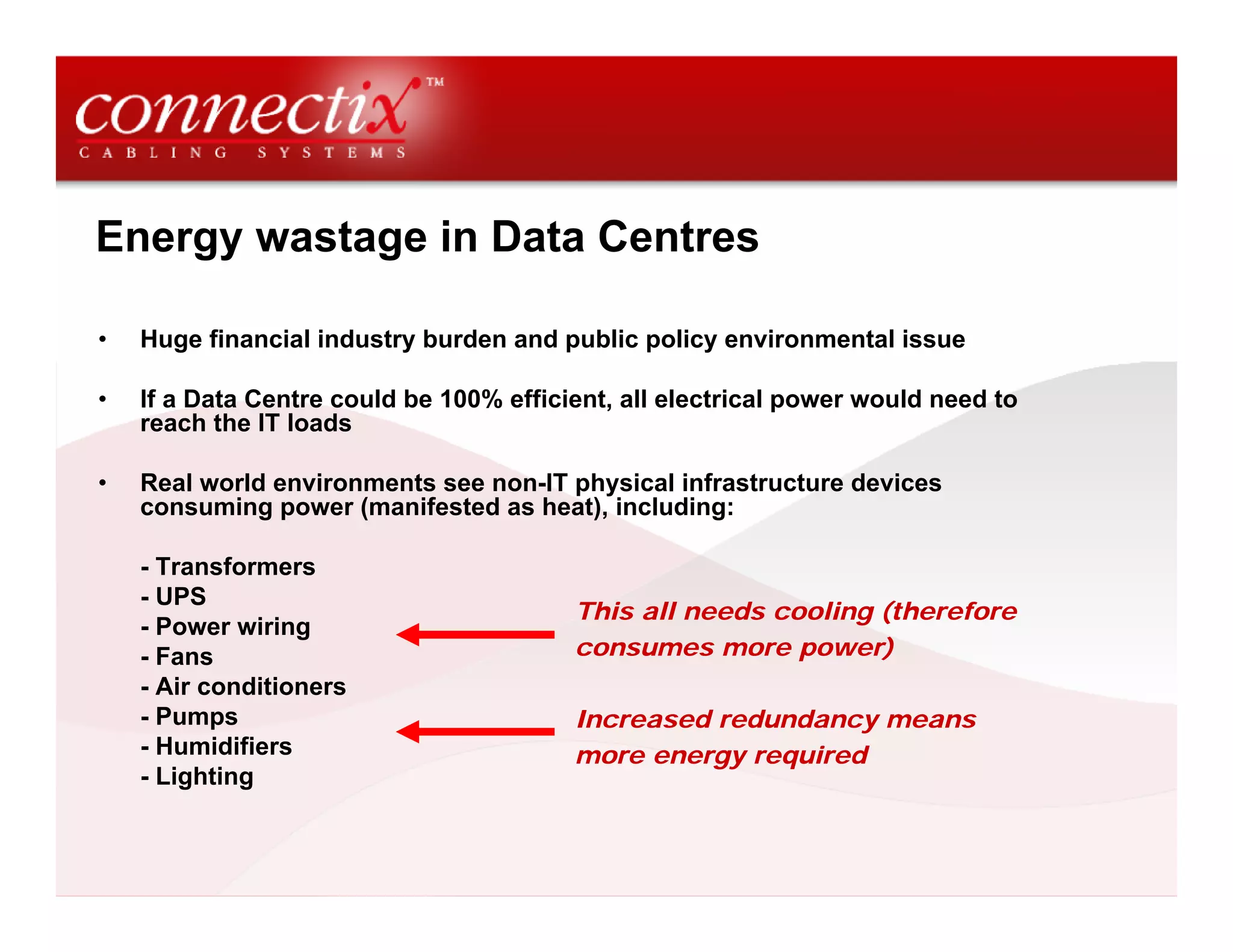
• Real world environments see non-IT physical infrastructure devices
consuming power (manifested as heat), including:
- Transformers
- UPS
- Power wiring
- Fans
- Air conditioners
- Pumps
- Humidifiers
- Lighting
This all needs cooling (therefore
consumes more power)
Increased redundancy means
more energy required
Why are data centres inefficient?
• Over sizing of the physical infrastructure creates fixed losses of electrical
power and cooling systems
• Data Centre industry power and cooling usage worldwide wastes more than
60,000,000 megawatt-hours per year of electricity
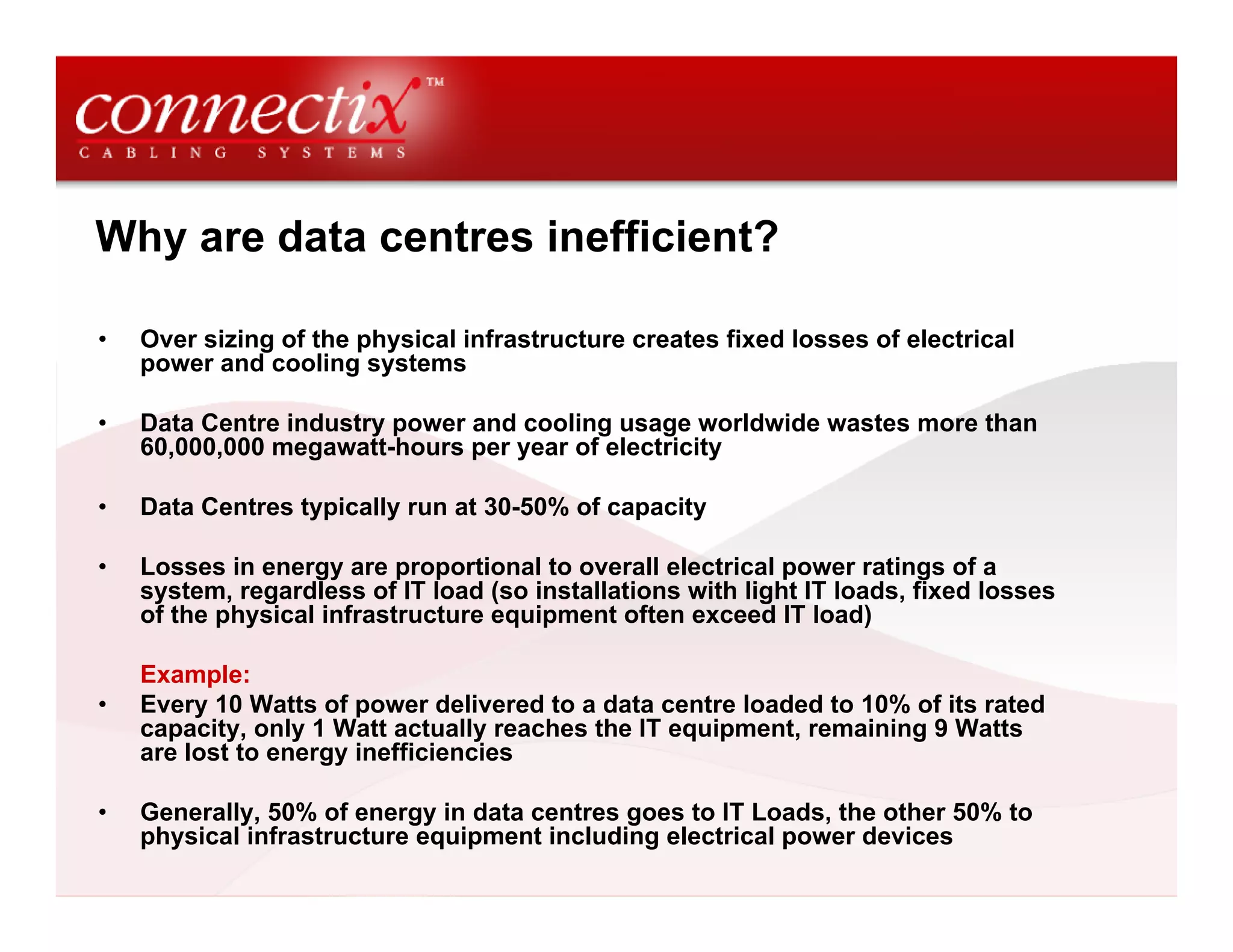
• Data Centres typically run at 30-50% of capacity
• Losses in energy are proportional to overall electrical power ratings of a
system, regardless of IT load (so installations with light IT loads, fixed losses
of the physical infrastructure equipment often exceed IT load)
Example:
• Every 10 Watts of power delivered to a data centre loaded to 10% of its rated
capacity, only 1 Watt actually reaches the IT equipment, remaining 9 Watts
are lost to energy inefficiencies
• Generally, 50% of energy in data centres goes to IT Loads, the other 50% to
physical infrastructure equipment including electrical power devices
Data Centre Infrastructure Efficiency (DCiE)
• Data centres needs to become more green
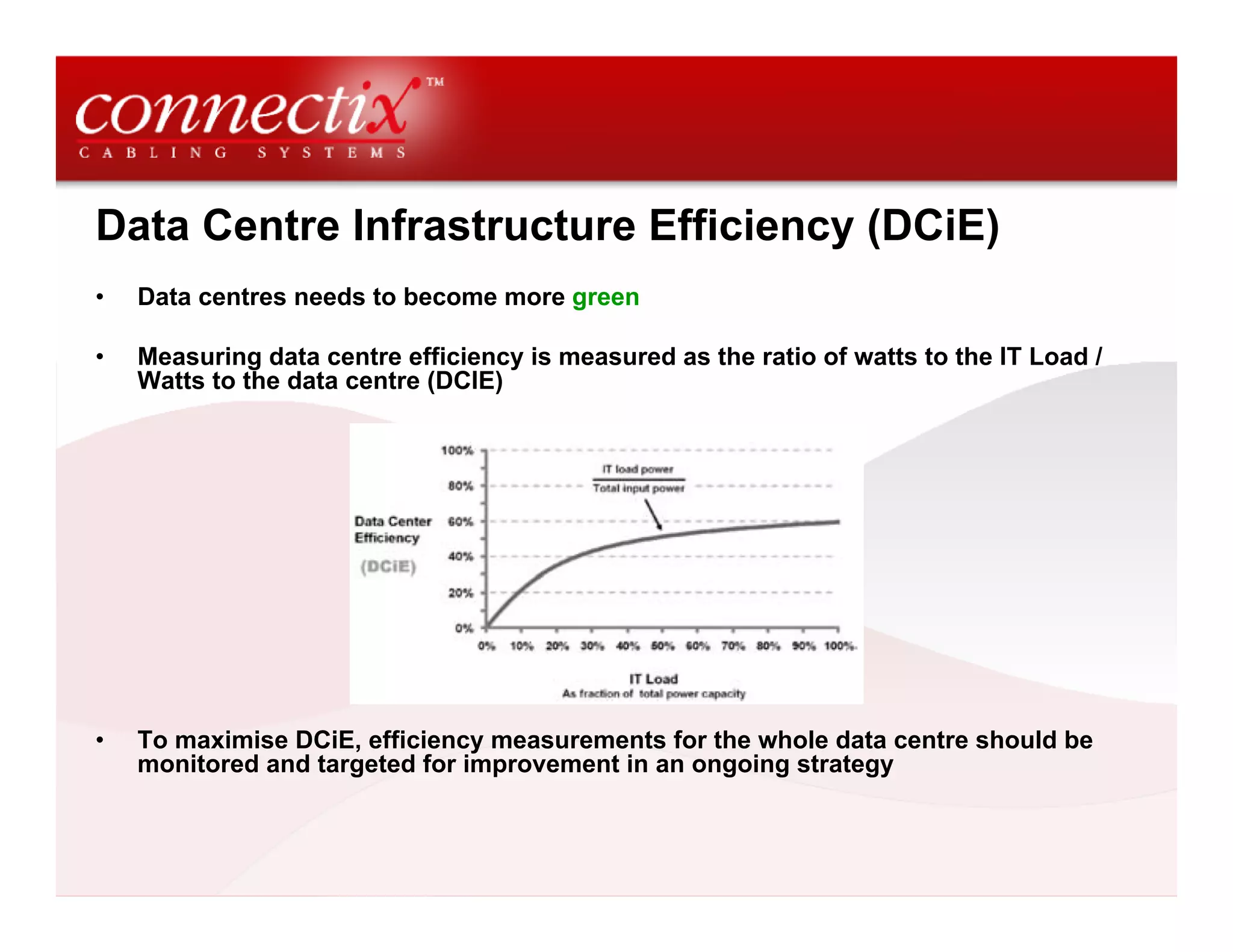
• Measuring data centre efficiency is measured as the ratio of watts to the IT Load /
Watts to the data centre (DCIE)
• To maximise DCiE, efficiency measurements for the whole data centre should be
monitored and targeted for improvement in an ongoing strategy
DCiE Architecture (Data Centre Subsystem)
• IT Load
• Auxiliary devices
• Lights
• Humidifiers
• Chillers
• Pumps
• Heat Rejection
• CRAC
• Distribution Wiring
• Switchgear
• Generator
• PDU
• UPS
Data Centre Greening
Improvement Guidelines – Part 1
• Electrical power and cooling equipment not needed should not be energised
• Minimise over sizing where possible, so equipment operated within the
optimum region of efficiency
• Electrical power, cooling and lighting equipment should utilise up-to-date
technology to minimise power consumption
• Sub-systems used for redundancy should be optimised for their fractional
load capacity, not the full load efficiency
Data Centre Greening
Improvement Guidelines – Part 2
• Use a capacity management tool to manage the amount of electrical power
and cooling to the Data Centre, ensuring ‘stranded capacity’ is minimised
• To optimise the efficiency of zones/areas within the data centre, an integrated
physical configuration should control the system and not just one room
Example
Row-based cooling for racks should be integrated with IT racks, independent
from the room based cooling
• Integrate management systems to monitor and alert electrical consumption
levels that cause high inefficiency levels
Data Centre Greening
Improvement Guidelines – Part 3 Cabling
• Design cabling and racks to maximise air flow (use blanking panels in
cabinets, hot and cold aisle placement)
• Use pre-terminated cabling to reduce waste
• Consider optical fibre:
- kinder to the environment in manufacturing v copper
- bullet proof for longer life cycle
- components consume less power v copper
- higher bandwidth, extended distance (performance)
- cabling such as Connectix Starlight MTP reduces amount of cables and
improves air flow
Sizing the Data Centre
• Sizing the physical infrastructure inline with the IT Load will have the most
impact on electrical consumption
• Scalable physical infrastructures that can grow with IT Load offer the best
opportunity to limit electrical waste and costs
• A well designed, correctly sized physical infrastructure can eliminate up to
50% of the electrical bill in real-world installations
• So….. Design a modular, scalable physical infrastructure
Sub-system Greening
Part 1
• Scalable electrical power and cooling:
Helps increase efficiency in smaller data centres or data centres early in their
life form
Helps defer capital and operating costs until needed
• Row-based cooling:
Shortens the air flow path to improve predictability of air distribution
Perimeter CRACs operate at 80% efficient at 70% IT Load
Row-base CRACs operate at 95% efficient at 70% IT Load
Sub-system Greening
Part 2
• High-efficiency UPS
Current new products can improve efficiency by over 10% compared to
current installed UPS
• Capacity management tools
A mixture of tools and company regulations that implements a safe operating
system that is higher density and more efficient, designed to reduce capital
costs and energy bills
Energy Efficiency Best Practices
• Install blanking panels
• Coordinate CRAC Units
• Improve under floor airflow
• Implement hot and cold aisles
• Install sensors to monitor temperature
• Implement cold aisle or hot aisle containment
• Raise the temperature in the data centre (ASHRAE)
to improve electrical use
• Exploit ‘free cooling’
• Design new data centres and computer rooms using modular cooling
Additional information can be
found in the Gartner report ‘How
to Save a Million Kilowatt Hours
in your Data Centre’
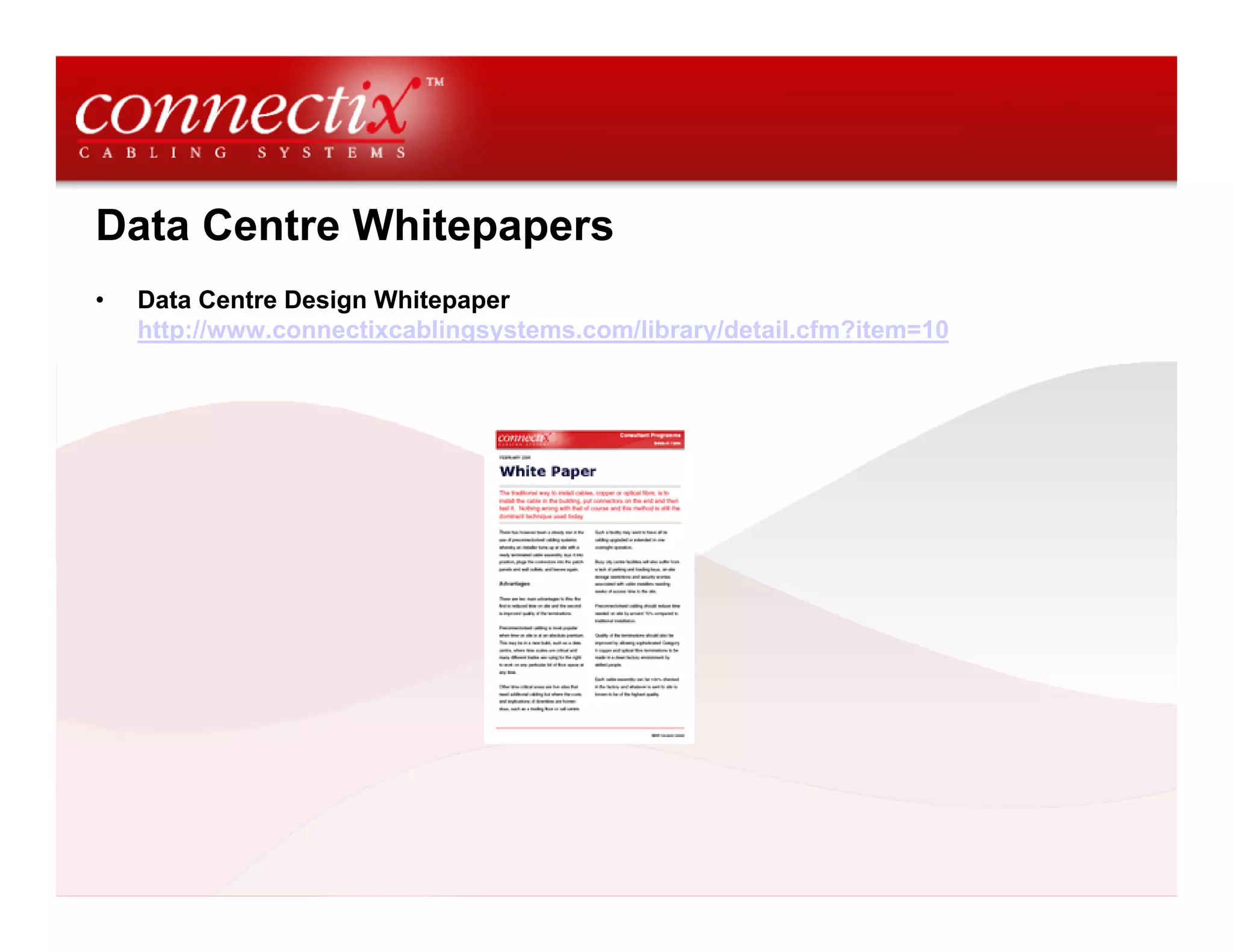
Data Centre Whitepapers
• Data Centre Design Whitepaper
http://www.connectixcablingsystems.com/library/detail.cfm?item=10
Connectix Technical Articles
• Log on to www.connectixcablingsystems.com for full access to our data
centre and high speed LAN support articles
• Log on to www.connectixcablingsystems.com/events for details of our Data
Centre Design Principle Seminars run in association with The IET
IET Endorsed
Training
provider
CIBSE Continuing
Professional Development BICSI Continuing Education Credits

Commercial Overview DC Session 3 The Greening Of The Data Centre

  • 1.
    Data Centre Environments CCSCommercial Overview Session 3 The Greening of the Data Centre 16th December 2008 Paul Mathews MInstSMM Global Channel Manager
  • 2.
    • The heartbeatof any business, designed to manage the flow, processing and storage of information • Must be reliable, secure and flexible to enable growth and reconfiguration • A data centre can support small singular businesses through to thousands of clients ecommerce facilities • “A building or portion of a building whose primary function is to house a computer room and its support areas,” according to TIA 942 Introduction to Data Centres
  • 3.
    Energy usage inData Centres • Average 200 sq m computer room in a data centre uses 52 more times electricity than an office LAN • An average of 7500 kW hours per sq m / pa • Present day servers generate around 2.5 kW of heat per sq m – this is expected to rise to 10 kW as CPUs become densely populated • A floor tile emits an average of 1.2 tonnes of carbon omissions pa • Based on costs of £450.00 per sq m would result in savings over £9000 if efficiency was improved by 10%
  • 4.
    Energy wastage inData Centres • Huge financial industry burden and public policy environmental issue • If a Data Centre could be 100% efficient, all electrical power would need to reach the IT loads • Real world environments see non-IT physical infrastructure devices consuming power (manifested as heat), including: - Transformers - UPS - Power wiring - Fans - Air conditioners - Pumps - Humidifiers - Lighting This all needs cooling (therefore consumes more power) Increased redundancy means more energy required
  • 5.
    Why are datacentres inefficient? • Over sizing of the physical infrastructure creates fixed losses of electrical power and cooling systems • Data Centre industry power and cooling usage worldwide wastes more than 60,000,000 megawatt-hours per year of electricity • Data Centres typically run at 30-50% of capacity • Losses in energy are proportional to overall electrical power ratings of a system, regardless of IT load (so installations with light IT loads, fixed losses of the physical infrastructure equipment often exceed IT load) Example: • Every 10 Watts of power delivered to a data centre loaded to 10% of its rated capacity, only 1 Watt actually reaches the IT equipment, remaining 9 Watts are lost to energy inefficiencies • Generally, 50% of energy in data centres goes to IT Loads, the other 50% to physical infrastructure equipment including electrical power devices
  • 6.
    Data Centre InfrastructureEfficiency (DCiE) • Data centres needs to become more green • Measuring data centre efficiency is measured as the ratio of watts to the IT Load / Watts to the data centre (DCIE) • To maximise DCiE, efficiency measurements for the whole data centre should be monitored and targeted for improvement in an ongoing strategy
  • 7.
    DCiE Architecture (DataCentre Subsystem) • IT Load • Auxiliary devices • Lights • Humidifiers • Chillers • Pumps • Heat Rejection • CRAC • Distribution Wiring • Switchgear • Generator • PDU • UPS
  • 8.
    Data Centre Greening ImprovementGuidelines – Part 1 • Electrical power and cooling equipment not needed should not be energised • Minimise over sizing where possible, so equipment operated within the optimum region of efficiency • Electrical power, cooling and lighting equipment should utilise up-to-date technology to minimise power consumption • Sub-systems used for redundancy should be optimised for their fractional load capacity, not the full load efficiency
  • 9.
    Data Centre Greening ImprovementGuidelines – Part 2 • Use a capacity management tool to manage the amount of electrical power and cooling to the Data Centre, ensuring ‘stranded capacity’ is minimised • To optimise the efficiency of zones/areas within the data centre, an integrated physical configuration should control the system and not just one room Example Row-based cooling for racks should be integrated with IT racks, independent from the room based cooling • Integrate management systems to monitor and alert electrical consumption levels that cause high inefficiency levels
  • 10.
    Data Centre Greening ImprovementGuidelines – Part 3 Cabling • Design cabling and racks to maximise air flow (use blanking panels in cabinets, hot and cold aisle placement) • Use pre-terminated cabling to reduce waste • Consider optical fibre: - kinder to the environment in manufacturing v copper - bullet proof for longer life cycle - components consume less power v copper - higher bandwidth, extended distance (performance) - cabling such as Connectix Starlight MTP reduces amount of cables and improves air flow
  • 11.
    Sizing the DataCentre • Sizing the physical infrastructure inline with the IT Load will have the most impact on electrical consumption • Scalable physical infrastructures that can grow with IT Load offer the best opportunity to limit electrical waste and costs • A well designed, correctly sized physical infrastructure can eliminate up to 50% of the electrical bill in real-world installations • So….. Design a modular, scalable physical infrastructure
  • 12.
    Sub-system Greening Part 1 •Scalable electrical power and cooling: Helps increase efficiency in smaller data centres or data centres early in their life form Helps defer capital and operating costs until needed • Row-based cooling: Shortens the air flow path to improve predictability of air distribution Perimeter CRACs operate at 80% efficient at 70% IT Load Row-base CRACs operate at 95% efficient at 70% IT Load
  • 13.
    Sub-system Greening Part 2 •High-efficiency UPS Current new products can improve efficiency by over 10% compared to current installed UPS • Capacity management tools A mixture of tools and company regulations that implements a safe operating system that is higher density and more efficient, designed to reduce capital costs and energy bills
  • 14.
    Energy Efficiency BestPractices • Install blanking panels • Coordinate CRAC Units • Improve under floor airflow • Implement hot and cold aisles • Install sensors to monitor temperature • Implement cold aisle or hot aisle containment • Raise the temperature in the data centre (ASHRAE) to improve electrical use • Exploit ‘free cooling’ • Design new data centres and computer rooms using modular cooling Additional information can be found in the Gartner report ‘How to Save a Million Kilowatt Hours in your Data Centre’
  • 15.
    Data Centre Whitepapers •Data Centre Design Whitepaper http://www.connectixcablingsystems.com/library/detail.cfm?item=10
  • 16.
    Connectix Technical Articles •Log on to www.connectixcablingsystems.com for full access to our data centre and high speed LAN support articles • Log on to www.connectixcablingsystems.com/events for details of our Data Centre Design Principle Seminars run in association with The IET IET Endorsed Training provider CIBSE Continuing Professional Development BICSI Continuing Education Credits