Emerging Management Issues
            And Challenges


                               Group – 6
                      Shaishav Kumar Dahal(106)
                        Aishwarya Dhakal(130)
                      Kritagya Raj Upadhaya(118)
                    Yogendra Bhadur shrestha(112)
1/8/2012
                         Sushant Gautam(124)
Emerging Management Challenges
•   Globalization
•   Development of Environment
•   Quality and Productivity
•   Ethics and Social Responsibility
•   Innovation and Change
•   Technological Development
•   Knowledge Management
•   Work Force Diversity
•   Multicultural Effects
•   Empowerment of Employees
1/8/2012
Globalization
• EXPANDING BUSINESS IN MORE THAN ONE
  COUNTRIES.
• THE PROCESS OF GLOBALIZATION,HOWEVER HAS
  MARKED SINCE 1980’S
• THERE ARE 3 REASON FOR THIS:
1. THE SPREAD OF MARKET BASED ECONOMIC SYSTEM.
2. FALLING BARRIERS TO INTERNATIONAL TRADE AND
   FOREIGN DIRECT INVESTMENT.
3. TUMBLING COMMUNICATION AND TRANSPOTATION
   COST.

1/8/2012
DEVELOPMENT OF
           ENVIRONMENTALISM
• MAJOR ISSUES IN MANAGEMENT.
• ISSUES INVOLVE TOXIC WASTE,GLOBAL
  WARMING,E.T.C
• DRAW ATTENTION OF DIFFERENT
  SOCIAL,BUSINESS N POLITICAL INSTITUTE.
• MASNAGER HAVE CHALLENGE TO DEVELOP
  CREATIVE WAY TO MAKE PROFIT.


1/8/2012
Ethical
           Consideration


1/8/2012       Business Ethics   5
 Conception of right and wrong conduct.
 Deals with human relationships.
 Judges our behavior as moral or
 immoral.
 Application of general
  ethical ideas to
  business behavior.

  1/8/2012       Business Ethics       6
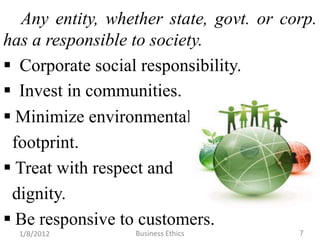
Any entity, whether state, govt. or corp.
has a responsible to society.
 Corporate social responsibility.
 Invest in communities.
 Minimize environmental
 footprint.
 Treat with respect and
 dignity.
 Be responsive to customers.
  1/8/2012        Business Ethics        7
Social
           Consideration


1/8/2012       Business Ethics   8
Quality and
           Productivity


1/8/2012      Quality and Productivity   9
• That best fulfills the particular needs
  of consumers at a price that they are
  willing to pay.
•   Consumer loyalty.
•   Lower level of complaints.
•   Longer product life cycles.
•   Less promotion.
•   Higher price.
•   Better corporate image.
    1/8/2012          Quality and Productivity   10
Quality Control Techniques


Inspection and testing.
 Random sampling.
 Delegating workforce for QC.
 Quality control charts and statistical measures to
 control quality.


 1/8/2012           Quality and Productivity      11
Innovation and Change

• What Is Innovation?
      – Turning the outcomes of the creative process into
        useful products, services, or work methods


            Inputs             Transformation         Output


                Creative           Creative        Innovative
           Individuals,Group   Environment,Pro   Products,work
             s,Organization     cess,Situation      Methods


1/8/2012
Innovation And change (Contd..)
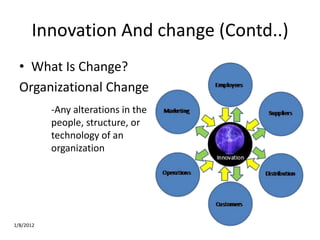
  • What Is Change?
  Organizational Change
           -Any alterations in the
           people, structure, or
           technology of an
           organization


1/8/2012
Technological Development
• Components Of Technological Development
  -Choice of Technology
  -Needs identification
  -Acquisition
  -Management and utilization
  -Upgrade and Maintenance
  -Information and Communication Technology

1/8/2012
Workforce Diversity And Multi –
                  Cultural Effects
• Multiculturalism a broad issue
• Diversity exist in any organization


1/8/2012
Factors of

1/8/2012
• Age distribution
• Gender
• Ethnicity
• Physically challenged
• Single parents
• People with special dietary
  preferences
• Political ideologies
1/8/2012
Managing Diversity

1/8/2012
• Individual Strategies
      – Understanding
      – Empathy
      – Tolerence
      – Willingness to communicate
      – Diversity and multicultural training
• Organizational Approaches
      – Policies
      – Practices

1/8/2012
Empowerment of
       Employees

1/8/2012
•   Demonstrate That You Value People
•   Share Leadership Vision
•   Share Goals and Direction
•   Trust People
•   Provide Information for Decision Making
•   Delegate Authority and Impact Opportunities, Not
    Just More Work
•   Provide Frequent Feedback
•   Solve Problems: Don't Pinpoint Problem People
•   Listen to Learn and Ask Questions for Guidance
•   Help Employees Feel Rewarded for Empowered
    Behavior
1/8/2012
Conclusion
• Challenges cannot be predicted
• No one way of solving a problem
• Uneven patterns
• Achieving economic
  diversification
• Steering Growth
1/8/2012
!!!!!! Thank you !!!!!!


1/8/2012
                Have A Great Day
Any Queries???


1/8/2012

Emerging management issues and challenges

  • 1.
    Emerging Management Issues And Challenges Group – 6 Shaishav Kumar Dahal(106) Aishwarya Dhakal(130) Kritagya Raj Upadhaya(118) Yogendra Bhadur shrestha(112) 1/8/2012 Sushant Gautam(124)
  • 2.
    Emerging Management Challenges • Globalization • Development of Environment • Quality and Productivity • Ethics and Social Responsibility • Innovation and Change • Technological Development • Knowledge Management • Work Force Diversity • Multicultural Effects • Empowerment of Employees 1/8/2012
  • 3.
    Globalization • EXPANDING BUSINESSIN MORE THAN ONE COUNTRIES. • THE PROCESS OF GLOBALIZATION,HOWEVER HAS MARKED SINCE 1980’S • THERE ARE 3 REASON FOR THIS: 1. THE SPREAD OF MARKET BASED ECONOMIC SYSTEM. 2. FALLING BARRIERS TO INTERNATIONAL TRADE AND FOREIGN DIRECT INVESTMENT. 3. TUMBLING COMMUNICATION AND TRANSPOTATION COST. 1/8/2012
  • 4.
    DEVELOPMENT OF ENVIRONMENTALISM • MAJOR ISSUES IN MANAGEMENT. • ISSUES INVOLVE TOXIC WASTE,GLOBAL WARMING,E.T.C • DRAW ATTENTION OF DIFFERENT SOCIAL,BUSINESS N POLITICAL INSTITUTE. • MASNAGER HAVE CHALLENGE TO DEVELOP CREATIVE WAY TO MAKE PROFIT. 1/8/2012
  • 5.
    Ethical Consideration 1/8/2012 Business Ethics 5
  • 6.
     Conception ofright and wrong conduct.  Deals with human relationships.  Judges our behavior as moral or immoral.  Application of general ethical ideas to business behavior. 1/8/2012 Business Ethics 6
  • 7.
    Any entity, whetherstate, govt. or corp. has a responsible to society.  Corporate social responsibility.  Invest in communities.  Minimize environmental footprint.  Treat with respect and dignity.  Be responsive to customers. 1/8/2012 Business Ethics 7
  • 8.
    Social Consideration 1/8/2012 Business Ethics 8
  • 9.
    Quality and Productivity 1/8/2012 Quality and Productivity 9
  • 10.
    • That bestfulfills the particular needs of consumers at a price that they are willing to pay. • Consumer loyalty. • Lower level of complaints. • Longer product life cycles. • Less promotion. • Higher price. • Better corporate image. 1/8/2012 Quality and Productivity 10
  • 11.
    Quality Control Techniques Inspectionand testing.  Random sampling.  Delegating workforce for QC.  Quality control charts and statistical measures to control quality. 1/8/2012 Quality and Productivity 11
  • 12.
    Innovation and Change •What Is Innovation? – Turning the outcomes of the creative process into useful products, services, or work methods Inputs Transformation Output Creative Creative Innovative Individuals,Group Environment,Pro Products,work s,Organization cess,Situation Methods 1/8/2012
  • 13.
    Innovation And change(Contd..) • What Is Change? Organizational Change -Any alterations in the people, structure, or technology of an organization 1/8/2012
  • 14.
    Technological Development • ComponentsOf Technological Development -Choice of Technology -Needs identification -Acquisition -Management and utilization -Upgrade and Maintenance -Information and Communication Technology 1/8/2012
  • 15.
    Workforce Diversity AndMulti – Cultural Effects • Multiculturalism a broad issue • Diversity exist in any organization 1/8/2012
  • 16.
  • 17.
    • Age distribution •Gender • Ethnicity • Physically challenged • Single parents • People with special dietary preferences • Political ideologies 1/8/2012
  • 18.
  • 19.
    • Individual Strategies – Understanding – Empathy – Tolerence – Willingness to communicate – Diversity and multicultural training • Organizational Approaches – Policies – Practices 1/8/2012
  • 20.
    Empowerment of Employees 1/8/2012
  • 21.
    Demonstrate That You Value People • Share Leadership Vision • Share Goals and Direction • Trust People • Provide Information for Decision Making • Delegate Authority and Impact Opportunities, Not Just More Work • Provide Frequent Feedback • Solve Problems: Don't Pinpoint Problem People • Listen to Learn and Ask Questions for Guidance • Help Employees Feel Rewarded for Empowered Behavior 1/8/2012
  • 22.
    Conclusion • Challenges cannotbe predicted • No one way of solving a problem • Uneven patterns • Achieving economic diversification • Steering Growth 1/8/2012
  • 23.
    !!!!!! Thank you!!!!!! 1/8/2012 Have A Great Day
  • 24.