Exploring Emergent Technologies SPLAT
Emergent Technologies = Social Software:   Online services & tools that enable users to connect, collaborate, customize, and share content; all of which are influenced and enhanced by group dynamics.
What’s so different from regular software? “ indie” software & developers Evolving (forever Beta)  Free Shareable Customizable Growing Web 2.0 concept
A  social phenomenon  referring to an approach to creating and distributing Web content itself, characterized by open communication, decentralization of authority, freedom to share and re-use Small software companies offering free, innovative, web-based software http://en.wikipedia.org/wiki/Web_2.0
What’s driving Web 2.0? Open Source Savvy users/developers  Browser functionality  Scripts (AJAX, Ruby) Plug-ins Virtual communities http://en.wikipedia.org/wiki/Web_2.0 Show & tell
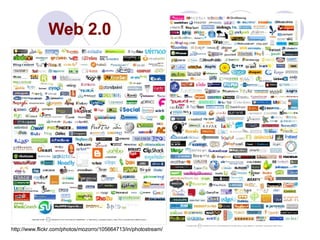
Web 2.0 http://www.flickr.com/photos/mozorro/105664713/in/photostream/
Categories we’ll discuss today: RSS   News Readers / Aggregators Blogs Social Networks Instant Messaging
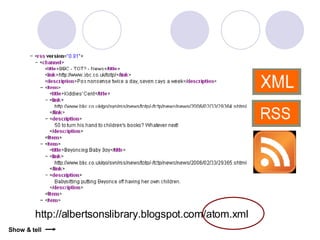
News Readers use: Real Simple Syndication Rich Site Summary XML code summarizes web content, sends feed to aggregator
http://albertsonslibrary.blogspot.com/atom.xml Show & tell
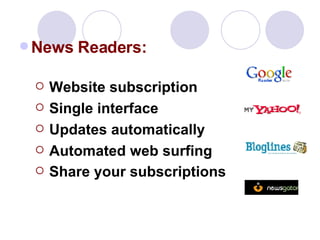
News Readers: Website subscription Single interface Updates automatically  Automated web surfing Share your subscriptions
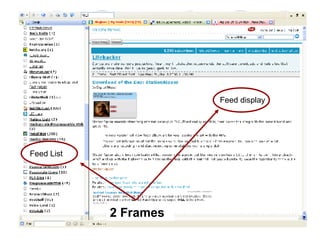
2 Frames Feed display Feed List
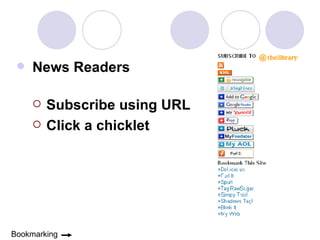
News Readers Subscribe using URL  Click a chicklet Bookmarking
What is a weblog? A “what’s new” page, updated frequently, detailing thoughts, issues, links, and minutiae of an individual. Web + log = weblog or Blog Blogger = one who blogs
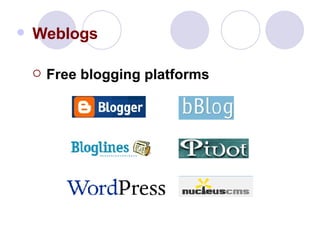
Weblogs Free blogging platforms
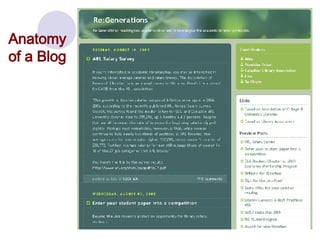
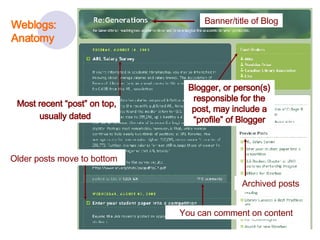
Anatomy  of a Blog
Banner/title of Blog Most recent “post” on top, usually dated   Blogger, or person(s) responsible for the post, may include a “profile” of Blogger Older posts move to bottom   Archived posts You can comment on content   Weblogs: Anatomy
Web 2.0 developments Social software as response to corporate control  Individuals share software solutions  Greater choice in functionality Shareable content Easier dissemination of content Always Beta
Web 2.0 momentum Newer publication formats Hybrids  Still evolving  Corporate vs. maverick software Shifting strategies
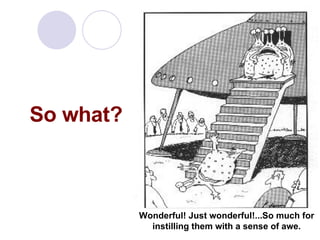
So what? Wonderful! Just wonderful!...So much for instilling them with a sense of awe.
From Web 2.0 meme to Library 2.0   Meme: a  unit of cultural information that represents a basic idea that can be transferred from one individual to another, and subjected to mutation, crossover, and adaptation. www.agsm.edu.au/~bobm/teaching/SimSS/glossary.html
Social Software – LIBRARY 2.0 Web-based, socially-tested, shareable software utilities and conceptual thinking    + Library resources, services, research expertise, and core community service
Social Software – LIBRARY 2.0 Concept is too broad  Library model is just fine Varies by library type Lack of concrete examples Divide of digital/non-digital  natives Control
Social Software – LIBRARY 2.0 Constant change is replacing the older model of upgrade cycles and static services  Comparable tools Anytime/anywhere access & services Personalized services http://en.wikipedia.org/wiki/Library_2.0
LIBRARY 2.0 A model for library service that reflects a transition within the library world in the way that services are delivered to library users Harness the library user’s ideas in both design and implementation of services Harvest and integrate ideas and products from peripheral fields into library service models   http://en.wikipedia.org/wiki/Library_2.0
LIBRARY 2.0 Integrate change Develop tools & services Encourage innovation Enhance models that work Educate  Experiment Beta works

Emergent Technologies

  • 1.
  • 2.
    Emergent Technologies =Social Software: Online services & tools that enable users to connect, collaborate, customize, and share content; all of which are influenced and enhanced by group dynamics.
  • 3.
    What’s so differentfrom regular software? “ indie” software & developers Evolving (forever Beta) Free Shareable Customizable Growing Web 2.0 concept
  • 4.
    A socialphenomenon referring to an approach to creating and distributing Web content itself, characterized by open communication, decentralization of authority, freedom to share and re-use Small software companies offering free, innovative, web-based software http://en.wikipedia.org/wiki/Web_2.0
  • 5.
    What’s driving Web2.0? Open Source Savvy users/developers Browser functionality Scripts (AJAX, Ruby) Plug-ins Virtual communities http://en.wikipedia.org/wiki/Web_2.0 Show & tell
  • 6.
  • 7.
    Categories we’ll discusstoday: RSS News Readers / Aggregators Blogs Social Networks Instant Messaging
  • 8.
    News Readers use:Real Simple Syndication Rich Site Summary XML code summarizes web content, sends feed to aggregator
  • 9.
  • 10.
    News Readers: Websitesubscription Single interface Updates automatically Automated web surfing Share your subscriptions
  • 11.
    2 Frames Feeddisplay Feed List
  • 12.
    News Readers Subscribeusing URL Click a chicklet Bookmarking
  • 13.
    What is aweblog? A “what’s new” page, updated frequently, detailing thoughts, issues, links, and minutiae of an individual. Web + log = weblog or Blog Blogger = one who blogs
  • 14.
  • 15.
    Anatomy ofa Blog
  • 16.
    Banner/title of BlogMost recent “post” on top, usually dated Blogger, or person(s) responsible for the post, may include a “profile” of Blogger Older posts move to bottom Archived posts You can comment on content Weblogs: Anatomy
  • 17.
    Web 2.0 developmentsSocial software as response to corporate control Individuals share software solutions Greater choice in functionality Shareable content Easier dissemination of content Always Beta
  • 18.
    Web 2.0 momentumNewer publication formats Hybrids Still evolving Corporate vs. maverick software Shifting strategies
  • 19.
    So what? Wonderful!Just wonderful!...So much for instilling them with a sense of awe.
  • 20.
    From Web 2.0meme to Library 2.0 Meme: a unit of cultural information that represents a basic idea that can be transferred from one individual to another, and subjected to mutation, crossover, and adaptation. www.agsm.edu.au/~bobm/teaching/SimSS/glossary.html
  • 21.
    Social Software –LIBRARY 2.0 Web-based, socially-tested, shareable software utilities and conceptual thinking + Library resources, services, research expertise, and core community service
  • 22.
    Social Software –LIBRARY 2.0 Concept is too broad Library model is just fine Varies by library type Lack of concrete examples Divide of digital/non-digital natives Control
  • 23.
    Social Software –LIBRARY 2.0 Constant change is replacing the older model of upgrade cycles and static services Comparable tools Anytime/anywhere access & services Personalized services http://en.wikipedia.org/wiki/Library_2.0
  • 24.
    LIBRARY 2.0 Amodel for library service that reflects a transition within the library world in the way that services are delivered to library users Harness the library user’s ideas in both design and implementation of services Harvest and integrate ideas and products from peripheral fields into library service models http://en.wikipedia.org/wiki/Library_2.0
  • 25.
    LIBRARY 2.0 Integratechange Develop tools & services Encourage innovation Enhance models that work Educate Experiment Beta works