The Turtles of Tulap
Biodiversity Loss of Sulawesi
Learning Objectives
• Give a brief outline on turtle ecology
and the type of sea turtles that exist
• Explain the major threats to turtle
populations around the world;
• Assess the causes and extent of beach
pollution in Hong Kong;
• Critically evaluate some solutions to
the problem of plastics in our oceans.
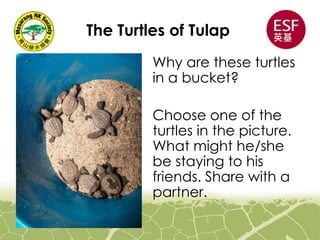
The Turtles of Tulap
Why are these turtles
in a bucket?
Choose one of the
turtles in the picture.
What might he/she
be staying to his
friends. Share with a
partner.
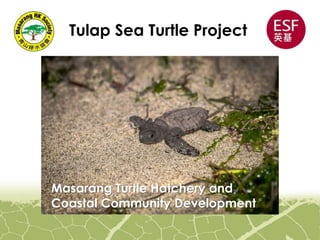
Tulap Sea Turtle Project
Masarang Turtle Hatchery and
Coastal Community Development
Tulap Sea Turtle Project
• A project of Masarang Foundation
under management of Tasikoki Wildlife
Rescue Centre
• Activities started with volunteers in
2010 and with full-time staff since
March 2011
• Collaboration with international sea
turtle conservation experts and local
community
Project Aims
• To maximise the number of sea turtles
successfully nesting at the beach area of
Tulap-Toloun
• To maximise the successful incubation of
the eggs at the correct temperature for
natural gender ratio
• To enable hatchlings to reach the sea
under natural conditions, to promote their
chances to adulthood
• To develop harmony between coastal
villages and the coastal ecology
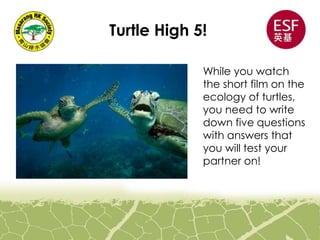
Turtle High 5!
While you watch
the short film on the
ecology of turtles,
you need to write
down five questions
with answers that
you will test your
partner on!
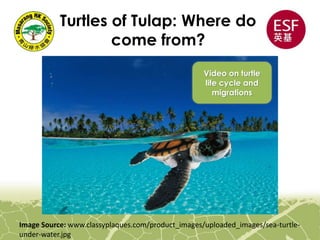
Turtles of Tulap: Where do
come from?
Image Source: www.classyplaques.com/product_images/uploaded_images/sea-turtle-
under-water.jpg
Video on turtle
life cycle and
migrations
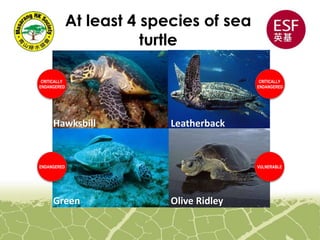
At least 4 species of sea
turtle
Hawksbill
Green
Leatherback
Olive Ridley
CRITICALLY
ENDANGERED
CRITICALLY
ENDANGERED
ENDANGERED VULNERABLE
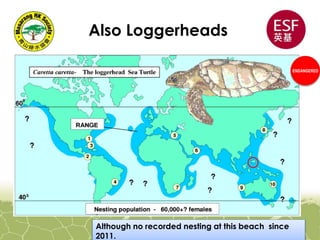
Also Loggerheads
Although no recorded nesting at this beach since
2011.
ENDANGERED
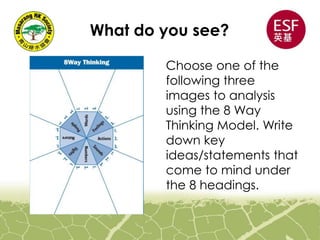
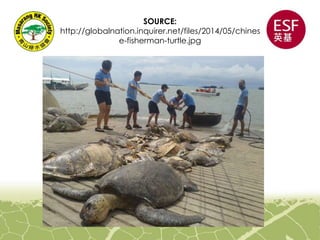
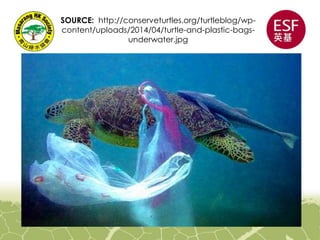
What do you see?
Choose one of the
following three
images to analysis
using the 8 Way
Thinking Model. Write
down key
ideas/statements that
come to mind under
the 8 headings.
SOURCE:
http://globalnation.inquirer.net/files/2014/05/chines
e-fisherman-turtle.jpg
SOURCE: http://conserveturtles.org/turtleblog/wp-
content/uploads/2014/04/turtle-and-plastic-bags-
underwater.jpg
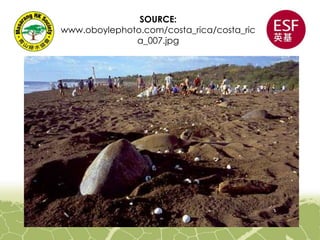
SOURCE:
www.oboylephoto.com/costa_rica/costa_ric
a_007.jpg
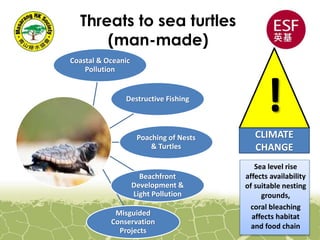
Threats to sea turtles
(man-made)
Coastal & Oceanic
Pollution
Destructive Fishing
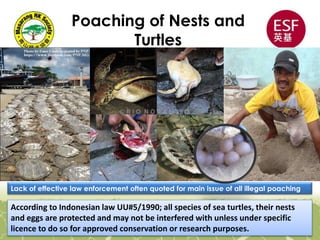
Poaching of Nests
& Turtles
Beachfront
Development &
Light Pollution
Misguided
Conservation
Projects
!
CLIMATE
CHANGE
Sea level rise
affects availability
of suitable nesting
grounds,
coral bleaching
affects habitat
and food chain
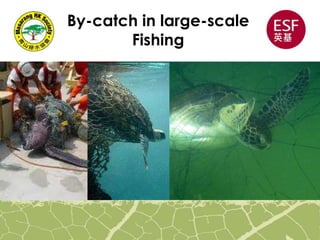
By-catch in large-scale
Fishing
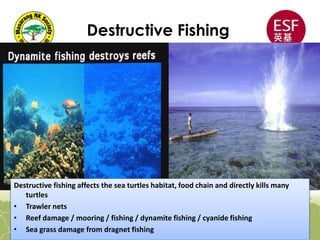
Destructive Fishing
Destructive fishing affects the sea turtles habitat, food chain and directly kills many
turtles
• Trawler nets
• Reef damage / mooring / fishing / dynamite fishing / cyanide fishing
• Sea grass damage from dragnet fishing
Poaching of Nests and
Turtles
Lack of effective law enforcement often quoted for main issue of all illegal poaching
According to Indonesian law UU#5/1990; all species of sea turtles, their nests
and eggs are protected and may not be interfered with unless under specific
licence to do so for approved conservation or research purposes.
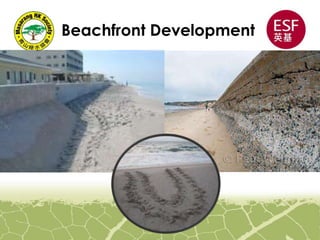
Beachfront Development
• Example batu putih wall
• Example house near pantai kawis
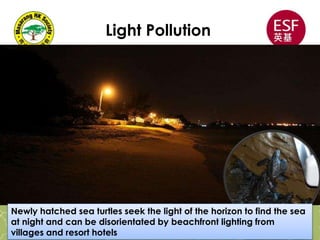
Light Pollution
Newly hatched sea turtles seek the light of the horizon to find the sea
at night and can be disorientated by beachfront lighting from
villages and resort hotels
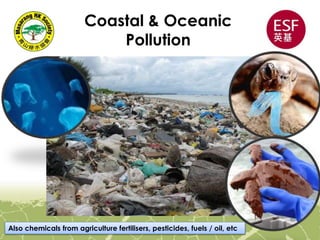
Coastal & Oceanic
Pollution
Also chemicals from agriculture fertilisers, pesticides, fuels / oil, etc
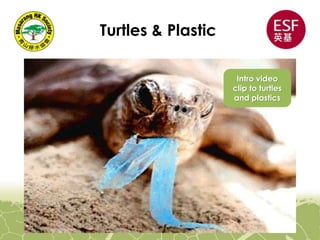
Turtles & Plastic
Intro video
clip to turtles
and plastics
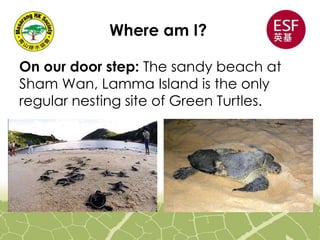
Where am I?
On our door step: The sandy beach at
Sham Wan, Lamma Island is the only
regular nesting site of Green Turtles.
Plastic Free Seas
Field Work Planning
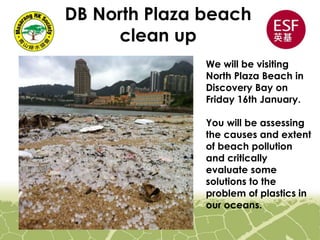
DB North Plaza beach
clean up
We will be visiting
North Plaza Beach in
Discovery Bay on
Friday 16th January.
You will be assessing
the causes and extent
of beach pollution
and critically
evaluate some
solutions to the
problem of plastics in
our oceans.
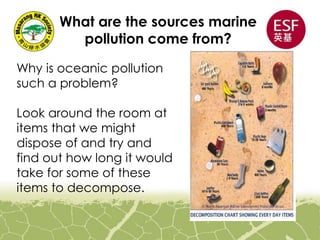
What are the sources marine
pollution come from?
Why is oceanic pollution
such a problem?
Look around the room at
items that we might
dispose of and try and
find out how long it would
take for some of these
items to decompose.
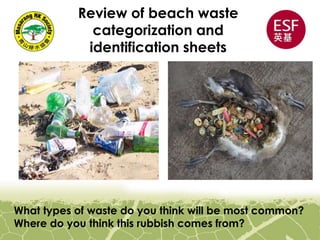
Review of beach waste
categorization and
identification sheets
What types of waste do you think will be most common?
Where do you think this rubbish comes from?
Roles
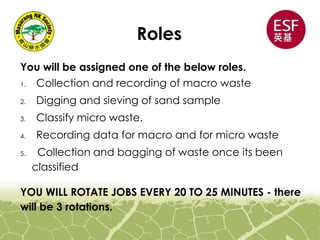
You will be assigned one of the below roles.
1. Collection and recording of macro waste
2. Digging and sieving of sand sample
3. Classify micro waste.
4. Recording data for macro and for micro waste
5. Collection and bagging of waste once its been
classified
YOU WILL ROTATE JOBS EVERY 20 TO 25 MINUTES - there
will be 3 rotations.
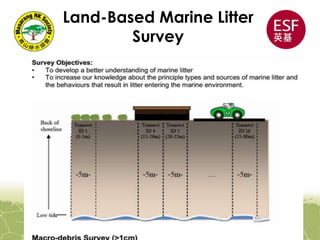
Land-Based Marine Litter
Survey
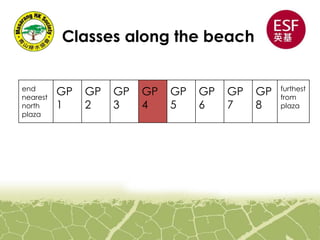
Classes along the beach
end
nearest
north
plaza
GP
1
GP
2
GP
3
GP
4
GP
5
GP
6
GP
7
GP
8
furthest
from
plaza
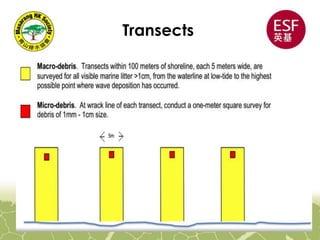
Transects
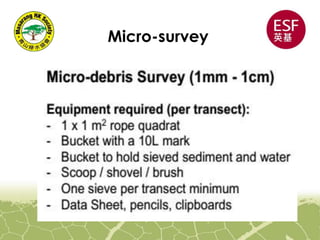
Micro-survey
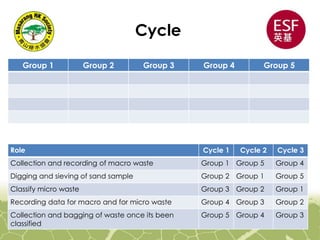
Cycle
Group 1 Group 2 Group 3 Group 4 Group 5
Role Cycle 1 Cycle 2 Cycle 3
Collection and recording of macro waste Group 1 Group 5 Group 4
Digging and sieving of sand sample Group 2 Group 1 Group 5
Classify micro waste Group 3 Group 2 Group 1
Recording data for macro and for micro waste Group 4 Group 3 Group 2
Collection and bagging of waste once its been
classified
Group 5 Group 4 Group 3
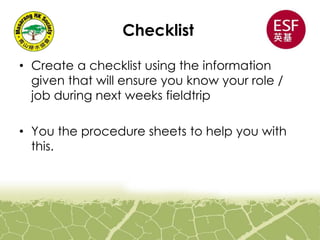
Checklist
• Create a checklist using the information
given that will ensure you know your role /
job during next weeks fieldtrip
• You the procedure sheets to help you with
this.
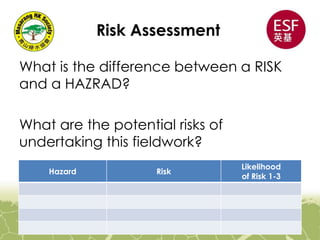
Risk Assessment
What is the difference between a RISK
and a HAZRAD?
What are the potential risks of
undertaking this fieldwork?
Hazard Risk
Likelihood
of Risk 1-3
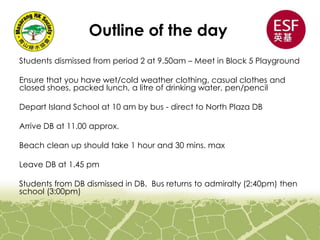
Outline of the day
Students dismissed from period 2 at 9.50am – Meet in Block 5 Playground
Ensure that you have wet/cold weather clothing, casual clothes and
closed shoes, packed lunch, a litre of drinking water, pen/pencil
Depart Island School at 10 am by bus - direct to North Plaza DB
Arrive DB at 11.00 approx.
Beach clean up should take 1 hour and 30 mins. max
Leave DB at 1.45 pm
Students from DB dismissed in DB. Bus returns to admiralty (2:40pm) then
school (3:00pm)
Common Assessment Task –
Part 1
You will produce a data presentation showing the
types of waste on our beaches. You should also
describe the causes and effects of this waste
Level 7
You produce a range of innovative graphs which
show the types and sources of waste. A well
developed detailed description is given for both
causes and effects of these types of waste.
Common Assessment Task –
Part 2
• You will be producing a letter to the local newspaper
(the editor SCMP) in which you have to evaluate 2
solutions to the environmental problem you identify in
part 1.
• You will considering both sides of an argument for and
against for both solutions. You should include reference
to real life examples of where these solutions have been
tried. You need to include reference to different
stakeholders and personal opinions.
• You will need to make a final decision on which solution
you would choose and justify your choice, particularly
referring to why the final decision is most suited to Hong
Kong.
Collaborative Research
What are the some of causes, effects and
solutions to the problems of plastic in our
oceans.
Use of Pinterest to collect information
Beach Clean up
Data presentation and analysis
Common Assessment Task –
Part 1
You will produce a data presentation showing the
types of waste on our beaches. You should also
describe the causes and effects of this waste
Level 7
You produce a range of innovative graphs which
show the types and sources of waste. A well
developed detailed description is given for both
causes and effects of these types of waste.
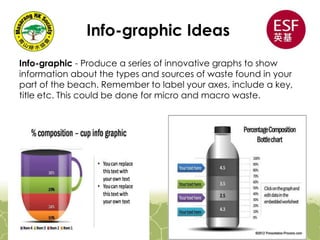
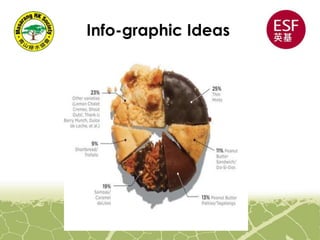
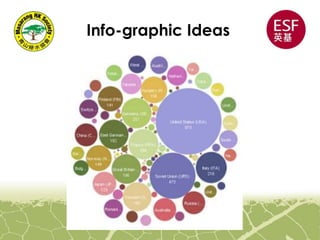
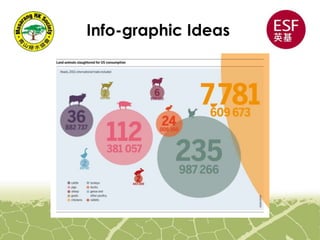
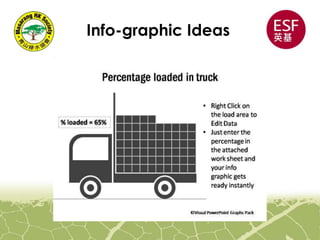
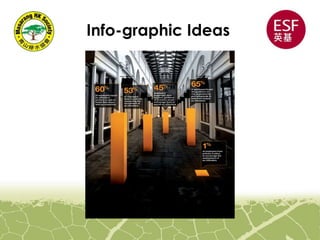
Info-graphic - Produce a series of innovative graphs to show
information about the types and sources of waste found in your
part of the beach. Remember to label your axes, include a key,
title etc. This could be done for micro and macro waste.
Info-graphic Ideas
Info-graphic Ideas
Info-graphic Ideas
Info-graphic Ideas
Info-graphic Ideas
Info-graphic Ideas
Info-graphic Ideas
Written analysis - Describe and
explain your results/graph.
• Describe the main types/categories of waste
found on the beach shown in your graph/s, use
numbers in your descriptions about the
amounts of different waste categories.
• Could also use annotated PHOTOS describing
and explaining cause and consequences of
the problem.
• What are the origins of the waste - Hong Kong?
China? elsewhere? how did it get into the sea?
Written analysis - Describe and
explain your results/graph.
• What are the causes of these types of waste?
(paragraph that describes the sources and
reasons for a couple of waste types being
found on the beach)
• Explain the types of problems that this waste
creates?(at least 2 problems - how does it
affect plants and animals, ecosystems, humans
etc)
How can the problem of
plastics in our seas be
tackled?
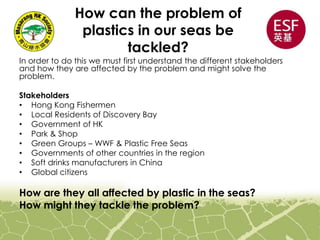
In order to do this we must first understand the different stakeholders
and how they are affected by the problem and might solve the
problem.
Stakeholders
• Hong Kong Fishermen
• Local Residents of Discovery Bay
• Government of HK
• Park & Shop
• Green Groups – WWF & Plastic Free Seas
• Governments of other countries in the region
• Soft drinks manufacturers in China
• Global citizens
How are they all affected by plastic in the seas?
How might they tackle the problem?
Reduce, Reuse, Recycle
Letter to the Hong Kong Government-
evaluating 2 potential solutions to the
waste problem
• Planning for the letter - critically
evaluating 2 solutions to the problem
of waste on beaches and in our seas.
• You will then write up a neat version of
your letter next week to send to the
Hong Kong Environment Secretary to
suggest the best way of solving the
problem of plastic in our seas.
Letter Writing
• Planning for the letter - critically evaluating
2 solutions to the problem of waste on
beaches and in our seas.
• You will then write up a neat version of your
letter next week to send to the Hong Kong
Environment Secretary to suggest the best
way of solving the problem of plastic in our
seas.
See Critial Evaluation Worksheet
Letter to the Hong Kong Government-
evaluating 2 potential solutions to the
waste problem
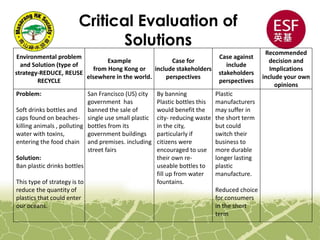
Critical Evaluation of
Solutions
Environmental problem
and Solution (type of
strategy-REDUCE, REUSE
RECYCLE
Example
from Hong Kong or
elsewhere in the world.
Case for
include stakeholders
perspectives
Case against
include
stakeholders
perspectives
Recommended
decision and
Implications
include your own
opinions
Problem:
Soft drinks bottles and
caps found on beaches-
killing animals , polluting
water with toxins,
entering the food chain
Solution:
Ban plastic drinks bottles
This type of strategy is to
reduce the quantity of
plastics that could enter
our oceans.
San Francisco (US) city
government has
banned the sale of
single use small plastic
bottles from its
government buildings
and premises. including
street fairs
By banning
Plastic bottles this
would benefit the
city- reducing waste
in the city,
particularly if
citizens were
encouraged to use
their own re-
useable bottles to
fill up from water
fountains.
Plastic
manufacturers
may suffer in
the short term
but could
switch their
business to
more durable
longer lasting
plastic
manufacture.
Reduced choice
for consumers
in the short
term
Plastic Free Seas -
Solutions
Homework last week - Planning for the letter –
Solution Evaluation
Model student ideas on the board
1. What solutions have you discussed?
With your partner feedback to each other
focusing on critical evaluation of their 2
solutions/ideas to the problem of plastic in the
seas.
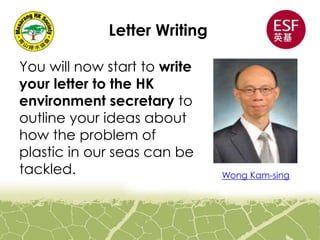
Letter Writing
You will now start to write
your letter to the HK
environment secretary to
outline your ideas about
how the problem of
plastic in our seas can be
tackled. Wong Kam-sing
Letter Writing - Structure
What are the components of a formal letter?
1) Your Address
The return address should be written in the top
right-hand corner of the letter.
2) The Address of the person you are writing to
The inside address should be written on the left, starting below your address.
3) Date:
You can write this on the right or the left on the line after the address you are writing
to. Write the month as a word.
4) Salutation or greeting:
Dear Mr. Wong,
If you know the name, use the title (Mr, Mrs, Miss or Ms, Dr, etc.) and the surname only.
5) Ending a letter:
a) Yours Faithfully
If you do not know the name of the person, end the letter this way.
b) Yours Sincerely
If you know the name of the person, end the letter this way.
c) Your signature
Sign your name, then print it underneath the signature. If you think the person you are
writing to might not know whether you are male of female, put you title in brackets
after your name.
So what do I write in the middle?
Exemplar paragraph for sleeping policeman idea.
I have two ideas for dealing with the problem of speeding traffic. Speeding traffic can be slowed by the use of
sleeping policeman. These are bump type structures, often made of concrete and tarmac, which are built on
roads which are designed to force drivers to slow down. These structures have been used successfully in Hong
Kong and in numerous cities around the world, studies in the UK have shown that speed bumps result in 18 %
reduction in traffic volumes and an average 13% reduction in traffic collisions. Sleeping Policemen slow traffic
down making it less likely that accidents will occur.
One of the advantages of sleeping policeman is that they are relatively low cost as they only require an asphalt or
tarmac structure. They do not require constant supervision from policeman or expensive traffic speed cameras. This
would work in areas of Hong Kong which have relatively slow moving traffic. Local Residents would be pleased
that traffic is slower and the likelihood of accidents is less.
One of the disadvantages of sleeping policeman is that vehicles will travel slower this may create slower flowing
traffic and this could cause congestion, which may actually increase air pollution. They are likely to result in
increased gases like Carbon Monoxide and Nitrous oxides which are harmful to human health in local areas. They
can result in increasing levels of respiratory disease such as asthma. They can also slow down emergency vehicles
which may result in longer response times for ambulances and this may cost lives. Local businesses may also be
disappointed because delivery vans may be slowed down.
Sleeping policemen cannot be used in areas where the traffic is meant to flow at high speeds such as on
motorways as it would be dangerous and damaging to vehicles.
Another strategy to reduce speeding traffic is to …..
Letter Writing Template
Use the letter writing template and your
critical evaluation sheet to write your
first argument for your letter.
You have 20 minutes to write this.
Peer review your first argument with
your partner

Emergency on Plant Earth - Turtles

  • 1.
    The Turtles ofTulap Biodiversity Loss of Sulawesi
  • 2.
    Learning Objectives • Givea brief outline on turtle ecology and the type of sea turtles that exist • Explain the major threats to turtle populations around the world; • Assess the causes and extent of beach pollution in Hong Kong; • Critically evaluate some solutions to the problem of plastics in our oceans.
  • 3.
    The Turtles ofTulap Why are these turtles in a bucket? Choose one of the turtles in the picture. What might he/she be staying to his friends. Share with a partner.
  • 4.
    Tulap Sea TurtleProject Masarang Turtle Hatchery and Coastal Community Development
  • 5.
    Tulap Sea TurtleProject • A project of Masarang Foundation under management of Tasikoki Wildlife Rescue Centre • Activities started with volunteers in 2010 and with full-time staff since March 2011 • Collaboration with international sea turtle conservation experts and local community
  • 6.
    Project Aims • Tomaximise the number of sea turtles successfully nesting at the beach area of Tulap-Toloun • To maximise the successful incubation of the eggs at the correct temperature for natural gender ratio • To enable hatchlings to reach the sea under natural conditions, to promote their chances to adulthood • To develop harmony between coastal villages and the coastal ecology
  • 7.
    Turtle High 5! Whileyou watch the short film on the ecology of turtles, you need to write down five questions with answers that you will test your partner on!
  • 8.
    Turtles of Tulap:Where do come from? Image Source: www.classyplaques.com/product_images/uploaded_images/sea-turtle- under-water.jpg Video on turtle life cycle and migrations
  • 9.
    At least 4species of sea turtle Hawksbill Green Leatherback Olive Ridley CRITICALLY ENDANGERED CRITICALLY ENDANGERED ENDANGERED VULNERABLE
  • 10.
    Also Loggerheads Although norecorded nesting at this beach since 2011. ENDANGERED
  • 11.
    What do yousee? Choose one of the following three images to analysis using the 8 Way Thinking Model. Write down key ideas/statements that come to mind under the 8 headings.
  • 12.
  • 13.
  • 14.
  • 15.
    Threats to seaturtles (man-made) Coastal & Oceanic Pollution Destructive Fishing Poaching of Nests & Turtles Beachfront Development & Light Pollution Misguided Conservation Projects ! CLIMATE CHANGE Sea level rise affects availability of suitable nesting grounds, coral bleaching affects habitat and food chain
  • 16.
  • 17.
    Destructive Fishing Destructive fishingaffects the sea turtles habitat, food chain and directly kills many turtles • Trawler nets • Reef damage / mooring / fishing / dynamite fishing / cyanide fishing • Sea grass damage from dragnet fishing
  • 18.
    Poaching of Nestsand Turtles Lack of effective law enforcement often quoted for main issue of all illegal poaching According to Indonesian law UU#5/1990; all species of sea turtles, their nests and eggs are protected and may not be interfered with unless under specific licence to do so for approved conservation or research purposes.
  • 19.
    Beachfront Development • Examplebatu putih wall • Example house near pantai kawis
  • 20.
    Light Pollution Newly hatchedsea turtles seek the light of the horizon to find the sea at night and can be disorientated by beachfront lighting from villages and resort hotels
  • 21.
    Coastal & Oceanic Pollution Alsochemicals from agriculture fertilisers, pesticides, fuels / oil, etc
  • 22.
    Turtles & Plastic Introvideo clip to turtles and plastics
  • 23.
    Where am I? Onour door step: The sandy beach at Sham Wan, Lamma Island is the only regular nesting site of Green Turtles.
  • 24.
  • 25.
    DB North Plazabeach clean up We will be visiting North Plaza Beach in Discovery Bay on Friday 16th January. You will be assessing the causes and extent of beach pollution and critically evaluate some solutions to the problem of plastics in our oceans.
  • 26.
    What are thesources marine pollution come from? Why is oceanic pollution such a problem? Look around the room at items that we might dispose of and try and find out how long it would take for some of these items to decompose.
  • 27.
    Review of beachwaste categorization and identification sheets What types of waste do you think will be most common? Where do you think this rubbish comes from?
  • 28.
    Roles You will beassigned one of the below roles. 1. Collection and recording of macro waste 2. Digging and sieving of sand sample 3. Classify micro waste. 4. Recording data for macro and for micro waste 5. Collection and bagging of waste once its been classified YOU WILL ROTATE JOBS EVERY 20 TO 25 MINUTES - there will be 3 rotations.
  • 29.
  • 30.
    Classes along thebeach end nearest north plaza GP 1 GP 2 GP 3 GP 4 GP 5 GP 6 GP 7 GP 8 furthest from plaza
  • 31.
  • 32.
  • 33.
    Cycle Group 1 Group2 Group 3 Group 4 Group 5 Role Cycle 1 Cycle 2 Cycle 3 Collection and recording of macro waste Group 1 Group 5 Group 4 Digging and sieving of sand sample Group 2 Group 1 Group 5 Classify micro waste Group 3 Group 2 Group 1 Recording data for macro and for micro waste Group 4 Group 3 Group 2 Collection and bagging of waste once its been classified Group 5 Group 4 Group 3
  • 34.
    Checklist • Create achecklist using the information given that will ensure you know your role / job during next weeks fieldtrip • You the procedure sheets to help you with this.
  • 35.
    Risk Assessment What isthe difference between a RISK and a HAZRAD? What are the potential risks of undertaking this fieldwork? Hazard Risk Likelihood of Risk 1-3
  • 36.
    Outline of theday Students dismissed from period 2 at 9.50am – Meet in Block 5 Playground Ensure that you have wet/cold weather clothing, casual clothes and closed shoes, packed lunch, a litre of drinking water, pen/pencil Depart Island School at 10 am by bus - direct to North Plaza DB Arrive DB at 11.00 approx. Beach clean up should take 1 hour and 30 mins. max Leave DB at 1.45 pm Students from DB dismissed in DB. Bus returns to admiralty (2:40pm) then school (3:00pm)
  • 37.
    Common Assessment Task– Part 1 You will produce a data presentation showing the types of waste on our beaches. You should also describe the causes and effects of this waste Level 7 You produce a range of innovative graphs which show the types and sources of waste. A well developed detailed description is given for both causes and effects of these types of waste.
  • 38.
    Common Assessment Task– Part 2 • You will be producing a letter to the local newspaper (the editor SCMP) in which you have to evaluate 2 solutions to the environmental problem you identify in part 1. • You will considering both sides of an argument for and against for both solutions. You should include reference to real life examples of where these solutions have been tried. You need to include reference to different stakeholders and personal opinions. • You will need to make a final decision on which solution you would choose and justify your choice, particularly referring to why the final decision is most suited to Hong Kong.
  • 39.
    Collaborative Research What arethe some of causes, effects and solutions to the problems of plastic in our oceans. Use of Pinterest to collect information
  • 40.
    Beach Clean up Datapresentation and analysis
  • 41.
    Common Assessment Task– Part 1 You will produce a data presentation showing the types of waste on our beaches. You should also describe the causes and effects of this waste Level 7 You produce a range of innovative graphs which show the types and sources of waste. A well developed detailed description is given for both causes and effects of these types of waste.
  • 42.
    Info-graphic - Producea series of innovative graphs to show information about the types and sources of waste found in your part of the beach. Remember to label your axes, include a key, title etc. This could be done for micro and macro waste. Info-graphic Ideas
  • 43.
  • 44.
  • 45.
  • 46.
  • 47.
  • 48.
  • 49.
    Written analysis -Describe and explain your results/graph. • Describe the main types/categories of waste found on the beach shown in your graph/s, use numbers in your descriptions about the amounts of different waste categories. • Could also use annotated PHOTOS describing and explaining cause and consequences of the problem. • What are the origins of the waste - Hong Kong? China? elsewhere? how did it get into the sea?
  • 50.
    Written analysis -Describe and explain your results/graph. • What are the causes of these types of waste? (paragraph that describes the sources and reasons for a couple of waste types being found on the beach) • Explain the types of problems that this waste creates?(at least 2 problems - how does it affect plants and animals, ecosystems, humans etc)
  • 51.
    How can theproblem of plastics in our seas be tackled? In order to do this we must first understand the different stakeholders and how they are affected by the problem and might solve the problem. Stakeholders • Hong Kong Fishermen • Local Residents of Discovery Bay • Government of HK • Park & Shop • Green Groups – WWF & Plastic Free Seas • Governments of other countries in the region • Soft drinks manufacturers in China • Global citizens How are they all affected by plastic in the seas? How might they tackle the problem?
  • 52.
  • 53.
    Letter to theHong Kong Government- evaluating 2 potential solutions to the waste problem • Planning for the letter - critically evaluating 2 solutions to the problem of waste on beaches and in our seas. • You will then write up a neat version of your letter next week to send to the Hong Kong Environment Secretary to suggest the best way of solving the problem of plastic in our seas.
  • 54.
  • 55.
    • Planning forthe letter - critically evaluating 2 solutions to the problem of waste on beaches and in our seas. • You will then write up a neat version of your letter next week to send to the Hong Kong Environment Secretary to suggest the best way of solving the problem of plastic in our seas. See Critial Evaluation Worksheet Letter to the Hong Kong Government- evaluating 2 potential solutions to the waste problem
  • 56.
    Critical Evaluation of Solutions Environmentalproblem and Solution (type of strategy-REDUCE, REUSE RECYCLE Example from Hong Kong or elsewhere in the world. Case for include stakeholders perspectives Case against include stakeholders perspectives Recommended decision and Implications include your own opinions Problem: Soft drinks bottles and caps found on beaches- killing animals , polluting water with toxins, entering the food chain Solution: Ban plastic drinks bottles This type of strategy is to reduce the quantity of plastics that could enter our oceans. San Francisco (US) city government has banned the sale of single use small plastic bottles from its government buildings and premises. including street fairs By banning Plastic bottles this would benefit the city- reducing waste in the city, particularly if citizens were encouraged to use their own re- useable bottles to fill up from water fountains. Plastic manufacturers may suffer in the short term but could switch their business to more durable longer lasting plastic manufacture. Reduced choice for consumers in the short term
  • 57.
    Plastic Free Seas- Solutions Homework last week - Planning for the letter – Solution Evaluation Model student ideas on the board 1. What solutions have you discussed? With your partner feedback to each other focusing on critical evaluation of their 2 solutions/ideas to the problem of plastic in the seas.
  • 58.
    Letter Writing You willnow start to write your letter to the HK environment secretary to outline your ideas about how the problem of plastic in our seas can be tackled. Wong Kam-sing
  • 59.
    Letter Writing -Structure What are the components of a formal letter? 1) Your Address The return address should be written in the top right-hand corner of the letter. 2) The Address of the person you are writing to The inside address should be written on the left, starting below your address. 3) Date: You can write this on the right or the left on the line after the address you are writing to. Write the month as a word. 4) Salutation or greeting: Dear Mr. Wong, If you know the name, use the title (Mr, Mrs, Miss or Ms, Dr, etc.) and the surname only. 5) Ending a letter: a) Yours Faithfully If you do not know the name of the person, end the letter this way. b) Yours Sincerely If you know the name of the person, end the letter this way. c) Your signature Sign your name, then print it underneath the signature. If you think the person you are writing to might not know whether you are male of female, put you title in brackets after your name.
  • 60.
    So what doI write in the middle? Exemplar paragraph for sleeping policeman idea. I have two ideas for dealing with the problem of speeding traffic. Speeding traffic can be slowed by the use of sleeping policeman. These are bump type structures, often made of concrete and tarmac, which are built on roads which are designed to force drivers to slow down. These structures have been used successfully in Hong Kong and in numerous cities around the world, studies in the UK have shown that speed bumps result in 18 % reduction in traffic volumes and an average 13% reduction in traffic collisions. Sleeping Policemen slow traffic down making it less likely that accidents will occur. One of the advantages of sleeping policeman is that they are relatively low cost as they only require an asphalt or tarmac structure. They do not require constant supervision from policeman or expensive traffic speed cameras. This would work in areas of Hong Kong which have relatively slow moving traffic. Local Residents would be pleased that traffic is slower and the likelihood of accidents is less. One of the disadvantages of sleeping policeman is that vehicles will travel slower this may create slower flowing traffic and this could cause congestion, which may actually increase air pollution. They are likely to result in increased gases like Carbon Monoxide and Nitrous oxides which are harmful to human health in local areas. They can result in increasing levels of respiratory disease such as asthma. They can also slow down emergency vehicles which may result in longer response times for ambulances and this may cost lives. Local businesses may also be disappointed because delivery vans may be slowed down. Sleeping policemen cannot be used in areas where the traffic is meant to flow at high speeds such as on motorways as it would be dangerous and damaging to vehicles. Another strategy to reduce speeding traffic is to …..
  • 61.
    Letter Writing Template Usethe letter writing template and your critical evaluation sheet to write your first argument for your letter. You have 20 minutes to write this. Peer review your first argument with your partner

Editor's Notes

  • #10 Ubur-ubur jellyfish
  • #17 Tangkapan samping (bycatch) Diperkirakan setiap tahunnya di Indonesia tangkapan samping penyu akibat penangkapan ikan tuna sekitar 6.400 – 19.200 ekor/tahun