Submitted to: AMIT
TRIPATHI SIR
Submitted by:
VARUNESH SUNDARAM
CHAKRAVARTI SHREYAS
RAJKIYA ENGINEERING COLLEGE
AMBEDKAR NAGAR
CONTENTS
 GARBAGE PATCHES
 GREAT PACIFIC GARBAGE PATCHES
 PLASTIC ACCUMULATION
 ESTIMATION OF SIZE
 QUANTITY OF FLOATING PLASTIC IN GPGP
 TYPES OF PLASTICS IN GPGP
 IMPACT ON MARINE AND HUMAN LIFE
 HOW TO GET RID OF GARBAGE PATCHES
 CASE STUDY
 CONCLUSION
 REFERENCES
1
WHAT ARE GARBAGE PATCHES ?
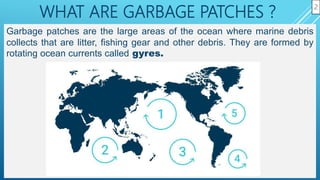
Garbage patches are the large areas of the ocean where marine debris
collects that are litter, fishing gear and other debris. They are formed by
rotating ocean currents called gyres.
2
GREAT PACIFIC GARBAGE PATCH
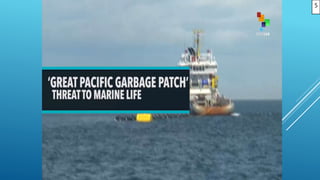
The Greatest Pacific Garbage Patch (GPGP) is the
largest accumulation of ocean plastic in the world and is
located between Hawaii and California.
It is the most famous Garbage Patch in all five offshore patches
and contains debris ranges in size, from large abandoned
fishing nets to tiny microplastics, which are plastic pieces
smaller than 5mm in size.
3
4
5
PLASTIC ACCUMULATION
It is estimated that 1.15 to 2.41 million tons of plastics are
entering the ocean each year from rivers.
Once these plastics enter the gyre ,they degrade into smaller
microplastics under the effect of sun, waves and marine life. As
more and more plastics are discarded into the environment,
microplastics concentration in great pacific garbage patch will
only continue to increase.
6
ESTIMATION OF SIZE
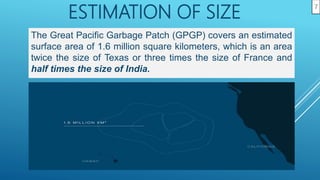
The Great Pacific Garbage Patch (GPGP) covers an estimated
surface area of 1.6 million square kilometers, which is an area
twice the size of Texas or three times the size of France and
half times the size of India.
7
HOW MUCH PLASTIC FLOATS IN THE GREAT PACIFIC
GARBAGE PATCH ?
The mass of the plastic in the GPGP was estimated to be approximate
80,000 tonnes, which is 4-16 times more than previous calculations.
The weight is equivalent to that of 500 Jumbo Jets.(333400 kg)
A total of 1.8 trillion plastic pieces were estimated to be floating in the
patch- a plastic count that is equivalent to 250 pieces of debris for every
human in the world.
Further research & calculations estimated that it may range from 1.1
trillion to 3.6 trillion pieces.
8
WHAT TYPES OF PLASTIC FLOAT
IN THE GPGP :
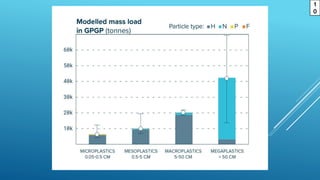
Size Classes: Plastic within the patch are
categorized into 4 size classes-
1- Microplastics ( 0.05 – 0.5cm )
2- Mesoplastics ( 0.5 – 5cm )
3- Macroplastics ( 5 – 50cm )
4- Megaplastics ( anything above 50cm )
9
1
0
CATEGORIZATION TYPES :
Once the plastics were collected , researchers
classified into:
- Type H: Hard plastic, plastic sheet or film
- Type N: Plastic lines, ropes, and fishing nets
- Type P: Pre- production plastics( cylinders,
spheres or disks )
- Type F: Fragments made of foamed materials
1
1
WHY LARGE DEBRIS MATTER
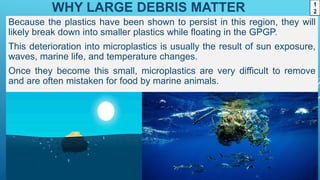
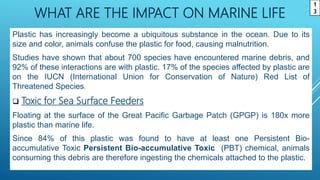
Because the plastics have been shown to persist in this region, they will
likely break down into smaller plastics while floating in the GPGP.
This deterioration into microplastics is usually the result of sun exposure,
waves, marine life, and temperature changes.
Once they become this small, microplastics are very difficult to remove
and are often mistaken for food by marine animals.
1
2
WHAT ARE THE IMPACT ON MARINE LIFE
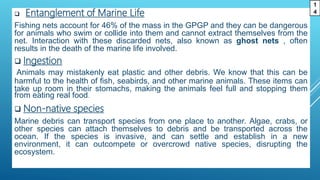
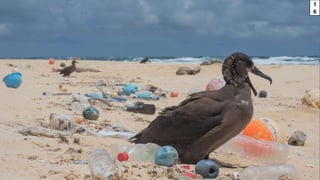
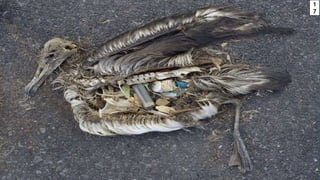
Plastic has increasingly become a ubiquitous substance in the ocean. Due to its
size and color, animals confuse the plastic for food, causing malnutrition.
Studies have shown that about 700 species have encountered marine debris, and
92% of these interactions are with plastic. 17% of the species affected by plastic are
on the IUCN (International Union for Conservation of Nature) Red List of
Threatened Species.
 Toxic for Sea Surface Feeders
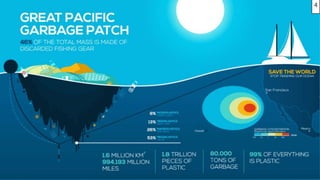
Floating at the surface of the Great Pacific Garbage Patch (GPGP) is 180x more
plastic than marine life.
Since 84% of this plastic was found to have at least one Persistent Bio-
accumulative Toxic Persistent Bio-accumulative Toxic (PBT) chemical, animals
consuming this debris are therefore ingesting the chemicals attached to the plastic.
1
3
 Entanglement of Marine Life
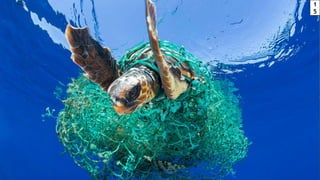
Fishing nets account for 46% of the mass in the GPGP and they can be dangerous
for animals who swim or collide into them and cannot extract themselves from the
net. Interaction with these discarded nets, also known as ghost nets , often
results in the death of the marine life involved.
 Ingestion
Animals may mistakenly eat plastic and other debris. We know that this can be
harmful to the health of fish, seabirds, and other marine animals. These items can
take up room in their stomachs, making the animals feel full and stopping them
from eating real food.
 Non-native species
Marine debris can transport species from one place to another. Algae, crabs, or
other species can attach themselves to debris and be transported across the
ocean. If the species is invasive, and can settle and establish in a new
environment, it can outcompete or overcrowd native species, disrupting the
ecosystem.
1
4
1
5
1
6
1
7
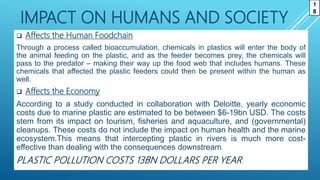
IMPACT ON HUMANS AND SOCIETY
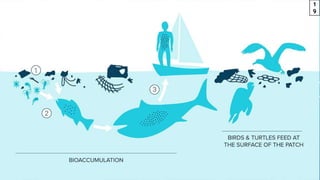
 Affects the Human Foodchain
Through a process called bioaccumulation, chemicals in plastics will enter the body of
the animal feeding on the plastic, and as the feeder becomes prey, the chemicals will
pass to the predator – making their way up the food web that includes humans. These
chemicals that affected the plastic feeders could then be present within the human as
well.
 Affects the Economy
According to a study conducted in collaboration with Deloitte, yearly economic
costs due to marine plastic are estimated to be between $6-19bn USD. The costs
stem from its impact on tourism, fisheries and aquaculture, and (governmental)
cleanups. These costs do not include the impact on human health and the marine
ecosystem.This means that intercepting plastic in rivers is much more cost-
effective than dealing with the consequences downstream.
PLASTIC POLLUTION COSTS 13BN DOLLARS PER YEAR.
1
8
1
9
CASE STUDY : THE OCEAN CLEANUP
The Ocean Cleanup is a non-government engineering environmental organization based in the
Netherlands, that develops technology to extract plastic pollution from the oceans.
The organization conducts scientific research into oceanic plastic pollution. It was founded in 2013
by Boyan Slat, a Dutch-born inventor-entrepreneur of Croatian origin who serves as its CEO.
The project aims to launch a total of 60 such systems in the patch by 2021. They predict this
capability could clean up 50% of the debris in the Great Pacific Garbage Patch in five years.
In late October 2019, TOC announced a new initiative, The Interceptor, to attack the trash problem
closer to the source, with plans to prevent the 80% of ocean trash coming from 1000 rivers
worldwide.
2
0
HOW TO GET RID OF GARBAGE PATCHES ?
It may not be possible to entirely get rid of garbage patches to solve this problem , it requires a combination of
closing the source and cleaning up what has already accumulated in the ocean.
 CLEANING THE GARBAGE PATCHES FROM OCEAN
The ocean is big. Cleaning up the Great Pacific Garbage Patch using conventional methods – vessels and nets –
would take thousands of years and tens of billions of dollars to complete. Our passive systems are estimated to
remove 50% of the Great Pacific Garbage patch in just five years, and at a fraction of the cost. This is how it
works:
 CAPTURE THE PLASTIC
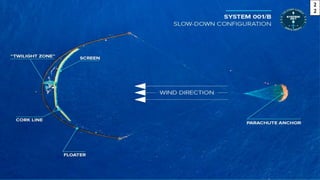
The combination of natural forces and a sea anchor create a drag, which makes the system move consistently
slower than the plastic, while allowing the plastic to be captured.
 ACCUMULATION
The system autonomously navigates the garbage patch for extended time periods, catching and retaining plastic
in the center of the system.
 EXTRACTION
Once the systems are full, a vessel acting as a garbage truck of the seas will periodically remove the collected
plastic.
2
1
2
2
2
3
 INTERCEPTING THE PLASTICS FROM RIVER
Rivers are the main source of ocean plastic pollution. They are the arteries that carry waste from land to
the ocean.
To rid the oceans of plastic, we need to not only clean up what is already out there, but also stop new
plastic from entering the ocean: we need to close the tap.
 80% OF RIVER PLASTIC COMES FROM 1000 RIVERS .
 THE INTERCEPTOR
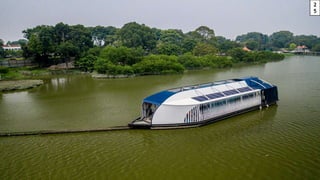
The Interceptor is The Ocean Cleanup’s answer for river plastic waste. It is the first scalable solution to
prevent plastic from entering the world’s oceans from rivers and it is 100% solar-powered, extracts
autonomously.
• 50,000 KG/DAY
• 24/7 OPERATION
• 50 M3 CAPACITY
2
4
2
5
2
6
WHAT HAPPENS IF NOTHING CHANGES ?
The locations and sizes of these garbage patches are not likely to change very much any time soon.
However, the amount of debris may continue to grow as more and more debris enters our ocean
each year. This growth will likely worsen current impacts on the environment, navigation, vessel safety,
and the economy.
To prevent marine debris, we need to understand where it is coming from. We know that marine
debris can enter our waterways and ocean in a variety of ways. Improper waste management,
dumping , and stormwater runoff all lead to marine debris. If we want to "turn off the tap," everyone,
including government, businesses, and people like you, will have to make some meaningful changes.
We are the problem, and so we must also be the solution.
2
7
REFERENCES
1- https://www.nationalgeographic.org/encyclopedia/great-pacific-garbage-patch/
2- https://marinedebris.noaa.gov/
3- https://theoceancleanup.com/great-pacific-garbage-patch/
4- Kurzgesagt – In a Nutshell https://youtu.be/RS7IzU2VJIQ
2
8
THANK YOU
Please use Plastic wisely

Oceanic trash

  • 1.
    Submitted to: AMIT TRIPATHISIR Submitted by: VARUNESH SUNDARAM CHAKRAVARTI SHREYAS RAJKIYA ENGINEERING COLLEGE AMBEDKAR NAGAR
  • 2.
    CONTENTS  GARBAGE PATCHES GREAT PACIFIC GARBAGE PATCHES  PLASTIC ACCUMULATION  ESTIMATION OF SIZE  QUANTITY OF FLOATING PLASTIC IN GPGP  TYPES OF PLASTICS IN GPGP  IMPACT ON MARINE AND HUMAN LIFE  HOW TO GET RID OF GARBAGE PATCHES  CASE STUDY  CONCLUSION  REFERENCES 1
  • 3.
    WHAT ARE GARBAGEPATCHES ? Garbage patches are the large areas of the ocean where marine debris collects that are litter, fishing gear and other debris. They are formed by rotating ocean currents called gyres. 2
  • 4.
    GREAT PACIFIC GARBAGEPATCH The Greatest Pacific Garbage Patch (GPGP) is the largest accumulation of ocean plastic in the world and is located between Hawaii and California. It is the most famous Garbage Patch in all five offshore patches and contains debris ranges in size, from large abandoned fishing nets to tiny microplastics, which are plastic pieces smaller than 5mm in size. 3
  • 5.
  • 6.
  • 7.
    PLASTIC ACCUMULATION It isestimated that 1.15 to 2.41 million tons of plastics are entering the ocean each year from rivers. Once these plastics enter the gyre ,they degrade into smaller microplastics under the effect of sun, waves and marine life. As more and more plastics are discarded into the environment, microplastics concentration in great pacific garbage patch will only continue to increase. 6
  • 8.
    ESTIMATION OF SIZE TheGreat Pacific Garbage Patch (GPGP) covers an estimated surface area of 1.6 million square kilometers, which is an area twice the size of Texas or three times the size of France and half times the size of India. 7
  • 9.
    HOW MUCH PLASTICFLOATS IN THE GREAT PACIFIC GARBAGE PATCH ? The mass of the plastic in the GPGP was estimated to be approximate 80,000 tonnes, which is 4-16 times more than previous calculations. The weight is equivalent to that of 500 Jumbo Jets.(333400 kg) A total of 1.8 trillion plastic pieces were estimated to be floating in the patch- a plastic count that is equivalent to 250 pieces of debris for every human in the world. Further research & calculations estimated that it may range from 1.1 trillion to 3.6 trillion pieces. 8
  • 10.
    WHAT TYPES OFPLASTIC FLOAT IN THE GPGP : Size Classes: Plastic within the patch are categorized into 4 size classes- 1- Microplastics ( 0.05 – 0.5cm ) 2- Mesoplastics ( 0.5 – 5cm ) 3- Macroplastics ( 5 – 50cm ) 4- Megaplastics ( anything above 50cm ) 9
  • 11.
  • 12.
    CATEGORIZATION TYPES : Oncethe plastics were collected , researchers classified into: - Type H: Hard plastic, plastic sheet or film - Type N: Plastic lines, ropes, and fishing nets - Type P: Pre- production plastics( cylinders, spheres or disks ) - Type F: Fragments made of foamed materials 1 1
  • 13.
    WHY LARGE DEBRISMATTER Because the plastics have been shown to persist in this region, they will likely break down into smaller plastics while floating in the GPGP. This deterioration into microplastics is usually the result of sun exposure, waves, marine life, and temperature changes. Once they become this small, microplastics are very difficult to remove and are often mistaken for food by marine animals. 1 2
  • 14.
    WHAT ARE THEIMPACT ON MARINE LIFE Plastic has increasingly become a ubiquitous substance in the ocean. Due to its size and color, animals confuse the plastic for food, causing malnutrition. Studies have shown that about 700 species have encountered marine debris, and 92% of these interactions are with plastic. 17% of the species affected by plastic are on the IUCN (International Union for Conservation of Nature) Red List of Threatened Species.  Toxic for Sea Surface Feeders Floating at the surface of the Great Pacific Garbage Patch (GPGP) is 180x more plastic than marine life. Since 84% of this plastic was found to have at least one Persistent Bio- accumulative Toxic Persistent Bio-accumulative Toxic (PBT) chemical, animals consuming this debris are therefore ingesting the chemicals attached to the plastic. 1 3
  • 15.
     Entanglement ofMarine Life Fishing nets account for 46% of the mass in the GPGP and they can be dangerous for animals who swim or collide into them and cannot extract themselves from the net. Interaction with these discarded nets, also known as ghost nets , often results in the death of the marine life involved.  Ingestion Animals may mistakenly eat plastic and other debris. We know that this can be harmful to the health of fish, seabirds, and other marine animals. These items can take up room in their stomachs, making the animals feel full and stopping them from eating real food.  Non-native species Marine debris can transport species from one place to another. Algae, crabs, or other species can attach themselves to debris and be transported across the ocean. If the species is invasive, and can settle and establish in a new environment, it can outcompete or overcrowd native species, disrupting the ecosystem. 1 4
  • 16.
  • 17.
  • 18.
  • 19.
    IMPACT ON HUMANSAND SOCIETY  Affects the Human Foodchain Through a process called bioaccumulation, chemicals in plastics will enter the body of the animal feeding on the plastic, and as the feeder becomes prey, the chemicals will pass to the predator – making their way up the food web that includes humans. These chemicals that affected the plastic feeders could then be present within the human as well.  Affects the Economy According to a study conducted in collaboration with Deloitte, yearly economic costs due to marine plastic are estimated to be between $6-19bn USD. The costs stem from its impact on tourism, fisheries and aquaculture, and (governmental) cleanups. These costs do not include the impact on human health and the marine ecosystem.This means that intercepting plastic in rivers is much more cost- effective than dealing with the consequences downstream. PLASTIC POLLUTION COSTS 13BN DOLLARS PER YEAR. 1 8
  • 20.
  • 21.
    CASE STUDY :THE OCEAN CLEANUP The Ocean Cleanup is a non-government engineering environmental organization based in the Netherlands, that develops technology to extract plastic pollution from the oceans. The organization conducts scientific research into oceanic plastic pollution. It was founded in 2013 by Boyan Slat, a Dutch-born inventor-entrepreneur of Croatian origin who serves as its CEO. The project aims to launch a total of 60 such systems in the patch by 2021. They predict this capability could clean up 50% of the debris in the Great Pacific Garbage Patch in five years. In late October 2019, TOC announced a new initiative, The Interceptor, to attack the trash problem closer to the source, with plans to prevent the 80% of ocean trash coming from 1000 rivers worldwide. 2 0
  • 22.
    HOW TO GETRID OF GARBAGE PATCHES ? It may not be possible to entirely get rid of garbage patches to solve this problem , it requires a combination of closing the source and cleaning up what has already accumulated in the ocean.  CLEANING THE GARBAGE PATCHES FROM OCEAN The ocean is big. Cleaning up the Great Pacific Garbage Patch using conventional methods – vessels and nets – would take thousands of years and tens of billions of dollars to complete. Our passive systems are estimated to remove 50% of the Great Pacific Garbage patch in just five years, and at a fraction of the cost. This is how it works:  CAPTURE THE PLASTIC The combination of natural forces and a sea anchor create a drag, which makes the system move consistently slower than the plastic, while allowing the plastic to be captured.  ACCUMULATION The system autonomously navigates the garbage patch for extended time periods, catching and retaining plastic in the center of the system.  EXTRACTION Once the systems are full, a vessel acting as a garbage truck of the seas will periodically remove the collected plastic. 2 1
  • 23.
  • 24.
  • 25.
     INTERCEPTING THEPLASTICS FROM RIVER Rivers are the main source of ocean plastic pollution. They are the arteries that carry waste from land to the ocean. To rid the oceans of plastic, we need to not only clean up what is already out there, but also stop new plastic from entering the ocean: we need to close the tap.  80% OF RIVER PLASTIC COMES FROM 1000 RIVERS .  THE INTERCEPTOR The Interceptor is The Ocean Cleanup’s answer for river plastic waste. It is the first scalable solution to prevent plastic from entering the world’s oceans from rivers and it is 100% solar-powered, extracts autonomously. • 50,000 KG/DAY • 24/7 OPERATION • 50 M3 CAPACITY 2 4
  • 26.
  • 27.
  • 28.
    WHAT HAPPENS IFNOTHING CHANGES ? The locations and sizes of these garbage patches are not likely to change very much any time soon. However, the amount of debris may continue to grow as more and more debris enters our ocean each year. This growth will likely worsen current impacts on the environment, navigation, vessel safety, and the economy. To prevent marine debris, we need to understand where it is coming from. We know that marine debris can enter our waterways and ocean in a variety of ways. Improper waste management, dumping , and stormwater runoff all lead to marine debris. If we want to "turn off the tap," everyone, including government, businesses, and people like you, will have to make some meaningful changes. We are the problem, and so we must also be the solution. 2 7
  • 29.
    REFERENCES 1- https://www.nationalgeographic.org/encyclopedia/great-pacific-garbage-patch/ 2- https://marinedebris.noaa.gov/ 3-https://theoceancleanup.com/great-pacific-garbage-patch/ 4- Kurzgesagt – In a Nutshell https://youtu.be/RS7IzU2VJIQ 2 8
  • 30.
    THANK YOU Please usePlastic wisely