On-Call
and Crisis Response
Online Pre-Service Training: Summer 2014
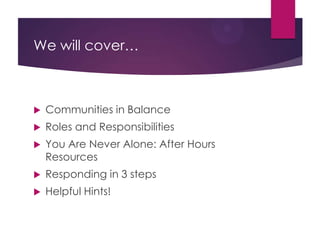
We will cover…
 Communities in balance
 Roles and responsibilities
 You are never alone: after-hours resources
 Responding in 3 steps
 Helpful hints!
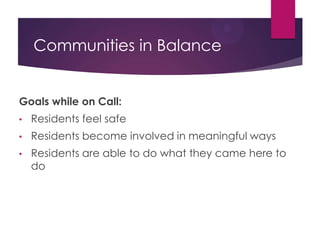
Communities in Balance
Goals while on call:
Promote a safe residential environment
Maintain an academically supportive
community
Encourage residents to take responsibility for
maintaining balance in their community
Create connections and develop relationships
with residents
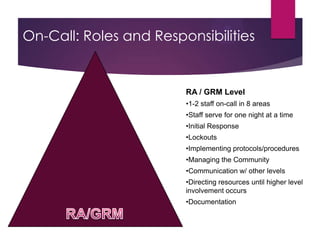
On-Call: Roles and Responsibilities
RA / GRM Level
•1-2 staff on-call in 8 areas
•Staff serve for one night at a time
•Initial response
•Lockouts
•Implementing protocols/procedures
•Managing the community
•Communication w/ other levels
•Directing resources until higher level
involvement occurs
•Documentation
On-Call: Roles and Responsibilities
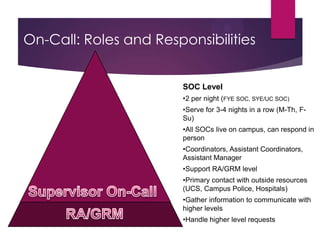
SOC Level
•2 per night (FYE SOC, SYE/UC SOC)
•Serve for 3-4 nights in a row (M-Th, F-Su)
•All SOCs live on campus, can respond in
person
• Res Life Coordinators, Assistant
Coordinators, Assistant Manager, Greek
Life Coordinators
•Support RA/GRM level
•Primary contact with outside resources
(UCS, CWRU Police, Hospitals)
•Gather information to communicate with
higher levels
•Handle higher level requests
On-Call: Roles and Responsibilities
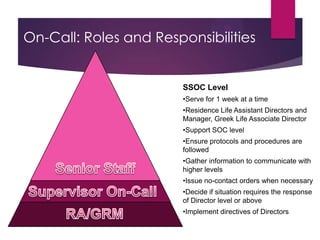
SSOC Level
•Serve for 1 week at a time
•Residence Life Assistant Directors and
Manager, Greek Life Associate Director
•Support SOC level
•Ensure protocols and procedures are
followed
•Gather information to communicate with
higher levels
•Issue no-contact orders when necessary
•Decide if situation requires the response
of Director level or above
•Implement directives of Directors
On-Call: Roles and Responsibilities
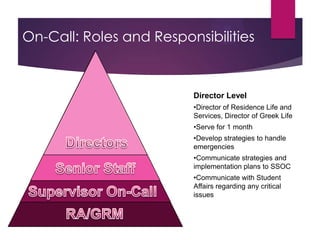
DirectorLevel
•Director of Residence Life and
Services, Director of Greek Life
•Serve for 1 month
•Develop strategies to handle
emergencies
•Communicate strategies and
implementation plans to SSOC
•Communicate with Student
Affairs regarding any critical
issues
On-Call: Roles and Responsibilities
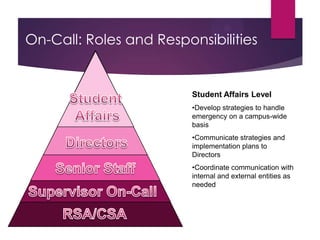
Student Affairs Level
•Develop strategies to handle
emergency on a campus-wide
basis
•Communicate strategies and
implementation plans to
Directors
•Coordinate communication with
internal and external entities as
needed
On-Call: Roles and Responsibilities
On-Call Time Frames
RA/GRM on-call (nights)
 Sunday-Thursday: 10pm-8:00am
 Friday: 9:00pm-11:00am
 Saturday: 9:00pm-12:00 (noon)
SOC (after business hours)
 Monday-Thursday: 5:00pm-8:30am
 Friday 5:00-Monday 8:30am
SSOC, DOC (24/7)
You Are Never Alone!
When you are on-call, you are not alone! In addition
to the supervisor on-call, you have an entire team of
emergency responders waiting to assist you with any
situation that may arise.
This section will introduce you to the other people who
may be involved in addressing late-night concerns
with you.
You Are Never Alone!
Dispatch (368-3333)
Dispatcher can send police, EMS, the fire department, or emergency
maintenance
Share as much information as possible to help them decide who to send
In an emergency, if you are put on hold - hang up, call again
For most emergencies, your first phone call will be to dispatch.
CWRU Police
In most situations, CWRU police will provide support while Residence Life
staff address policy violations.
Recognize when they may need to take over – and when they shouldn’t.
Call CWRU police for any situations that could involve drugs, weapons, or
violence.
You Are Never Alone!
Counselor On-Call
LEAVE A DETAILED VOICEMAIL; the COC will call back within 5 minutes
Contact if you receive any indication of self-harm or suicidal comments
Contact for any concerning mental health issues
COC can consult with you as well as speak directly with students
Will determine if hospitalization is necessary
Nurse On-Call
LEAVE A DETAILED VOICEMAIL; the NOC will call back within 20 minutes
Not sure if EMS is needed? Contact the Nurse On-Call
Can provide guidance regarding minor injuries and illness
 Note: the NOC will want to speak directly to the student, but it is up to the RA to
make the initial call and set up the conversation for the NOC and student.
You Are Never Alone!
EMS
Any time you suspect a student needs urgent medical care, contact dispatch
and ask for EMS
Any time a student has vomited, passed-out, or suffered a head injury, request
EMS
Dispatch may send Case EMS or Cleveland EMS depending on the issue and the
time of day
Final decisions of whether or not to transport a student are made by the EMT.
Emergency Maintenance/BioHazard
Emergency Maintenance will respond 24/7 to any urgent facility issue
Contact for flood, broken glass, bodily fluids, or any other mess or damage that
needs immediate attention
Remember, it may take some time (at least 10-15 minutes) for emergency
maintenance personnel to get to campus. You should not leave the scene while
waiting for them to arrive.
Responding in 3 steps
 Primary Response
• Address the policy violation or immediate
concern
 Secondary Response
• Community support
 Tertiary Response
• Document the situation
Responding in 3 steps: Primary
 Triage-what MUST be taken care of NOW?
• Getting the community back in balance
 When these things happen, you must take
action:
• Articulable Suspicion
• Report of a problem
• From other students
• From staff
• From Dispatch
Responding in 3 steps: Primary
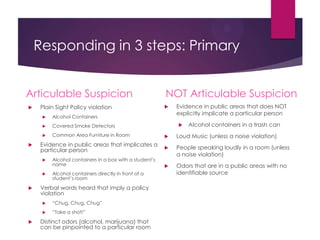
Articulable Suspicion NOT Articulable Suspicion
 Policy violation in plain sight
• Alcohol Containers
• Covered Smoke Detectors
• Common Area Furniture in Room
 Evidence in public areas that implicates
a particular person
• Alcohol containers in a box with a student’s
name
• Alcohol containers directly in front of a
student’s room
 Verbal words heard that imply a policy
violation
• “Chug, Chug, Chug”
• “Take a shot!”
 Distinct odors (alcohol, marijuana) that
can be pinpointed to a particular room
 Evidence in public areas that does NOT
explicitly implicate a particular person
• Alcohol containers in a trash can
 Loud Music (unless a noise violation)
 People speaking loudly in a room (unless a
noise violation)
 Odors that are in a public area with no
identifiable source
Responding in 3 steps: Primary
 Identify articulable suspicion of a policy
violation
 Initiate contact with residents, introduce
yourself, and explain why you are
confronting them
 Determine if suspicion was founded or
unfounded
Responding in 3 steps: Primary
Get residents to help address the situation by assisting with
the remaining steps
 When responding to an incident, work directly with
the resident(s) of the room whenever possible. If this is
not appropriate, try to work with the person who
seems to be in a leadership position in the group
 When working with the resident, be specific about
the things that need to happen (keeping in mind our
goals)
Responding in 3 steps: Primary
Levels of Responsibility
 Resident Autonomy – a situation where staff only need to
point out what is out of balance and ask the resident to do
something (i.e. – quiet down if things are too loud) and
then stop back to make sure they were able to handle it.
 Resident Support – the situation needs to be balanced
immediately. Staff will remain present while resident works
on achieving balance, with direction from the staff on
what specifically needs to be done.
 Resident Collaboration – resident may feel unable to
handle the situation but will work with staff on getting
things back in balance.
 Staff Only – resident is unwilling or unable to assist, staff will
directly work on restoring balance.
Responding in 3 steps: Secondary
Community Support
After the primary issue has been addressed, ask
yourself: who else in the community needs support?
• Roommates?
• Floor mates?
• Guests?
• Other impacted parties?
Maintain confidentiality
Offer assurance that the student is receiving the
support they need.
Responding in 3 steps: Tertiary
Document and Communicate!
Submit an incident report immediately after the incident
If multiple staff members were involved, work together to
submit 1 incident report
Does the SOC need to know? (Refer to the Emergency
Protocol)
If anyone else needs to be informed, the SOC will offer
you guidance
Helpful Hints!
 Be flexible, but thorough with each step
 Remain calm (take a breath, count to 5!)
 Use Supervisor On-Call and peers as support
 Take notes (but do not write a book)
 It is always ok to call the SOC! If you don’t
know what to do, call the SOC!

Emergencies and on call

  • 1.
    On-Call and Crisis Response OnlinePre-Service Training: Summer 2014
  • 2.
    We will cover… Communities in balance  Roles and responsibilities  You are never alone: after-hours resources  Responding in 3 steps  Helpful hints!
  • 3.
    Communities in Balance Goalswhile on call: Promote a safe residential environment Maintain an academically supportive community Encourage residents to take responsibility for maintaining balance in their community Create connections and develop relationships with residents
  • 4.
    On-Call: Roles andResponsibilities RA / GRM Level •1-2 staff on-call in 8 areas •Staff serve for one night at a time •Initial response •Lockouts •Implementing protocols/procedures •Managing the community •Communication w/ other levels •Directing resources until higher level involvement occurs •Documentation
  • 5.
    On-Call: Roles andResponsibilities SOC Level •2 per night (FYE SOC, SYE/UC SOC) •Serve for 3-4 nights in a row (M-Th, F-Su) •All SOCs live on campus, can respond in person • Res Life Coordinators, Assistant Coordinators, Assistant Manager, Greek Life Coordinators •Support RA/GRM level •Primary contact with outside resources (UCS, CWRU Police, Hospitals) •Gather information to communicate with higher levels •Handle higher level requests
  • 6.
    On-Call: Roles andResponsibilities SSOC Level •Serve for 1 week at a time •Residence Life Assistant Directors and Manager, Greek Life Associate Director •Support SOC level •Ensure protocols and procedures are followed •Gather information to communicate with higher levels •Issue no-contact orders when necessary •Decide if situation requires the response of Director level or above •Implement directives of Directors
  • 7.
    On-Call: Roles andResponsibilities DirectorLevel •Director of Residence Life and Services, Director of Greek Life •Serve for 1 month •Develop strategies to handle emergencies •Communicate strategies and implementation plans to SSOC •Communicate with Student Affairs regarding any critical issues
  • 8.
    On-Call: Roles andResponsibilities Student Affairs Level •Develop strategies to handle emergency on a campus-wide basis •Communicate strategies and implementation plans to Directors •Coordinate communication with internal and external entities as needed
  • 9.
    On-Call: Roles andResponsibilities On-Call Time Frames RA/GRM on-call (nights)  Sunday-Thursday: 10pm-8:00am  Friday: 9:00pm-11:00am  Saturday: 9:00pm-12:00 (noon) SOC (after business hours)  Monday-Thursday: 5:00pm-8:30am  Friday 5:00-Monday 8:30am SSOC, DOC (24/7)
  • 10.
    You Are NeverAlone! When you are on-call, you are not alone! In addition to the supervisor on-call, you have an entire team of emergency responders waiting to assist you with any situation that may arise. This section will introduce you to the other people who may be involved in addressing late-night concerns with you.
  • 11.
    You Are NeverAlone! Dispatch (368-3333) Dispatcher can send police, EMS, the fire department, or emergency maintenance Share as much information as possible to help them decide who to send In an emergency, if you are put on hold - hang up, call again For most emergencies, your first phone call will be to dispatch. CWRU Police In most situations, CWRU police will provide support while Residence Life staff address policy violations. Recognize when they may need to take over – and when they shouldn’t. Call CWRU police for any situations that could involve drugs, weapons, or violence.
  • 12.
    You Are NeverAlone! Counselor On-Call LEAVE A DETAILED VOICEMAIL; the COC will call back within 5 minutes Contact if you receive any indication of self-harm or suicidal comments Contact for any concerning mental health issues COC can consult with you as well as speak directly with students Will determine if hospitalization is necessary Nurse On-Call LEAVE A DETAILED VOICEMAIL; the NOC will call back within 20 minutes Not sure if EMS is needed? Contact the Nurse On-Call Can provide guidance regarding minor injuries and illness  Note: the NOC will want to speak directly to the student, but it is up to the RA to make the initial call and set up the conversation for the NOC and student.
  • 13.
    You Are NeverAlone! EMS Any time you suspect a student needs urgent medical care, contact dispatch and ask for EMS Any time a student has vomited, passed-out, or suffered a head injury, request EMS Dispatch may send Case EMS or Cleveland EMS depending on the issue and the time of day Final decisions of whether or not to transport a student are made by the EMT. Emergency Maintenance/BioHazard Emergency Maintenance will respond 24/7 to any urgent facility issue Contact for flood, broken glass, bodily fluids, or any other mess or damage that needs immediate attention Remember, it may take some time (at least 10-15 minutes) for emergency maintenance personnel to get to campus. You should not leave the scene while waiting for them to arrive.
  • 14.
    Responding in 3steps  Primary Response • Address the policy violation or immediate concern  Secondary Response • Community support  Tertiary Response • Document the situation
  • 15.
    Responding in 3steps: Primary  Triage-what MUST be taken care of NOW? • Getting the community back in balance  When these things happen, you must take action: • Articulable Suspicion • Report of a problem • From other students • From staff • From Dispatch
  • 16.
    Responding in 3steps: Primary Articulable Suspicion NOT Articulable Suspicion  Policy violation in plain sight • Alcohol Containers • Covered Smoke Detectors • Common Area Furniture in Room  Evidence in public areas that implicates a particular person • Alcohol containers in a box with a student’s name • Alcohol containers directly in front of a student’s room  Verbal words heard that imply a policy violation • “Chug, Chug, Chug” • “Take a shot!”  Distinct odors (alcohol, marijuana) that can be pinpointed to a particular room  Evidence in public areas that does NOT explicitly implicate a particular person • Alcohol containers in a trash can  Loud Music (unless a noise violation)  People speaking loudly in a room (unless a noise violation)  Odors that are in a public area with no identifiable source
  • 17.
    Responding in 3steps: Primary  Identify articulable suspicion of a policy violation  Initiate contact with residents, introduce yourself, and explain why you are confronting them  Determine if suspicion was founded or unfounded
  • 18.
    Responding in 3steps: Primary Get residents to help address the situation by assisting with the remaining steps  When responding to an incident, work directly with the resident(s) of the room whenever possible. If this is not appropriate, try to work with the person who seems to be in a leadership position in the group  When working with the resident, be specific about the things that need to happen (keeping in mind our goals)
  • 19.
    Responding in 3steps: Primary Levels of Responsibility  Resident Autonomy – a situation where staff only need to point out what is out of balance and ask the resident to do something (i.e. – quiet down if things are too loud) and then stop back to make sure they were able to handle it.  Resident Support – the situation needs to be balanced immediately. Staff will remain present while resident works on achieving balance, with direction from the staff on what specifically needs to be done.  Resident Collaboration – resident may feel unable to handle the situation but will work with staff on getting things back in balance.  Staff Only – resident is unwilling or unable to assist, staff will directly work on restoring balance.
  • 20.
    Responding in 3steps: Secondary Community Support After the primary issue has been addressed, ask yourself: who else in the community needs support? • Roommates? • Floor mates? • Guests? • Other impacted parties? Maintain confidentiality Offer assurance that the student is receiving the support they need.
  • 21.
    Responding in 3steps: Tertiary Document and Communicate! Submit an incident report immediately after the incident If multiple staff members were involved, work together to submit 1 incident report Does the SOC need to know? (Refer to the Emergency Protocol) If anyone else needs to be informed, the SOC will offer you guidance
  • 22.
    Helpful Hints!  Beflexible, but thorough with each step  Remain calm (take a breath, count to 5!)  Use Supervisor On-Call and peers as support  Take notes (but do not write a book)  It is always ok to call the SOC! If you don’t know what to do, call the SOC!