Resident Advisor
Being on Call at GMU
2015 Online Module
You are a vital asset to the prevention
of incidents, ensuring a caring,
supportive, inclusive, and safe
environment for residents.
Duty Structure
• RA on-duty for each building.
• HRA on-duty for each neighborhood.
• 2 RDs on call at all times (Except winter break &
summer)
– Rappahannock call 571-308-4506
– Aquia/Shenandoah call 703-307-8894
– ADNO 571-423-6852
• ADRL/Neighborhood Coordinator on-duty for entire
campus.
• University Police (703-993-2810), CAPS (703-
9932380) and SAS (703-993-9999) available at all
times
• All levels of staff are expected to respond to concerns
regardless of whether or not they are “on duty.”
Duty Check-in
• You will check-in for duty at your
neighborhood desk with your Head
Resident Advisor.
– Your Neighborhood ADRL will have
specific check-in times.
• You will be required to check-out the
Duty phone from the desk staff.
Duty Attire & Must haves
• Duty badge
• Clean HRL staff shirt
• Closed toe shoes
• Duty phone (fully charged)
• At least 2 writing utensils and a
blank paper.
Duty Switches
• Duty switches are allowed
• Must be a swap with another RA
living in your building.
• Submit in writing via email to your
RD and HRA (both RAs must email)
• Taking a shift without trading is
highly discouraged
Breaks while on-duty
• Only on weekends
• 1 hour no more than 3 times in a
weekend and cannot be back to back
• Only between 9am and 6:30pm.
• Cannot leave campus
• Contact your duty partner to coordinate
breaks
• Call the HRA on-duty to check-out for
break and check back in to end your
break.
The Community Walk-through
• Walk-through times
– Weekdays: 8pm, 10pm, and 12am
– Weekends: 9pm, 12am, and 2am
• Check every bathroom stall, shower, fire extinguisher,
lounge, exterior door, trash room, and common
spaces.
• Greet resident in a cordial and respectful manner.
• Always inform residents that you are the RA on-duty
and provide your name when confronting a policy
violation.
• Never listen closely at a door to catch a policy
violation.
• Never cover the peep hole when knocking on a
closed door to confront a suspected violation.
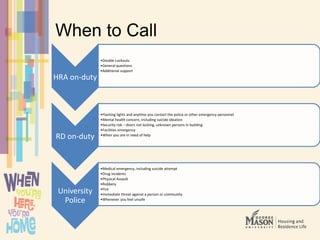
When to Call
HRA on-duty
•Double Lockouts
•General questions
•Additional support
RD on-duty
•Flashing lights and anytime you contact the police or other emergency personnel
•Mental health concern, including suicide ideation
•Security risk – doors not locking, unknown persons in building
•Facilities emergency
•When you are in need of help
University
Police
•Medical emergency, including suicide attempt
•Drug incidents
•Physical Assault
•Robbery
•Fire
•Immediate threat against a person or community
•Whenever you feel unsafe
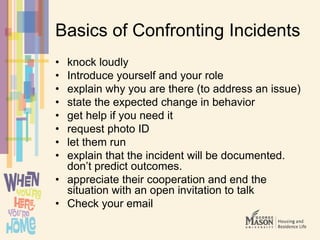
Basics of Confronting Incidents
• knock loudly
• Introduce yourself and your role
• explain why you are there (to address an issue)
• state the expected change in behavior
• get help if you need it
• request photo ID
• let them run
• explain that the incident will be documented.
don’t predict outcomes.
• appreciate their cooperation and end the
situation with an open invitation to talk
• Check your email
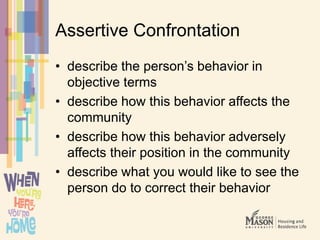
Assertive Confrontation
• describe the person’s behavior in
objective terms
• describe how this behavior affects the
community
• describe how this behavior adversely
affects their position in the community
• describe what you would like to see the
person do to correct their behavior
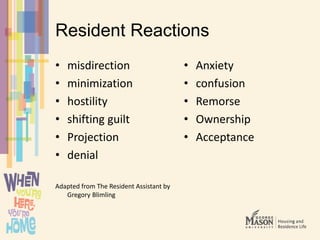
Resident Reactions
• misdirection
• minimization
• hostility
• shifting guilt
• Projection
• denial
Adapted from The Resident Assistant by
Gregory Blimling
• Anxiety
• confusion
• Remorse
• Ownership
• Acceptance
After Confronting an Incident
• if student wishes to discuss the incident,
engage in open dialogue
– focus on learning and building the relationship
– ask them to examine their actions from your
perspective
– express concern for them as a person (if
appropriate)
• provide resources
• give them direction on the student conduct
process
• submit an IR and include the IR number in
your Duty Report.
Duty Report
• Submitted after your last community
walk-through.

2015 being on call

  • 1.
    Resident Advisor Being onCall at GMU 2015 Online Module
  • 2.
    You are avital asset to the prevention of incidents, ensuring a caring, supportive, inclusive, and safe environment for residents.
  • 3.
    Duty Structure • RAon-duty for each building. • HRA on-duty for each neighborhood. • 2 RDs on call at all times (Except winter break & summer) – Rappahannock call 571-308-4506 – Aquia/Shenandoah call 703-307-8894 – ADNO 571-423-6852 • ADRL/Neighborhood Coordinator on-duty for entire campus. • University Police (703-993-2810), CAPS (703- 9932380) and SAS (703-993-9999) available at all times • All levels of staff are expected to respond to concerns regardless of whether or not they are “on duty.”
  • 4.
    Duty Check-in • Youwill check-in for duty at your neighborhood desk with your Head Resident Advisor. – Your Neighborhood ADRL will have specific check-in times. • You will be required to check-out the Duty phone from the desk staff.
  • 5.
    Duty Attire &Must haves • Duty badge • Clean HRL staff shirt • Closed toe shoes • Duty phone (fully charged) • At least 2 writing utensils and a blank paper.
  • 6.
    Duty Switches • Dutyswitches are allowed • Must be a swap with another RA living in your building. • Submit in writing via email to your RD and HRA (both RAs must email) • Taking a shift without trading is highly discouraged
  • 7.
    Breaks while on-duty •Only on weekends • 1 hour no more than 3 times in a weekend and cannot be back to back • Only between 9am and 6:30pm. • Cannot leave campus • Contact your duty partner to coordinate breaks • Call the HRA on-duty to check-out for break and check back in to end your break.
  • 8.
    The Community Walk-through •Walk-through times – Weekdays: 8pm, 10pm, and 12am – Weekends: 9pm, 12am, and 2am • Check every bathroom stall, shower, fire extinguisher, lounge, exterior door, trash room, and common spaces. • Greet resident in a cordial and respectful manner. • Always inform residents that you are the RA on-duty and provide your name when confronting a policy violation. • Never listen closely at a door to catch a policy violation. • Never cover the peep hole when knocking on a closed door to confront a suspected violation.
  • 9.
    When to Call HRAon-duty •Double Lockouts •General questions •Additional support RD on-duty •Flashing lights and anytime you contact the police or other emergency personnel •Mental health concern, including suicide ideation •Security risk – doors not locking, unknown persons in building •Facilities emergency •When you are in need of help University Police •Medical emergency, including suicide attempt •Drug incidents •Physical Assault •Robbery •Fire •Immediate threat against a person or community •Whenever you feel unsafe
  • 10.
    Basics of ConfrontingIncidents • knock loudly • Introduce yourself and your role • explain why you are there (to address an issue) • state the expected change in behavior • get help if you need it • request photo ID • let them run • explain that the incident will be documented. don’t predict outcomes. • appreciate their cooperation and end the situation with an open invitation to talk • Check your email
  • 11.
    Assertive Confrontation • describethe person’s behavior in objective terms • describe how this behavior affects the community • describe how this behavior adversely affects their position in the community • describe what you would like to see the person do to correct their behavior
  • 12.
    Resident Reactions • misdirection •minimization • hostility • shifting guilt • Projection • denial Adapted from The Resident Assistant by Gregory Blimling • Anxiety • confusion • Remorse • Ownership • Acceptance
  • 13.
    After Confronting anIncident • if student wishes to discuss the incident, engage in open dialogue – focus on learning and building the relationship – ask them to examine their actions from your perspective – express concern for them as a person (if appropriate) • provide resources • give them direction on the student conduct process • submit an IR and include the IR number in your Duty Report.
  • 14.
    Duty Report • Submittedafter your last community walk-through.

Editor's Notes

  • #4 Remember you are always on-duty as you are identified as a first responder. There is always an RA on call for each community. A HRA on-call for neighborhood and 2 RDs on call- 1 RD for Rappahannock and one RD for Aquia & Shenandoah. Take note of all numbers listed. Also, take this time to enter all numbers into your personal phone. This is helpful for if you encounter an incident while you are not on-duty and do not have the duty phone. RA Duty scheduling is handled within your small staff.
  • #5 Duty check-in occurs at the neighborhood desk where you will meet with other RAs on-duty and the HRA. It is advised you report to check-in at least 10 minutes prior to check-in time. During check-in you will be issued your duty phone, made aware of any pertinent information, checked for appropriate attire and duty badge. There will be instances where the duty teams will be issued a task to complete while on-duty. Additionally, this is the opportune time to ask any questions about the evening. Duty Time Monday through Thursday: 8pm-8:30am the next day. Friday 8pm to Saturday 8pm Saturday 8pm to Sunday 8pm
  • #6 Required attire is a clean housing staff shirt, RA badge, and closed toe shoes. If you are an external community and you are wearing a jacket, you will need to ensure your duty badge is visible. While completing walk-throughs you are to have blank paper and writing utensils, and a fully charged duty phone. Taking notes of an incident on your phone is not allowed- everything must be written down on paper.
  • #7 RA Duty scheduling is managed in small staff. RAs may swap duty shifts with another RA in the building. The RA you are swapping with must live in the same building to guarantee an appropriate response time and to ensure the safety and security of the residents living in their respective buildings. When swapping shifts, you should swap a weekday for a weekday and a weekend for a weekend. Taking a shift is without trading is discouraged. The swap must be communicated in writing via email to your RD and HRA. Both RAs are to send an email acknowledging the swap.
  • #8 Breaks are only allowed on 24-hour duty shifts (or unless specifically directed by professional staff.) Breaks are not allowed during weekday duty shifts. You are allowed only 1 hour to break. You must communicate with your duty partner and/or team and your HRA on-duty. You are not allowed to leave campus on your break. Must still be able to respond to a situation should the need present itself.
  • #9 The walk-through should be thorough and precise- checking all spaces – greeting residents as you see them – a responding to incidents/policy violations as you are made aware. If your duty partner does not show for a walk-through after you have attempted to contact them (calling and/or knocking on their room door), you should consult with your HRA on-duty.
  • #10 This slide list out the time you should either the Resident Director On-duty or University Police University Police medical emergency (including suicide attempt) drug incidents physical assault robbery fire immediate threat against a person or community whenever an RA feels unsafe The Resident Director any flashing lights every time you call the police whenever an ambulance, police or fire truck respond to the scene mental health concern, including suicidal ideation security risk (NAs contact the Night Operations Coordinator) door not locking, unknown person in building facilities emergency (NAs contact the Night Operations Coordinator) when you need help or have questions Please note NA’s will call directly if on call staff need to be notified of a situation
  • #11 These are the steps you should take if you are responding to an incident. Main points are to be assertive, exercise clear and respectful communication, document everything taking place, things you see and what is said. Should you feel an incident escalating always call for back up (fellow RA, HRA, RD and/or GMUPD).
  • #12 While you are only documenting the situation, Please don’t make any promises or guarantees. Nothing is absolute and you may not have all the details that go into the final decision making process. Encourage students to check their email. All of our communication is by way of email so that is how they will be contacted for an administrative hearing. Should there be questions that you are unaware of the answer, never make up anything or take wild guesses. Simply, tell them you will get them an answer soon.
  • #13 Residents can tend to provide the listed reactions when they are being confronted about a policy violation. Please do not allow their reaction to intimidate you. Should you need assistance do not hesitate to contact another RA or HRA for backup.
  • #14 Encourage students to check their email. All of our communication is by way of email so that is how they will be contacted for an administrative hearing. Please don’t make any promises or guarantees. Nothing is absolute and you may not have all the details that go into the final decision making process.