ON-CALL
PROTOCOL
ON-CALL
• What is the purpose of RA’s On-Call?
• To ensure the safety and welfare of the building and
its residents
• To enforce University and Housing Policies
• REMEMBER! As an RA you represent FAU. Not only is
it your duty to enforce policy you need to abide by it
as well
ON-CALL STRUCTURE
• 2 RAs On-Call each night
• Weekdays (Sunday through Thursday) - 4:45PM-8:00AM
• Weekends (Fridays through Saturdays) - 4:45PM-4:45PM
• CANNOT leave your area or have someone else hold the phone. This means you can’t go to the Café or
hang out in another building.
• Know your building. Become familiar with:
• Your buildings room types
• Who is trespassed
• Where the fire safety equipment is located
• Where the trouble spots are. Specifically where students tend to smoke drink or lack of surveillance
• Custodial closets and other maintenance areas
• All of these will help you be better prepared during rounds and when responding to incidents.
• If you are 21 or over you are not allowed to consume alcohol prior to or while On-Call.
• Remember to always stay calm, cool, and collected
• Remember your training. As an RA you have been trained on how to respond to incidents and crisis. But even the
best of us forget details and steps in the heat of the moment. It’s a good idea to review On-Call protocols before
your shift. Don’t forget that you always have the RA binder to refer to while On-Call.
• You are never alone while On-Call. You will always have someone to call if you have questions or need assistance
with a situation. Such as a Co-RA, ProStaff, or the Police Department
HOLIDAY AND BREAK ON-CALL STRUCTURE
• Most residence halls are open 24/7, 365 days of the year
• RA contract ends in December and begins again in January
• RA’s will need to return early to assist with opening
• RA’s will have the opportunity to work during winter break
for a stipend.
PREPARATION
• You need to be prepared to be On-Call
• Get plenty of rest.
• Eat BEFORE 4:45PM. You will not be able to leave
the building
• Try to complete academic responsibilities before
duty begins
• Expect the unexpected. You could have a night with
no calls or a night where you never stop responding
to incidents. This is why it’s important to take care of
yourself prior to being On-Call
ARRIVING ON SHIFT
• Change into FAU Housing Attire (shirt, name tag, closed toed
shoes)
• Pick up the On-Call phone and binder at the area desk
• Text Grad on Duty for your area (East or West)
• Change Duty Boards (Name & Room Extension )
• Change Voicemail at the Area Desk
• Wait at the desk until the Grad on call calls you
• Begin On-Call Rounds
ON-CALL BINDER
• The On-Call Binder is your go-to resource for
questions and forms while On-Call.
• The On-Call Binder contains:
• Building Roster
• Scratch Paper
• Writing Utensil
• Duty Logs
• Housing Resources (i.e. On-Call Protocol)
• You must carry the Binder with you at all times while
On-Call
DUTY LOGS
• Duty logs should be used to document what happens
while On-Call
• Duty logs must be completed every night while On-Call.
• Duty logs must be submitted to Prostaff by 8am on
weekdays and 5pm on weekends.
• Duty logs are located in the On-Call Binder
• If you are out of duty logs be sure to notify building
ProStaff as soon as possible to get replacements
• Example of a duty log can be found on the following slides
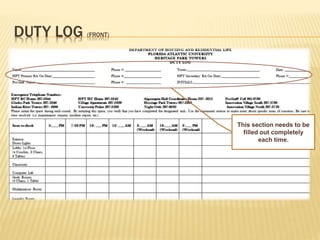
DUTY LOG (FRONT)
This section needs to be
filled out completely
each time.
DUTY LOG (FRONT)
Each round needs to be
initialed for each item.
DUTY LOG (FRONT)
Use the comments section to write out all issues.
Please remember to submit IR’s or Work Orders. Do
not assume that writing in the comments it will be
taken care of.
DUTY LOG (BACK)
Use this section to briefly cite
incidents that have occurred while on
duty.
DUTY LOG (BACK)
Use this section to cite any work
orders submitted while on duty.
ROUND EXPECTATIONS
• The following are areas that you should be checking
while On-Call
• Safety equipment
• Maintenance issues/repairs
• Common areas
• Lock doors
• Propped doors
• Remove old fliers
• Perimeter/courtyard
• Hazards & Policies
ROUND EXPECTATIONS
• Keep Grad On-Call informed on appropriate
situations. Refer to incident response protocol.
• Be sure to document everything. Not only will it help
you write more detailed and accurate Incident
Reports but it will help when an incident needs to be
referred to by ProStaff or the Police.
ROUND TIMES
Weekdays (Sun-Thu)
• Rounds are 5pm, 7:30pm, and
10pm
• 1 RA will sit desk 5pm-7:30pm, 1
RA will conduct rounds
• At 7:30pm the two RA’s will
switch rolls
• 1 RA will sit desk 7:30pm-10pm, 1
RA will conduct rounds
Weekends (Fri-Sat)
• Rounds are at 5pm, 7pm, 9pm and
11pm
• RA’s will conduct rounds together
• No RA will be required to sit desk
COMMUNITY SERVICE OFFICERS
• As an RA you should be aware that CSO’s will be
conducting rounds throughout the residence
halls.
• CSO’s will be in the buildings daily 10pm to 3am
• CSO’s will contact RA’s on-call when they sight a
policy violation.
• CSO’s will confront law enforcement issues
KEYS
• Every RA is given a Sequence Key that will give
you access to a Master Key
• These keys are used for lock-outs, room-checks
and emergency situations
• It is very important to never lose or misplace a
Sequence or Master key
• Loss of any one of these keys can result in corrective
action, including termination and the cost to replace
the keys and locks
SEQUENCE & MASTER KEY
• The master key can be
found in a designated
area of your building.
• Use the sequence key to
unlock the master key
LOCK OUTS
• 8:00AM-4:30PM: DA and AAD take care of lock outs
• 4:45PM-8:00AM: RA on Duty takes care of lock outs
• When an RA receives a lock out call they should:
• Report to the front desk to fill out lock out paper work
• Retrieve the Master Key using the Sequence key
• Walk the resident to their room and unlock the door for them
• The Master Key should never be given out!
ON-CALL SWITCHES
• This will vary with each building. ProStaff of your building will inform
you how to do this in your building.
• Some will require physical paperwork while others will use electronic
forms
• It is your responsibility to find someone to switch with you. It is not the
responsibility of ProStaff to find a switch for you.
• Never assume your On-Call switch is approved. Make sure you do not
make alternative plans until you get an official approval.
• You can not make partial switches or have someone hold the phone for
you. If you are On-Call then it is 100% your responsibility to be in your
area and hold the phone.

Duty protocol spring 2014 (blackboard)

  • 1.
  • 2.
    ON-CALL • What isthe purpose of RA’s On-Call? • To ensure the safety and welfare of the building and its residents • To enforce University and Housing Policies • REMEMBER! As an RA you represent FAU. Not only is it your duty to enforce policy you need to abide by it as well
  • 3.
    ON-CALL STRUCTURE • 2RAs On-Call each night • Weekdays (Sunday through Thursday) - 4:45PM-8:00AM • Weekends (Fridays through Saturdays) - 4:45PM-4:45PM • CANNOT leave your area or have someone else hold the phone. This means you can’t go to the Café or hang out in another building. • Know your building. Become familiar with: • Your buildings room types • Who is trespassed • Where the fire safety equipment is located • Where the trouble spots are. Specifically where students tend to smoke drink or lack of surveillance • Custodial closets and other maintenance areas • All of these will help you be better prepared during rounds and when responding to incidents. • If you are 21 or over you are not allowed to consume alcohol prior to or while On-Call. • Remember to always stay calm, cool, and collected • Remember your training. As an RA you have been trained on how to respond to incidents and crisis. But even the best of us forget details and steps in the heat of the moment. It’s a good idea to review On-Call protocols before your shift. Don’t forget that you always have the RA binder to refer to while On-Call. • You are never alone while On-Call. You will always have someone to call if you have questions or need assistance with a situation. Such as a Co-RA, ProStaff, or the Police Department
  • 4.
    HOLIDAY AND BREAKON-CALL STRUCTURE • Most residence halls are open 24/7, 365 days of the year • RA contract ends in December and begins again in January • RA’s will need to return early to assist with opening • RA’s will have the opportunity to work during winter break for a stipend.
  • 5.
    PREPARATION • You needto be prepared to be On-Call • Get plenty of rest. • Eat BEFORE 4:45PM. You will not be able to leave the building • Try to complete academic responsibilities before duty begins • Expect the unexpected. You could have a night with no calls or a night where you never stop responding to incidents. This is why it’s important to take care of yourself prior to being On-Call
  • 6.
    ARRIVING ON SHIFT •Change into FAU Housing Attire (shirt, name tag, closed toed shoes) • Pick up the On-Call phone and binder at the area desk • Text Grad on Duty for your area (East or West) • Change Duty Boards (Name & Room Extension ) • Change Voicemail at the Area Desk • Wait at the desk until the Grad on call calls you • Begin On-Call Rounds
  • 7.
    ON-CALL BINDER • TheOn-Call Binder is your go-to resource for questions and forms while On-Call. • The On-Call Binder contains: • Building Roster • Scratch Paper • Writing Utensil • Duty Logs • Housing Resources (i.e. On-Call Protocol) • You must carry the Binder with you at all times while On-Call
  • 8.
    DUTY LOGS • Dutylogs should be used to document what happens while On-Call • Duty logs must be completed every night while On-Call. • Duty logs must be submitted to Prostaff by 8am on weekdays and 5pm on weekends. • Duty logs are located in the On-Call Binder • If you are out of duty logs be sure to notify building ProStaff as soon as possible to get replacements • Example of a duty log can be found on the following slides
  • 9.
    DUTY LOG (FRONT) Thissection needs to be filled out completely each time.
  • 10.
    DUTY LOG (FRONT) Eachround needs to be initialed for each item.
  • 11.
    DUTY LOG (FRONT) Usethe comments section to write out all issues. Please remember to submit IR’s or Work Orders. Do not assume that writing in the comments it will be taken care of.
  • 12.
    DUTY LOG (BACK) Usethis section to briefly cite incidents that have occurred while on duty.
  • 13.
    DUTY LOG (BACK) Usethis section to cite any work orders submitted while on duty.
  • 14.
    ROUND EXPECTATIONS • Thefollowing are areas that you should be checking while On-Call • Safety equipment • Maintenance issues/repairs • Common areas • Lock doors • Propped doors • Remove old fliers • Perimeter/courtyard • Hazards & Policies
  • 15.
    ROUND EXPECTATIONS • KeepGrad On-Call informed on appropriate situations. Refer to incident response protocol. • Be sure to document everything. Not only will it help you write more detailed and accurate Incident Reports but it will help when an incident needs to be referred to by ProStaff or the Police.
  • 16.
    ROUND TIMES Weekdays (Sun-Thu) •Rounds are 5pm, 7:30pm, and 10pm • 1 RA will sit desk 5pm-7:30pm, 1 RA will conduct rounds • At 7:30pm the two RA’s will switch rolls • 1 RA will sit desk 7:30pm-10pm, 1 RA will conduct rounds Weekends (Fri-Sat) • Rounds are at 5pm, 7pm, 9pm and 11pm • RA’s will conduct rounds together • No RA will be required to sit desk
  • 17.
    COMMUNITY SERVICE OFFICERS •As an RA you should be aware that CSO’s will be conducting rounds throughout the residence halls. • CSO’s will be in the buildings daily 10pm to 3am • CSO’s will contact RA’s on-call when they sight a policy violation. • CSO’s will confront law enforcement issues
  • 18.
    KEYS • Every RAis given a Sequence Key that will give you access to a Master Key • These keys are used for lock-outs, room-checks and emergency situations • It is very important to never lose or misplace a Sequence or Master key • Loss of any one of these keys can result in corrective action, including termination and the cost to replace the keys and locks
  • 19.
    SEQUENCE & MASTERKEY • The master key can be found in a designated area of your building. • Use the sequence key to unlock the master key
  • 20.
    LOCK OUTS • 8:00AM-4:30PM:DA and AAD take care of lock outs • 4:45PM-8:00AM: RA on Duty takes care of lock outs • When an RA receives a lock out call they should: • Report to the front desk to fill out lock out paper work • Retrieve the Master Key using the Sequence key • Walk the resident to their room and unlock the door for them • The Master Key should never be given out!
  • 21.
    ON-CALL SWITCHES • Thiswill vary with each building. ProStaff of your building will inform you how to do this in your building. • Some will require physical paperwork while others will use electronic forms • It is your responsibility to find someone to switch with you. It is not the responsibility of ProStaff to find a switch for you. • Never assume your On-Call switch is approved. Make sure you do not make alternative plans until you get an official approval. • You can not make partial switches or have someone hold the phone for you. If you are On-Call then it is 100% your responsibility to be in your area and hold the phone.