Bystander intervention[1]
Online catch-up module
• To complete this module, read through the materials, then
complete the relevant quiz on Blackboard.
• In order to answer all of the questions on the quiz, you will
need to read through all of the information, including the
linked resources.
Welcome to the online module
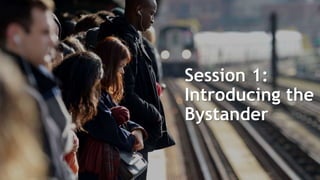
Session 1:
Introducing the
Bystander
By the end of this online catch-up session, you will be able to:
• Understand the concept of bystander intervention.
• Understand the problems associated with sexual assault and
domestic violence in student populations.
• Speak out against violence as an active bystander.
Session objectives
Who is a bystander?
• Someone who witnesses an event.
• Someone who is not involved in the event.
• i.e. They are not a victim or a perpetrator.
• There are two types of bystander:
• Passive bystanders
• Active/prosocial bystanders
It’s a lovely sunny day and you are sitting by the river on your
own, no one else is around. Suddenly you hear splashing and
screaming for help. A person is caught in the current and
drowning.[2]
You are the bystander. There is no mobile phone signal.
You can swim. There is a life ring on the riverbank.
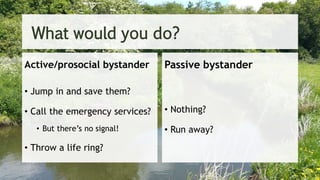
What would you do?
Active/prosocial bystander
• Jump in and save them?
• Call the emergency services?
• But there’s no signal!
• Throw a life ring?
Passive bystander
• Nothing?
• Run away?
What would you do?
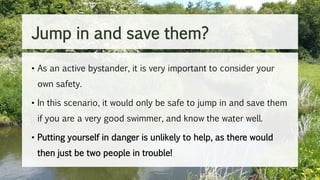
• As an active bystander, it is very important to consider your
own safety.
• In this scenario, it would only be safe to jump in and save them
if you are a very good swimmer, and know the water well.
• Putting yourself in danger is unlikely to help, as there would
then just be two people in trouble!
Jump in and save them?
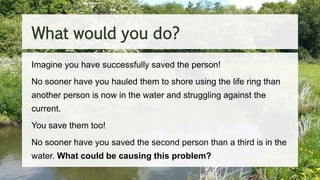
Imagine you have successfully saved the person!
No sooner have you hauled them to shore using the life ring than
another person is now in the water and struggling against the
current.
You save them too!
No sooner have you saved the second person than a third is in the
water. What could be causing this problem?
What would you do?
What would you do?
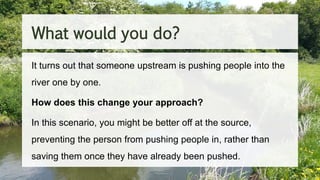
It turns out that someone upstream is pushing people into the
river one by one.
How does this change your approach?
In this scenario, you might be better off at the source,
preventing the person from pushing people in, rather than
saving them once they have already been pushed.
An active bystander can intervene in a number of ways:
1. Helping to deal with potential outcomes of an event.
2. Stopping the events while they are happening
3. Preventing the events before they happen
Being an active bystander
Have you ever been in a situation where you have been a
bystander and something problematic has happened?
Try to think of a time when you did intervene and a time that
you did not.
Being an active bystander
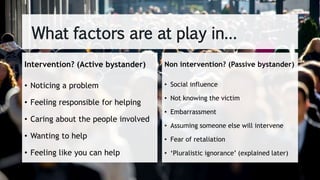
• Noticing a problem
• Feeling responsible for helping
• Caring about the people involved
• Wanting to help
• Feeling like you can help
Intervention? (Active bystander)
• Social influence
• Not knowing the victim
• Embarrassment
• Assuming someone else will intervene
• Fear of retaliation
• ‘Pluralistic ignorance’ (explained later)
Non intervention? (Passive bystander)
What factors are at play in…
Video: The Bystander Effect
• Interventions may be relatively small acts which don’t need
to be confrontational.
• Various techniques and forms of intervention are outlined
in the document: ‘Some Bystander Intervention Strategies’
on Blackboard.
Intervention doesn’t mean confrontation
• Body language signalling disapproval
• Distraction
• Interruption
• Facebook post
• Choosing not to laugh at a joke
• Being supportive to friends
Intervention doesn’t mean confrontation
Stages of intervention
Research shows that there are 4 stages that are necessary for intervention to
occur.
1. Notice the event
2. Interpret the event as a problem
3. Feel responsible for dealing with it
4. Possess the necessary skills to act.[3]
Non-intervention occurs when one or more of these stages is not present.
Why don’t we
intervene?
1. Social influence and social identity
‘No one else is doing anything so I shouldn’t either’
‘I don’t feel a connection to the victim’
2. Fear of embarrassment
Audience inhibition – not wanting to look foolish in front of others.
3. Diffusion of responsibility
Assumption that someone else will intervene when others are present.
4. Fear of retaliation
Concerns about physical harm or negative reactions from others.
5. Pluralistic ignorance
Social norms theory: wrongly believing that you are the only one who
thinks the behaviour is wrong, and therefore doing nothing.[3]
False consensus
• Occurs when the problematic person believes that others would
do the same thing, when in fact they would not.
• This, combined with pluralistic ignorance, is ‘mutually
reinforcing’ of negative behaviour.
• The problematic person incorrectly believes they are in the
majority due to false consensus, while the real majority is silent
due to pluralistic ignorance.
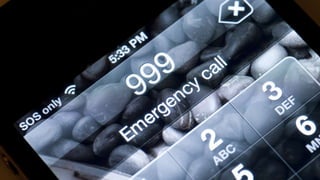
• Only intervene when it is safe to do so.
• In an emergency, if it is not safe, dial 999.
• Throughout this course, you will learn how to make safe,
unthreatening interventions without putting yourself in danger.
• Sometimes, the best way to intervene is to wait for a better
opportunity, or get in touch with a professional who can handle
things safely.
Golden rule of intervention:
This course is specifically about bystander intervention in sexual
violence and domestic violence.
Why is this relevant to students?
• 77% of students have
experienced sexual
harassment once or more
during their time at
university.[4]
Why is this relevant to students?
• 28.5% of students have
experienced sexual assault.[4]
Why is this relevant to students?
• Of those students who have experienced
rape, sexual assault, violence or stalking,
85% report a negative impact on their
mental health.[4]
Why is this relevant to students?
• 91% of perpetrators of sexual
assault were male.[4]
Key points
• Domestic abuse, sexual coercion and rape in student populations are a serious
and widespread problem, and we can be part of the solution!
• Anyone can experience the trauma of being in an abusive relationship or situation
and anyone can be an abuser.
• The majority of victims are women and the majority of perpetrators are men.
• This doesn’t mean that most men are offenders or that no women are offenders.
• Both men and women can feel resistant to this message about
gender.
• It is important to note that we are not pointing the finger at men as
abusers.
• In fact, the vast majority of people of any gender are not abusers,
but we can work to prevent the negative behaviour of the minority.
The gender debate
Role play 1: Calling the police
Read through the role play and think about the following
questions:
• What different ways does Kofi try to intervene?
• How do you think you would have reacted to this situation? Would you
have done anything differently?
• Was Kofi right to call the police?
Remember: Only ever intervene when it is safe to do so!
Violence is everyone’s problem
• Violence directly impacts many people, including those we love
and care about.
• When adding up the costs of absence from work, NHS, police,
prosecution, courts, social services etc. the estimated cost to
society of domestic violence is around £23 billion a year.
• We can be part of the solution by being active bystanders!
By the end of this online catch-up session, you will be able to:
• Understand the concept of bystander intervention.
• Understand the problems associated with sexual assault and
domestic violence in student populations.
• Speak out against violence as an active bystander.
Session objectives
1. Fenton, R. A., Mott, H. L., McCartan, K. and Rumney, P. (2014). The Intervention Initiative. Bristol: UWE and
Public Health England. Online at www.uwe.ac.uk/bl/research/InterventionInitiative.
2. (Adapted from Crapser, B. G., & Stewart, A. L. (2014). Men's Project: Sexual assault prevention program for
college men program manual. Storrs, CT: University of Connecticut, pp.26-27).
3. Adapted from Berkowitz, A. (2009) Response Ability: A Complete Guide to Bystander Intervention, Beck &
Co.)
4. CUSU (Cambridge University Students' Union) (2014). Cambridge Speaks Out. Cambridge: CUSU
Women's Campaign. Online at
http://www.womens.cusu.cam.ac.uk/Cambridge%20Speaks%20Out%20Report%202014.pdf
References

Session 1 introducing the bystander [autosaved]

  • 1.
  • 2.
    • To completethis module, read through the materials, then complete the relevant quiz on Blackboard. • In order to answer all of the questions on the quiz, you will need to read through all of the information, including the linked resources. Welcome to the online module
  • 3.
  • 5.
    By the endof this online catch-up session, you will be able to: • Understand the concept of bystander intervention. • Understand the problems associated with sexual assault and domestic violence in student populations. • Speak out against violence as an active bystander. Session objectives
  • 7.
    Who is abystander? • Someone who witnesses an event. • Someone who is not involved in the event. • i.e. They are not a victim or a perpetrator. • There are two types of bystander: • Passive bystanders • Active/prosocial bystanders
  • 9.
    It’s a lovelysunny day and you are sitting by the river on your own, no one else is around. Suddenly you hear splashing and screaming for help. A person is caught in the current and drowning.[2] You are the bystander. There is no mobile phone signal. You can swim. There is a life ring on the riverbank. What would you do?
  • 10.
    Active/prosocial bystander • Jumpin and save them? • Call the emergency services? • But there’s no signal! • Throw a life ring? Passive bystander • Nothing? • Run away? What would you do?
  • 11.
    • As anactive bystander, it is very important to consider your own safety. • In this scenario, it would only be safe to jump in and save them if you are a very good swimmer, and know the water well. • Putting yourself in danger is unlikely to help, as there would then just be two people in trouble! Jump in and save them?
  • 12.
    Imagine you havesuccessfully saved the person! No sooner have you hauled them to shore using the life ring than another person is now in the water and struggling against the current. You save them too! No sooner have you saved the second person than a third is in the water. What could be causing this problem? What would you do?
  • 13.
    What would youdo? It turns out that someone upstream is pushing people into the river one by one. How does this change your approach? In this scenario, you might be better off at the source, preventing the person from pushing people in, rather than saving them once they have already been pushed.
  • 14.
    An active bystandercan intervene in a number of ways: 1. Helping to deal with potential outcomes of an event. 2. Stopping the events while they are happening 3. Preventing the events before they happen Being an active bystander
  • 15.
    Have you everbeen in a situation where you have been a bystander and something problematic has happened? Try to think of a time when you did intervene and a time that you did not. Being an active bystander
  • 16.
    • Noticing aproblem • Feeling responsible for helping • Caring about the people involved • Wanting to help • Feeling like you can help Intervention? (Active bystander) • Social influence • Not knowing the victim • Embarrassment • Assuming someone else will intervene • Fear of retaliation • ‘Pluralistic ignorance’ (explained later) Non intervention? (Passive bystander) What factors are at play in…
  • 17.
  • 19.
    • Interventions maybe relatively small acts which don’t need to be confrontational. • Various techniques and forms of intervention are outlined in the document: ‘Some Bystander Intervention Strategies’ on Blackboard. Intervention doesn’t mean confrontation
  • 20.
    • Body languagesignalling disapproval • Distraction • Interruption • Facebook post • Choosing not to laugh at a joke • Being supportive to friends Intervention doesn’t mean confrontation
  • 21.
    Stages of intervention Researchshows that there are 4 stages that are necessary for intervention to occur. 1. Notice the event 2. Interpret the event as a problem 3. Feel responsible for dealing with it 4. Possess the necessary skills to act.[3] Non-intervention occurs when one or more of these stages is not present.
  • 22.
  • 23.
    1. Social influenceand social identity ‘No one else is doing anything so I shouldn’t either’ ‘I don’t feel a connection to the victim’
  • 24.
    2. Fear ofembarrassment Audience inhibition – not wanting to look foolish in front of others.
  • 25.
    3. Diffusion ofresponsibility Assumption that someone else will intervene when others are present.
  • 26.
    4. Fear ofretaliation Concerns about physical harm or negative reactions from others.
  • 27.
    5. Pluralistic ignorance Socialnorms theory: wrongly believing that you are the only one who thinks the behaviour is wrong, and therefore doing nothing.[3]
  • 28.
    False consensus • Occurswhen the problematic person believes that others would do the same thing, when in fact they would not. • This, combined with pluralistic ignorance, is ‘mutually reinforcing’ of negative behaviour. • The problematic person incorrectly believes they are in the majority due to false consensus, while the real majority is silent due to pluralistic ignorance.
  • 29.
    • Only intervenewhen it is safe to do so. • In an emergency, if it is not safe, dial 999. • Throughout this course, you will learn how to make safe, unthreatening interventions without putting yourself in danger. • Sometimes, the best way to intervene is to wait for a better opportunity, or get in touch with a professional who can handle things safely. Golden rule of intervention:
  • 30.
    This course isspecifically about bystander intervention in sexual violence and domestic violence.
  • 32.
    Why is thisrelevant to students? • 77% of students have experienced sexual harassment once or more during their time at university.[4]
  • 33.
    Why is thisrelevant to students? • 28.5% of students have experienced sexual assault.[4]
  • 34.
    Why is thisrelevant to students? • Of those students who have experienced rape, sexual assault, violence or stalking, 85% report a negative impact on their mental health.[4]
  • 35.
    Why is thisrelevant to students? • 91% of perpetrators of sexual assault were male.[4]
  • 37.
    Key points • Domesticabuse, sexual coercion and rape in student populations are a serious and widespread problem, and we can be part of the solution! • Anyone can experience the trauma of being in an abusive relationship or situation and anyone can be an abuser. • The majority of victims are women and the majority of perpetrators are men. • This doesn’t mean that most men are offenders or that no women are offenders.
  • 38.
    • Both menand women can feel resistant to this message about gender. • It is important to note that we are not pointing the finger at men as abusers. • In fact, the vast majority of people of any gender are not abusers, but we can work to prevent the negative behaviour of the minority. The gender debate
  • 40.
    Role play 1:Calling the police Read through the role play and think about the following questions: • What different ways does Kofi try to intervene? • How do you think you would have reacted to this situation? Would you have done anything differently? • Was Kofi right to call the police? Remember: Only ever intervene when it is safe to do so!
  • 41.
    Violence is everyone’sproblem • Violence directly impacts many people, including those we love and care about. • When adding up the costs of absence from work, NHS, police, prosecution, courts, social services etc. the estimated cost to society of domestic violence is around £23 billion a year. • We can be part of the solution by being active bystanders!
  • 43.
    By the endof this online catch-up session, you will be able to: • Understand the concept of bystander intervention. • Understand the problems associated with sexual assault and domestic violence in student populations. • Speak out against violence as an active bystander. Session objectives
  • 44.
    1. Fenton, R.A., Mott, H. L., McCartan, K. and Rumney, P. (2014). The Intervention Initiative. Bristol: UWE and Public Health England. Online at www.uwe.ac.uk/bl/research/InterventionInitiative. 2. (Adapted from Crapser, B. G., & Stewart, A. L. (2014). Men's Project: Sexual assault prevention program for college men program manual. Storrs, CT: University of Connecticut, pp.26-27). 3. Adapted from Berkowitz, A. (2009) Response Ability: A Complete Guide to Bystander Intervention, Beck & Co.) 4. CUSU (Cambridge University Students' Union) (2014). Cambridge Speaks Out. Cambridge: CUSU Women's Campaign. Online at http://www.womens.cusu.cam.ac.uk/Cambridge%20Speaks%20Out%20Report%202014.pdf References