Embryonic stem cells – Promises and Issues
Introduction
Embryonic stem cells are stem cells derived from the inner cell mass of human embryos. They are
called pluripotent stem cells as they can grow and can differentiate into all three primary germ
layers – Ectoderm, Endoderm and Mesoderm. These type of cells have the property to differentiate
indefinitely which makes tem unique in nature. They have the ability to differentiate as about 200
different adult human cells.
The proliferative and developmental potential of the human embryonic stem cells promises
unlimited supply of specific cell types for basic research and for transplantation therapies of
diseases ranging from heart disease to Parkinson's disease to leukemia and what not.
Embryonic Stem Cells
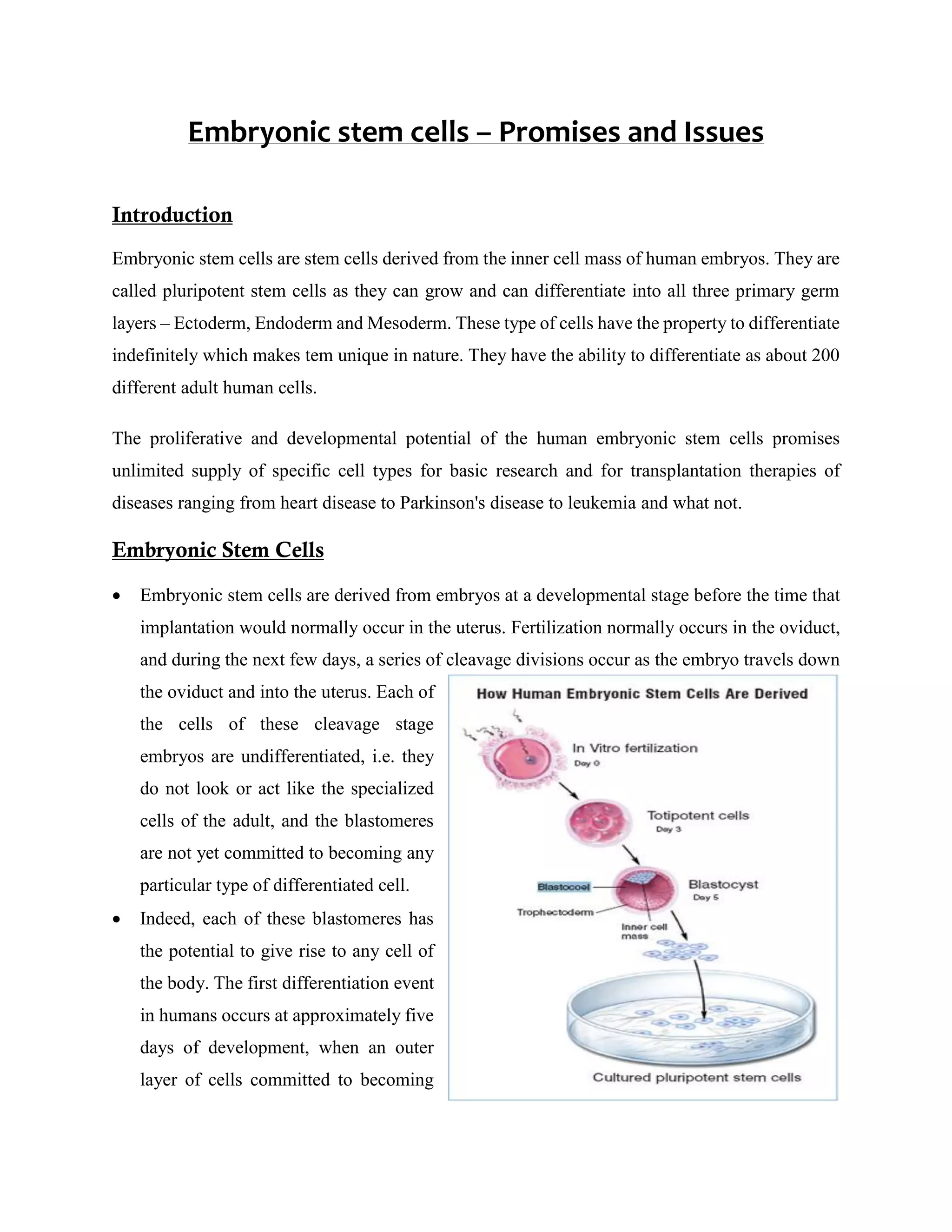
 Embryonic stem cells are derived from embryos at a developmental stage before the time that
implantation would normally occur in the uterus. Fertilization normally occurs in the oviduct,
and during the next few days, a series of cleavage divisions occur as the embryo travels down
the oviduct and into the uterus. Each of
the cells of these cleavage stage
embryos are undifferentiated, i.e. they
do not look or act like the specialized
cells of the adult, and the blastomeres
are not yet committed to becoming any
particular type of differentiated cell.
 Indeed, each of these blastomeres has
the potential to give rise to any cell of
the body. The first differentiation event
in humans occurs at approximately five
days of development, when an outer
layer of cells committed to becoming
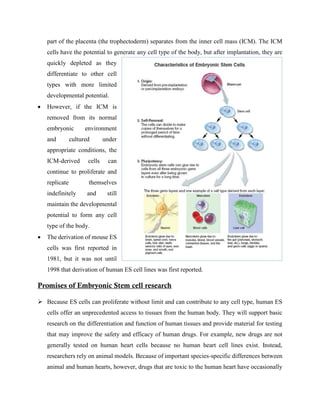
part of the placenta (the trophectoderm) separates from the inner cell mass (ICM). The ICM
cells have the potential to generate any cell type of the body, but after implantation, they are
quickly depleted as they
differentiate to other cell
types with more limited
developmental potential.
 However, if the ICM is
removed from its normal
embryonic environment
and cultured under
appropriate conditions, the
ICM-derived cells can
continue to proliferate and
replicate themselves
indefinitely and still
maintain the developmental
potential to form any cell
type of the body.
 The derivation of mouse ES
cells was first reported in
1981, but it was not until
1998 that derivation of human ES cell lines was first reported.
Promises of Embryonic Stem cell research
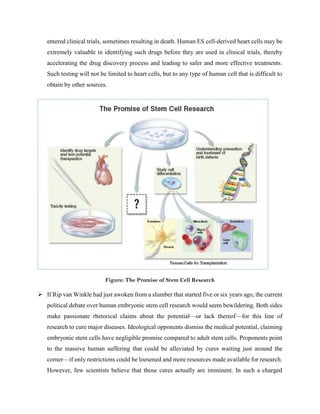
 Because ES cells can proliferate without limit and can contribute to any cell type, human ES
cells offer an unprecedented access to tissues from the human body. They will support basic
research on the differentiation and function of human tissues and provide material for testing
that may improve the safety and efficacy of human drugs. For example, new drugs are not
generally tested on human heart cells because no human heart cell lines exist. Instead,
researchers rely on animal models. Because of important species-specific differences between
animal and human hearts, however, drugs that are toxic to the human heart have occasionally
entered clinical trials, sometimes resulting in death. Human ES cell-derived heart cells may be
extremely valuable in identifying such drugs before they are used in clinical trials, thereby
accelerating the drug discovery process and leading to safer and more effective treatments.
Such testing will not be limited to heart cells, but to any type of human cell that is difficult to
obtain by other sources.
Figure: The Promise of Stem Cell Research
 If Rip van Winkle had just awoken from a slumber that started five or six years ago, the current
political debate over human embryonic stem cell research would seem bewildering. Both sides
make passionate rhetorical claims about the potential—or lack thereof—for this line of
research to cure major diseases. Ideological opponents dismiss the medical potential, claiming
embryonic stem cells have negligible promise compared to adult stem cells. Proponents point
to the massive human suffering that could be alleviated by cures waiting just around the
corner—if only restrictions could be loosened and more resources made available for research.
However, few scientists believe that those cures actually are imminent. In such a charged
climate, disabusing supporters of such ideas may seem like giving ground to the opposition,
but allowing a mismatch between expectation and reality to flourish may be even more
dangerous in the long run.
 The promise of cell replacement therapy using stem cells is clear. Most scientists accept that
embryonic stem cells, which have the unique ability to turn into any kind of cell, have
enormous promise for replacing neurons lost to neurodegenerative disease. Opponents argue
that adult stem cells have already proven to be just as useful as embryonic cells, but it remains
controversial whether non-neural adult stem cells can turn into real neurons. In contrast, normal
brain development leaves no doubt that embryonic cells can become neurons in the appropriate
context.
 In Parkinson disease, and to a lesser extent, Huntington disease, clinical trials of fetal tissue
transplantation have provided a proof of principle that cell replacement can work.
Dopaminergic neurons from human fetal tissue survive in patients' brains, and take over the
function of neurons lost to disease. Some patients show encouraging reduction of symptoms,
and the grafted neurons have survived as long as ten years. These clinical improvements have
been accomplished with tissue derived from aborted fetuses, which is often obtained under
non-optimal scientific circumstances. Neurons derived under controlled circumstances would
undeniably accelerate these efforts, but Anders of Lund University cautions that supply is only
one immediate problem. Once the cells become available, he stresses, systematic research
would still be needed to ensure a safe, effective treatment. "Even if the cells were to become
available tomorrow, we would not have a therapy immediately. The field would simply enter
a new phase of research."
 In both these diseases, a clearly localized population of neurons is degenerating, and so
targeted replacement is a straightforward solution. For other neurodegenerative disorders, such
as Alzheimer disease, in which the affected population of neurons is less well defined, or
amyotrophic lateral sclerosis, in which the new motor neurons would have to navigate very
long distances to their eventual targets, an effective cell replacement therapy is likely to be
further in the future.
 Our understanding of the developmental biology of human embryonic stem cells is increasing
steadily. Scientists are able to stimulate human embryonic cells in vitro into taking on the
chemical, structural and even electrophysiological characteristics of neurons. More
importantly, when injected into developing mice, these cells appear to become neurons and
glia. These are promising findings, and clearly show the potential of human embryonic stem
cells. But scientists caution that outside the human embryo, these newly born neurons lack the
environmental cues that enable them to mature normally, and it will probably take years of
research before embryonic cells will be ready to be injected into adult humans.
 Stem cell research also has wide potential beyond cell replacement that seems often to go under
the radar of the public and many scientists. Stem cell cultures provide a unique opportunity for
scientists to study almost every aspect of human biology, from development to gene function.
Cells can be genetically modified or infected to create models for studying disease mechanisms
or for drug screening. This potential should not be ignored.
 Given the great possibilities of this field, it must be encouraged to mature under supportive but
responsible conditions. In the United States, the government funding situation is anything but.
Three years ago President Bush made a decision to restrict government research funding to
certain cell lines created before September 2001, and the administration assured the public that
this would provide an ample supply of cells. Despite initial claims that over 70 lines would be
eligible, most have turned out to be unsuitable or have died, and the National Institutes of
Health website now lists just 12 cell lines available for purchase. Further hampering research,
all the lines eligible for federal funding are grown on mouse cells, which some scientists feel
seriously compromises their utility in clinical applications.
 With no guaranteed relief from these restrictions in sight, we applaud the efforts of those in
the United States who are pushing the research ahead without federal funding. This November,
voters in California will decide on Proposition 71, a $3 billion initiative for stem cell research.
New Jersey recently passed a law permitting stem cell research and has already raised $11
million in start-up funds for a new stem cell research center. Several universities have raised
donations to fund their own stem cell institutes, including the University of Wisconsin at
Madison, Rockefeller and Harvard, where this journal's former editor Charles Jennings is now
executive director. Clearly, there are many in the public who are willing to invest in this
scientific effort.
 These are exciting times, but as scientists around the world solicit public support, both political
and financial, for embryonic stem cell research, we encourage moderation in promising rapid
clinical cures. In the current politically charged atmosphere, rash promises will ultimately be
detrimental. Small scientific setbacks are used by ideological opponents as ammunition, and
they run the risk of disillusioning supporters whose hopes were falsely raised. The realistic
scientific potential of embryonic stem cells should be argument enough for pushing this line
of research forward.
Issues in Embryonic Stem cells
New discoveries in stem cell biology will soon bring revolutionary changes in the way physicians
approach degenerative diseases, wound repair, autoimmune conditions, cancer, and reproductive
medicine. Stem cells are self-renewing cells capable of producing many different cell types. Adult
stem cells do well in repairing their organ of origin but have limited capabilities in self-renewal
and distant organ repair under normal physiologic conditions. The degree of plasticity potential of
the adult stem cell has yet to be determined. Embryonic stem cells have tremendous therapeutic
and research potential to produce any tissue of the body and to grow unperturbed in plastic culture
dishes for many years. Stem cells currently are used in transplantation regimens to repair wounded
organs. They are also used experimentally in toxicity studies to test drug safety, cancer
investigations to pinpoint methods of unregulated growth, and reproduction protocols to identify
critical steps in fertility and pregnancy. However, along with these remarkable abilities, use of
stem cells carries many ethical challenges.
 New embryonic stem cell lines from frozen embryos
Women and couples who undergo infertility treatment often have frozen embryos remaining after
they complete their infertility treatment. The disposition of these frozen embryos is often a difficult
decision for them to make. Some choose to donate these remaining embryos to research rather than
giving them to another couple for reproductive purposes or destroying them. Several ethical
concerns come into play when a frozen embryo is donated, including informed consent from the
woman or couple donating the embryo, consent from gamete donors involved in the creation of
the embryo, and the confidentiality of donor information.
 Informed consent for donation of materials for stem cell research
Since the Nuremburg Code, informed consent has been regarded as a basic requirement for
research with human subjects. Consent is particularly important in research with human embryos.
Members of the public and potential donors of embryos for research hold strong and diverse
opinions on the matter. Some consider all embryo research to be unacceptable; others only support
some forms of research. For instance, a person might consider infertility research acceptable but
object to research to derive stem cell lines or research that might lead to patents or commercial
products. Obtaining informed consent for potential future uses of the donated embryo respects this
diversity of views. Additionally, people commonly place special emotional and moral significance
on their reproductive materials, compared with other tissues.
 Waiver of consent
In the United States, federal regulations on research permit a waiver of informed consent for the
research use of deidentified biological materials that cannot be linked to donors. Thus, logistically
it would be possible to carry out embryo and stem cell research on deidentified materials without
consent. For example, during IVF procedures, oocytes that fail to fertilize or embryos that fail to
develop sufficiently to be implanted are ordinarily discarded. These materials could be deidentified
and then used by researchers. Furthermore, if infertility patients have frozen embryos remaining
after they complete treatment, they are routinely contacted by the IVF program to decide whether
they want to continue to store the embryos (and to pay freezer storage fees), to donate them to
another infertile woman or couple, or to discard them. If a patient chooses to discard the embryos,
it would be possible to instead remove identifiers and use them for research. Still another
possibility involves frozen embryos from patients who do not respond to requests to make a
decision regarding the disposition of frozen embryos. Again, rather than discard such frozen
embryos, it is logistically feasible to deidentify them and give them to researchers. Donors might
be offended or feel wronged if their frozen embryos were used for research that they did not
consent to. Deidentifying the materials would not address their concerns.
 Consent from gamete donors
Frozen embryos may be created with sperm or oocytes from donors who do not participate any
further in assisted reproduction or childrearing. Some people argue that consent from gamete
donors is not required for embryo research because they have ceded their right to direct further
usage of their gametes to the artificial reproductive technology (ART) patients. However, gamete
donors who are willing to help women and couples bear children may object to the use of their
genetic materials for research. In one study, 25% of women who donated oocytes for infertility
treatment did not want the embryos created to be used for research. This percentage is not
unexpected because reproductive materials have special significance, and many people in the
United States oppose embryo research. Little is known about the wishes of sperm donors
concerning research. Furthermore, sperm is often donated anonymously to sperm banks, with strict
confidentiality provisions.
 Confidentiality of donor information
Confidentiality must be carefully protected in embryo and hESC research because breaches of
confidentiality might subject donors to unwanted publicity or even harassment by opponents of
hESC research. Although identifying information about donors must be retained in case of audits
by the Food and Drug Administration as part of the approval process for new therapies, concerns
about confidentiality may deter some donors from agreeing to be recontacted.
 Ethical concerns about oocyte donation for research
Concerns about oocyte donation specifically for research are particularly serious in the wake of
the Hwang scandal in South Korea, in which widely hailed claims of deriving human SCNT lines
were fabricated. In addition to scientific fraud, the scandal involved inappropriate payments to
oocyte donors, serious deficiencies in the informed consent process, undue influence on staff and
junior scientists to serve as donors, and an unacceptably high incidence of medical complications
from oocyte donation. In California, some legislators and members of the public have charged that
infertility clinics downplay the risks of oocyte donation. CIRM has put in place several protections
for women donating oocytes in state-funded stem cell research.
1. Medical risks of oocyte retrieval
The medical risks of oocyte retrieval include ovarian hyperstimulation syndrome, bleeding,
infection, and complications of anesthesia. These risks may be minimized by the exclusion of
donors at high-risk for these complications, careful monitoring of the number of developing
follicles, and adjusting the dose of human chorionic gonadotropin administered to induce ovulation
or canceling the cycle.
Because severe hyperovulation syndrome may require hospitalization or surgery, women donating
oocytes for research should be protected against the costs of complications of hormonal stimulation
and oocyte retrieval. As a matter of fairness, women who undergo an invasive procedure for the
benefit of science and who are not receiving payment beyond expenses should not bear any costs
for the treatment of complications.
2. Protecting the reproductive interests of women in infertility treatment
If women in infertility treatment share oocytes with researchers—either their own oocytes or those
from an oocyte donor—their prospect of reproductive success may be compromised because fewer
oocytes are available for reproductive purposes. In this situation, the physician carrying out oocyte
retrieval and infertility care should give priority to the reproductive needs of the patient in IVF.
The highest quality oocytes should be used for reproductive purposes.
3. Payment to oocyte donors
Many jurisdictions have conflicting policies about payment to oocyte donors. Reimbursement to
oocyte donors for out-of-pocket expenses presents no ethical problems because donors gain no
financial advantage from participating in research. However, payment to oocyte donors in excess
of reasonable out-of-pocket expenses is controversial, and jurisdictions have conflicting policies
that may also be internally inconsistent.
For example, participants could be asked questions to ensure that they understood key features of
the study and that they felt they had a choice regarding participation. Also, careful monitoring and
adjustment of hormone doses can minimize the risks associated with oocyte donation. A further
objection is that paying women who provide research oocytes undermines human dignity because
human biological materials and intimate relationships are devalued if these materials are bought
and sold like commodities.
4. Informed consent for oocyte donation
In California, CIRM has instituted heightened requirements for informed consent for oocyte
donation for research. The CIRM regulations go beyond requirements for disclosure of information
to oocyte donors. The major ethical issue is whether donors appreciate key information about
oocyte donation, not simply whether the information has been disclosed to them or not. As
discussed previously, in other research settings, research participants often fail to understand the
information in detailed consent forms. CIRM thus reasons that disclosure, while necessary, is not
sufficient to guarantee informed consent. In CIRM-funded research, oocyte donors must be asked
questions to ensure that they comprehend the key features of the research. Evaluating
comprehension is feasible because it has been carried out in other research contexts, such as in
HIV prevention trials in the developing world. According to testimony presented to CIRM,
evaluation of comprehension has also been carried out with respect to oocyte donation for clinical
infertility services.
References:
1. Rip, I., 2004. The promise of stem cells. NATURE NEUROSCIENCE, 7(10), p.1013.
2. Yu, J. and Thomson, J.A., 2006. Embryonic stem cells. Regenerative medicine, p.1.
3. Cogle, C.R., Guthrie, S.M., Sanders, R.C., Allen, W.L., Scott, E.W. and Petersen, B.E., 2003,
August. An overview of stem cell research and regulatory issues. In Mayo Clinic Proceedings (Vol.
78, No. 8, pp. 993-1003). Elsevier.
4. Magnus, D. and Cho, M.K., 2005. Issues in oocyte donation for stem cell
research. Science, 308(5729), pp.1747-1748.
5. Lo, B. and Parham, L., 2009. Ethical issues in stem cell research. Endocrine reviews, 30(3),
pp.204-213.
6. Ruse, M. and Pynes, C.A., 2003. The stem cell controversy: Debating the issues.

Embryonic stem cells – Promises and Issues

  • 1.
    Embryonic stem cells– Promises and Issues Introduction Embryonic stem cells are stem cells derived from the inner cell mass of human embryos. They are called pluripotent stem cells as they can grow and can differentiate into all three primary germ layers – Ectoderm, Endoderm and Mesoderm. These type of cells have the property to differentiate indefinitely which makes tem unique in nature. They have the ability to differentiate as about 200 different adult human cells. The proliferative and developmental potential of the human embryonic stem cells promises unlimited supply of specific cell types for basic research and for transplantation therapies of diseases ranging from heart disease to Parkinson's disease to leukemia and what not. Embryonic Stem Cells  Embryonic stem cells are derived from embryos at a developmental stage before the time that implantation would normally occur in the uterus. Fertilization normally occurs in the oviduct, and during the next few days, a series of cleavage divisions occur as the embryo travels down the oviduct and into the uterus. Each of the cells of these cleavage stage embryos are undifferentiated, i.e. they do not look or act like the specialized cells of the adult, and the blastomeres are not yet committed to becoming any particular type of differentiated cell.  Indeed, each of these blastomeres has the potential to give rise to any cell of the body. The first differentiation event in humans occurs at approximately five days of development, when an outer layer of cells committed to becoming
  • 2.
    part of theplacenta (the trophectoderm) separates from the inner cell mass (ICM). The ICM cells have the potential to generate any cell type of the body, but after implantation, they are quickly depleted as they differentiate to other cell types with more limited developmental potential.  However, if the ICM is removed from its normal embryonic environment and cultured under appropriate conditions, the ICM-derived cells can continue to proliferate and replicate themselves indefinitely and still maintain the developmental potential to form any cell type of the body.  The derivation of mouse ES cells was first reported in 1981, but it was not until 1998 that derivation of human ES cell lines was first reported. Promises of Embryonic Stem cell research  Because ES cells can proliferate without limit and can contribute to any cell type, human ES cells offer an unprecedented access to tissues from the human body. They will support basic research on the differentiation and function of human tissues and provide material for testing that may improve the safety and efficacy of human drugs. For example, new drugs are not generally tested on human heart cells because no human heart cell lines exist. Instead, researchers rely on animal models. Because of important species-specific differences between animal and human hearts, however, drugs that are toxic to the human heart have occasionally
  • 3.
    entered clinical trials,sometimes resulting in death. Human ES cell-derived heart cells may be extremely valuable in identifying such drugs before they are used in clinical trials, thereby accelerating the drug discovery process and leading to safer and more effective treatments. Such testing will not be limited to heart cells, but to any type of human cell that is difficult to obtain by other sources. Figure: The Promise of Stem Cell Research  If Rip van Winkle had just awoken from a slumber that started five or six years ago, the current political debate over human embryonic stem cell research would seem bewildering. Both sides make passionate rhetorical claims about the potential—or lack thereof—for this line of research to cure major diseases. Ideological opponents dismiss the medical potential, claiming embryonic stem cells have negligible promise compared to adult stem cells. Proponents point to the massive human suffering that could be alleviated by cures waiting just around the corner—if only restrictions could be loosened and more resources made available for research. However, few scientists believe that those cures actually are imminent. In such a charged
  • 4.
    climate, disabusing supportersof such ideas may seem like giving ground to the opposition, but allowing a mismatch between expectation and reality to flourish may be even more dangerous in the long run.  The promise of cell replacement therapy using stem cells is clear. Most scientists accept that embryonic stem cells, which have the unique ability to turn into any kind of cell, have enormous promise for replacing neurons lost to neurodegenerative disease. Opponents argue that adult stem cells have already proven to be just as useful as embryonic cells, but it remains controversial whether non-neural adult stem cells can turn into real neurons. In contrast, normal brain development leaves no doubt that embryonic cells can become neurons in the appropriate context.  In Parkinson disease, and to a lesser extent, Huntington disease, clinical trials of fetal tissue transplantation have provided a proof of principle that cell replacement can work. Dopaminergic neurons from human fetal tissue survive in patients' brains, and take over the function of neurons lost to disease. Some patients show encouraging reduction of symptoms, and the grafted neurons have survived as long as ten years. These clinical improvements have been accomplished with tissue derived from aborted fetuses, which is often obtained under non-optimal scientific circumstances. Neurons derived under controlled circumstances would undeniably accelerate these efforts, but Anders of Lund University cautions that supply is only one immediate problem. Once the cells become available, he stresses, systematic research would still be needed to ensure a safe, effective treatment. "Even if the cells were to become available tomorrow, we would not have a therapy immediately. The field would simply enter a new phase of research."  In both these diseases, a clearly localized population of neurons is degenerating, and so targeted replacement is a straightforward solution. For other neurodegenerative disorders, such as Alzheimer disease, in which the affected population of neurons is less well defined, or amyotrophic lateral sclerosis, in which the new motor neurons would have to navigate very long distances to their eventual targets, an effective cell replacement therapy is likely to be further in the future.  Our understanding of the developmental biology of human embryonic stem cells is increasing steadily. Scientists are able to stimulate human embryonic cells in vitro into taking on the chemical, structural and even electrophysiological characteristics of neurons. More
  • 5.
    importantly, when injectedinto developing mice, these cells appear to become neurons and glia. These are promising findings, and clearly show the potential of human embryonic stem cells. But scientists caution that outside the human embryo, these newly born neurons lack the environmental cues that enable them to mature normally, and it will probably take years of research before embryonic cells will be ready to be injected into adult humans.  Stem cell research also has wide potential beyond cell replacement that seems often to go under the radar of the public and many scientists. Stem cell cultures provide a unique opportunity for scientists to study almost every aspect of human biology, from development to gene function. Cells can be genetically modified or infected to create models for studying disease mechanisms or for drug screening. This potential should not be ignored.  Given the great possibilities of this field, it must be encouraged to mature under supportive but responsible conditions. In the United States, the government funding situation is anything but. Three years ago President Bush made a decision to restrict government research funding to certain cell lines created before September 2001, and the administration assured the public that this would provide an ample supply of cells. Despite initial claims that over 70 lines would be eligible, most have turned out to be unsuitable or have died, and the National Institutes of Health website now lists just 12 cell lines available for purchase. Further hampering research, all the lines eligible for federal funding are grown on mouse cells, which some scientists feel seriously compromises their utility in clinical applications.  With no guaranteed relief from these restrictions in sight, we applaud the efforts of those in the United States who are pushing the research ahead without federal funding. This November, voters in California will decide on Proposition 71, a $3 billion initiative for stem cell research. New Jersey recently passed a law permitting stem cell research and has already raised $11 million in start-up funds for a new stem cell research center. Several universities have raised donations to fund their own stem cell institutes, including the University of Wisconsin at Madison, Rockefeller and Harvard, where this journal's former editor Charles Jennings is now executive director. Clearly, there are many in the public who are willing to invest in this scientific effort.  These are exciting times, but as scientists around the world solicit public support, both political and financial, for embryonic stem cell research, we encourage moderation in promising rapid clinical cures. In the current politically charged atmosphere, rash promises will ultimately be
  • 6.
    detrimental. Small scientificsetbacks are used by ideological opponents as ammunition, and they run the risk of disillusioning supporters whose hopes were falsely raised. The realistic scientific potential of embryonic stem cells should be argument enough for pushing this line of research forward. Issues in Embryonic Stem cells New discoveries in stem cell biology will soon bring revolutionary changes in the way physicians approach degenerative diseases, wound repair, autoimmune conditions, cancer, and reproductive medicine. Stem cells are self-renewing cells capable of producing many different cell types. Adult stem cells do well in repairing their organ of origin but have limited capabilities in self-renewal and distant organ repair under normal physiologic conditions. The degree of plasticity potential of the adult stem cell has yet to be determined. Embryonic stem cells have tremendous therapeutic and research potential to produce any tissue of the body and to grow unperturbed in plastic culture dishes for many years. Stem cells currently are used in transplantation regimens to repair wounded organs. They are also used experimentally in toxicity studies to test drug safety, cancer investigations to pinpoint methods of unregulated growth, and reproduction protocols to identify critical steps in fertility and pregnancy. However, along with these remarkable abilities, use of stem cells carries many ethical challenges.  New embryonic stem cell lines from frozen embryos Women and couples who undergo infertility treatment often have frozen embryos remaining after they complete their infertility treatment. The disposition of these frozen embryos is often a difficult decision for them to make. Some choose to donate these remaining embryos to research rather than giving them to another couple for reproductive purposes or destroying them. Several ethical concerns come into play when a frozen embryo is donated, including informed consent from the woman or couple donating the embryo, consent from gamete donors involved in the creation of the embryo, and the confidentiality of donor information.  Informed consent for donation of materials for stem cell research Since the Nuremburg Code, informed consent has been regarded as a basic requirement for research with human subjects. Consent is particularly important in research with human embryos. Members of the public and potential donors of embryos for research hold strong and diverse opinions on the matter. Some consider all embryo research to be unacceptable; others only support
  • 7.
    some forms ofresearch. For instance, a person might consider infertility research acceptable but object to research to derive stem cell lines or research that might lead to patents or commercial products. Obtaining informed consent for potential future uses of the donated embryo respects this diversity of views. Additionally, people commonly place special emotional and moral significance on their reproductive materials, compared with other tissues.  Waiver of consent In the United States, federal regulations on research permit a waiver of informed consent for the research use of deidentified biological materials that cannot be linked to donors. Thus, logistically it would be possible to carry out embryo and stem cell research on deidentified materials without consent. For example, during IVF procedures, oocytes that fail to fertilize or embryos that fail to develop sufficiently to be implanted are ordinarily discarded. These materials could be deidentified and then used by researchers. Furthermore, if infertility patients have frozen embryos remaining after they complete treatment, they are routinely contacted by the IVF program to decide whether they want to continue to store the embryos (and to pay freezer storage fees), to donate them to another infertile woman or couple, or to discard them. If a patient chooses to discard the embryos, it would be possible to instead remove identifiers and use them for research. Still another possibility involves frozen embryos from patients who do not respond to requests to make a decision regarding the disposition of frozen embryos. Again, rather than discard such frozen embryos, it is logistically feasible to deidentify them and give them to researchers. Donors might be offended or feel wronged if their frozen embryos were used for research that they did not consent to. Deidentifying the materials would not address their concerns.  Consent from gamete donors Frozen embryos may be created with sperm or oocytes from donors who do not participate any further in assisted reproduction or childrearing. Some people argue that consent from gamete donors is not required for embryo research because they have ceded their right to direct further usage of their gametes to the artificial reproductive technology (ART) patients. However, gamete donors who are willing to help women and couples bear children may object to the use of their genetic materials for research. In one study, 25% of women who donated oocytes for infertility treatment did not want the embryos created to be used for research. This percentage is not unexpected because reproductive materials have special significance, and many people in the
  • 8.
    United States opposeembryo research. Little is known about the wishes of sperm donors concerning research. Furthermore, sperm is often donated anonymously to sperm banks, with strict confidentiality provisions.  Confidentiality of donor information Confidentiality must be carefully protected in embryo and hESC research because breaches of confidentiality might subject donors to unwanted publicity or even harassment by opponents of hESC research. Although identifying information about donors must be retained in case of audits by the Food and Drug Administration as part of the approval process for new therapies, concerns about confidentiality may deter some donors from agreeing to be recontacted.  Ethical concerns about oocyte donation for research Concerns about oocyte donation specifically for research are particularly serious in the wake of the Hwang scandal in South Korea, in which widely hailed claims of deriving human SCNT lines were fabricated. In addition to scientific fraud, the scandal involved inappropriate payments to oocyte donors, serious deficiencies in the informed consent process, undue influence on staff and junior scientists to serve as donors, and an unacceptably high incidence of medical complications from oocyte donation. In California, some legislators and members of the public have charged that infertility clinics downplay the risks of oocyte donation. CIRM has put in place several protections for women donating oocytes in state-funded stem cell research. 1. Medical risks of oocyte retrieval The medical risks of oocyte retrieval include ovarian hyperstimulation syndrome, bleeding, infection, and complications of anesthesia. These risks may be minimized by the exclusion of donors at high-risk for these complications, careful monitoring of the number of developing follicles, and adjusting the dose of human chorionic gonadotropin administered to induce ovulation or canceling the cycle. Because severe hyperovulation syndrome may require hospitalization or surgery, women donating oocytes for research should be protected against the costs of complications of hormonal stimulation and oocyte retrieval. As a matter of fairness, women who undergo an invasive procedure for the
  • 9.
    benefit of scienceand who are not receiving payment beyond expenses should not bear any costs for the treatment of complications. 2. Protecting the reproductive interests of women in infertility treatment If women in infertility treatment share oocytes with researchers—either their own oocytes or those from an oocyte donor—their prospect of reproductive success may be compromised because fewer oocytes are available for reproductive purposes. In this situation, the physician carrying out oocyte retrieval and infertility care should give priority to the reproductive needs of the patient in IVF. The highest quality oocytes should be used for reproductive purposes. 3. Payment to oocyte donors Many jurisdictions have conflicting policies about payment to oocyte donors. Reimbursement to oocyte donors for out-of-pocket expenses presents no ethical problems because donors gain no financial advantage from participating in research. However, payment to oocyte donors in excess of reasonable out-of-pocket expenses is controversial, and jurisdictions have conflicting policies that may also be internally inconsistent. For example, participants could be asked questions to ensure that they understood key features of the study and that they felt they had a choice regarding participation. Also, careful monitoring and adjustment of hormone doses can minimize the risks associated with oocyte donation. A further objection is that paying women who provide research oocytes undermines human dignity because human biological materials and intimate relationships are devalued if these materials are bought and sold like commodities. 4. Informed consent for oocyte donation In California, CIRM has instituted heightened requirements for informed consent for oocyte donation for research. The CIRM regulations go beyond requirements for disclosure of information to oocyte donors. The major ethical issue is whether donors appreciate key information about oocyte donation, not simply whether the information has been disclosed to them or not. As discussed previously, in other research settings, research participants often fail to understand the information in detailed consent forms. CIRM thus reasons that disclosure, while necessary, is not sufficient to guarantee informed consent. In CIRM-funded research, oocyte donors must be asked
  • 10.
    questions to ensurethat they comprehend the key features of the research. Evaluating comprehension is feasible because it has been carried out in other research contexts, such as in HIV prevention trials in the developing world. According to testimony presented to CIRM, evaluation of comprehension has also been carried out with respect to oocyte donation for clinical infertility services. References: 1. Rip, I., 2004. The promise of stem cells. NATURE NEUROSCIENCE, 7(10), p.1013. 2. Yu, J. and Thomson, J.A., 2006. Embryonic stem cells. Regenerative medicine, p.1. 3. Cogle, C.R., Guthrie, S.M., Sanders, R.C., Allen, W.L., Scott, E.W. and Petersen, B.E., 2003, August. An overview of stem cell research and regulatory issues. In Mayo Clinic Proceedings (Vol. 78, No. 8, pp. 993-1003). Elsevier. 4. Magnus, D. and Cho, M.K., 2005. Issues in oocyte donation for stem cell research. Science, 308(5729), pp.1747-1748. 5. Lo, B. and Parham, L., 2009. Ethical issues in stem cell research. Endocrine reviews, 30(3), pp.204-213. 6. Ruse, M. and Pynes, C.A., 2003. The stem cell controversy: Debating the issues.