Fetal DevelopmentFetal Development
From 9 weeks to birthFrom 9 weeks to birth
Prof Dr Ambreen UsmaniProf Dr Ambreen Usmani
11
Learning objectivesLearning objectives
• Describe the events of development fromDescribe the events of development from
9 weeks to birth9 weeks to birth
22
IntroductionIntroduction
• Development during fetal period isDevelopment during fetal period is
concerned primarily with body growth andconcerned primarily with body growth and
differentiation of tissues, organs anddifferentiation of tissues, organs and
systemssystems
• The rate of body growth is rapidThe rate of body growth is rapid
33
Estimation of fetal ageEstimation of fetal age
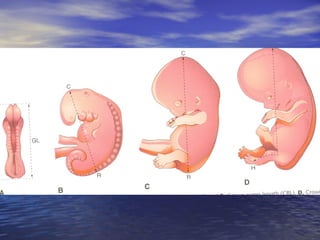
• US measurement of crown-rump lengthUS measurement of crown-rump length
(CRL) can be used to determine fetal size(CRL) can be used to determine fetal size
and probable ageand probable age
• It can be used to provide a reliableIt can be used to provide a reliable
prediction of the expected date of deliveryprediction of the expected date of delivery
44
9 weeks to 12 weeks9 weeks to 12 weeks
• Beginning– the head constitutes half of theBeginning– the head constitutes half of the
CRL of the fetusCRL of the fetus
• Face is broad, eyes are widely separated,Face is broad, eyes are widely separated,
the ears are low set and the eye-lids arethe ears are low set and the eye-lids are
fusedfused
55
Limbs (9-12 weeks)Limbs (9-12 weeks)
• Upper limbs have almost reached theirUpper limbs have almost reached their
final relative lengthsfinal relative lengths
• Lower limbs are relatively smaller thanLower limbs are relatively smaller than
their final lengthstheir final lengths
77
ErythropoiesisErythropoiesis
• Liver is a major site for erythropoiesisLiver is a major site for erythropoiesis
initiallyinitially
• By the end of 12 weeks- activity hasBy the end of 12 weeks- activity has
decreased in the liver and has begun indecreased in the liver and has begun in
the spleenthe spleen
88
Urine formationUrine formation
• Begins between the 9Begins between the 9thth
and 12and 12thth
weeksweeks
• Urine is discharged through the urethraUrine is discharged through the urethra
into the amniotic fluidinto the amniotic fluid
• Fetus reabsorbs some of this fluid afterFetus reabsorbs some of this fluid after
swallowing itswallowing it
• Waste products are transferred to theWaste products are transferred to the
maternal circulation by passing across thematernal circulation by passing across the
placental membraneplacental membrane
99
13 weeks to 16 weeks13 weeks to 16 weeks
• Growth is rapidGrowth is rapid
• Head is relatively smallHead is relatively small
• Limb movementsLimb movements
• Ossification of fetal skeletal is activeOssification of fetal skeletal is active
• Eyes- slow eye movementsEyes- slow eye movements
• HairHair
• Ovaries are differentiatedOvaries are differentiated
1010
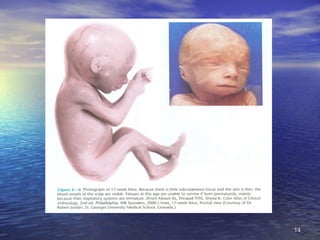
17 weeks to 20 weeks17 weeks to 20 weeks
• Growth slowsGrowth slows
• QuickeningQuickening
• Vernix caseosaVernix caseosa
• Eye brows and head hair are also visible at 20Eye brows and head hair are also visible at 20thth
weeksweeks
• LanugoLanugo
• Brown fat formsBrown fat forms
• Uterus is formed and canalization of vagina has beganUterus is formed and canalization of vagina has began
(18weeks)(18weeks)
• Primordial ovarian follicles containing oogoniaPrimordial ovarian follicles containing oogonia
• testestestes
1111
PlacentaPlacenta
• The placenta is the primary site of nutrient andThe placenta is the primary site of nutrient and
gas exchange between mother and fetusgas exchange between mother and fetus
• The placenta is a fetomaternal organ that has 2The placenta is a fetomaternal organ that has 2
components by the beginning of 4components by the beginning of 4thth
monthmonth
#fetal part#fetal part
#maternal part#maternal part
• The uterus ,chorionic sac and placenta enlargesThe uterus ,chorionic sac and placenta enlarges
as the embryo and later the fetus growsas the embryo and later the fetus grows
(18weeks old). During these weeks the placenta(18weeks old). During these weeks the placenta
weighs about 1/6weighs about 1/6thth
that of fetusthat of fetus
1212
1313
1414
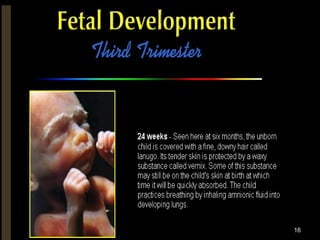
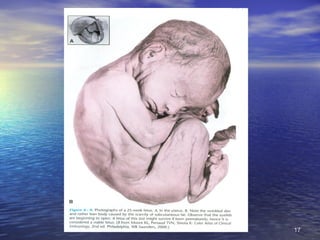
21 to 25 weeks21 to 25 weeks
• Weight gainWeight gain
• SkinSkin
• Rapid eye movement (at 21 weeks)Rapid eye movement (at 21 weeks)
• Blink-startle response (22-23 weeks)Blink-startle response (22-23 weeks)
• Surfactant (24 weeks)Surfactant (24 weeks)
• Finger nails (24 weeks)Finger nails (24 weeks)
1515
1616
1717
26 weeks to 29 weeks26 weeks to 29 weeks
• Lungs and pulmonary vasculature haveLungs and pulmonary vasculature have
developed sufficientlydeveloped sufficiently
• CNS has maturedCNS has matured
• Eye lids are open at 26 weeksEye lids are open at 26 weeks
• Lanugo and head hair are well developedLanugo and head hair are well developed
• Toe nailsToe nails
• SkinSkin
• The fetal spleen is now an important site ofThe fetal spleen is now an important site of
hematopoiesis.Erythropoiesis in the spleen ends by 28hematopoiesis.Erythropoiesis in the spleen ends by 28
weeks ,then the bone marrow becomes the major site ofweeks ,then the bone marrow becomes the major site of
this processthis process
1818
1919
30 to 34 weeks30 to 34 weeks
• Pupillary light reflex can be elicitedPupillary light reflex can be elicited
• The skin is pink and smooth .The upperThe skin is pink and smooth .The upper
and lower limbs have a chubbyand lower limbs have a chubby
appearanceappearance
• The quantity of white fat is about 8% ofThe quantity of white fat is about 8% of
body weightbody weight
• Fetuses 32 weeks and older usuallyFetuses 32 weeks and older usually
survive if born prematurelysurvive if born prematurely
2020
2121
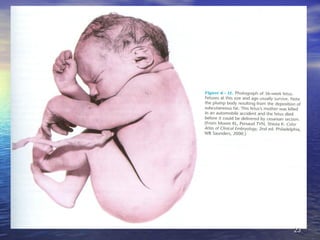
35 to 38 weeks35 to 38 weeks
• Nervous system is sufficiently matureNervous system is sufficiently mature
• Most fetuses during this finishing periodMost fetuses during this finishing period
are plumpare plump
• By 36 weeks circumferences of the headBy 36 weeks circumferences of the head
and abdomen are approximately equaland abdomen are approximately equal
after this ,the circumference of theafter this ,the circumference of the
abdomen maybe greater than the headabdomen maybe greater than the head
• Fetal foot measurement is usually slightlyFetal foot measurement is usually slightly
larger than femoral length at 37 weekslarger than femoral length at 37 weeks
2222
2323
Full termFull term
• Most fetuses have a CRL of 360mm andMost fetuses have a CRL of 360mm and
weight about 3400gmweight about 3400gm
• White fat is about 16% of body weightWhite fat is about 16% of body weight
• A fetus adds about 14gms of fat a dayA fetus adds about 14gms of fat a day
during these last weeks of gestationduring these last weeks of gestation
• Testes are in scrotum usuallyTestes are in scrotum usually
2424
Parturition (child birth)Parturition (child birth)
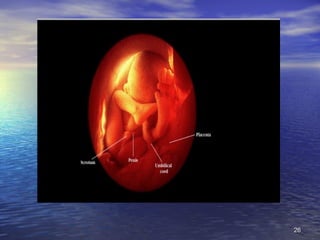
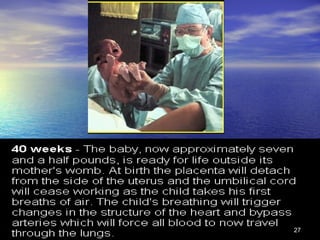
Fetus ,placenta and fetal membranes areFetus ,placenta and fetal membranes are
expelled from the mother’s reproductiveexpelled from the mother’s reproductive
tracttract
2525
2626
2727
2828
2929
3030
PlacentaPlacenta
• The placenta is the primary site of nutrient andThe placenta is the primary site of nutrient and
gas exchange between mother and fetusgas exchange between mother and fetus
• The placenta is a fetomaternal organ that has 2The placenta is a fetomaternal organ that has 2
components by the beginning of 4components by the beginning of 4thth
monthmonth
#fetal part#fetal part
#maternal part#maternal part
• The uterus ,chorionic sac and placenta enlargesThe uterus ,chorionic sac and placenta enlarges
as the embryo and later the fetus growsas the embryo and later the fetus grows
(18weeks old). During these weeks the placenta(18weeks old). During these weeks the placenta
weighs about 1/6weighs about 1/6thth
that of fetusthat of fetus
3131
• Fetal part of the placenta is formed byFetal part of the placenta is formed by
villous chorionvillous chorion
• Maternal part is formed by decidua basalisMaternal part is formed by decidua basalis
• By the end of 4By the end of 4thth
month decidua basalis ismonth decidua basalis is
replaced by the fetal partreplaced by the fetal part
3232
Fetomaternal junctionFetomaternal junction
• Cytotrophoblastic shell—the external layer ofCytotrophoblastic shell—the external layer of
trophoblastic cells on the maternal surface of thetrophoblastic cells on the maternal surface of the
placentaplacenta
• The decidua capsularis ,is the layer of deciduaThe decidua capsularis ,is the layer of decidua
overlying the implanted chorionic sac ,forms aoverlying the implanted chorionic sac ,forms a
capsule over the external surface of the saccapsule over the external surface of the sac ,as,as
the conceptus enlarges ,the dc bulges into thethe conceptus enlarges ,the dc bulges into the
uterine cavity and becomes greatly attenuated.uterine cavity and becomes greatly attenuated.
By 22-24 weeks ,the reduced blood supply to theBy 22-24 weeks ,the reduced blood supply to the
dc causes it to degenerate and disappeardc causes it to degenerate and disappear
3333
Amniochorionic membraneAmniochorionic membrane
• The amniotic sac enlarges faster than theThe amniotic sac enlarges faster than the
chorionic sac as a result ,the amnion andchorionic sac as a result ,the amnion and
smooth chorion soon fuse to form thesmooth chorion soon fuse to form the
amniochorionic membraneamniochorionic membrane
• It is the amniochorionic membrane thatIt is the amniochorionic membrane that
ruptures during laborruptures during labor
3434
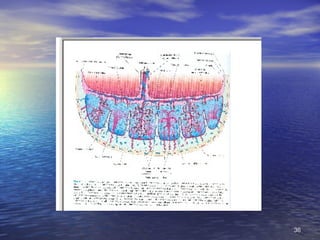
Placental circulationPlacental circulation
• Fetal placental circulationFetal placental circulation
• Maternal placental circulationMaternal placental circulation
3535
3636
Placental membranePlacental membrane
• Structure that consists of the extrafetal tissuesStructure that consists of the extrafetal tissues
separating the maternal and fetal bloodseparating the maternal and fetal blood
• At 20At 20thth
week ,the placental membrane consistsweek ,the placental membrane consists
of 4 layersof 4 layers
syncytiotrophoblassyncytiotrophoblas
connective tissue of villusconnective tissue of villus
cytotrophoblastscytotrophoblasts
endothelium of fetal capillariesendothelium of fetal capillaries
• After 20After 20thth
week ,histological changes occurweek ,histological changes occur
• As pregnancy advances ,the placentalAs pregnancy advances ,the placental
membrane becomes progressively thinnermembrane becomes progressively thinner
3737

9th week to birth

  • 1.
    Fetal DevelopmentFetal Development From9 weeks to birthFrom 9 weeks to birth Prof Dr Ambreen UsmaniProf Dr Ambreen Usmani 11
  • 2.
    Learning objectivesLearning objectives •Describe the events of development fromDescribe the events of development from 9 weeks to birth9 weeks to birth 22
  • 3.
    IntroductionIntroduction • Development duringfetal period isDevelopment during fetal period is concerned primarily with body growth andconcerned primarily with body growth and differentiation of tissues, organs anddifferentiation of tissues, organs and systemssystems • The rate of body growth is rapidThe rate of body growth is rapid 33
  • 4.
    Estimation of fetalageEstimation of fetal age • US measurement of crown-rump lengthUS measurement of crown-rump length (CRL) can be used to determine fetal size(CRL) can be used to determine fetal size and probable ageand probable age • It can be used to provide a reliableIt can be used to provide a reliable prediction of the expected date of deliveryprediction of the expected date of delivery 44
  • 5.
    9 weeks to12 weeks9 weeks to 12 weeks • Beginning– the head constitutes half of theBeginning– the head constitutes half of the CRL of the fetusCRL of the fetus • Face is broad, eyes are widely separated,Face is broad, eyes are widely separated, the ears are low set and the eye-lids arethe ears are low set and the eye-lids are fusedfused 55
  • 7.
    Limbs (9-12 weeks)Limbs(9-12 weeks) • Upper limbs have almost reached theirUpper limbs have almost reached their final relative lengthsfinal relative lengths • Lower limbs are relatively smaller thanLower limbs are relatively smaller than their final lengthstheir final lengths 77
  • 8.
    ErythropoiesisErythropoiesis • Liver isa major site for erythropoiesisLiver is a major site for erythropoiesis initiallyinitially • By the end of 12 weeks- activity hasBy the end of 12 weeks- activity has decreased in the liver and has begun indecreased in the liver and has begun in the spleenthe spleen 88
  • 9.
    Urine formationUrine formation •Begins between the 9Begins between the 9thth and 12and 12thth weeksweeks • Urine is discharged through the urethraUrine is discharged through the urethra into the amniotic fluidinto the amniotic fluid • Fetus reabsorbs some of this fluid afterFetus reabsorbs some of this fluid after swallowing itswallowing it • Waste products are transferred to theWaste products are transferred to the maternal circulation by passing across thematernal circulation by passing across the placental membraneplacental membrane 99
  • 10.
    13 weeks to16 weeks13 weeks to 16 weeks • Growth is rapidGrowth is rapid • Head is relatively smallHead is relatively small • Limb movementsLimb movements • Ossification of fetal skeletal is activeOssification of fetal skeletal is active • Eyes- slow eye movementsEyes- slow eye movements • HairHair • Ovaries are differentiatedOvaries are differentiated 1010
  • 11.
    17 weeks to20 weeks17 weeks to 20 weeks • Growth slowsGrowth slows • QuickeningQuickening • Vernix caseosaVernix caseosa • Eye brows and head hair are also visible at 20Eye brows and head hair are also visible at 20thth weeksweeks • LanugoLanugo • Brown fat formsBrown fat forms • Uterus is formed and canalization of vagina has beganUterus is formed and canalization of vagina has began (18weeks)(18weeks) • Primordial ovarian follicles containing oogoniaPrimordial ovarian follicles containing oogonia • testestestes 1111
  • 12.
    PlacentaPlacenta • The placentais the primary site of nutrient andThe placenta is the primary site of nutrient and gas exchange between mother and fetusgas exchange between mother and fetus • The placenta is a fetomaternal organ that has 2The placenta is a fetomaternal organ that has 2 components by the beginning of 4components by the beginning of 4thth monthmonth #fetal part#fetal part #maternal part#maternal part • The uterus ,chorionic sac and placenta enlargesThe uterus ,chorionic sac and placenta enlarges as the embryo and later the fetus growsas the embryo and later the fetus grows (18weeks old). During these weeks the placenta(18weeks old). During these weeks the placenta weighs about 1/6weighs about 1/6thth that of fetusthat of fetus 1212
  • 13.
  • 14.
  • 15.
    21 to 25weeks21 to 25 weeks • Weight gainWeight gain • SkinSkin • Rapid eye movement (at 21 weeks)Rapid eye movement (at 21 weeks) • Blink-startle response (22-23 weeks)Blink-startle response (22-23 weeks) • Surfactant (24 weeks)Surfactant (24 weeks) • Finger nails (24 weeks)Finger nails (24 weeks) 1515
  • 16.
  • 17.
  • 18.
    26 weeks to29 weeks26 weeks to 29 weeks • Lungs and pulmonary vasculature haveLungs and pulmonary vasculature have developed sufficientlydeveloped sufficiently • CNS has maturedCNS has matured • Eye lids are open at 26 weeksEye lids are open at 26 weeks • Lanugo and head hair are well developedLanugo and head hair are well developed • Toe nailsToe nails • SkinSkin • The fetal spleen is now an important site ofThe fetal spleen is now an important site of hematopoiesis.Erythropoiesis in the spleen ends by 28hematopoiesis.Erythropoiesis in the spleen ends by 28 weeks ,then the bone marrow becomes the major site ofweeks ,then the bone marrow becomes the major site of this processthis process 1818
  • 19.
  • 20.
    30 to 34weeks30 to 34 weeks • Pupillary light reflex can be elicitedPupillary light reflex can be elicited • The skin is pink and smooth .The upperThe skin is pink and smooth .The upper and lower limbs have a chubbyand lower limbs have a chubby appearanceappearance • The quantity of white fat is about 8% ofThe quantity of white fat is about 8% of body weightbody weight • Fetuses 32 weeks and older usuallyFetuses 32 weeks and older usually survive if born prematurelysurvive if born prematurely 2020
  • 21.
  • 22.
    35 to 38weeks35 to 38 weeks • Nervous system is sufficiently matureNervous system is sufficiently mature • Most fetuses during this finishing periodMost fetuses during this finishing period are plumpare plump • By 36 weeks circumferences of the headBy 36 weeks circumferences of the head and abdomen are approximately equaland abdomen are approximately equal after this ,the circumference of theafter this ,the circumference of the abdomen maybe greater than the headabdomen maybe greater than the head • Fetal foot measurement is usually slightlyFetal foot measurement is usually slightly larger than femoral length at 37 weekslarger than femoral length at 37 weeks 2222
  • 23.
  • 24.
    Full termFull term •Most fetuses have a CRL of 360mm andMost fetuses have a CRL of 360mm and weight about 3400gmweight about 3400gm • White fat is about 16% of body weightWhite fat is about 16% of body weight • A fetus adds about 14gms of fat a dayA fetus adds about 14gms of fat a day during these last weeks of gestationduring these last weeks of gestation • Testes are in scrotum usuallyTestes are in scrotum usually 2424
  • 25.
    Parturition (child birth)Parturition(child birth) Fetus ,placenta and fetal membranes areFetus ,placenta and fetal membranes are expelled from the mother’s reproductiveexpelled from the mother’s reproductive tracttract 2525
  • 26.
  • 27.
  • 28.
  • 29.
  • 30.
  • 31.
    PlacentaPlacenta • The placentais the primary site of nutrient andThe placenta is the primary site of nutrient and gas exchange between mother and fetusgas exchange between mother and fetus • The placenta is a fetomaternal organ that has 2The placenta is a fetomaternal organ that has 2 components by the beginning of 4components by the beginning of 4thth monthmonth #fetal part#fetal part #maternal part#maternal part • The uterus ,chorionic sac and placenta enlargesThe uterus ,chorionic sac and placenta enlarges as the embryo and later the fetus growsas the embryo and later the fetus grows (18weeks old). During these weeks the placenta(18weeks old). During these weeks the placenta weighs about 1/6weighs about 1/6thth that of fetusthat of fetus 3131
  • 32.
    • Fetal partof the placenta is formed byFetal part of the placenta is formed by villous chorionvillous chorion • Maternal part is formed by decidua basalisMaternal part is formed by decidua basalis • By the end of 4By the end of 4thth month decidua basalis ismonth decidua basalis is replaced by the fetal partreplaced by the fetal part 3232
  • 33.
    Fetomaternal junctionFetomaternal junction •Cytotrophoblastic shell—the external layer ofCytotrophoblastic shell—the external layer of trophoblastic cells on the maternal surface of thetrophoblastic cells on the maternal surface of the placentaplacenta • The decidua capsularis ,is the layer of deciduaThe decidua capsularis ,is the layer of decidua overlying the implanted chorionic sac ,forms aoverlying the implanted chorionic sac ,forms a capsule over the external surface of the saccapsule over the external surface of the sac ,as,as the conceptus enlarges ,the dc bulges into thethe conceptus enlarges ,the dc bulges into the uterine cavity and becomes greatly attenuated.uterine cavity and becomes greatly attenuated. By 22-24 weeks ,the reduced blood supply to theBy 22-24 weeks ,the reduced blood supply to the dc causes it to degenerate and disappeardc causes it to degenerate and disappear 3333
  • 34.
    Amniochorionic membraneAmniochorionic membrane •The amniotic sac enlarges faster than theThe amniotic sac enlarges faster than the chorionic sac as a result ,the amnion andchorionic sac as a result ,the amnion and smooth chorion soon fuse to form thesmooth chorion soon fuse to form the amniochorionic membraneamniochorionic membrane • It is the amniochorionic membrane thatIt is the amniochorionic membrane that ruptures during laborruptures during labor 3434
  • 35.
    Placental circulationPlacental circulation •Fetal placental circulationFetal placental circulation • Maternal placental circulationMaternal placental circulation 3535
  • 36.
  • 37.
    Placental membranePlacental membrane •Structure that consists of the extrafetal tissuesStructure that consists of the extrafetal tissues separating the maternal and fetal bloodseparating the maternal and fetal blood • At 20At 20thth week ,the placental membrane consistsweek ,the placental membrane consists of 4 layersof 4 layers syncytiotrophoblassyncytiotrophoblas connective tissue of villusconnective tissue of villus cytotrophoblastscytotrophoblasts endothelium of fetal capillariesendothelium of fetal capillaries • After 20After 20thth week ,histological changes occurweek ,histological changes occur • As pregnancy advances ,the placentalAs pregnancy advances ,the placental membrane becomes progressively thinnermembrane becomes progressively thinner 3737