PRE CONCEPTION CARE
PRESENTED BY
MRS.V.ELIZEBETH RANI
READER
Preconception care
Maximizing the gains for maternal and
child health
Preconception care
 DEFINITION
Preconception care is the
provision of biomedi- cal,
behavioural and social health
interventions to women and
couples before conception
occurs.
Preconception care AIMS
 To improve their health status, and reducing behaviors
and individual and environmental factors that contribute
to poor maternal and child health outcomes.
 To improve maternal and child health, in both the short
and long term .
 Opportunities to prevent and control diseases occur at
multiple stages of life; strong public health programmes
that use a life-course perspective from infancy through
childhood and adolescence to adulthood are needed.
 To improve maternal and child health, it brings health
benefits to the adolescents, women and men, irrespective
of their plans to become parents.
Preconception care AIMS
To secure optimal health & nutritional condition in both
parents not only improves the chances of conception but
reduces the possibility of prenatal death & many congenital
anomalies.
To ensure that the women & her partner are in optimal state of
physical & emotional heath at the onset of pregnancy.
To access normal health by a child bearing women, while at
the same time identifying
 Existing or emerging illness or disease which may have gone undetected
before.
 Existing risk for the women who may become pregnant.
 Existing risk which may affect a foetus if the women doesn’t become
pregnant.
Preconception care AIMS
To promote the prenatal health which include developing
positive attitude about sexuality , womanhood & child
bearing.
To benefit women being treated for a condition such as
sickle cell anaemia , hypertension , heart disease
,diabetics this may cause a high risk pregnancy.
Purpose of Preconception care
Establish lifestyle behaviours to maintain optimum
health.
Identify & treat risk ( e.g. medical condition, substance
abuse ) before.
Conceive a pregnancy with out necessary risk factors.
Prepare people psychologically for pregnancy & the
responsibilities to become with parenthhood.
Why preconception care?
 Preconception care has a positive effect on a range of health outcomes.
Among others, preconception care can:
 • reduce maternal and child mortality
 • prevent unintended pregnancies
 • prevent complications during pregnancy and delivery
 • prevent stillbirths, preterm birth and lowbirth weight
 • prevent birth defects
 • prevent neonatal infections
 • prevent underweight and stunting
 • prevent vertical transmission of HIV/STIs
 • lower the risk of some forms of childhood
cancers
 • lower the risk of type 2 diabetesand
cardiovascular disease later in life.
Areas addressed by the preconception care package
 Nutritional conditions
 Vaccine- preventable diseases
 Genetic conditions
 Environmental health
 Infertility/ subfertility
 Female genital mutilation
 Too early, unwanted and rapid successive pregnancies
 Sexually transmitted infections
 Human immunodefi ciency virus (HIV)
 Interpersonal violence
 Mental health
 Psychoactive substance use
 Tobacco use
The COMPONENTS of preconception care
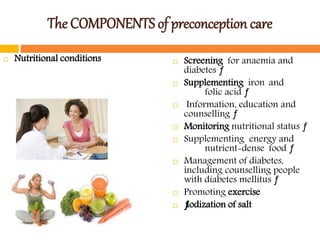
 Nutritional conditions  Screening for anaemia and
diabetes ƒ
 Supplementing iron and
folic acid ƒ
 Information, education and
counselling ƒ
 Monitoring nutritional status ƒ
 Supplementing energy and
nutrient-dense food ƒ
 Management of diabetes,
including counselling people
with diabetes mellitus ƒ
 Promoting exercise
 ƒIodization of salt
The COMPONENTS of preconception care
 Tobacco use  ƒScreening of women and girls
for tobacco use (smoking and
smokeless tobacco) at all clinical
visits using “5 As” (ask, advise,
assess, assist, arrange)
 ƒProviding brief tobacco cessation
advice, pharmacotherapy
(including nicotine replacement
therapy, if available) and
intensive behavioural counselling
services ƒ
 Screening of all non-smokers
(menand women) and advising
about harm of second-hand
smoke and harmful effects on
pregnant women and unborn
children
The COMPONENTS of preconception care
 Genetic conditions  ƒTaking a thorough family
history to identify risk
factors for genetic
conditions
 ƒFamily planning
 ƒGenetic counselling
 ƒCarrier screening and
testing ƒ
 Appropriate treatment of
genetic conditions ƒ
 Community-wide or
national screening among
populations at high risk
The COMPONENTS of preconception care
 Environmental health  Providing guidance and
information on environmental
hazards and prevention
 ƒProtecting from unnecessary
radiation exposure in
occupational, environmental and
medical settings ƒ
 Avoiding unnecessary pesticide
use/providing alternatives to
pesticides ƒProtecting from lead
exposure
 ƒInforming women of
childbearing age about levels of
methyl mercury in fish ƒ
 Promoting use of improved stoves
and cleaner liquid/gaseous fuels
The COMPONENTS of preconception care
 Infertility/sub-fertility  ƒCreating awareness and
understanding of fertility and
infertility and their preventable
and unpreventable causes. ƒ
 Defusing stigmatization of
infertility and assumption of fate. ƒ
 Screening and diagnosis of couples
following 6–12 months of
attempting pregnancy, and
management of underlying causes
of infertility/sub-fertility,
including past STIs. ƒ
 Counselling for
individuals/couples diagnosed
with unpreventable cause of
infertility/sub-fertility.
The COMPONENTS of preconception care
 Interpersonal violence  Health promotion to prevent dating
violence ƒ
 Providing age-appropriate comprehensive
sexuality education that addresses gender
equality, human rights, and sexual
relations ƒ
 Combining and linking economic
empowerment, gender equality and
community mobilization activities ƒ
 Recognizing signs of violence against
women ƒ
 Providing health care services (including
post-rape care), referral and psychosocial
support to victims of violence ƒ
 Changing individual and social norms
regarding drinking, screening and
counselling of people who are problem
drinkers, and treating people who have
alcohol use disorders
The COMPONENTS of preconception care
 Too-early, unwanted and
rapid successive
pregnancies
 ƒKeeping girls in school
 ƒInfluencing cultural norms that support
early marriage and coerced sex ƒ
 Providing age-appropriate
comprehensive sexuality education ƒ
 Providing contraceptives and building
community support for preventing early
pregnancy and contraceptive provision
to adolescents
 ƒEmpowering girls to resist coerced sex ƒ
 Engaging men and boys to critically
assess norms and practices regarding
gender-based violence and coerced sex ƒ
 Educating women and couples about the
dangers to the baby and mother of short
birth intervals
The COMPONENTS of preconception care
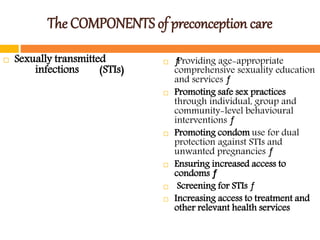
 Sexually transmitted
infections (STIs)
 ƒProviding age-appropriate
comprehensive sexuality education
and services ƒ
 Promoting safe sex practices
through individual, group and
community-level behavioural
interventions ƒ
 Promoting condom use for dual
protection against STIs and
unwanted pregnancies ƒ
 Ensuring increased access to
condoms ƒ
 Screening for STIs ƒ
 Increasing access to treatment and
other relevant health services
The COMPONENTS of preconception care
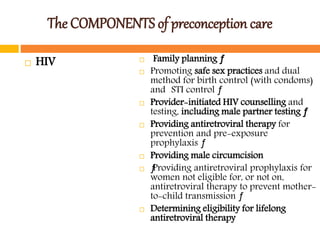
 HIV  Family planning ƒ
 Promoting safe sex practices and dual
method for birth control (with condoms)
and STI control ƒ
 Provider-initiated HIV counselling and
testing, including male partner testing ƒ
 Providing antiretroviral therapy for
prevention and pre-exposure
prophylaxis ƒ
 Providing male circumcision
 ƒProviding antiretroviral prophylaxis for
women not eligible for, or not on,
antiretroviral therapy to prevent mother-
to-child transmission ƒ
 Determining eligibility for lifelong
antiretroviral therapy
The COMPONENTS of preconception care
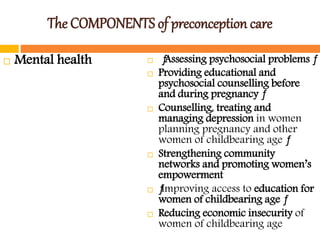
 Mental health  ƒAssessing psychosocial problems ƒ
 Providing educational and
psychosocial counselling before
and during pregnancy ƒ
 Counselling, treating and
managing depression in women
planning pregnancy and other
women of childbearing age ƒ
 Strengthening community
networks and promoting women’s
empowerment
 ƒImproving access to education for
women of childbearing age ƒ
 Reducing economic insecurity of
women of childbearing age
The COMPONENTS of preconception care
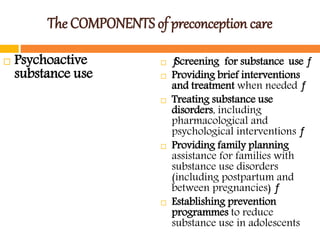
 Psychoactive
substance use
 ƒScreening for substance use ƒ
 Providing brief interventions
and treatment when needed ƒ
 Treating substance use
disorders, including
pharmacological and
psychological interventions ƒ
 Providing family planning
assistance for families with
substance use disorders
(including postpartum and
between pregnancies) ƒ
 Establishing prevention
programmes to reduce
substance use in adolescents
The COMPONENTS of preconception care
 Vaccine-
preventable
diseases
 ƒVaccination against rubella ƒ
 Vaccination against tetanus
and diphtheria ƒ
 Vaccination against Hepatitis
B
The COMPONENTS of preconception care
 Female genital mutilation
(FGM)
 ƒDiscussing and discouraging
the practice with the girl and
her parents and/ or partner ƒ
 Screening women and girls for
FGM to detect complications ƒ
 Informing women and couples
about complications of FGM
and about access to treatment ƒ
 Carrying out defibulation of
infibulated or sealed girls and
women before or early in
pregnancy ƒ
 Removing cysts and treating
other complications
Promotion of a women for healthy pregnancy
 Folic acid
 Proper immunization for the women
 Healthy behaviours
 Other nutritional supplements
 Blood tests
 Other check up
Steps can the women can take to improve health before
pregnancy
Eat a well balanced diet.
Drink plenty of water
Take nutritional supplements wisely
Quit or cut down smoking cigarettes
Avoid caffeine
Avoid alcohol
Avoid medication
Avoid contact with chemicals
Steps can the women can take to improve health before
pregnancy
 If have a cat, get someone else to empty the
kitty litter due to the risk of infection with
toxoplasmosis.
 If exercising make sure to wear cool ,
comfortable cloth ing & drink plenty of water.
 If do not exercise , try to start a reasonable &
regular exercise routine.
 Visit a health care practitioner specializing in
preconception care.
PRECONCEPTION CARE FOR MEN
STOP SMOKING
USE MOBILE PHONESONLY WHEN NEEDED
AVOID INCREASED TEMPERATURE AROUND GENITALS
CUT BACK ON CAFFINE
AVOID MEDICINES THAT IMPAIR FERTILITY & DESIRE SEX
DESIRE
INCULCATE A RELAXING SCHEDULE
STOP CONSUMING ALCOHOL & STEROIDS
MAINTAIN A HEALTHY WEIGHT
PLAN FOR FINANCES
THINK ABOUT PARENTING

Pre conception care

  • 1.
    PRE CONCEPTION CARE PRESENTEDBY MRS.V.ELIZEBETH RANI READER
  • 2.
    Preconception care Maximizing thegains for maternal and child health
  • 3.
    Preconception care  DEFINITION Preconceptioncare is the provision of biomedi- cal, behavioural and social health interventions to women and couples before conception occurs.
  • 4.
    Preconception care AIMS To improve their health status, and reducing behaviors and individual and environmental factors that contribute to poor maternal and child health outcomes.  To improve maternal and child health, in both the short and long term .  Opportunities to prevent and control diseases occur at multiple stages of life; strong public health programmes that use a life-course perspective from infancy through childhood and adolescence to adulthood are needed.  To improve maternal and child health, it brings health benefits to the adolescents, women and men, irrespective of their plans to become parents.
  • 5.
    Preconception care AIMS Tosecure optimal health & nutritional condition in both parents not only improves the chances of conception but reduces the possibility of prenatal death & many congenital anomalies. To ensure that the women & her partner are in optimal state of physical & emotional heath at the onset of pregnancy. To access normal health by a child bearing women, while at the same time identifying  Existing or emerging illness or disease which may have gone undetected before.  Existing risk for the women who may become pregnant.  Existing risk which may affect a foetus if the women doesn’t become pregnant.
  • 6.
    Preconception care AIMS Topromote the prenatal health which include developing positive attitude about sexuality , womanhood & child bearing. To benefit women being treated for a condition such as sickle cell anaemia , hypertension , heart disease ,diabetics this may cause a high risk pregnancy.
  • 7.
    Purpose of Preconceptioncare Establish lifestyle behaviours to maintain optimum health. Identify & treat risk ( e.g. medical condition, substance abuse ) before. Conceive a pregnancy with out necessary risk factors. Prepare people psychologically for pregnancy & the responsibilities to become with parenthhood.
  • 8.
    Why preconception care? Preconception care has a positive effect on a range of health outcomes. Among others, preconception care can:  • reduce maternal and child mortality  • prevent unintended pregnancies  • prevent complications during pregnancy and delivery  • prevent stillbirths, preterm birth and lowbirth weight  • prevent birth defects  • prevent neonatal infections  • prevent underweight and stunting  • prevent vertical transmission of HIV/STIs  • lower the risk of some forms of childhood cancers  • lower the risk of type 2 diabetesand cardiovascular disease later in life.
  • 9.
    Areas addressed bythe preconception care package  Nutritional conditions  Vaccine- preventable diseases  Genetic conditions  Environmental health  Infertility/ subfertility  Female genital mutilation  Too early, unwanted and rapid successive pregnancies  Sexually transmitted infections  Human immunodefi ciency virus (HIV)  Interpersonal violence  Mental health  Psychoactive substance use  Tobacco use
  • 10.
    The COMPONENTS ofpreconception care  Nutritional conditions  Screening for anaemia and diabetes ƒ  Supplementing iron and folic acid ƒ  Information, education and counselling ƒ  Monitoring nutritional status ƒ  Supplementing energy and nutrient-dense food ƒ  Management of diabetes, including counselling people with diabetes mellitus ƒ  Promoting exercise  ƒIodization of salt
  • 11.
    The COMPONENTS ofpreconception care  Tobacco use  ƒScreening of women and girls for tobacco use (smoking and smokeless tobacco) at all clinical visits using “5 As” (ask, advise, assess, assist, arrange)  ƒProviding brief tobacco cessation advice, pharmacotherapy (including nicotine replacement therapy, if available) and intensive behavioural counselling services ƒ  Screening of all non-smokers (menand women) and advising about harm of second-hand smoke and harmful effects on pregnant women and unborn children
  • 12.
    The COMPONENTS ofpreconception care  Genetic conditions  ƒTaking a thorough family history to identify risk factors for genetic conditions  ƒFamily planning  ƒGenetic counselling  ƒCarrier screening and testing ƒ  Appropriate treatment of genetic conditions ƒ  Community-wide or national screening among populations at high risk
  • 13.
    The COMPONENTS ofpreconception care  Environmental health  Providing guidance and information on environmental hazards and prevention  ƒProtecting from unnecessary radiation exposure in occupational, environmental and medical settings ƒ  Avoiding unnecessary pesticide use/providing alternatives to pesticides ƒProtecting from lead exposure  ƒInforming women of childbearing age about levels of methyl mercury in fish ƒ  Promoting use of improved stoves and cleaner liquid/gaseous fuels
  • 14.
    The COMPONENTS ofpreconception care  Infertility/sub-fertility  ƒCreating awareness and understanding of fertility and infertility and their preventable and unpreventable causes. ƒ  Defusing stigmatization of infertility and assumption of fate. ƒ  Screening and diagnosis of couples following 6–12 months of attempting pregnancy, and management of underlying causes of infertility/sub-fertility, including past STIs. ƒ  Counselling for individuals/couples diagnosed with unpreventable cause of infertility/sub-fertility.
  • 15.
    The COMPONENTS ofpreconception care  Interpersonal violence  Health promotion to prevent dating violence ƒ  Providing age-appropriate comprehensive sexuality education that addresses gender equality, human rights, and sexual relations ƒ  Combining and linking economic empowerment, gender equality and community mobilization activities ƒ  Recognizing signs of violence against women ƒ  Providing health care services (including post-rape care), referral and psychosocial support to victims of violence ƒ  Changing individual and social norms regarding drinking, screening and counselling of people who are problem drinkers, and treating people who have alcohol use disorders
  • 16.
    The COMPONENTS ofpreconception care  Too-early, unwanted and rapid successive pregnancies  ƒKeeping girls in school  ƒInfluencing cultural norms that support early marriage and coerced sex ƒ  Providing age-appropriate comprehensive sexuality education ƒ  Providing contraceptives and building community support for preventing early pregnancy and contraceptive provision to adolescents  ƒEmpowering girls to resist coerced sex ƒ  Engaging men and boys to critically assess norms and practices regarding gender-based violence and coerced sex ƒ  Educating women and couples about the dangers to the baby and mother of short birth intervals
  • 17.
    The COMPONENTS ofpreconception care  Sexually transmitted infections (STIs)  ƒProviding age-appropriate comprehensive sexuality education and services ƒ  Promoting safe sex practices through individual, group and community-level behavioural interventions ƒ  Promoting condom use for dual protection against STIs and unwanted pregnancies ƒ  Ensuring increased access to condoms ƒ  Screening for STIs ƒ  Increasing access to treatment and other relevant health services
  • 18.
    The COMPONENTS ofpreconception care  HIV  Family planning ƒ  Promoting safe sex practices and dual method for birth control (with condoms) and STI control ƒ  Provider-initiated HIV counselling and testing, including male partner testing ƒ  Providing antiretroviral therapy for prevention and pre-exposure prophylaxis ƒ  Providing male circumcision  ƒProviding antiretroviral prophylaxis for women not eligible for, or not on, antiretroviral therapy to prevent mother- to-child transmission ƒ  Determining eligibility for lifelong antiretroviral therapy
  • 19.
    The COMPONENTS ofpreconception care  Mental health  ƒAssessing psychosocial problems ƒ  Providing educational and psychosocial counselling before and during pregnancy ƒ  Counselling, treating and managing depression in women planning pregnancy and other women of childbearing age ƒ  Strengthening community networks and promoting women’s empowerment  ƒImproving access to education for women of childbearing age ƒ  Reducing economic insecurity of women of childbearing age
  • 20.
    The COMPONENTS ofpreconception care  Psychoactive substance use  ƒScreening for substance use ƒ  Providing brief interventions and treatment when needed ƒ  Treating substance use disorders, including pharmacological and psychological interventions ƒ  Providing family planning assistance for families with substance use disorders (including postpartum and between pregnancies) ƒ  Establishing prevention programmes to reduce substance use in adolescents
  • 21.
    The COMPONENTS ofpreconception care  Vaccine- preventable diseases  ƒVaccination against rubella ƒ  Vaccination against tetanus and diphtheria ƒ  Vaccination against Hepatitis B
  • 22.
    The COMPONENTS ofpreconception care  Female genital mutilation (FGM)  ƒDiscussing and discouraging the practice with the girl and her parents and/ or partner ƒ  Screening women and girls for FGM to detect complications ƒ  Informing women and couples about complications of FGM and about access to treatment ƒ  Carrying out defibulation of infibulated or sealed girls and women before or early in pregnancy ƒ  Removing cysts and treating other complications
  • 23.
    Promotion of awomen for healthy pregnancy  Folic acid  Proper immunization for the women  Healthy behaviours  Other nutritional supplements  Blood tests  Other check up
  • 24.
    Steps can thewomen can take to improve health before pregnancy Eat a well balanced diet. Drink plenty of water Take nutritional supplements wisely Quit or cut down smoking cigarettes Avoid caffeine Avoid alcohol Avoid medication Avoid contact with chemicals
  • 25.
    Steps can thewomen can take to improve health before pregnancy  If have a cat, get someone else to empty the kitty litter due to the risk of infection with toxoplasmosis.  If exercising make sure to wear cool , comfortable cloth ing & drink plenty of water.  If do not exercise , try to start a reasonable & regular exercise routine.  Visit a health care practitioner specializing in preconception care.
  • 26.
    PRECONCEPTION CARE FORMEN STOP SMOKING USE MOBILE PHONESONLY WHEN NEEDED AVOID INCREASED TEMPERATURE AROUND GENITALS CUT BACK ON CAFFINE AVOID MEDICINES THAT IMPAIR FERTILITY & DESIRE SEX DESIRE INCULCATE A RELAXING SCHEDULE STOP CONSUMING ALCOHOL & STEROIDS MAINTAIN A HEALTHY WEIGHT PLAN FOR FINANCES THINK ABOUT PARENTING