The Tavistock Institute of Human Relations


Action research as a methodology that
 brings together value-based and
 evidence based approaches

Dr. Milena Stateva
Lisbon
May 2012
This presentation

• Exploring the tensions and possible links between value-
  based and evidence-based research and evaluation
  approaches;

• Discussing the relevance of action research to policy
  making;

• Evaluating the ability of action research to bring together
  these two perspectives through a case study.
The diversity in value relevancies
          in contemporary research

• Value-neutral or value-laden research (Hammersley,
  2008).

• Value-based medicine: overlooking genuine value conflicts
  and their importance, undermining the value of 'value' and
  leaving the practitioner with a reduced ability to discern and
  negotiate conflicts of value (see Fulford, 2006; Gascoigne,
  2008; Cox, Campbell and Fullford, 2007).

• Evaluation research: a vacuum in judging the value of
  available options deriving from the inadequacy of „rational‟
  procedures to support judgments of the value of policies,
  programs, or the agencies responsible for them (Julnes,
  2010).
What is action research?

• Action research emerged as a distinctive mode of
  social science theory and practice in the times of re-
  building the Post-World War II world (see Lewin, 1946)
  and has continuily shown its relevance to bringing
  change whilst studying this change as it unfolds – a
  process of co-creation with the research participants.

• It can be viewed as ‘practical science’ with a distinctive
  iterative cycle of problem identification, diagnosis,
  intervention, evaluation and problem re-statement
  (Checkland, 1991) while offering the potential for
  citizen participation policy in the construction of
  knowledge (Stringer, 1999).
The value base of action research

Action research ’cannot but be a political activity, [because]
  professional status, despite the claims often made for it,
  does not place the practitioner beyond the realm of values’
  (Miller, 1993:3).

Values, logics and practice are mutually influencing hence
  they are deeply linked with issues of ontology,
  epistemology, methodology and intent - a dynamic, self-
  recreating constellation of forms that are also influenced by
  context (McNiff and Whitehead, 2011:10).
The evidence base of action research

Action research allows for bringing together qualitative and
  quantiative methodologies which is a leading trend today.

How empirical data is used to validate and defend an
  interpretation: quantitative and qualitative methodologies
  form a continuum rather than standing in opposition.

Bringing them together: developing a picture of an empirical
   world, asking questions and turning them into researchable
   problems, finding the best means of doing so, developing
   and using concepts, and serving policy ends and ‘user’
   interests (Alasuutari, Bickman and Brannen, 2008).
Action research and policy making


• Action research within policy making has a long
  tradition, in particular for addressing needs and complex
  problems as it is about using research to influence and
  directly change policy and practice (see DoH, 2001).

• It is a style of research rather than a specific method with
  three key elements: its participatory character; its
  democratic impulse; and its simultaneous contribution to
  social science and social change (Meyer, 2000).
TIHR Trauma Stream of work
• The stream aims to provide support to organisations and
  systems working with or going through traumatic
  experiences as well as those wanting to build their
  resilience.

• The support takes the form of training, multi-disciplinary
  research-based consultancy and consultancy-based
  research to feed into theory development as a means for
  better understanding and policy enhancement.

• The objective is to contribute to efforts to a) prevent
  traumatic events and trauma (building resilience); and b)
  improve interventions in the process of a traumatic event/s
  taking place as well as in its aftermath (including crisis
  intervention, long-term and short-term consequences).
Case study: evaluative action research
         of the Nottinghamshire County Council
         Fostering Futures Therapeutic Service
• To examine the significance of the background, experience
  and specialist knowledge of the foster carers;

• To examine the effectiveness of the team’s therapeutic
  foundation and the particular effect of various techniques;

• To provide a longitudinal view of the impact of the fostering
  service on the children it cares for;

• To develop Fostering Futures’ internal capacities by
  embedding within its structures and processes a
  sustainable research component;

• To enable staff and users to influence practice and policy.
Case study: evaluative action research
        of the Nottinghamshire County Council
        Fostering Futures Therapeutic Service


  Research support team/originators of the
                   study
Ian Tabberer, Team manager, Fostering Futures TF Service
Dr Mannie Sher, TIHR Principal Researcher/Consultant
Dr Milena Stateva, TIHR Senior Researcher/Consultant
Laura Stock, TIHR Researcher/Consultant
Case study: evaluative action research
        of the Nottinghamshire County Council
        Fostering Futures Therapeutic Service
• Applying Theory of Change and its principles of using
  multiple data sources to triangulate data capturing the
  processes and mechanisms through which goals are (not)
  met.
• Grounding the research in the carers’ and young people’s
  voices and experiences: the goal is to open a space in
  which their perspective matters and is taken into account.
• Employing an action research framework based on
  principles of participation and collaboration: the goal is to
  achieve deeper understanding of the processes
  surrounding foster care and to leave behind a research
  capacity that will bring to a qualitatively higher level the
  existing mechanisms of learning from experience.
Case study: evaluative action research
        of the Nottinghamshire County Council
        Fostering Futures Therapeutic Service

• Does young people’s wellbeing improve since
  joining the scheme: a) is there a line of evidence that
  symptoms are reduced and b) is there a line of
  evidence based on positive indicators of
  development and wellbeing?

It is most likely that the various inputs from the system’s
    layers interact in a non-linear and complex manner with
    individual factors stemming from the young people’s history
    and personality structure on one hand and with other
    contributory factors from the environment, on the other
    hand.
Case study: evaluative action research
         of the Nottinghamshire County Council
         Fostering Futures Therapeutic Service
• The components of each of these factors are themselves in a
  dynamic interaction (e.g. the background, experience and
  specialist knowledge of the foster carers interweaves with the
  team’s therapeutic foundation and the effectiveness of various
  techniques).
• All of them most probably depend on the culture, availability of
  service components, conceptual frameworks, structures and
  mechanisms of the fostering organisation as well as its
  resources, management, policies, regulations and relationship
  with other services that can complement the care for the
  young people.
• The fostering organisation will be affected in turn by its
  immediate and wider environment.
Case study: evaluative action research
          of the Nottinghamshire County Council
          Fostering Futures Therapeutic Service


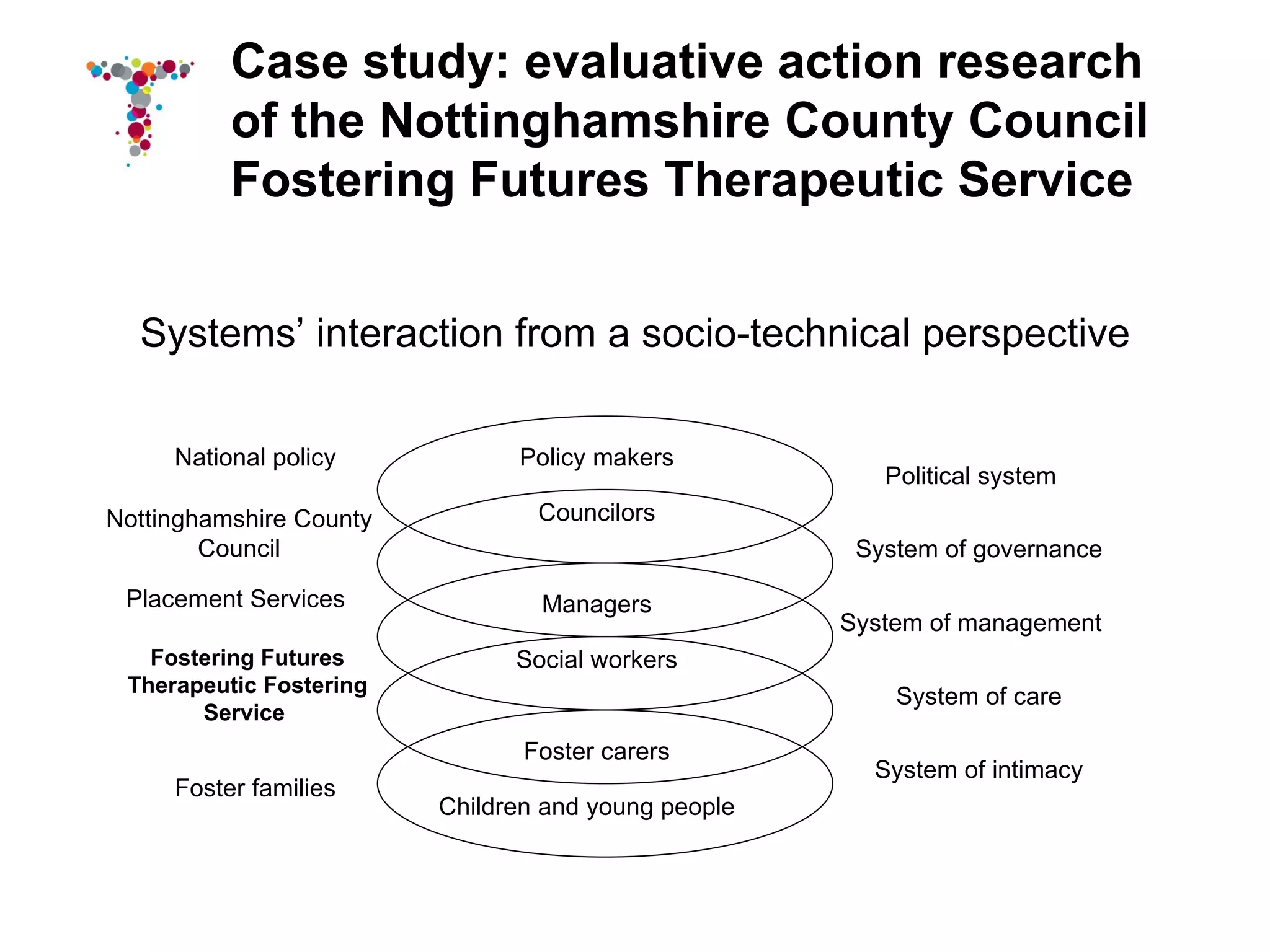
  Systems’ interaction from a socio-technical perspective

     National policy           Policy makers
                                                        Political system
Nottinghamshire County           Councilors
        Council                                       System of governance

 Placement Services              Managers
                                                     System of management
   Fostering Futures           Social workers
 Therapeutic Fostering
                                                         System of care
       Service
                                Foster carers
                                                       System of intimacy
     Foster families
                         Children and young people
Case study: evaluative action research
         of the Nottinghamshire County Council
         Fostering Futures Therapeutic Service


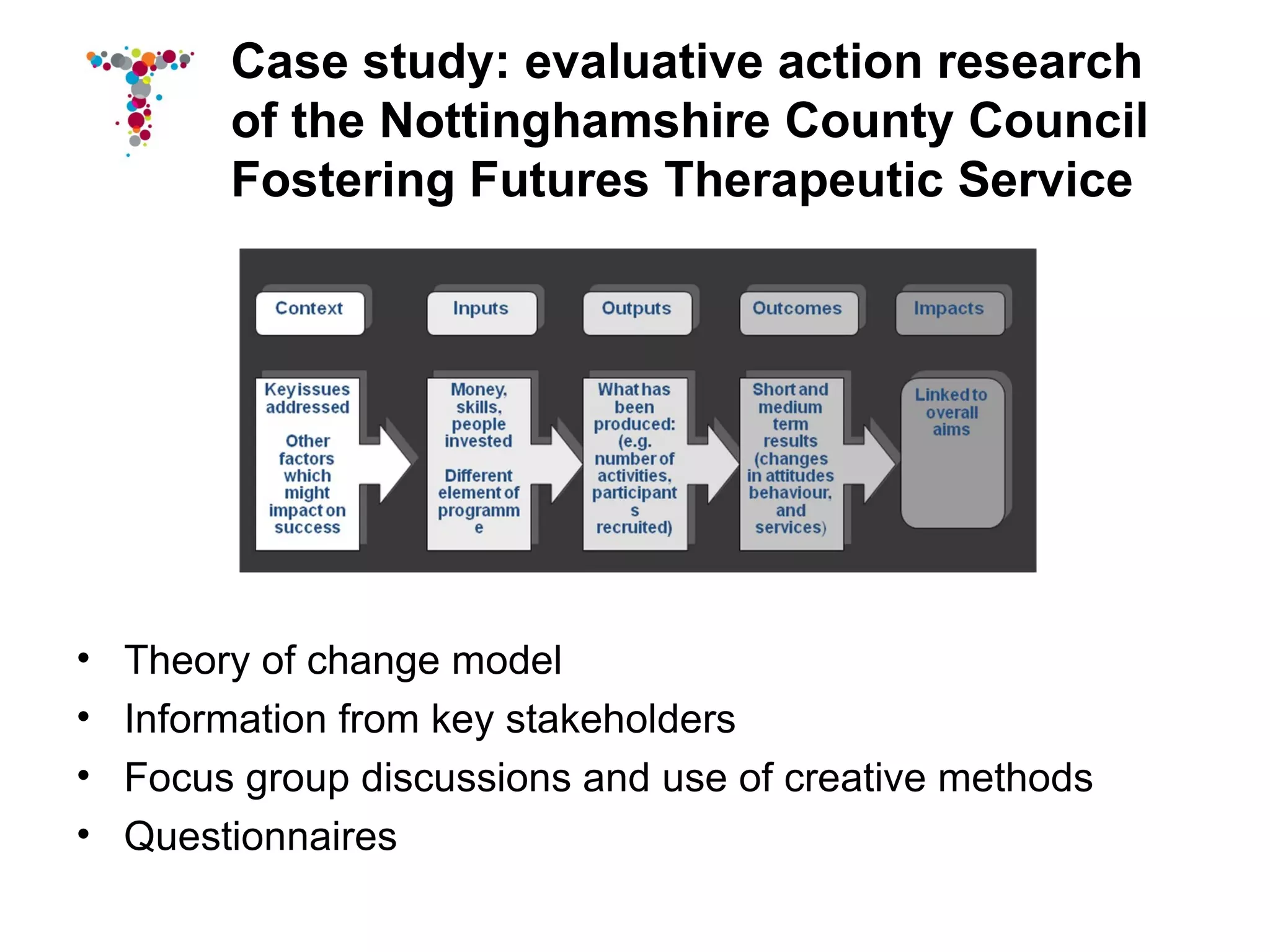
•   Theory of change model
•   Information from key stakeholders
•   Focus group discussions and use of creative methods
•   Questionnaires
Case study: evaluative action research
             of the Nottingham County Council
             Fostering Futures Therapeutic Service


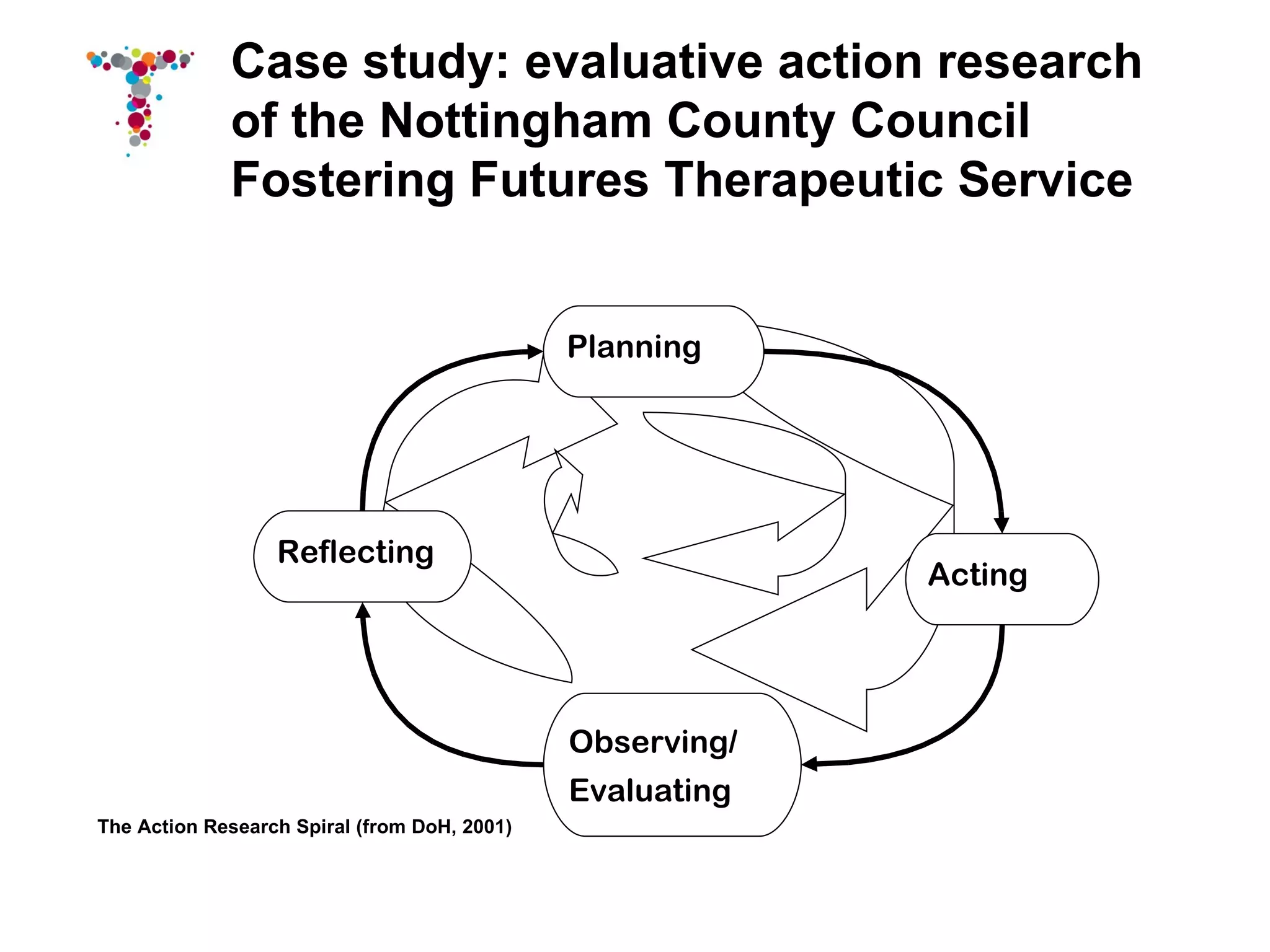
                                              Planning


                  Reflecting
                                                           Acting


                                              Observing/
                                              Evaluating
The Action Research Spiral (from DoH, 2001)
Case study: evaluative action research
        of the Nottinghamshite County Council
        Fostering Futures Therapeutic Service

                      Whose values?

Putting the young people using Fostering Futures at the
  centre of the research.

Involving in the research as researchers foster carers and
   social workers.

Fostering forums for communication between all
  stakeholders: training workshops, regular meetings, joint/
  discussion papers, etc
In conclusion

• Learning from experience is a psychodynamic concept and
  practice derived from Kurt Lewin's model of informal
  learning that lies at the basis of our contemporary
  understanding of action research as a research method
  directed toward the solving of social problems (Lewin,
  1948).
• Lewin's approach has been oversimplified into a
  mechanistic three-step process: 'Unfreeze - Change -
  Refreeze'. In reality, it is a complex mental model of
  interwoven psychological, organisational and social
  processes of analysing actions within a systematic and
  feedback driven framework (Rosh, 2002).
• Bringing together evaluative and action research allows for
  efficient, co-created and democratic practice development
  and policy making.
Thank you for your attention.

    m.stateva@tavinstitute.org

I am looking forward to an interesting
         discussion with you!

Action research as a methodology that brings together value-based and evidence based approaches

  • 1.
    The Tavistock Instituteof Human Relations Action research as a methodology that brings together value-based and evidence based approaches Dr. Milena Stateva Lisbon May 2012
  • 2.
    This presentation • Exploringthe tensions and possible links between value- based and evidence-based research and evaluation approaches; • Discussing the relevance of action research to policy making; • Evaluating the ability of action research to bring together these two perspectives through a case study.
  • 3.
    The diversity invalue relevancies in contemporary research • Value-neutral or value-laden research (Hammersley, 2008). • Value-based medicine: overlooking genuine value conflicts and their importance, undermining the value of 'value' and leaving the practitioner with a reduced ability to discern and negotiate conflicts of value (see Fulford, 2006; Gascoigne, 2008; Cox, Campbell and Fullford, 2007). • Evaluation research: a vacuum in judging the value of available options deriving from the inadequacy of „rational‟ procedures to support judgments of the value of policies, programs, or the agencies responsible for them (Julnes, 2010).
  • 4.
    What is actionresearch? • Action research emerged as a distinctive mode of social science theory and practice in the times of re- building the Post-World War II world (see Lewin, 1946) and has continuily shown its relevance to bringing change whilst studying this change as it unfolds – a process of co-creation with the research participants. • It can be viewed as ‘practical science’ with a distinctive iterative cycle of problem identification, diagnosis, intervention, evaluation and problem re-statement (Checkland, 1991) while offering the potential for citizen participation policy in the construction of knowledge (Stringer, 1999).
  • 5.
    The value baseof action research Action research ’cannot but be a political activity, [because] professional status, despite the claims often made for it, does not place the practitioner beyond the realm of values’ (Miller, 1993:3). Values, logics and practice are mutually influencing hence they are deeply linked with issues of ontology, epistemology, methodology and intent - a dynamic, self- recreating constellation of forms that are also influenced by context (McNiff and Whitehead, 2011:10).
  • 6.
    The evidence baseof action research Action research allows for bringing together qualitative and quantiative methodologies which is a leading trend today. How empirical data is used to validate and defend an interpretation: quantitative and qualitative methodologies form a continuum rather than standing in opposition. Bringing them together: developing a picture of an empirical world, asking questions and turning them into researchable problems, finding the best means of doing so, developing and using concepts, and serving policy ends and ‘user’ interests (Alasuutari, Bickman and Brannen, 2008).
  • 7.
    Action research andpolicy making • Action research within policy making has a long tradition, in particular for addressing needs and complex problems as it is about using research to influence and directly change policy and practice (see DoH, 2001). • It is a style of research rather than a specific method with three key elements: its participatory character; its democratic impulse; and its simultaneous contribution to social science and social change (Meyer, 2000).
  • 8.
    TIHR Trauma Streamof work • The stream aims to provide support to organisations and systems working with or going through traumatic experiences as well as those wanting to build their resilience. • The support takes the form of training, multi-disciplinary research-based consultancy and consultancy-based research to feed into theory development as a means for better understanding and policy enhancement. • The objective is to contribute to efforts to a) prevent traumatic events and trauma (building resilience); and b) improve interventions in the process of a traumatic event/s taking place as well as in its aftermath (including crisis intervention, long-term and short-term consequences).
  • 9.
    Case study: evaluativeaction research of the Nottinghamshire County Council Fostering Futures Therapeutic Service • To examine the significance of the background, experience and specialist knowledge of the foster carers; • To examine the effectiveness of the team’s therapeutic foundation and the particular effect of various techniques; • To provide a longitudinal view of the impact of the fostering service on the children it cares for; • To develop Fostering Futures’ internal capacities by embedding within its structures and processes a sustainable research component; • To enable staff and users to influence practice and policy.
  • 10.
    Case study: evaluativeaction research of the Nottinghamshire County Council Fostering Futures Therapeutic Service Research support team/originators of the study Ian Tabberer, Team manager, Fostering Futures TF Service Dr Mannie Sher, TIHR Principal Researcher/Consultant Dr Milena Stateva, TIHR Senior Researcher/Consultant Laura Stock, TIHR Researcher/Consultant
  • 11.
    Case study: evaluativeaction research of the Nottinghamshire County Council Fostering Futures Therapeutic Service • Applying Theory of Change and its principles of using multiple data sources to triangulate data capturing the processes and mechanisms through which goals are (not) met. • Grounding the research in the carers’ and young people’s voices and experiences: the goal is to open a space in which their perspective matters and is taken into account. • Employing an action research framework based on principles of participation and collaboration: the goal is to achieve deeper understanding of the processes surrounding foster care and to leave behind a research capacity that will bring to a qualitatively higher level the existing mechanisms of learning from experience.
  • 12.
    Case study: evaluativeaction research of the Nottinghamshire County Council Fostering Futures Therapeutic Service • Does young people’s wellbeing improve since joining the scheme: a) is there a line of evidence that symptoms are reduced and b) is there a line of evidence based on positive indicators of development and wellbeing? It is most likely that the various inputs from the system’s layers interact in a non-linear and complex manner with individual factors stemming from the young people’s history and personality structure on one hand and with other contributory factors from the environment, on the other hand.
  • 13.
    Case study: evaluativeaction research of the Nottinghamshire County Council Fostering Futures Therapeutic Service • The components of each of these factors are themselves in a dynamic interaction (e.g. the background, experience and specialist knowledge of the foster carers interweaves with the team’s therapeutic foundation and the effectiveness of various techniques). • All of them most probably depend on the culture, availability of service components, conceptual frameworks, structures and mechanisms of the fostering organisation as well as its resources, management, policies, regulations and relationship with other services that can complement the care for the young people. • The fostering organisation will be affected in turn by its immediate and wider environment.
  • 14.
    Case study: evaluativeaction research of the Nottinghamshire County Council Fostering Futures Therapeutic Service Systems’ interaction from a socio-technical perspective National policy Policy makers Political system Nottinghamshire County Councilors Council System of governance Placement Services Managers System of management Fostering Futures Social workers Therapeutic Fostering System of care Service Foster carers System of intimacy Foster families Children and young people
  • 15.
    Case study: evaluativeaction research of the Nottinghamshire County Council Fostering Futures Therapeutic Service • Theory of change model • Information from key stakeholders • Focus group discussions and use of creative methods • Questionnaires
  • 16.
    Case study: evaluativeaction research of the Nottingham County Council Fostering Futures Therapeutic Service Planning Reflecting Acting Observing/ Evaluating The Action Research Spiral (from DoH, 2001)
  • 17.
    Case study: evaluativeaction research of the Nottinghamshite County Council Fostering Futures Therapeutic Service Whose values? Putting the young people using Fostering Futures at the centre of the research. Involving in the research as researchers foster carers and social workers. Fostering forums for communication between all stakeholders: training workshops, regular meetings, joint/ discussion papers, etc
  • 18.
    In conclusion • Learningfrom experience is a psychodynamic concept and practice derived from Kurt Lewin's model of informal learning that lies at the basis of our contemporary understanding of action research as a research method directed toward the solving of social problems (Lewin, 1948). • Lewin's approach has been oversimplified into a mechanistic three-step process: 'Unfreeze - Change - Refreeze'. In reality, it is a complex mental model of interwoven psychological, organisational and social processes of analysing actions within a systematic and feedback driven framework (Rosh, 2002). • Bringing together evaluative and action research allows for efficient, co-created and democratic practice development and policy making.
  • 19.
    Thank you foryour attention. m.stateva@tavinstitute.org I am looking forward to an interesting discussion with you!