 Special education or special needs education is 
the practice of educating students with special 
needs in a way that addresses their individual 
differences and needs. 
 This process involves the individually planned 
and systematically monitored arrangement of 
teaching procedures, adapted equipment and 
materials, accessible settings.
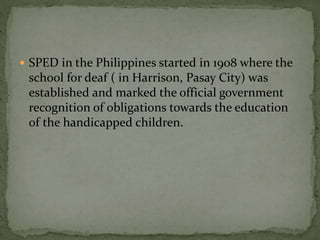
 SPED in the Philippines started in 1908 where the 
school for deaf ( in Harrison, Pasay City) was 
established and marked the official government 
recognition of obligations towards the education 
of the handicapped children.
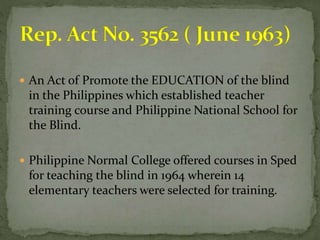
 An Act of Promote the EDUCATION of the blind 
in the Philippines which established teacher 
training course and Philippine National School for 
the Blind. 
 Philippine Normal College offered courses in Sped 
for teaching the blind in 1964 wherein 14 
elementary teachers were selected for training.
 In 1952, a pilot school for the SPED ( at the Phil. 
Women’s University) of mentally handicapped 
children was started. All children from this school 
were transferred to the Special Child Study Center 
in Cubao, Q.C. in 1957.
 AN ACT PROVIDING FOR THE 
REHABILITATION, SELF-DEVELOPMENT AND 
SELF-RELIANCE OF DISABLED PERSONS AND 
THEIR INTEGRATION INTO THE 
MAINSTREAM OF SOCIETY AND FOR OTHER 
PURPOSES.
 AN ACT ESTABLISHING A TEN-YEAR TRAINING 
PROGRAM FOR TEACHERS OF SPECIAL AND 
EXCEPTIONAL CHILDREN IN THE PHILIPPINES 
AND AUTHORIZING THE APPROPRIATION OF 
FUNDS THEREOF.
Goal of special 
Education
 States that the ultimate goal of special education 
shall be integration of mainstreaming of learners 
with special needs into the regular school system 
and eventually in the community. 
 To meet the individual educational needs of the 
learners and, to extent possible, prepare them for 
going to a more regular classroom setting.
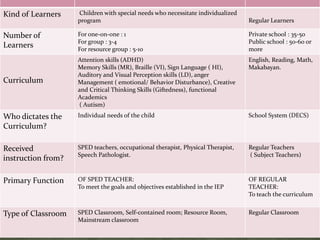
Kind of Learners Children with special needs who necessitate individualized 
program Regular Learners 
Number of 
Learners 
For one-on-one : 1 
For group : 3-4 
For resource group : 5-10 
Private school : 35-50 
Public school : 50-60 or 
more 
Curriculum 
Attention skills (ADHD) 
Memory Skills (MR), Braille (VI), Sign Language ( HI), 
Auditory and Visual Perception skills (LD), anger 
Management ( emotional/ Behavior Disturbance), Creative 
and Critical Thinking Skills (Giftedness), functional 
Academics 
( Autism) 
English, Reading, Math, 
Makabayan. 
Who dictates the 
Curriculum? 
Individual needs of the child School System (DECS) 
Received 
instruction from? 
SPED teachers, occupational therapist, Physical Therapist, 
Speech Pathologist. 
Regular Teachers 
( Subject Teachers) 
Primary Function OF SPED TEACHER: 
To meet the goals and objectives established in the IEP 
OF REGULAR 
TEACHER: 
To teach the curriculum 
Type of Classroom SPED Classroom, Self-contained room; Resource Room, 
Mainstream classroom 
Regular Classroom

Brief History of Special Education

  • 2.
     Special educationor special needs education is the practice of educating students with special needs in a way that addresses their individual differences and needs.  This process involves the individually planned and systematically monitored arrangement of teaching procedures, adapted equipment and materials, accessible settings.
  • 4.
     SPED inthe Philippines started in 1908 where the school for deaf ( in Harrison, Pasay City) was established and marked the official government recognition of obligations towards the education of the handicapped children.
  • 5.
     An Actof Promote the EDUCATION of the blind in the Philippines which established teacher training course and Philippine National School for the Blind.  Philippine Normal College offered courses in Sped for teaching the blind in 1964 wherein 14 elementary teachers were selected for training.
  • 6.
     In 1952,a pilot school for the SPED ( at the Phil. Women’s University) of mentally handicapped children was started. All children from this school were transferred to the Special Child Study Center in Cubao, Q.C. in 1957.
  • 7.
     AN ACTPROVIDING FOR THE REHABILITATION, SELF-DEVELOPMENT AND SELF-RELIANCE OF DISABLED PERSONS AND THEIR INTEGRATION INTO THE MAINSTREAM OF SOCIETY AND FOR OTHER PURPOSES.
  • 8.
     AN ACTESTABLISHING A TEN-YEAR TRAINING PROGRAM FOR TEACHERS OF SPECIAL AND EXCEPTIONAL CHILDREN IN THE PHILIPPINES AND AUTHORIZING THE APPROPRIATION OF FUNDS THEREOF.
  • 9.
    Goal of special Education
  • 10.
     States thatthe ultimate goal of special education shall be integration of mainstreaming of learners with special needs into the regular school system and eventually in the community.  To meet the individual educational needs of the learners and, to extent possible, prepare them for going to a more regular classroom setting.
  • 12.
    Kind of LearnersChildren with special needs who necessitate individualized program Regular Learners Number of Learners For one-on-one : 1 For group : 3-4 For resource group : 5-10 Private school : 35-50 Public school : 50-60 or more Curriculum Attention skills (ADHD) Memory Skills (MR), Braille (VI), Sign Language ( HI), Auditory and Visual Perception skills (LD), anger Management ( emotional/ Behavior Disturbance), Creative and Critical Thinking Skills (Giftedness), functional Academics ( Autism) English, Reading, Math, Makabayan. Who dictates the Curriculum? Individual needs of the child School System (DECS) Received instruction from? SPED teachers, occupational therapist, Physical Therapist, Speech Pathologist. Regular Teachers ( Subject Teachers) Primary Function OF SPED TEACHER: To meet the goals and objectives established in the IEP OF REGULAR TEACHER: To teach the curriculum Type of Classroom SPED Classroom, Self-contained room; Resource Room, Mainstream classroom Regular Classroom