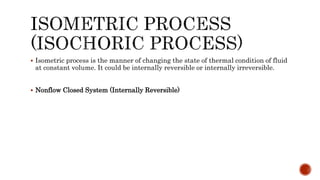
 Isometric process is the manner of changing the state of thermal condition of fluid
at constant volume. It could be internally reversible or internally irreversible.
 Nonflow Closed System (Internally Reversible)
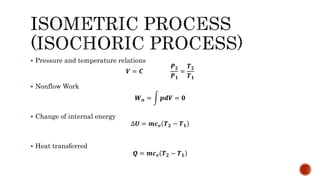
 Pressure and temperature relations
𝑽 = 𝑪
𝑷 𝟐
𝑷 𝟏
=
𝑻 𝟐
𝑻 𝟏
 Nonflow Work
𝑾 𝒏 = 𝒑𝒅𝑽 = 𝟎
 Change of internal energy
∆𝑼 = 𝒎𝒄 𝒗 𝑻 𝟐 − 𝑻 𝟏
 Heat transferred
𝑸 = 𝒎𝒄 𝒗 𝑻 𝟐 − 𝑻 𝟏
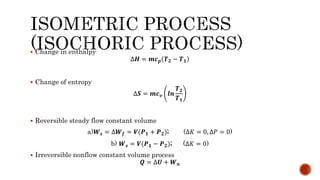
 Change in enthalpy
∆𝑯 = 𝒎𝒄 𝒑 𝑻 𝟐 − 𝑻 𝟏
 Change of entropy
∆𝑺 = 𝒎𝒄 𝒗 𝒍𝒏
𝑻 𝟐
𝑻 𝟏
 Reversible steady flow constant volume
a)𝑾 𝒔 = ∆𝑾 𝒇 = 𝑽(𝑷 𝟏 + 𝑷 𝟐); (∆𝐾 = 0, ∆𝑃 = 0)
b) 𝑾 𝒔 = 𝑽(𝑷 𝟏 − 𝑷 𝟐); (∆𝐾 = 0)
 Irreversible nonflow constant volume process
𝑸 = ∆𝑼 + 𝑾 𝒏
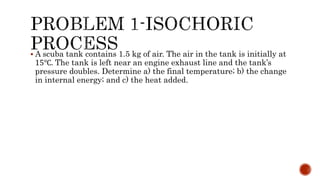
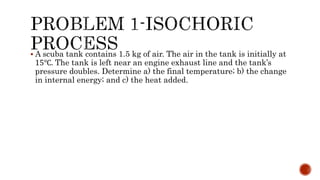
 A scuba tank contains 1.5 kg of air. The air in the tank is initially at
15℃. The tank is left near an engine exhaust line and the tank’s
pressure doubles. Determine a) the final temperature; b) the change
in internal energy; and c) the heat added.
 A scuba tank contains 1.5 kg of air. The air in the tank is initially at
15℃. The tank is left near an engine exhaust line and the tank’s
pressure doubles. Determine a) the final temperature; b) the change
in internal energy; and c) the heat added.
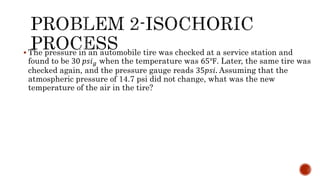
 The pressure in an automobile tire was checked at a service station and
found to be 30 𝑝𝑠𝑖 𝑔 when the temperature was 65℉. Later, the same tire was
checked again, and the pressure gauge reads 35𝑝𝑠𝑖. Assuming that the
atmospheric pressure of 14.7 psi did not change, what was the new
temperature of the air in the tire?
 The pressure in an automobile tire was checked at a service station and
found to be 30 𝑝𝑠𝑖 𝑔 when the temperature was 65℉. Later, the same tire was
checked again, and the pressure gauge reads 35𝑝𝑠𝑖. Assuming that the
atmospheric pressure of 14.7 psi did not change, what was the new
temperature of the air in the tire?
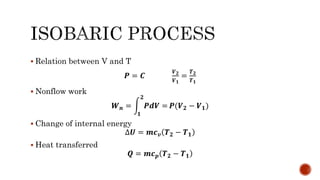
 An isobaric process is an internally reversible process of a substance during which
the pressure remains constant.
Nonflow Closed System
 Relation between V and T
𝑷 = 𝑪
𝑽 𝟐
𝑽 𝟏
=
𝑻 𝟐
𝑻 𝟏
 Nonflow work
𝑾 𝒏 =
𝟏
𝟐
𝑷𝒅𝑽 = 𝑷(𝑽 𝟐 − 𝑽 𝟏)
 Change of internal energy
∆𝑼 = 𝒎𝒄 𝒗 𝑻 𝟐 − 𝑻 𝟏
 Heat transferred
𝑸 = 𝒎𝒄 𝒑 𝑻 𝟐 − 𝑻 𝟏
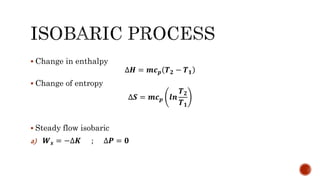
 Change in enthalpy
∆𝑯 = 𝒎𝒄 𝒑 𝑻 𝟐 − 𝑻 𝟏
 Change of entropy
∆𝑺 = 𝒎𝒄 𝒑 𝒍𝒏
𝑻 𝟐
𝑻 𝟏
 Steady flow isobaric
a) 𝑾 𝒔 = −∆𝑲 ; ∆𝑷 = 𝟎
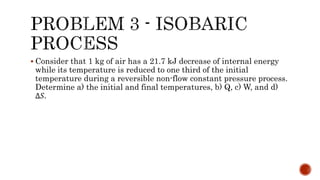
 Consider that 1 kg of air has a 21.7 kJ decrease of internal energy
while its temperature is reduced to one third of the initial
temperature during a reversible non-flow constant pressure process.
Determine a) the initial and final temperatures, b) Q, c) W, and d)
∆𝑆.
 Consider that 1 kg of air has a 21.7 kJ decrease of internal energy
while its temperature is reduced to one third of the initial
temperature during a reversible non-flow constant pressure process.
Determine a) the initial and final temperatures, b) Q, c) W, and d)
∆𝑆.
 Assume 0.9 kg of hydrogen simultaneously rejects heat and receives paddle work
input in a nonflow change of state at constant pressure from an initial
temperature of 21℃ to a final temperature of 32.2℃. If the heat rejected is thrice
the paddle work, determine a) ∆𝑼, ∆𝑯, ∆𝑺 for the system; b) 𝑄; and c) 𝑊𝑛𝑒𝑡.
 Assume 0.9 kg of hydrogen simultaneously rejects heat and receives paddle work
input in a nonflow change of state at constant pressure from an initial
temperature of 21℃ to a final temperature of 32.2℃. If the heat rejected is thrice
the paddle work, determine a) ∆𝑼, ∆𝑯, ∆𝑺 for the system; b) 𝑄; and c) 𝑊𝑛𝑒𝑡.
 An isothermal process is an internally reversible constant temperature process of
a substance.
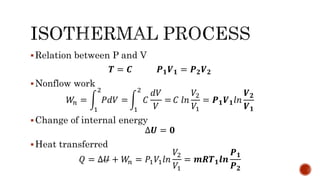
Relation between P and V
𝑻 = 𝑪 𝑷 𝟏 𝑽 𝟏 = 𝑷 𝟐 𝑽 𝟐
Nonflow work
𝑊𝑛 =
1
2
𝑃𝑑𝑉 =
1
2
𝐶
𝑑𝑉
𝑉
= 𝐶 𝑙𝑛
𝑉2
𝑉1
= 𝑷 𝟏 𝑽 𝟏 𝑙𝑛
𝑽 𝟐
𝑽 𝟏
Change of internal energy
∆𝑼 = 𝟎
Heat transferred
𝑄 = ∆𝑈 + 𝑊𝑛 = 𝑃1 𝑉1 𝑙𝑛
𝑉2
𝑉1
= 𝒎𝑹𝑻 𝟏 𝒍𝒏
𝑷 𝟏
𝑷 𝟐
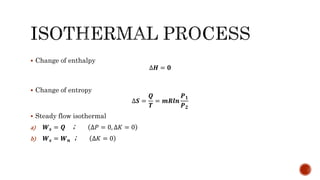
 Change of enthalpy
∆𝑯 = 𝟎
 Change of entropy
∆𝑺 =
𝑸
𝑻
= 𝒎𝑹𝒍𝒏
𝑷 𝟏
𝑷 𝟐
 Steady flow isothermal
a) 𝑾 𝒔 = 𝑸 ; ∆𝑃 = 0, ∆𝐾 = 0
b) 𝑾 𝒔 = 𝑾 𝒏 ; ∆𝐾 = 0
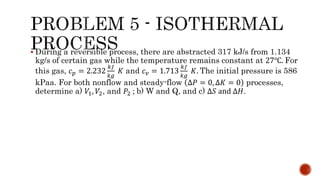
 During a reversible process, there are abstracted 317 kJ/s from 1.134
kg/s of certain gas while the temperature remains constant at 27℃. For
this gas, 𝑐 𝑝 = 2.232
𝑘𝐽
𝑘𝑔
𝐾 and 𝑐 𝑣 = 1.713
𝑘𝐽
𝑘𝑔
𝐾. The initial pressure is 586
kPaa. For both nonflow and steady-flow ∆𝑃 = 0, ∆𝐾 = 0 processes,
determine a) 𝑉1, 𝑉2, and 𝑃2 ; b) W and Q, and c) ∆𝑆 and ∆𝐻.
 During a reversible process, there are abstracted 317 kJ/s from 1.134
kg/s of certain gas while the temperature remains constant at 27℃. For
this gas, 𝑐 𝑝 = 2.232
𝑘𝐽
𝑘𝑔
𝐾 and 𝑐 𝑣 = 1.713
𝑘𝐽
𝑘𝑔
𝐾. The initial pressure is 586
kPaa. For both nonflow and steady-flow ∆𝑃 = 0, ∆𝐾 = 0 processes,
determine a) 𝑉1, 𝑉2, and 𝑃2 ; b) W and Q, and c) ∆𝑆 and ∆𝐻.
 During a reversible process, there are abstracted 317 kJ/s from 1.134
kg/s of certain gas while the temperature remains constant at 27℃. For
this gas, 𝑐 𝑝 = 2.232
𝑘𝐽
𝑘𝑔
𝐾 and 𝑐 𝑣 = 1.713
𝑘𝐽
𝑘𝑔
𝐾. The initial pressure is 586
kPaa. For both nonflow and steady-flow ∆𝑃 = 0, ∆𝐾 = 0 processes,
determine a) 𝑉1, 𝑉2, and 𝑃2 ; b) W and Q, and c) ∆𝑆 and ∆𝐻.
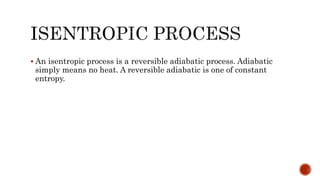
 An isentropic process is a reversible adiabatic process. Adiabatic
simply means no heat. A reversible adiabatic is one of constant
entropy.
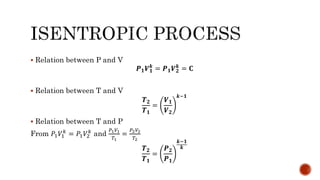
 Relation between P and V
𝑷 𝟏 𝑽 𝟏
𝒌
= 𝑷 𝟏 𝑽 𝟐
𝒌
= 𝐂
 Relation between T and V
𝑻 𝟐
𝑻 𝟏
=
𝑽 𝟏
𝑽 𝟐
𝒌−𝟏
 Relation between T and P
From 𝑃1 𝑉1
𝑘
= 𝑃1 𝑉2
𝑘
and
𝑃1 𝑉1
𝑇1
=
𝑃2 𝑉2
𝑇2
𝑻 𝟐
𝑻 𝟏
=
𝑷 𝟐
𝑷 𝟏
𝒌−𝟏
𝒌
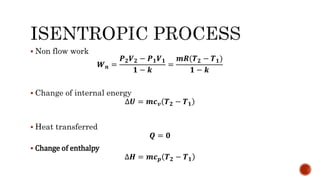
 Non flow work
𝑾 𝒏 =
𝑷 𝟐 𝑽 𝟐 − 𝑷 𝟏 𝑽 𝟏
𝟏 − 𝒌
=
𝒎𝑹(𝑻 𝟐 − 𝑻 𝟏)
𝟏 − 𝒌
 Change of internal energy
∆𝑼 = 𝒎𝒄 𝒗 𝑻 𝟐 − 𝑻 𝟏
 Heat transferred
𝑸 = 𝟎
 Change of enthalpy
∆𝑯 = 𝒎𝒄 𝒑 𝑻 𝟐 − 𝑻 𝟏
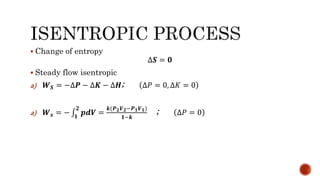
 Change of entropy
∆𝑺 = 𝟎
 Steady flow isentropic
a) 𝑾 𝑺 = −∆𝑷 − ∆𝑲 − ∆𝑯; ∆𝑃 = 0, ∆𝐾 = 0
a) 𝑾 𝒔 = − 𝟏
𝟐
𝒑𝒅𝑽 =
𝒌(𝑷 𝟐 𝑽 𝟐−𝑷 𝟏 𝑽 𝟏)
𝟏−𝒌
; ∆𝑃 = 0
 During an isentropic process of 1.36 kg/s of air, the temperature
increases from 5℃ to 116℃. For nonflow process and steady flow
process, find a) ∆𝑼; b) W; c) ∆𝑯; d) ∆𝑺; and e) Q.
 During an isentropic process of 1.36 kg/s of air, the temperature
increases from 5℃ to 116℃. For nonflow process and steady flow
process, find a) ∆𝑼; b) W; c) ∆𝑯; d) ∆𝑺; and e) Q.
 A nozzle is designed to expand air from 689 kPaa and 32℃ to 138 kPaa. Assume
an isentropic expansion and negligible approach velocity. The airflow rate is 1.36
kg/s. calculate a) the exit velocity; b) the proper exit cross-sectionl area.

Ideal gas-processes

  • 2.
     Isometric processis the manner of changing the state of thermal condition of fluid at constant volume. It could be internally reversible or internally irreversible.  Nonflow Closed System (Internally Reversible)
  • 3.
     Pressure andtemperature relations 𝑽 = 𝑪 𝑷 𝟐 𝑷 𝟏 = 𝑻 𝟐 𝑻 𝟏  Nonflow Work 𝑾 𝒏 = 𝒑𝒅𝑽 = 𝟎  Change of internal energy ∆𝑼 = 𝒎𝒄 𝒗 𝑻 𝟐 − 𝑻 𝟏  Heat transferred 𝑸 = 𝒎𝒄 𝒗 𝑻 𝟐 − 𝑻 𝟏
  • 4.
     Change inenthalpy ∆𝑯 = 𝒎𝒄 𝒑 𝑻 𝟐 − 𝑻 𝟏  Change of entropy ∆𝑺 = 𝒎𝒄 𝒗 𝒍𝒏 𝑻 𝟐 𝑻 𝟏  Reversible steady flow constant volume a)𝑾 𝒔 = ∆𝑾 𝒇 = 𝑽(𝑷 𝟏 + 𝑷 𝟐); (∆𝐾 = 0, ∆𝑃 = 0) b) 𝑾 𝒔 = 𝑽(𝑷 𝟏 − 𝑷 𝟐); (∆𝐾 = 0)  Irreversible nonflow constant volume process 𝑸 = ∆𝑼 + 𝑾 𝒏
  • 5.
     A scubatank contains 1.5 kg of air. The air in the tank is initially at 15℃. The tank is left near an engine exhaust line and the tank’s pressure doubles. Determine a) the final temperature; b) the change in internal energy; and c) the heat added.
  • 6.
     A scubatank contains 1.5 kg of air. The air in the tank is initially at 15℃. The tank is left near an engine exhaust line and the tank’s pressure doubles. Determine a) the final temperature; b) the change in internal energy; and c) the heat added.
  • 7.
     The pressurein an automobile tire was checked at a service station and found to be 30 𝑝𝑠𝑖 𝑔 when the temperature was 65℉. Later, the same tire was checked again, and the pressure gauge reads 35𝑝𝑠𝑖. Assuming that the atmospheric pressure of 14.7 psi did not change, what was the new temperature of the air in the tire?
  • 8.
     The pressurein an automobile tire was checked at a service station and found to be 30 𝑝𝑠𝑖 𝑔 when the temperature was 65℉. Later, the same tire was checked again, and the pressure gauge reads 35𝑝𝑠𝑖. Assuming that the atmospheric pressure of 14.7 psi did not change, what was the new temperature of the air in the tire?
  • 9.
     An isobaricprocess is an internally reversible process of a substance during which the pressure remains constant. Nonflow Closed System
  • 10.
     Relation betweenV and T 𝑷 = 𝑪 𝑽 𝟐 𝑽 𝟏 = 𝑻 𝟐 𝑻 𝟏  Nonflow work 𝑾 𝒏 = 𝟏 𝟐 𝑷𝒅𝑽 = 𝑷(𝑽 𝟐 − 𝑽 𝟏)  Change of internal energy ∆𝑼 = 𝒎𝒄 𝒗 𝑻 𝟐 − 𝑻 𝟏  Heat transferred 𝑸 = 𝒎𝒄 𝒑 𝑻 𝟐 − 𝑻 𝟏
  • 11.
     Change inenthalpy ∆𝑯 = 𝒎𝒄 𝒑 𝑻 𝟐 − 𝑻 𝟏  Change of entropy ∆𝑺 = 𝒎𝒄 𝒑 𝒍𝒏 𝑻 𝟐 𝑻 𝟏  Steady flow isobaric a) 𝑾 𝒔 = −∆𝑲 ; ∆𝑷 = 𝟎
  • 12.
     Consider that1 kg of air has a 21.7 kJ decrease of internal energy while its temperature is reduced to one third of the initial temperature during a reversible non-flow constant pressure process. Determine a) the initial and final temperatures, b) Q, c) W, and d) ∆𝑆.
  • 13.
     Consider that1 kg of air has a 21.7 kJ decrease of internal energy while its temperature is reduced to one third of the initial temperature during a reversible non-flow constant pressure process. Determine a) the initial and final temperatures, b) Q, c) W, and d) ∆𝑆.
  • 14.
     Assume 0.9kg of hydrogen simultaneously rejects heat and receives paddle work input in a nonflow change of state at constant pressure from an initial temperature of 21℃ to a final temperature of 32.2℃. If the heat rejected is thrice the paddle work, determine a) ∆𝑼, ∆𝑯, ∆𝑺 for the system; b) 𝑄; and c) 𝑊𝑛𝑒𝑡.
  • 15.
     Assume 0.9kg of hydrogen simultaneously rejects heat and receives paddle work input in a nonflow change of state at constant pressure from an initial temperature of 21℃ to a final temperature of 32.2℃. If the heat rejected is thrice the paddle work, determine a) ∆𝑼, ∆𝑯, ∆𝑺 for the system; b) 𝑄; and c) 𝑊𝑛𝑒𝑡.
  • 18.
     An isothermalprocess is an internally reversible constant temperature process of a substance.
  • 19.
    Relation between Pand V 𝑻 = 𝑪 𝑷 𝟏 𝑽 𝟏 = 𝑷 𝟐 𝑽 𝟐 Nonflow work 𝑊𝑛 = 1 2 𝑃𝑑𝑉 = 1 2 𝐶 𝑑𝑉 𝑉 = 𝐶 𝑙𝑛 𝑉2 𝑉1 = 𝑷 𝟏 𝑽 𝟏 𝑙𝑛 𝑽 𝟐 𝑽 𝟏 Change of internal energy ∆𝑼 = 𝟎 Heat transferred 𝑄 = ∆𝑈 + 𝑊𝑛 = 𝑃1 𝑉1 𝑙𝑛 𝑉2 𝑉1 = 𝒎𝑹𝑻 𝟏 𝒍𝒏 𝑷 𝟏 𝑷 𝟐
  • 20.
     Change ofenthalpy ∆𝑯 = 𝟎  Change of entropy ∆𝑺 = 𝑸 𝑻 = 𝒎𝑹𝒍𝒏 𝑷 𝟏 𝑷 𝟐  Steady flow isothermal a) 𝑾 𝒔 = 𝑸 ; ∆𝑃 = 0, ∆𝐾 = 0 b) 𝑾 𝒔 = 𝑾 𝒏 ; ∆𝐾 = 0
  • 21.
     During areversible process, there are abstracted 317 kJ/s from 1.134 kg/s of certain gas while the temperature remains constant at 27℃. For this gas, 𝑐 𝑝 = 2.232 𝑘𝐽 𝑘𝑔 𝐾 and 𝑐 𝑣 = 1.713 𝑘𝐽 𝑘𝑔 𝐾. The initial pressure is 586 kPaa. For both nonflow and steady-flow ∆𝑃 = 0, ∆𝐾 = 0 processes, determine a) 𝑉1, 𝑉2, and 𝑃2 ; b) W and Q, and c) ∆𝑆 and ∆𝐻.
  • 22.
     During areversible process, there are abstracted 317 kJ/s from 1.134 kg/s of certain gas while the temperature remains constant at 27℃. For this gas, 𝑐 𝑝 = 2.232 𝑘𝐽 𝑘𝑔 𝐾 and 𝑐 𝑣 = 1.713 𝑘𝐽 𝑘𝑔 𝐾. The initial pressure is 586 kPaa. For both nonflow and steady-flow ∆𝑃 = 0, ∆𝐾 = 0 processes, determine a) 𝑉1, 𝑉2, and 𝑃2 ; b) W and Q, and c) ∆𝑆 and ∆𝐻.
  • 23.
     During areversible process, there are abstracted 317 kJ/s from 1.134 kg/s of certain gas while the temperature remains constant at 27℃. For this gas, 𝑐 𝑝 = 2.232 𝑘𝐽 𝑘𝑔 𝐾 and 𝑐 𝑣 = 1.713 𝑘𝐽 𝑘𝑔 𝐾. The initial pressure is 586 kPaa. For both nonflow and steady-flow ∆𝑃 = 0, ∆𝐾 = 0 processes, determine a) 𝑉1, 𝑉2, and 𝑃2 ; b) W and Q, and c) ∆𝑆 and ∆𝐻.
  • 24.
     An isentropicprocess is a reversible adiabatic process. Adiabatic simply means no heat. A reversible adiabatic is one of constant entropy.
  • 25.
     Relation betweenP and V 𝑷 𝟏 𝑽 𝟏 𝒌 = 𝑷 𝟏 𝑽 𝟐 𝒌 = 𝐂  Relation between T and V 𝑻 𝟐 𝑻 𝟏 = 𝑽 𝟏 𝑽 𝟐 𝒌−𝟏  Relation between T and P From 𝑃1 𝑉1 𝑘 = 𝑃1 𝑉2 𝑘 and 𝑃1 𝑉1 𝑇1 = 𝑃2 𝑉2 𝑇2 𝑻 𝟐 𝑻 𝟏 = 𝑷 𝟐 𝑷 𝟏 𝒌−𝟏 𝒌
  • 26.
     Non flowwork 𝑾 𝒏 = 𝑷 𝟐 𝑽 𝟐 − 𝑷 𝟏 𝑽 𝟏 𝟏 − 𝒌 = 𝒎𝑹(𝑻 𝟐 − 𝑻 𝟏) 𝟏 − 𝒌  Change of internal energy ∆𝑼 = 𝒎𝒄 𝒗 𝑻 𝟐 − 𝑻 𝟏  Heat transferred 𝑸 = 𝟎  Change of enthalpy ∆𝑯 = 𝒎𝒄 𝒑 𝑻 𝟐 − 𝑻 𝟏
  • 27.
     Change ofentropy ∆𝑺 = 𝟎  Steady flow isentropic a) 𝑾 𝑺 = −∆𝑷 − ∆𝑲 − ∆𝑯; ∆𝑃 = 0, ∆𝐾 = 0 a) 𝑾 𝒔 = − 𝟏 𝟐 𝒑𝒅𝑽 = 𝒌(𝑷 𝟐 𝑽 𝟐−𝑷 𝟏 𝑽 𝟏) 𝟏−𝒌 ; ∆𝑃 = 0
  • 28.
     During anisentropic process of 1.36 kg/s of air, the temperature increases from 5℃ to 116℃. For nonflow process and steady flow process, find a) ∆𝑼; b) W; c) ∆𝑯; d) ∆𝑺; and e) Q.
  • 29.
     During anisentropic process of 1.36 kg/s of air, the temperature increases from 5℃ to 116℃. For nonflow process and steady flow process, find a) ∆𝑼; b) W; c) ∆𝑯; d) ∆𝑺; and e) Q.
  • 30.
     A nozzleis designed to expand air from 689 kPaa and 32℃ to 138 kPaa. Assume an isentropic expansion and negligible approach velocity. The airflow rate is 1.36 kg/s. calculate a) the exit velocity; b) the proper exit cross-sectionl area.