
© Innova Biosciences ltd. 2014. All rights reserved
ELISA
An introduction to the basic principles
and assay formats
© Innova Biosciences ltd. 2014. All rights reserved
Agenda
Agenda:
• Introduction to ELISA
• The different assay types
• Assay development tips
• Data analysis tips
• Troubleshooting tips
• Indirect vs. Direct antibody detection
• Using Lightning-Link for primary antibody labeling
• Immuno PCR
© Innova Biosciences ltd. 2014. All rights reserved
Helene Fransolet
International Distributor Manager and
Sales Executive at Innova Biosciences
© Innova Biosciences ltd. 2014. All rights reserved
Introduction
ELISA:
• Enzyme-Linked Immunosorbent Assay
• Immunoassay utilising antibodies linked to enzymes for detection by colour
change
• Evolved from RIA in the 1960s
• Antibody or analyte being detected is absorbed to a solid surface, meaning
unbound materials can be washed away with ease
• With time, more techniques were developed and ELISA is now used to
describe any assay where a molecule is absorbed on a solid phase
© Innova Biosciences ltd. 2014. All rights reserved
Introduction
Advantages:
• Qualitative and Quantitative assay
• Screen a large number of samples in one go
• Relatively easy to perform and to transfer to an automated format
Disadvantages:
• No information on the biochemical properties of the analyte being detected
• Other techniques such as Western Blotting or IHC need to be employed
© Innova Biosciences ltd. 2014. All rights reserved
Introduction
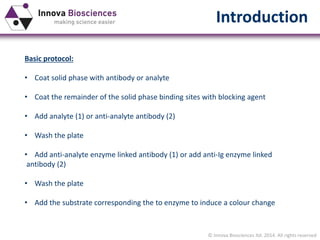
Basic protocol:
• Coat solid phase with antibody or analyte
• Coat the remainder of the solid phase binding sites with blocking agent
• Add analyte (1) or anti-analyte antibody (2)
• Wash the plate
• Add anti-analyte enzyme linked antibody (1) or add anti-Ig enzyme linked
antibody (2)
• Wash the plate
• Add the substrate corresponding the to enzyme to induce a colour change
© Innova Biosciences ltd. 2014. All rights reserved
Assay Formats
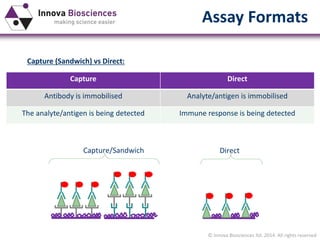
Capture (Sandwich) vs Direct:
Capture Direct
Antibody is immobilised Analyte/antigen is immobilised
The analyte/antigen is being detected Immune response is being detected
© Innova Biosciences ltd. 2014. All rights reserved
Assay Formats
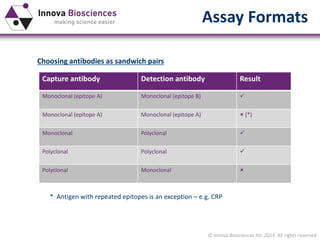
Choosing antibodies as sandwich pairs
Capture antibody Detection antibody Result
Monoclonal (epitope A) Monoclonal (epitope B) 
Monoclonal (epitope A) Monoclonal (epitope A)  (*)
Monoclonal Polyclonal 
Polyclonal Polyclonal 
Polyclonal Monoclonal 
* Antigen with repeated epitopes is an exception – e.g. CRP
© Innova Biosciences ltd. 2014. All rights reserved
Assay Formats
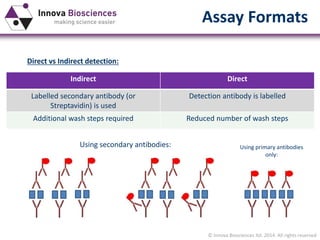
Direct vs Indirect detection:
Indirect Direct
Labelled secondary antibody (or
Streptavidin) is used
Detection antibody is labelled
Additional wash steps required Reduced number of wash steps
Using secondary antibodies: Using primary antibodies
only:
© Innova Biosciences ltd. 2014. All rights reserved
Assay Formats
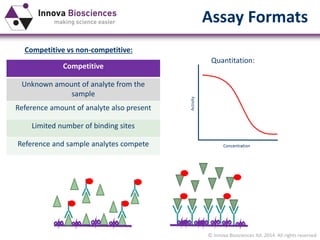
Competitive vs non-competitive:
Competitive
Unknown amount of analyte from the
sample
Reference amount of analyte also present
Limited number of binding sites
Reference and sample analytes compete
Quantitation:
© Innova Biosciences ltd. 2014. All rights reserved
Assay Formats
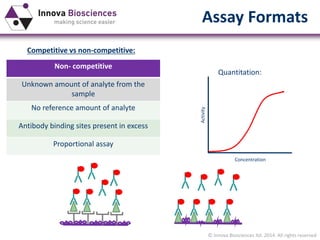
Competitive vs non-competitive:
Non- competitive
Unknown amount of analyte from the
sample
No reference amount of analyte
Antibody binding sites present in excess
Proportional assay
Activity
Concentration
Quantitation:
© Innova Biosciences ltd. 2014. All rights reserved
Assay development
Tips:
• What is being detected?
• Is it a qualitative or quantitative assay?
• What is being measured?
• What level of sensitivity is required?
© Innova Biosciences ltd. 2014. All rights reserved
Data Analysis
Tips:
• Controls are required
• A standard curve is required for quantitative assays
• Use replicates to generate robust data points
• Assay range must be established
• Determine the limit of detection
© Innova Biosciences ltd. 2014. All rights reserved
Troubleshooting
• High background
• No signal
• Too much signal
• Poor standard curve
• Poor duplicates
• Poor reproducibility
• Edge effect
© Innova Biosciences ltd. 2014. All rights reserved
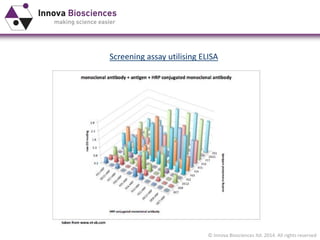
Screening assay utilising ELISA
© Innova Biosciences ltd. 2014. All rights reserved
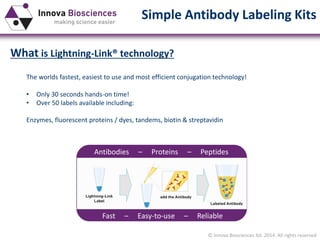
What is Lightning-Link® technology?
The worlds fastest, easiest to use and most efficient conjugation technology!
• Only 30 seconds hands-on time!
• Over 50 labels available including:
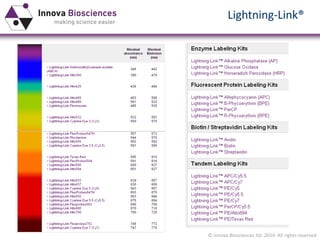
Enzymes, fluorescent proteins / dyes, tandems, biotin & streptavidin
Antibodies – Proteins – Peptides
Fast – Easy-to-use – Reliable
Simple Antibody Labeling Kits
© Innova Biosciences ltd. 2014. All rights reserved
What is Lightning-Link® technology?
• Chemistry expertise not required
• 100% antibody recovery
• Pack sizes range from 10ug, 100ug up to 5+mg
• Covalent conjugation ensures long-term stability
• Two ranges Lightning-Link® (3 hours incubation) and Lightning-Link® RAPID
(15 minutes)
Lightning-Link®
© Innova Biosciences ltd. 2014. All rights reserved
Lightning-Link®
© Innova Biosciences ltd. 2014. All rights reserved
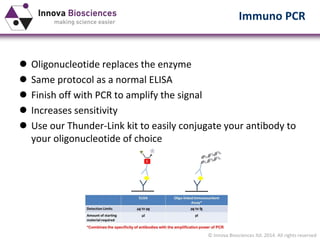
 Oligonucleotide replaces the enzyme
 Same protocol as a normal ELISA
 Finish off with PCR to amplify the signal
 Increases sensitivity
 Use our Thunder-Link kit to easily conjugate your antibody to
your oligonucleotide of choice
Immuno PCR
© Innova Biosciences ltd. 2014. All rights reserved
Contact
If you would like any more information, please contact us at
info@innovabiosciences.com
facebook.com/InnovaBiosciences
@InnovaBioSci
Innova Biosciences
© Innova Biosciences ltd. 2014. All rights reserved
Innova Biosciences Ltd.
Babraham Research Campus,
Cambridge, UK,
CB22 3AT
www.innovabiosciences.com
Lightning-Link® is a registered trademark of Innova Biosciences
DyLight® is a registered trademark of Thermo Fisher Scientific Inc. and its subsidiaries

Elisa - an introduction to the basic principles and assay formats presentation

  • 1.
    © Innova Biosciencesltd. 2014. All rights reserved ELISA An introduction to the basic principles and assay formats
  • 2.
    © Innova Biosciencesltd. 2014. All rights reserved Agenda Agenda: • Introduction to ELISA • The different assay types • Assay development tips • Data analysis tips • Troubleshooting tips • Indirect vs. Direct antibody detection • Using Lightning-Link for primary antibody labeling • Immuno PCR
  • 3.
    © Innova Biosciencesltd. 2014. All rights reserved Helene Fransolet International Distributor Manager and Sales Executive at Innova Biosciences
  • 4.
    © Innova Biosciencesltd. 2014. All rights reserved Introduction ELISA: • Enzyme-Linked Immunosorbent Assay • Immunoassay utilising antibodies linked to enzymes for detection by colour change • Evolved from RIA in the 1960s • Antibody or analyte being detected is absorbed to a solid surface, meaning unbound materials can be washed away with ease • With time, more techniques were developed and ELISA is now used to describe any assay where a molecule is absorbed on a solid phase
  • 5.
    © Innova Biosciencesltd. 2014. All rights reserved Introduction Advantages: • Qualitative and Quantitative assay • Screen a large number of samples in one go • Relatively easy to perform and to transfer to an automated format Disadvantages: • No information on the biochemical properties of the analyte being detected • Other techniques such as Western Blotting or IHC need to be employed
  • 6.
    © Innova Biosciencesltd. 2014. All rights reserved Introduction Basic protocol: • Coat solid phase with antibody or analyte • Coat the remainder of the solid phase binding sites with blocking agent • Add analyte (1) or anti-analyte antibody (2) • Wash the plate • Add anti-analyte enzyme linked antibody (1) or add anti-Ig enzyme linked antibody (2) • Wash the plate • Add the substrate corresponding the to enzyme to induce a colour change
  • 7.
    © Innova Biosciencesltd. 2014. All rights reserved Assay Formats Capture (Sandwich) vs Direct: Capture Direct Antibody is immobilised Analyte/antigen is immobilised The analyte/antigen is being detected Immune response is being detected
  • 8.
    © Innova Biosciencesltd. 2014. All rights reserved Assay Formats Choosing antibodies as sandwich pairs Capture antibody Detection antibody Result Monoclonal (epitope A) Monoclonal (epitope B)  Monoclonal (epitope A) Monoclonal (epitope A)  (*) Monoclonal Polyclonal  Polyclonal Polyclonal  Polyclonal Monoclonal  * Antigen with repeated epitopes is an exception – e.g. CRP
  • 9.
    © Innova Biosciencesltd. 2014. All rights reserved Assay Formats Direct vs Indirect detection: Indirect Direct Labelled secondary antibody (or Streptavidin) is used Detection antibody is labelled Additional wash steps required Reduced number of wash steps Using secondary antibodies: Using primary antibodies only:
  • 10.
    © Innova Biosciencesltd. 2014. All rights reserved Assay Formats Competitive vs non-competitive: Competitive Unknown amount of analyte from the sample Reference amount of analyte also present Limited number of binding sites Reference and sample analytes compete Quantitation:
  • 11.
    © Innova Biosciencesltd. 2014. All rights reserved Assay Formats Competitive vs non-competitive: Non- competitive Unknown amount of analyte from the sample No reference amount of analyte Antibody binding sites present in excess Proportional assay Activity Concentration Quantitation:
  • 12.
    © Innova Biosciencesltd. 2014. All rights reserved Assay development Tips: • What is being detected? • Is it a qualitative or quantitative assay? • What is being measured? • What level of sensitivity is required?
  • 13.
    © Innova Biosciencesltd. 2014. All rights reserved Data Analysis Tips: • Controls are required • A standard curve is required for quantitative assays • Use replicates to generate robust data points • Assay range must be established • Determine the limit of detection
  • 14.
    © Innova Biosciencesltd. 2014. All rights reserved Troubleshooting • High background • No signal • Too much signal • Poor standard curve • Poor duplicates • Poor reproducibility • Edge effect
  • 15.
    © Innova Biosciencesltd. 2014. All rights reserved Screening assay utilising ELISA
  • 16.
    © Innova Biosciencesltd. 2014. All rights reserved What is Lightning-Link® technology? The worlds fastest, easiest to use and most efficient conjugation technology! • Only 30 seconds hands-on time! • Over 50 labels available including: Enzymes, fluorescent proteins / dyes, tandems, biotin & streptavidin Antibodies – Proteins – Peptides Fast – Easy-to-use – Reliable Simple Antibody Labeling Kits
  • 17.
    © Innova Biosciencesltd. 2014. All rights reserved What is Lightning-Link® technology? • Chemistry expertise not required • 100% antibody recovery • Pack sizes range from 10ug, 100ug up to 5+mg • Covalent conjugation ensures long-term stability • Two ranges Lightning-Link® (3 hours incubation) and Lightning-Link® RAPID (15 minutes) Lightning-Link®
  • 18.
    © Innova Biosciencesltd. 2014. All rights reserved Lightning-Link®
  • 19.
    © Innova Biosciencesltd. 2014. All rights reserved  Oligonucleotide replaces the enzyme  Same protocol as a normal ELISA  Finish off with PCR to amplify the signal  Increases sensitivity  Use our Thunder-Link kit to easily conjugate your antibody to your oligonucleotide of choice Immuno PCR
  • 20.
    © Innova Biosciencesltd. 2014. All rights reserved Contact If you would like any more information, please contact us at info@innovabiosciences.com facebook.com/InnovaBiosciences @InnovaBioSci Innova Biosciences
  • 21.
    © Innova Biosciencesltd. 2014. All rights reserved Innova Biosciences Ltd. Babraham Research Campus, Cambridge, UK, CB22 3AT www.innovabiosciences.com Lightning-Link® is a registered trademark of Innova Biosciences DyLight® is a registered trademark of Thermo Fisher Scientific Inc. and its subsidiaries