• Personal –
introspective
flow of thought -
written in a
moment of crisis
• Five sections;
reflect the
fragmented
experience of
the 20th
c.
T. S. Eliot
The Waste
Land
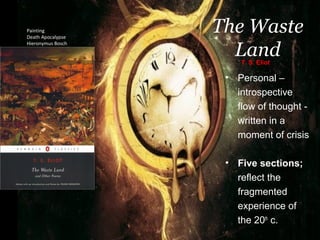
Painting
Death Apocalypse
Hieronymus Bosch
• Collection of undefined states of
mind, hallucinations, impressions,
personalities – blended and
superimposed
• Voice goes beyond the boundaries
of time and place.
• The speaking voice is related to
various personalities:
Tiresias,
a knight from the Grail legend,
the Fisher King.
• disillusionment and disgust after World War I.
• Contrast between
past – fertility and
Present – sterility.
• The mythical past linked to a new concept of
History (repetition of the same events - Vico)
Though reality has somehow become warped (ill)
• Spring Symbols: compared to Chaucer – no
rebirth.
Themes
April is the cruelest month, breeding
Lilacs out of the dead land, mixing
Memory and desire, stirring
Dull roots with spring rain.
Style
Quotations from a series of works of diff. cultures.Quotations from a series of works of diff. cultures.
Fragmentation of text.Fragmentation of text.
reader is required to “presume” significance.reader is required to “presume” significance.
Use of the idea of objective correlative :Use of the idea of objective correlative :
Repetition of words, images and phrasesRepetition of words, images and phrases.
Association of ideas – past and present are relative.
Myth – to give depth to present stagnation.
The Intimate – Introspective as representative of all humanity – universal.
Use of Juxtaposition, Enjambement – Jarring, displacing the reader . Forcing reflection
expressing emotion in the form of art - "objective
correlative“
objects, a situation, events which trigger that particular
emotion so the external sensory experience directs the
emotion immediately evoked
“Objective correlative” a
pattern, events, actions, or
situation
- awaken in the reader
emotional response without
direct statement of that
subjective emotion.
i.e. - The day the world woke up
to scream
i.e. – Today I Glittered
Objective correlative
 Eliot - Montale depict bleak setting.
 reference to a barren setting – spiritual emptiness.
 World decadence in Eliot.
 Native – local emptiness (isolation) in Montale.
What The Thunder said Meriggiare pallido e assorto
(“Ossi di Seppia”)
Here is no water but only rock
Rock and no water and the sandy road
The road winding above among the mountains
Which are mountains of rock without water.
Meriggiare pallido e assorto
presso un rovente muro d’orto,
ascoltare tra i pruni e gli sterpi
schiocchi di merli, frusci di serpi.
Association –
T. S. Eliot and Montale
Modern world view 19th-century world view
Chaotic - Complex Ordered
Futile Meaningful
Pessimistic Optimistic
Unstable Stable
Loss of faith Faith
Loss of moral values Morality/Values
Uncertain identity Clearly defined sense of identity
John Everett Millais

Eliot

  • 1.
    • Personal – introspective flowof thought - written in a moment of crisis • Five sections; reflect the fragmented experience of the 20th c. T. S. Eliot The Waste Land Painting Death Apocalypse Hieronymus Bosch
  • 2.
    • Collection ofundefined states of mind, hallucinations, impressions, personalities – blended and superimposed • Voice goes beyond the boundaries of time and place. • The speaking voice is related to various personalities: Tiresias, a knight from the Grail legend, the Fisher King.
  • 3.
    • disillusionment anddisgust after World War I. • Contrast between past – fertility and Present – sterility. • The mythical past linked to a new concept of History (repetition of the same events - Vico) Though reality has somehow become warped (ill) • Spring Symbols: compared to Chaucer – no rebirth. Themes April is the cruelest month, breeding Lilacs out of the dead land, mixing Memory and desire, stirring Dull roots with spring rain.
  • 4.
    Style Quotations from aseries of works of diff. cultures.Quotations from a series of works of diff. cultures. Fragmentation of text.Fragmentation of text. reader is required to “presume” significance.reader is required to “presume” significance. Use of the idea of objective correlative :Use of the idea of objective correlative : Repetition of words, images and phrasesRepetition of words, images and phrases. Association of ideas – past and present are relative. Myth – to give depth to present stagnation. The Intimate – Introspective as representative of all humanity – universal. Use of Juxtaposition, Enjambement – Jarring, displacing the reader . Forcing reflection expressing emotion in the form of art - "objective correlative“ objects, a situation, events which trigger that particular emotion so the external sensory experience directs the emotion immediately evoked
  • 5.
    “Objective correlative” a pattern,events, actions, or situation - awaken in the reader emotional response without direct statement of that subjective emotion. i.e. - The day the world woke up to scream i.e. – Today I Glittered Objective correlative
  • 6.
     Eliot -Montale depict bleak setting.  reference to a barren setting – spiritual emptiness.  World decadence in Eliot.  Native – local emptiness (isolation) in Montale. What The Thunder said Meriggiare pallido e assorto (“Ossi di Seppia”) Here is no water but only rock Rock and no water and the sandy road The road winding above among the mountains Which are mountains of rock without water. Meriggiare pallido e assorto presso un rovente muro d’orto, ascoltare tra i pruni e gli sterpi schiocchi di merli, frusci di serpi. Association – T. S. Eliot and Montale
  • 7.
    Modern world view19th-century world view Chaotic - Complex Ordered Futile Meaningful Pessimistic Optimistic Unstable Stable Loss of faith Faith Loss of moral values Morality/Values Uncertain identity Clearly defined sense of identity John Everett Millais