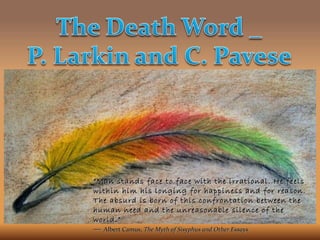
““Man stands face to face with the irrational. He feelsMan stands face to face with the irrational. He feels
within him his longing for happiness and for reason.within him his longing for happiness and for reason.
The absurd is born of this confrontation between theThe absurd is born of this confrontation between the
human need and the unreasonable silence of thehuman need and the unreasonable silence of the
world.”world.”
―― Albert Camus,Albert Camus, The Myth of Sisyphus and Other EssaysThe Myth of Sisyphus and Other Essays
Neo-Realism and Post War trauma
The Post War Writer’s PTSD*
 Death and Loss – an obsessive theme in poetry.
 The concept of death as natural as life
 Reality as hard earned, brutal – life is violent
 Inevitable and permanent – no religious illusions
 Hard. Pure. Violent in his delving into the depths
of humanity. Proposes universal truths -
antimodern, but authentic and brutally honest.
Cesare Pavese –
9 Sept. 1908 – 27 Aug. 1950
Philip Arthur Larkin –
9 Aug. 1922 – 2 Dec. 1985
Quote: Beckett, Hardy and Larkin and successive
poets - Death and Loss – a common theme in poetry.
The concept of death as natural as life
Reality as hard earned, brutal – life is violent
Beyond the grave is a blank nothingness
nothing more terrible, nothing more true. The
alliterative “t”
*Post Traumatic Stress Disorder
Aubade
I work all day, and get half-drunk at night.
Waking at four to soundless dark, I stare.
In time the curtain-edges will grow light.
Till then I see what’s really always there:
Unresting death, a whole day nearer now,
Making all thought impossible but how
And where and when I shall myself die.
Arid interrogation: yet the dread
Of dying, and being dead,
Flashes afresh to hold and horrify.
The mind blanks at the glare. Not in remorse
—The good not done, the love not given, time
Torn off unused—nor wretchedly because
An only life can take so long to climb
Clear of its wrong beginnings, and may never;
But at the total emptiness for ever,
The sure extinction that we travel to
And shall be lost in always. Not to be here,
Not to be anywhere,
And soon; nothing more terrible, nothing more true.
This is a special way of being afraid
No trick dispels. Religion used to try,
That vast moth-eaten musical brocade
Created to pretend we never die,
And specious stuff that says No rational being
Can fear a thing it will not feel, not seeing
Song to the Dawn
1) Death is immanent (essential-innate{inherent}) and
2) Imminent (forthcoming.. Not if … but when – looming above-at any moment)
Song to the morning – (Aubade – conv. love song, or dialogue between lovers) but Larkin s‟
silent partner in this dialogue-monologue is not a lover (comfort), but “unresting
death” l.5.
• Death- a source of fear and fright in life.
“__ the dread
Of dying, and being dead,
Flashes afresh to hold and horrify.” (Aubade)
• Death- a perpetual vehicle for our journey into eternity.
“The sure extinction that we travel to
And shall be lost in always. Not to be here
Not to be anywhere,” (Aubade)
• Death gives chances to think and calculate our life and its activities.
“__ The good not done, the love not given, time
Torn off unused__” (Aubade)
Death according to Larkin
• Rationality is not quite enough in facing the dread of death but it is our only
safeguard.
“No rational being
Can fear a thing it will not feel.” (Aubade)
HOWEVER
• Death has -
“ __no sight, no sound,
No touch or taste or smell, nothing to think with,
Nothing to love or link with.” (Aubade)
The fear of death and facing the moment with courage.
“Courage is no good:
It means not scaring others. Being brave
Lets no one off the grave.” (Aubade)
It is pointless, and in fact, when we are caught off guard or alone, we recollect the
awesome fear :
“realization of it rages out
In furnace-fear when we are caught without
People or drink.”
….
“Death is no different whined at than withstood.”
The reality of its existence is all the same, whether we accept it stoically or drop in
prayer and abjection
Death Will Come And Will Wear Your Eyes
Death will come and will wear your eyes
–
the death that is with us
from morning to evening, sleepless,
deaf, like an old regret
or an absurd vice. Your eyes
will be a futile word,
a cry unspoken, a silence.
Thus you see them every morning
when alone you stoop over yourself
in the mirror. O sweet hope,
that day we too will know
that you are life and nothingness.
Death keeps an eye on each of us.
Death will come and will have your eyes.
It will be like giving up a vice,
like watching a dead face
re-emerge in the mirror,
like listening to a lip closed.
We will go down into the gorge mute.
[22 March 1950]
Verrà la morte e avrà i tuoi occhi-
questa morte che ci accompagna
dal mattino alla sera, insonne,
sorda, come un vecchio rimorso
o un vizio assurdo. I tuoi occhi
saranno una vana parola
un grido taciuto, un silenzio.
Così li vedi ogni mattina
quando su te sola ti pieghi
nello specchio. O cara speranza,
quel giorno sapremo anche noi
che sei la vita e sei il nulla.
Per tutti la morte ha uno sguardo.
Verrà la morte e avrà i tuoi occhi.
Sarà come smettere un vizio,
come vedere nello specchio
riemergere un viso morto,
come ascoltare un labbro chiuso.
Scenderemo nel gorgo muti.
[22 March 1950]
Attributes to “Picture” Death
 “Unresting”;
 “the total emptiness”;
 “the sure extinction”;
 “nothing more terrible,
nothing more true.”
 “The anesthetic from which none
come round.”
 “__stays just on the edge of vision.
A small unfocused blur, a
standing chill.”
 “__ the solving emptiness”
 unfocused blur
 plain as a wardrobe
 Looming,
 “sleepless”;
 “deaf”;
 “an old regret, … and absurd vice.”
 “you are life and nothingness”
 Vigil
 A liberation, “like giving up a vice”
 “ like watching a dead face
re-emerge in the mirror,
like listening to a lip closed.” (an old
memory or a private thought from a
long time before)
 ? An old friend
Rummaging in our souls, we often dig up something that ought to have lain there unnoticed. ”
― Count Lev Nikolayevich Tolstoy, Anna Karenina
Larkin emphasizes the attitude typical of an agnostic(?).
Death – not a gateway to heaven.
Death is the ultimate truth – so to that end … our lives and
activities are absurd (Albert Camus). The absurd is lucid reason noting its limits
WhatWhat to do … ?
Myth of Sisyphus?
(jubris)- to dareto dare
OR
Delve into that fear, down into the belly
of the whale, and miraculously
re-emerge safe, whole, and healed? (Jonah)
Larkin offers some hope …Larkin offers some hope …
Our love, deeds and attitudes are immortal.
“Only an attitude remains”
“What will remain of us is love”
(An Arundel Tomb) =^.^==^.^=
Larkin-Pavese
Larkin-Pavese

Larkin-Pavese

  • 1.
    ““Man stands faceto face with the irrational. He feelsMan stands face to face with the irrational. He feels within him his longing for happiness and for reason.within him his longing for happiness and for reason. The absurd is born of this confrontation between theThe absurd is born of this confrontation between the human need and the unreasonable silence of thehuman need and the unreasonable silence of the world.”world.” ―― Albert Camus,Albert Camus, The Myth of Sisyphus and Other EssaysThe Myth of Sisyphus and Other Essays
  • 2.
    Neo-Realism and PostWar trauma The Post War Writer’s PTSD*  Death and Loss – an obsessive theme in poetry.  The concept of death as natural as life  Reality as hard earned, brutal – life is violent  Inevitable and permanent – no religious illusions  Hard. Pure. Violent in his delving into the depths of humanity. Proposes universal truths - antimodern, but authentic and brutally honest. Cesare Pavese – 9 Sept. 1908 – 27 Aug. 1950 Philip Arthur Larkin – 9 Aug. 1922 – 2 Dec. 1985 Quote: Beckett, Hardy and Larkin and successive poets - Death and Loss – a common theme in poetry. The concept of death as natural as life Reality as hard earned, brutal – life is violent Beyond the grave is a blank nothingness nothing more terrible, nothing more true. The alliterative “t” *Post Traumatic Stress Disorder
  • 4.
    Aubade I work allday, and get half-drunk at night. Waking at four to soundless dark, I stare. In time the curtain-edges will grow light. Till then I see what’s really always there: Unresting death, a whole day nearer now, Making all thought impossible but how And where and when I shall myself die. Arid interrogation: yet the dread Of dying, and being dead, Flashes afresh to hold and horrify. The mind blanks at the glare. Not in remorse —The good not done, the love not given, time Torn off unused—nor wretchedly because An only life can take so long to climb Clear of its wrong beginnings, and may never; But at the total emptiness for ever, The sure extinction that we travel to And shall be lost in always. Not to be here, Not to be anywhere, And soon; nothing more terrible, nothing more true. This is a special way of being afraid No trick dispels. Religion used to try, That vast moth-eaten musical brocade Created to pretend we never die, And specious stuff that says No rational being Can fear a thing it will not feel, not seeing
  • 5.
    Song to theDawn 1) Death is immanent (essential-innate{inherent}) and 2) Imminent (forthcoming.. Not if … but when – looming above-at any moment) Song to the morning – (Aubade – conv. love song, or dialogue between lovers) but Larkin s‟ silent partner in this dialogue-monologue is not a lover (comfort), but “unresting death” l.5. • Death- a source of fear and fright in life. “__ the dread Of dying, and being dead, Flashes afresh to hold and horrify.” (Aubade) • Death- a perpetual vehicle for our journey into eternity. “The sure extinction that we travel to And shall be lost in always. Not to be here Not to be anywhere,” (Aubade) • Death gives chances to think and calculate our life and its activities. “__ The good not done, the love not given, time Torn off unused__” (Aubade) Death according to Larkin
  • 6.
    • Rationality isnot quite enough in facing the dread of death but it is our only safeguard. “No rational being Can fear a thing it will not feel.” (Aubade) HOWEVER • Death has - “ __no sight, no sound, No touch or taste or smell, nothing to think with, Nothing to love or link with.” (Aubade) The fear of death and facing the moment with courage. “Courage is no good: It means not scaring others. Being brave Lets no one off the grave.” (Aubade) It is pointless, and in fact, when we are caught off guard or alone, we recollect the awesome fear : “realization of it rages out In furnace-fear when we are caught without People or drink.” …. “Death is no different whined at than withstood.” The reality of its existence is all the same, whether we accept it stoically or drop in prayer and abjection
  • 7.
    Death Will ComeAnd Will Wear Your Eyes Death will come and will wear your eyes – the death that is with us from morning to evening, sleepless, deaf, like an old regret or an absurd vice. Your eyes will be a futile word, a cry unspoken, a silence. Thus you see them every morning when alone you stoop over yourself in the mirror. O sweet hope, that day we too will know that you are life and nothingness. Death keeps an eye on each of us. Death will come and will have your eyes. It will be like giving up a vice, like watching a dead face re-emerge in the mirror, like listening to a lip closed. We will go down into the gorge mute. [22 March 1950] Verrà la morte e avrà i tuoi occhi- questa morte che ci accompagna dal mattino alla sera, insonne, sorda, come un vecchio rimorso o un vizio assurdo. I tuoi occhi saranno una vana parola un grido taciuto, un silenzio. Così li vedi ogni mattina quando su te sola ti pieghi nello specchio. O cara speranza, quel giorno sapremo anche noi che sei la vita e sei il nulla. Per tutti la morte ha uno sguardo. Verrà la morte e avrà i tuoi occhi. Sarà come smettere un vizio, come vedere nello specchio riemergere un viso morto, come ascoltare un labbro chiuso. Scenderemo nel gorgo muti. [22 March 1950]
  • 8.
    Attributes to “Picture”Death  “Unresting”;  “the total emptiness”;  “the sure extinction”;  “nothing more terrible, nothing more true.”  “The anesthetic from which none come round.”  “__stays just on the edge of vision. A small unfocused blur, a standing chill.”  “__ the solving emptiness”  unfocused blur  plain as a wardrobe  Looming,  “sleepless”;  “deaf”;  “an old regret, … and absurd vice.”  “you are life and nothingness”  Vigil  A liberation, “like giving up a vice”  “ like watching a dead face re-emerge in the mirror, like listening to a lip closed.” (an old memory or a private thought from a long time before)  ? An old friend Rummaging in our souls, we often dig up something that ought to have lain there unnoticed. ” ― Count Lev Nikolayevich Tolstoy, Anna Karenina
  • 9.
    Larkin emphasizes theattitude typical of an agnostic(?). Death – not a gateway to heaven. Death is the ultimate truth – so to that end … our lives and activities are absurd (Albert Camus). The absurd is lucid reason noting its limits WhatWhat to do … ? Myth of Sisyphus? (jubris)- to dareto dare OR Delve into that fear, down into the belly of the whale, and miraculously re-emerge safe, whole, and healed? (Jonah) Larkin offers some hope …Larkin offers some hope … Our love, deeds and attitudes are immortal. “Only an attitude remains” “What will remain of us is love” (An Arundel Tomb) =^.^==^.^=