JAMES JOYCE, THOMAS STERNE ELIOT,GEORGE
ORWELL, SALMAN RUSHDIE
LANGSTON HUGHES, AMY TAN,
NADINE GORDIMER, BRUCE CHATWIN
JAMES JOYCE
He thought that the artist ought to be ‘invisible’ in his
works, in the sense that he must not express his own
viewpoint. He should instead try to express the thoughts
and experiences of other men.
He advocated the total objectivity of the artist and
his independence from all moral, religious or
political pressures.
A Portrait of an artist
as a young man
Use of stream of consciousness technique
The claustral sense of a young intelligence swaddled in
convention and constricted by poverty
The intensity of its first response to aesthetic experience
and life at large
Art associated to women (mother,
prostitutes, Our Lady)
A Portrait of an artist
as a young man
Morbid atmosphere of introspection
All characters are portrayed in the Hero’s reveries and
resentments
Word-painting technique
The awaking of religious doubts and sexual instincts,
leading Stephen’s carnal sin at the age of 16
A symbolic association between art and sex
leading to a contrast between art and religion
A Portrait of an artist
as a young man
Nationalism, language and religion as 3 forms of
subjection
Beauty is separated from Good and Evil and related to
Truth
Epiphany as a a moment of sudden insight
when mind reaches revelation
DUBLINERS
Dublin as the centre of paralysis
Careful progression from childhood to maturity,
broadening from private to public scope
The essential history of the soul of a people which has
confused and weakened its relation to the source of
spiritual life and cannot restore it
Dreams of escape
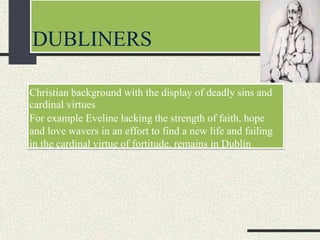
DUBLINERS
Christian background with the display of deadly sins and
cardinal virtues
For example Eveline lacking the strength of faith, hope
and love wavers in an effort to find a new life and failing
in the cardinal virtue of fortitude, remains in Dublin
ULYSSES
Mythic method in taking Odissey as an overlapping of
structures
A new picaresque dimension
Two races: Israel and Ireland facing themselves
A never-ending search for protection
Ulysses as a sort of Everyman
ULYSSES
Molly as an emblem for all women
16.06.1906
An inverted Victorianism
Stephen in search of inner freedom
Bloom represents home, Ithaca
T. S. ELIOT
Brought up with a strongly traditional English literary
education, he soon rejected the ‘romantic’ conventions
Endowed with a cosmopolitan culture, he broke away
from all canons and evolved a new poetic technique
T. S. ELIOT
Modern man’s alienation from society
Time versus eternity
The quest for personal identity
The problem of faith in modern civilization
The sense that the presence is inferior to the past
The fear of living
The moral spiritual emptiness of our
time
T. S. ELIOT
Objective impersonality of art against the romantic
conception of poetic subjectivism
Use of rhythm and musicality
Objective correlative as a set of objects capable of
expressing a certain emotion
Difficult and even obscure poetry
He revalued the importance of past since man was a blend
of past and present experiences
He advocated a universal poetry searching
influences everywhere
T. S. ELIOT
Minimum use of words
He learnt to draw images from everyday life, to deflate the
tragic through irony and cynicism and to juxtapose the
lyrical and the commonplace, the poetic and the squalid.
Two stages in his career: before
conversion and after it
THE WASTE LAND
The symbolic framework of the medieval Grail legend,
inspired by ancient fertility rites
There is not plot in the poem but a sequence of images,
sometimes ambiguous
Large use of quotations
The same vision of a nightmarish world inhabited by people
that are spiritually dead, since their lack of faith has turned
their lives into a sterile waste land.
The frequent allusions to people, traditions,
or events that require a wide cultural background
THE WASTE LAND
The various levels of reading the poem suggests (realistic,
symbolical, surrealistic…)
The use of stream of consciousness technique and interior
monologue
Its peculiar time progression mingling past, present and
future
References to specific places assuming the role of
universal symbols
THE FOUR QUARTETS
A new mood and new attitude to life, out of the desert
of
Doubt into the garden of spiritual faith
A complex work focusing on the main theme of time and
eternity, conveying a somewhat mystical view of life
He must learn to disregard the temporal and look beyond
this life to eternity, which he can contemplate only by
dispossessing himself of all earthly attributes.
Each quartet is structured musically
GEORGE ORWELL
An outstanding English example of the politically
committed intellectual
The danger of propaganda
The danger of the personality cult
Easy manipulation of masses
Control of the language as a political instrument
Turn political writing into art
A warning against the vaguenessof modern English
prose
GEORGE ORWELL
Language as a suitable means of real communication
Focus on the political mechanisms of totalitarianism: the
methods by which thought is controlled, privacy invaded,
and personal resistance broken down
The depth of pessimism
With the destruction of words, language will be corrupt,
and man too will be corrupt, reduced to a hollow
automation.
SALMAN RUSHDIE
Anglo-Indian novelist, who uses in his works tales from
various genres - fantasy, mythology, religion, oral
tradition. Rushdie's narrative technique has connected his
books to magic realism
Reality is a question of perspective; the further you get
from the past, the more concrete and plausible it seems -
but as you approach the present, it
inevitably seems more and more incredible
MIDNIGHT'S CHILDREN
It won the Booker Prize and brought him international
fame. Written in exuberant style, the comic allegory of
Indian history revolves around the lives of the narrator
Saleem Sinai and the 1 000 children born after the
Declaration of Independence.
All of the children are given some magical property.
Saleem has a very large nose, which grants him the ability
to see "into the hearts and minds of delivered
at the stroke of midnight, 14 August 1947, as
India gained its independence from England
MIDNIGHT'S CHILDREN
His chief rival is Shiva, who has the power of war.
Saleem, dying in a pickle factory near Bombay, tells his
tragic story with special interest on its comical sides. The
work arose much controversy in India because of its
unflattering portrait of Indira Gandhi and her son Sanjay,
who was involved in a controversial sterilization
campaign. Midnight's Children took its title from Nehru's
speech delivered at the
stroke of midnight, 14 August 1947, as
India gained its independence from England
MIDNIGHT'S CHILDREN
The fog of larger events is never permitted to detract from
the more personal experiences of all the multi-faceted
characters in the novel. This is perhaps why this form of
"magical realism" is so effective in a novel that is at once
the history of a sub-continent, the story of a boy's coming
to age, the saga of a family and the off-key liberation-song
of a people.
LAUGHTON HUGHES
A protagonist of the advent of the Harlem renaissance in
the 1920's
Rhythm and beat. His stanzas weave wildly smooth tunes
about life as a black American.
His primary poetic influences were the blues bars of
Harlem and D.C..
Individual dark-skinned selves
without fear or shame.
LAUGHTON HUGHES
The streets of black America contained a culture rich and
vibrant and fiercely poetic. This announcement was to
become his life mission,
He tried to write poems like the songs they sang on
Seventh Street...(these songs) had the pulse beat of
the people who keep on going."
LAUGHTON HUGHES
His work emphasized the oral tradition stylistically and
social engagement of critical attention to his writing has
tended to focus thematically, so it comes as no surprise
that the preponderance was on the SOCIOLOGICAL and
HISTORICAL approaches
A gentle and mild-mannered soul who spent much of his
life at the center of controversy, a gregarious spirit who
was also zealously private, a writer of social conscience
and solidarity who was
fundamentally alone
LAUGHTON HUGHES
He devoted his art to the true expression of the lives,
hopes, fears, and angers of ordinary black people, without
self-consciousness or sugar-coating.
This devotion has been repaid with an extraordinary and
continuing popularity, as well as with a still-increasing
critical acceptance of the literary artistry with which it
was conveyed
LAUGHTON HUGHES
His work emphasized the oral tradition stylistically and
social engagement because of his lifelong affection for
and identification with ordinary black people, and his
vivid and affectionate rendering of their lives in their own
language, he has a place in the hearts of his
many readers that goes far beyond
his literary accomplishments,
considerable as they are.
AMY TAN
The difficult quest for identity
✓ A great personal loss and interpersonal conflict
A fundamental asymmetry in the mothers’ and daughters’
understanding of each other’s native cultures
The mothers draw on a broad experimental base for their
knowledge of American pattern of thought and behavior
The daughters have only fragmentary
knowledge of that universe
AMY TAN
Difficult understanding from both parts
Many courageous people can be found throughout the
book.
The characterizations in this novel paint images of women
with elaborate lives.
Their traumatic experiences affected their outlook on life
and made them courageous.
"The test of a courageous person is the ability to
bear defeat without losing heart," is a quote
that is true in its entirety
AMY TAN
A courageous person knows how to go on and never look
back because "to despair was to wish back for something
already lost” .
Ironically, the same spirit of individualism that seems so
liberating to the older women makes their daughters
resistant to maternal advice and criticism.
Born into a culture in which a multiplicity of religious
beliefs flourishes and the individual is permitted, even
encouraged, to challenge
tradition and authority,
AMY TAN
The younger women are reluctant to accept their mothers'
values without question.
The daughters experience themselves socially as a
recognizable ethnic minority and want to eradicate the
sense of "difference" they feel among their peers. They
endeavor to dissociate themselves from their mothers'
broken English and Chinese mannerisms, and
they reject as nonsense the fragments of
traditional lore their mothers try to pass
along to them.
AMY TAN
However, cut adrift from any spiritual moorings, the
younger women are overwhelmed by the number of
choices that their materialistic culture offers and are
insecure about their ability to perform satisfactorily in
multiple roles ranging from dutiful Chinese daughter to
successful American career woman
She uses the contrast between the mothers' and daughters'
beliefs and values to show the difficulties first-generation
immigrants face in
transmitting their native culture to
their offspring.
AMY TAN
She endorses the mothers' traditional Chinese worldview
because it offers the possibility of choice and action in a
world where paralysis is frequently a threat
She draws on astrology in The Joy Luck Club in order to
shape characters and conflicts.
As with astrology, she uses the theory of the Five
Elements not only for characterization but also
for the development of conflict
NADINE GORDIMER
- She writes about her own country and a racially divided
society
- Fighting against oppression
- In 'Pickup' a problematic love story
- migration from poor eastern countries to newly
democratic South Africa, a promised land
- those who are free to move and those who are not
- search for identity
NADINE GORDIMER
- focus on social and racial differences
- the need for spiritual escape symbolized by the desert
- the importance of religion in the life of the man's family
- the theme of freedom embodied by the couple's different
decisions
- Ambiguity since it's not clear who picked up whom and
their reasons
- Sex as the only way of contact between two
different worlds
- independence and responsibilities
NADINE GORDIMER
- two stories in the novel
- it alternates third-person passages, usually
narrative or descriptive, with first-person ones for
interior monologues
- the dialogues are not always introduced by
inverted commas
- punctuation is sometimes used in such a way as to
break a sentence into segments or create suspence
through dots and dashes
BRUCE CHATWIN
- His main concern is man's restlessness
- Why does man decide to leave?
- Walkabout as his main issue
- He is interested in recording what he sees rather
than his own feelings and reactions.
- Travel, the fascination with pre-historic cultures
and exile as his main themes
BRUCE CHATWIN
- The search for freedom, to be what one chooses
to be
- He was interested in detailed descriptions and in
anedoctes rather than in a psychological insight
- A patchwork of different experiences and pictures
-The contrast between the native and the civilized
man
- The search for identity
- The relationship between man and nature

Modernism

  • 1.
    JAMES JOYCE, THOMASSTERNE ELIOT,GEORGE ORWELL, SALMAN RUSHDIE LANGSTON HUGHES, AMY TAN, NADINE GORDIMER, BRUCE CHATWIN
  • 2.
    JAMES JOYCE He thoughtthat the artist ought to be ‘invisible’ in his works, in the sense that he must not express his own viewpoint. He should instead try to express the thoughts and experiences of other men. He advocated the total objectivity of the artist and his independence from all moral, religious or political pressures.
  • 3.
    A Portrait ofan artist as a young man Use of stream of consciousness technique The claustral sense of a young intelligence swaddled in convention and constricted by poverty The intensity of its first response to aesthetic experience and life at large Art associated to women (mother, prostitutes, Our Lady)
  • 4.
    A Portrait ofan artist as a young man Morbid atmosphere of introspection All characters are portrayed in the Hero’s reveries and resentments Word-painting technique The awaking of religious doubts and sexual instincts, leading Stephen’s carnal sin at the age of 16 A symbolic association between art and sex leading to a contrast between art and religion
  • 5.
    A Portrait ofan artist as a young man Nationalism, language and religion as 3 forms of subjection Beauty is separated from Good and Evil and related to Truth Epiphany as a a moment of sudden insight when mind reaches revelation
  • 6.
    DUBLINERS Dublin as thecentre of paralysis Careful progression from childhood to maturity, broadening from private to public scope The essential history of the soul of a people which has confused and weakened its relation to the source of spiritual life and cannot restore it Dreams of escape
  • 7.
    DUBLINERS Christian background withthe display of deadly sins and cardinal virtues For example Eveline lacking the strength of faith, hope and love wavers in an effort to find a new life and failing in the cardinal virtue of fortitude, remains in Dublin
  • 8.
    ULYSSES Mythic method intaking Odissey as an overlapping of structures A new picaresque dimension Two races: Israel and Ireland facing themselves A never-ending search for protection Ulysses as a sort of Everyman
  • 9.
    ULYSSES Molly as anemblem for all women 16.06.1906 An inverted Victorianism Stephen in search of inner freedom Bloom represents home, Ithaca
  • 10.
    T. S. ELIOT Broughtup with a strongly traditional English literary education, he soon rejected the ‘romantic’ conventions Endowed with a cosmopolitan culture, he broke away from all canons and evolved a new poetic technique
  • 11.
    T. S. ELIOT Modernman’s alienation from society Time versus eternity The quest for personal identity The problem of faith in modern civilization The sense that the presence is inferior to the past The fear of living The moral spiritual emptiness of our time
  • 12.
    T. S. ELIOT Objectiveimpersonality of art against the romantic conception of poetic subjectivism Use of rhythm and musicality Objective correlative as a set of objects capable of expressing a certain emotion Difficult and even obscure poetry He revalued the importance of past since man was a blend of past and present experiences He advocated a universal poetry searching influences everywhere
  • 13.
    T. S. ELIOT Minimumuse of words He learnt to draw images from everyday life, to deflate the tragic through irony and cynicism and to juxtapose the lyrical and the commonplace, the poetic and the squalid. Two stages in his career: before conversion and after it
  • 14.
    THE WASTE LAND Thesymbolic framework of the medieval Grail legend, inspired by ancient fertility rites There is not plot in the poem but a sequence of images, sometimes ambiguous Large use of quotations The same vision of a nightmarish world inhabited by people that are spiritually dead, since their lack of faith has turned their lives into a sterile waste land. The frequent allusions to people, traditions, or events that require a wide cultural background
  • 15.
    THE WASTE LAND Thevarious levels of reading the poem suggests (realistic, symbolical, surrealistic…) The use of stream of consciousness technique and interior monologue Its peculiar time progression mingling past, present and future References to specific places assuming the role of universal symbols
  • 16.
    THE FOUR QUARTETS Anew mood and new attitude to life, out of the desert of Doubt into the garden of spiritual faith A complex work focusing on the main theme of time and eternity, conveying a somewhat mystical view of life He must learn to disregard the temporal and look beyond this life to eternity, which he can contemplate only by dispossessing himself of all earthly attributes. Each quartet is structured musically
  • 17.
    GEORGE ORWELL An outstandingEnglish example of the politically committed intellectual The danger of propaganda The danger of the personality cult Easy manipulation of masses Control of the language as a political instrument Turn political writing into art A warning against the vaguenessof modern English prose
  • 18.
    GEORGE ORWELL Language asa suitable means of real communication Focus on the political mechanisms of totalitarianism: the methods by which thought is controlled, privacy invaded, and personal resistance broken down The depth of pessimism With the destruction of words, language will be corrupt, and man too will be corrupt, reduced to a hollow automation.
  • 19.
    SALMAN RUSHDIE Anglo-Indian novelist,who uses in his works tales from various genres - fantasy, mythology, religion, oral tradition. Rushdie's narrative technique has connected his books to magic realism Reality is a question of perspective; the further you get from the past, the more concrete and plausible it seems - but as you approach the present, it inevitably seems more and more incredible
  • 20.
    MIDNIGHT'S CHILDREN It wonthe Booker Prize and brought him international fame. Written in exuberant style, the comic allegory of Indian history revolves around the lives of the narrator Saleem Sinai and the 1 000 children born after the Declaration of Independence. All of the children are given some magical property. Saleem has a very large nose, which grants him the ability to see "into the hearts and minds of delivered at the stroke of midnight, 14 August 1947, as India gained its independence from England
  • 21.
    MIDNIGHT'S CHILDREN His chiefrival is Shiva, who has the power of war. Saleem, dying in a pickle factory near Bombay, tells his tragic story with special interest on its comical sides. The work arose much controversy in India because of its unflattering portrait of Indira Gandhi and her son Sanjay, who was involved in a controversial sterilization campaign. Midnight's Children took its title from Nehru's speech delivered at the stroke of midnight, 14 August 1947, as India gained its independence from England
  • 22.
    MIDNIGHT'S CHILDREN The fogof larger events is never permitted to detract from the more personal experiences of all the multi-faceted characters in the novel. This is perhaps why this form of "magical realism" is so effective in a novel that is at once the history of a sub-continent, the story of a boy's coming to age, the saga of a family and the off-key liberation-song of a people.
  • 23.
    LAUGHTON HUGHES A protagonistof the advent of the Harlem renaissance in the 1920's Rhythm and beat. His stanzas weave wildly smooth tunes about life as a black American. His primary poetic influences were the blues bars of Harlem and D.C.. Individual dark-skinned selves without fear or shame.
  • 24.
    LAUGHTON HUGHES The streetsof black America contained a culture rich and vibrant and fiercely poetic. This announcement was to become his life mission, He tried to write poems like the songs they sang on Seventh Street...(these songs) had the pulse beat of the people who keep on going."
  • 25.
    LAUGHTON HUGHES His workemphasized the oral tradition stylistically and social engagement of critical attention to his writing has tended to focus thematically, so it comes as no surprise that the preponderance was on the SOCIOLOGICAL and HISTORICAL approaches A gentle and mild-mannered soul who spent much of his life at the center of controversy, a gregarious spirit who was also zealously private, a writer of social conscience and solidarity who was fundamentally alone
  • 26.
    LAUGHTON HUGHES He devotedhis art to the true expression of the lives, hopes, fears, and angers of ordinary black people, without self-consciousness or sugar-coating. This devotion has been repaid with an extraordinary and continuing popularity, as well as with a still-increasing critical acceptance of the literary artistry with which it was conveyed
  • 27.
    LAUGHTON HUGHES His workemphasized the oral tradition stylistically and social engagement because of his lifelong affection for and identification with ordinary black people, and his vivid and affectionate rendering of their lives in their own language, he has a place in the hearts of his many readers that goes far beyond his literary accomplishments, considerable as they are.
  • 28.
    AMY TAN The difficultquest for identity ✓ A great personal loss and interpersonal conflict A fundamental asymmetry in the mothers’ and daughters’ understanding of each other’s native cultures The mothers draw on a broad experimental base for their knowledge of American pattern of thought and behavior The daughters have only fragmentary knowledge of that universe
  • 29.
    AMY TAN Difficult understandingfrom both parts Many courageous people can be found throughout the book. The characterizations in this novel paint images of women with elaborate lives. Their traumatic experiences affected their outlook on life and made them courageous. "The test of a courageous person is the ability to bear defeat without losing heart," is a quote that is true in its entirety
  • 30.
    AMY TAN A courageousperson knows how to go on and never look back because "to despair was to wish back for something already lost” . Ironically, the same spirit of individualism that seems so liberating to the older women makes their daughters resistant to maternal advice and criticism. Born into a culture in which a multiplicity of religious beliefs flourishes and the individual is permitted, even encouraged, to challenge tradition and authority,
  • 31.
    AMY TAN The youngerwomen are reluctant to accept their mothers' values without question. The daughters experience themselves socially as a recognizable ethnic minority and want to eradicate the sense of "difference" they feel among their peers. They endeavor to dissociate themselves from their mothers' broken English and Chinese mannerisms, and they reject as nonsense the fragments of traditional lore their mothers try to pass along to them.
  • 32.
    AMY TAN However, cutadrift from any spiritual moorings, the younger women are overwhelmed by the number of choices that their materialistic culture offers and are insecure about their ability to perform satisfactorily in multiple roles ranging from dutiful Chinese daughter to successful American career woman She uses the contrast between the mothers' and daughters' beliefs and values to show the difficulties first-generation immigrants face in transmitting their native culture to their offspring.
  • 33.
    AMY TAN She endorsesthe mothers' traditional Chinese worldview because it offers the possibility of choice and action in a world where paralysis is frequently a threat She draws on astrology in The Joy Luck Club in order to shape characters and conflicts. As with astrology, she uses the theory of the Five Elements not only for characterization but also for the development of conflict
  • 34.
    NADINE GORDIMER - Shewrites about her own country and a racially divided society - Fighting against oppression - In 'Pickup' a problematic love story - migration from poor eastern countries to newly democratic South Africa, a promised land - those who are free to move and those who are not - search for identity
  • 35.
    NADINE GORDIMER - focuson social and racial differences - the need for spiritual escape symbolized by the desert - the importance of religion in the life of the man's family - the theme of freedom embodied by the couple's different decisions - Ambiguity since it's not clear who picked up whom and their reasons - Sex as the only way of contact between two different worlds - independence and responsibilities
  • 36.
    NADINE GORDIMER - twostories in the novel - it alternates third-person passages, usually narrative or descriptive, with first-person ones for interior monologues - the dialogues are not always introduced by inverted commas - punctuation is sometimes used in such a way as to break a sentence into segments or create suspence through dots and dashes
  • 37.
    BRUCE CHATWIN - Hismain concern is man's restlessness - Why does man decide to leave? - Walkabout as his main issue - He is interested in recording what he sees rather than his own feelings and reactions. - Travel, the fascination with pre-historic cultures and exile as his main themes
  • 38.
    BRUCE CHATWIN - Thesearch for freedom, to be what one chooses to be - He was interested in detailed descriptions and in anedoctes rather than in a psychological insight - A patchwork of different experiences and pictures -The contrast between the native and the civilized man - The search for identity - The relationship between man and nature