Mythical technique in “The Waste Land”. 
Name :- Neelamba R Sarvaiya. 
M. A. Sem-3 
Paper no-9 “The Modernist Literature”. 
S.B.Gardi English department 
M.K. Bhavnagar University. 
Year-2013-2014
T.S.Eliot was considers as a 
‘Mythic poet’ 
Eliot was considers as mythic poet not because 
he uses a known myth for the skeletal structure of 
the poem but because his artistic point of view is 
always formed by mythic perspective. 
Mythic conscious conceive a real world as 
unified, individual and self-contained despite 
apparent contradiction in both the universe and 
human affairs.
 The profane world of illusion which an 
ordinary man thinks to be real is not more than 
“a broken bundle of mirrors”--- in words of 
Pound, a fragrant that never cohere. 
 Here April as a cruelest month 
The beneficent death by water 
that transformed the father’s bones into 
something rich and strange that drowning of 
Phelbas, without hope of transformation.
 All other mythic conscious are brought to 
bear on his opposition of the meaningful 
sacrificial death and the pointless death in life 
which are the condition of the waste land. 
There are many features that we can observe 
in The Waste Land. 
 The complexity and the fragmentation of 
modern life is reflected in the fragmented style 
of the poem and the juxtaposition of different 
images (a visual parallel could be drawn with 
certain paintings by Picasso and Braque).
 Each section of the poem is formed by several 
fragments put together whose narrative continuum 
is achieved through consistent tone and atmosphere. 
These emphasize the sterility of the present as 
contrasted to the fertility of a mythical past. 
 Eliot defined this technique as "the mythical 
method", a constant parallel between the writer's 
contemporary age and the past achieved through 
mythological references in the depiction of ordinary 
and common sketches. Eliot concluded that this 
techniques was "a way of . . . giving a shape and a 
significance to the immense panorama of futility and 
anarchy which is contemporary history".
Ø The Mythical Background 
 On the eve of the composition of the waste land, T.S. 
Eliot had been reading Jessie Weston’s book from Ritual to 
Romance, and James Frazer’s famous book the Golden 
tough. The poet himself has acknowledged that he was 
deeply influenced by these works or anthropology, and 
the ancient and primitive myths and legends which from 
the mythical background to poem are derived from these 
books Miss Weston’s book supplied him with the legend 
of the Grail and the Eisner King, and from the Golden 
Bough he derived his knowledge of a number of 
vegetation and fertility myths and rituals, especially those 
connected with Attics, Adonis and Osiris.
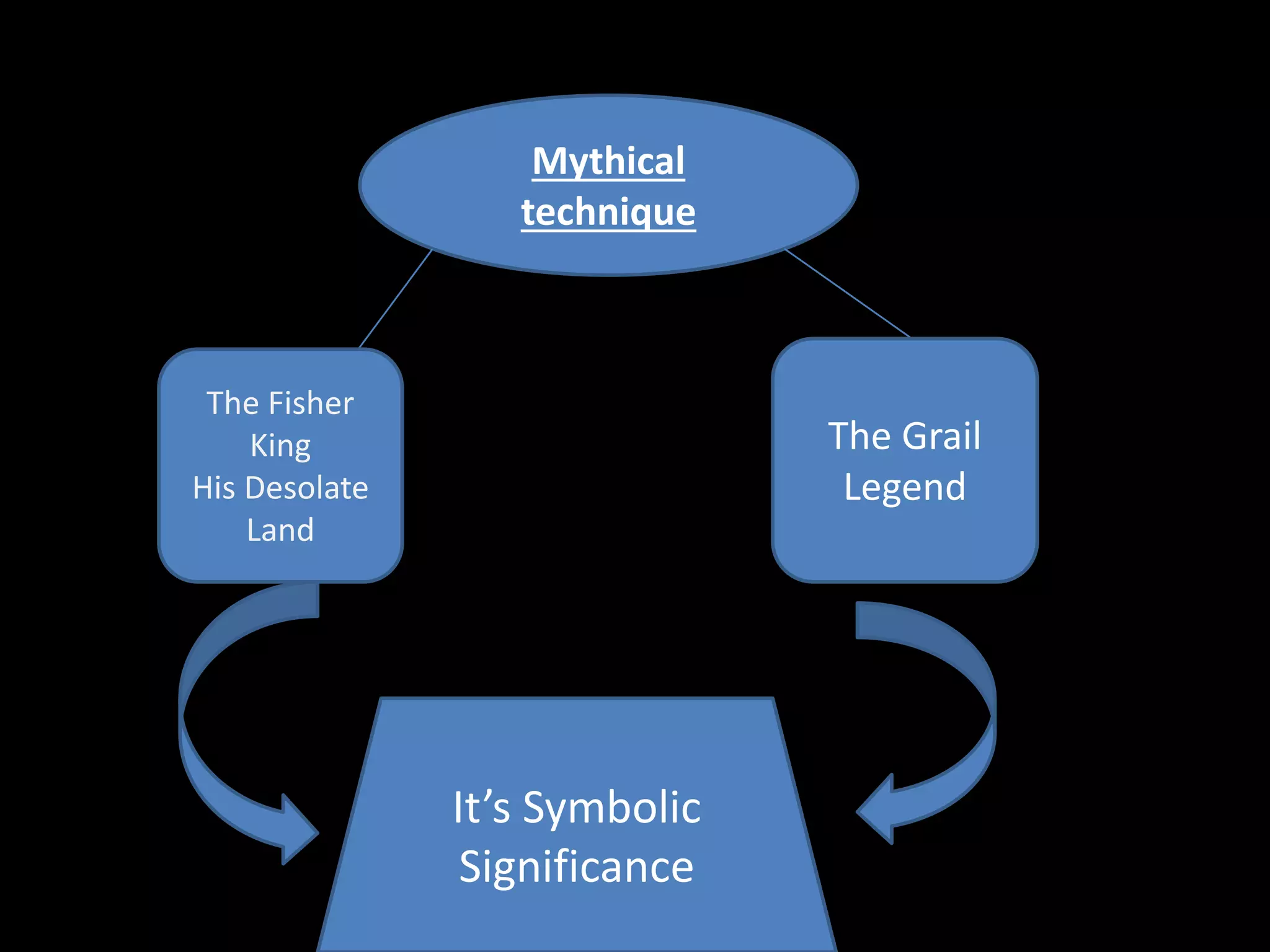
Mythical 
technique 
The Fisher 
King 
His Desolate 
Land 
The Grail 
Legend 
It’s Symbolic 
Significance
The mythical land of the fisher king 
symbolizes contemporary decay and 
spiritual sterility. The Sick king 
symbolizes the sick humanity and this 
sickness results, as in the case of the 
fisher king from its Sexual sins. It has 
been degraded to mere ‘animal 
copulation’, and this Sexual perversion 
has led to Spiritual death. Spiritual 
health can be regained only through 
penance, suffering and self-discipline.
conclusion 
myths as “Objective co-relatives” one aspects of 
Eliot’s use of the mythical technique is his use of 
ancient myths as “objective correlatives.’ Eliot 
defined objective correlative as a, “set of objects, a 
situation, and a chain of events” which shall be 
formula for some particular emotion of the Poet, so 
that when the external facts are given, the emotion 
is immediately evoked’. The waste Land contains, 
according to A.G. George.
 “A series of emotions and impressions of the 
poet which are expressed through the objective 
correlative of the mythical waste lands, a series of 
emotions and also impressions which originate in 
the Poet’s mind as he surveys human life in the 
present as well as in the past.” 
 The ancient myths act as objective co-relatives 
for the poet’s emotions, in ancient 
customs and rituals he finds symbols for his 
emotions and ideas.
Mythical technique in the waste land

Mythical technique in the waste land

  • 1.
    Mythical technique in“The Waste Land”. Name :- Neelamba R Sarvaiya. M. A. Sem-3 Paper no-9 “The Modernist Literature”. S.B.Gardi English department M.K. Bhavnagar University. Year-2013-2014
  • 3.
    T.S.Eliot was considersas a ‘Mythic poet’ Eliot was considers as mythic poet not because he uses a known myth for the skeletal structure of the poem but because his artistic point of view is always formed by mythic perspective. Mythic conscious conceive a real world as unified, individual and self-contained despite apparent contradiction in both the universe and human affairs.
  • 4.
     The profaneworld of illusion which an ordinary man thinks to be real is not more than “a broken bundle of mirrors”--- in words of Pound, a fragrant that never cohere.  Here April as a cruelest month The beneficent death by water that transformed the father’s bones into something rich and strange that drowning of Phelbas, without hope of transformation.
  • 5.
     All othermythic conscious are brought to bear on his opposition of the meaningful sacrificial death and the pointless death in life which are the condition of the waste land. There are many features that we can observe in The Waste Land.  The complexity and the fragmentation of modern life is reflected in the fragmented style of the poem and the juxtaposition of different images (a visual parallel could be drawn with certain paintings by Picasso and Braque).
  • 6.
     Each sectionof the poem is formed by several fragments put together whose narrative continuum is achieved through consistent tone and atmosphere. These emphasize the sterility of the present as contrasted to the fertility of a mythical past.  Eliot defined this technique as "the mythical method", a constant parallel between the writer's contemporary age and the past achieved through mythological references in the depiction of ordinary and common sketches. Eliot concluded that this techniques was "a way of . . . giving a shape and a significance to the immense panorama of futility and anarchy which is contemporary history".
  • 7.
    Ø The MythicalBackground  On the eve of the composition of the waste land, T.S. Eliot had been reading Jessie Weston’s book from Ritual to Romance, and James Frazer’s famous book the Golden tough. The poet himself has acknowledged that he was deeply influenced by these works or anthropology, and the ancient and primitive myths and legends which from the mythical background to poem are derived from these books Miss Weston’s book supplied him with the legend of the Grail and the Eisner King, and from the Golden Bough he derived his knowledge of a number of vegetation and fertility myths and rituals, especially those connected with Attics, Adonis and Osiris.
  • 8.
    Mythical technique TheFisher King His Desolate Land The Grail Legend It’s Symbolic Significance
  • 9.
    The mythical landof the fisher king symbolizes contemporary decay and spiritual sterility. The Sick king symbolizes the sick humanity and this sickness results, as in the case of the fisher king from its Sexual sins. It has been degraded to mere ‘animal copulation’, and this Sexual perversion has led to Spiritual death. Spiritual health can be regained only through penance, suffering and self-discipline.
  • 10.
    conclusion myths as“Objective co-relatives” one aspects of Eliot’s use of the mythical technique is his use of ancient myths as “objective correlatives.’ Eliot defined objective correlative as a, “set of objects, a situation, and a chain of events” which shall be formula for some particular emotion of the Poet, so that when the external facts are given, the emotion is immediately evoked’. The waste Land contains, according to A.G. George.
  • 11.
     “A seriesof emotions and impressions of the poet which are expressed through the objective correlative of the mythical waste lands, a series of emotions and also impressions which originate in the Poet’s mind as he surveys human life in the present as well as in the past.”  The ancient myths act as objective co-relatives for the poet’s emotions, in ancient customs and rituals he finds symbols for his emotions and ideas.