Hellenism in Keats’s Poetry
“Ode to Autumn”
By Mehwish Rana
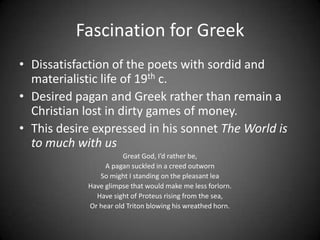
Fascination for Greek
• Dissatisfaction of the poets with sordid and
materialistic life of 19th c.
• Desired pagan and Greek rather than remain a
Christian lost in dirty games of money.
• This desire expressed in his sonnet The World is
to much with us
Great God, I’d rather be,
A pagan suckled in a creed outworn
So might I standing on the pleasant lea
Have glimpse that would make me less forlorn.
Have sight of Proteus rising from the sea,
Or hear old Triton blowing his wreathed horn.
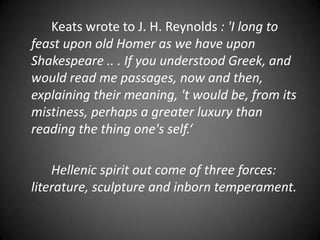
Keats wrote to J. H. Reynolds : 'I long to
feast upon old Homer as we have upon
Shakespeare .. . If you understood Greek, and
would read me passages, now and then,
explaining their meaning, 't would be, from its
mistiness, perhaps a greater luxury than
reading the thing one's self.‘
Hellenic spirit out come of three forces:
literature, sculpture and inborn temperament.
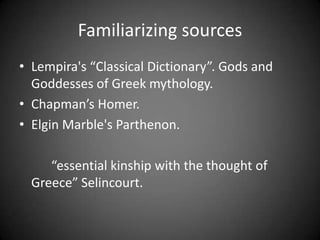
Familiarizing sources
• Lempira's “Classical Dictionary”. Gods and
Goddesses of Greek mythology.
• Chapman’s Homer.
• Elgin Marble's Parthenon.
“essential kinship with the thought of
Greece” Selincourt.
Hellenic features in Keats’s Poetry
• Love for beauty and spontaneous .
• Pagan delight in nature.
• Delight in physical side of life.
• Personifying nature. (beauty and shapeliness)
• Perfection of the loveliness.
• Subjects of old Greek writers.
• Simplicity and directness of expression.
• Concrete imagery.
“a thing of beauty is a joy forever”.....sense of
beauty overcomes every other consideration.
• Combined romanticism with Greek.
• Lovers of beauty.
• Expression of beauty aim of all art.
• Exclusively physical, intellectual or spiritual
but fullest developed.
Ode to Autumn
• Personifying autumn.
• Giving life to inanimate objects.
• Creates concrete figures.
• Keen observation and detailed pictures.
• Passion rather than action and adventure.
• Does not bring personal feelings to it– objectivity
of the Greek.
• Romantic atmosphere with Greek background.
• Paints picture– looking at a painting in art gallery
that gives multiple perceptions on each look.
Hellenism in 1st Stanza
• Opens with the Greek tradition of invoking the muse.
• Praises the beauty of autumn.
• Autumn – beneficent, ripens fruits, bends, fills, plumps,
sets budding, loads with fruit etc.
• Sun – life provider.
• Sun and Autumn as deities working together for the
working of the universe and giving it motion.
• Bees – like humans.
• Appreciates the fullness of the season.
• Beauties and bounties.
• Natural process.
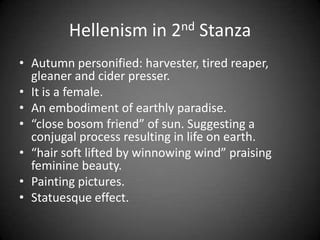
Hellenism in 2nd Stanza
• Autumn personified: harvester, tired reaper,
gleaner and cider presser.
• It is a female.
• An embodiment of earthly paradise.
• “close bosom friend” of sun. Suggesting a
conjugal process resulting in life on earth.
• “hair soft lifted by winnowing wind” praising
feminine beauty.
• Painting pictures.
• Statuesque effect.
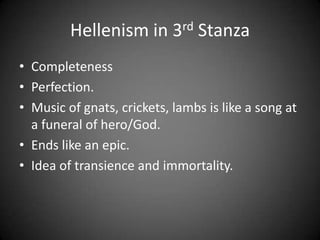
Hellenism in 3rd Stanza
• Completeness
• Perfection.
• Music of gnats, crickets, lambs is like a song at
a funeral of hero/God.
• Ends like an epic.
• Idea of transience and immortality.
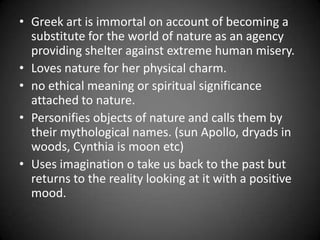
• Greek art is immortal on account of becoming a
substitute for the world of nature as an agency
providing shelter against extreme human misery.
• Loves nature for her physical charm.
• no ethical meaning or spiritual significance
attached to nature.
• Personifies objects of nature and calls them by
their mythological names. (sun Apollo, dryads in
woods, Cynthia is moon etc)
• Uses imagination o take us back to the past but
returns to the reality looking at it with a positive
mood.

Hellenism in keats’s poetry

  • 1.
    Hellenism in Keats’sPoetry “Ode to Autumn” By Mehwish Rana
  • 2.
    Fascination for Greek •Dissatisfaction of the poets with sordid and materialistic life of 19th c. • Desired pagan and Greek rather than remain a Christian lost in dirty games of money. • This desire expressed in his sonnet The World is to much with us Great God, I’d rather be, A pagan suckled in a creed outworn So might I standing on the pleasant lea Have glimpse that would make me less forlorn. Have sight of Proteus rising from the sea, Or hear old Triton blowing his wreathed horn.
  • 3.
    Keats wrote toJ. H. Reynolds : 'I long to feast upon old Homer as we have upon Shakespeare .. . If you understood Greek, and would read me passages, now and then, explaining their meaning, 't would be, from its mistiness, perhaps a greater luxury than reading the thing one's self.‘ Hellenic spirit out come of three forces: literature, sculpture and inborn temperament.
  • 4.
    Familiarizing sources • Lempira's“Classical Dictionary”. Gods and Goddesses of Greek mythology. • Chapman’s Homer. • Elgin Marble's Parthenon. “essential kinship with the thought of Greece” Selincourt.
  • 5.
    Hellenic features inKeats’s Poetry • Love for beauty and spontaneous . • Pagan delight in nature. • Delight in physical side of life. • Personifying nature. (beauty and shapeliness) • Perfection of the loveliness. • Subjects of old Greek writers. • Simplicity and directness of expression. • Concrete imagery. “a thing of beauty is a joy forever”.....sense of beauty overcomes every other consideration.
  • 6.
    • Combined romanticismwith Greek. • Lovers of beauty. • Expression of beauty aim of all art. • Exclusively physical, intellectual or spiritual but fullest developed.
  • 7.
    Ode to Autumn •Personifying autumn. • Giving life to inanimate objects. • Creates concrete figures. • Keen observation and detailed pictures. • Passion rather than action and adventure. • Does not bring personal feelings to it– objectivity of the Greek. • Romantic atmosphere with Greek background. • Paints picture– looking at a painting in art gallery that gives multiple perceptions on each look.
  • 8.
    Hellenism in 1stStanza • Opens with the Greek tradition of invoking the muse. • Praises the beauty of autumn. • Autumn – beneficent, ripens fruits, bends, fills, plumps, sets budding, loads with fruit etc. • Sun – life provider. • Sun and Autumn as deities working together for the working of the universe and giving it motion. • Bees – like humans. • Appreciates the fullness of the season. • Beauties and bounties. • Natural process.
  • 9.
    Hellenism in 2ndStanza • Autumn personified: harvester, tired reaper, gleaner and cider presser. • It is a female. • An embodiment of earthly paradise. • “close bosom friend” of sun. Suggesting a conjugal process resulting in life on earth. • “hair soft lifted by winnowing wind” praising feminine beauty. • Painting pictures. • Statuesque effect.
  • 10.
    Hellenism in 3rdStanza • Completeness • Perfection. • Music of gnats, crickets, lambs is like a song at a funeral of hero/God. • Ends like an epic. • Idea of transience and immortality.
  • 11.
    • Greek artis immortal on account of becoming a substitute for the world of nature as an agency providing shelter against extreme human misery. • Loves nature for her physical charm. • no ethical meaning or spiritual significance attached to nature. • Personifies objects of nature and calls them by their mythological names. (sun Apollo, dryads in woods, Cynthia is moon etc) • Uses imagination o take us back to the past but returns to the reality looking at it with a positive mood.