© 2020 Downey Law Group LLC. For educational purposes only.
Implicit Bias and Diversity in the
Legal Profession
February 2020
Downey Law Group LLC
Paige Tungate Michael Downey
2
Questions:
PTungate@DowneyLawGroup.com
3
*
Warning on Scope and Language
• Cannot cover every group or issue in 50
minutes
• Need to use language to discuss issues – do
not intend to alienate or offend
4
Missouri Rules Against Bias,
Prejudice and Harassment
5
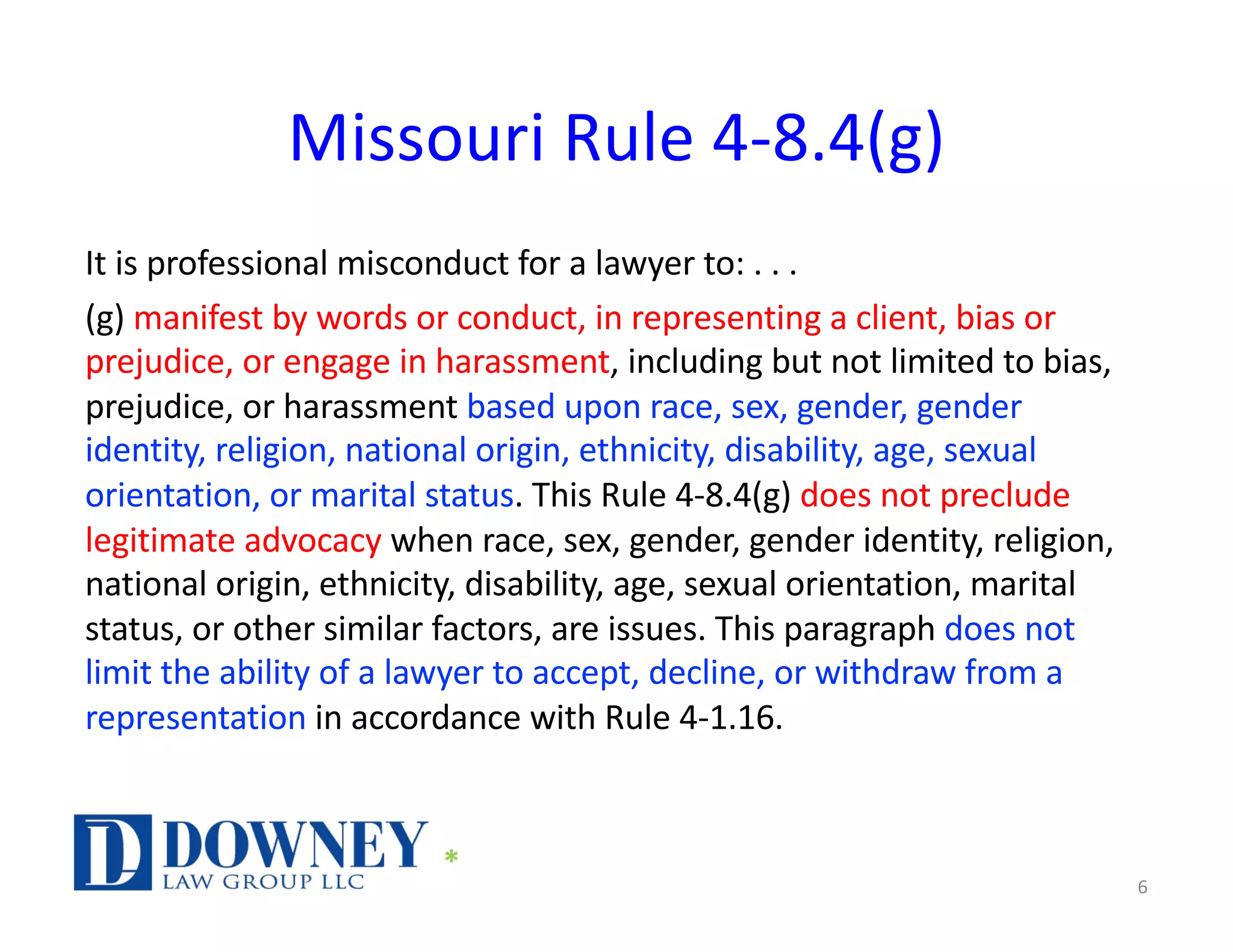
Missouri Rule 4-8.4(g)
It is professional misconduct for a lawyer to: . . .
(g) manifest by words or conduct, in representing a client, bias or
prejudice, or engage in harassment, including but not limited to bias,
prejudice, or harassment based upon race, sex, gender, gender
identity, religion, national origin, ethnicity, disability, age, sexual
orientation, or marital status. This Rule 4-8.4(g) does not preclude
legitimate advocacy when race, sex, gender, gender identity, religion,
national origin, ethnicity, disability, age, sexual orientation, marital
status, or other similar factors, are issues. This paragraph does not
limit the ability of a lawyer to accept, decline, or withdraw from a
representation in accordance with Rule 4-1.16.
6
*
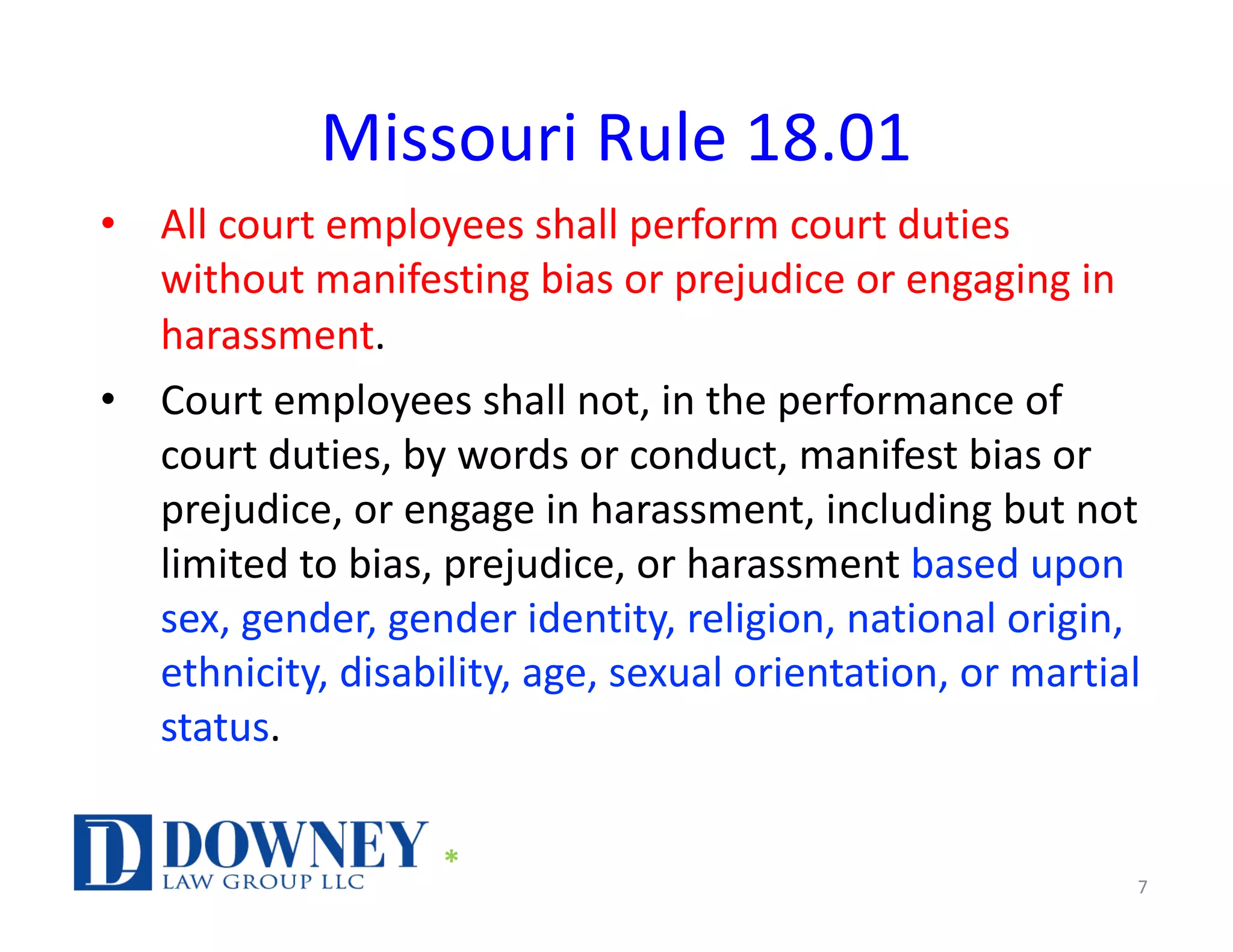
Missouri Rule 18.01
• All court employees shall perform court duties
without manifesting bias or prejudice or engaging in
harassment.
• Court employees shall not, in the performance of
court duties, by words or conduct, manifest bias or
prejudice, or engage in harassment, including but not
limited to bias, prejudice, or harassment based upon
sex, gender, gender identity, religion, national origin,
ethnicity, disability, age, sexual orientation, or martial
status.
7
*
Missouri Rule 15.05(a)(2)
[E]ach lawyer shall complete and report, during each
reporting year, a total of at least 15 credit hours of accredited
programs, seminars, and activities. For each reporting year:
1) at least three of the total 15 credit hours must be devoted
exclusively to accredited ethics programs . . . ; and
2) at least one of the three ethics credit hours required under
Rule 15.05(a)(1) must be devoted exclusively to explicit or
implicit bias, diversity, inclusion, or cultural competency.
8
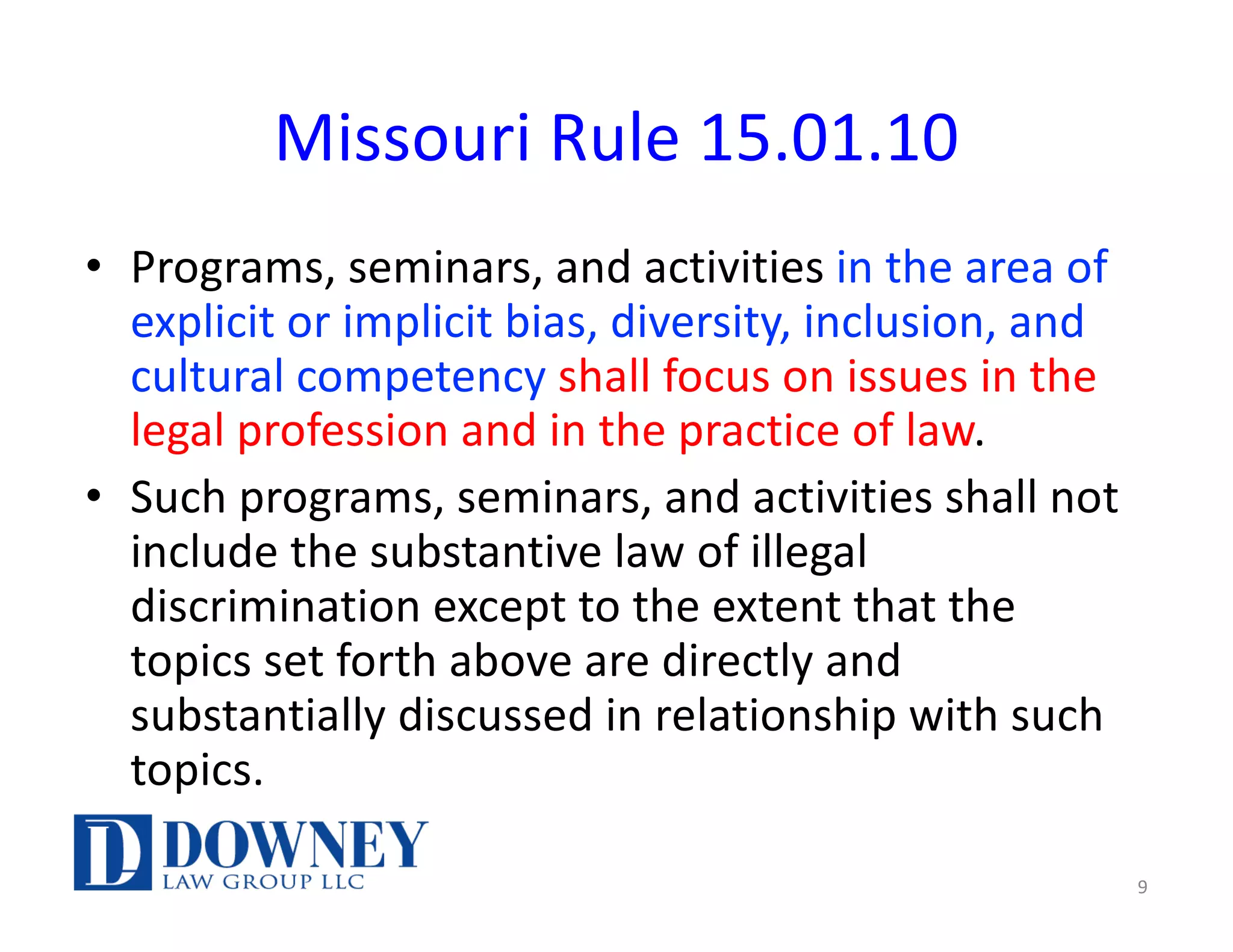
Missouri Rule 15.01.10
• Programs, seminars, and activities in the area of
explicit or implicit bias, diversity, inclusion, and
cultural competency shall focus on issues in the
legal profession and in the practice of law.
• Such programs, seminars, and activities shall not
include the substantive law of illegal
discrimination except to the extent that the
topics set forth above are directly and
substantially discussed in relationship with such
topics.
9
Stereotypes
10
“Us” v. “Them” Mentality
• Can be about a person’s race, gender, social
economic status, body weight, ethnicity, etc.
• Can be good or bad, justified or unjustified
• Even “lawyer” can be a stereotype that invokes a
certain bias
11
Example – Irish
• Poet
• Drunk and disorderly
• Quarrelsome
• Rarely dabbling in counterfeit money, breaking into houses or
swindling
• Women were “reckless breeders”
• “What you always have to remember with the Irish is they get
mean. Virtually every Irish I've known gets mean when he
drinks.” – President Richard Nixon
12
*
Example – German
• Extremely punctual
• Love order
• Undiplomatic (too straightforward) and unfriendly
• “Nazis”
• No sense of humor
• Cold and unromantic
13
Explicit Bias and
Prejudice
14
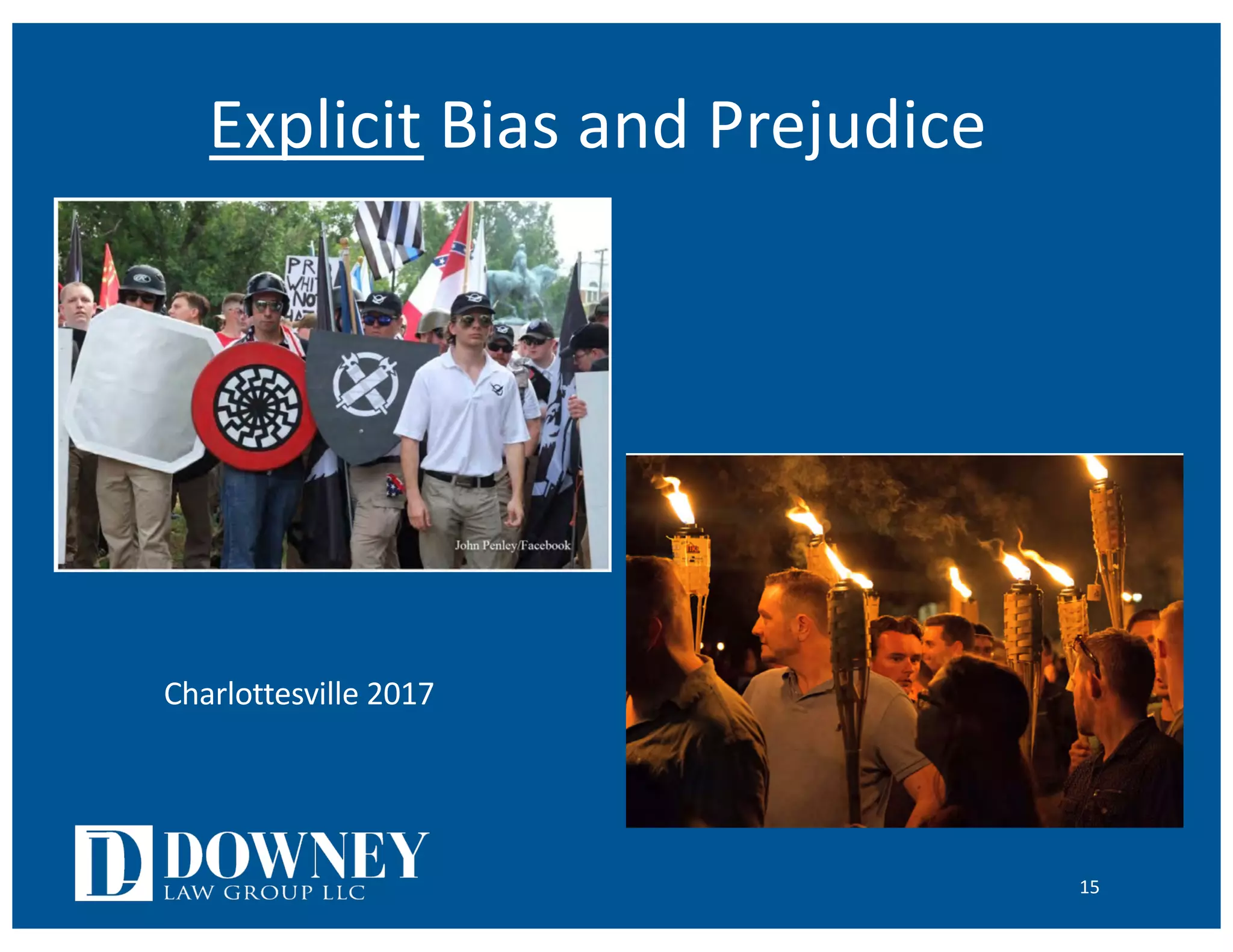
Explicit Bias and Prejudice
15
Charlottesville 2017
Implicit Bias
16
Implicit Bias
• When we have attitudes towards people or
associate stereotypes with them without our
conscious knowledge
• Can be positive or negative
17
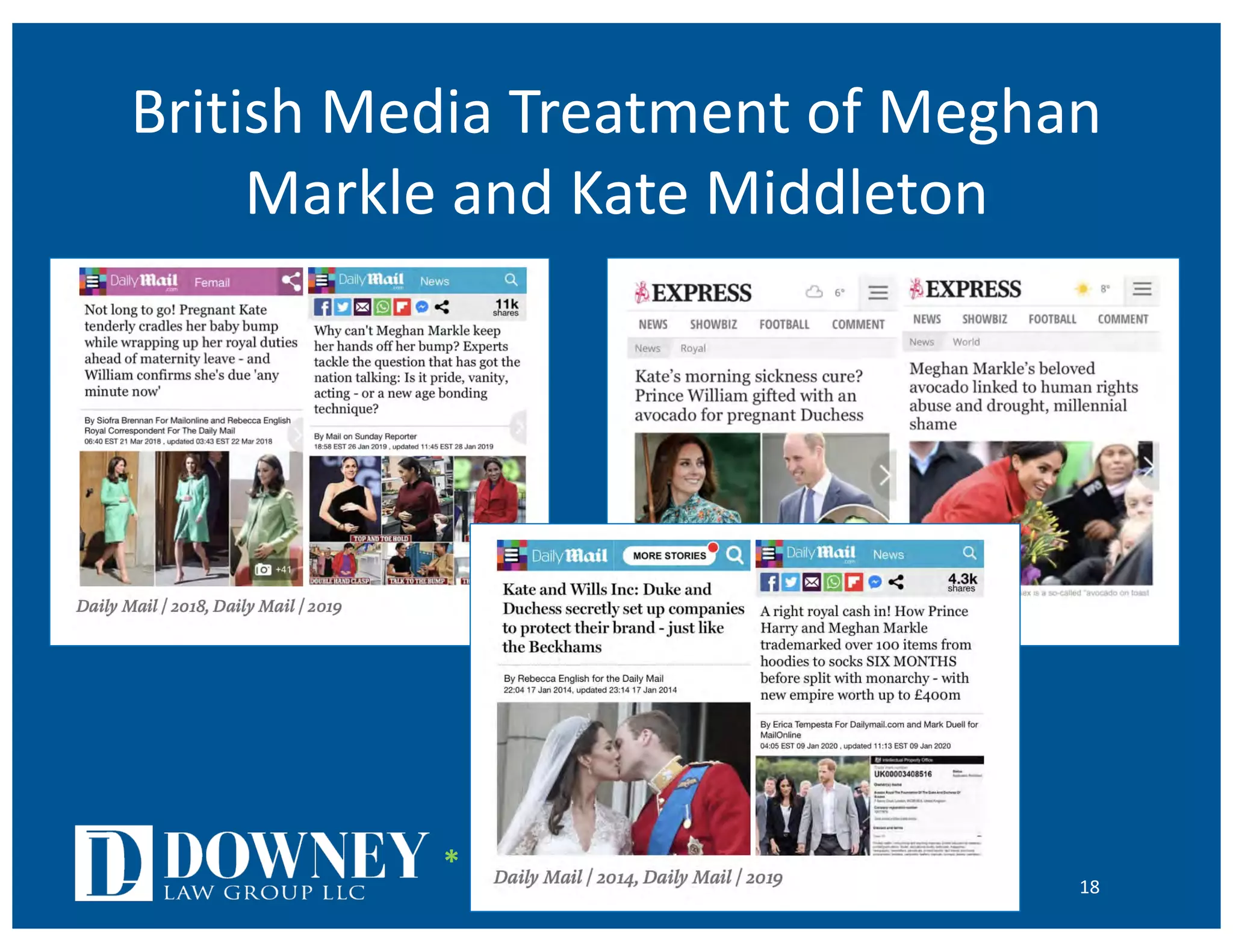
British Media Treatment of Meghan
Markle and Kate Middleton
18
*
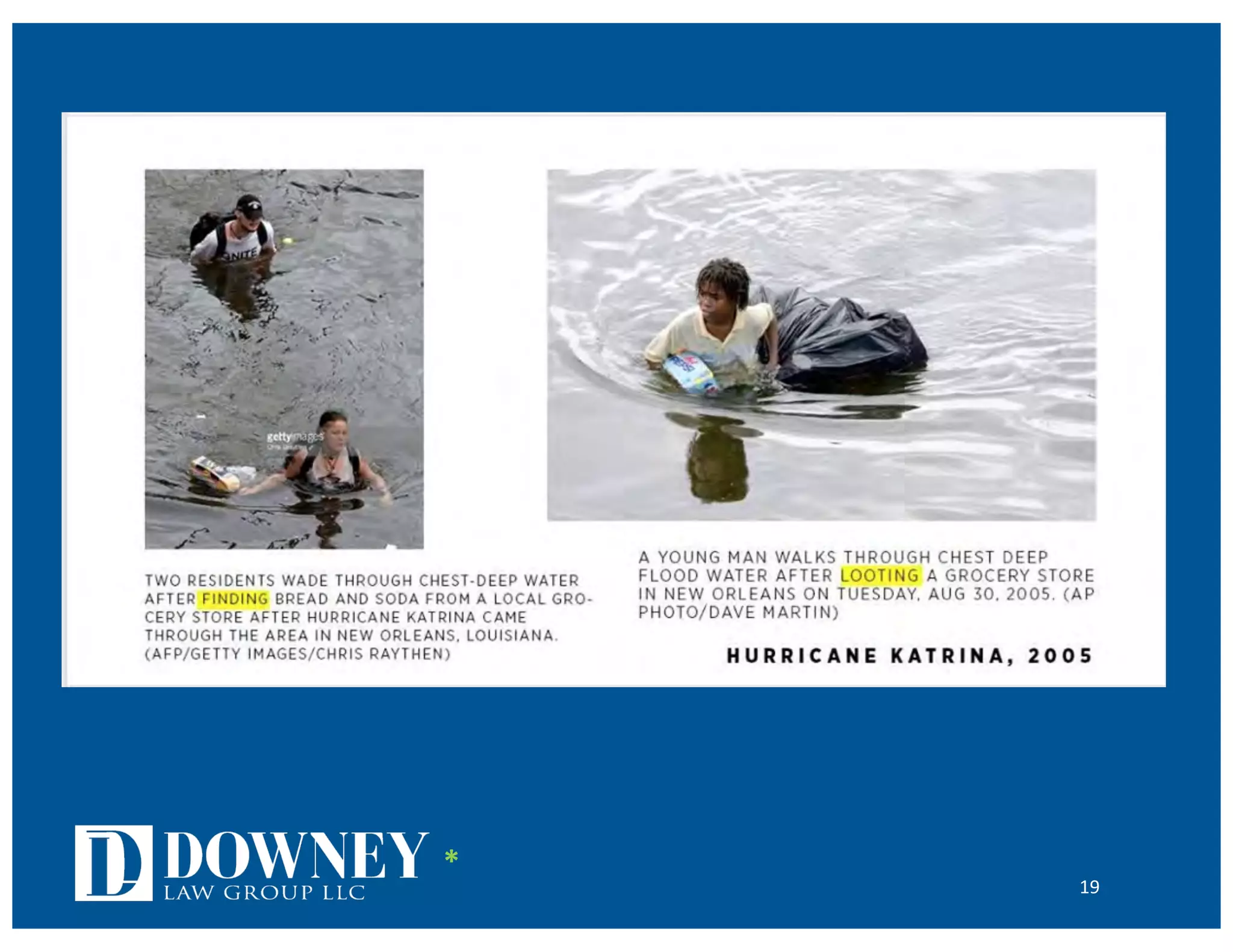
19
*
“Bias Blind Spot”
• Easily identify when others are perpetuating
stereotypes
• Struggle to recognize the same biases in
ourselves
20
Presumption Against Bias
• Sampling of 600 US residents in 2015
• 85% believed they were less biased than average
Americans
• 1 person believed he/she was more biased than
average
21
Implicit Association Test (IAT)
• Measures time differences between schema-
consistent pairings and schema-inconsistent pairings
of concepts represented by words or pictures
Project Implicit at Harvard University
www.implicit.Harvard.edu
22
*
IAT Categories
23
q Asian
q Weight
q Gender-Career
q Disability
q Sexuality
q Skin-tone
q Age
q Religion
q Presidents
q Arab-Muslim
q Race
q Gender-Science
q Weapons
*
24
”Written in Black & White” (2014)
• Study in the legal profession conducted in 2014
– 60 law firm partners at 22 firms were given identical
memos to review
• 37 men, 23 women
• 39 Caucasian and 21 racial/ethnic minorities
– All memos had the same author “Thomas Meyer,” a third-
year associate from NYU Law School
• 30 partners were told the memo was written by an African
American associate
• 30 partners were told the memo was written by a Caucasian
associate
Memo written by NYU Law School 3rd year students
25
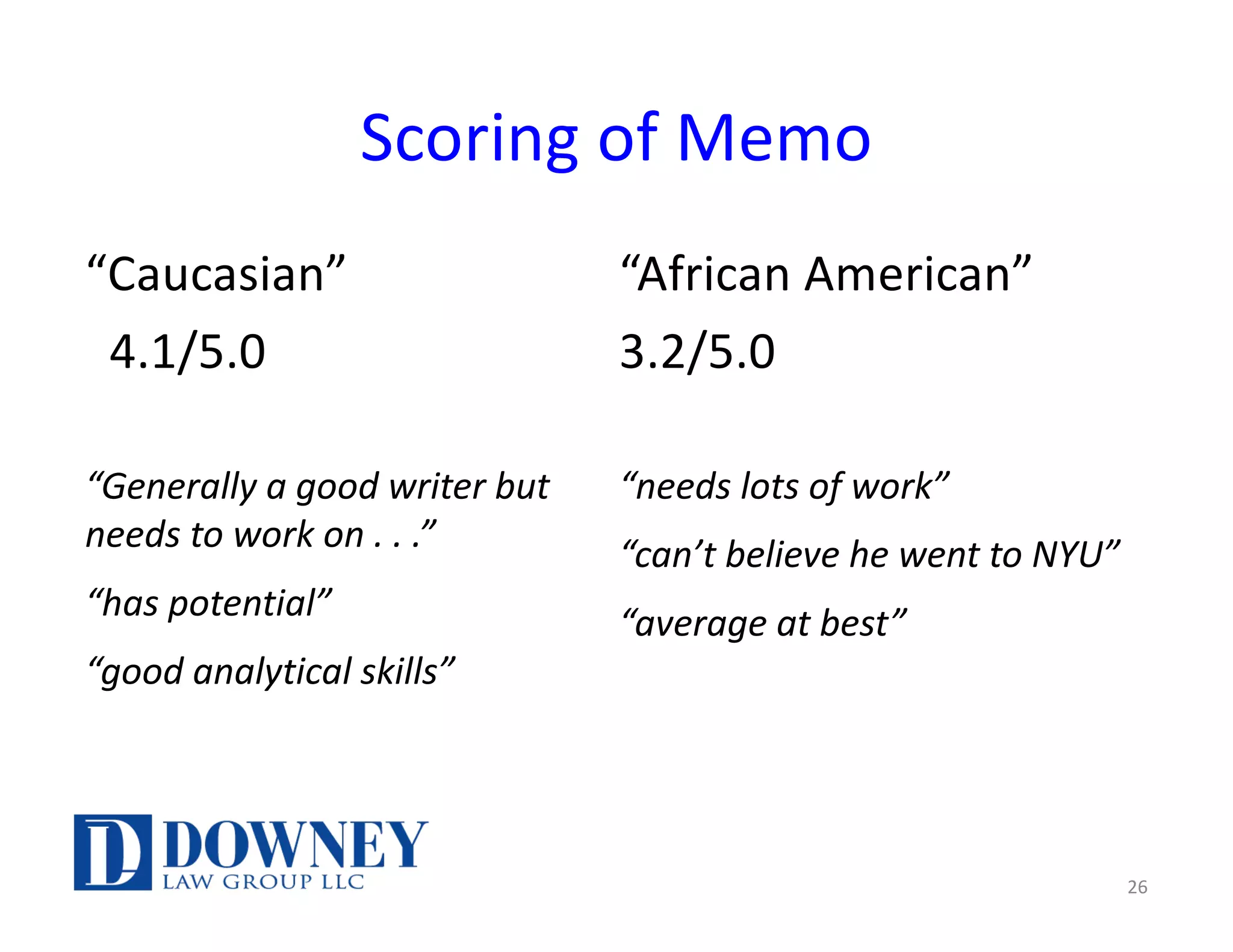
Scoring of Memo
“Caucasian”
4.1/5.0
“Generally a good writer but
needs to work on . . .”
“has potential”
“good analytical skills”
“African American”
3.2/5.0
“needs lots of work”
“can’t believe he went to NYU”
“average at best”
26
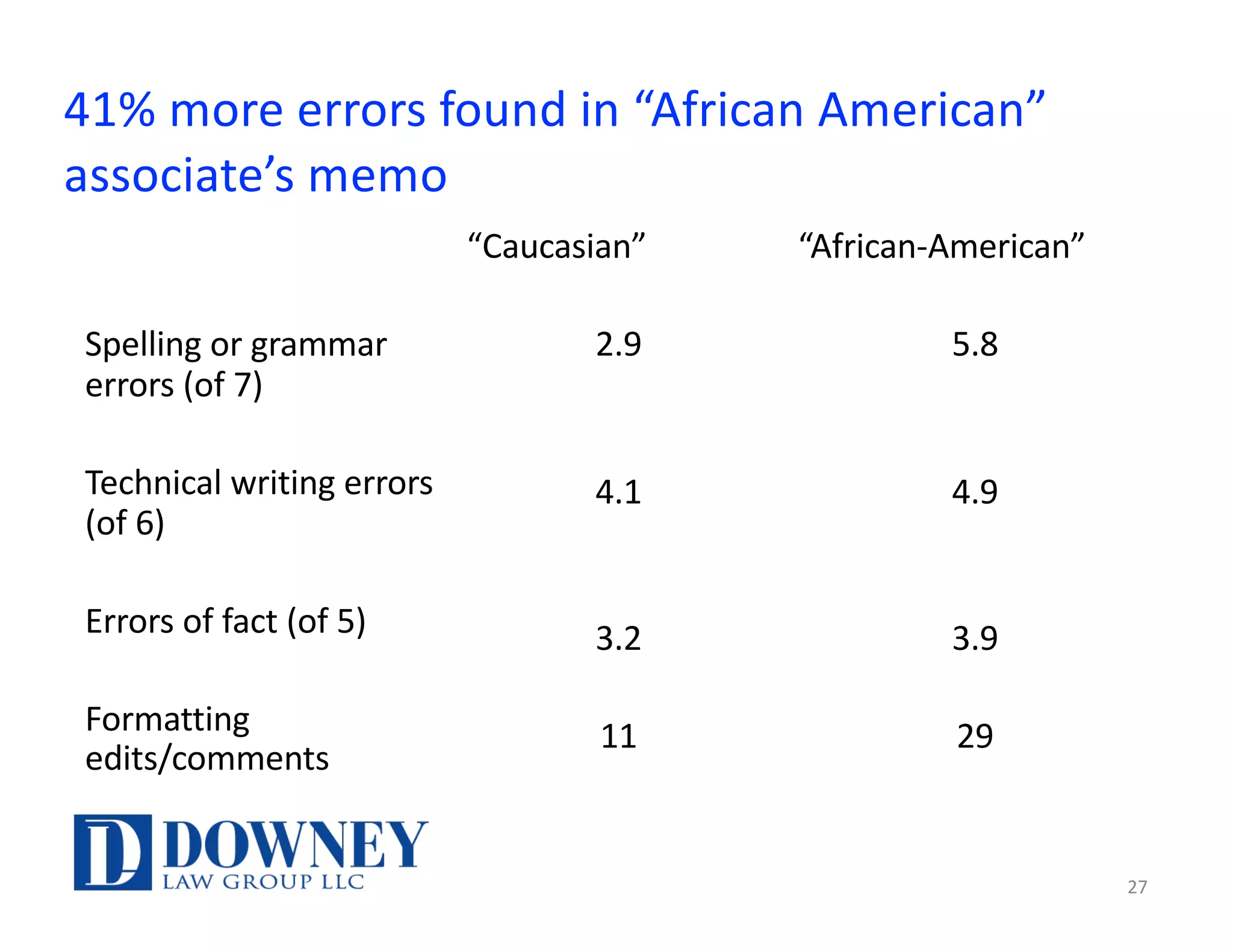
Spelling or grammar
errors (of 7)
Technical writing errors
(of 6)
Errors of fact (of 5)
Formatting
edits/comments
“Caucasian”
2.9
4.1
3.2
11
“African-American”
5.8
4.9
3.9
29
27
41% more errors found in “African American”
associate’s memo
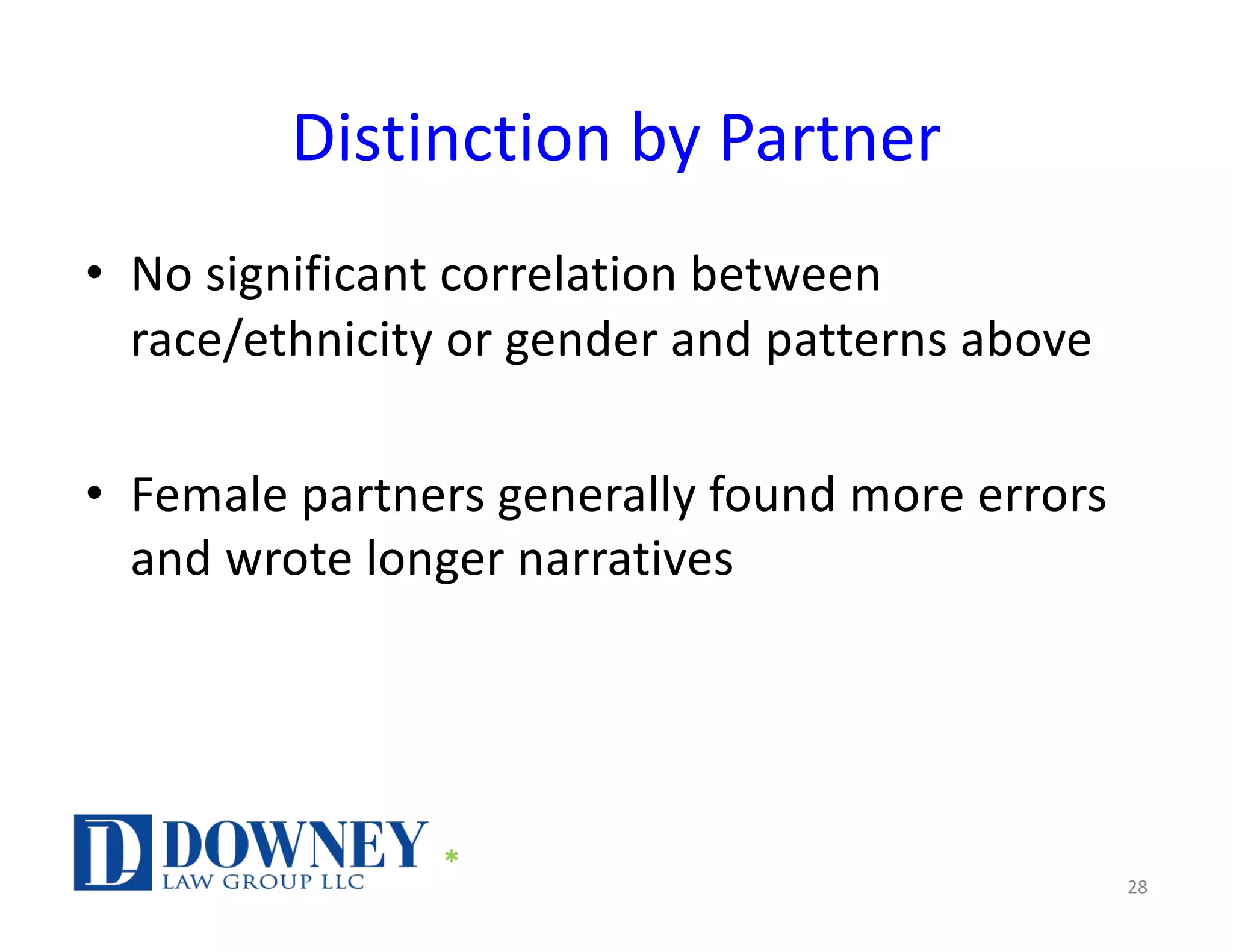
Distinction by Partner
• No significant correlation between
race/ethnicity or gender and patterns above
• Female partners generally found more errors
and wrote longer narratives
28
*
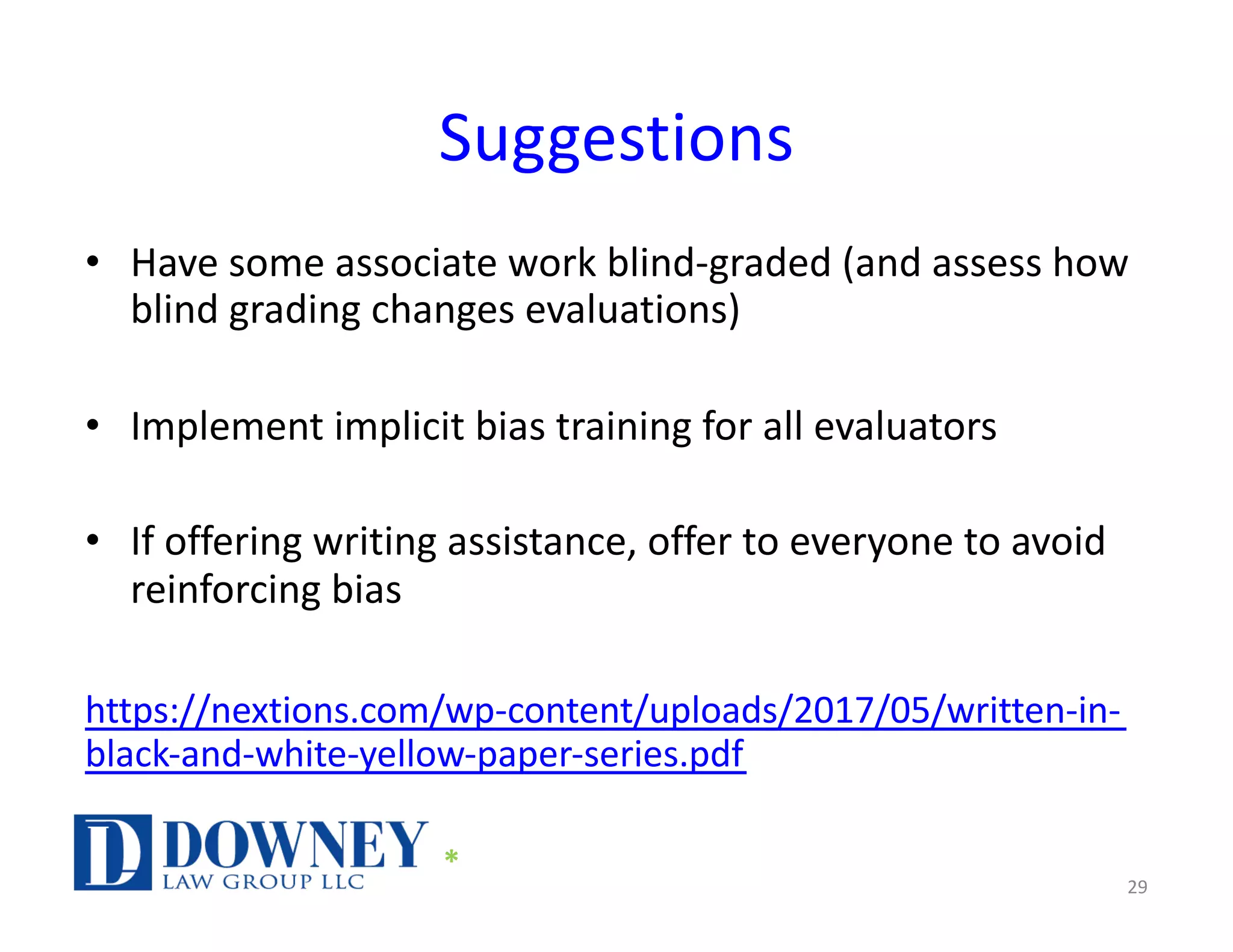
Suggestions
• Have some associate work blind-graded (and assess how
blind grading changes evaluations)
• Implement implicit bias training for all evaluators
• If offering writing assistance, offer to everyone to avoid
reinforcing bias
https://nextions.com/wp-content/uploads/2017/05/written-in-
black-and-white-yellow-paper-series.pdf
29
*
Implicit Bias in the Courtroom
UCLA Law Review (2012)
Stages of a criminal trial where implicit bias can
have an impact
1. Reporting of crime by witness/victim
2. Charging decision by prosecutor
3. Bail determination by judge
4. Acceptance of plea by defendant
5. Management of trial proceedings by judge
6. Determination of guilt by jury
7. Sentencing of defendant if guilty
30
Bias in Everyday Work Interactions
1. “Prove it again” – group required to do more to prove competency (In
one study, “Jamal” needed 8 more years’ experience to be as qualified as
“Greg”)
2. “Tightrope” – narrower range of behaviors accepted
3. “Maternal Wall” – commitment and competence of mothers challenged,
or criticized for being career focused
4. “Tug of War” – pitting of one disadvantaged group against another, often
based on different strategies for assimilation
Important to recognize when these forms of bias arise and address them accordingly
31
*
Interrupting Bias
• Eliminate artificial advantages
– Establish objective criteria
– Structure interviews with skills-based
questions
• Avoid common pitfalls in evaluations
– Explain how promotions and pay decisions will
be made
– Follow pre-announced rules
32
Reducing Effect of Implicit Bias
• Resolve problematic dynamics
• Become self-aware of the implicit bias
• Be motivated to change
• Think about stereotyped groups as
individuals
33
Tools for Reducing Effect of Implicit Bias
• Orchestra auditions
– Skills-based assessments with no individual
information attached
• Model pioneered by a start-up called GapJumpers
• Commit to total inclusion
– Including in relationships with co-workers,
performance evaluations, and advancement
opportunities
34
*
Diversity
36
Diversity
37
*
38
*
What Is Diversity
• Race
• Sexuality
• Culture
• Values
• Religion
• Gender
39
Why Is Diversity Important?
• Diverse perspectives à avoid “groupthink”
– Different talents, skills, experiences
• Reflect communities being represented
• Increased talent pool
• Inclusivity can lead to better performance by
employees
40
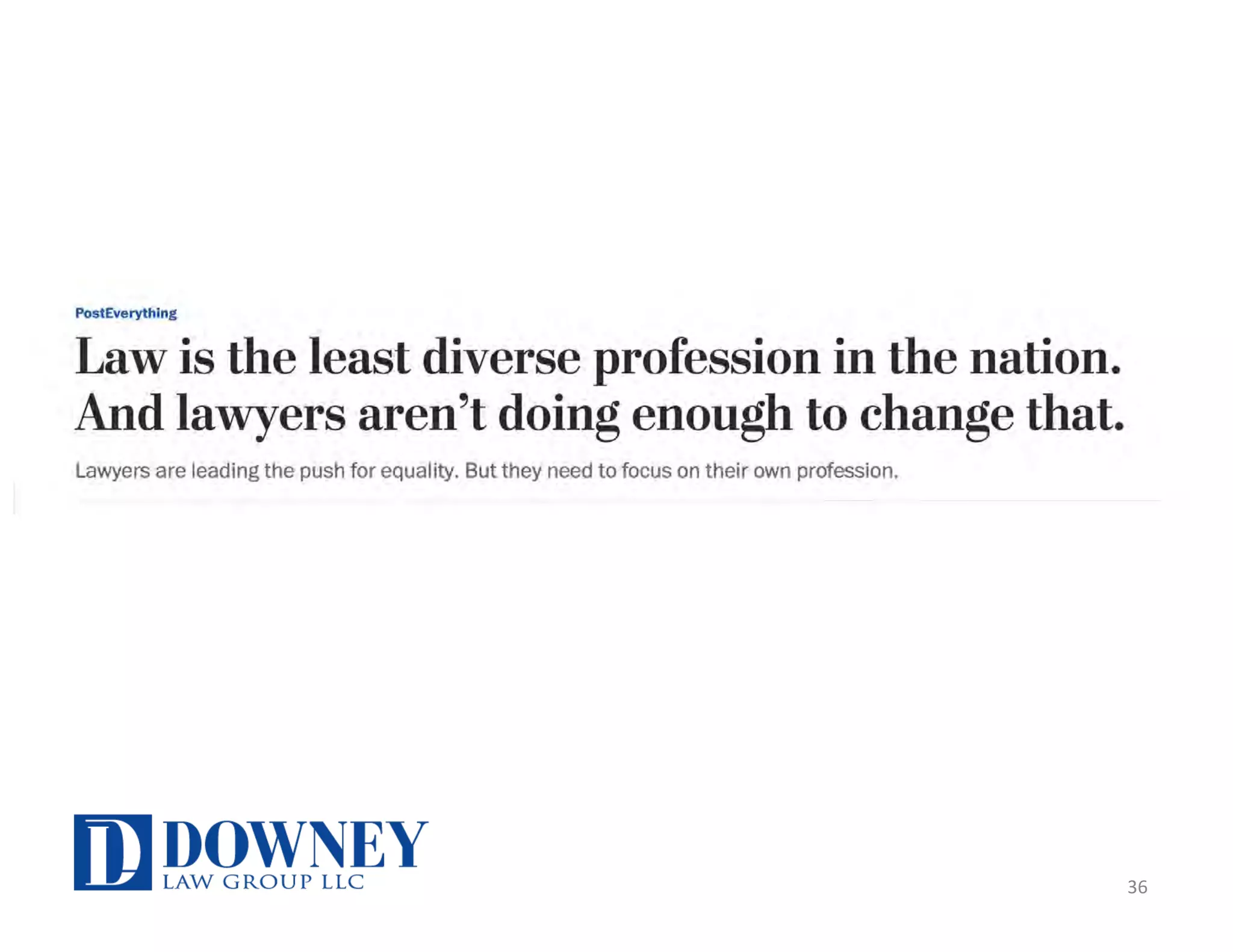
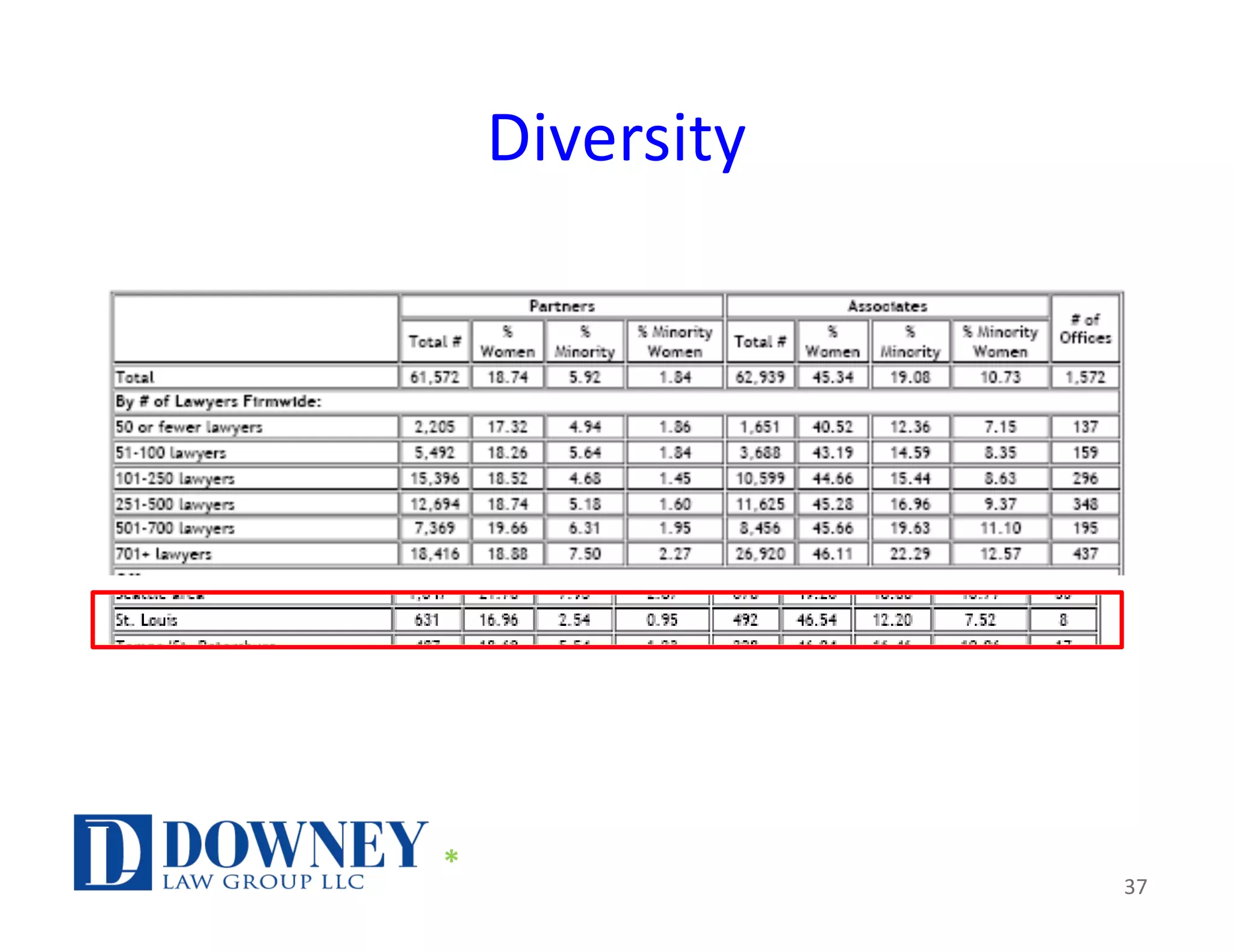
Diversity in the Legal Profession
• Widely embraced as a principle and core value
• Seldomly realized in practice
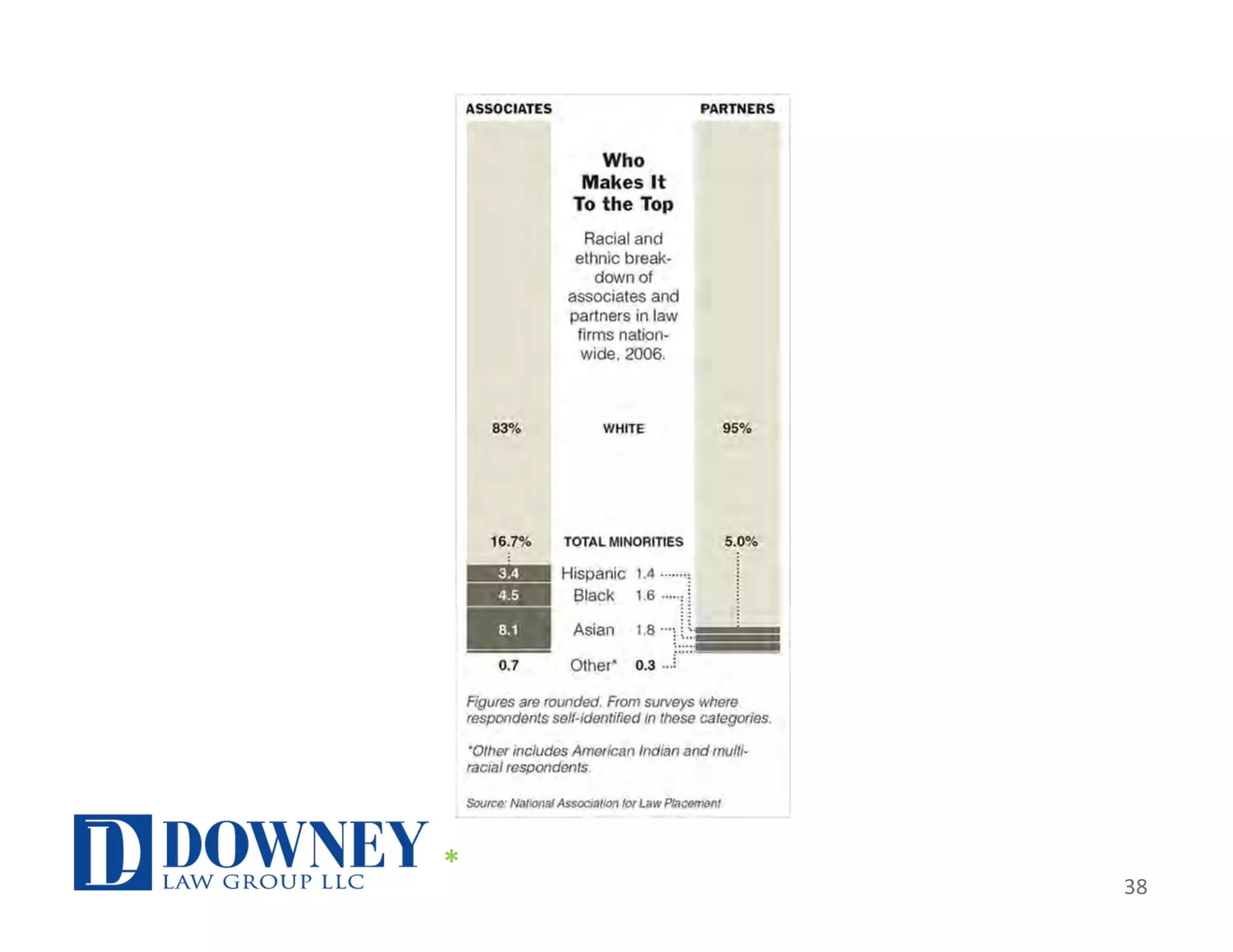
The ABA reports that only dentistry and natural
sciences have less diversity than the legal profession
41
*
42
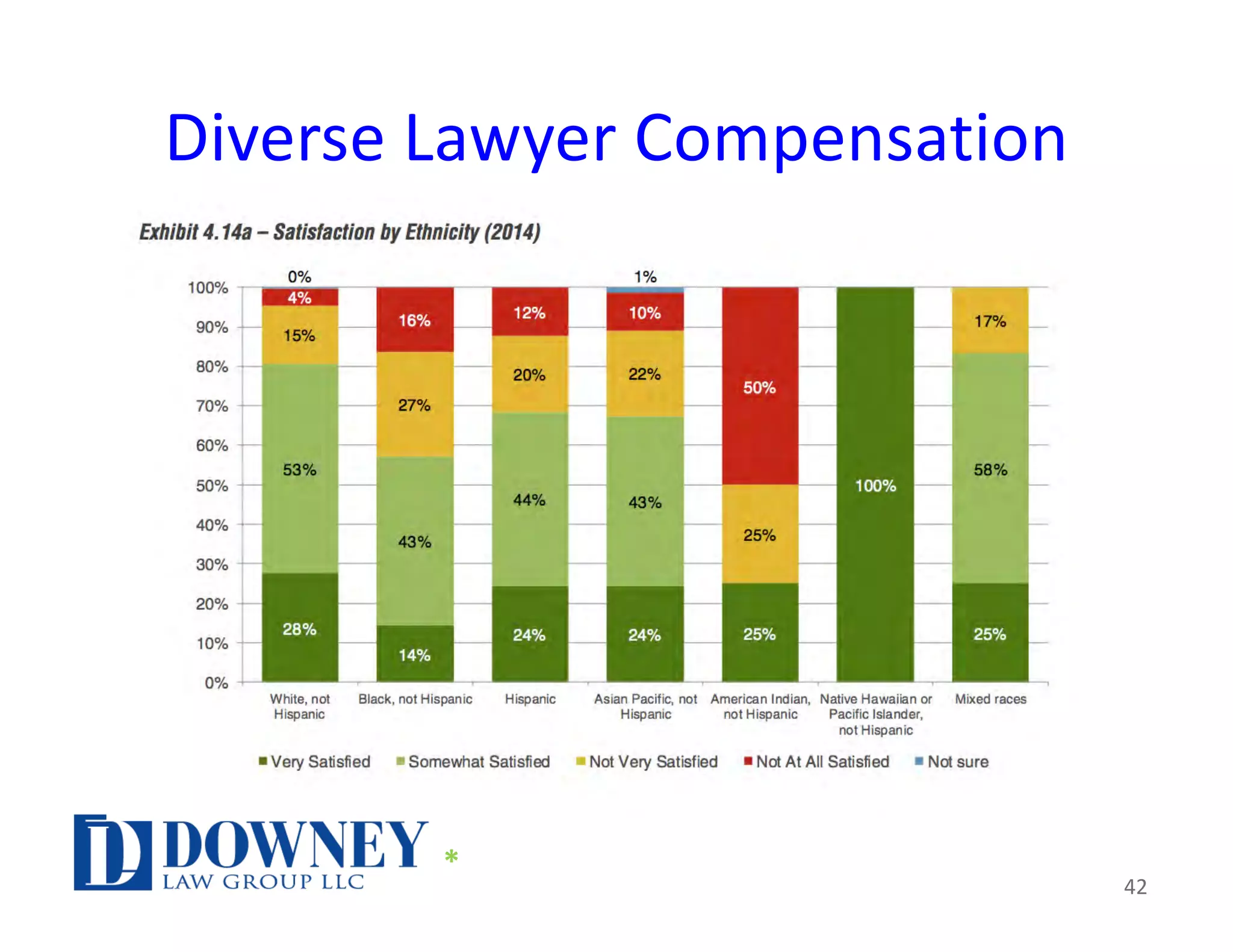
Diverse Lawyer Compensation
*
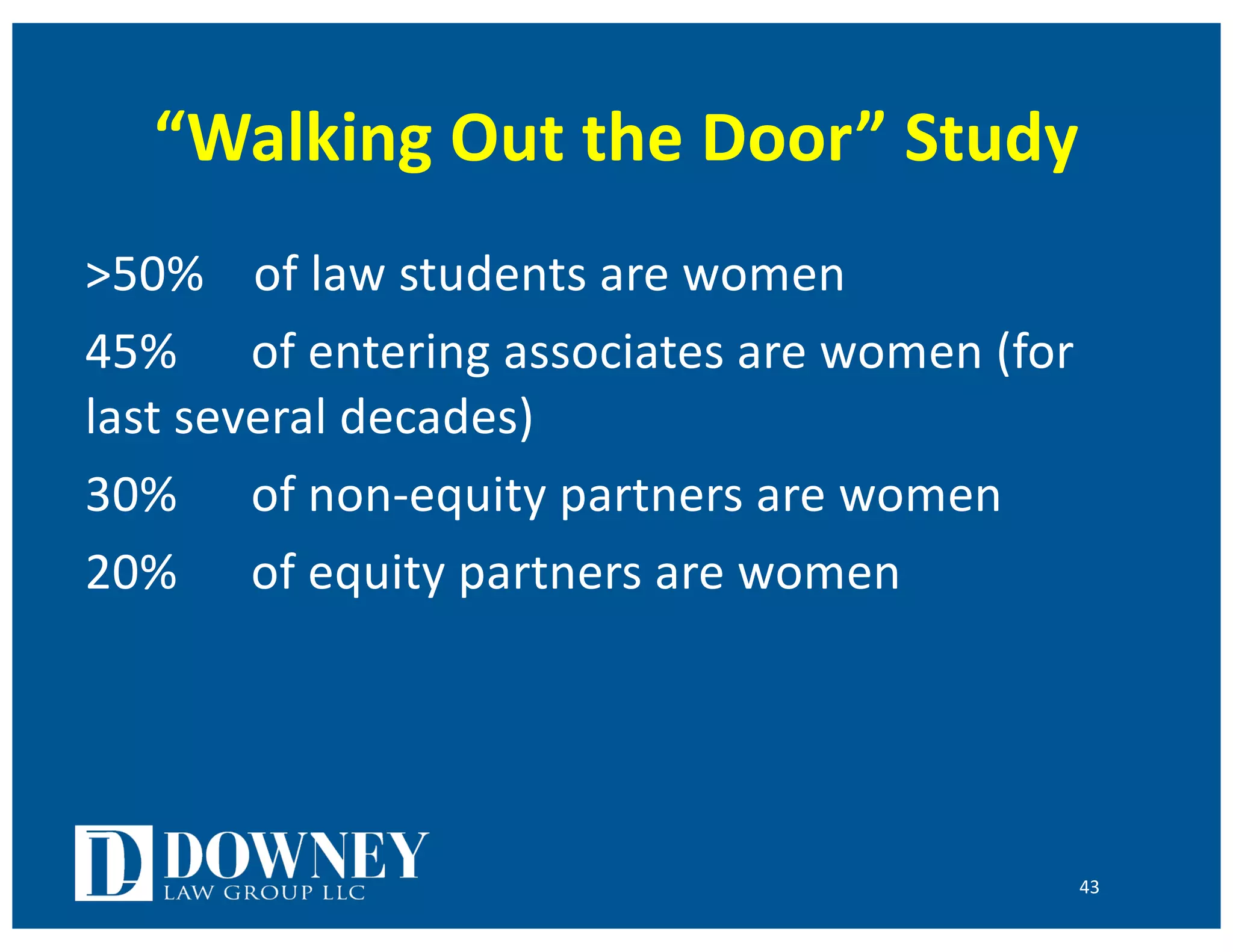
“Walking Out the Door” Study
>50% of law students are women
45% of entering associates are women (for
last several decades)
30% of non-equity partners are women
20% of equity partners are women
43
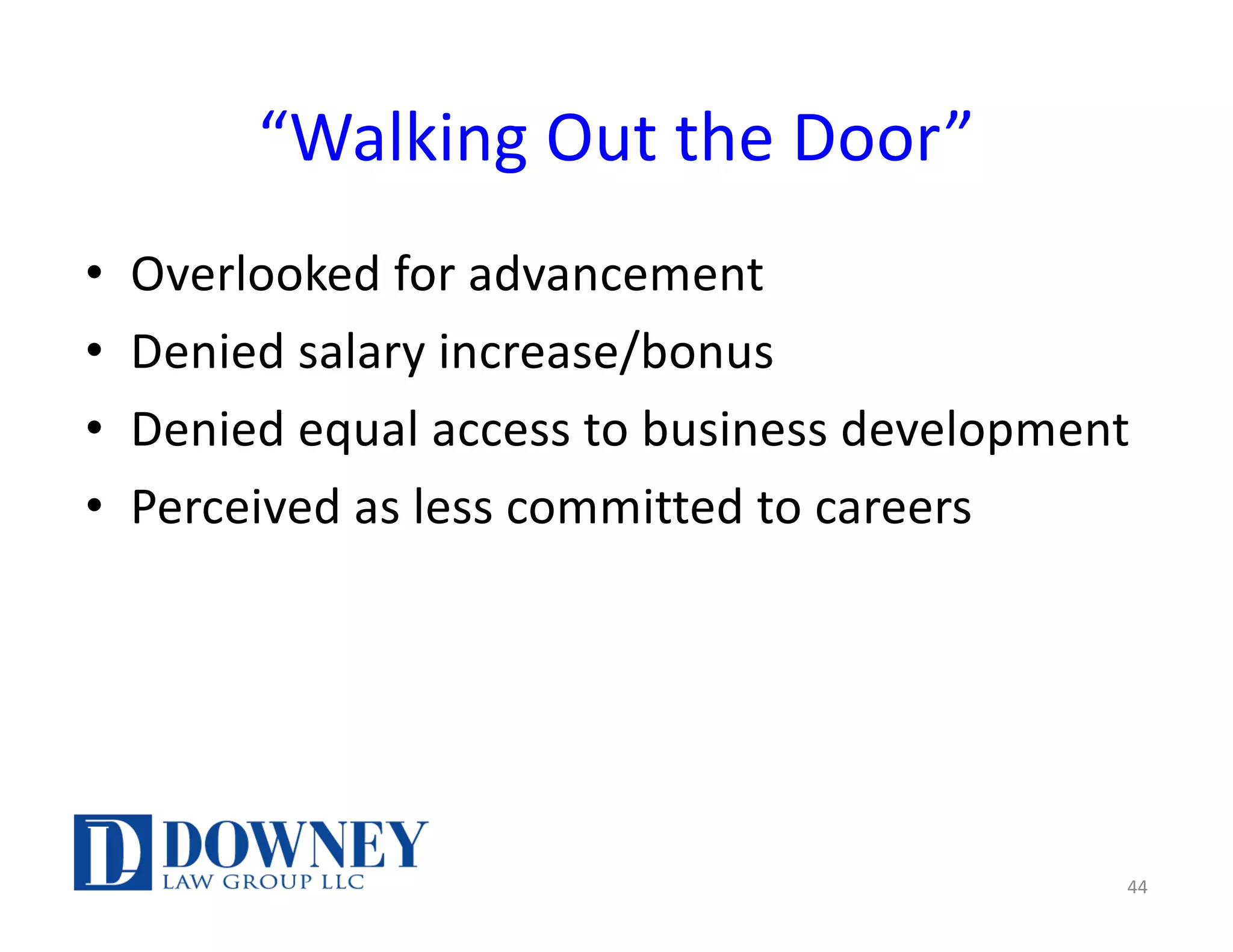
“Walking Out the Door”
• Overlooked for advancement
• Denied salary increase/bonus
• Denied equal access to business development
• Perceived as less committed to careers
44
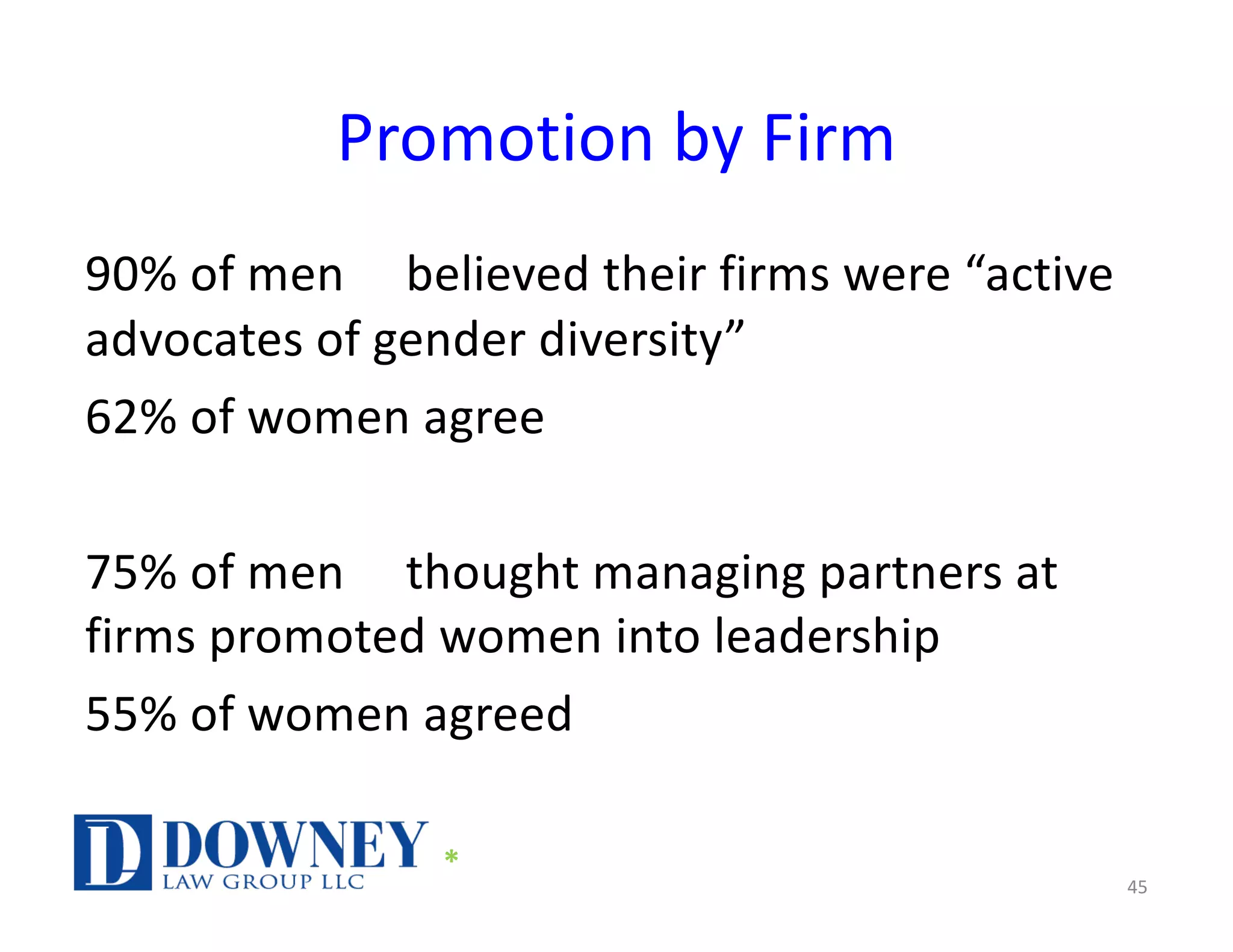
Promotion by Firm
90% of men believed their firms were “active
advocates of gender diversity”
62% of women agree
75% of men thought managing partners at
firms promoted women into leadership
55% of women agreed
45
*
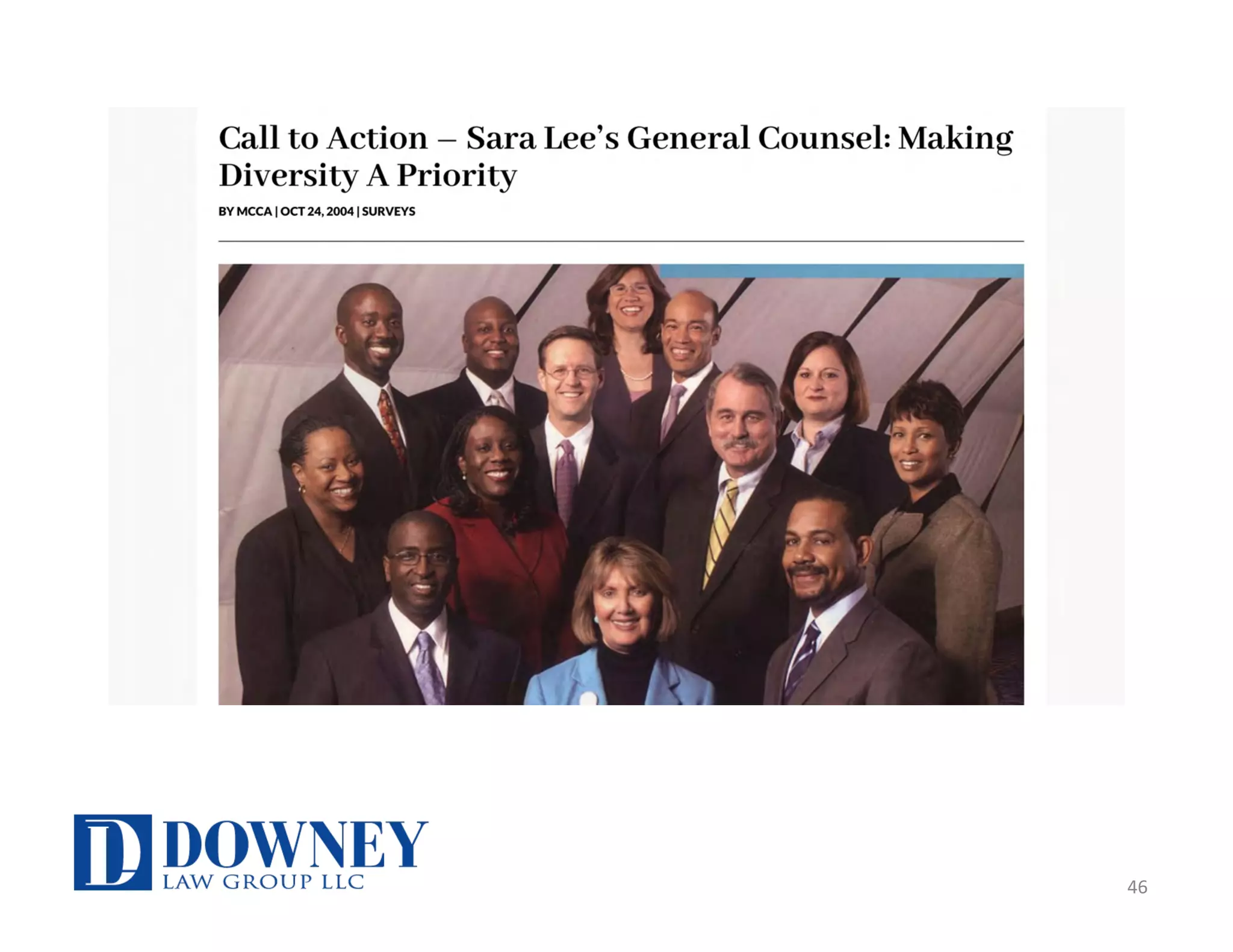
46
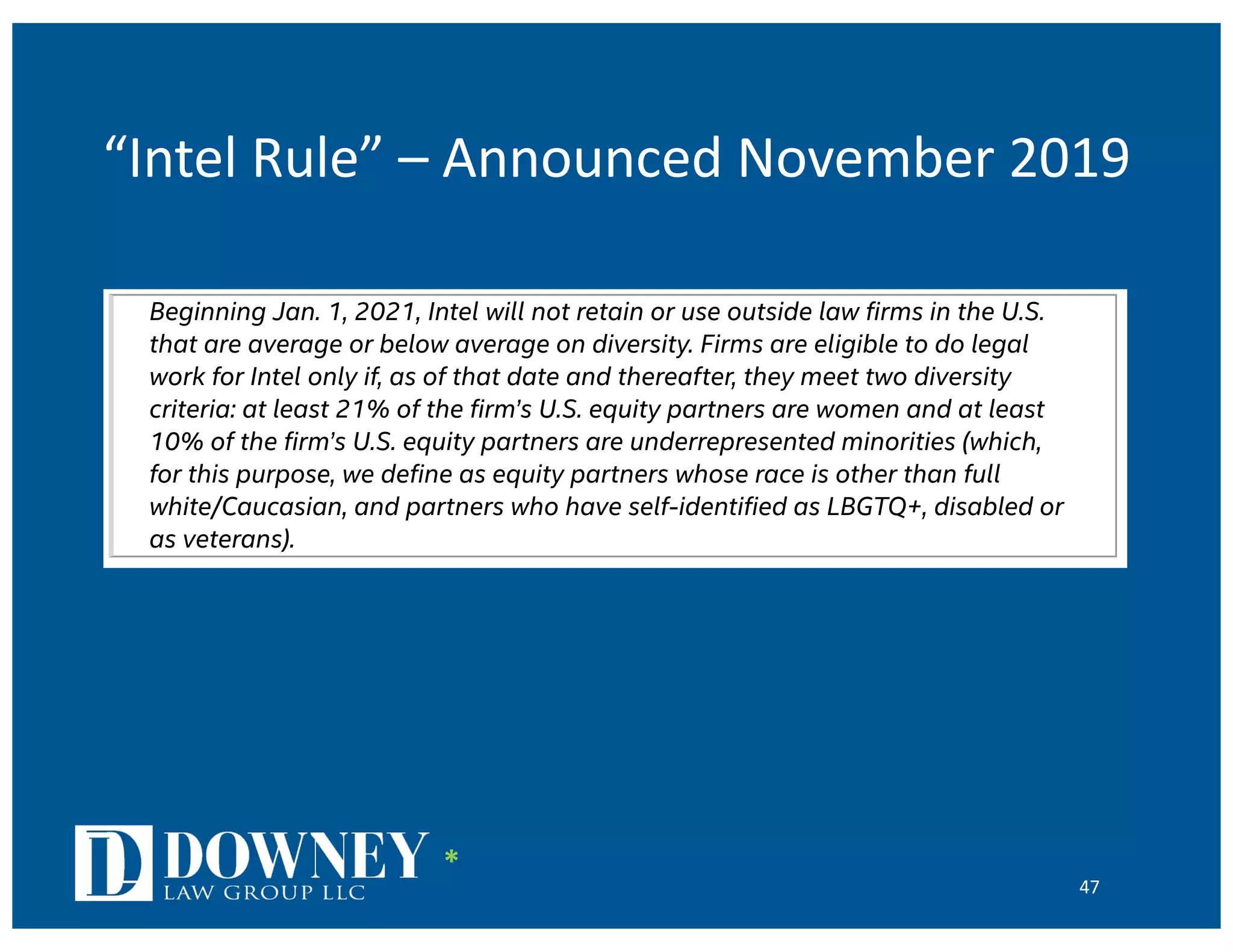
“Intel Rule” – Announced November 2019
47
industry’s belief in our ability to achieve the core promise of Gordon’s prediction has
driven thousands of engineers and scientists to produce ever-faster computer chips.
We believe that driving real progress in the legal profession’s diversity requires taking risk
and being audacious, in the best spirit of Moore’s Law. In fact, we need a Moore’s Law of
diversity in the legal profession and, even more, we need the fearlessness that goes with
it. Today, we are taking a step toward that ambition by announcing something we call the
Intel Rule:
Beginning Jan. 1, 2021, Intel will not retain or use outside law firms in the U.S.
that are average or below average on diversity. Firms are eligible to do legal
work for Intel only if, as of that date and thereafter, they meet two diversity
criteria: at least 21% of the firm’s U.S. equity partners are women and at least
10% of the firm’s U.S. equity partners are underrepresented minorities (which,
for this purpose, we define as equity partners whose race is other than full
white/Caucasian, and partners who have self-identified as LBGTQ+, disabled or
as veterans).
The Intel Rule adds above-average diversity to a small list of mandatory items we require
from every lawyer in every retention: results, value, professionalism and diversity. We
understand that doing this may deny to us the services of many highly skilled lawyers,
perhaps including the services of some law firms with which we have worked for
decades. But Intel cannot abide the current state of progress – it is not enough, and
progress is not happening fast enough. At Intel, below average and average on diversity is
no longer good enough to be a member of our regular outside counsel roster.
Initially, our diversity criteria will focus on equity partners. As many firms now have
multiple tiers of equity partners, over time we intend to develop the data necessary to
adopt and apply diversity criteria based only on the top tier of equity partners at firms. We
*
Mansfield Rule
• Adopted by 100+ major law firms
• Goal: increase representation of diverse lawyers in
leadership
– Women
– LGBT+ lawyers
– Lawyers with disabilities
– Racial/ethnic minority lawyers
• Like “Rooney Rule” for NFL hiring
• Named for Arabella Mansfield – first woman admitted
to practice law in the United States (Iowa 1869)
48
Mansfield Certification
• Consider at least 50% historically
underrepresented lawyers for 70% or more of
firm leadership roles
49
Unintended Gender Impacts
• Conflating long hours with passion and dedication
– Women handle more childcare and family responsibilities
• Women asked to do more administrative tasks
• Women presumed to be court reporters, staff, non-
professionals, etc. (58% women attorneys of color versus
7% white men)
• Women don’t get top opportunities – and receive less
performance-based feedback
• Women do not self-promote as much as men . . . And do
so in different ways
50
“Treat Everyone Equally”
• 50-50 bathroom space – but women spend 2.3 times
longer in bathroom on average
• Bus routes and snow clearance patterns favor men, not
women
• Maternity/paternity leave impedes progress and
promotions
• Use of Braille
• Everyone must walk same distance
• Use same communications/encouragement for everyone
51
*
52
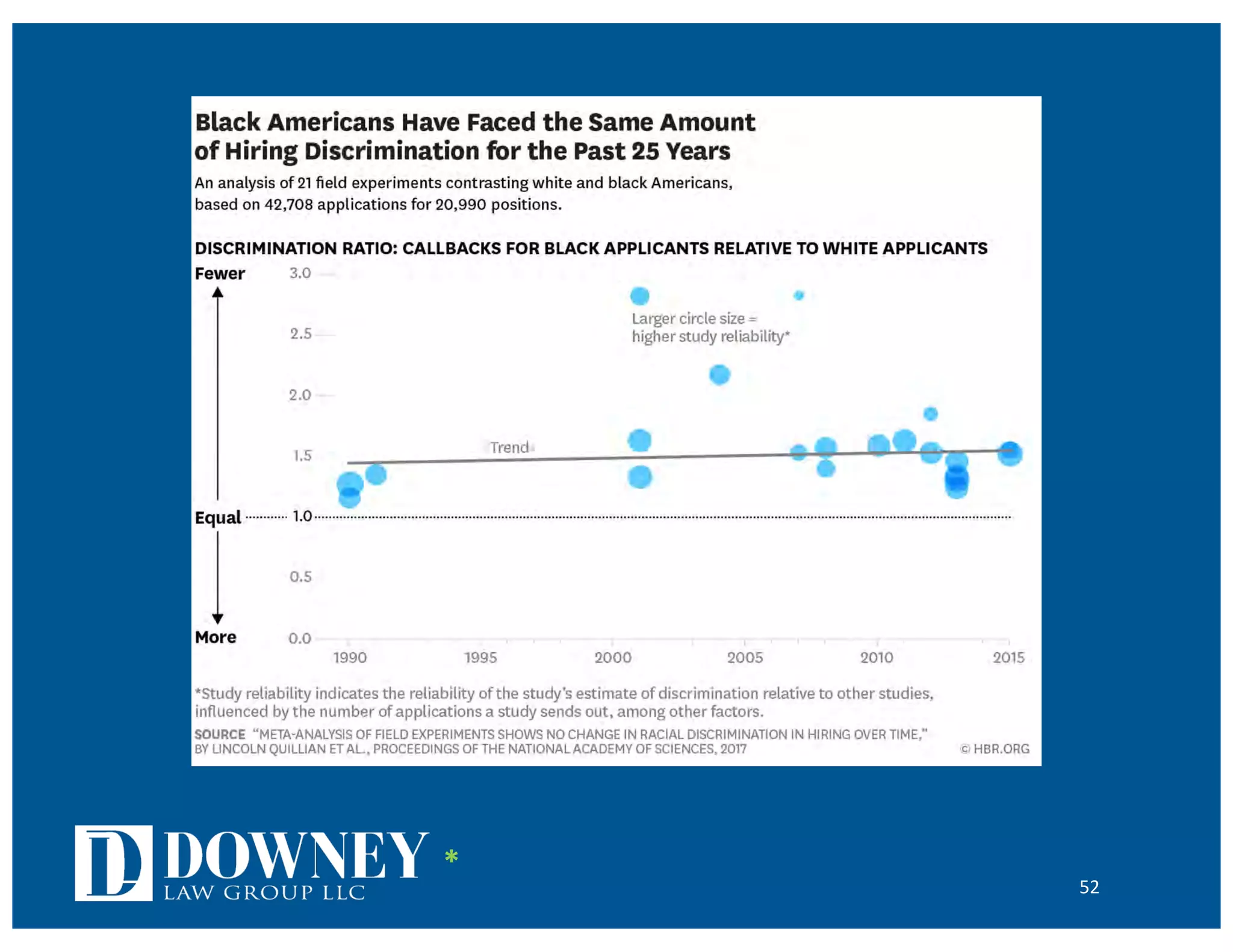
1/12/20, 7:48 PMHiring Discrimination Against Black Americans Hasn’t Declined in 25 Years
changed since 1990.
Our results do not address the possibility that hiring discrimination may have
substantially dropped in the 1960s or early 1970s, during the civil rights era, when
many forms of direct discrimination were outlawed. Further, our results pertain
*
53
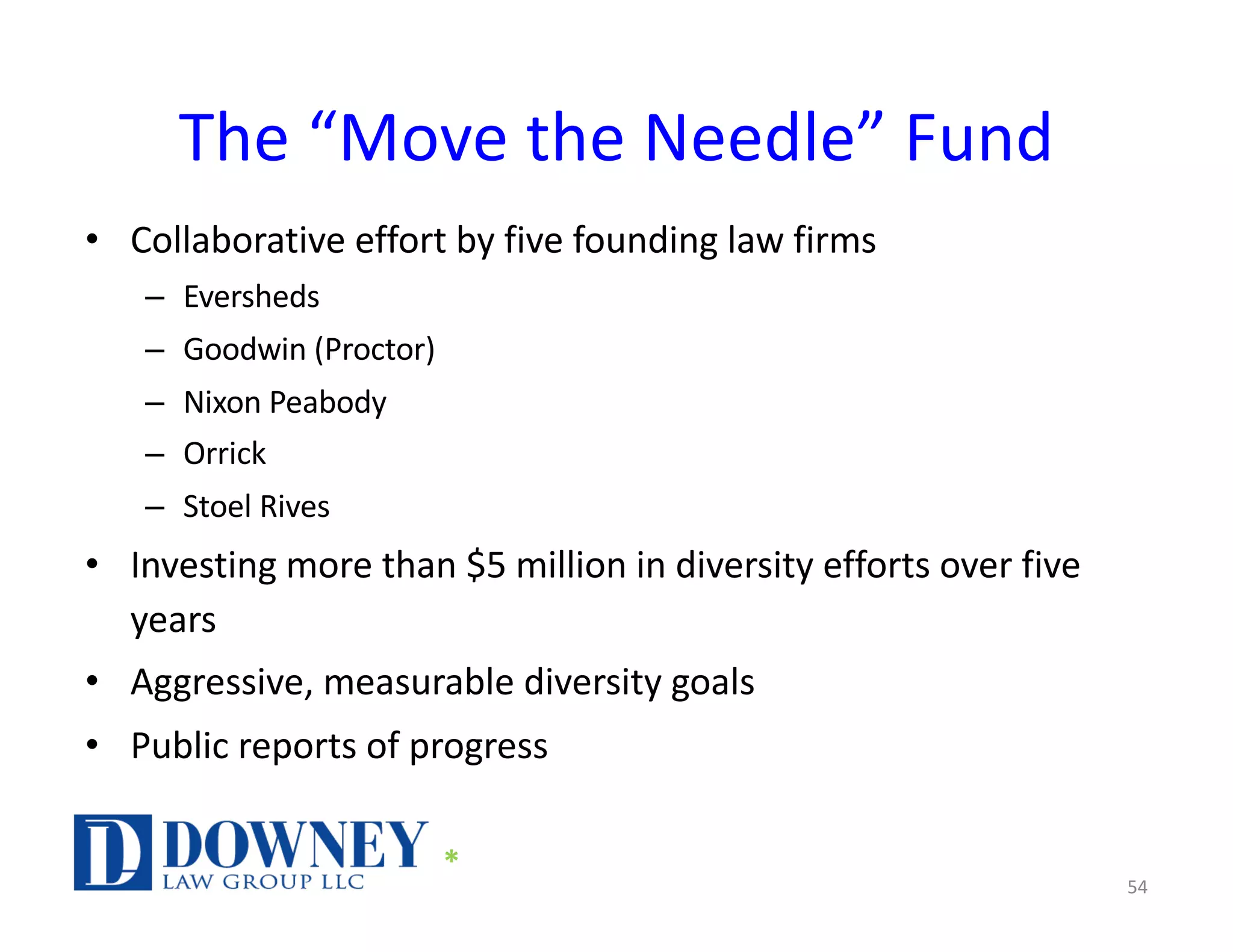
The “Move the Needle” Fund
• Collaborative effort by five founding law firms
– Eversheds
– Goodwin (Proctor)
– Nixon Peabody
– Orrick
– Stoel Rives
• Investing more than $5 million in diversity efforts over five
years
• Aggressive, measurable diversity goals
• Public reports of progress
54
*
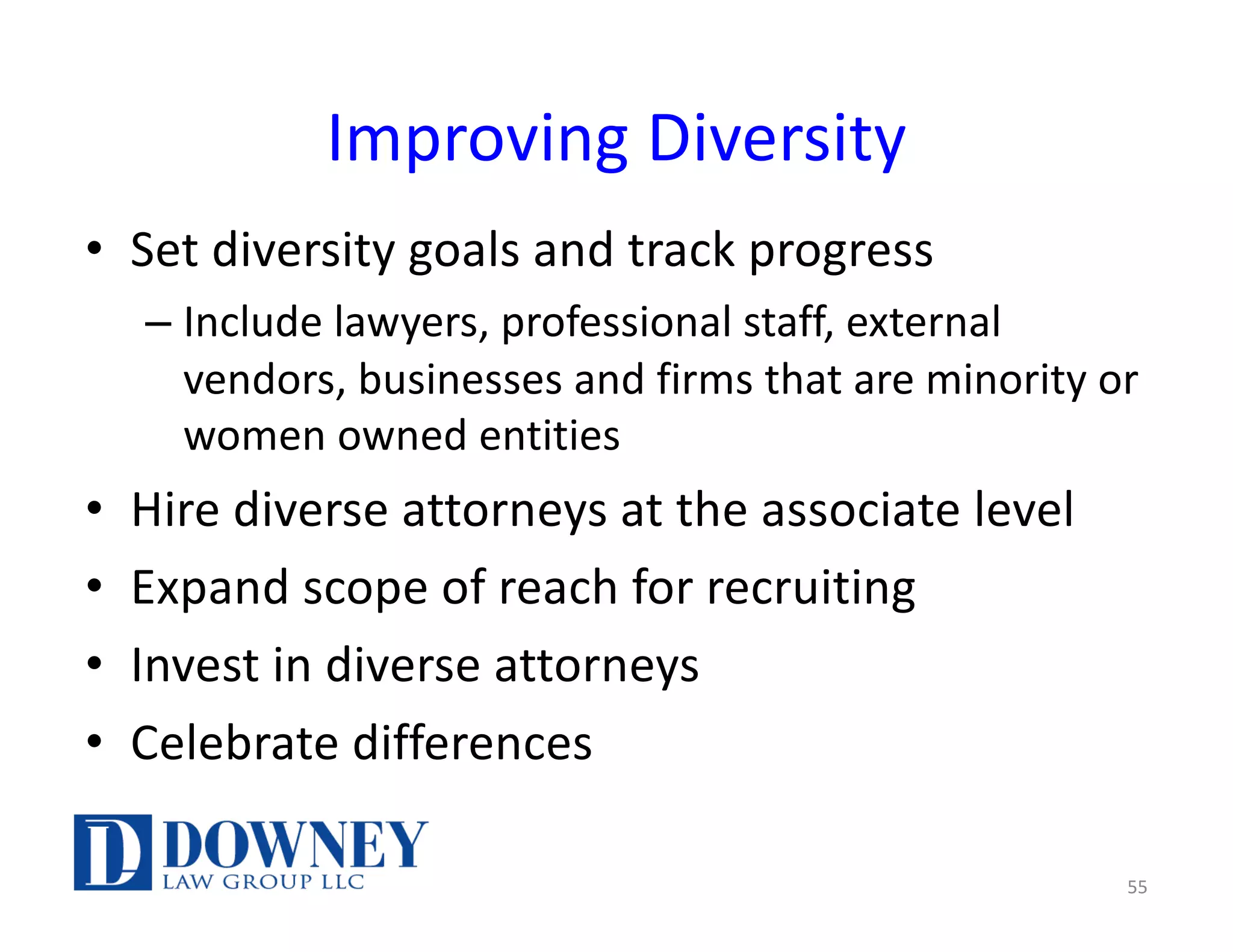
Improving Diversity
• Set diversity goals and track progress
– Include lawyers, professional staff, external
vendors, businesses and firms that are minority or
women owned entities
• Hire diverse attorneys at the associate level
• Expand scope of reach for recruiting
• Invest in diverse attorneys
• Celebrate differences
55
Sponsorship
• Sponsor = Advocate who has power and
influence
• Advance protégé’s career
– Opportunities for development and support
56
57
58
59
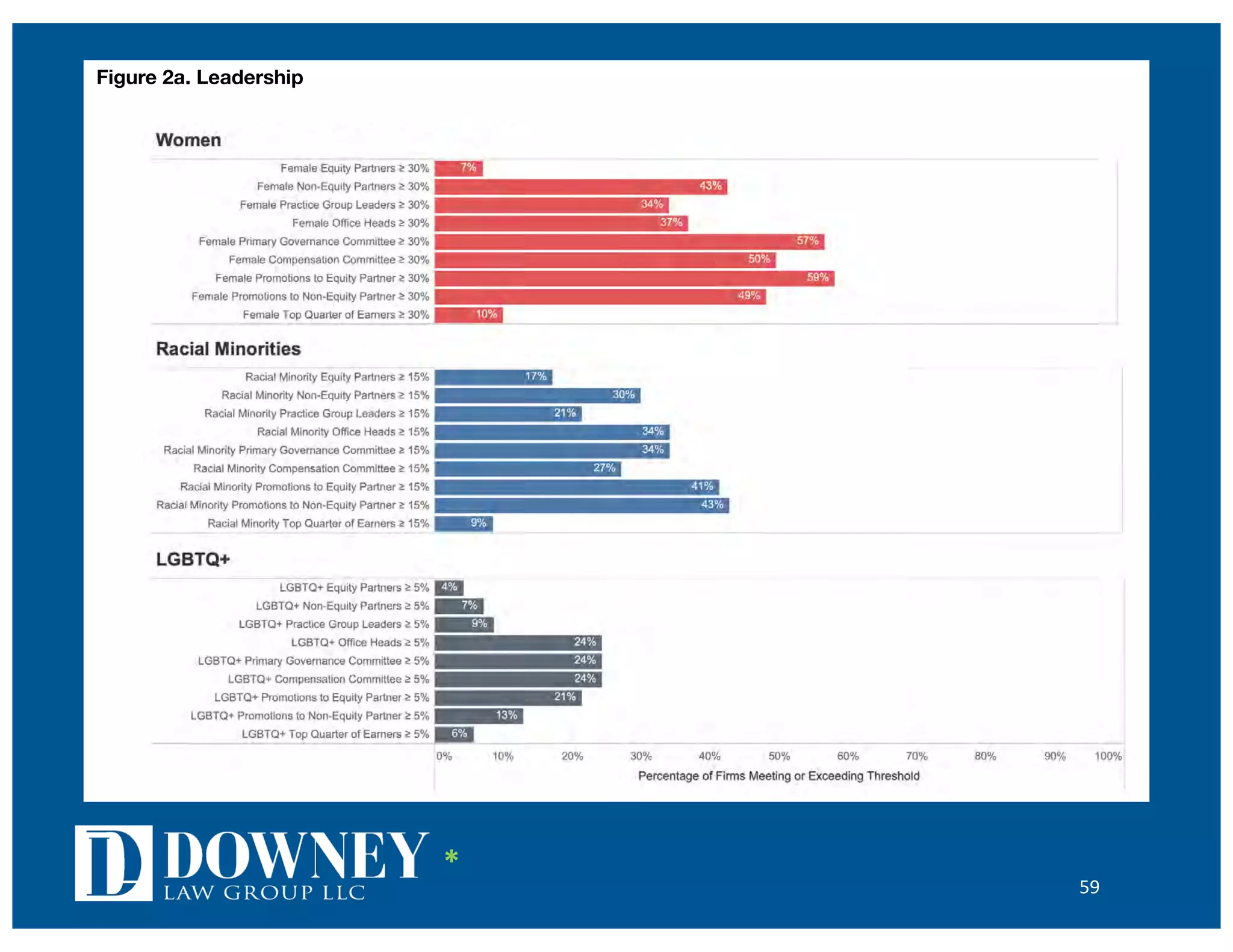
of firms have at least 30% female equity partners, 17% of firms have at least 15% racial minority equity partners, and 4%
of firms have at least 5% LGBTQ+ equity partners.

Figure 2a. Leadership

*
60
Page 4 of 22https://hbr.org/2016/07/why-diversity-programs-fail
training rarely last beyond a day or two, and a number of studies suggest that it can
activate bias or spark a backlash. Nonetheless, nearly half of midsize companies use
it, as do nearly all the Fortune 500.

*
61
1/12/20, 7:50 PMWhy Diversity Programs Fail
Find this and other HBR graphics in our Visual Library
Take college recruitment programs targeting women and minorities. Our interviews

*
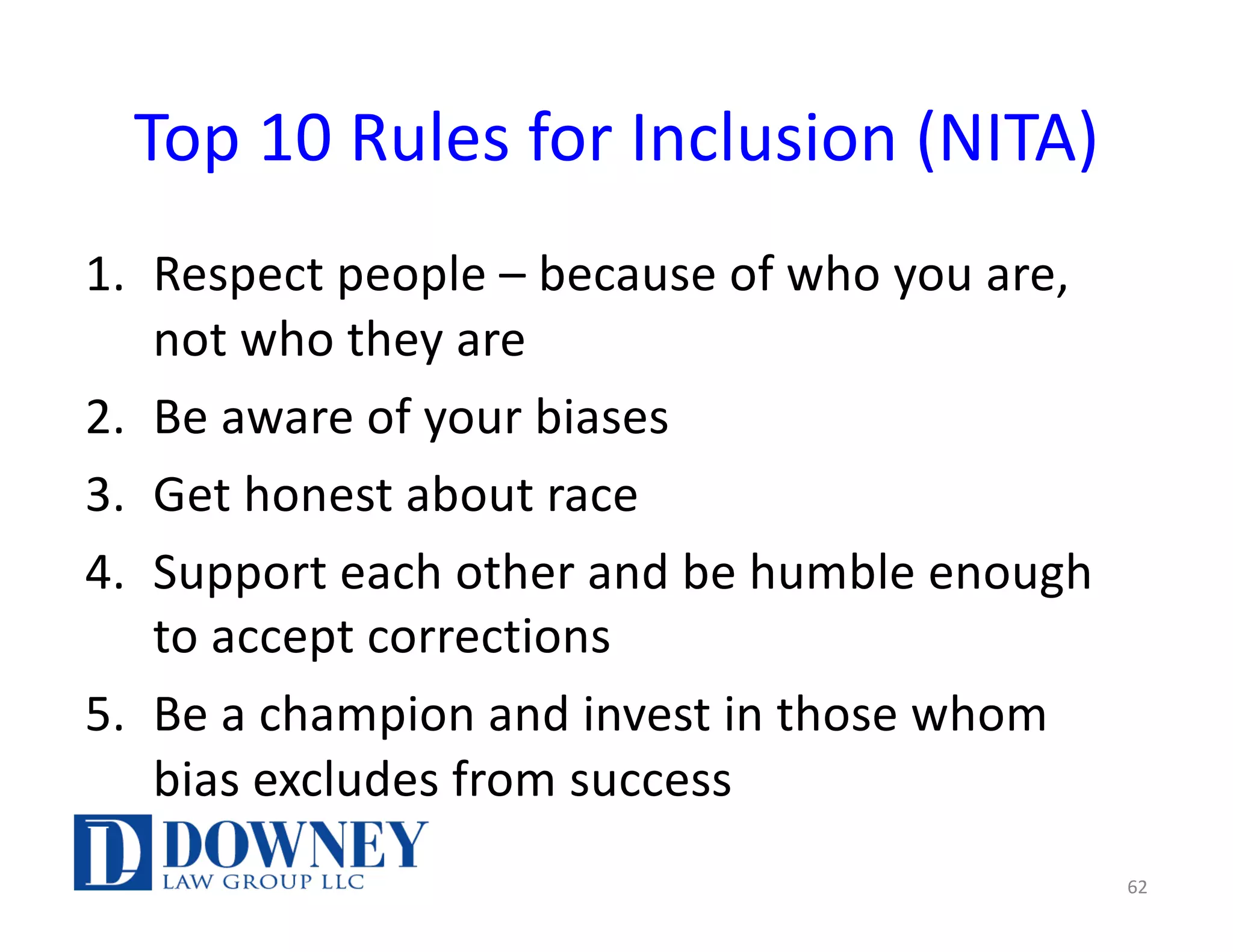
Top 10 Rules for Inclusion (NITA)
1. Respect people – because of who you are,
not who they are
2. Be aware of your biases
3. Get honest about race
4. Support each other and be humble enough
to accept corrections
5. Be a champion and invest in those whom
bias excludes from success
62
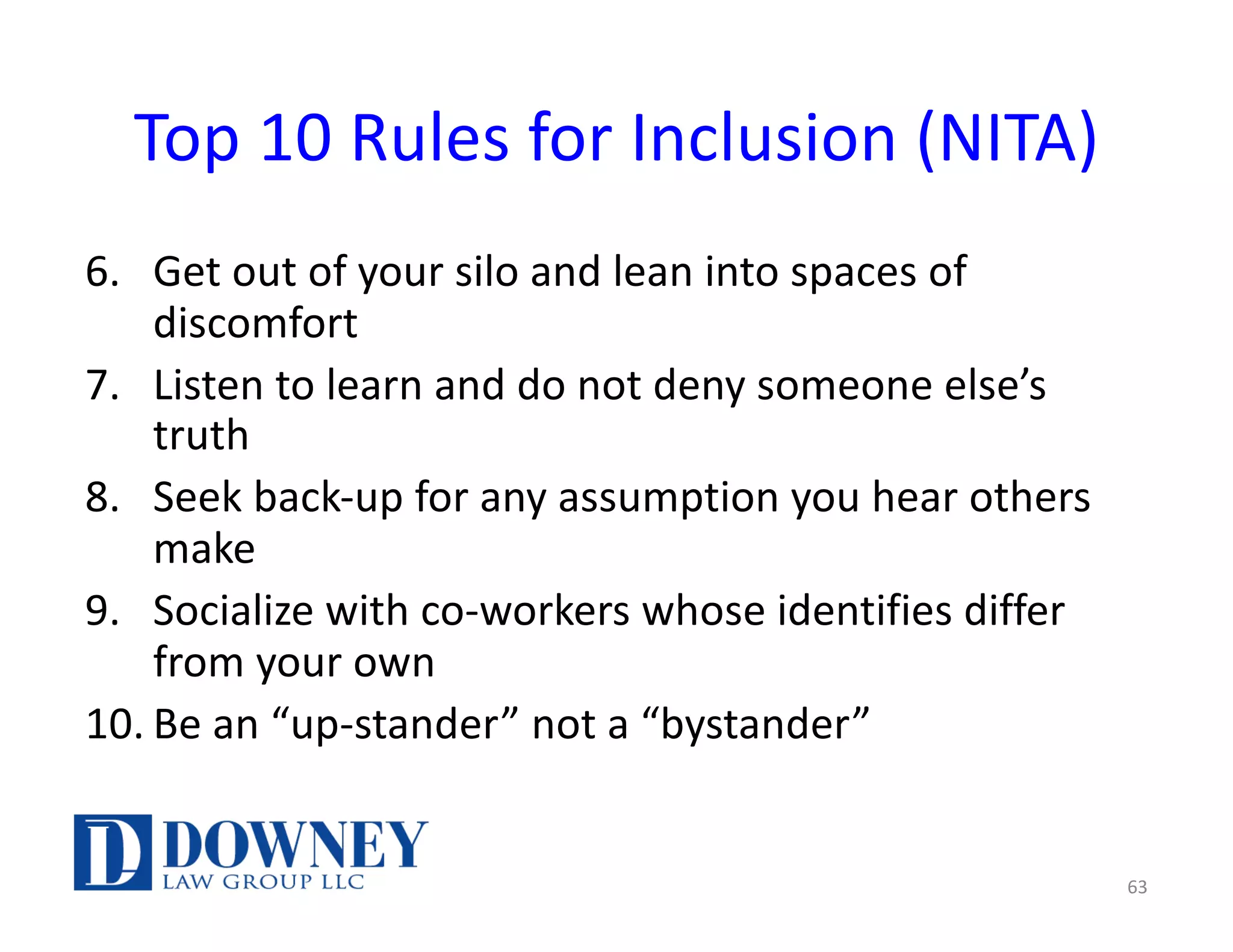
Top 10 Rules for Inclusion (NITA)
6. Get out of your silo and lean into spaces of
discomfort
7. Listen to learn and do not deny someone else’s
truth
8. Seek back-up for any assumption you hear others
make
9. Socialize with co-workers whose identifies differ
from your own
10. Be an “up-stander” not a “bystander”
63
Additional Resources
• Seek out resources regarding implicit bias/diversity
– Scientific literature
– Take an IAT test
• Identify and consciously acknowledge differences
– Appreciate group differences and multi-cultural viewpoints
– Make egalitarianism the norm
64
Downey Law Group LLC
(314) 961-6644
(844) 961-6644 toll free
info@DowneyLawGroup.com
Thank You

Elimination of Bias Slides - Presentation March 5, 2020 at 3:30 PM CT

  • 1.
    © 2020 DowneyLaw Group LLC. For educational purposes only. Implicit Bias and Diversity in the Legal Profession February 2020
  • 2.
    Downey Law GroupLLC Paige Tungate Michael Downey 2 Questions: PTungate@DowneyLawGroup.com
  • 3.
  • 4.
    Warning on Scopeand Language • Cannot cover every group or issue in 50 minutes • Need to use language to discuss issues – do not intend to alienate or offend 4
  • 5.
    Missouri Rules AgainstBias, Prejudice and Harassment 5
  • 6.
    Missouri Rule 4-8.4(g) Itis professional misconduct for a lawyer to: . . . (g) manifest by words or conduct, in representing a client, bias or prejudice, or engage in harassment, including but not limited to bias, prejudice, or harassment based upon race, sex, gender, gender identity, religion, national origin, ethnicity, disability, age, sexual orientation, or marital status. This Rule 4-8.4(g) does not preclude legitimate advocacy when race, sex, gender, gender identity, religion, national origin, ethnicity, disability, age, sexual orientation, marital status, or other similar factors, are issues. This paragraph does not limit the ability of a lawyer to accept, decline, or withdraw from a representation in accordance with Rule 4-1.16. 6 *
  • 7.
    Missouri Rule 18.01 •All court employees shall perform court duties without manifesting bias or prejudice or engaging in harassment. • Court employees shall not, in the performance of court duties, by words or conduct, manifest bias or prejudice, or engage in harassment, including but not limited to bias, prejudice, or harassment based upon sex, gender, gender identity, religion, national origin, ethnicity, disability, age, sexual orientation, or martial status. 7 *
  • 8.
    Missouri Rule 15.05(a)(2) [E]achlawyer shall complete and report, during each reporting year, a total of at least 15 credit hours of accredited programs, seminars, and activities. For each reporting year: 1) at least three of the total 15 credit hours must be devoted exclusively to accredited ethics programs . . . ; and 2) at least one of the three ethics credit hours required under Rule 15.05(a)(1) must be devoted exclusively to explicit or implicit bias, diversity, inclusion, or cultural competency. 8
  • 9.
    Missouri Rule 15.01.10 •Programs, seminars, and activities in the area of explicit or implicit bias, diversity, inclusion, and cultural competency shall focus on issues in the legal profession and in the practice of law. • Such programs, seminars, and activities shall not include the substantive law of illegal discrimination except to the extent that the topics set forth above are directly and substantially discussed in relationship with such topics. 9
  • 10.
  • 11.
    “Us” v. “Them”Mentality • Can be about a person’s race, gender, social economic status, body weight, ethnicity, etc. • Can be good or bad, justified or unjustified • Even “lawyer” can be a stereotype that invokes a certain bias 11
  • 12.
    Example – Irish •Poet • Drunk and disorderly • Quarrelsome • Rarely dabbling in counterfeit money, breaking into houses or swindling • Women were “reckless breeders” • “What you always have to remember with the Irish is they get mean. Virtually every Irish I've known gets mean when he drinks.” – President Richard Nixon 12 *
  • 13.
    Example – German •Extremely punctual • Love order • Undiplomatic (too straightforward) and unfriendly • “Nazis” • No sense of humor • Cold and unromantic 13
  • 14.
  • 15.
    Explicit Bias andPrejudice 15 Charlottesville 2017
  • 16.
  • 17.
    Implicit Bias • Whenwe have attitudes towards people or associate stereotypes with them without our conscious knowledge • Can be positive or negative 17
  • 18.
    British Media Treatmentof Meghan Markle and Kate Middleton 18 *
  • 19.
  • 20.
    “Bias Blind Spot” •Easily identify when others are perpetuating stereotypes • Struggle to recognize the same biases in ourselves 20
  • 21.
    Presumption Against Bias •Sampling of 600 US residents in 2015 • 85% believed they were less biased than average Americans • 1 person believed he/she was more biased than average 21
  • 22.
    Implicit Association Test(IAT) • Measures time differences between schema- consistent pairings and schema-inconsistent pairings of concepts represented by words or pictures Project Implicit at Harvard University www.implicit.Harvard.edu 22 *
  • 23.
    IAT Categories 23 q Asian qWeight q Gender-Career q Disability q Sexuality q Skin-tone q Age q Religion q Presidents q Arab-Muslim q Race q Gender-Science q Weapons *
  • 24.
  • 25.
    ”Written in Black& White” (2014) • Study in the legal profession conducted in 2014 – 60 law firm partners at 22 firms were given identical memos to review • 37 men, 23 women • 39 Caucasian and 21 racial/ethnic minorities – All memos had the same author “Thomas Meyer,” a third- year associate from NYU Law School • 30 partners were told the memo was written by an African American associate • 30 partners were told the memo was written by a Caucasian associate Memo written by NYU Law School 3rd year students 25
  • 26.
    Scoring of Memo “Caucasian” 4.1/5.0 “Generallya good writer but needs to work on . . .” “has potential” “good analytical skills” “African American” 3.2/5.0 “needs lots of work” “can’t believe he went to NYU” “average at best” 26
  • 27.
    Spelling or grammar errors(of 7) Technical writing errors (of 6) Errors of fact (of 5) Formatting edits/comments “Caucasian” 2.9 4.1 3.2 11 “African-American” 5.8 4.9 3.9 29 27 41% more errors found in “African American” associate’s memo
  • 28.
    Distinction by Partner •No significant correlation between race/ethnicity or gender and patterns above • Female partners generally found more errors and wrote longer narratives 28 *
  • 29.
    Suggestions • Have someassociate work blind-graded (and assess how blind grading changes evaluations) • Implement implicit bias training for all evaluators • If offering writing assistance, offer to everyone to avoid reinforcing bias https://nextions.com/wp-content/uploads/2017/05/written-in- black-and-white-yellow-paper-series.pdf 29 *
  • 30.
    Implicit Bias inthe Courtroom UCLA Law Review (2012) Stages of a criminal trial where implicit bias can have an impact 1. Reporting of crime by witness/victim 2. Charging decision by prosecutor 3. Bail determination by judge 4. Acceptance of plea by defendant 5. Management of trial proceedings by judge 6. Determination of guilt by jury 7. Sentencing of defendant if guilty 30
  • 31.
    Bias in EverydayWork Interactions 1. “Prove it again” – group required to do more to prove competency (In one study, “Jamal” needed 8 more years’ experience to be as qualified as “Greg”) 2. “Tightrope” – narrower range of behaviors accepted 3. “Maternal Wall” – commitment and competence of mothers challenged, or criticized for being career focused 4. “Tug of War” – pitting of one disadvantaged group against another, often based on different strategies for assimilation Important to recognize when these forms of bias arise and address them accordingly 31 *
  • 32.
    Interrupting Bias • Eliminateartificial advantages – Establish objective criteria – Structure interviews with skills-based questions • Avoid common pitfalls in evaluations – Explain how promotions and pay decisions will be made – Follow pre-announced rules 32
  • 33.
    Reducing Effect ofImplicit Bias • Resolve problematic dynamics • Become self-aware of the implicit bias • Be motivated to change • Think about stereotyped groups as individuals 33
  • 34.
    Tools for ReducingEffect of Implicit Bias • Orchestra auditions – Skills-based assessments with no individual information attached • Model pioneered by a start-up called GapJumpers • Commit to total inclusion – Including in relationships with co-workers, performance evaluations, and advancement opportunities 34 *
  • 35.
  • 36.
  • 37.
  • 38.
  • 39.
    What Is Diversity •Race • Sexuality • Culture • Values • Religion • Gender 39
  • 40.
    Why Is DiversityImportant? • Diverse perspectives à avoid “groupthink” – Different talents, skills, experiences • Reflect communities being represented • Increased talent pool • Inclusivity can lead to better performance by employees 40
  • 41.
    Diversity in theLegal Profession • Widely embraced as a principle and core value • Seldomly realized in practice The ABA reports that only dentistry and natural sciences have less diversity than the legal profession 41 *
  • 42.
  • 43.
    “Walking Out theDoor” Study >50% of law students are women 45% of entering associates are women (for last several decades) 30% of non-equity partners are women 20% of equity partners are women 43
  • 44.
    “Walking Out theDoor” • Overlooked for advancement • Denied salary increase/bonus • Denied equal access to business development • Perceived as less committed to careers 44
  • 45.
    Promotion by Firm 90%of men believed their firms were “active advocates of gender diversity” 62% of women agree 75% of men thought managing partners at firms promoted women into leadership 55% of women agreed 45 *
  • 46.
  • 47.
    “Intel Rule” –Announced November 2019 47 industry’s belief in our ability to achieve the core promise of Gordon’s prediction has driven thousands of engineers and scientists to produce ever-faster computer chips. We believe that driving real progress in the legal profession’s diversity requires taking risk and being audacious, in the best spirit of Moore’s Law. In fact, we need a Moore’s Law of diversity in the legal profession and, even more, we need the fearlessness that goes with it. Today, we are taking a step toward that ambition by announcing something we call the Intel Rule: Beginning Jan. 1, 2021, Intel will not retain or use outside law firms in the U.S. that are average or below average on diversity. Firms are eligible to do legal work for Intel only if, as of that date and thereafter, they meet two diversity criteria: at least 21% of the firm’s U.S. equity partners are women and at least 10% of the firm’s U.S. equity partners are underrepresented minorities (which, for this purpose, we define as equity partners whose race is other than full white/Caucasian, and partners who have self-identified as LBGTQ+, disabled or as veterans). The Intel Rule adds above-average diversity to a small list of mandatory items we require from every lawyer in every retention: results, value, professionalism and diversity. We understand that doing this may deny to us the services of many highly skilled lawyers, perhaps including the services of some law firms with which we have worked for decades. But Intel cannot abide the current state of progress – it is not enough, and progress is not happening fast enough. At Intel, below average and average on diversity is no longer good enough to be a member of our regular outside counsel roster. Initially, our diversity criteria will focus on equity partners. As many firms now have multiple tiers of equity partners, over time we intend to develop the data necessary to adopt and apply diversity criteria based only on the top tier of equity partners at firms. We *
  • 48.
    Mansfield Rule • Adoptedby 100+ major law firms • Goal: increase representation of diverse lawyers in leadership – Women – LGBT+ lawyers – Lawyers with disabilities – Racial/ethnic minority lawyers • Like “Rooney Rule” for NFL hiring • Named for Arabella Mansfield – first woman admitted to practice law in the United States (Iowa 1869) 48
  • 49.
    Mansfield Certification • Considerat least 50% historically underrepresented lawyers for 70% or more of firm leadership roles 49
  • 50.
    Unintended Gender Impacts •Conflating long hours with passion and dedication – Women handle more childcare and family responsibilities • Women asked to do more administrative tasks • Women presumed to be court reporters, staff, non- professionals, etc. (58% women attorneys of color versus 7% white men) • Women don’t get top opportunities – and receive less performance-based feedback • Women do not self-promote as much as men . . . And do so in different ways 50
  • 51.
    “Treat Everyone Equally” •50-50 bathroom space – but women spend 2.3 times longer in bathroom on average • Bus routes and snow clearance patterns favor men, not women • Maternity/paternity leave impedes progress and promotions • Use of Braille • Everyone must walk same distance • Use same communications/encouragement for everyone 51 *
  • 52.
    52 1/12/20, 7:48 PMHiringDiscrimination Against Black Americans Hasn’t Declined in 25 Years changed since 1990. Our results do not address the possibility that hiring discrimination may have substantially dropped in the 1960s or early 1970s, during the civil rights era, when many forms of direct discrimination were outlawed. Further, our results pertain *
  • 53.
  • 54.
    The “Move theNeedle” Fund • Collaborative effort by five founding law firms – Eversheds – Goodwin (Proctor) – Nixon Peabody – Orrick – Stoel Rives • Investing more than $5 million in diversity efforts over five years • Aggressive, measurable diversity goals • Public reports of progress 54 *
  • 55.
    Improving Diversity • Setdiversity goals and track progress – Include lawyers, professional staff, external vendors, businesses and firms that are minority or women owned entities • Hire diverse attorneys at the associate level • Expand scope of reach for recruiting • Invest in diverse attorneys • Celebrate differences 55
  • 56.
    Sponsorship • Sponsor =Advocate who has power and influence • Advance protégé’s career – Opportunities for development and support 56
  • 57.
  • 58.
  • 59.
    59 of firms haveat least 30% female equity partners, 17% of firms have at least 15% racial minority equity partners, and 4% of firms have at least 5% LGBTQ+ equity partners. Figure 2a. Leadership *
  • 60.
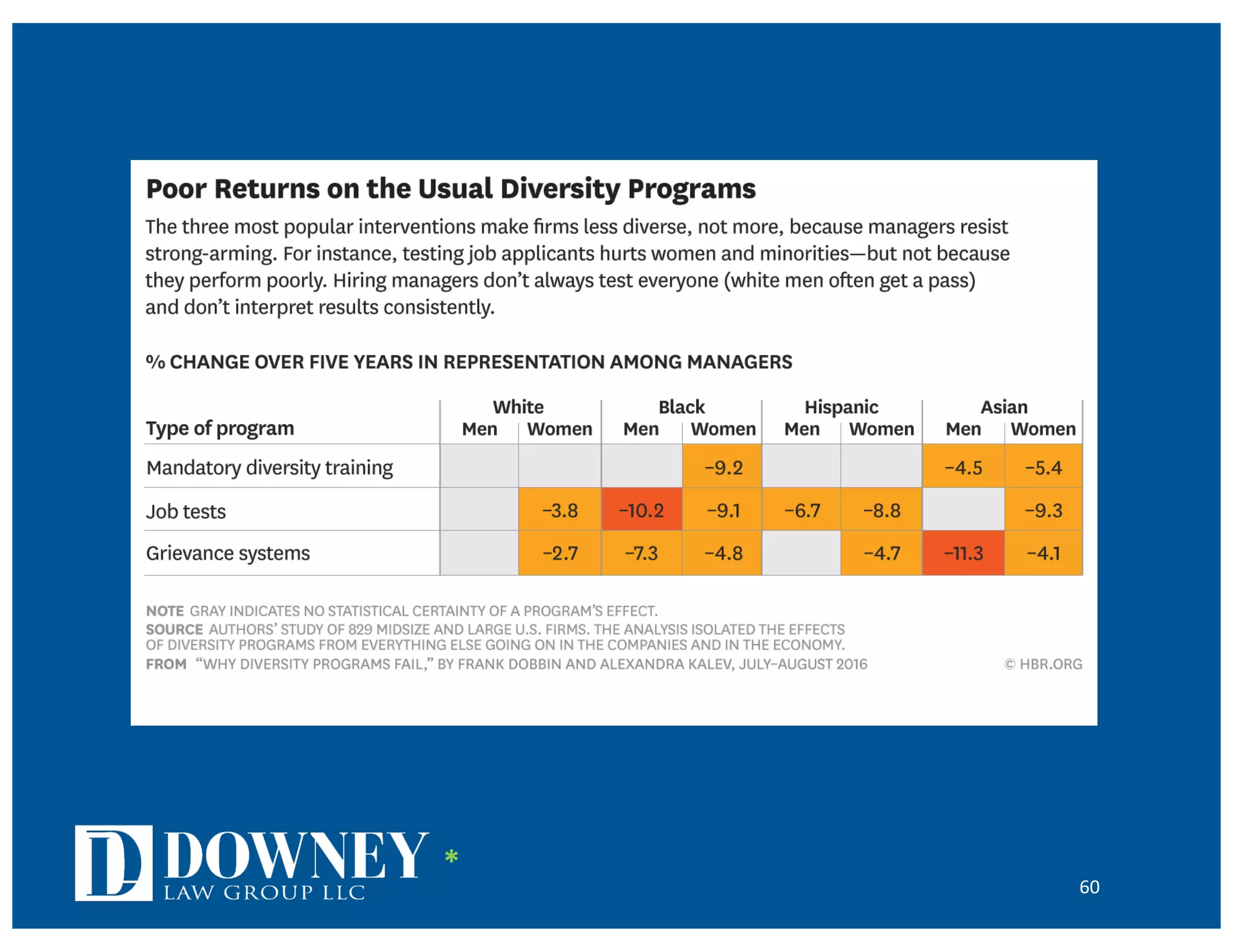
    60 Page 4 of22https://hbr.org/2016/07/why-diversity-programs-fail training rarely last beyond a day or two, and a number of studies suggest that it can activate bias or spark a backlash. Nonetheless, nearly half of midsize companies use it, as do nearly all the Fortune 500.  *
  • 61.
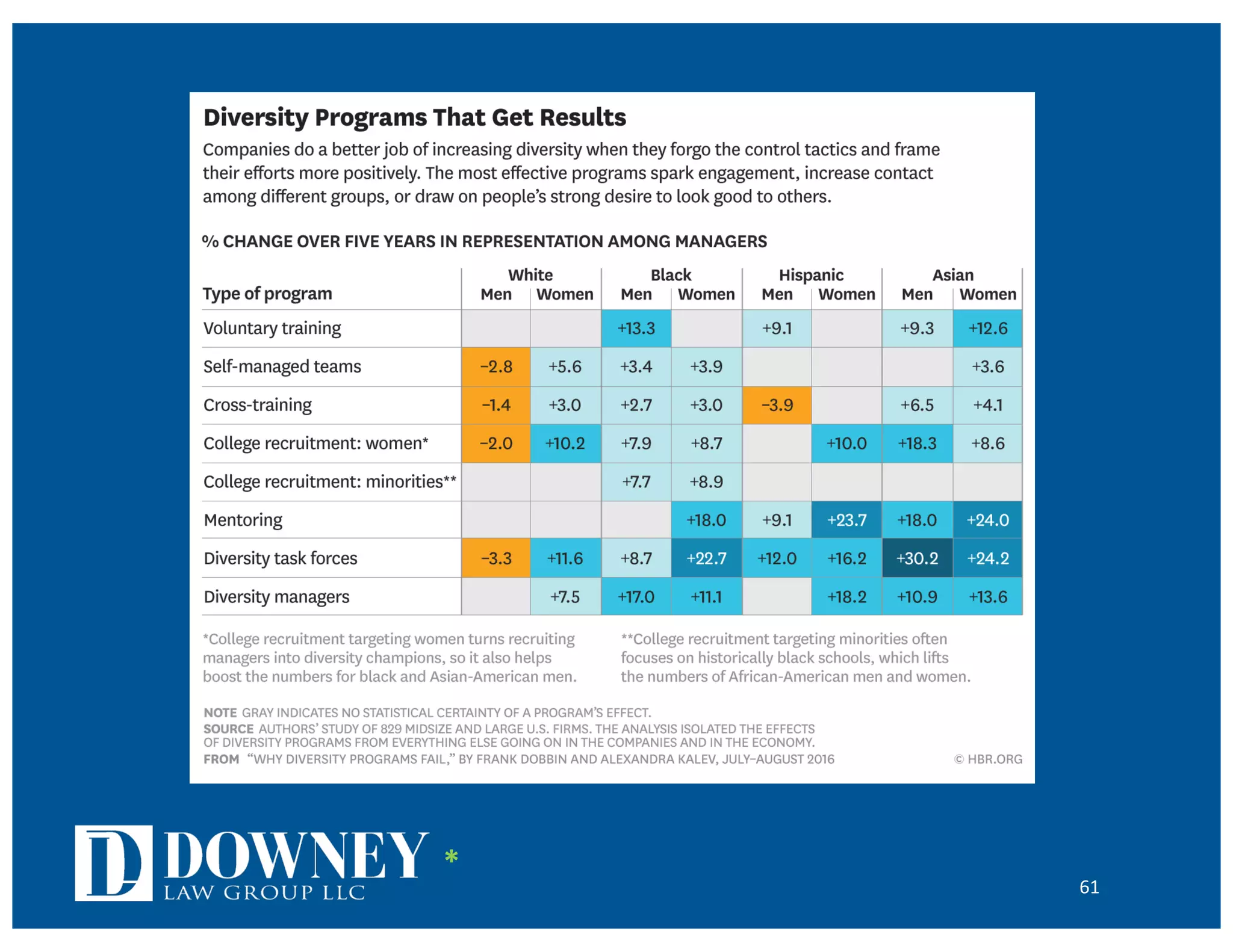
    61 1/12/20, 7:50 PMWhyDiversity Programs Fail Find this and other HBR graphics in our Visual Library Take college recruitment programs targeting women and minorities. Our interviews  *
  • 62.
    Top 10 Rulesfor Inclusion (NITA) 1. Respect people – because of who you are, not who they are 2. Be aware of your biases 3. Get honest about race 4. Support each other and be humble enough to accept corrections 5. Be a champion and invest in those whom bias excludes from success 62
  • 63.
    Top 10 Rulesfor Inclusion (NITA) 6. Get out of your silo and lean into spaces of discomfort 7. Listen to learn and do not deny someone else’s truth 8. Seek back-up for any assumption you hear others make 9. Socialize with co-workers whose identifies differ from your own 10. Be an “up-stander” not a “bystander” 63
  • 64.
    Additional Resources • Seekout resources regarding implicit bias/diversity – Scientific literature – Take an IAT test • Identify and consciously acknowledge differences – Appreciate group differences and multi-cultural viewpoints – Make egalitarianism the norm 64
  • 65.
    Downey Law GroupLLC (314) 961-6644 (844) 961-6644 toll free info@DowneyLawGroup.com Thank You