10	Ways	To	Work	Smarter,	Not	
Harder,	And	Be	Ethical
Michael	Downey
Downey	Law	Group	LLC
March	2017
13
Your	Firm
1.	Surround	yourself	with	good,
happy	people
• Law	practice	is	stressful
• Stressed	people	do	dumb	things
• Minimize	your	stress
• And	you	may	be	responsible	under	IL	RPC	5.1	
thru	5.3
3
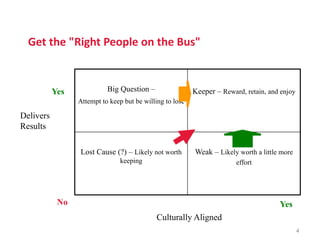
Get	the	"Right	People	on	the	Bus"
Big Question –
Attempt to keep but be willing to lose
Keeper – Reward, retain, and enjoy
Lost Cause (?) – Likely not worth
keeping
Weak – Likely worth a little more
effort
Delivers
Results
Culturally Aligned
Yes
YesNo
4
2.	Compensate	Fairly
• Money	(alone)	will	not	motivate	the	best	employees
• Need	fair	compensation
– External
– Internal
• Assess	what	else	makes	employees	tick
– Cause
– Work	to	live
– Interesting/exciting	work
5
Motivation	– Daniel	Pink
• Autonomy	– urge	to	direct	own	life
• Mastery	– desire	to	get	better	and	better	at	
something	that	matters
• Purpose	– Yearning	to	do	what	we	do	in	the	
service	of	something	larger	than	ourselves
• http://www.yesware.com/blog/daniel-pink-on-sales-motivation-and-compensation/
6
3.	Use	Employment	Agreements
• Four	things	for	all	lawyer	employment	agreements
1. Sharing	of	fees	– or	that	fees	are	not	shared
2. Confidentiality	provisions
3. Notice	upon	departure	
4. Return	of	firm	property
• Omit	the	non-compete	for	lawyers	– it	likely	violates	
Rule	5.6(a)
7
Hess	v. Bresney (7th Cir. 2015)
• Hess	was	terminated	from	K&A
• Hess sued	for	fees	for	cases	where	he	"did	all	
the	work"	before	his	termination
– Employment	agreement included	bonuses	based	
upon	fees	generated
• Potential ambiguity	– "generated"	versus	
"received"
8
4.	Consider	Some	Lawyer	Help
• Flexible	staffing	ethics
– "Contract	attorney"	– "in"	firm
• Imputation	of	conflicts
• Likely	no	limit	on	fee	sharing
– "Temporary	attorney"
• Notice	if	independent	or	fee	sharing
• Possible	imputation	of	conflicts	– segregation	from	firm
• Charge	as	expense	(with	any	surcharge	disclosed	to	client)	or	bill	
as	fees	(reasonableness	limitation)
9
Your	Practice
Whom	Do	You	Recommend?
A	teenage	relative	has	been	charged	with	a	
significant	crime.		Whom	would	you	
recommend?
A. Your	best	friend,	a	solo	lawyer	who	"does	everything"
B. A	friend	who	is	building	a	criminal	defense	practice,	
seems	very	competent,	and	has	tried	to	send	you	work
C. Star	criminal	defense	attorney	Michael	Tigar
Why?
• Familiarity
• Relationship
• Reciprocity
• Choosing	"good	enough" – people	don't	look	
to	make	the	superior	choice,	but	to	avoid	
making	a	bad	choice		
– Harry	Beckwith,	Marketing	the	Invisible
Why	Focus?
"Narrow	your	focus	to	broaden	your	appeal."
Harry	Beckwith,	Selling	the	Invisible
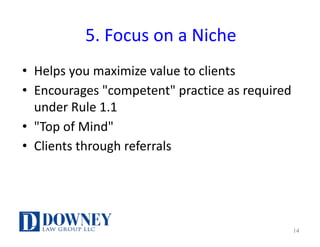
5.	Focus	on	a	Niche
• Helps	you	maximize	value	to	clients
• Encourages	"competent"	practice	as	required	
under	Rule	1.1
• "Top	of	Mind"
• Clients	through	referrals
14
15
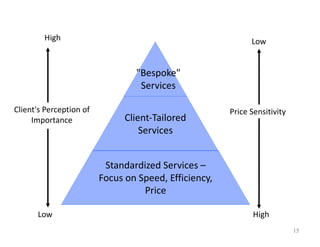
Client-Tailored	
Services
Standardized	Services	–
Focus	on	Speed,	Efficiency,	
Price
"Bespoke"	
Services
High
Low
Client's	Perception	of	
Importance
Low
High
Price	Sensitivity
15
16
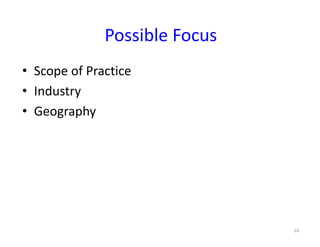
Possible	Focus
• Scope	of	Practice
• Industry
• Geography
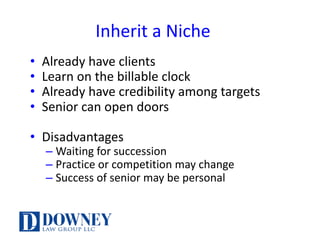
Inherit	a	Niche
• Already	have	clients
• Learn	on	the	billable	clock
• Already	have	credibility	among	targets
• Senior	can	open	doors
• Disadvantages
– Waiting	for	succession
– Practice	or	competition	may	change
– Success	of	senior	may	be	personal
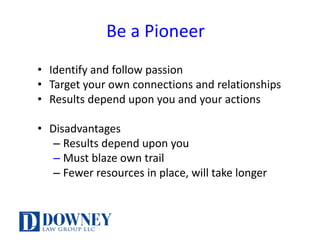
Be	a	Pioneer
• Identify	and	follow	passion
• Target	your	own	connections	and	relationships
• Results	depend	upon	you	and	your	actions
• Disadvantages
– Results	depend	upon	you	
– Must	blaze	own	trail
– Fewer	resources	in	place,	will	take	longer
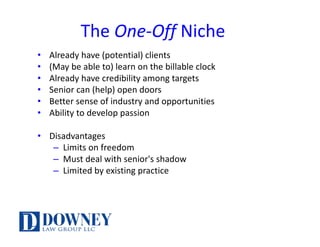
The	One-Off	Niche
• Already	have	(potential)	clients
• (May	be	able	to)	learn	on	the	billable	clock
• Already	have	credibility	among	targets
• Senior	can	(help)	open	doors
• Better	sense	of	industry	and	opportunities	
• Ability	to	develop	passion
• Disadvantages
– Limits	on	freedom
– Must	deal	with	senior's	shadow
– Limited	by	existing	practice
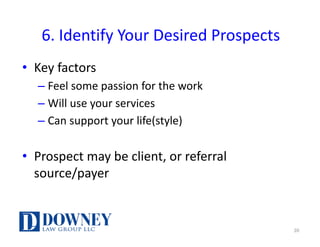
6.	Identify	Your	Desired	Prospects
• Key	factors
– Feel	some	passion	for	the	work
– Will	use	your	services
– Can	support	your	life(style)
• Prospect	may	be	client,	or	referral	
source/payer	
20
7.	Communicate	with	Targeted	Prospects
Decent,	competent	lawyers	with
solid	marketing	
Out-earn
great	lawyers	with	little	marketing
21
Prime	Limits	on	Marketing
22
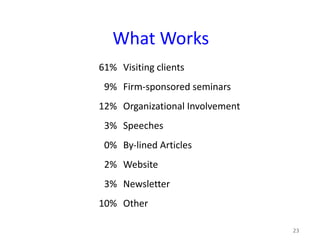
What	Works
61% Visiting	clients
9% Firm-sponsored	seminars
12% Organizational	Involvement
3% Speeches
0% By-lined	Articles
2% Website
3% Newsletter
10% Other
23
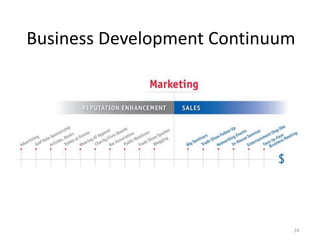
Business	Development	Continuum
24
25
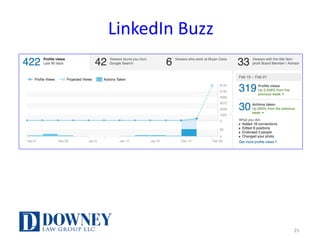
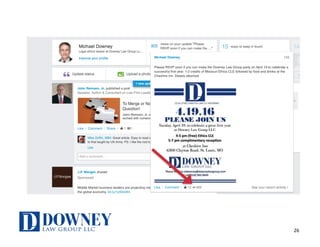
LinkedIn	Buzz
26
Ethics	Regulations	of	Solicitations
• Marketing	techniques	not	allowed
– In-person	or	real-time	solicitation	of	strangers
– Paying	others	to	refer	you	work	(but	pay-per-click	and	pay-
per-lead	are	probably	okay)
– Using	"runners"	or	sharing	fees	with	non-lawyers
– Illegal	activities
– Improper	claims	as	"specialist"	or	"expert"
27
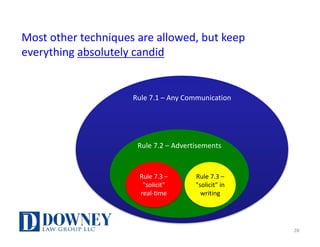
Most	other	techniques	are	allowed,	but	keep	
everything	absolutely	candid
28
Rule	7.1	– Any	Communication
Rule	7.2	– Advertisements
Rule	7.3	–
"solicit"
real-time
Rule	7.3	–
"solicit" in	
writing
8.	Screen	Your	Clients
29
Protections	from	Bad	Clients
• Establish	"warning	signs"
• Talk	about	matter	up	front	– what	are	the	
expectations
• Engagement	letters
• Retainers
• Beware	slow	payers	
• Beware	"shoppers"
30
Dealing	with	Dangerous	Clients
• EAR	Statements
– Empathy
– Attention
– Respect
• Ask	them	to	evaluate	alternative	courses	of	action
• Focus	on	future	not	past	conduct
• Consider	terminating	the	representation
31
Get	Paid
9.	Tell	Clients	What	It	Will	Cost
• Rule	1.5	comment	[2]
– [2]	When	the	lawyer	has	regularly	represented	a	client,	they	ordinarily	will	
have	evolved	an	understanding	concerning	the	basis	or	rate	of	the	fee	and	the	
expenses	for	which	the	client	will	be	responsible.	
– In	a	new	client-lawyer	relationship,	however,	an	understanding	as	to	fees	and	
expenses	must	be	promptly	established.
– Generally,	it	is	desirable	to	furnish	the	client	with	at	least	a	simple	
memorandum	or	copy	of	the	lawyer's	customary	fee	arrangements	that	states	
the	general	nature	of	the	legal	services	to	be	provided,	the	basis,	rate	or	total	
amount	of	the	fee,	and	whether	and	to	what	extent	the	client	will	be	
responsible	for	any	costs,	expenses	or	disbursements	in	the	course	of	the	
representation.	
– A	written	statement	concerning	the	terms	of	the	engagement	reduces	the	
possibility	of	misunderstanding.	
33
10.	Consider	“Retainers”
• “Retainers”	– needs	an	explanation
– How	much?
– Where	do	you	deposit	them?
• Where	should	a	lawyer	put	an	advanced	
payment	of	a	fixed	fee?
34
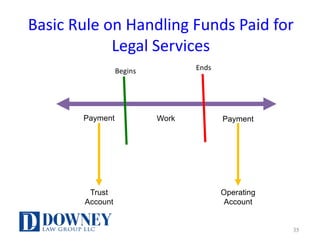
Basic	Rule	on	Handling	Funds	Paid	for	
Legal	Services
WorkPayment Payment
Trust
Account
Operating
Account
35
Begins Ends
"Tricky"	Transactions
• "True"	retainers
• Fixed	fees	paid	in	advance	– in	trust	or	not
• Funds	subject	to	dispute
• "Advance	payment"	retainers
36
Retainers	by	Credit	Card
• Where	do	fees	paid	in	advance	go?
– Majority	– Trust	account	(must	track	bank	fees)
– Minority	– Operating	account
• Consider	lawyer-specific	credit	card	service
– Advance	payments	can	go	to	trust account,	but	bank	
charges	and	chargebacks	come	from	operating account
37
11. Consider	Alternative	Fees
• Time-based	(Hourly)
• Contingency
• Fixed	or	flat
• Asset-based
• "Value"
38
39
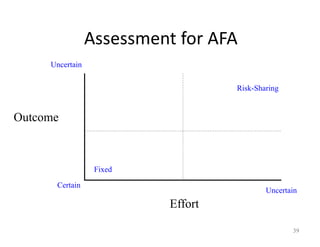
Assessment	for	AFA
Outcome
Effort
Certain
Uncertain
Uncertain
Fixed
Risk-Sharing
12.	Terminate	Problem	Clients
• Rule	1.16(a)	requires termination	when	a	
representation	is	illegal,	unethical,	against	client's	
will
• Rule	1.16(b)	permits termination	when	there	is	
"good	cause"	or	the	termination	can	occur	without	
causing	the	client	"undue	prejudice"
40
Mandatory	Withdrawal	– Rule	1.16
• Except	as	stated	in	paragraph	(c),	a	lawyer	shall	not	
represent	a	client	or,	where	representation	has	
commenced,	shall	withdraw	from	the	representation	of	
a	client	if:
(1) the	representation	will	result	in	violation	of	the	Rules	of	
Professional	Conduct	or	other	law;
(2) the	lawyer's	physical	or	mental	condition	materially	
impairs	the	lawyer's	ability	to	represent	the	client;	or
(3) the	lawyer	is	discharged.
•
41
Permissive	Withdrawal	– Rule	1.16(b)
• Except	as	stated	in	paragraph	(c),	a	lawyer	may	withdraw	from	representing	a	
client	if:
(1) withdrawal	can	be	accomplished	without	material	adverse	effect	on	the	interests	of	the	
client;
(2) the	client	persists	in	a	course	of	action	involving	the	lawyer's	services	that	the	lawyer	
reasonably	believes	is	criminal	or	fraudulent;
(3) the	client	has	used	the	lawyer's	services	to	perpetrate	a	crime	or	fraud;
(4) the	client	insists	upon	taking	action	that	the	lawyer	considers	repugnant	or	with	which	the	
lawyer	has	a	fundamental	disagreement;
(5) the	client	fails	substantially	to	fulfill	an	obligation	to	the	lawyer	regarding	the	lawyer's	
services	and	has	been	given	reasonable	warning	that	the	lawyer	will	withdraw	unless	the	
obligation	is	fulfilled;
(6) the	representation	will	result	in	an	unreasonable	financial	burden	on	the	lawyer	or	has	
been	rendered	unreasonably	difficult	by	the	client;	or
(7) other	good	cause	for	withdrawal	exists.
42
Court	Approval	– Rule	1.16(c)
• A	lawyer	must	comply	with	applicable	law	requiring	
notice	to	or	permission	of	a	tribunal	when	
terminating	a	representation.	When	ordered	to	do	so	
by	a	tribunal,	a	lawyer	shall	continue	representation	
notwithstanding	good	cause	for	terminating	the	
representation.
43
Protecting	Client's	Interests	– Rule	1.16(d)
• Upon	termination	of	representation,	a	lawyer	shall	take	steps	
to	the	extent	reasonably	practicable	to	protect	a	client's	
interests,	such	as	
– giving	reasonable	notice	to	the	client,	
– allowing	time	for	employment	of	other	counsel,	
– surrendering	papers	and	property	to	which	the	client	is	entitled	and	
– refunding	any	advance	payment	of	fee	or	expense	that	has	not	been	
earned	or	incurred.	
• The	lawyer	may	retain	papers	relating	to	the	client	to	the	
extent	permitted	by	other	law.
44
13.	Don't	Let	Your	Client's	Problem	
Become	YOUR	Problem
• Would	you	surrender	your	license	for	a	client?
45
Michael	Downey
Downey	Law	Group	LLC
(314)	961-6644
(844)	961-6644	toll	free
mdowney@DowneyLawGroup.com	
Thank	You
47

ABA Litigation - Ethics Presentation