Career Search
Strategies in Business
•Instructor:
• Anita Galiano – CohnReznick
• Sr. Campus Recruiting Specialist
• Email: anitagln@umd.edu
•TA:
• Andrea Campos
• Finance
• Email: andrea22@terpmail.umd.edu
Attendance
Assignments
March 12th
 Resume & Cover Letter Revision (5 pm)
 Submit original and updated documents along with reviewer
comments
 Carefully read and follow each assignment’s rubric to avoid losing
points
Announcements
• Smith’s Councils application: LINK
• Smith Undergraduate Research Experience
Application: LINK
• Snider Enterprise and Leadership Fellows
(SELF) Experience: LINK
• Professor Updates
Guest speaker
Diversity Equity Inclusion and
Belonging in the Workplace
Carol Rowland
Senior Operations Manager at CohnReznick LLP, Tysons, VA
What is diversity?
What is diversity?
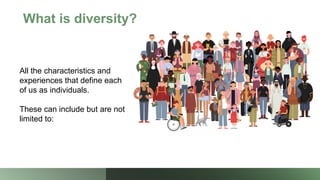
All the characteristics and
experiences that define each
of us as individuals.
These can include but are not
limited to:
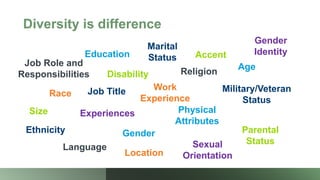
Diversity is difference
Age
Race
Experiences
Location
Gender
Religion
Sexual
Orientation
Physical
Attributes
Education
Job Title
Disability
Size
Marital
Status
Language
Accent
Ethnicity
Work
Experience
Parental
Status
Military/Veteran
Status
Job Role and
Responsibilities
Gender
Identity
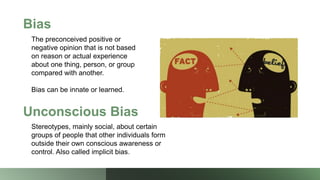
Bias
The preconceived positive or
negative opinion that is not based
on reason or actual experience
about one thing, person, or group
compared with another.
Bias can be innate or learned.
Unconscious Bias
Stereotypes, mainly social, about certain
groups of people that other individuals form
outside their own conscious awareness or
control. Also called implicit bias.
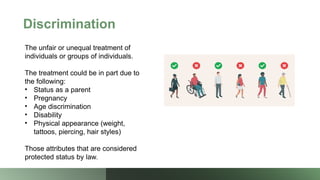
Discrimination
The unfair or unequal treatment of
individuals or groups of individuals.
The treatment could be in part due to
the following:
• Status as a parent
• Pregnancy
• Age discrimination
• Disability
• Physical appearance (weight,
tattoos, piercing, hair styles)
Those attributes that are considered
protected status by law.
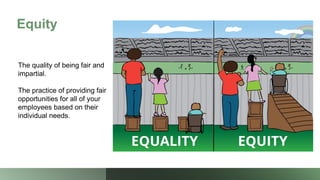
Equity
The quality of being fair and
impartial.
The practice of providing fair
opportunities for all of your
employees based on their
individual needs.
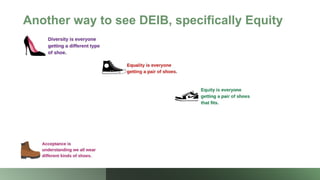
Another way to see DEIB, specifically Equity
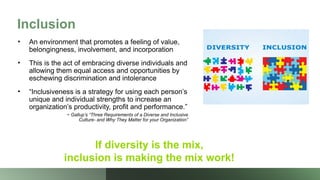
Inclusion
• An environment that promotes a feeling of value,
belongingness, involvement, and incorporation
• This is the act of embracing diverse individuals and
allowing them equal access and opportunities by
eschewing discrimination and intolerance
• “Inclusiveness is a strategy for using each person’s
unique and individual strengths to increase an
organization’s productivity, profit and performance.”
~ Gallup’s “Three Requirements of a Diverse and Inclusive
Culture- and Why They Matter for your Organization”
If diversity is the mix,
inclusion is making the mix work!
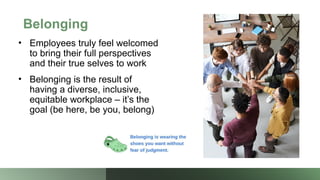
Belonging
• Employees truly feel welcomed
to bring their full perspectives
and their true selves to work
• Belonging is the result of
having a diverse, inclusive,
equitable workplace – it’s the
goal (be here, be you, belong)
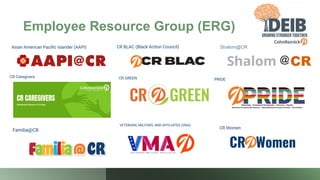
Employee Resource Group (ERG)
Shalom@CR
Shalom CR
@
The case for diversity
Workplaces should value diversity because it is good for business, and good for
employees.
A diverse workforce can bring new and innovative perspectives that give companies
a strategic, competitive advantage. Fostering diversity can help to attract and retain
new talent.
Having people on your team with a variety of experiences, knowledge, cultural
backgrounds, and wide-ranging thoughts and ideas can be an asset
“In addition, it is the right thing to do. A diverse workforce is not only fair, it should be
consistent with the broader values and culture of the organization.” The commitment
to diversity can help to create a workplace where equity is commonplace.
-Quote Source: Catalyst
The case for diversity
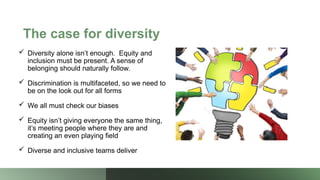
 Diversity alone isn’t enough. Equity and
inclusion must be present. A sense of
belonging should naturally follow.
 Discrimination is multifaceted, so we need to
be on the look out for all forms
 We all must check our biases
 Equity isn’t giving everyone the same thing,
it’s meeting people where they are and
creating an even playing field
 Diverse and inclusive teams deliver
Further Reading/Action Items
 The Mix That Matters-Innovation Through Diversity – BCG.com
 How Individuals Can Challenge Implicit Bias: Infographic – Catalyst.com
 Implicit Association Test – implicit.Harvard.edu/implicit/taketest.html
(the test itself, disclaimer before proceeding with the test, also contact
information for questions about the test)
Quiz
QR Code: Equity

DEIB in the workplace - Spring 2024v3.pptx

  • 1.
    Career Search Strategies inBusiness •Instructor: • Anita Galiano – CohnReznick • Sr. Campus Recruiting Specialist • Email: anitagln@umd.edu •TA: • Andrea Campos • Finance • Email: andrea22@terpmail.umd.edu
  • 2.
  • 3.
    Assignments March 12th  Resume& Cover Letter Revision (5 pm)  Submit original and updated documents along with reviewer comments  Carefully read and follow each assignment’s rubric to avoid losing points
  • 4.
    Announcements • Smith’s Councilsapplication: LINK • Smith Undergraduate Research Experience Application: LINK • Snider Enterprise and Leadership Fellows (SELF) Experience: LINK • Professor Updates
  • 5.
    Guest speaker Diversity EquityInclusion and Belonging in the Workplace Carol Rowland Senior Operations Manager at CohnReznick LLP, Tysons, VA
  • 6.
  • 7.
    What is diversity? Allthe characteristics and experiences that define each of us as individuals. These can include but are not limited to:
  • 8.
    Diversity is difference Age Race Experiences Location Gender Religion Sexual Orientation Physical Attributes Education JobTitle Disability Size Marital Status Language Accent Ethnicity Work Experience Parental Status Military/Veteran Status Job Role and Responsibilities Gender Identity
  • 9.
    Bias The preconceived positiveor negative opinion that is not based on reason or actual experience about one thing, person, or group compared with another. Bias can be innate or learned. Unconscious Bias Stereotypes, mainly social, about certain groups of people that other individuals form outside their own conscious awareness or control. Also called implicit bias.
  • 10.
    Discrimination The unfair orunequal treatment of individuals or groups of individuals. The treatment could be in part due to the following: • Status as a parent • Pregnancy • Age discrimination • Disability • Physical appearance (weight, tattoos, piercing, hair styles) Those attributes that are considered protected status by law.
  • 11.
    Equity The quality ofbeing fair and impartial. The practice of providing fair opportunities for all of your employees based on their individual needs.
  • 12.
    Another way tosee DEIB, specifically Equity
  • 13.
    Inclusion • An environmentthat promotes a feeling of value, belongingness, involvement, and incorporation • This is the act of embracing diverse individuals and allowing them equal access and opportunities by eschewing discrimination and intolerance • “Inclusiveness is a strategy for using each person’s unique and individual strengths to increase an organization’s productivity, profit and performance.” ~ Gallup’s “Three Requirements of a Diverse and Inclusive Culture- and Why They Matter for your Organization” If diversity is the mix, inclusion is making the mix work!
  • 14.
    Belonging • Employees trulyfeel welcomed to bring their full perspectives and their true selves to work • Belonging is the result of having a diverse, inclusive, equitable workplace – it’s the goal (be here, be you, belong)
  • 15.
    Employee Resource Group(ERG) Shalom@CR Shalom CR @
  • 17.
    The case fordiversity Workplaces should value diversity because it is good for business, and good for employees. A diverse workforce can bring new and innovative perspectives that give companies a strategic, competitive advantage. Fostering diversity can help to attract and retain new talent. Having people on your team with a variety of experiences, knowledge, cultural backgrounds, and wide-ranging thoughts and ideas can be an asset “In addition, it is the right thing to do. A diverse workforce is not only fair, it should be consistent with the broader values and culture of the organization.” The commitment to diversity can help to create a workplace where equity is commonplace. -Quote Source: Catalyst
  • 18.
    The case fordiversity  Diversity alone isn’t enough. Equity and inclusion must be present. A sense of belonging should naturally follow.  Discrimination is multifaceted, so we need to be on the look out for all forms  We all must check our biases  Equity isn’t giving everyone the same thing, it’s meeting people where they are and creating an even playing field  Diverse and inclusive teams deliver
  • 19.
    Further Reading/Action Items The Mix That Matters-Innovation Through Diversity – BCG.com  How Individuals Can Challenge Implicit Bias: Infographic – Catalyst.com  Implicit Association Test – implicit.Harvard.edu/implicit/taketest.html (the test itself, disclaimer before proceeding with the test, also contact information for questions about the test)
  • 20.

Editor's Notes

  • #1 Anita Kicks-off class – welcomes everyone Intro/Why I’m here Office hours Andrea Intro/Why I’m here/Experience with the class
  • #5 A little about myself, I manage the operations for CohnReznick’s Tysons, Virginia office and for part of its Global Consulting Services group. Prior to CohnReznick I worked for the federal government. While high school, I had after school and summer jobs with the Dept. of Defense; I took some college courses at NOVA while in high school. I worked at the Department of Energy while continuing my education in business administration. One of my colleagues at Energy left to work for CohnReznick (formerly Reznick Fedder & Silverman), and I subsequently joined her there. I have had opportunities to work my way up from an entry level administrative position to management. Full disclosure, DEI is not my area of expertise, but I can speak to my experiences and perspective.
  • #6 Promise that this is the only call and response question. Ask the audience what they think diversity is (what does diversity mean to you, what do you think of when you hear or see the term?)
  • #8 These are the mixture of attributes that make each person unique. All together it’s what we offer to the world, to society, in our workplaces, and classrooms, and within our homes. Diversity in the workplace should mean that companies hire, promote, and include people with diverse characteristics, worldviews, job functions and experiences. Diversity comes in many forms and intersectionality of these attributes should also be taken into account in the workplace. Having a lot of different people in the workplace is great, but we all come with different perspectives and outlooks, which can include bias. Because we come from different backgrounds, we need to be cognizant of how we interact with others.
  • #9 We all have bias in one form or another. To help overcome and check bias, we can take steps to become familiar with different types of bias (ageism, gender, beauty or weight bias, as well as racism, colorism, bias against the LGBTQ+ community and even further learning how these play out in the workplace). Taking the time for self-reflection, questioning your own assumptions, and stopping to consider the opposite before making assumptions are ways we can recognize our own biases. Harvard Implicit Association Test (IAT) – It is a tool that measures attitudes and beliefs about different topics. The IAT may show that you have an implicit attitude that you did not know about, in turn, allowing you to check your biases.
  • #10 In the workplace, from a business standpoint, it is vital that our biases do not lead us to unlawful actions, like discrimination. (Review slide) As business students, it is important to understand risk mitigation. In everything you do, you want to protect your company. At CR, like other companies, we all must undergo mandatory annual training on computer safety, bias, discrimination, harassment, and HIPAA. (hipaa-health insurance portability and accountability act, federal law protecting individual health information.
  • #11 The left side of the infographic represents equality, where each person has the same sized box to view the game. The right side represents equity where each person has the tools necessary to have a fair vantage point. Equality treats everyone the same, which assumes everyone starts out the same. Equity is working toward fair outcomes for people or groups by treating them in ways that address their unique barrier or advantages. Equity involves meeting employees where they are, and ensuring that they have resources to do their jobs well
  • #12 Diversity is everyone getting a different type of shoe because we are individuals and have different needs. Equality assumes that we are all in the same place or starting out in the same place, so all we need is a pair of shoes Equity, you get a pair of shoes that fit you, that you can walk comfortably in; equity again is about working toward fair outcomes Belonging is wearing the shoes that not only fit your feet, but fit your personality, and can be worn without fear of judgment Professor Galiano would not recommend wearing Crocs to work, but hopefully you get the analogy 
  • #13 Inclusion filters through everything we do. An inclusive workplace welcomes employees with all sorts of differences, makes them feel comfortable, is collaborative, and supportive. For example at CohnReznick, when engagement teams, speaking panels, and networking event representatives, even campus recruiting teams are being put together, leadership tries to ensure that unique and diverse thoughts, and inclusive ideas are represented. Ensuring that inclusive ideas permeate throughout the company. We have the mix, the ingredients or pieces needed for a complete picture. When we put forth the effort to include all the pieces, the puzzles comes together to make a complete picture. I have also heard the analogy of diversity being asked to the dance, and inclusion as being asked to dance
  • #14 When you have a diverse, equitable, and inclusive workplace, everyone should feel like they belong, the should be a sense of belonging in the workplace. A company’s employees should be able to be their true, authentic selves to the workplace and feel like they belong regardless of backgrounds, personal traits, or any of those attributes that makes them unique. The ultimate goal is for employees to feel valued and empowered in the workplace.
  • #15 From creating an environment based on DEIB, Employee Resource Groups have been developed at CohnReznickprint . These are the ERGs or employee resource groups that have formed (SO FAR) at CohnReznick, most of them organically. The groups are diverse in that they are comprised of marginalized, protected classes, common interests or societal needs. Anyone can join the ERG of their choosing to learn more or help carry out that group’s mission, a form of allyship. (When explaining each group not the public accounting world had been historically dominated by men). Allyship – Anita - Allyship refers to the actions, behaviors, and practices that leaders take to support, amplify, and advocate with others, especially with individuals who don't belong to the same social identity groups as themselves These groups also serve as safe spaces for individual members, as well as a means of teaching and learning for others. Events are sponsored by the ERGs throughout the year, particularly highlighting cultural observances such as AAPI History Month, Pride observances, Juneteenth, Women’s History Month, Veterans Day, Earth Day, and more.
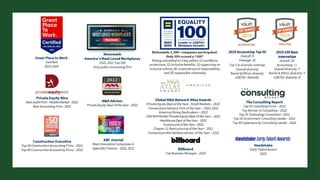
  • #16 CohnReznick – recognition of its efforts from a diversity standpoint. Job search options - Anita
  • #17 CohnReznick’s efforts toward achieving an equitable, diverse and inclusive workforce has led to recognition from organizations.
  • #18 In summary