Legal Ethics for a Changing
Profession
Michael Downey
Downey Law Group LLC
September 2017
SlideShare.net/DowneyLawGroupLLC
2
3
Changing Nature of Firms
4
5
6
7
8
9
10
Marketing and Funding
for Firms
11
12
13
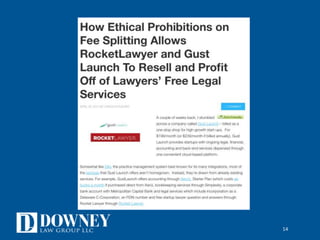
14
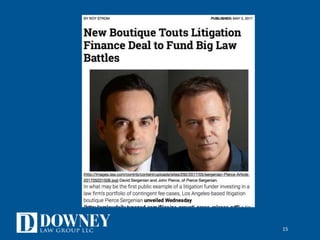
15
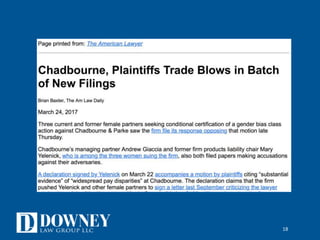
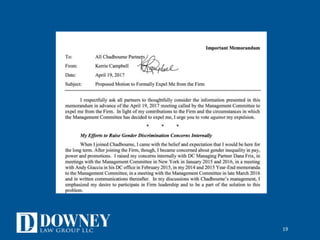
Gender and Diversity Issues
16
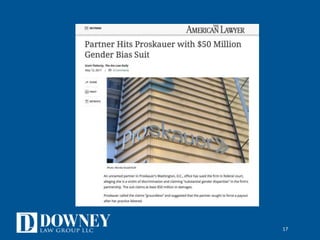
17
18
19
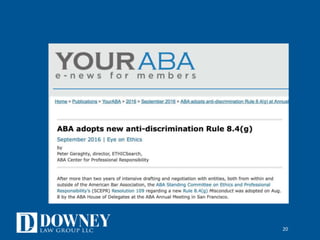
20
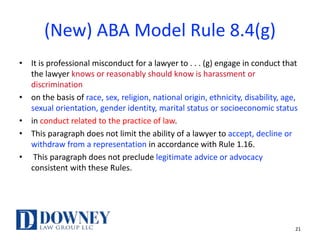
(New) ABA Model Rule 8.4(g)
• It is professional misconduct for a lawyer to . . . (g) engage in conduct that
the lawyer knows or reasonably should know is harassment or
discrimination
• on the basis of race, sex, religion, national origin, ethnicity, disability, age,
sexual orientation, gender identity, marital status or socioeconomic status
• in conduct related to the practice of law.
• This paragraph does not limit the ability of a lawyer to accept, decline or
withdraw from a representation in accordance with Rule 1.16.
• This paragraph does not preclude legitimate advice or advocacy
consistent with these Rules.
21
Lawyer as Gatekeeper
22
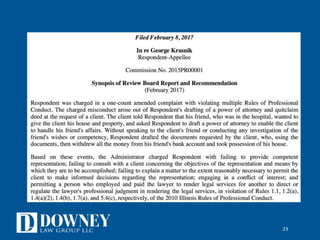
23
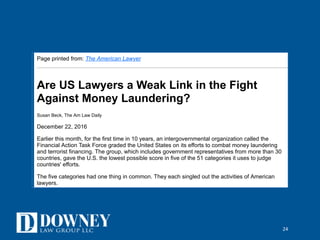
24
12/27/16, 3)12 PMAre US Lawyers a Weak Link in the Fight Against Money Laundering | The American Lawyer
NOT FOR REPRINT
Click to Print or Select 'Print' in your browser menu to print this document.
Page printed from: The American Lawyer
Are US Lawyers a Weak Link in the Fight
Against Money Laundering?
Susan Beck, The Am Law Daily
December 22, 2016
Earlier this month, for the first time in 10 years, an intergovernmental organization called the
Financial Action Task Force graded the United States on its efforts to combat money laundering
and terrorist financing. The group, which includes government representatives from more than 30
countries, gave the U.S. the lowest possible score in five of the 51 categories it uses to judge
countries' efforts.
The five categories had one thing in common. They each singled out the activities of American
lawyers.
This isn't surprising. Going back to 2002, when Congress floated new rules to identify money
laundering in the wake of the Sept. 11 attacks, the American Bar Association has staunchly
opposed any federal legislation that would require lawyers to help identify money laundering or
terrorist financing. Banks and other financial institutions must comply with the Bank Secrecy Act,
which imposes stringent "know your customer" rules and requires that suspicious transaction be
reported to federal authorities.
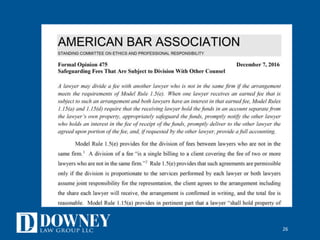
25
Search Here...
March-April 2017 Journal of The Missouri Bar Home Page (/journal/marapr2017/)
The Ethics of Client Trust Accounts: Fr equently Asked QuestionsThe Ethics of Client Trust Accounts: Fr equently Asked Questions
by Melinda J. Bentley[1]
Some of the most frequently asked questions of the Legal Ethics Counsel office focus on how to comply with ethical
obligations related to handling client trust accounts. Lawyers are often wary of making a misstep with their client
trust accounts, but by instituting sound accounting practices within their offices in accordance with Rules 4-1.145 –
4-1.155, lawyers should be able to readily comply with their safekeeping obligations. To assist lawyers with meeting
these obligations, this article will provide answers to some of the most frequently asked ethics questions.
Q: How do I find out if m y financial institutionQ: How do I find out if m y financial institution is appr oved to hold client trust accounts?is appr oved to hold client trust accounts?
A: There are two steps by which financial institutions may be approved to hold client trust accounts. First, the
financial institution must be deemed “eligible” by the Missouri Lawyer Trust Account Foundation in accordance with
the requirements of Rule 4-1.145.[2] Second, the financial institution must be “approved” by the Advisory
Committee pursuant to the regulation it has adopted, which includes overdraft reporting to the Office of Chief
Disciplinary Counsel.[3] To find out if a financial institution is approved to hold client trust accounts, you may view
the list published at www.Mo-Legal-Ethics.org (http://www.Mo-Legal-Ethics.org).
Q: What do I do when I r eceive a paym ent thr oughQ: What do I do when I r eceive a paym ent thr ough an instrum ent that contains both earned feesan instrum ent that contains both earned fees
and advance paym ent of fees andand advance paym ent of fees and expenses?expenses?
A: Rule 4-1.15(a)(4) requires that receipts be deposited intact, so you cannot make a split deposit.[4] The proper
way to handle this situation is to deposit the full amount into the trust account. Once the funds have become
“good funds,” meaning the funds have actually been collected by the financial institution in which the trust account
Governance/Bylaws/MoBar%20Bylaws.pdf)
ectory/The_Missouri_Bar_Staff.htm)
26
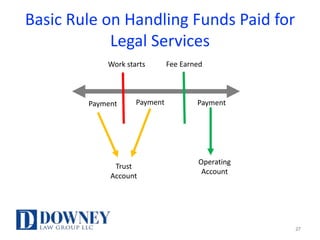
Basic Rule on Handling Funds Paid for
Legal Services
27
PaymentPayment Payment
Trust
Account
Operating
Account
Fee EarnedWork starts
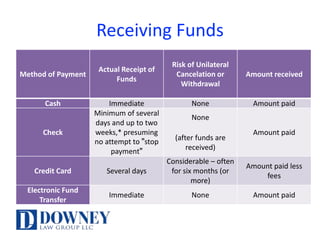
Receiving Funds
Method of Payment
Actual Receipt of
Funds
Risk of Unilateral
Cancelation or
Withdrawal
Amount received
Cash Immediate None Amount paid
Check
Minimum of several
days and up to two
weeks,* presuming
no attempt to "stop
payment"
None
(after funds are
received)
Amount paid
Credit Card Several days
Considerable – often
for six months (or
more)
Amount paid less
fees
Electronic Fund
Transfer
Immediate None Amount paid
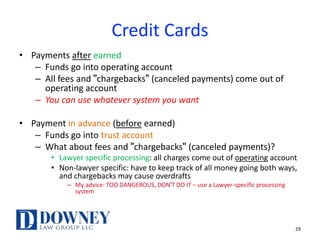
Credit Cards
• Payments after earned
– Funds go into operating account
– All fees and "chargebacks" (canceled payments) come out of
operating account
– You can use whatever system you want
• Payment in advance (before earned)
– Funds go into trust account
– What about fees and "chargebacks" (canceled payments)?
• Lawyer specific processing: all charges come out of operating account
• Non-lawyer specific: have to keep track of all money going both ways,
and chargebacks may cause overdrafts
– My advice: TOO DANGEROUS, DON'T DO IT – use a Lawyer-specific processing
system
29
Storing Client Information
30
31
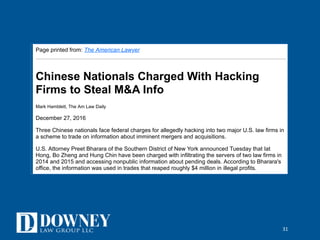
1/8/17, 9(45 PMChinese Nationals Charged With Hacking Firms to Steal M A Info | The American Lawyer
NOT FOR REPRINT
Click to Print or Select 'Print' in your browser menu to print this document.
Page printed from: The American Lawyer
Chinese Nationals Charged With Hacking
Firms to Steal M&A Info
Mark Hamblett, The Am Law Daily
December 27, 2016
Three Chinese nationals face federal charges for allegedly hacking into two major U.S. law firms in
a scheme to trade on information about imminent mergers and acquisitions.
U.S. Attorney Preet Bharara of the Southern District of New York announced Tuesday that Iat
Hong, Bo Zheng and Hung Chin have been charged with infiltrating the servers of two law firms in
2014 and 2015 and accessing nonpublic information about pending deals. According to Bharara's
office, the information was used in trades that reaped roughly $4 million in illegal profits.
The indictment unsealed Tuesday does not name the law firms, which are referred to as Law Firm
1 and Law Firm 2. According to the charges, Law Firm 1 advised Intel Corp. on its 2015 acquisition
of Altera Corp. for $16.7 billion and represented a company that was in deal talks with InterMune
Inc., which sold to Roche AG in 2014 for $8.9 billion.
The second major law firm advised Pitney Bowes Inc. in the 2015 acquisition of New York-based e-
commerce company Borderfree, the indictment states.
Based on those details the two firms appear to be Weil, Gotshal & Manges and Cravath, Swaine &
Moore, firms where cyberbreaches previously were reported. Weil represented Intel in the Altera
32
33
34
35
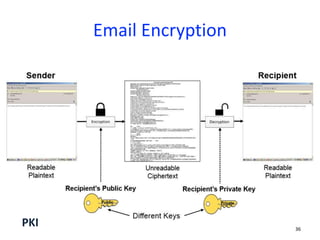
PrivatePublic
36
PKI
Email Encryption
37
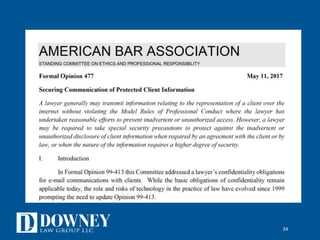
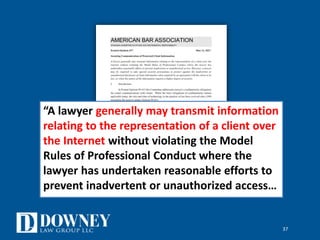
“A lawyer generally may transmit information
relating to the representation of a client over
the Internet without violating the Model
Rules of Professional Conduct where the
lawyer has undertaken reasonable efforts to
prevent inadvertent or unauthorized access…
Multijurisdictional Practice
38
39
40
Regulation Shifts to Proactive
41
42
Michael Downey
Downey Law Group LLC
(314) 961-6644
(844) 961-6644 toll free
mdowney@DowneyLawGroup.com
Thank You

Legal Ethics for a Changing Profession

  • 1.
    Legal Ethics fora Changing Profession Michael Downey Downey Law Group LLC September 2017
  • 2.
  • 3.
  • 4.
  • 5.
  • 6.
  • 7.
  • 8.
  • 9.
  • 10.
  • 11.
  • 12.
  • 13.
  • 14.
  • 15.
  • 16.
  • 17.
  • 18.
  • 19.
  • 20.
  • 21.
    (New) ABA ModelRule 8.4(g) • It is professional misconduct for a lawyer to . . . (g) engage in conduct that the lawyer knows or reasonably should know is harassment or discrimination • on the basis of race, sex, religion, national origin, ethnicity, disability, age, sexual orientation, gender identity, marital status or socioeconomic status • in conduct related to the practice of law. • This paragraph does not limit the ability of a lawyer to accept, decline or withdraw from a representation in accordance with Rule 1.16. • This paragraph does not preclude legitimate advice or advocacy consistent with these Rules. 21
  • 22.
  • 23.
  • 24.
    24 12/27/16, 3)12 PMAreUS Lawyers a Weak Link in the Fight Against Money Laundering | The American Lawyer NOT FOR REPRINT Click to Print or Select 'Print' in your browser menu to print this document. Page printed from: The American Lawyer Are US Lawyers a Weak Link in the Fight Against Money Laundering? Susan Beck, The Am Law Daily December 22, 2016 Earlier this month, for the first time in 10 years, an intergovernmental organization called the Financial Action Task Force graded the United States on its efforts to combat money laundering and terrorist financing. The group, which includes government representatives from more than 30 countries, gave the U.S. the lowest possible score in five of the 51 categories it uses to judge countries' efforts. The five categories had one thing in common. They each singled out the activities of American lawyers. This isn't surprising. Going back to 2002, when Congress floated new rules to identify money laundering in the wake of the Sept. 11 attacks, the American Bar Association has staunchly opposed any federal legislation that would require lawyers to help identify money laundering or terrorist financing. Banks and other financial institutions must comply with the Bank Secrecy Act, which imposes stringent "know your customer" rules and requires that suspicious transaction be reported to federal authorities.
  • 25.
    25 Search Here... March-April 2017Journal of The Missouri Bar Home Page (/journal/marapr2017/) The Ethics of Client Trust Accounts: Fr equently Asked QuestionsThe Ethics of Client Trust Accounts: Fr equently Asked Questions by Melinda J. Bentley[1] Some of the most frequently asked questions of the Legal Ethics Counsel office focus on how to comply with ethical obligations related to handling client trust accounts. Lawyers are often wary of making a misstep with their client trust accounts, but by instituting sound accounting practices within their offices in accordance with Rules 4-1.145 – 4-1.155, lawyers should be able to readily comply with their safekeeping obligations. To assist lawyers with meeting these obligations, this article will provide answers to some of the most frequently asked ethics questions. Q: How do I find out if m y financial institutionQ: How do I find out if m y financial institution is appr oved to hold client trust accounts?is appr oved to hold client trust accounts? A: There are two steps by which financial institutions may be approved to hold client trust accounts. First, the financial institution must be deemed “eligible” by the Missouri Lawyer Trust Account Foundation in accordance with the requirements of Rule 4-1.145.[2] Second, the financial institution must be “approved” by the Advisory Committee pursuant to the regulation it has adopted, which includes overdraft reporting to the Office of Chief Disciplinary Counsel.[3] To find out if a financial institution is approved to hold client trust accounts, you may view the list published at www.Mo-Legal-Ethics.org (http://www.Mo-Legal-Ethics.org). Q: What do I do when I r eceive a paym ent thr oughQ: What do I do when I r eceive a paym ent thr ough an instrum ent that contains both earned feesan instrum ent that contains both earned fees and advance paym ent of fees andand advance paym ent of fees and expenses?expenses? A: Rule 4-1.15(a)(4) requires that receipts be deposited intact, so you cannot make a split deposit.[4] The proper way to handle this situation is to deposit the full amount into the trust account. Once the funds have become “good funds,” meaning the funds have actually been collected by the financial institution in which the trust account Governance/Bylaws/MoBar%20Bylaws.pdf) ectory/The_Missouri_Bar_Staff.htm)
  • 26.
  • 27.
    Basic Rule onHandling Funds Paid for Legal Services 27 PaymentPayment Payment Trust Account Operating Account Fee EarnedWork starts
  • 28.
    Receiving Funds Method ofPayment Actual Receipt of Funds Risk of Unilateral Cancelation or Withdrawal Amount received Cash Immediate None Amount paid Check Minimum of several days and up to two weeks,* presuming no attempt to "stop payment" None (after funds are received) Amount paid Credit Card Several days Considerable – often for six months (or more) Amount paid less fees Electronic Fund Transfer Immediate None Amount paid
  • 29.
    Credit Cards • Paymentsafter earned – Funds go into operating account – All fees and "chargebacks" (canceled payments) come out of operating account – You can use whatever system you want • Payment in advance (before earned) – Funds go into trust account – What about fees and "chargebacks" (canceled payments)? • Lawyer specific processing: all charges come out of operating account • Non-lawyer specific: have to keep track of all money going both ways, and chargebacks may cause overdrafts – My advice: TOO DANGEROUS, DON'T DO IT – use a Lawyer-specific processing system 29
  • 30.
  • 31.
    31 1/8/17, 9(45 PMChineseNationals Charged With Hacking Firms to Steal M A Info | The American Lawyer NOT FOR REPRINT Click to Print or Select 'Print' in your browser menu to print this document. Page printed from: The American Lawyer Chinese Nationals Charged With Hacking Firms to Steal M&A Info Mark Hamblett, The Am Law Daily December 27, 2016 Three Chinese nationals face federal charges for allegedly hacking into two major U.S. law firms in a scheme to trade on information about imminent mergers and acquisitions. U.S. Attorney Preet Bharara of the Southern District of New York announced Tuesday that Iat Hong, Bo Zheng and Hung Chin have been charged with infiltrating the servers of two law firms in 2014 and 2015 and accessing nonpublic information about pending deals. According to Bharara's office, the information was used in trades that reaped roughly $4 million in illegal profits. The indictment unsealed Tuesday does not name the law firms, which are referred to as Law Firm 1 and Law Firm 2. According to the charges, Law Firm 1 advised Intel Corp. on its 2015 acquisition of Altera Corp. for $16.7 billion and represented a company that was in deal talks with InterMune Inc., which sold to Roche AG in 2014 for $8.9 billion. The second major law firm advised Pitney Bowes Inc. in the 2015 acquisition of New York-based e- commerce company Borderfree, the indictment states. Based on those details the two firms appear to be Weil, Gotshal & Manges and Cravath, Swaine & Moore, firms where cyberbreaches previously were reported. Weil represented Intel in the Altera
  • 32.
  • 33.
  • 34.
  • 35.
  • 36.
  • 37.
    37 “A lawyer generallymay transmit information relating to the representation of a client over the Internet without violating the Model Rules of Professional Conduct where the lawyer has undertaken reasonable efforts to prevent inadvertent or unauthorized access…
  • 38.
  • 39.
  • 40.
  • 41.
  • 42.
  • 43.
    Michael Downey Downey LawGroup LLC (314) 961-6644 (844) 961-6644 toll free mdowney@DowneyLawGroup.com Thank You