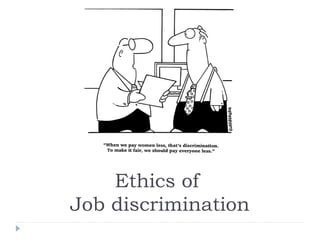



Ethics of
Job discrimination
 Discrimination – the wrongful act of distinguishing illicitly
among people not on the basis of individual merit, but on the
basis of prejudice or some other invidious or morally
reprehensible attitude.
 E.g. – employment discrimination in US-
religious groups – Jews & Catholics
ethnic groups – Italians, Poles & Irish
racial groups – Blacks & Asians
Forms of discrimination
 Isolated behavior (intentional)- male interviewer
preferring women candidates
 Routine behavior
 Isolated behavior (unintentional)- individual unthinkingly
adopts traditional practices & stereotypes
 Systematic routine of org to discriminate against women
or minorities
Extent of Discrimination
 Average Income Comparison
 Lowest Income Group Comparison
 Desirable Occupation Comparisons
 Discrimination in US –
(i) The income gap b/w Whites & minorities has not
decreased
(ii) Large inequalities based on sex exist
(iii) Black unemployment is more than twice as high as Whites
(iv) Minority poverty rate is 2-3 times of Whites
(v) Poverty rate of families headed by women is 3 times that of
male headed ones
(vi) Most higher-paying jobs go to white males
 Glass ceiling – an invisible, but impenetrable barrier to
further promotion sometimes encountered by women
or minorities
 Increasing problems for women & minorities –
(i) Women & minorities make up most new workers
(ii) Women are steered into low-paying jobs & face a glass
ceiling & sexual harassment
 Utilitarian arguments which claims that discrimination
leads to an inefficient use of human resources
 Rights arguments violates basic human rights
 Justice arguments which claims that discrimination results
in an unjust distribution of society’s benefits & burdens
Utility
 Discriminating job applicants on the basis of race, sex, or
other characteristics unrelated to job performance is
necessarily inefficient & contrary to utilitarian principles
 Objections encountered:
(i) The jobs shud be assigned on the basis of job related
qualifications only so long as such assignments will advance
the public welfare
(ii) Society as a whole may benefit from some forms of sexual
discrimination
Rights
 Discriminatory practices violate the principle in two
ways :
(i) Racial & sexual discrimination is based on stereotypes
that see minorities as “lazy” or “shiftless” & women as
“emotional” & “weak”.
(ii) Placing members at lower positions, lower salaries &
lower job opportunities
Justice
 Principle of equal opportunity – social & economic
inequalities are to be arranged so that they are attached
to offices & positions open to all under conditions of fair
equality of opportunity
Discriminating practices
 Recruitment practices – word of mouth referrals, only White
males, for MEN only
 Screening practices – disqualifying minority class who are
unfamiliar with the language, concepts & social situations in
the aptitude & intelligence tests
 Promotion practices
 Conditions of employment – less wages & salaries to women
& minorities, providing secretarial or clerical positions only,
less benefits
Sexual harassment
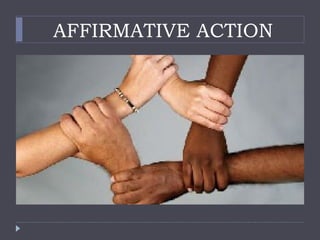
AFFIRMATIVE ACTION
Perspectives of Affirmative Actions
 Affirmative Action as Compensation :
 Based on concept of compensatory justice
 Criticism – compensation should come from specific
individuals who intentionally inflicted a wrong, and it
requires them to compensate only those specific
individuals whom they have wronged
 Affirmative Action as an Instrument for Achieving Social
Goals :
 Morally legitimate instruments to meet morally legitimate ends
 Promotion of public welfare
 Criticisms –
 Whether the social costs of affirmative action programs outweigh
their obvious benefits
 Identification of the needy
The basic end of affirmative programs is to seek
a more just society in which individuals are not
limited by his/her race or sex
Implementing Affirmative Action and
Managing Diversity
Comparable pay for jobs of
Comparable Worth
 Measuring the value of each job in an organization and
ensuring that jobs of equal value are paid same salary
 Each job is assigned a certain number of points for
difficulty, skill requirements, working conditions and any
other factors worthy of compensation
Job+discrimination

Job+discrimination

  • 1.
  • 2.
     Discrimination –the wrongful act of distinguishing illicitly among people not on the basis of individual merit, but on the basis of prejudice or some other invidious or morally reprehensible attitude.  E.g. – employment discrimination in US- religious groups – Jews & Catholics ethnic groups – Italians, Poles & Irish racial groups – Blacks & Asians
  • 3.
    Forms of discrimination Isolated behavior (intentional)- male interviewer preferring women candidates  Routine behavior  Isolated behavior (unintentional)- individual unthinkingly adopts traditional practices & stereotypes  Systematic routine of org to discriminate against women or minorities
  • 4.
    Extent of Discrimination Average Income Comparison  Lowest Income Group Comparison  Desirable Occupation Comparisons
  • 5.
     Discrimination inUS – (i) The income gap b/w Whites & minorities has not decreased (ii) Large inequalities based on sex exist (iii) Black unemployment is more than twice as high as Whites (iv) Minority poverty rate is 2-3 times of Whites (v) Poverty rate of families headed by women is 3 times that of male headed ones (vi) Most higher-paying jobs go to white males
  • 6.
     Glass ceiling– an invisible, but impenetrable barrier to further promotion sometimes encountered by women or minorities  Increasing problems for women & minorities – (i) Women & minorities make up most new workers (ii) Women are steered into low-paying jobs & face a glass ceiling & sexual harassment
  • 7.
     Utilitarian argumentswhich claims that discrimination leads to an inefficient use of human resources  Rights arguments violates basic human rights  Justice arguments which claims that discrimination results in an unjust distribution of society’s benefits & burdens
  • 8.
    Utility  Discriminating jobapplicants on the basis of race, sex, or other characteristics unrelated to job performance is necessarily inefficient & contrary to utilitarian principles  Objections encountered: (i) The jobs shud be assigned on the basis of job related qualifications only so long as such assignments will advance the public welfare (ii) Society as a whole may benefit from some forms of sexual discrimination
  • 9.
    Rights  Discriminatory practicesviolate the principle in two ways : (i) Racial & sexual discrimination is based on stereotypes that see minorities as “lazy” or “shiftless” & women as “emotional” & “weak”. (ii) Placing members at lower positions, lower salaries & lower job opportunities
  • 10.
    Justice  Principle ofequal opportunity – social & economic inequalities are to be arranged so that they are attached to offices & positions open to all under conditions of fair equality of opportunity
  • 11.
    Discriminating practices  Recruitmentpractices – word of mouth referrals, only White males, for MEN only  Screening practices – disqualifying minority class who are unfamiliar with the language, concepts & social situations in the aptitude & intelligence tests  Promotion practices  Conditions of employment – less wages & salaries to women & minorities, providing secretarial or clerical positions only, less benefits
  • 12.
  • 13.
  • 14.
    Perspectives of AffirmativeActions  Affirmative Action as Compensation :  Based on concept of compensatory justice  Criticism – compensation should come from specific individuals who intentionally inflicted a wrong, and it requires them to compensate only those specific individuals whom they have wronged
  • 15.
     Affirmative Actionas an Instrument for Achieving Social Goals :  Morally legitimate instruments to meet morally legitimate ends  Promotion of public welfare  Criticisms –  Whether the social costs of affirmative action programs outweigh their obvious benefits  Identification of the needy
  • 16.
    The basic endof affirmative programs is to seek a more just society in which individuals are not limited by his/her race or sex
  • 17.
    Implementing Affirmative Actionand Managing Diversity
  • 18.
    Comparable pay forjobs of Comparable Worth  Measuring the value of each job in an organization and ensuring that jobs of equal value are paid same salary  Each job is assigned a certain number of points for difficulty, skill requirements, working conditions and any other factors worthy of compensation