Short Story
Elements
What is a short story?
 A brief, imaginative narrative containing few
characters, simple plot, conflict, and
suspense which leads to a climax and a
swift conclusion.
 Can be read in one sitting
THE 6 ELEMENTS OF THE SHORT STORY
 PLOT
 CONFLICT
 SETTING
 CHARACTER
 THEME
 POINT OF VIEW
#1. PLOT
The chain of events in a story.
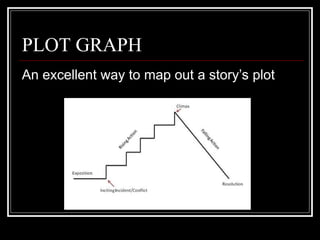
Consists of 6 main ingredients:
1. Introduction/Exposition
2. Inciting incident
3. Rising action
4. Climax
5. Falling Action
6. Resolution
PLOT GRAPH
An excellent way to map out a story’s plot
Introduction
Introduces the reader to:
 Setting
 Basic situation
 Characters involved
 Narrative Hook: question or statement that
grabs the reader’s attention
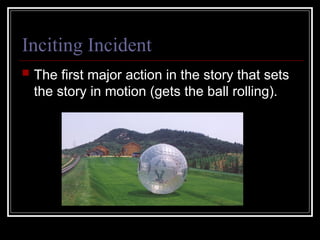
Inciting Incident
 The first major action in the story that sets
the story in motion (gets the ball rolling).
Rising Action
Incidents which carry the plot along. It often
includes the following:
 Foreshadowing
 Flashback
 Conflict
 Suspense
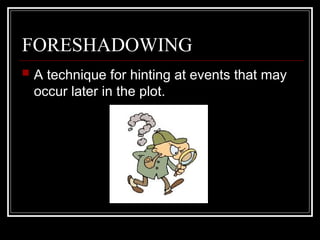
FORESHADOWING
 A technique for hinting at events that may
occur later in the plot.
FLASHBACK
 The insertion of an earlier event into the time
order of a narrative.
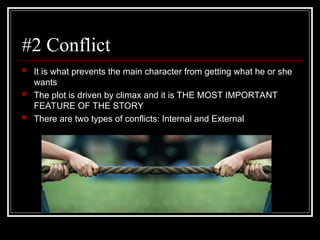
#2 Conflict
 It is what prevents the main character from getting what he or she
wants
 The plot is driven by climax and it is THE MOST IMPORTANT
FEATURE OF THE STORY
 There are two types of conflicts: Internal and External
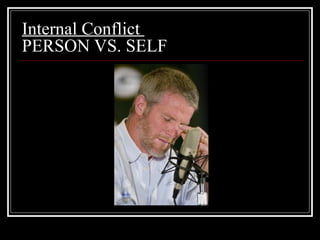
Internal Conflict
PERSON VS. SELF
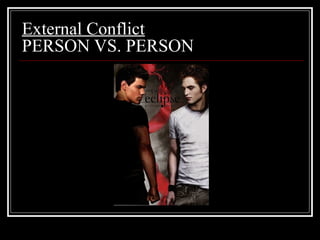
External Conflict
PERSON VS. PERSON
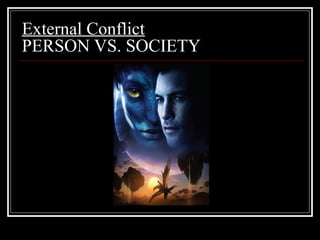
External Conflict
PERSON VS. SOCIETY
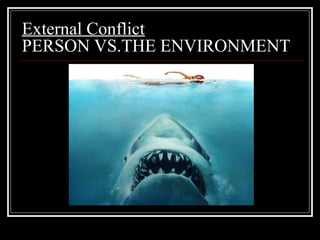
External Conflict
PERSON VS.THE ENVIRONMENT
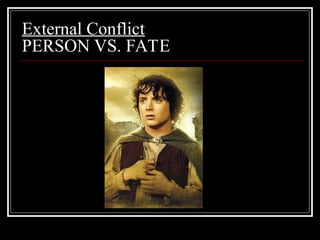
External Conflict
PERSON VS. FATE
External Conflict
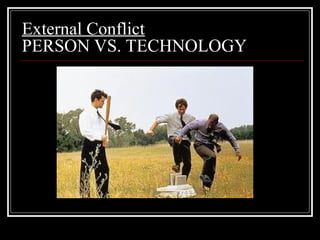
PERSON VS. TECHNOLOGY
External Conflict
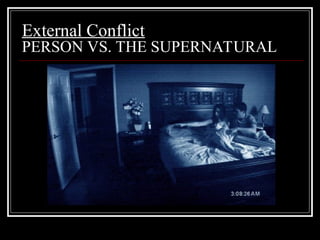
PERSON VS. THE SUPERNATURAL
SUSPENSE
 The feeling of
excitement and
curiosity that keeps
the reader turning the
pages; created by
making the readers
wonder how the
conflict will be
resolved
CLIMAX
 The highest point of
interest in the story when
the character(s) solves
his/her struggles
 Usually the point of
highest emotion
 The climax can be
SUBJECTIVE (there may
be different answers, so
you must prove your
choice)
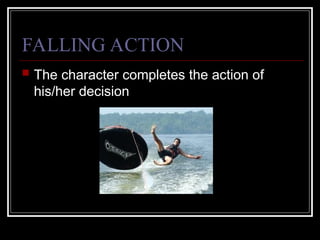
FALLING ACTION
 The character completes the action of
his/her decision
THE RESOLUTION
 The final workings of a story’s conflict
 All of the loose ends are tied up (usually)
 Narrative Twist: a surprise ending
#3. SETTING
 The time (time of day, season, present, past, future) and
the location (country, planet, town, buildings, PLUS a
description of the surroundings) where the action occurs
 Helps to create the mood and atmosphere of the text
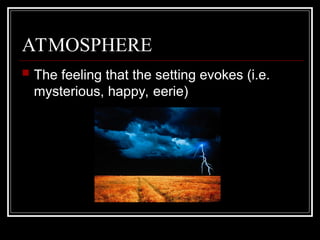
ATMOSPHERE
 The feeling that the setting evokes (i.e.
mysterious, happy, eerie)
MOOD
 The author’s emotional attitude toward the
subject matter (i.e. excitement, nostalgia)
 NOT the mood of the characters
#4. CHARACTERs
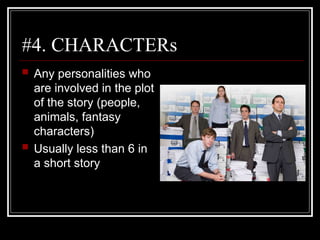
 Any personalities who
are involved in the plot
of the story (people,
animals, fantasy
characters)
 Usually less than 6 in
a short story
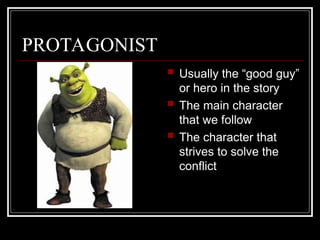
PROTAGONIST
 Usually the “good guy”
or hero in the story
 The main character
that we follow
 The character that
strives to solve the
conflict
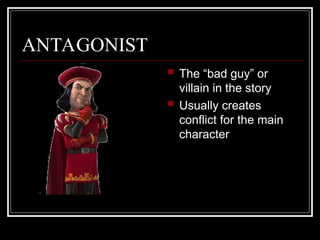
ANTAGONIST
 The “bad guy” or
villain in the story
 Usually creates
conflict for the main
character
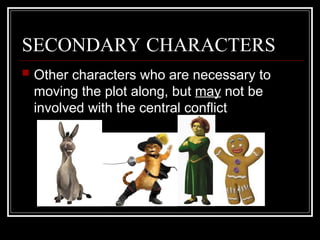
SECONDARY CHARACTERS
 Other characters who are necessary to
moving the plot along, but may not be
involved with the central conflict
CHARACTER TRAITS
Physical and personality characteristics that
are revealed through:
1. What the character does
2. What the character says
3. What other characters say or do about the
character
4. What the author states directly
5. What the author infers
#5. THEME
The central idea about life that the story
highlights; THE MAIN IDEA (universal truths).
The message the author is conveying.
1. Determine the specific conflict
2. Decide what side of the conflict the story
represents
3. How is the conflict resolved? Who wins?
Who loses?
THEME
 Theme is NOT the moral of the story
 Theme is NOT plot
 Theme IS the general subject matter of a
work of art
 Theme may contain a message
THEME
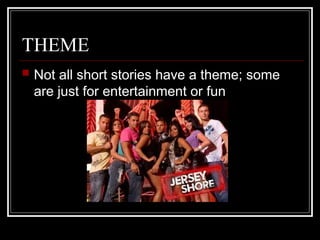
 Not all short stories have a theme; some
are just for entertainment or fun
THEME OR NOT A THEME?
1) Red Riding Hood is about how you shouldn’t trust strangers
2) Stars Wars is a movie about Luke Skywalker
3) Apocalypse Now is about the insanity of war.
4) This painting is about loneliness
5) That story is about two guys who steal a car
6) Romeo and Juliet is about love
7) Romeo and Juliet is about two families fighting
8) I saw a movie last night about survival
9) Hansel and Gretel is about two children
10) Cinderella is about poetic justice
#6. POINT OF VIEW
 Point of View, or P.O.V. is defined as the
angle form which the story is told
1. Innocent Eye - The story is told through the
eyes of a child (his/her judgment being
different from that of an adult) .
2. Stream of Consciousness - The story is told so
that the reader feels as if they are inside the
head of one character and knows all their
thoughts and reactions.
#6. POINT OF VIEW
3. First Person - The story is told by the
protagonist or one of the characters who
interacts closely with the protagonist or
other characters (using pronouns I, me,
we, etc). The reader sees the story
through this person's eyes as he/she
experiences it and only knows what
he/she knows or feels.
#6. POINT OF VIEW
4. There are two main types of Third Person
point of view:
A. Omniscient Limited - The author tells the
story in third person (using pronouns
they, she, he, it, etc). We know only what
the character knows and what the author
allows him/her to tell us. We can see the
thoughts and feelings of characters if the
author chooses to reveal them to us.
#6. POINT OF VIEW
4. two main types of Third Person point of view:
A. Third Person Objective - The author tells the
story in the third person. It appears as though a
camera is following the characters, going
anywhere, and recording only what is seen and
heard. There is no comment on the characters or
their thoughts. No interpretations are offered.
The reader is placed in the position of spectator
without the author there to explain. The reader
has to interpret events on his own.
#6. POINT OF VIEW
5. Second Person -- the story is
told to another character using
the pronouns you, your, and
yours. It is not often used in
fiction writing, but is used in
letters, speeches, and other
forms of nonfiction.
Short-Story-Elements for grade 8 students.ppt

  • 1.
  • 2.
    What is ashort story?  A brief, imaginative narrative containing few characters, simple plot, conflict, and suspense which leads to a climax and a swift conclusion.  Can be read in one sitting
  • 3.
    THE 6 ELEMENTSOF THE SHORT STORY  PLOT  CONFLICT  SETTING  CHARACTER  THEME  POINT OF VIEW
  • 4.
    #1. PLOT The chainof events in a story. Consists of 6 main ingredients: 1. Introduction/Exposition 2. Inciting incident 3. Rising action 4. Climax 5. Falling Action 6. Resolution
  • 5.
    PLOT GRAPH An excellentway to map out a story’s plot
  • 6.
    Introduction Introduces the readerto:  Setting  Basic situation  Characters involved  Narrative Hook: question or statement that grabs the reader’s attention
  • 7.
    Inciting Incident  Thefirst major action in the story that sets the story in motion (gets the ball rolling).
  • 8.
    Rising Action Incidents whichcarry the plot along. It often includes the following:  Foreshadowing  Flashback  Conflict  Suspense
  • 9.
    FORESHADOWING  A techniquefor hinting at events that may occur later in the plot.
  • 10.
    FLASHBACK  The insertionof an earlier event into the time order of a narrative.
  • 11.
    #2 Conflict  Itis what prevents the main character from getting what he or she wants  The plot is driven by climax and it is THE MOST IMPORTANT FEATURE OF THE STORY  There are two types of conflicts: Internal and External
  • 12.
  • 13.
  • 14.
  • 15.
  • 16.
  • 17.
  • 18.
  • 19.
    SUSPENSE  The feelingof excitement and curiosity that keeps the reader turning the pages; created by making the readers wonder how the conflict will be resolved
  • 20.
    CLIMAX  The highestpoint of interest in the story when the character(s) solves his/her struggles  Usually the point of highest emotion  The climax can be SUBJECTIVE (there may be different answers, so you must prove your choice)
  • 21.
    FALLING ACTION  Thecharacter completes the action of his/her decision
  • 22.
    THE RESOLUTION  Thefinal workings of a story’s conflict  All of the loose ends are tied up (usually)  Narrative Twist: a surprise ending
  • 23.
    #3. SETTING  Thetime (time of day, season, present, past, future) and the location (country, planet, town, buildings, PLUS a description of the surroundings) where the action occurs  Helps to create the mood and atmosphere of the text
  • 24.
    ATMOSPHERE  The feelingthat the setting evokes (i.e. mysterious, happy, eerie)
  • 25.
    MOOD  The author’semotional attitude toward the subject matter (i.e. excitement, nostalgia)  NOT the mood of the characters
  • 26.
    #4. CHARACTERs  Anypersonalities who are involved in the plot of the story (people, animals, fantasy characters)  Usually less than 6 in a short story
  • 27.
    PROTAGONIST  Usually the“good guy” or hero in the story  The main character that we follow  The character that strives to solve the conflict
  • 28.
    ANTAGONIST  The “badguy” or villain in the story  Usually creates conflict for the main character
  • 29.
    SECONDARY CHARACTERS  Othercharacters who are necessary to moving the plot along, but may not be involved with the central conflict
  • 30.
    CHARACTER TRAITS Physical andpersonality characteristics that are revealed through: 1. What the character does 2. What the character says 3. What other characters say or do about the character 4. What the author states directly 5. What the author infers
  • 31.
    #5. THEME The centralidea about life that the story highlights; THE MAIN IDEA (universal truths). The message the author is conveying. 1. Determine the specific conflict 2. Decide what side of the conflict the story represents 3. How is the conflict resolved? Who wins? Who loses?
  • 32.
    THEME  Theme isNOT the moral of the story  Theme is NOT plot  Theme IS the general subject matter of a work of art  Theme may contain a message
  • 33.
    THEME  Not allshort stories have a theme; some are just for entertainment or fun
  • 34.
    THEME OR NOTA THEME? 1) Red Riding Hood is about how you shouldn’t trust strangers 2) Stars Wars is a movie about Luke Skywalker 3) Apocalypse Now is about the insanity of war. 4) This painting is about loneliness 5) That story is about two guys who steal a car 6) Romeo and Juliet is about love 7) Romeo and Juliet is about two families fighting 8) I saw a movie last night about survival 9) Hansel and Gretel is about two children 10) Cinderella is about poetic justice
  • 35.
    #6. POINT OFVIEW  Point of View, or P.O.V. is defined as the angle form which the story is told 1. Innocent Eye - The story is told through the eyes of a child (his/her judgment being different from that of an adult) . 2. Stream of Consciousness - The story is told so that the reader feels as if they are inside the head of one character and knows all their thoughts and reactions.
  • 36.
    #6. POINT OFVIEW 3. First Person - The story is told by the protagonist or one of the characters who interacts closely with the protagonist or other characters (using pronouns I, me, we, etc). The reader sees the story through this person's eyes as he/she experiences it and only knows what he/she knows or feels.
  • 37.
    #6. POINT OFVIEW 4. There are two main types of Third Person point of view: A. Omniscient Limited - The author tells the story in third person (using pronouns they, she, he, it, etc). We know only what the character knows and what the author allows him/her to tell us. We can see the thoughts and feelings of characters if the author chooses to reveal them to us.
  • 38.
    #6. POINT OFVIEW 4. two main types of Third Person point of view: A. Third Person Objective - The author tells the story in the third person. It appears as though a camera is following the characters, going anywhere, and recording only what is seen and heard. There is no comment on the characters or their thoughts. No interpretations are offered. The reader is placed in the position of spectator without the author there to explain. The reader has to interpret events on his own.
  • 39.
    #6. POINT OFVIEW 5. Second Person -- the story is told to another character using the pronouns you, your, and yours. It is not often used in fiction writing, but is used in letters, speeches, and other forms of nonfiction.