SEMINAR BY
J.K.ANUBHAV,B.sc(Film and Tv Production)
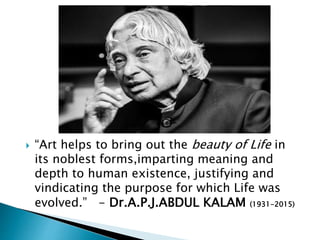
 “Art helps to bring out the beauty of Life in
its noblest forms,imparting meaning and
depth to human existence, justifying and
vindicating the purpose for which Life was
evolved.” - Dr.A.P.J.ABDUL KALAM (1931-2015)
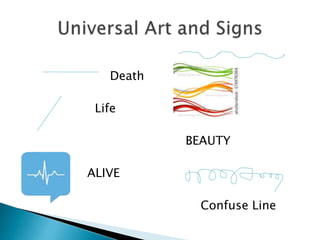
Death
Life
BEAUTY
ECG –
ALIVE
Confuse Line
◦ Good ultimately triumphs over evil (Westerns, police
thrillers)
◦ Life is basically good and Worth Living (It’s a wonderful
life)
◦ It is sweet and proper to die for Country (Most War Films)
◦ Love Conquers all (Most Romantic Comedies)
◦ True Love is happiness,or happiness is true love (Most
Love Stories)
◦ Action trumps Intellect (Most action films celebrate man of
action , not man of rational thought)
◦ Revenge is sweet (Killing your enemy who has done you
wrong is your right)
◦ The Underdog can win (Rocky,1976 and whole host of
films about reversal of fortune)
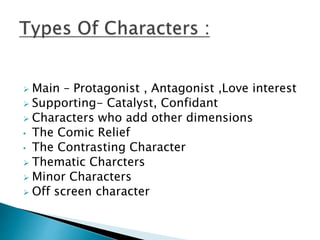
 Main – Protagonist , Antagonist ,Love interest
 Supporting- Catalyst, Confidant
 Characters who add other dimensions
• The Comic Relief
• The Contrasting Character
 Thematic Charcters
 Minor Characters
 Off screen character
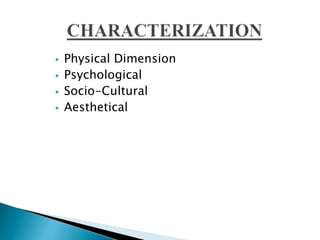
 Physical Dimension
 Psychological
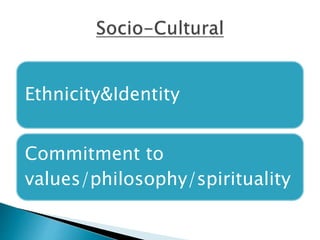
 Socio-Cultural
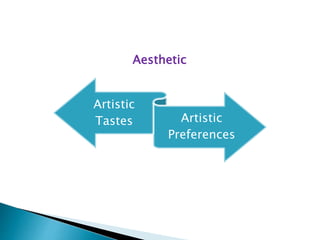
 Aesthetical
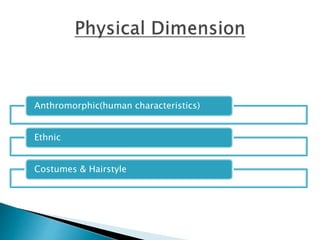
Anthromorphic(human characteristics)
Ethnic
Costumes & Hairstyle
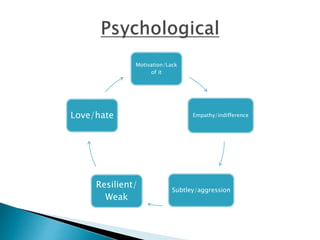
Motivation/Lack
of it
Empathy/indifference
Subtley/aggression
Resilient/
Weak
Love/hate
Ethnicity&Identity
Commitment to
values/philosophy/spirituality
Aesthetic
Artistic
Tastes Artistic
Preferences
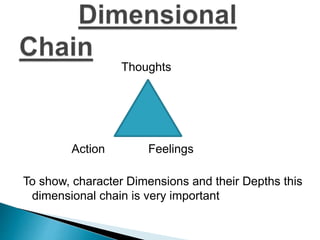
Thoughts
Action Feelings
To show, character Dimensions and their Depths this
dimensional chain is very important
Actions always Comes first , Dialog has to
Support the Action.
FACTORS DECIDING GOOD
CHARACTERIZATION:
• DRAMATIC NEED
(the engine that powers the story)
• AESTHETICAL NEED
Point Of View
Voice Over
Flash Back/Flash
Forward
Intercutting
 Nature of Focus on film
 How much we should know ?
 Through whose eyes we see story
 Whether we know only,what main character
knows ?
 Whether we need a broader point of view than
that of Protagonist ?
 First Person (Subjective)
Eg: Memento(2000), Presumed Innocent,
Lady in the lake(1947).
 Second Person
Instead of using literary second POV, it uses two
characters POV the Protagonist and Antagonist
Eg: The fugitive , Thani Oruvan (2015)
Allows author to tell larger story
Permits authors to show us how
all pieces fit together
An all knowing narrator who
stands back to give us big picture
from all view points
Note : It has less depth & width more
o Voice over is any off-screen voice
o It must enhance the scene
Voice over can be
Subjective or Objective
 Pulls us into the mood and psyche of the
Protagonist
Eg : The Movie Sunset Bouleyard begins with
the Voice over of dead Man.
o Other examples :
o Michael Clayton
o Forrest Gump (1994)
o Shawshank Redemption(1993)
 The voice comes from relatively unimportant
or anonymus character
 The story teller does not reveal the character
are in Subjective Voice over
 In certain film a character tells the story or
leads us into story
Objective Voice-over is less wanted in a
film than subjective voice-over
( A film is supposed to show rather than tell)
Eg : Generally Documentary Films
Does Voice over Improve narrative quality
of fiction film ?
Yes, if used
• Discretly
• Irony
• Pathos
• Lost innocence
• Nostalgia
 Clear
 Complement the image
 Match character or subject matter
 Be pronounceable or speakable
 Be suitable for target audience
Flash Back :
 It shows events that have taken place before ‘present
time’ established in the film
 It can be used to explain or providing background to,
events in the story
 It can be a subjective or objective as a POINT OF VIEW
of a character
Eg : Born identity , Born supremacy
Flash Forward :
 Flash forward is less significant compared to
flashbacks. Now, in new age cinemas it is used as a
creative tool.
Intercutting :
 Bits of little shots from different scenes
TRIVIA :
AN ACTION THRILLER IS
GENERALLY PLOT DRIVEN
EG: FAST AND FURIOUS SERIES
A MELODRAMA FAMILY GENRE
IS GENERALLY CHARACTER
DRIVEN
EG: ANANDAM (2001)
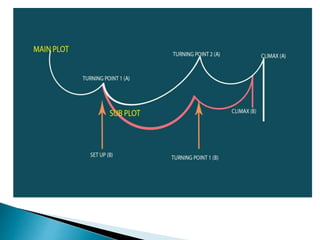
 It is normally relationship of stories of different
themes that interwave with main plot
 It can be a love story linked to main story
Structure Of Subplot :
 Like the main plot, subplot too have a
beginning,middle and an end.
 Subplots compares and contrasts with the main
character
 Adds dimensionality to script (without which
script will be flat and too linear)
 Supports story’s theme
 Pushes sub plot, often changing direction
 Reveals characters goals, dreams, desires
 Shows transformation of character
 Reveals beat by beat development of
characters identity, self esteem and self
confidence.
A GOOD FILM HAS 3 TO 7 SUBPLOTS
a) Supports Theme
b) Character
c) Makes story interesting
Normally, avoid subplot in act 1
In hollywood film making , final script has
100-120 pages with
 ACT 1 – 25 TO 35 Pages
 ACT 2 – 50 TO 60 Pages
 ACT 3 – 25 TO 30 Pages
1 A4 PAGE = 1 MINUTE SCREEN TIME ( 12.1 FONT)
 More information about
characters
 Characters back story
 Information about antagonist
 Motivation of protagonist
 The central conflict
ACT 1 :
i. Where and When?
ii. Who are important characters?
iii. Sub-conscious Theme
iv. Twist
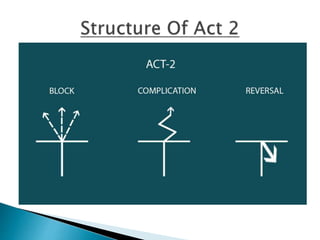
ACT 2 : (making story unique) (action oriented)
Advancing the story with strong action that has direction
Develop ‘conflict’ by exploring theme
Building relationship before
 Rising action
 complication
 Obstacles
 Twist
 Reversal
 Push to social issue
 Second turning point
Understanding ACT 2 :
 Raises central question and makes us
wonder about answer
 Again demands hard decision or
commitment from on the part of main
character
 Takes audience into new arena, where
characters action may be seen with new
focus
ACT 3
 Shows CONSEQUENCES of act 2
 Close subplot by resolving into main plot
 Climax
• Resolution of original conflict
• Sometimes through the agency of a character
from subplot
What does Central Question do ?
Central question operates subconsciously
 But keeps coming throughout story
 With each turning point, with each step
back,with each step forward
 Intensity the problem
 Create an ultimate reversal or a set
back in predicament of main character
 Brain about a resolution of final set
back and the whole story
 Create triumph of hero, protagonist or
main character and downfall of
antagonist or villan
 Storyline (plot)
 Characters
 The underlying theme
 Dialogue
 Images
Eg : cuilinary images in Kaaka muttai
TRIVIA : CHARACTER NAMES AND CAMERA
ANGLES ARE WRITTEN IN UPPER CASE
 Theme and its relevance
 Plot & content
 Characters & experience
 History and the period
 Geography/location
 Culture manners and customs
 Language dialect
 Storyline and narration
 Artistic collobaration
 Casting tool
 Planning: financial , organisation & time
Screenplay can be taught as an craft using
 Concepts
 Methods
 Procedures
 Techniques & devices
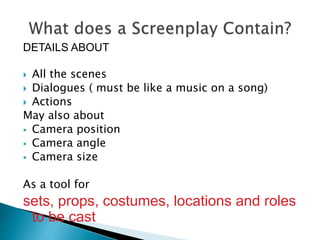
DETAILS ABOUT
 All the scenes
 Dialogues ( must be like a music on a song)
 Actions
May also about
 Camera position
 Camera angle
 Camera size
As a tool for
sets, props, costumes, locations and roles
to be cast
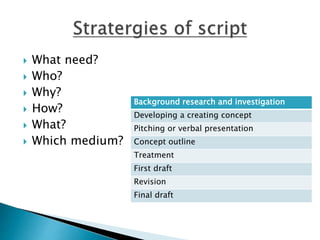
 What need?
 Who?
 Why?
 How?
 What?
 Which medium?
Background research and investigation
Developing a creating concept
Pitching or verbal presentation
Concept outline
Treatment
First draft
Revision
Final draft
 DURING 1909-1929 Hollywood age of
Commercial cinema, scripting became very vital.
They developed a style for themselves for pre
planning and cutting out budget and saving
time.Till then,Directors,edited their films
themselves
 It was like a assembly chain in car making. The
Process was very auxilary.
 Length
 Point of view
 Narrative tense & screen time
 Setting and period
 Dialogue Versus Action
 Acting
Breakdown of Script Formats :
 Storyboard
 Miniscripts for video,audio,animation&text
 Branching,flowchart.
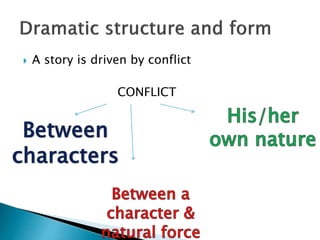
 A story is driven by conflict
CONFLICT
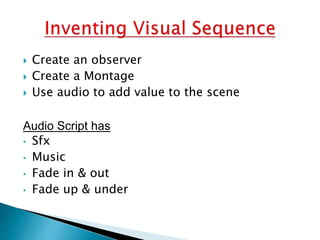
 Create an observer
 Create a Montage
 Use audio to add value to the scene
Audio Script has
• Sfx
• Music
• Fade in & out
• Fade up & under
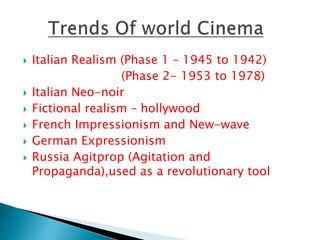
 Italian Realism (Phase 1 – 1945 to 1942)
(Phase 2- 1953 to 1978)
 Italian Neo-noir
 Fictional realism – hollywood
 French Impressionism and New-wave
 German Expressionism
 Russia Agitprop (Agitation and
Propaganda),used as a revolutionary tool
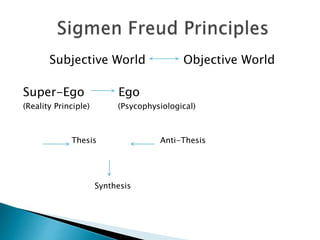
Subjective World Objective World
Super-Ego Ego
(Reality Principle) (Psycophysiological)
Thesis Anti-Thesis
Synthesis
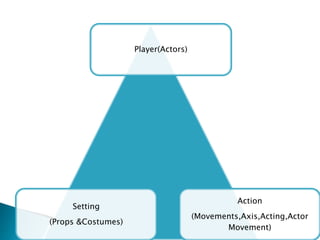
Player(Actors)
Setting
(Props &Costumes)
Action
(Movements,Axis,Acting,Actor
Movement)
“Lets Promote a more Reflective Film
Viewing Culture”
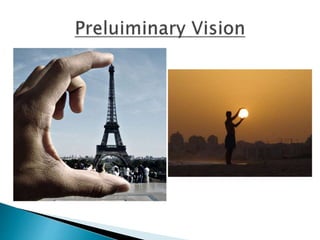
Hope it Changes , Your vision on film
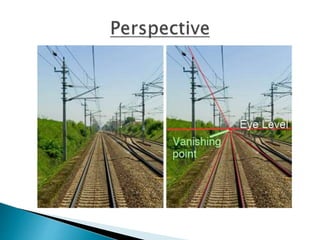
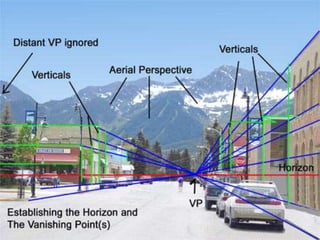
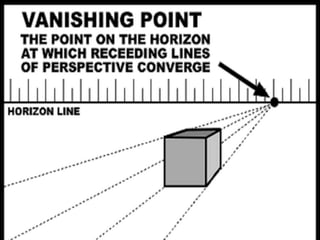
Watching, perception & Perspective

Film analysis ,Screenplay Writing

  • 1.
  • 2.
     “Art helpsto bring out the beauty of Life in its noblest forms,imparting meaning and depth to human existence, justifying and vindicating the purpose for which Life was evolved.” - Dr.A.P.J.ABDUL KALAM (1931-2015)
  • 8.
  • 10.
    ◦ Good ultimatelytriumphs over evil (Westerns, police thrillers) ◦ Life is basically good and Worth Living (It’s a wonderful life) ◦ It is sweet and proper to die for Country (Most War Films) ◦ Love Conquers all (Most Romantic Comedies) ◦ True Love is happiness,or happiness is true love (Most Love Stories) ◦ Action trumps Intellect (Most action films celebrate man of action , not man of rational thought) ◦ Revenge is sweet (Killing your enemy who has done you wrong is your right) ◦ The Underdog can win (Rocky,1976 and whole host of films about reversal of fortune)
  • 11.
     Main –Protagonist , Antagonist ,Love interest  Supporting- Catalyst, Confidant  Characters who add other dimensions • The Comic Relief • The Contrasting Character  Thematic Charcters  Minor Characters  Off screen character
  • 12.
     Physical Dimension Psychological  Socio-Cultural  Aesthetical
  • 13.
  • 14.
  • 15.
  • 16.
  • 17.
    Thoughts Action Feelings To show,character Dimensions and their Depths this dimensional chain is very important
  • 18.
    Actions always Comesfirst , Dialog has to Support the Action. FACTORS DECIDING GOOD CHARACTERIZATION: • DRAMATIC NEED (the engine that powers the story) • AESTHETICAL NEED
  • 19.
    Point Of View VoiceOver Flash Back/Flash Forward Intercutting
  • 20.
     Nature ofFocus on film  How much we should know ?  Through whose eyes we see story  Whether we know only,what main character knows ?  Whether we need a broader point of view than that of Protagonist ?
  • 21.
     First Person(Subjective) Eg: Memento(2000), Presumed Innocent, Lady in the lake(1947).  Second Person Instead of using literary second POV, it uses two characters POV the Protagonist and Antagonist Eg: The fugitive , Thani Oruvan (2015)
  • 22.
    Allows author totell larger story Permits authors to show us how all pieces fit together An all knowing narrator who stands back to give us big picture from all view points Note : It has less depth & width more
  • 23.
    o Voice overis any off-screen voice o It must enhance the scene Voice over can be Subjective or Objective
  • 24.
     Pulls usinto the mood and psyche of the Protagonist Eg : The Movie Sunset Bouleyard begins with the Voice over of dead Man. o Other examples : o Michael Clayton o Forrest Gump (1994) o Shawshank Redemption(1993)
  • 25.
     The voicecomes from relatively unimportant or anonymus character  The story teller does not reveal the character are in Subjective Voice over  In certain film a character tells the story or leads us into story Objective Voice-over is less wanted in a film than subjective voice-over ( A film is supposed to show rather than tell) Eg : Generally Documentary Films
  • 26.
    Does Voice overImprove narrative quality of fiction film ? Yes, if used • Discretly • Irony • Pathos • Lost innocence • Nostalgia
  • 27.
     Clear  Complementthe image  Match character or subject matter  Be pronounceable or speakable  Be suitable for target audience
  • 28.
    Flash Back : It shows events that have taken place before ‘present time’ established in the film  It can be used to explain or providing background to, events in the story  It can be a subjective or objective as a POINT OF VIEW of a character Eg : Born identity , Born supremacy Flash Forward :  Flash forward is less significant compared to flashbacks. Now, in new age cinemas it is used as a creative tool. Intercutting :  Bits of little shots from different scenes
  • 29.
    TRIVIA : AN ACTIONTHRILLER IS GENERALLY PLOT DRIVEN EG: FAST AND FURIOUS SERIES A MELODRAMA FAMILY GENRE IS GENERALLY CHARACTER DRIVEN EG: ANANDAM (2001)
  • 30.
     It isnormally relationship of stories of different themes that interwave with main plot  It can be a love story linked to main story Structure Of Subplot :  Like the main plot, subplot too have a beginning,middle and an end.  Subplots compares and contrasts with the main character
  • 32.
     Adds dimensionalityto script (without which script will be flat and too linear)  Supports story’s theme  Pushes sub plot, often changing direction  Reveals characters goals, dreams, desires  Shows transformation of character  Reveals beat by beat development of characters identity, self esteem and self confidence.
  • 33.
    A GOOD FILMHAS 3 TO 7 SUBPLOTS a) Supports Theme b) Character c) Makes story interesting Normally, avoid subplot in act 1
  • 34.
    In hollywood filmmaking , final script has 100-120 pages with  ACT 1 – 25 TO 35 Pages  ACT 2 – 50 TO 60 Pages  ACT 3 – 25 TO 30 Pages 1 A4 PAGE = 1 MINUTE SCREEN TIME ( 12.1 FONT)
  • 35.
     More informationabout characters  Characters back story  Information about antagonist  Motivation of protagonist  The central conflict
  • 36.
    ACT 1 : i.Where and When? ii. Who are important characters? iii. Sub-conscious Theme iv. Twist ACT 2 : (making story unique) (action oriented) Advancing the story with strong action that has direction Develop ‘conflict’ by exploring theme Building relationship before  Rising action  complication  Obstacles
  • 37.
     Twist  Reversal Push to social issue  Second turning point Understanding ACT 2 :  Raises central question and makes us wonder about answer  Again demands hard decision or commitment from on the part of main character  Takes audience into new arena, where characters action may be seen with new focus
  • 39.
    ACT 3  ShowsCONSEQUENCES of act 2  Close subplot by resolving into main plot  Climax • Resolution of original conflict • Sometimes through the agency of a character from subplot What does Central Question do ? Central question operates subconsciously  But keeps coming throughout story  With each turning point, with each step back,with each step forward
  • 41.
     Intensity theproblem  Create an ultimate reversal or a set back in predicament of main character  Brain about a resolution of final set back and the whole story  Create triumph of hero, protagonist or main character and downfall of antagonist or villan
  • 42.
     Storyline (plot) Characters  The underlying theme  Dialogue  Images Eg : cuilinary images in Kaaka muttai TRIVIA : CHARACTER NAMES AND CAMERA ANGLES ARE WRITTEN IN UPPER CASE
  • 43.
     Theme andits relevance  Plot & content  Characters & experience  History and the period  Geography/location  Culture manners and customs  Language dialect
  • 44.
     Storyline andnarration  Artistic collobaration  Casting tool  Planning: financial , organisation & time Screenplay can be taught as an craft using  Concepts  Methods  Procedures  Techniques & devices
  • 45.
    DETAILS ABOUT  Allthe scenes  Dialogues ( must be like a music on a song)  Actions May also about  Camera position  Camera angle  Camera size As a tool for sets, props, costumes, locations and roles to be cast
  • 46.
     What need? Who?  Why?  How?  What?  Which medium? Background research and investigation Developing a creating concept Pitching or verbal presentation Concept outline Treatment First draft Revision Final draft
  • 47.
     DURING 1909-1929Hollywood age of Commercial cinema, scripting became very vital. They developed a style for themselves for pre planning and cutting out budget and saving time.Till then,Directors,edited their films themselves  It was like a assembly chain in car making. The Process was very auxilary.
  • 48.
     Length  Pointof view  Narrative tense & screen time  Setting and period  Dialogue Versus Action  Acting Breakdown of Script Formats :  Storyboard  Miniscripts for video,audio,animation&text  Branching,flowchart.
  • 49.
     A storyis driven by conflict CONFLICT
  • 50.
     Create anobserver  Create a Montage  Use audio to add value to the scene Audio Script has • Sfx • Music • Fade in & out • Fade up & under
  • 51.
     Italian Realism(Phase 1 – 1945 to 1942) (Phase 2- 1953 to 1978)  Italian Neo-noir  Fictional realism – hollywood  French Impressionism and New-wave  German Expressionism  Russia Agitprop (Agitation and Propaganda),used as a revolutionary tool
  • 52.
    Subjective World ObjectiveWorld Super-Ego Ego (Reality Principle) (Psycophysiological) Thesis Anti-Thesis Synthesis
  • 63.
  • 64.
    “Lets Promote amore Reflective Film Viewing Culture”
  • 65.
    Hope it Changes, Your vision on film Watching, perception & Perspective