FUNDAMENTALS OF MUSIC
RHYTHM
Movement marked by the
regulated succession of strong
and weak elements, or of
opposite or different conditions.
 from the Greek word “rhythmos”
meaning any regular recurring motion
PARTS OF RHYTHM
 is a unit of time that is felt and
sensed
 is a pulse of a time
BEAT
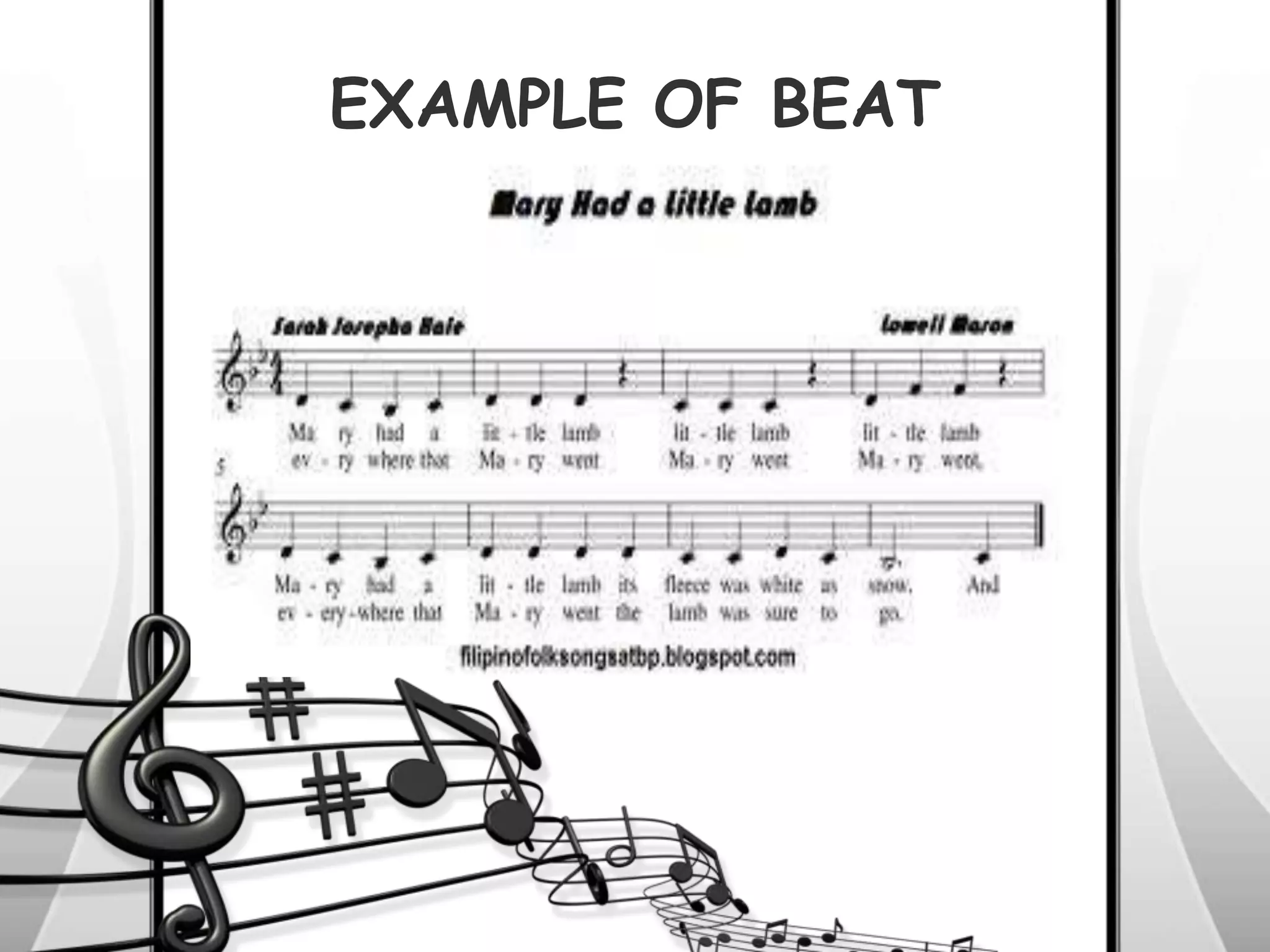
EXAMPLE OF BEAT
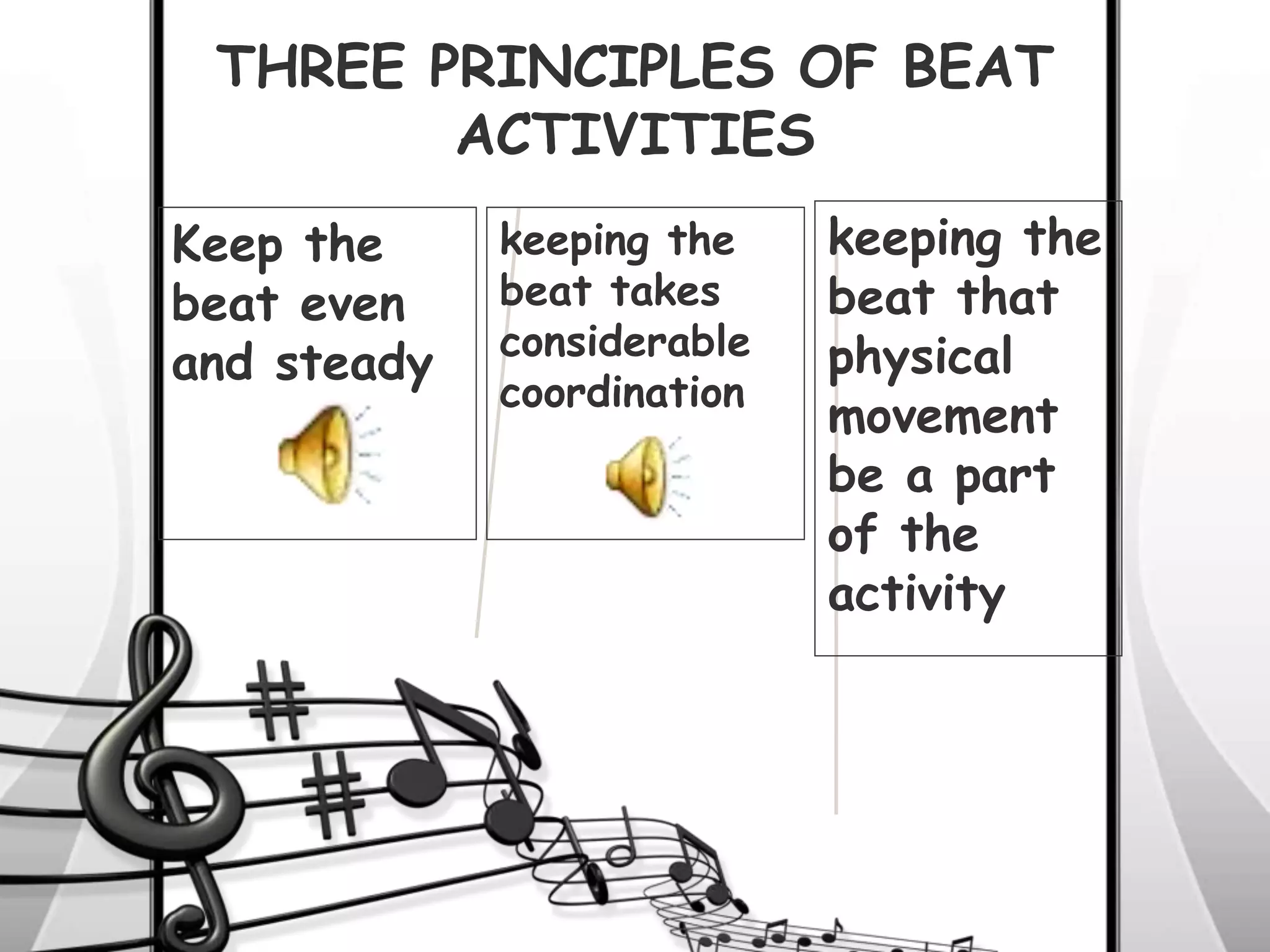
THREE PRINCIPLES OF BEAT
ACTIVITIES
Keep the
beat even
and steady
keeping the
beat takes
considerable
coordination
keeping the
beat that
physical
movement
be a part
of the
activity
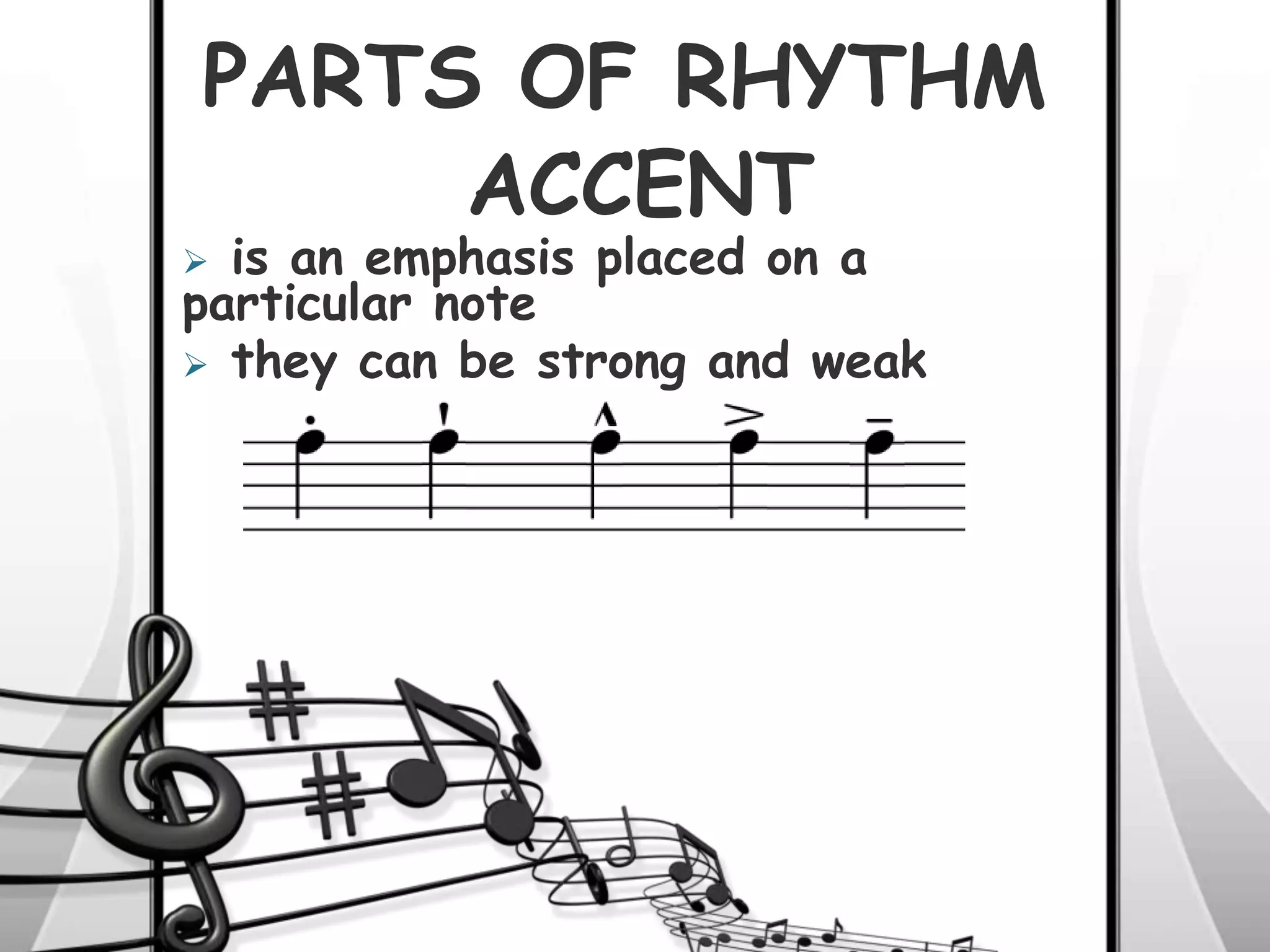
PARTS OF RHYTHM
 is an emphasis placed on a
particular note
 they can be strong and weak
ACCENT
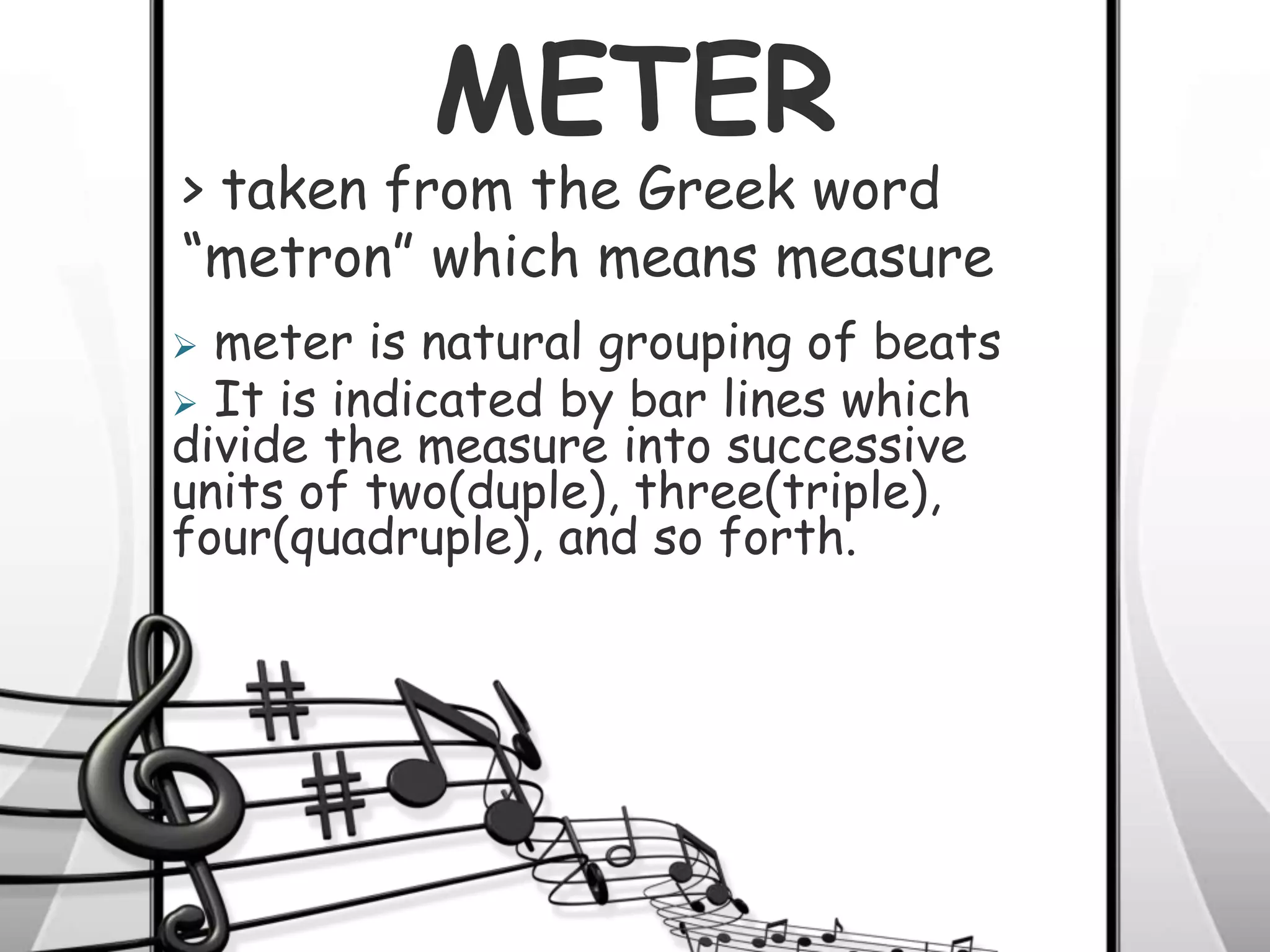
METER
 meter is natural grouping of beats
 It is indicated by bar lines which
divide the measure into successive
units of two(duple), three(triple),
four(quadruple), and so forth.
> taken from the Greek word
“metron” which means measure
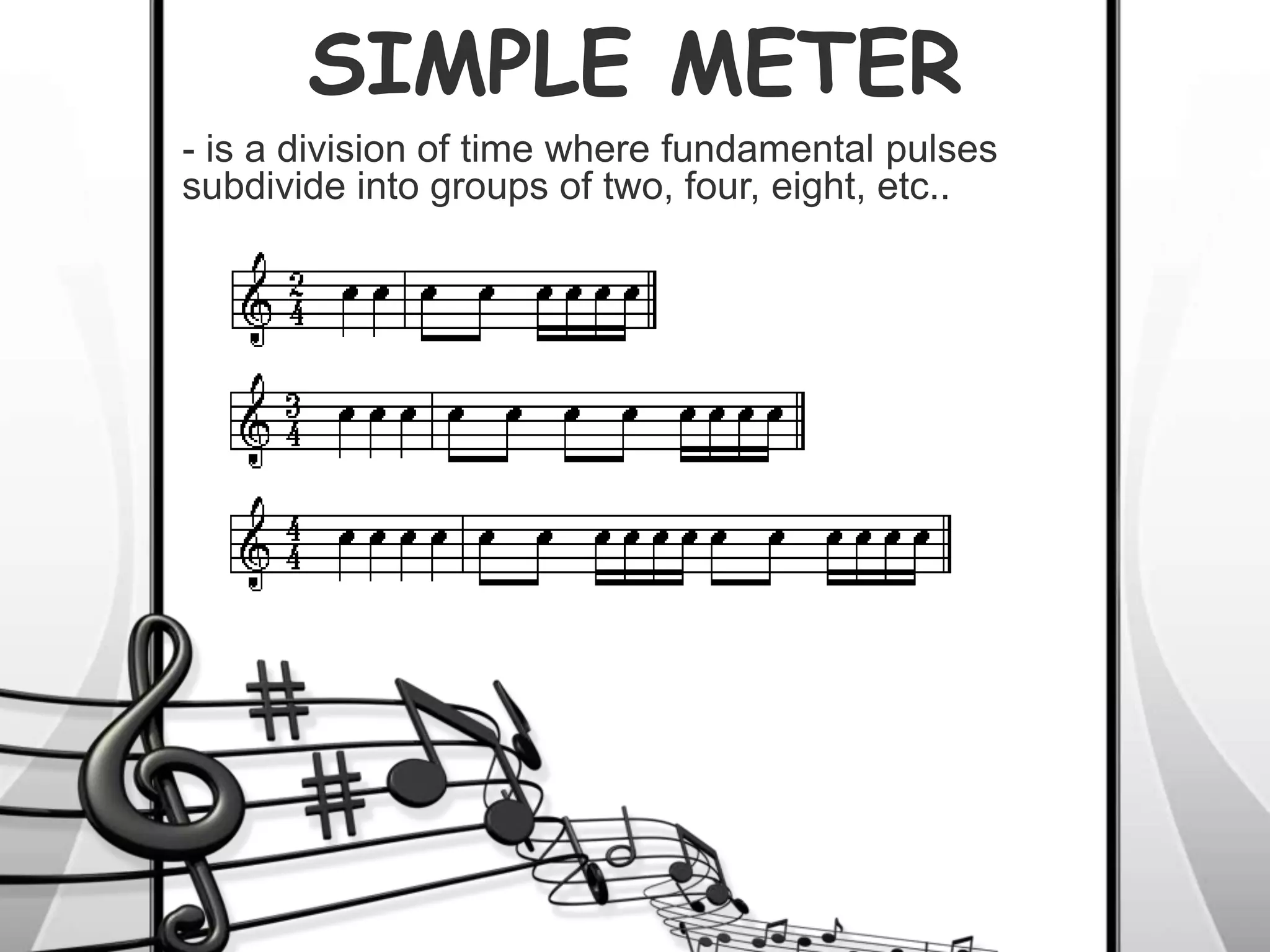
SIMPLE METER
- is a division of time where fundamental pulses
subdivide into groups of two, four, eight, etc..
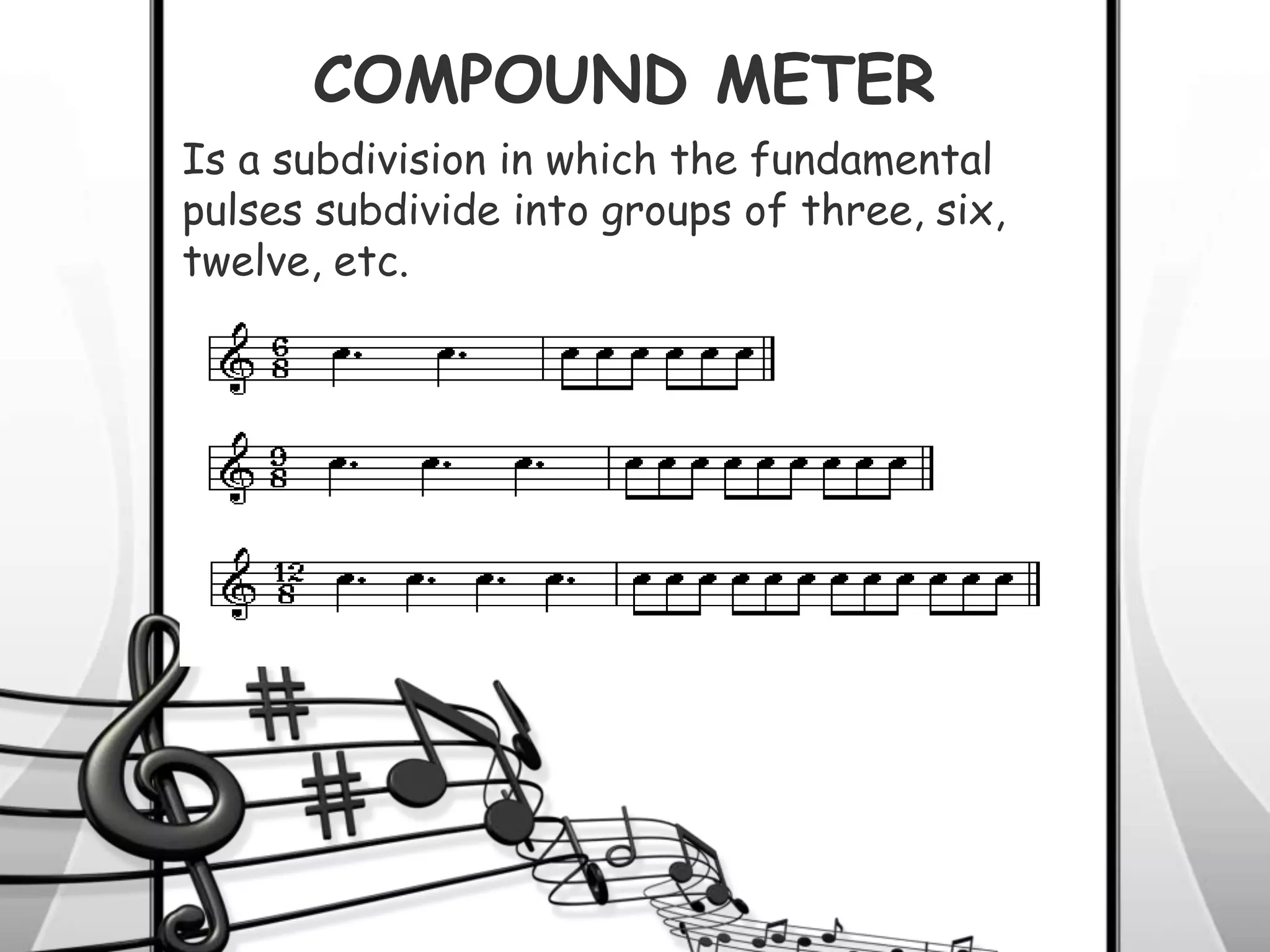
COMPOUND METER
Is a subdivision in which the fundamental
pulses subdivide into groups of three, six,
twelve, etc.
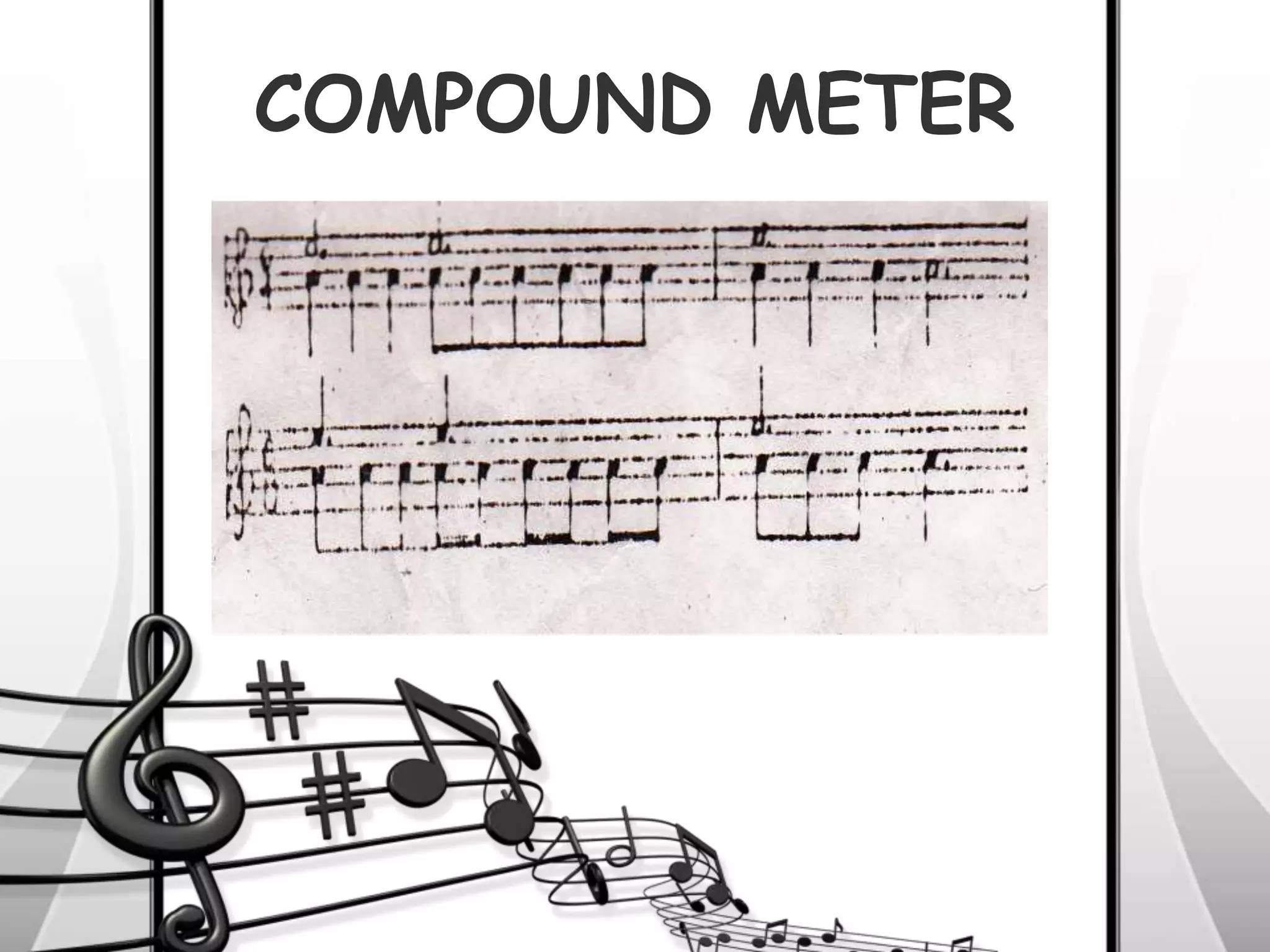
COMPOUND METER
POLYMETER
- Is a double meter to indicate
the two meters are combined
or there is constant change
from one meter to the other
back and both
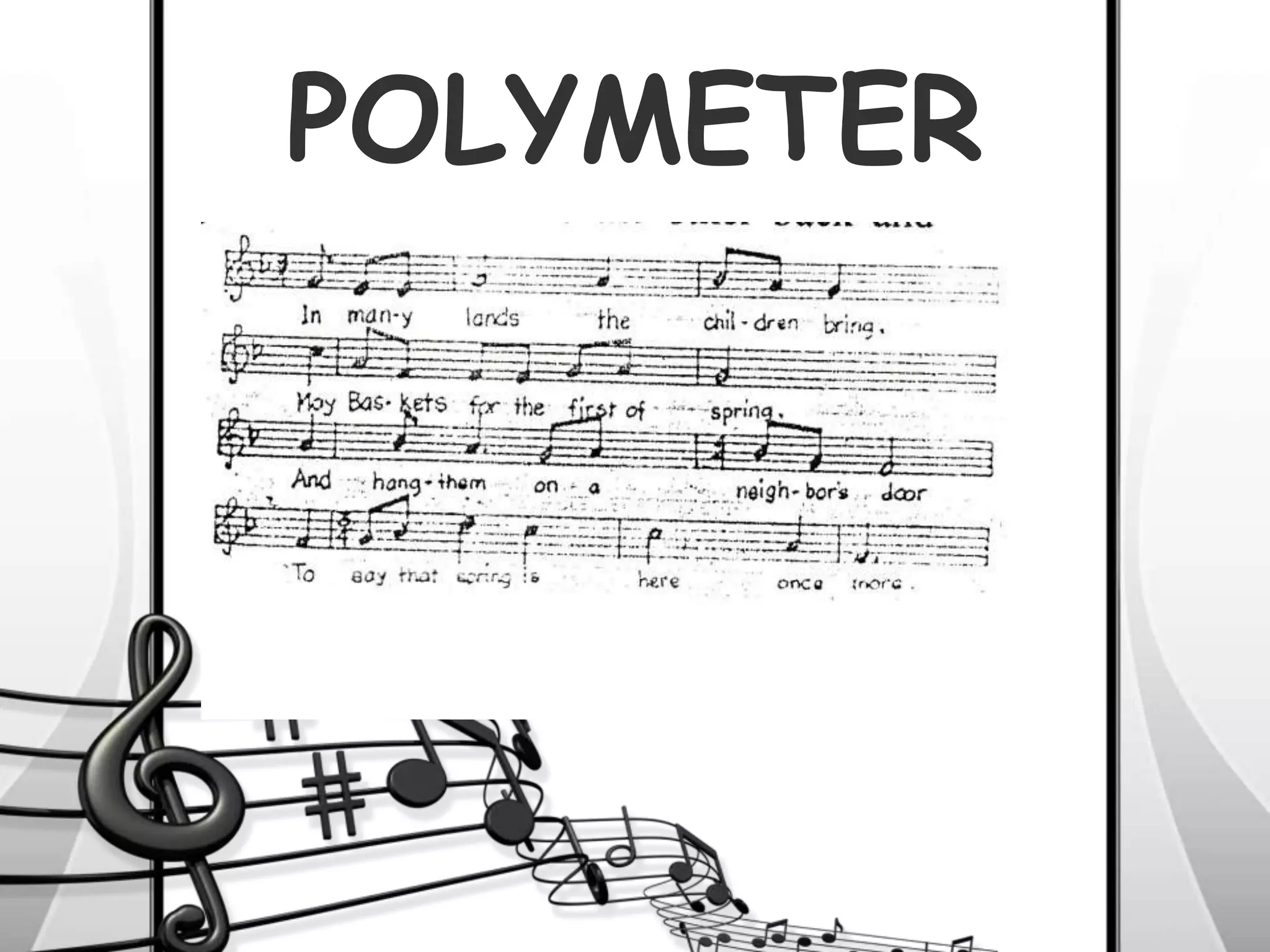
POLYMETER
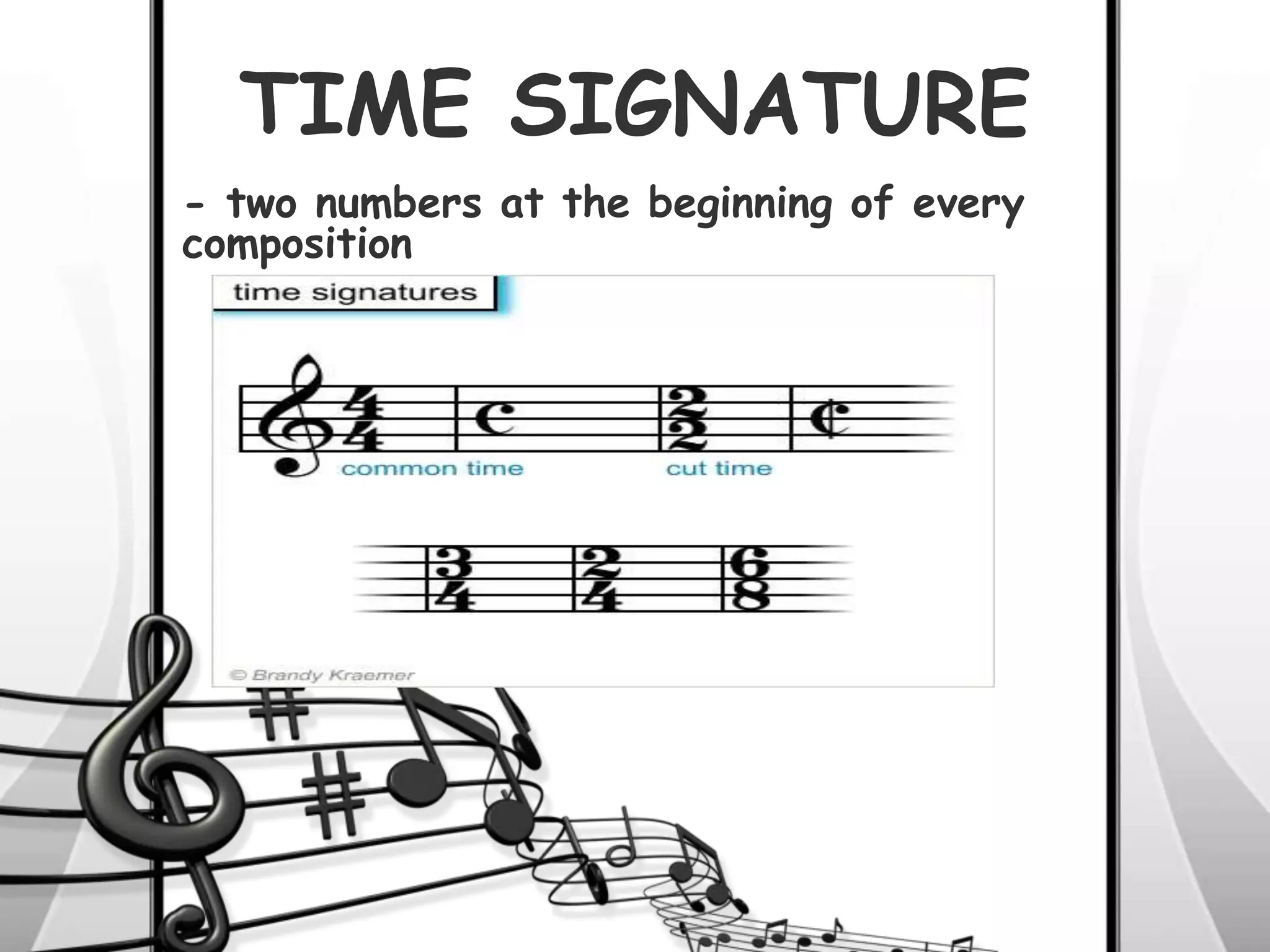
TIME SIGNATURE
- two numbers at the beginning of every
composition
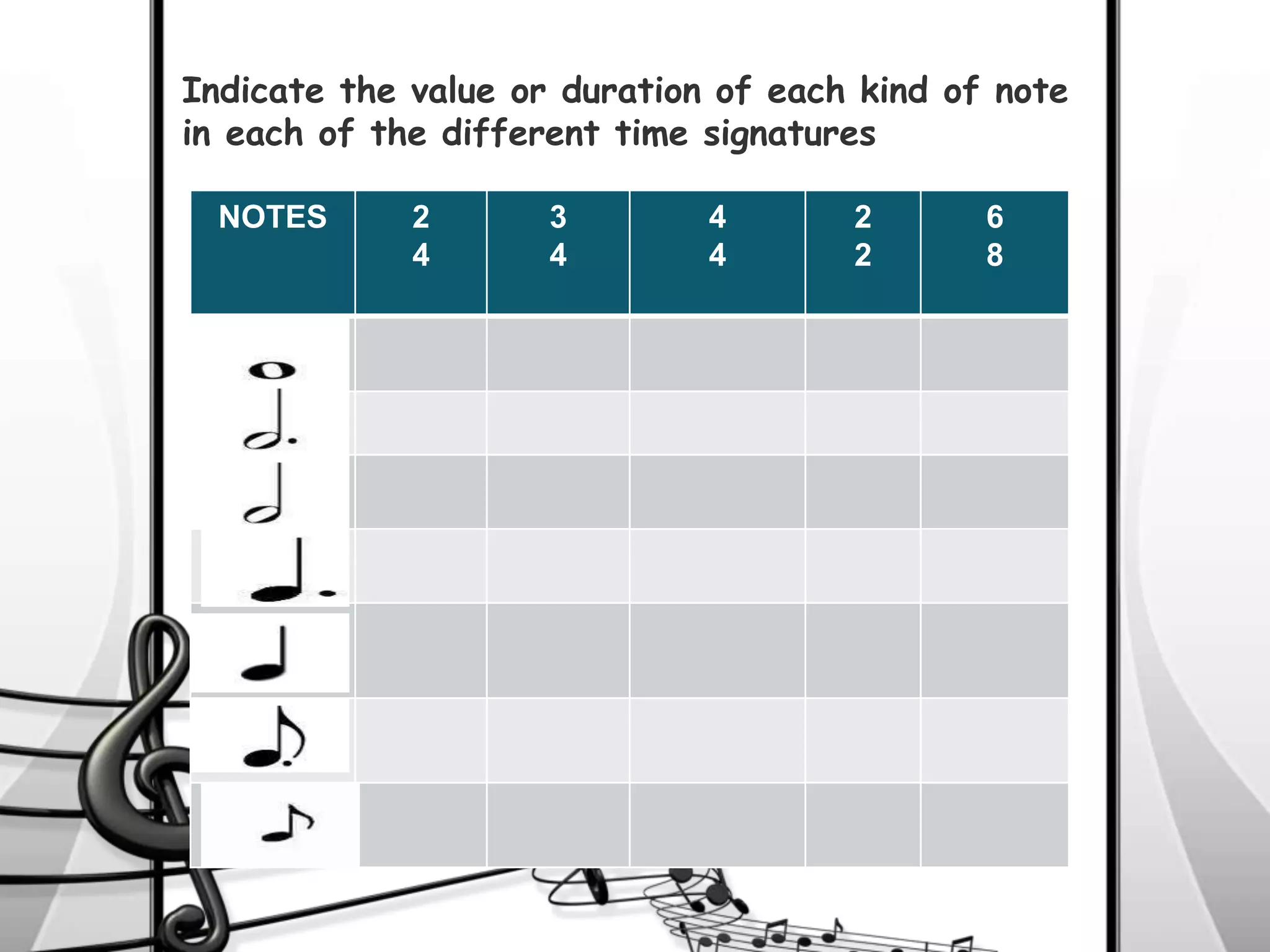
Indicate the value or duration of each kind of note
in each of the different time signatures
NOTES 2
4
3
4
4
4
2
2
6
8
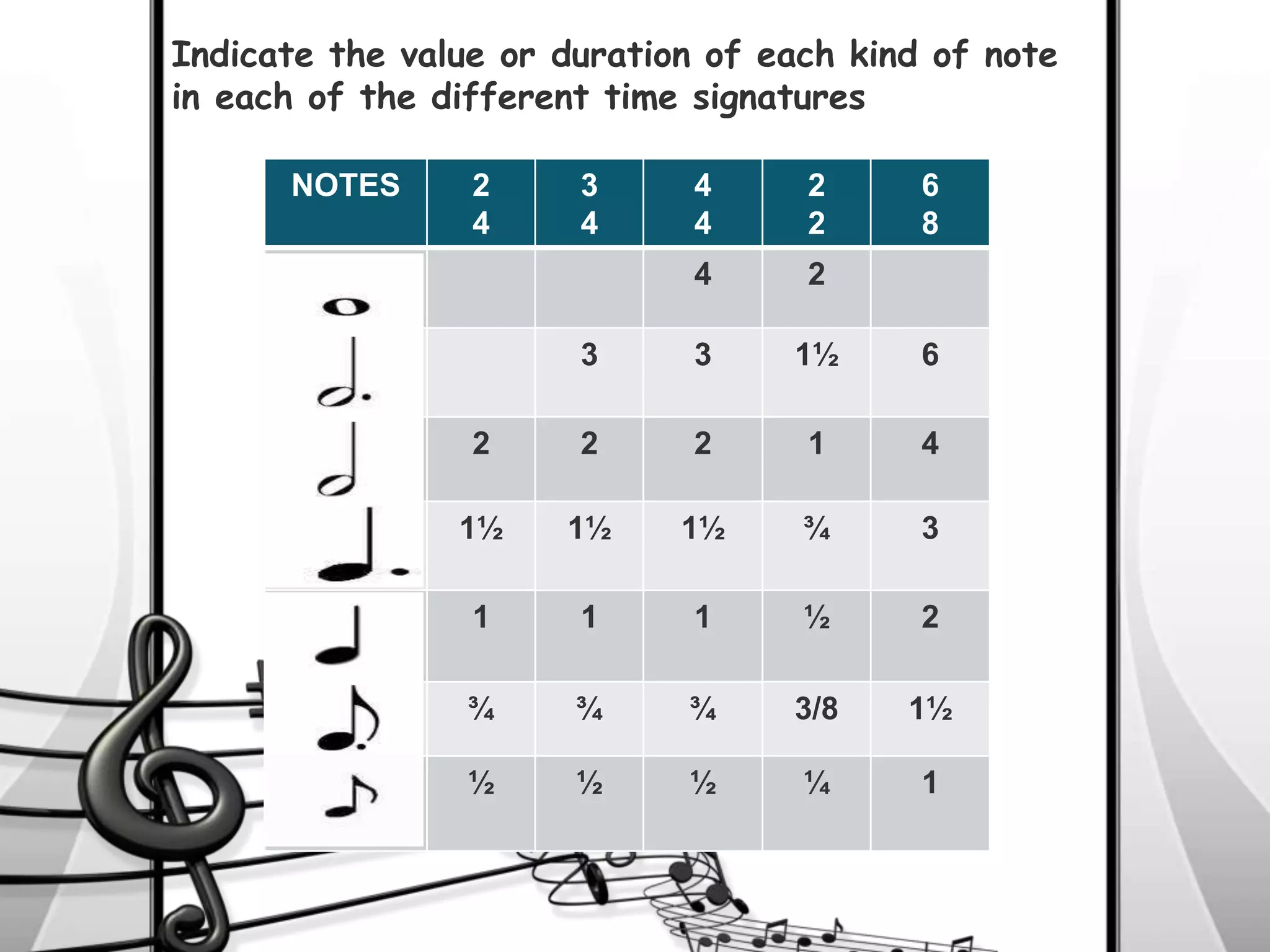
Indicate the value or duration of each kind of note
in each of the different time signatures
NOTES 2
4
3
4
4
4
2
2
6
8
4 2
3 3 1½ 6
2 2 2 1 4
1½ 1½ 1½ ¾ 3
1 1 1 ½ 2
¾ ¾ ¾ 3/8 1½
½ ½ ½ ¼ 1
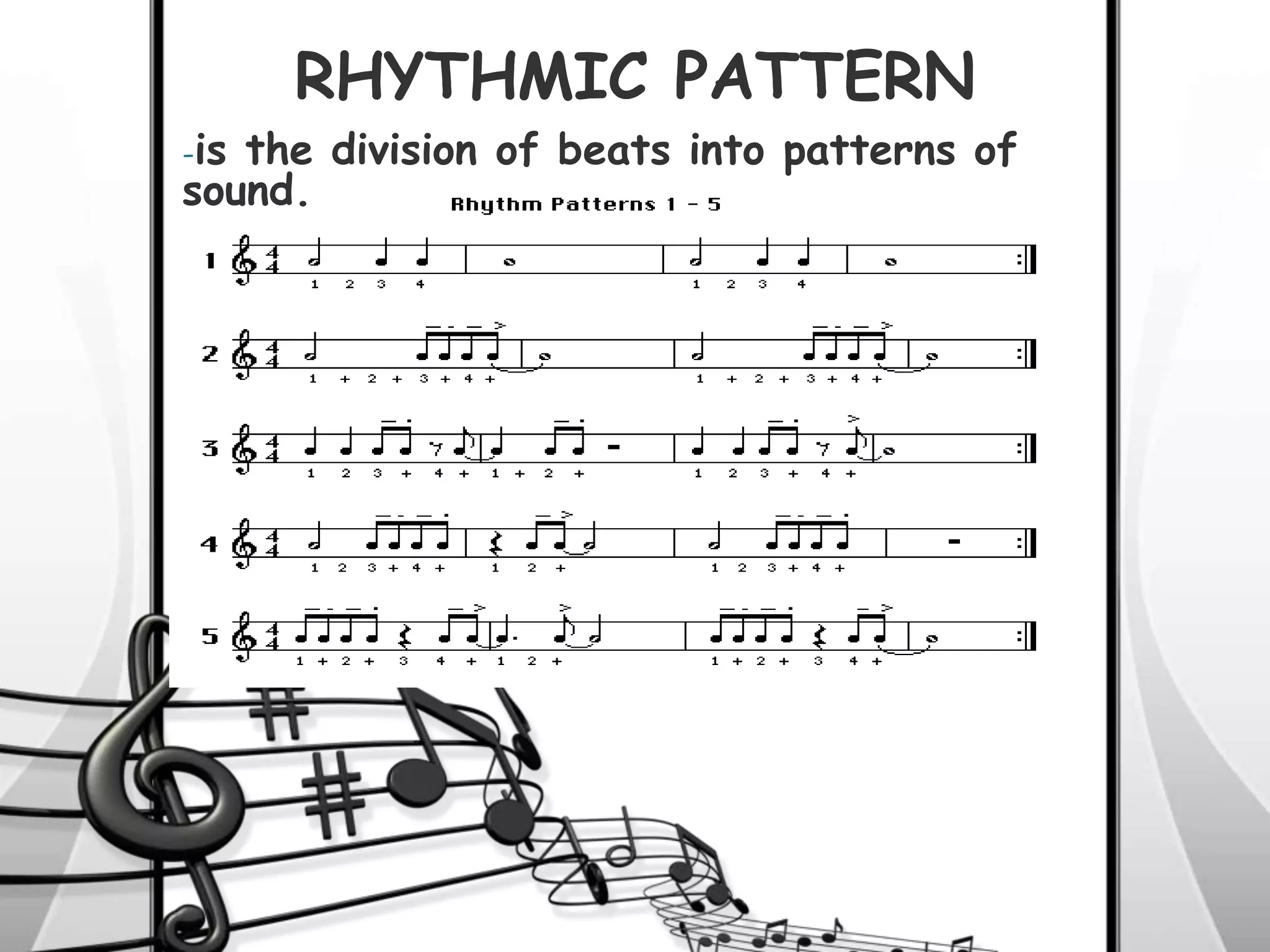
RHYTHMIC PATTERN
-is the division of beats into patterns of
sound.
ACTIVITY
A. CREATE A RAP/ SHORT POEM
AND PERFORM WITH A SIMPLE
BEAT.
B. SING A FOLK SONG AND MAKE
SIMPLE DANCE STEPS.
C. PERFORM AN ETHNIC DANCE
USING MATERIALS FROM THE
NATURE AS INSTRUMENT.
PITCH
Is the highness or
lowness of tone
which is determined
by the number of
vibration per second
The length of time
the tone last
DURATION
MELODY
> Is a succession of related single tones
expressing an idea.
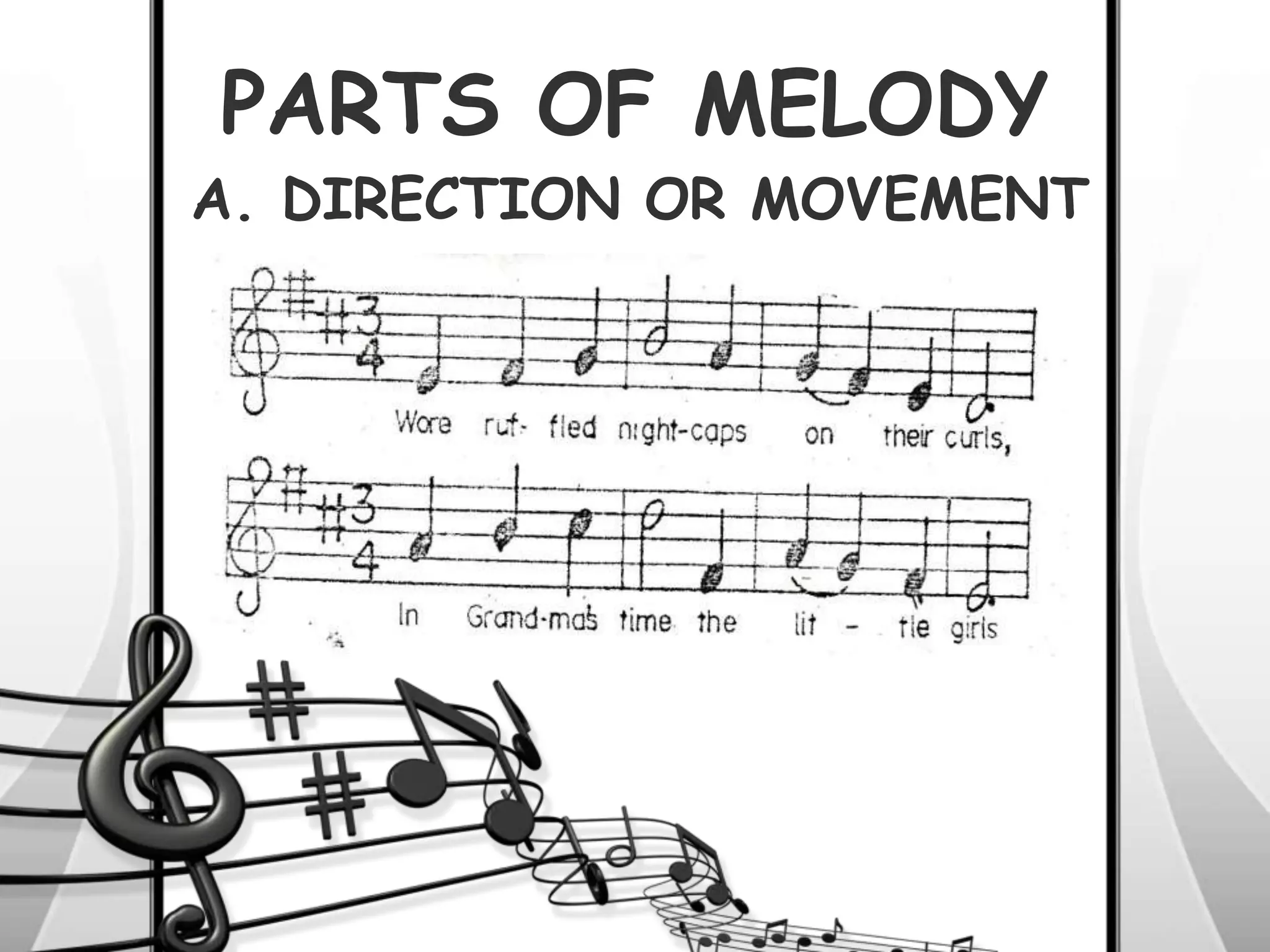
PARTS OF MELODY
A. DIRECTION OR MOVEMENT
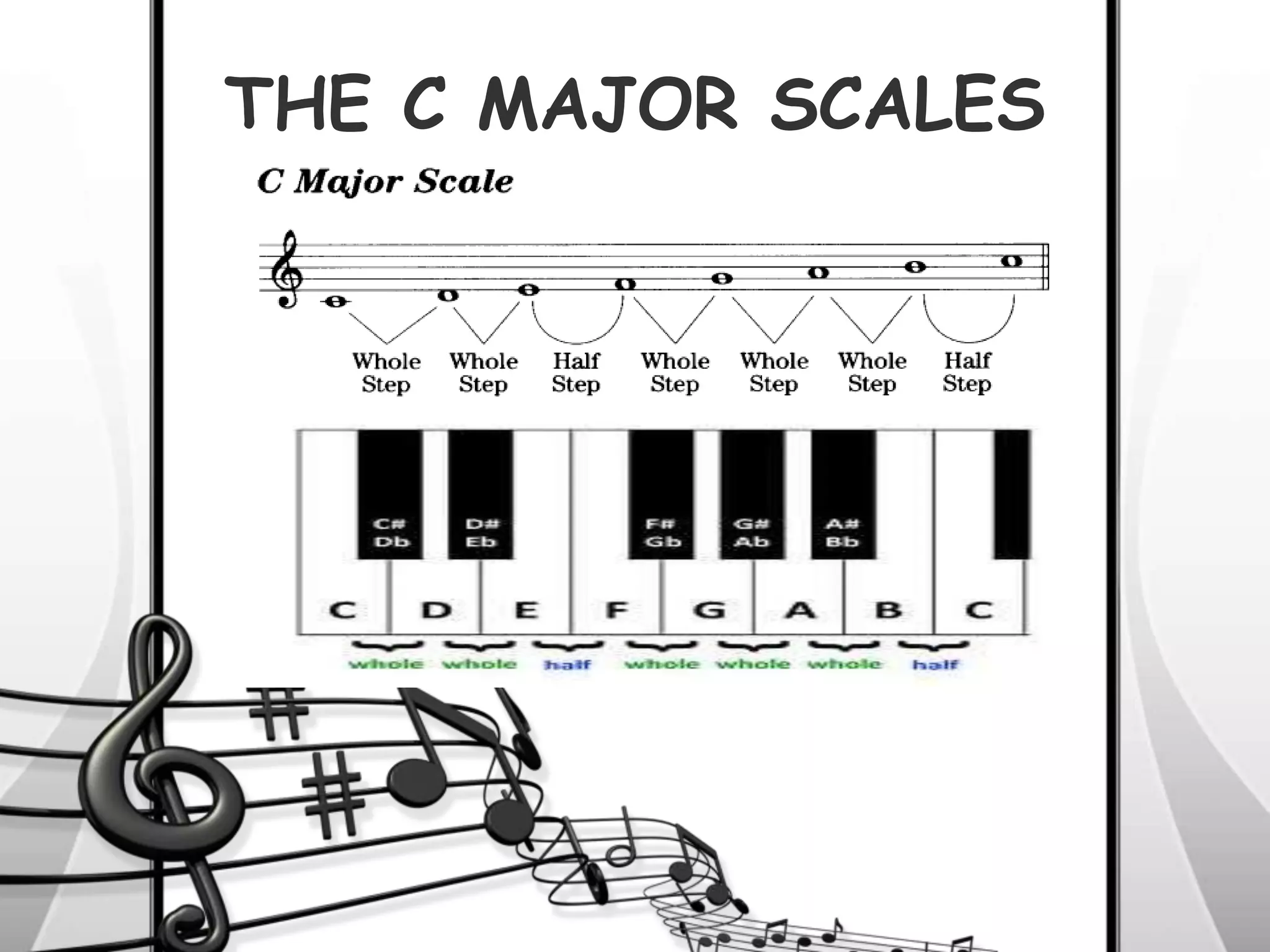
CHROMATIC SCALE
 Has twelve steps
and is formed
entirely of half
steps.
 Has eight steps
and is composed of
whole steps and half
steps
DIATONIC SCALE
B. SCALES
A succession of consecutive tones in a
certain arrangement of whole and half
steps generally embracing eight degrees
THE C MAJOR SCALES
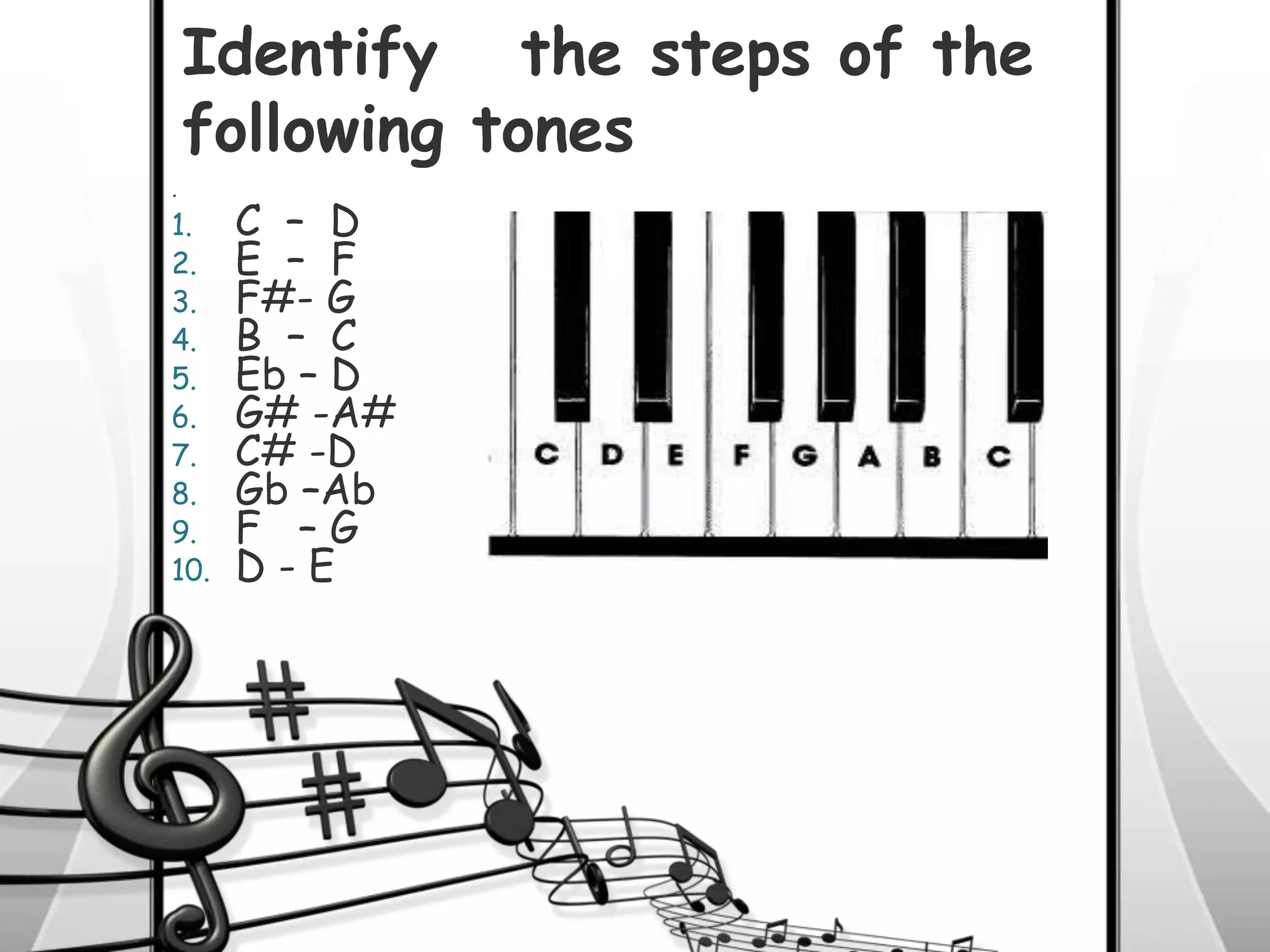
.
1. C – D
2. E – F
3. F#- G
4. B – C
5. Eb – D
6. G# -A#
7. C# -D
8. Gb –Ab
9. F – G
10. D - E
Identify the steps of the
following tones
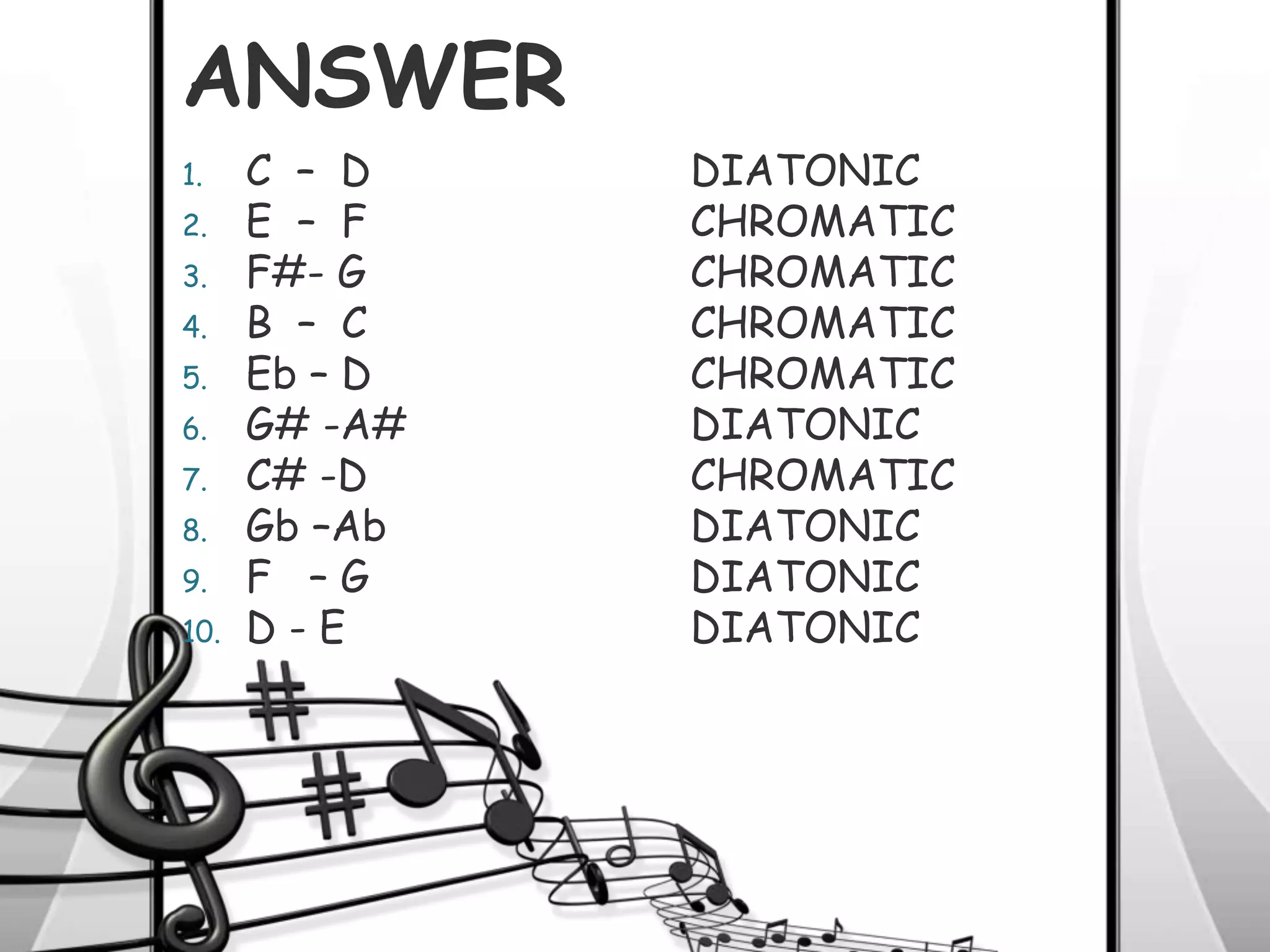
ANSWER
1. C – D DIATONIC
2. E – F CHROMATIC
3. F#- G CHROMATIC
4. B – C CHROMATIC
5. Eb – D CHROMATIC
6. G# -A# DIATONIC
7. C# -D CHROMATIC
8. Gb –Ab DIATONIC
9. F – G DIATONIC
10. D - E DIATONIC
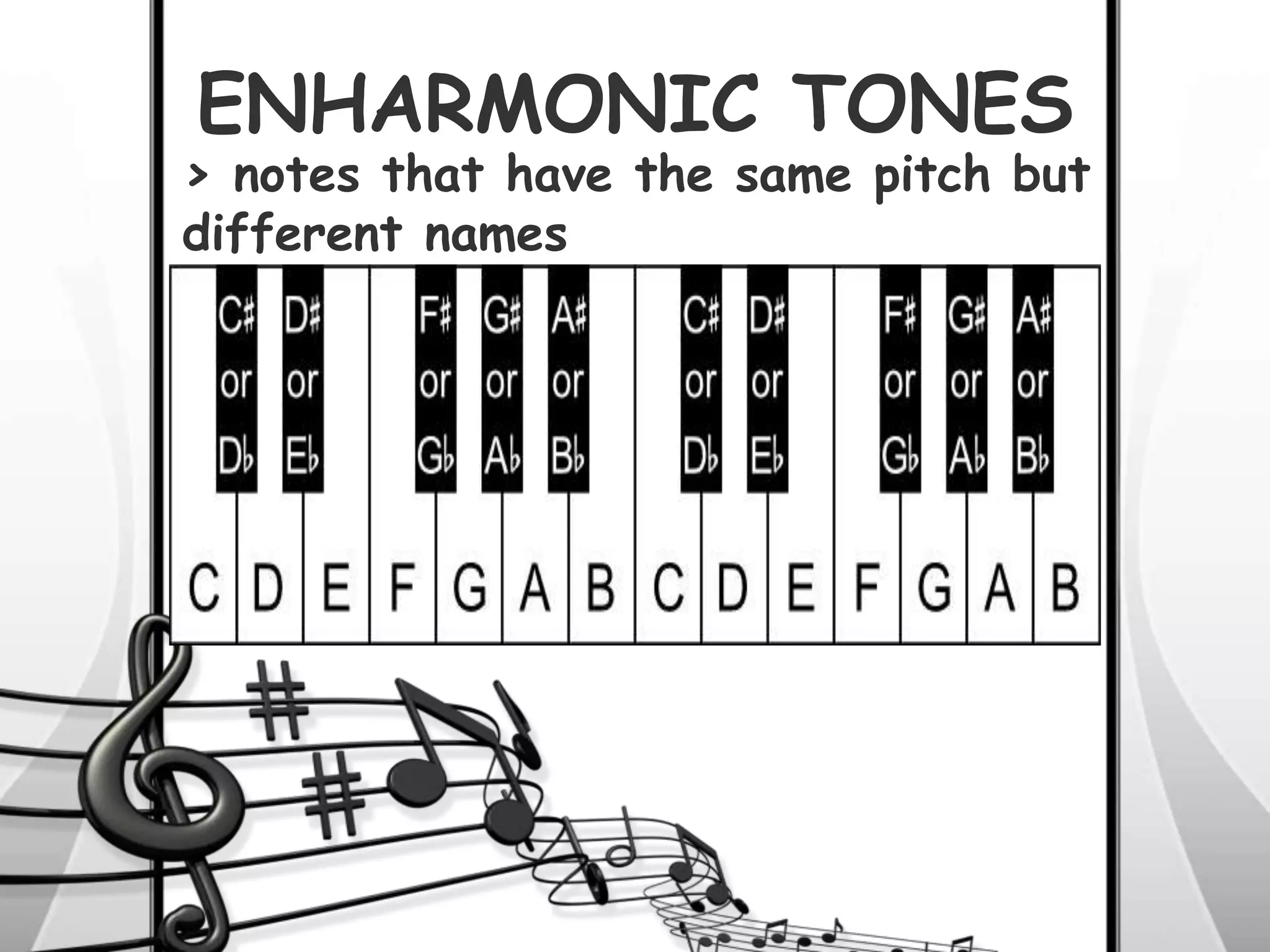
ENHARMONIC TONES
> notes that have the same pitch but
different names
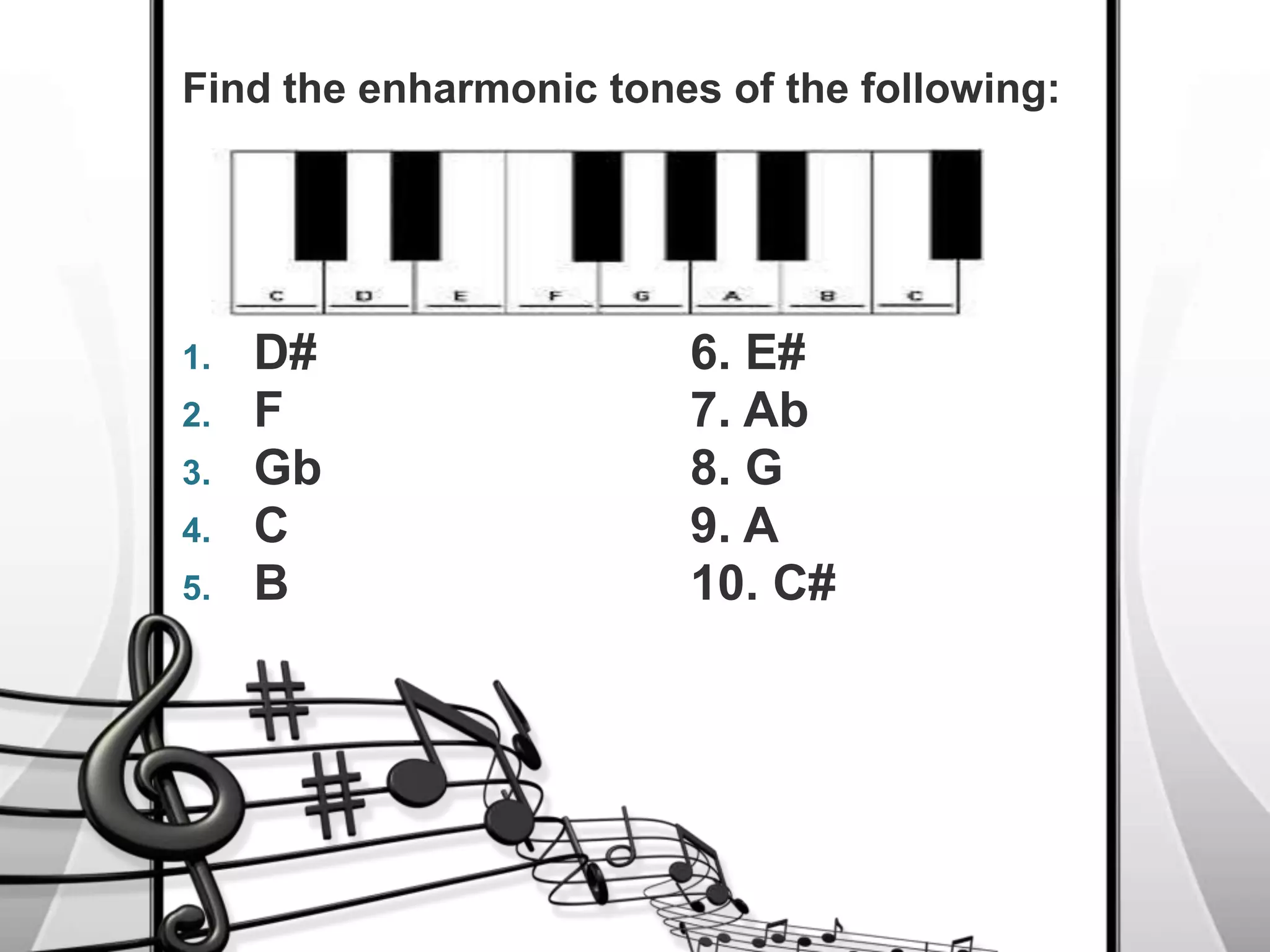
Find the enharmonic tones of the following:
1. D# 6. E#
2. F 7. Ab
3. Gb 8. G
4. C 9. A
5. B 10. C#
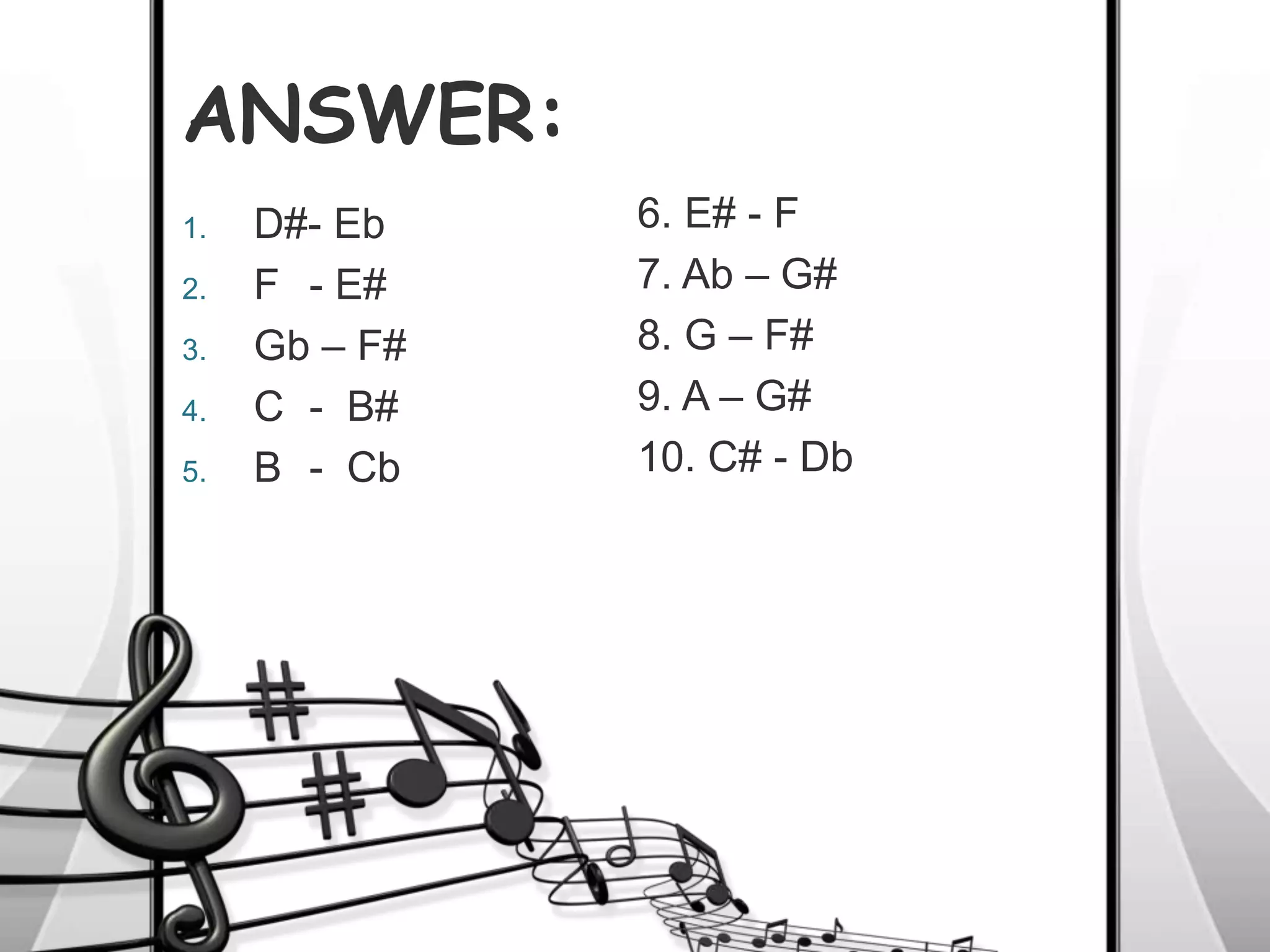
1. D#- Eb
2. F - E#
3. Gb – F#
4. C - B#
5. B - Cb
6. E# - F
7. Ab – G#
8. G – F#
9. A – G#
10. C# - Db
ANSWER:
KEY SIGNATURES
 is a series of sharp
or flat symbols placed at
the beginning of
the staff
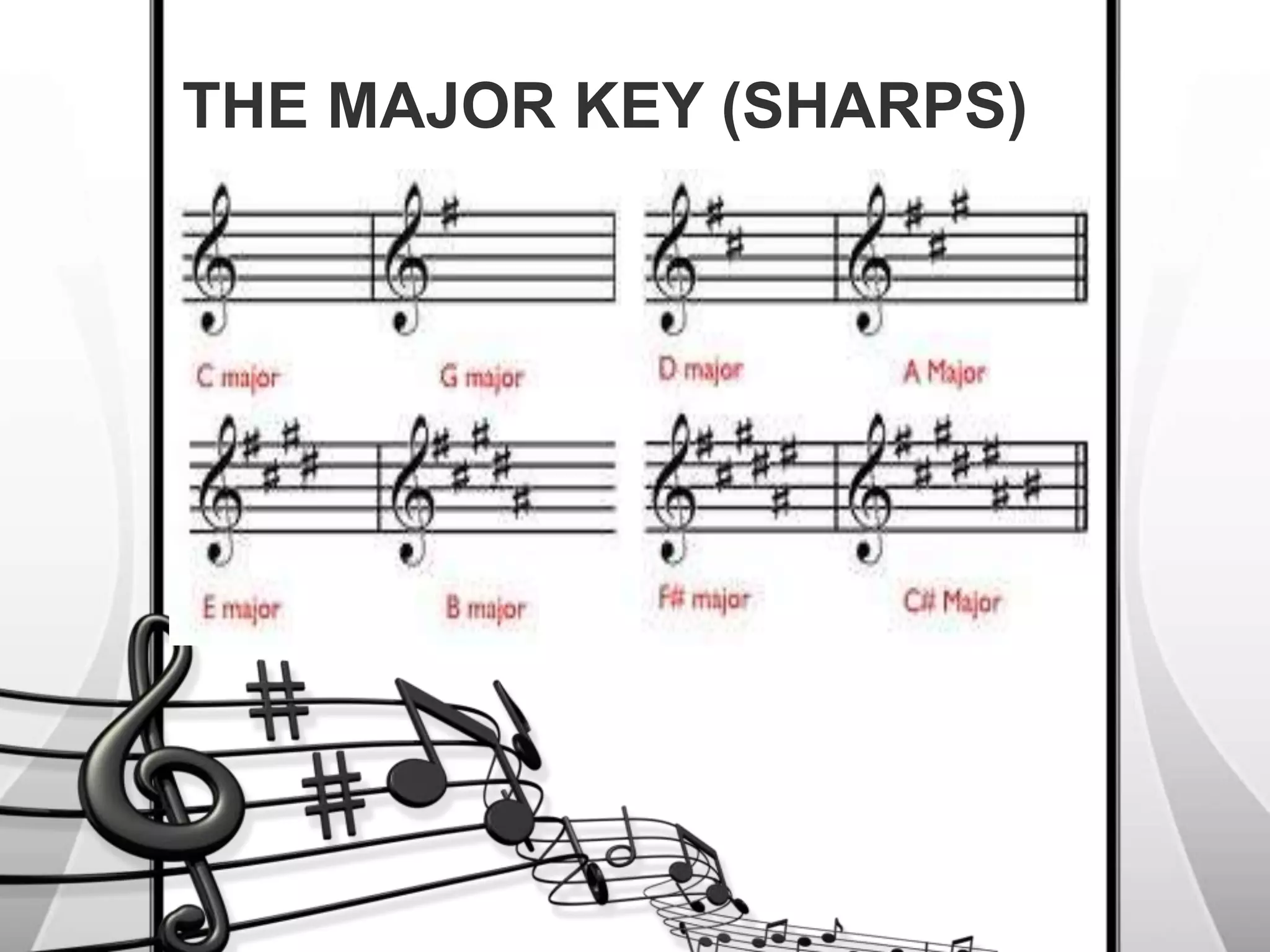
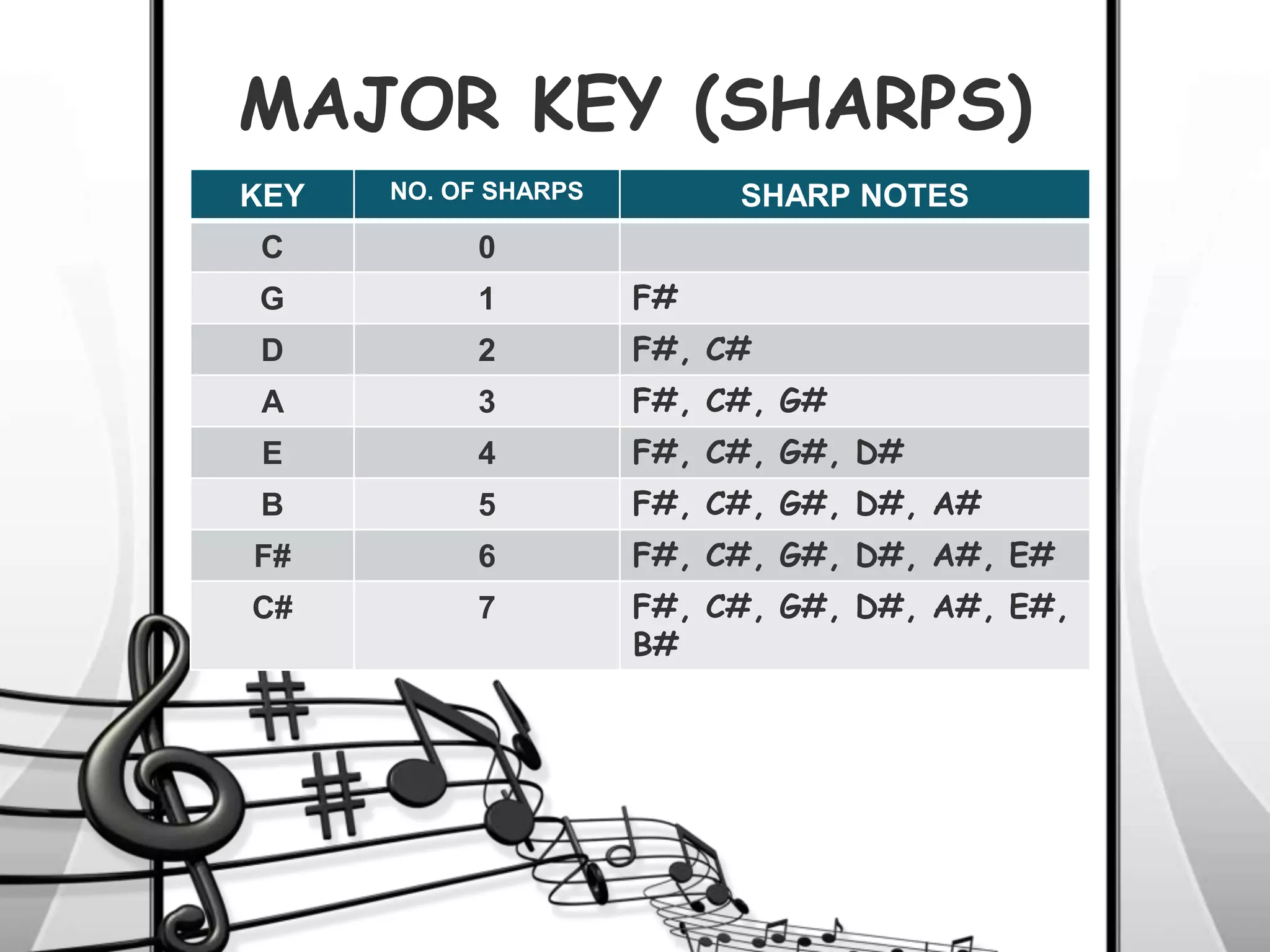
THE MAJOR KEY (SHARPS)
MAJOR KEY (SHARPS)
KEY NO. OF SHARPS SHARP NOTES
C 0
G 1 F#
D 2 F#, C#
A 3 F#, C#, G#
E 4 F#, C#, G#, D#
B 5 F#, C#, G#, D#, A#
F# 6 F#, C#, G#, D#, A#, E#
C# 7 F#, C#, G#, D#, A#, E#,
B#
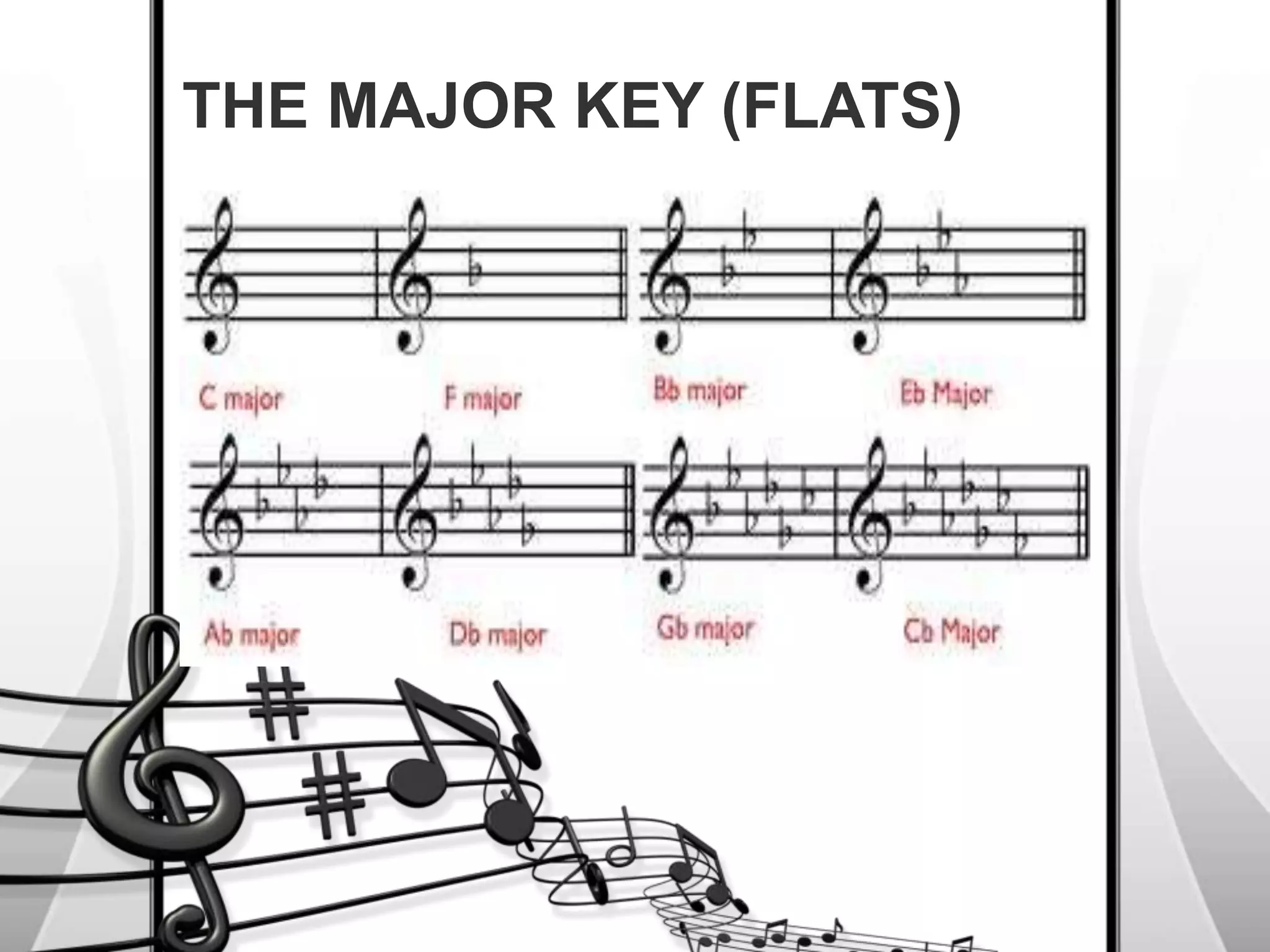
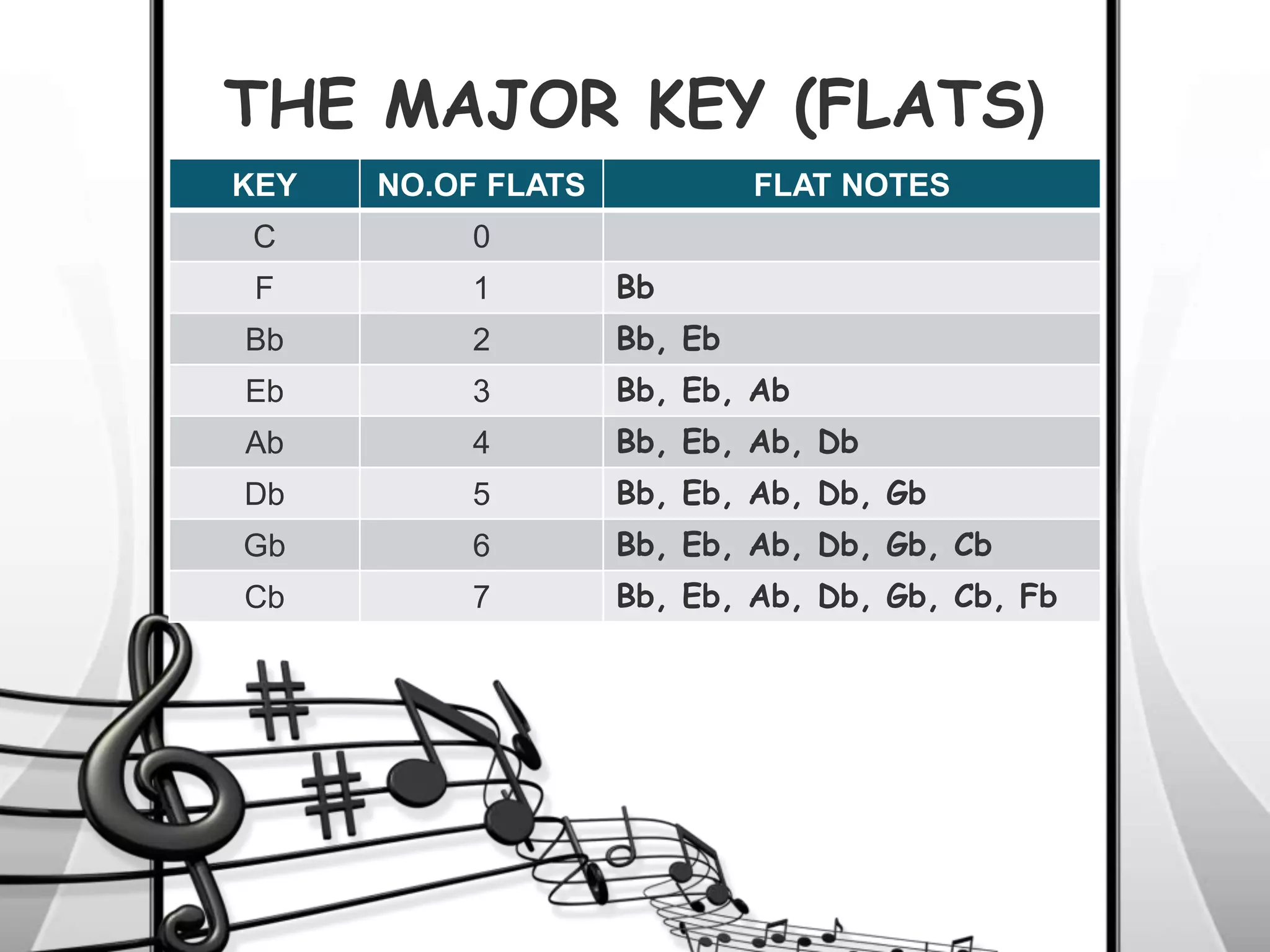
THE MAJOR KEY (FLATS)
KEY NO.OF FLATS FLAT NOTES
C 0
F 1 Bb
Bb 2 Bb, Eb
Eb 3 Bb, Eb, Ab
Ab 4 Bb, Eb, Ab, Db
Db 5 Bb, Eb, Ab, Db, Gb
Gb 6 Bb, Eb, Ab, Db, Gb, Cb
Cb 7 Bb, Eb, Ab, Db, Gb, Cb, Fb
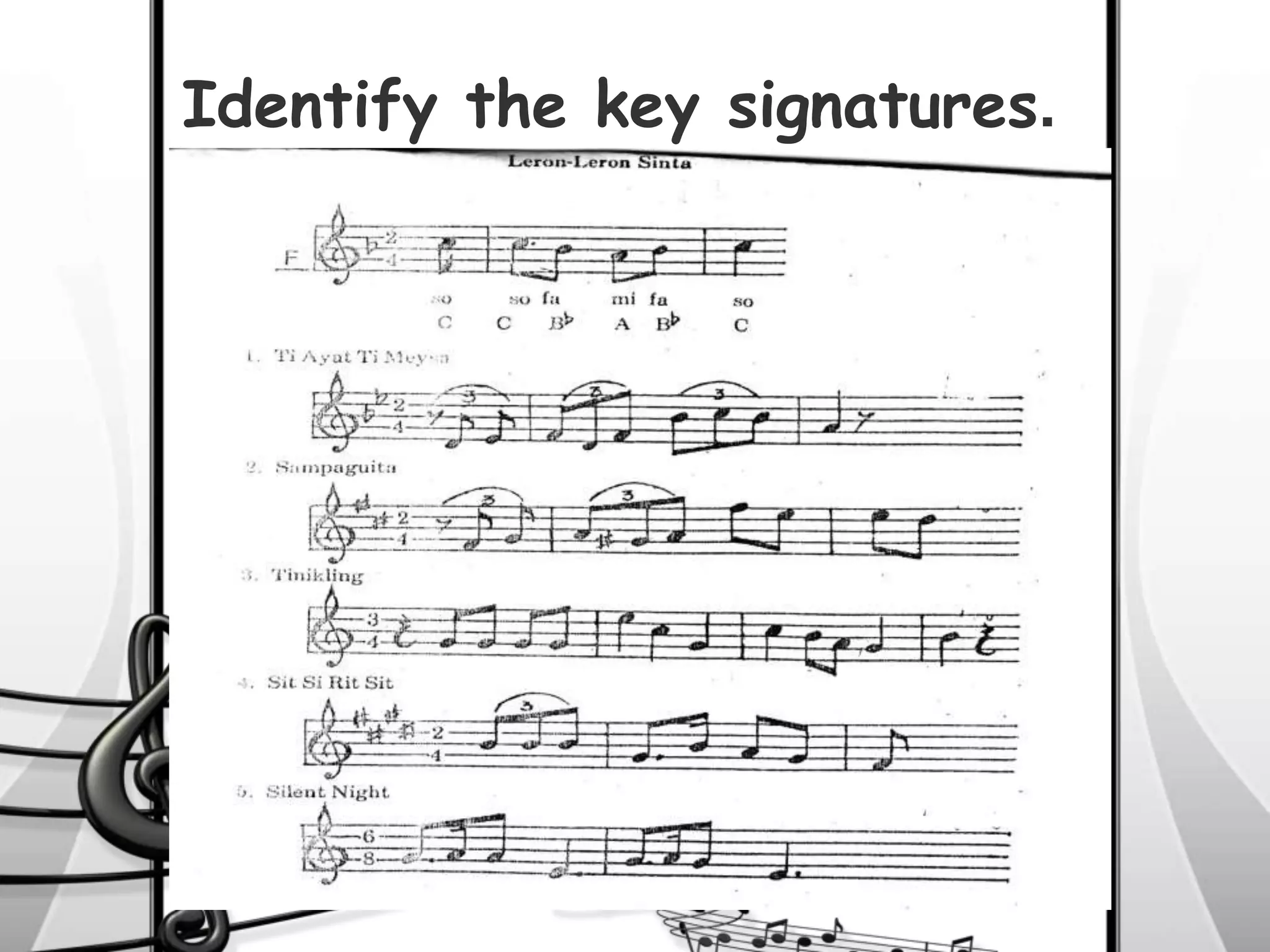
Identify the key signatures.
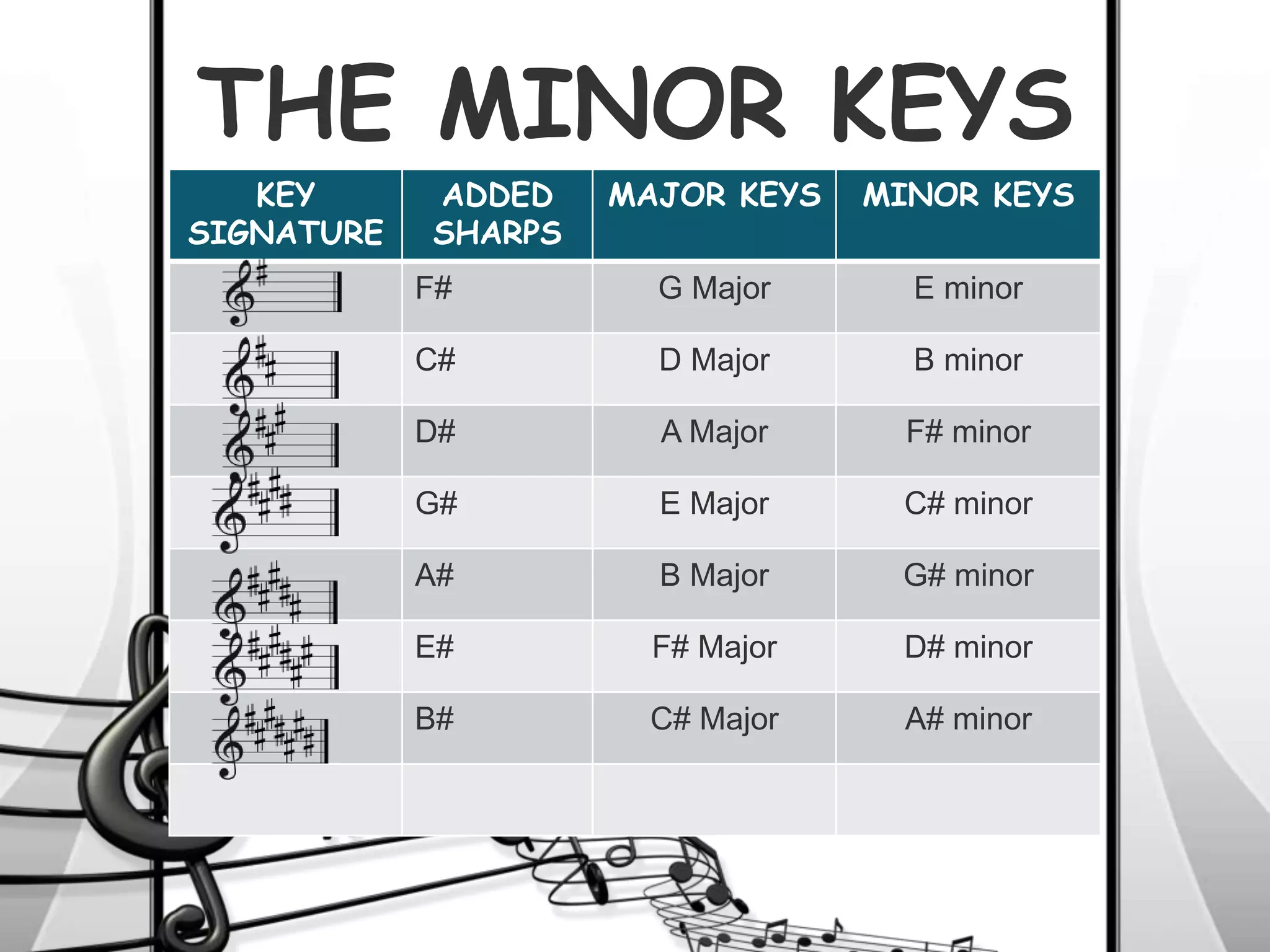
THE MINOR KEYS
KEY
SIGNATURE
ADDED
SHARPS
MAJOR KEYS MINOR KEYS
F# G Major E minor
C# D Major B minor
D# A Major F# minor
G# E Major C# minor
A# B Major G# minor
E# F# Major D# minor
B# C# Major A# minor
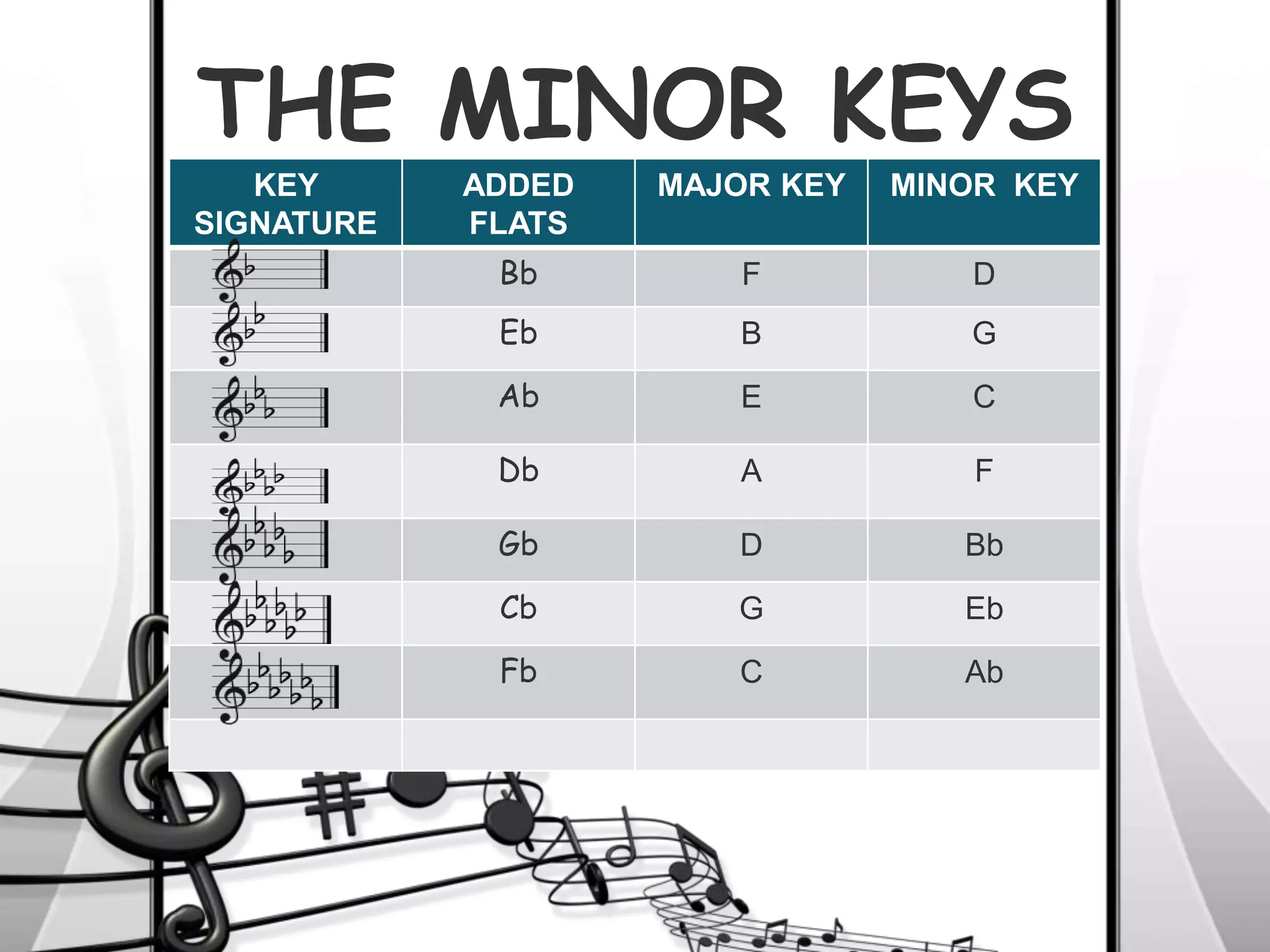
THE MINOR KEYS
KEY
SIGNATURE
ADDED
FLATS
MAJOR KEY MINOR KEY
Bb F D
Eb B G
Ab E C
Db A F
Gb D Bb
Cb G Eb
Fb C Ab
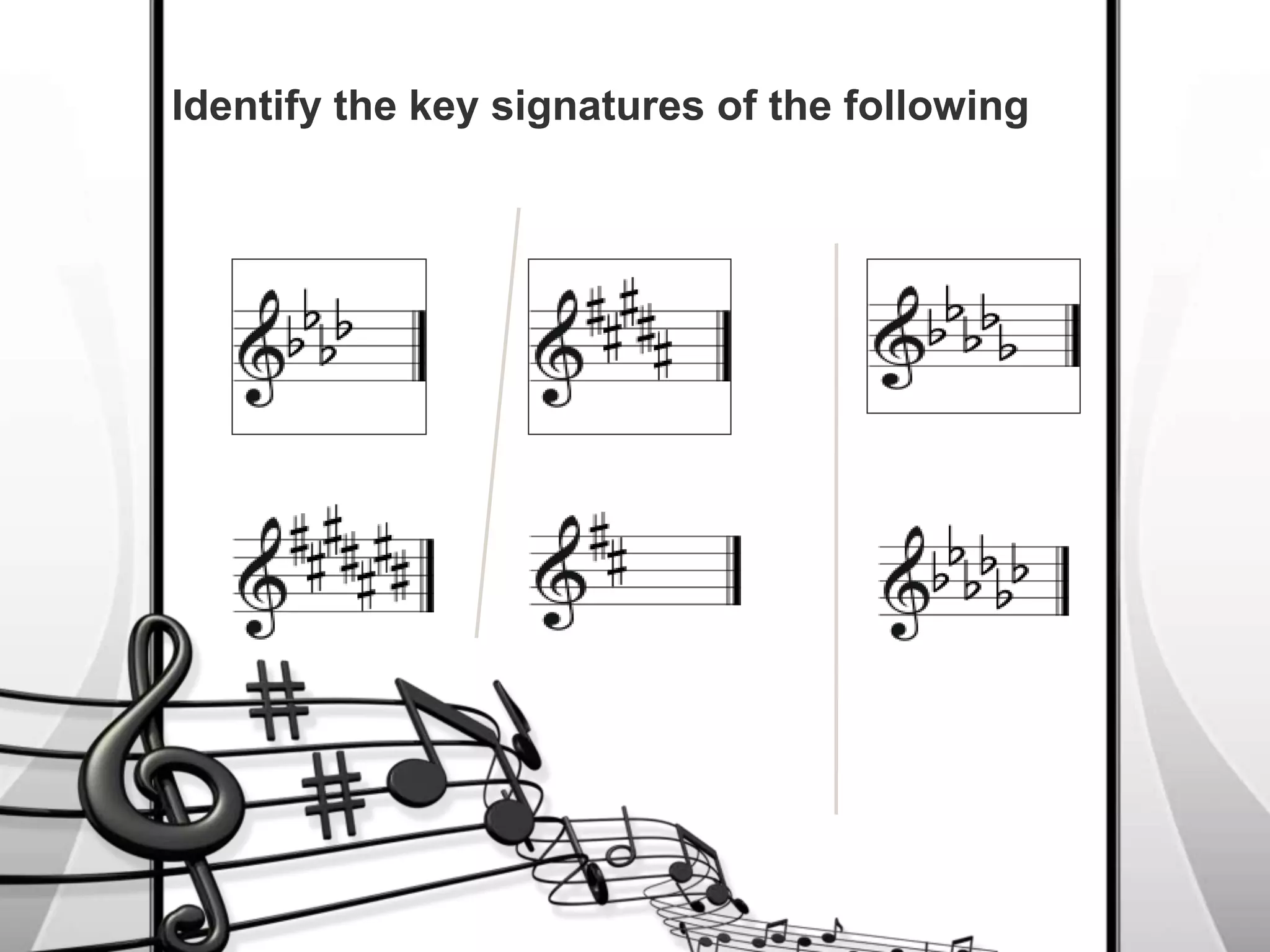
Identify the key signatures of the following
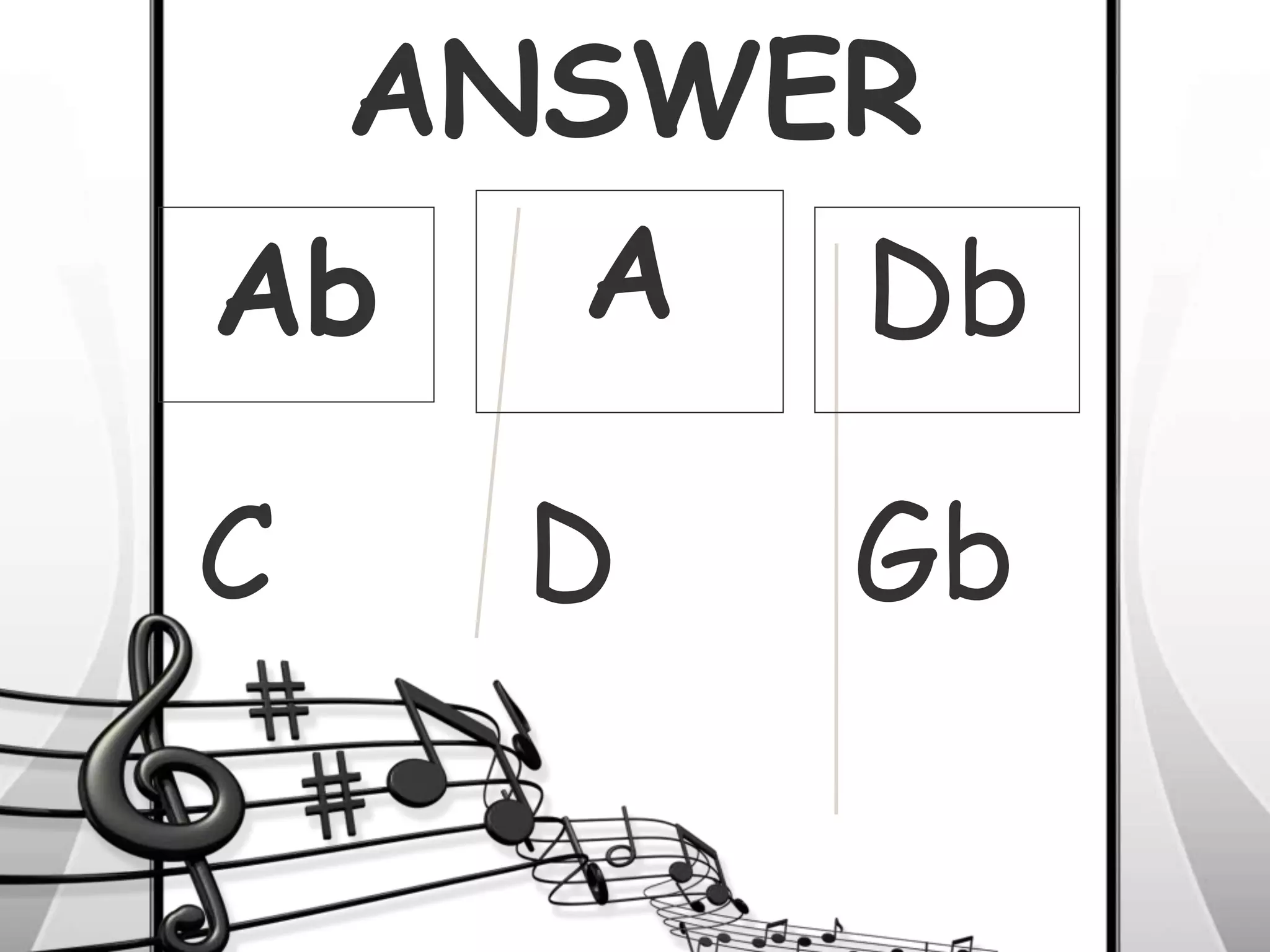
ANSWER
C D Gb
Ab A Db
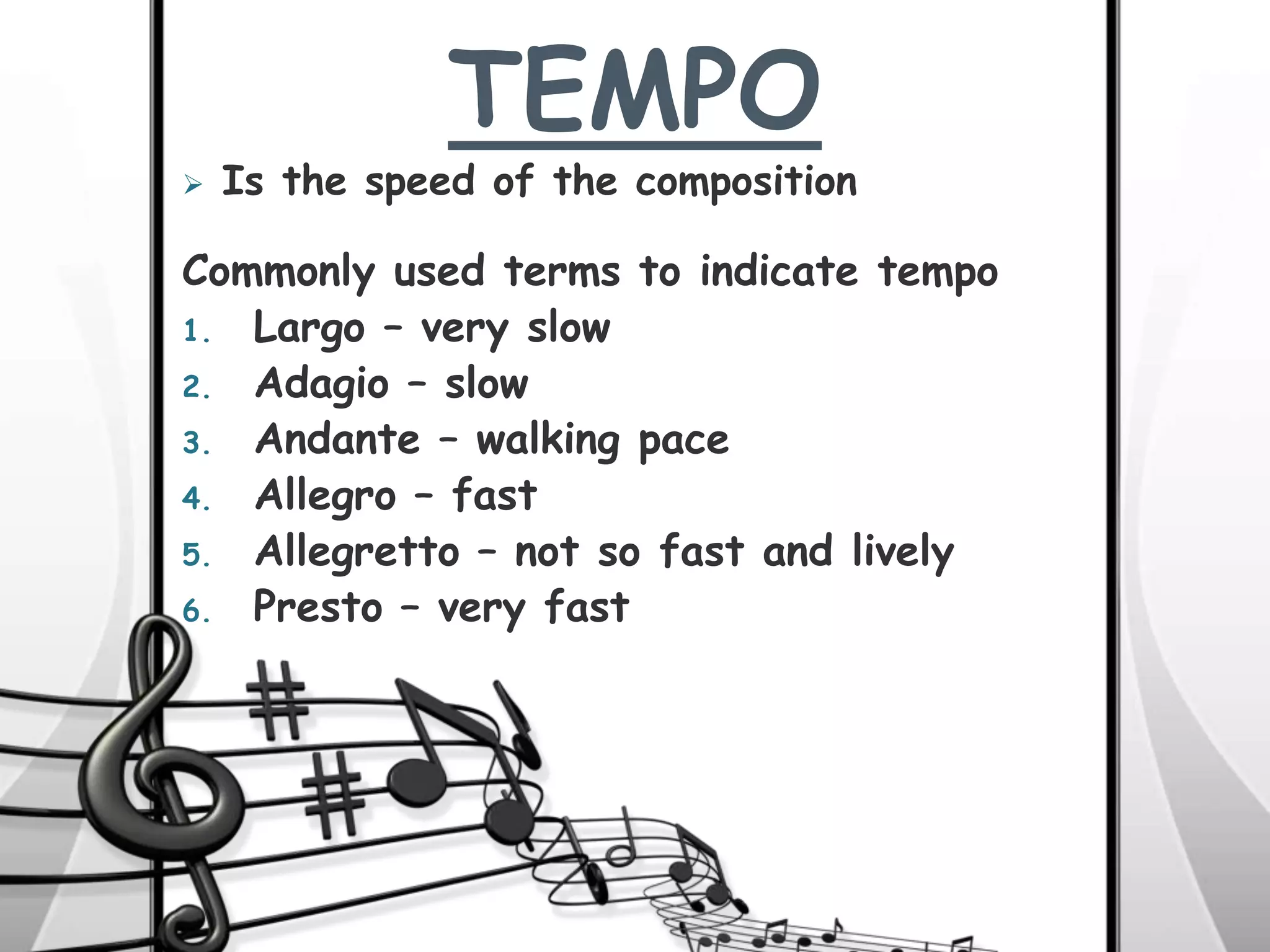
TEMPO
Commonly used terms to indicate tempo
1. Largo – very slow
2. Adagio – slow
3. Andante – walking pace
4. Allegro – fast
5. Allegretto – not so fast and lively
6. Presto – very fast
 Is the speed of the composition
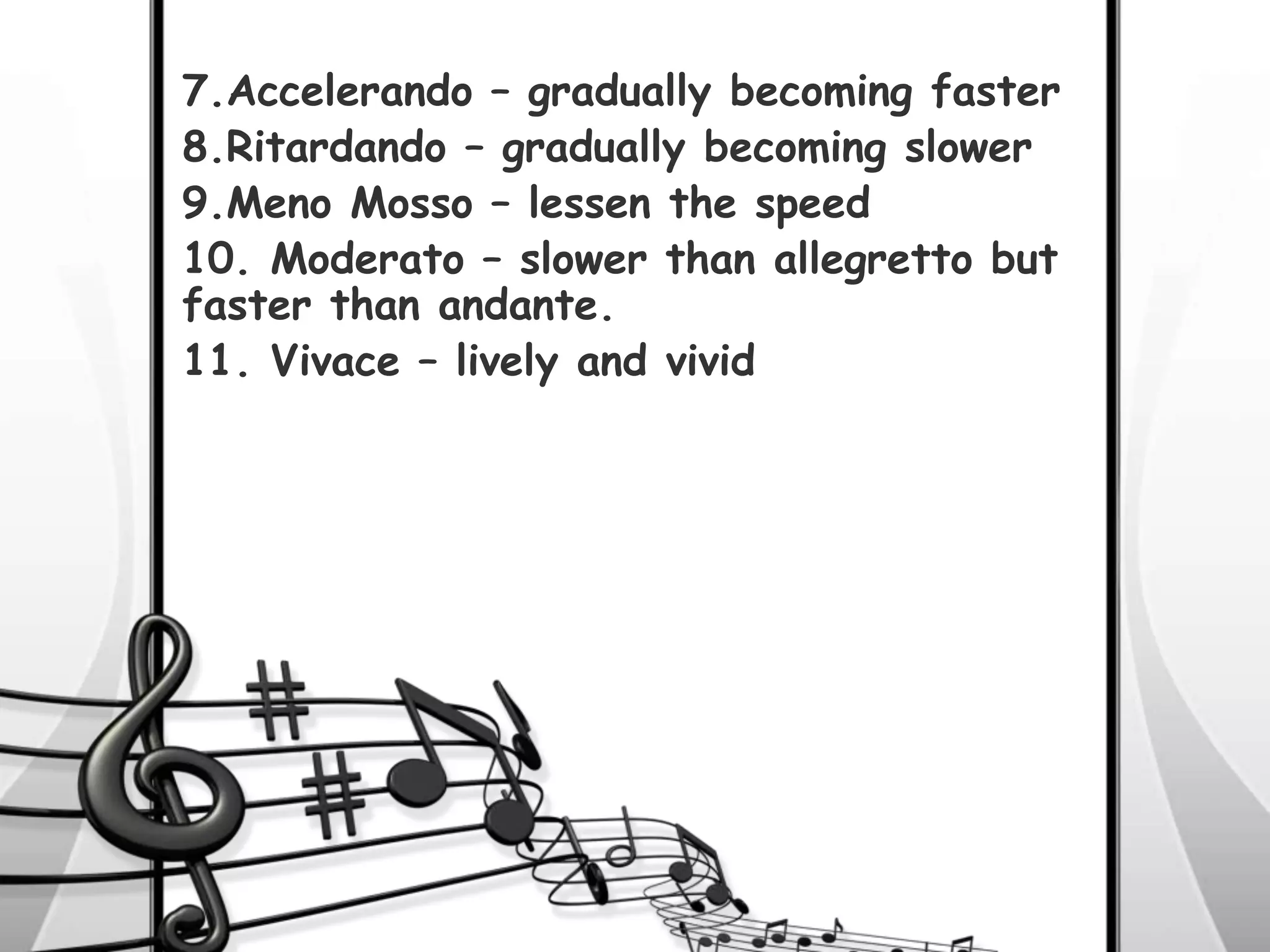
7.Accelerando – gradually becoming faster
8.Ritardando – gradually becoming slower
9.Meno Mosso – lessen the speed
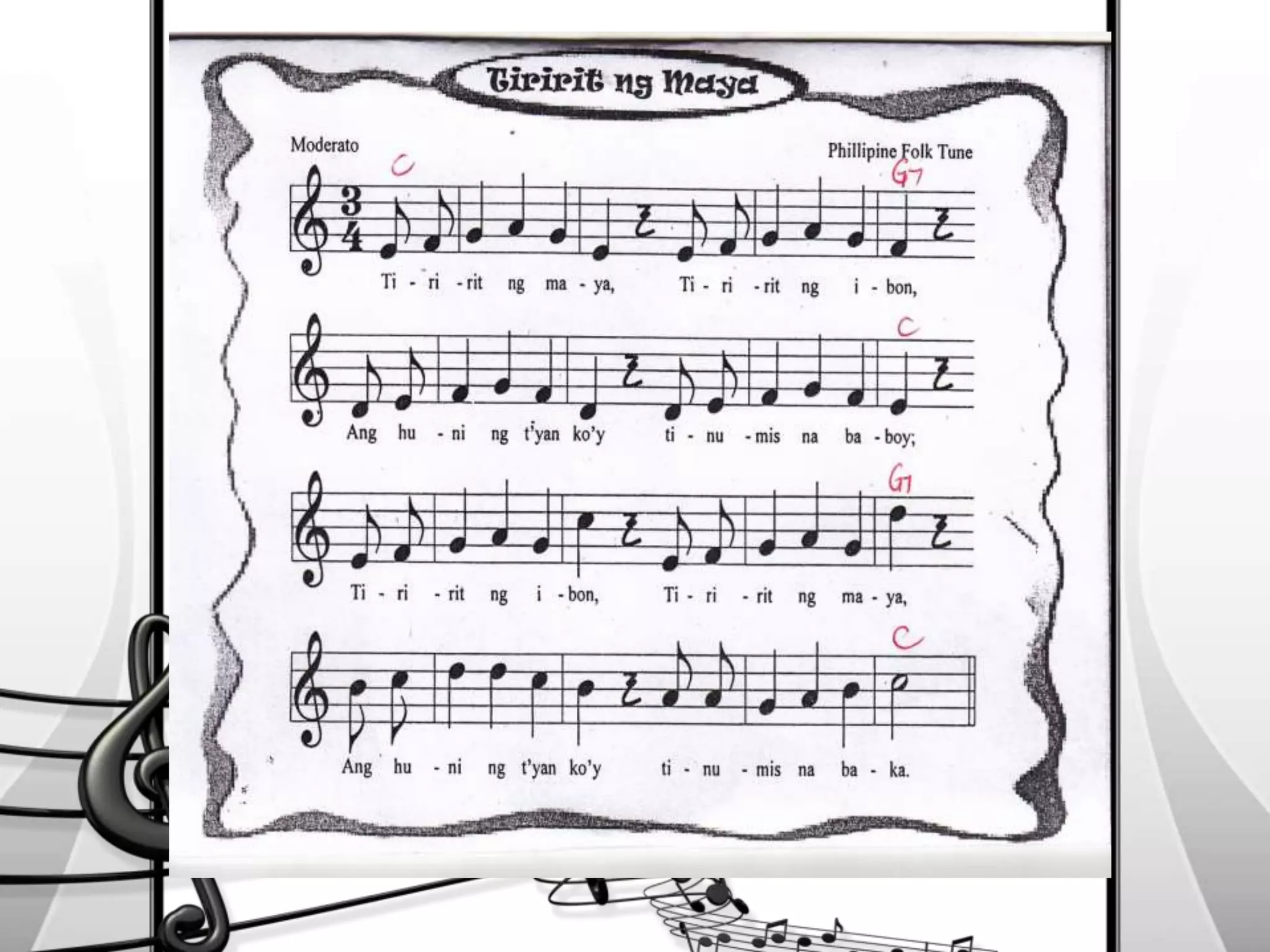
10. Moderato – slower than allegretto but
faster than andante.
11. Vivace – lively and vivid
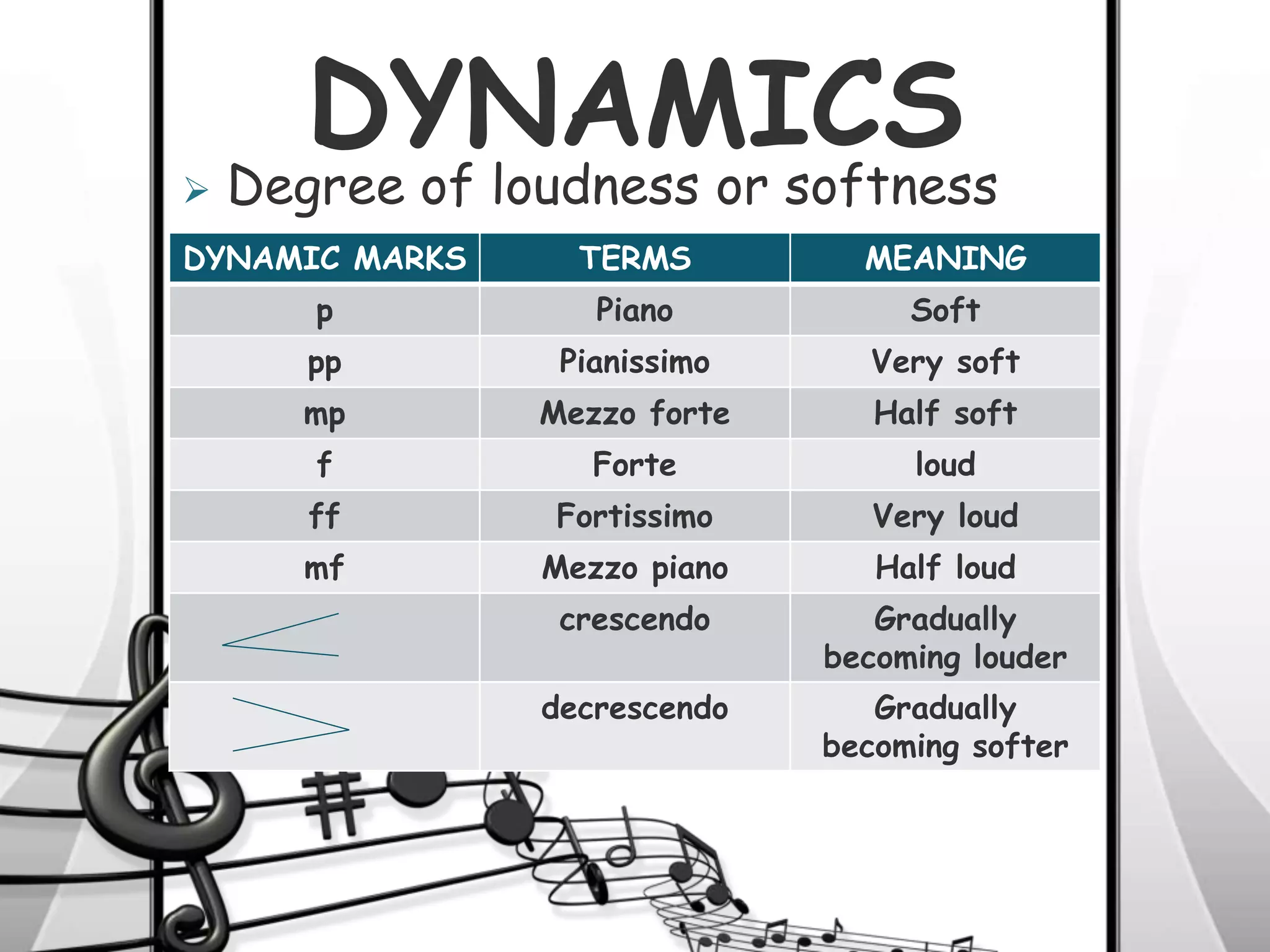
DYNAMICS
DYNAMIC MARKS TERMS MEANING
p Piano Soft
pp Pianissimo Very soft
mp Mezzo forte Half soft
f Forte loud
ff Fortissimo Very loud
mf Mezzo piano Half loud
crescendo Gradually
becoming louder
decrescendo Gradually
becoming softer
 Degree of loudness or softness
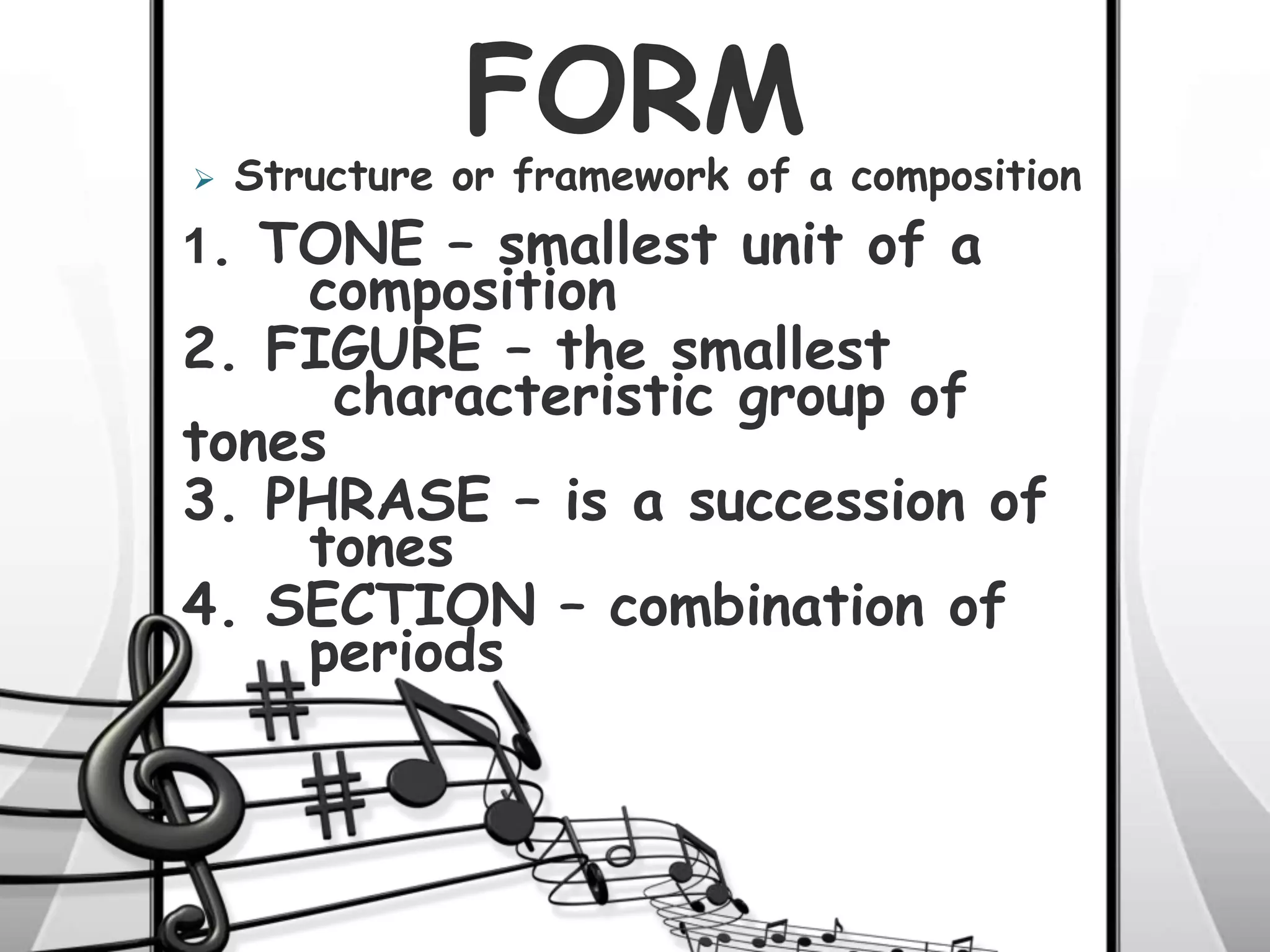
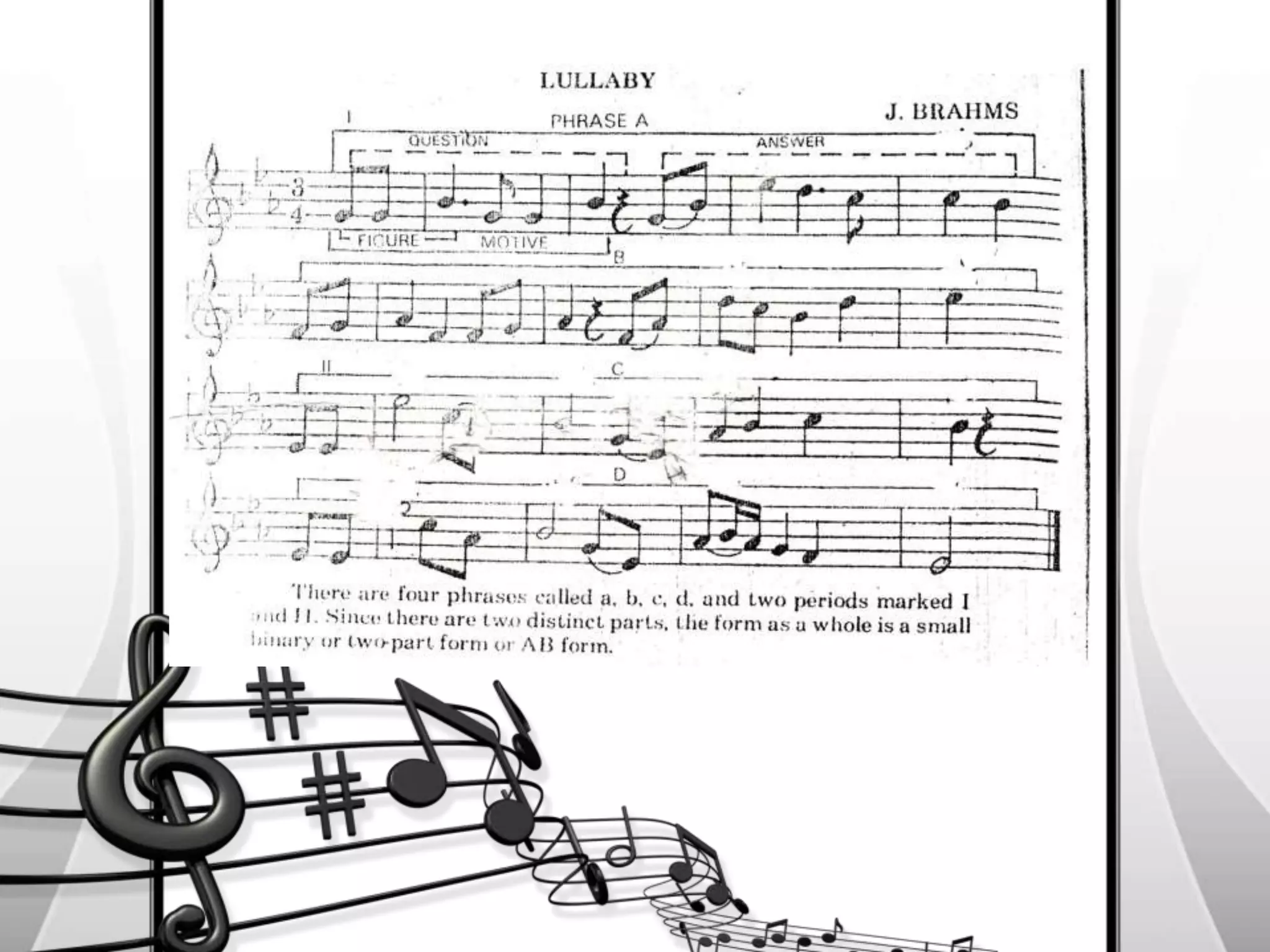
FORM
1. TONE – smallest unit of a
composition
2. FIGURE – the smallest
characteristic group of
tones
3. PHRASE – is a succession of
tones
4. SECTION – combination of
periods
 Structure or framework of a composition
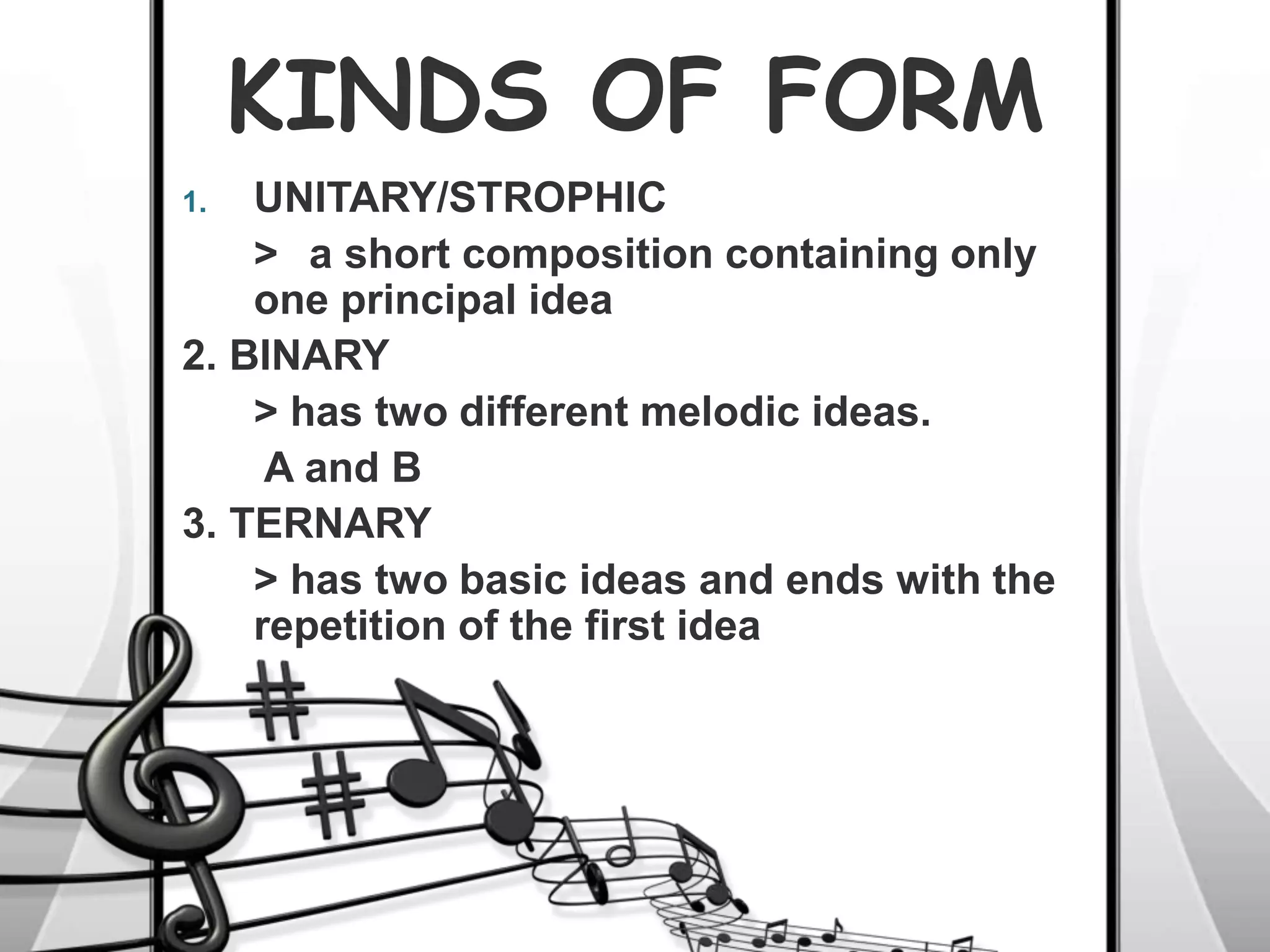
KINDS OF FORM
1. UNITARY/STROPHIC
> a short composition containing only
one principal idea
2. BINARY
> has two different melodic ideas.
A and B
3. TERNARY
> has two basic ideas and ends with the
repetition of the first idea
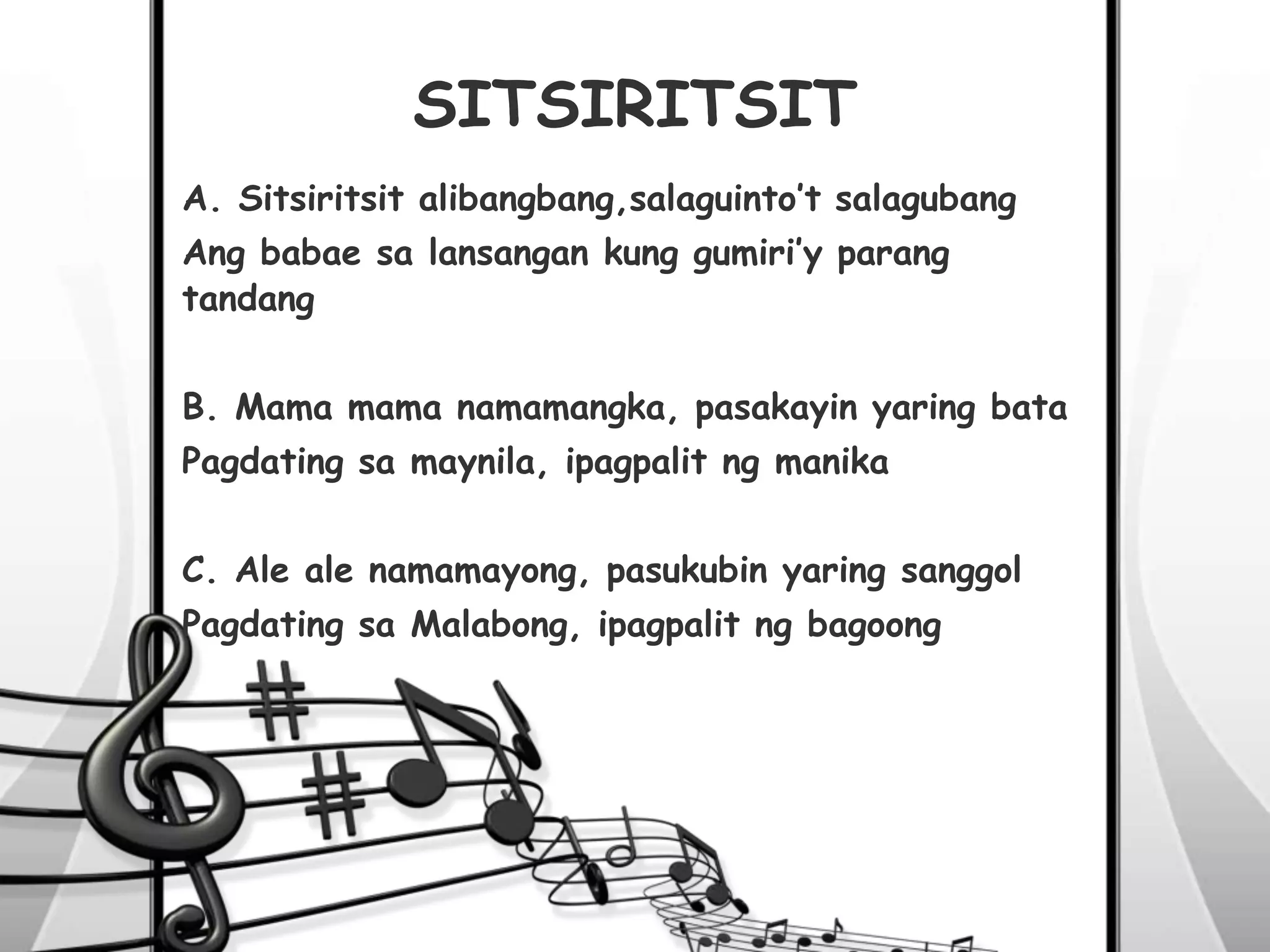
SITSIRITSIT
A. Sitsiritsit alibangbang,salaguinto’t salagubang
Ang babae sa lansangan kung gumiri’y parang
tandang
B. Mama mama namamangka, pasakayin yaring bata
Pagdating sa maynila, ipagpalit ng manika
C. Ale ale namamayong, pasukubin yaring sanggol
Pagdating sa Malabong, ipagpalit ng bagoong
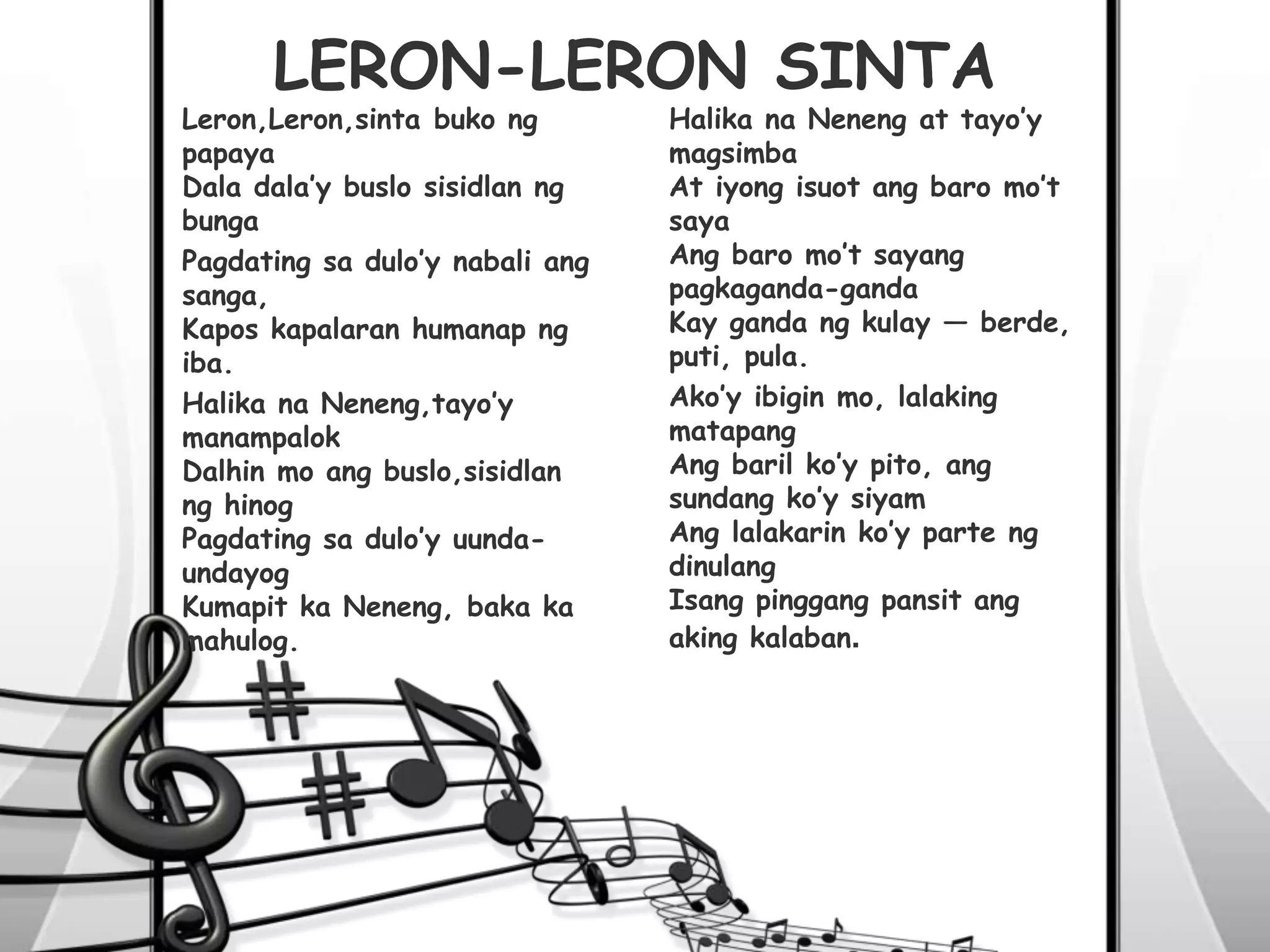
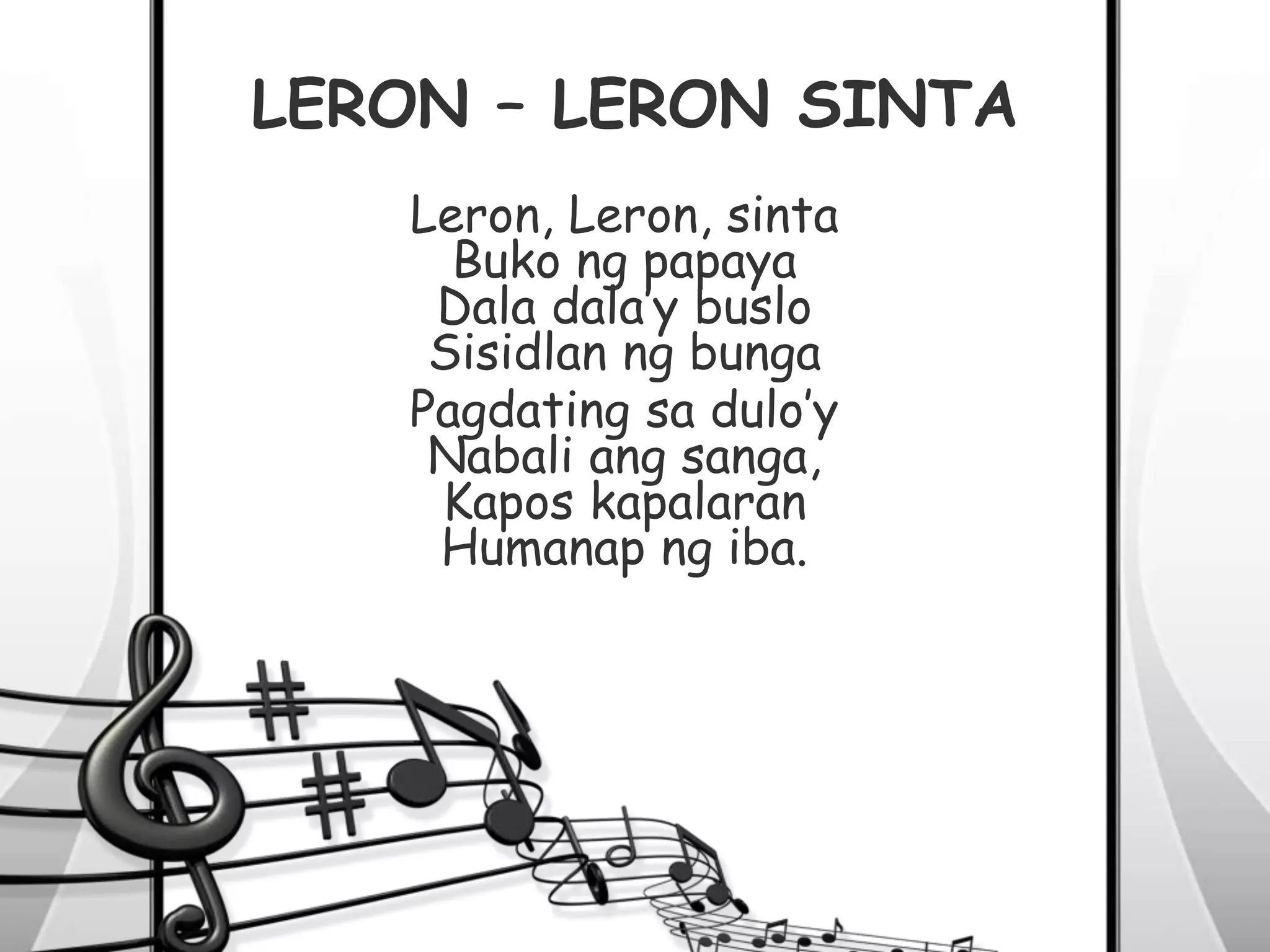
Leron,Leron,sinta buko ng
papaya
Dala dala’y buslo sisidlan ng
bunga
Pagdating sa dulo’y nabali ang
sanga,
Kapos kapalaran humanap ng
iba.
Halika na Neneng,tayo’y
manampalok
Dalhin mo ang buslo,sisidlan
ng hinog
Pagdating sa dulo’y uunda-
undayog
Kumapit ka Neneng, baka ka
mahulog.
Halika na Neneng at tayo’y
magsimba
At iyong isuot ang baro mo’t
saya
Ang baro mo’t sayang
pagkaganda-ganda
Kay ganda ng kulay — berde,
puti, pula.
Ako’y ibigin mo, lalaking
matapang
Ang baril ko’y pito, ang
sundang ko’y siyam
Ang lalakarin ko’y parte ng
dinulang
Isang pinggang pansit ang
aking kalaban.
LERON-LERON SINTA
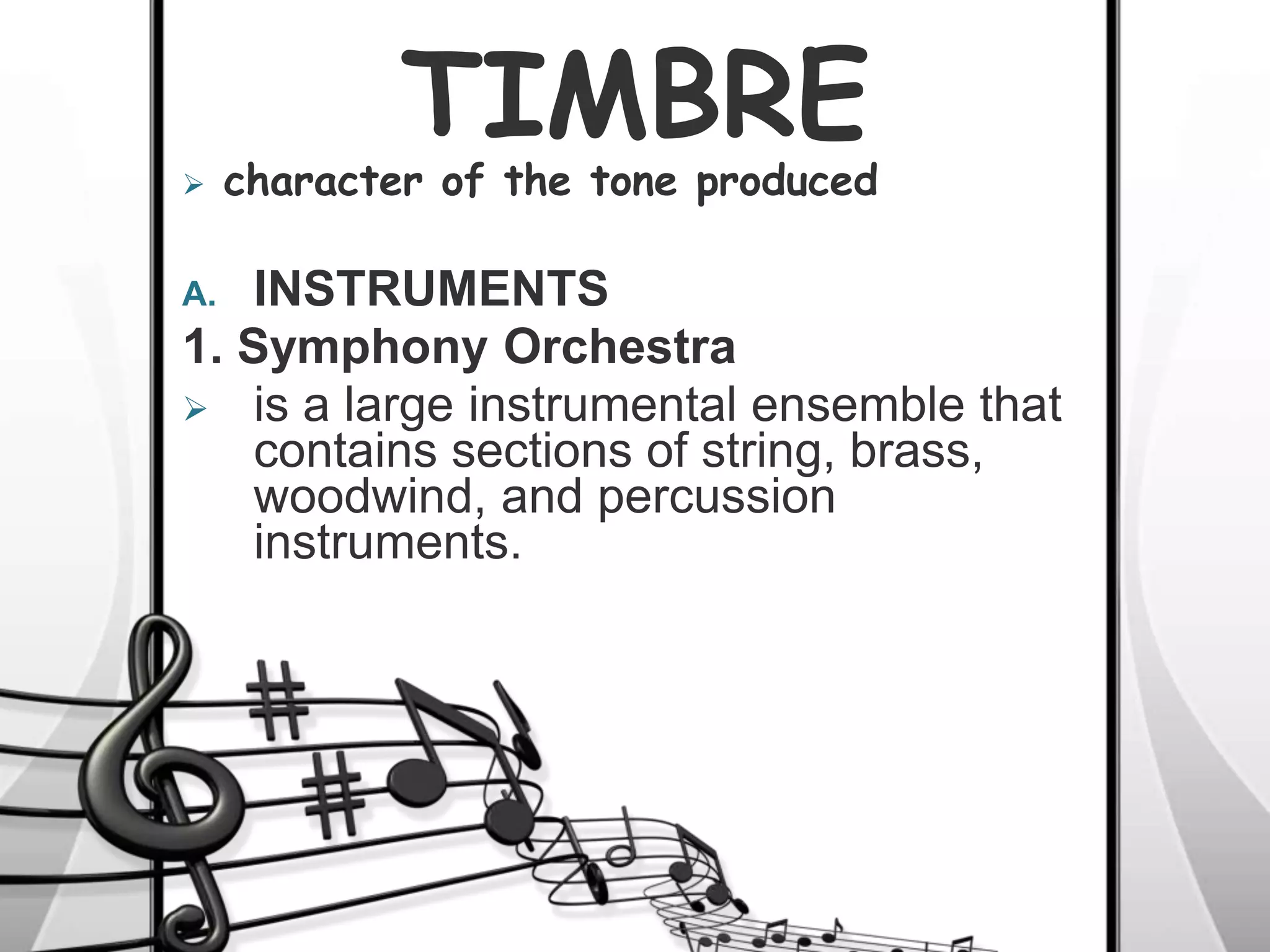
TIMBRE
A. INSTRUMENTS
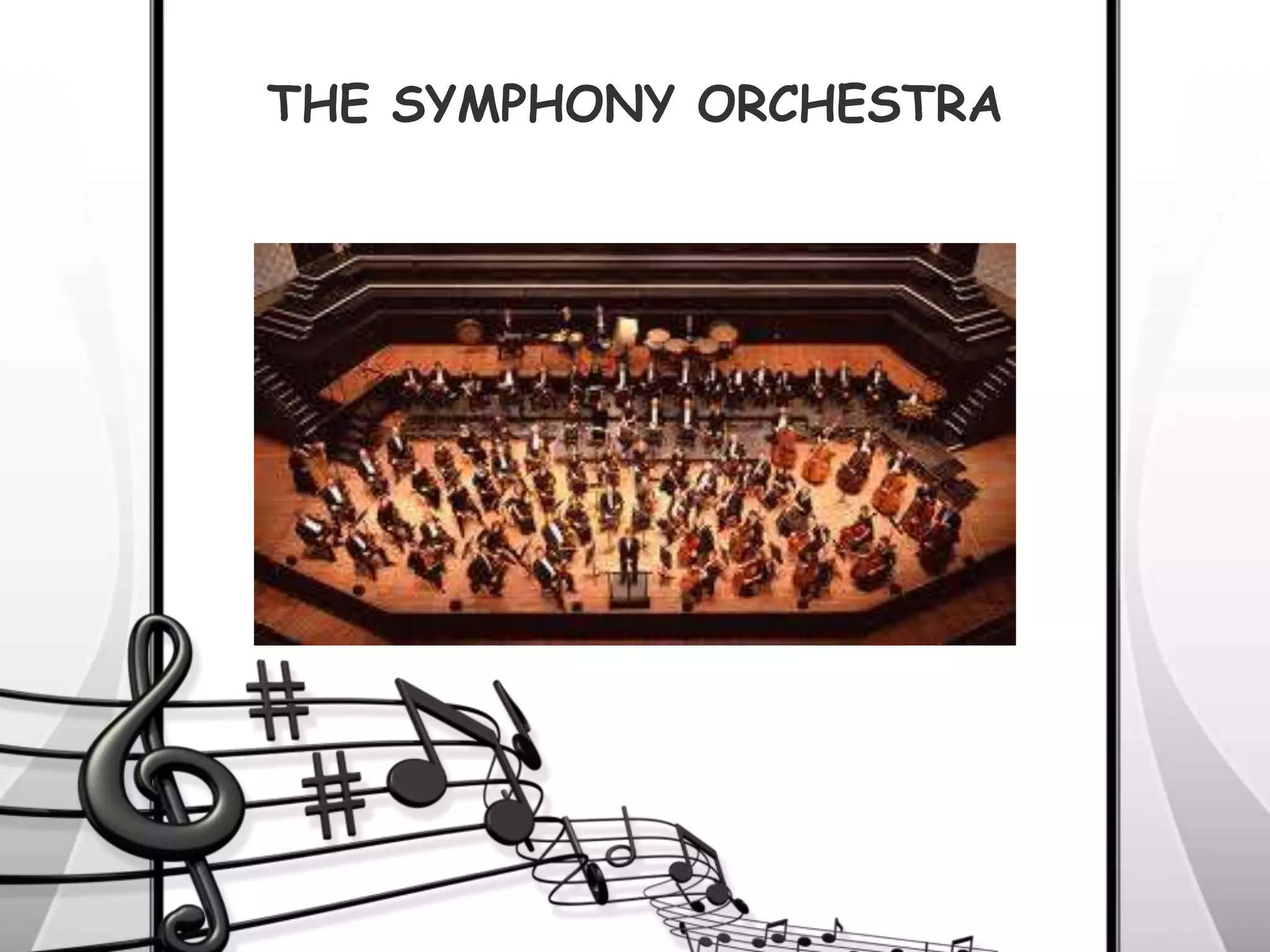
1. Symphony Orchestra
 is a large instrumental ensemble that
contains sections of string, brass,
woodwind, and percussion
instruments.
 character of the tone produced
THE SYMPHONY ORCHESTRA
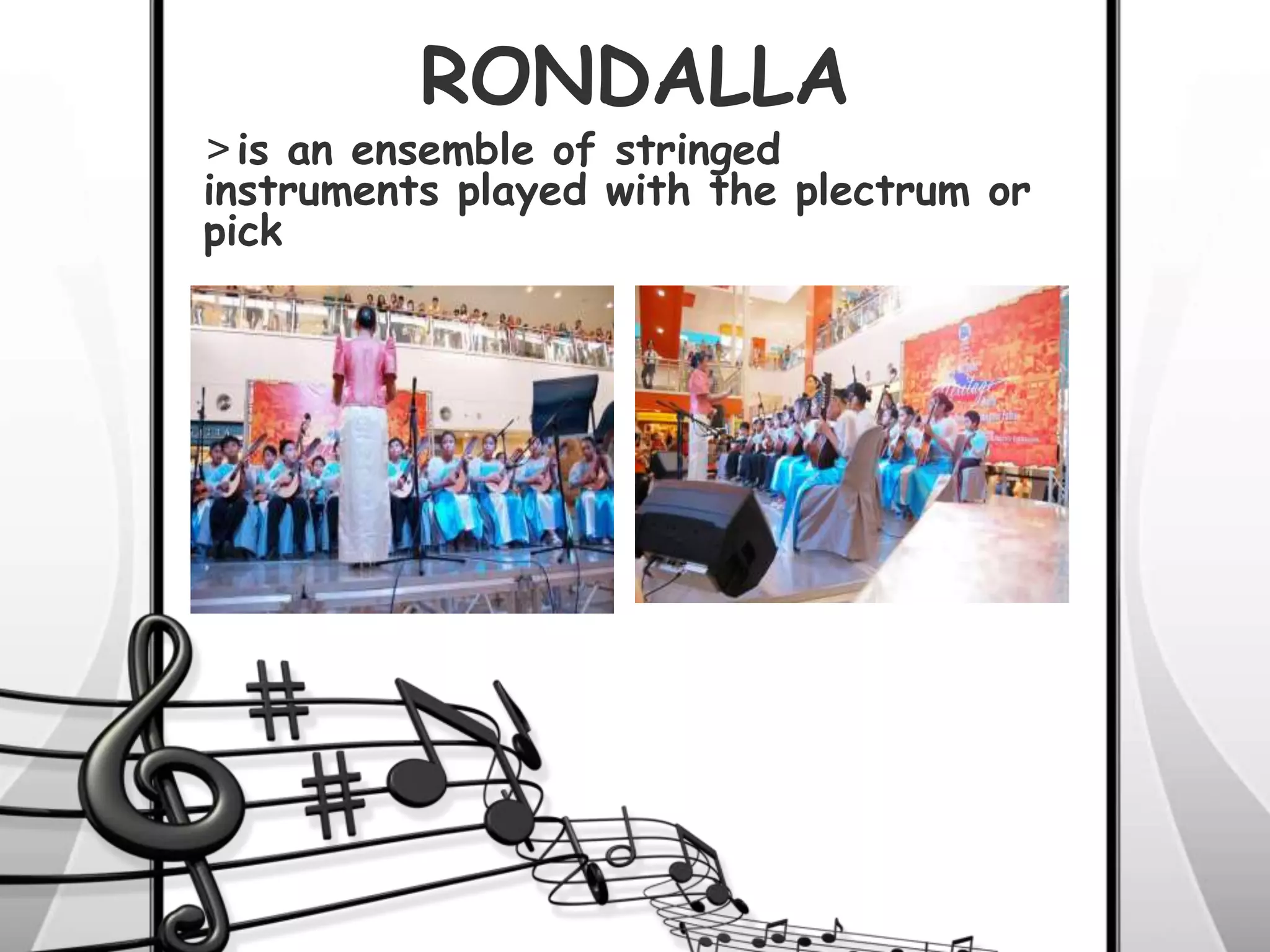
RONDALLA
>is an ensemble of stringed
instruments played with the plectrum or
pick
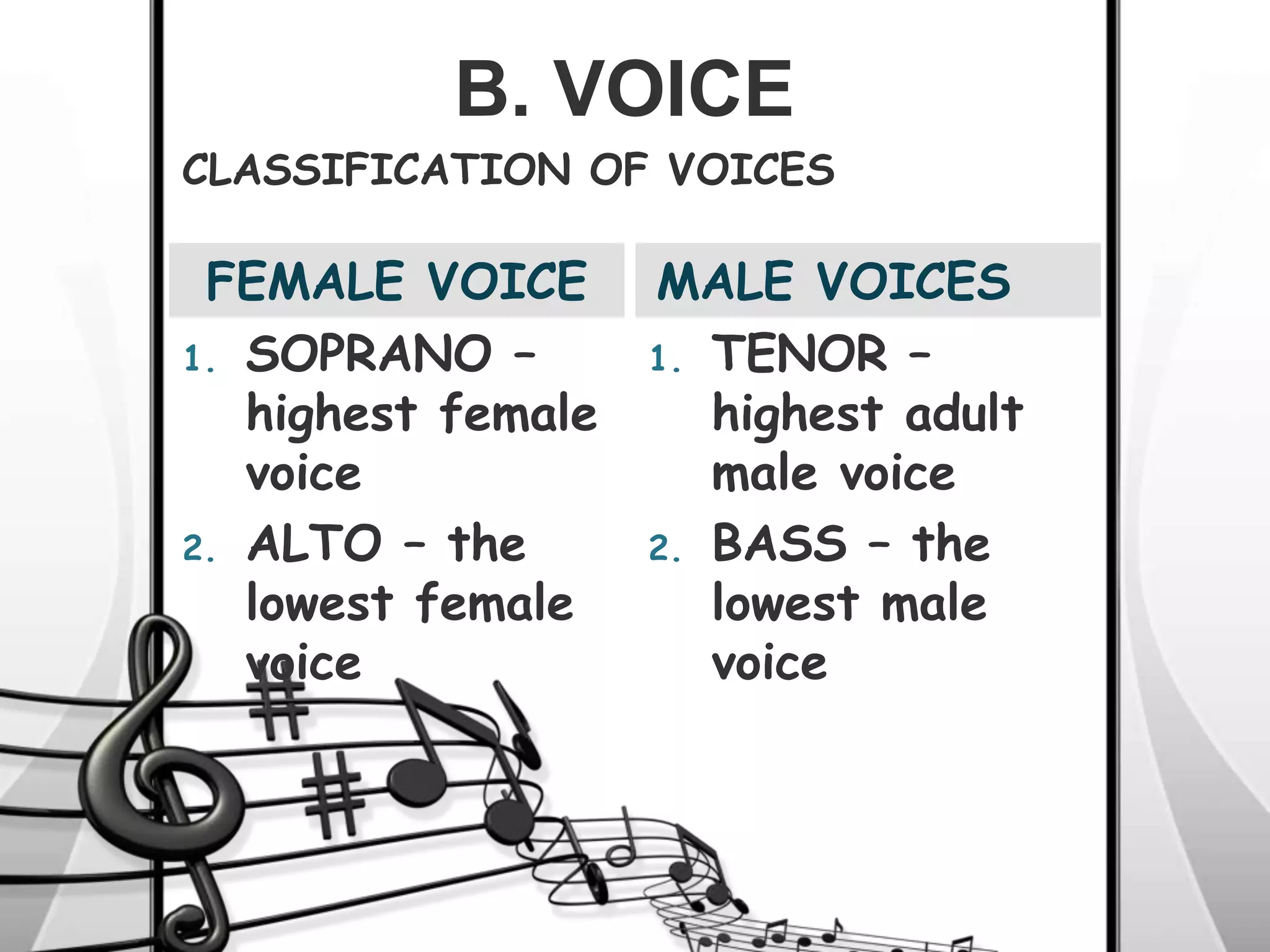
FEMALE VOICE
1. SOPRANO –
highest female
voice
2. ALTO – the
lowest female
voice
1. TENOR –
highest adult
male voice
2. BASS – the
lowest male
voice
MALE VOICES
B. VOICE
CLASSIFICATION OF VOICES
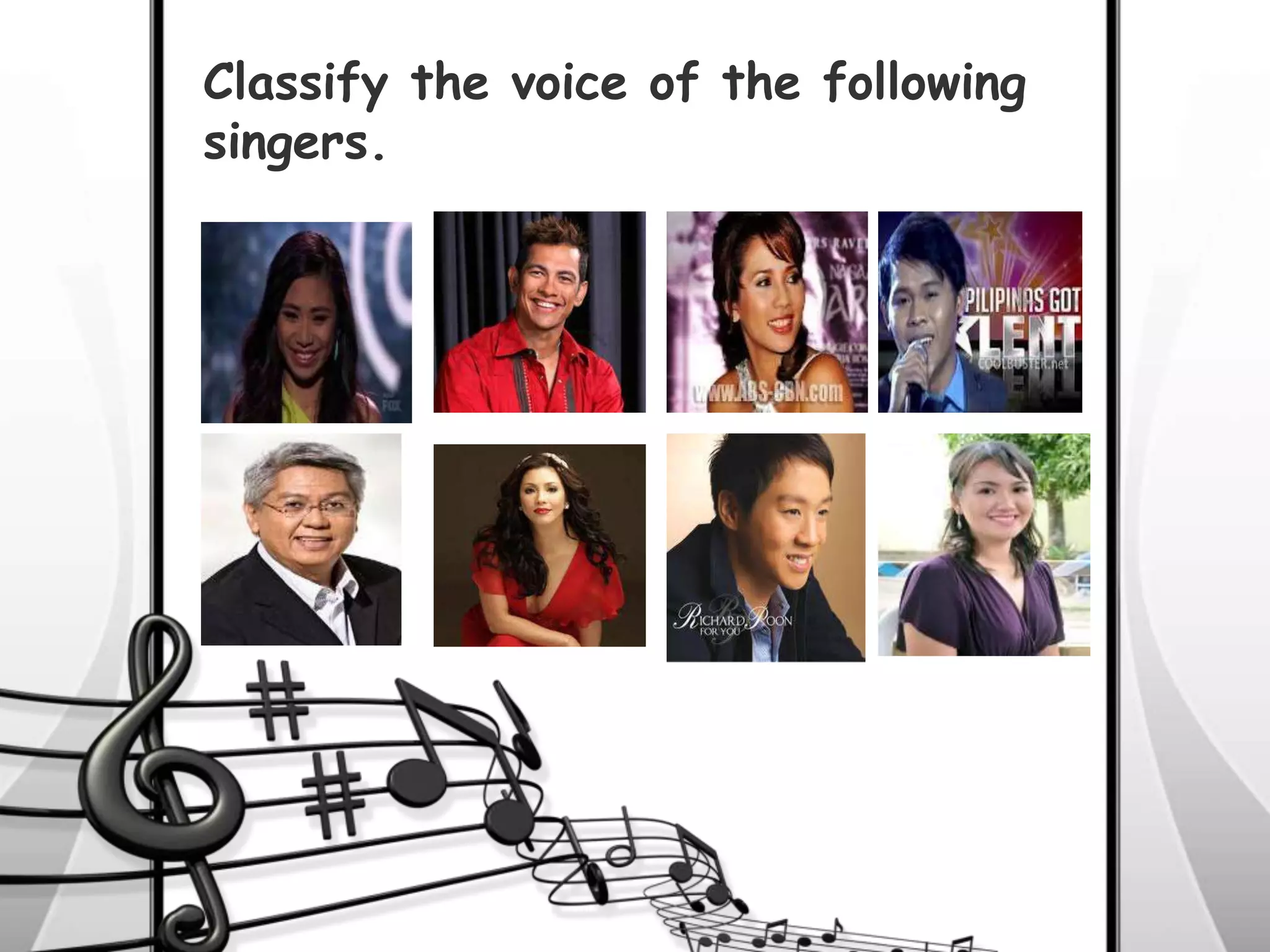
Classify the voice of the following
singers.
TEXTURE
A. MONOPHONIC – a single melody
without accompaniment or any
added part
Example: Chant
A. HOMOPHONIC – is a melody which
has a supporting set of chords for
accompaniment.
 Is the relationship of melodies
(horizontal) and harmonic (vertical elements
of music
TEXTURE
3. POLYPHONIC - has two or more
melodies without supporting chords.
Example:
Round example:
DONA NOBIS PACEM
> Partner Song
LERON – LERON SINTA
Leron, Leron, sinta
Buko ng papaya
Dala dala’y buslo
Sisidlan ng bunga
Pagdating sa dulo’y
Nabali ang sanga,
Kapos kapalaran
Humanap ng iba.
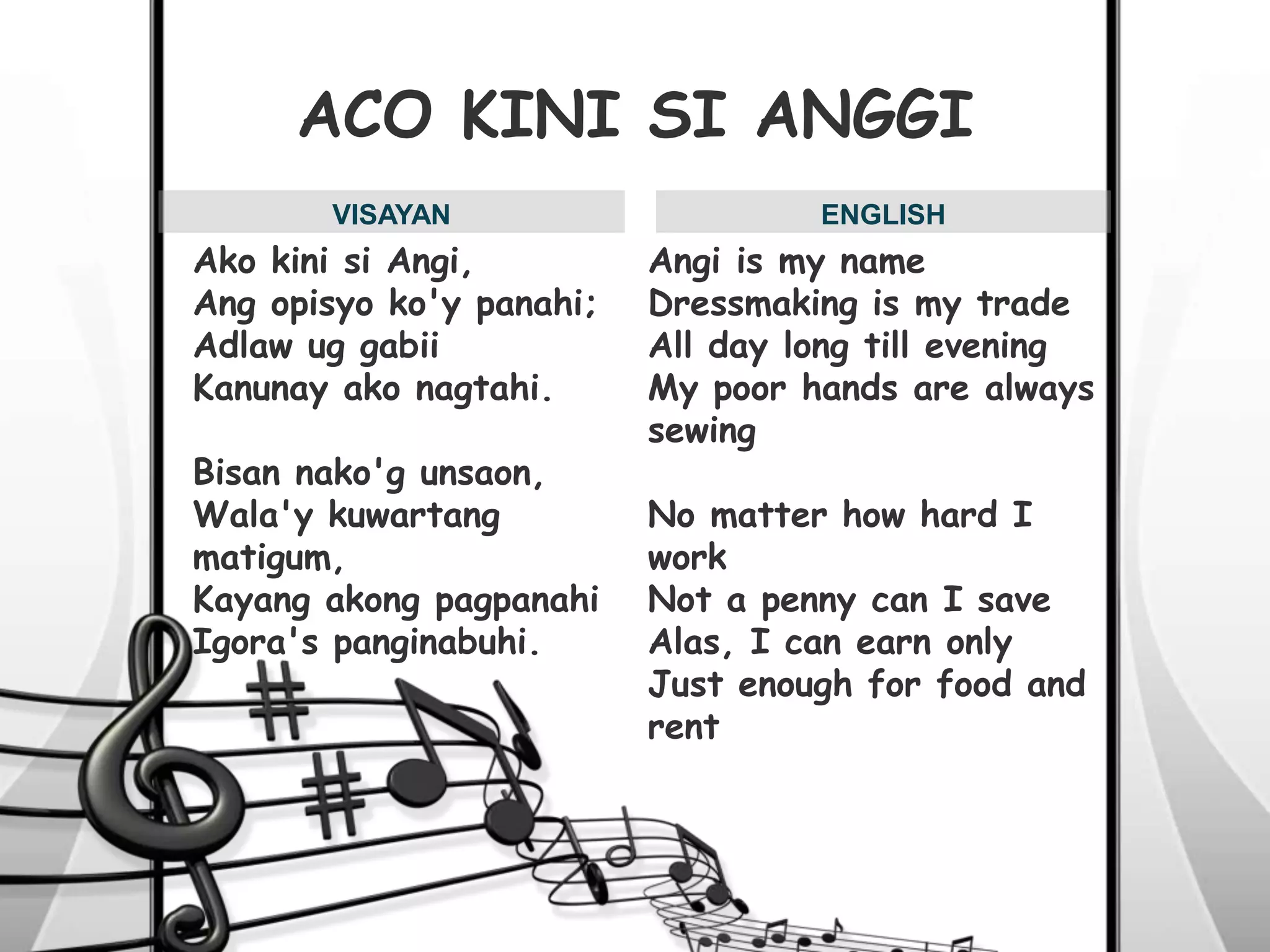
VISAYAN
Ako kini si Angi,
Ang opisyo ko'y panahi;
Adlaw ug gabii
Kanunay ako nagtahi.
Bisan nako'g unsaon,
Wala'y kuwartang
matigum,
Kayang akong pagpanahi
Igora's panginabuhi.
Angi is my name
Dressmaking is my trade
All day long till evening
My poor hands are always
sewing
No matter how hard I
work
Not a penny can I save
Alas, I can earn only
Just enough for food and
rent
ENGLISH
ACO KINI SI ANGGI
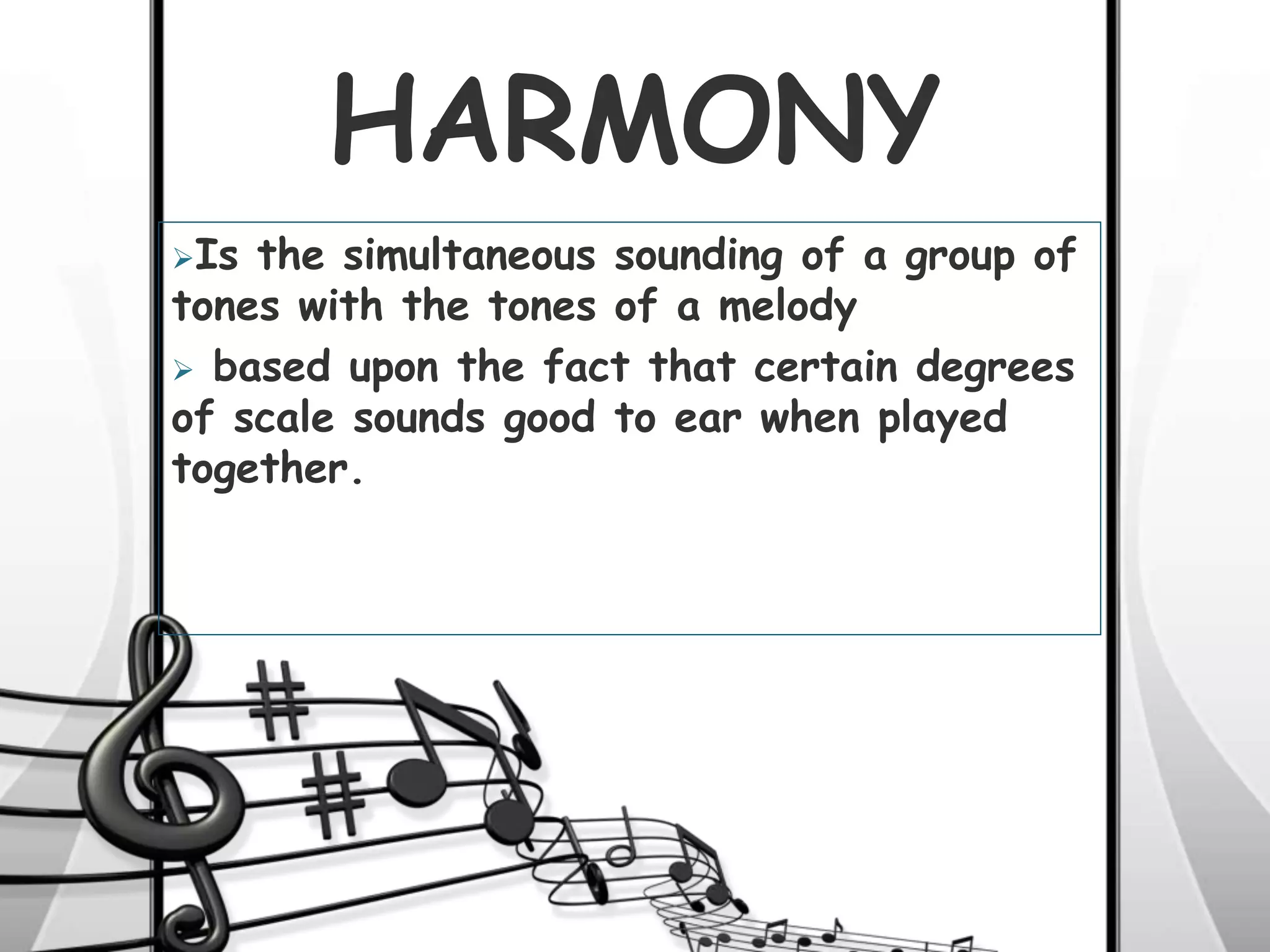
HARMONY
Is the simultaneous sounding of a group of
tones with the tones of a melody
 based upon the fact that certain degrees
of scale sounds good to ear when played
together.
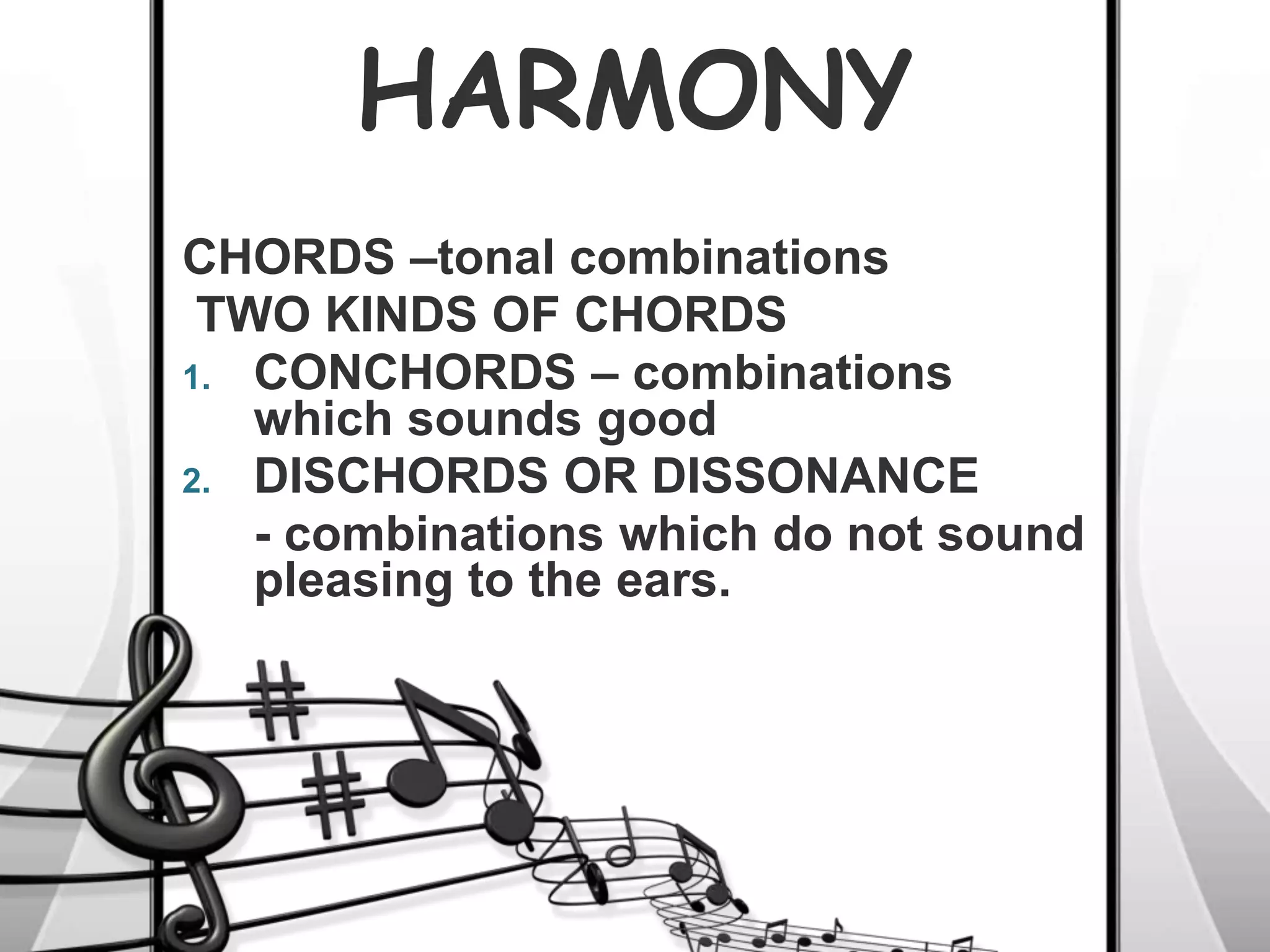
HARMONY
CHORDS –tonal combinations
TWO KINDS OF CHORDS
1. CONCHORDS – combinations
which sounds good
2. DISCHORDS OR DISSONANCE
- combinations which do not sound
pleasing to the ears.
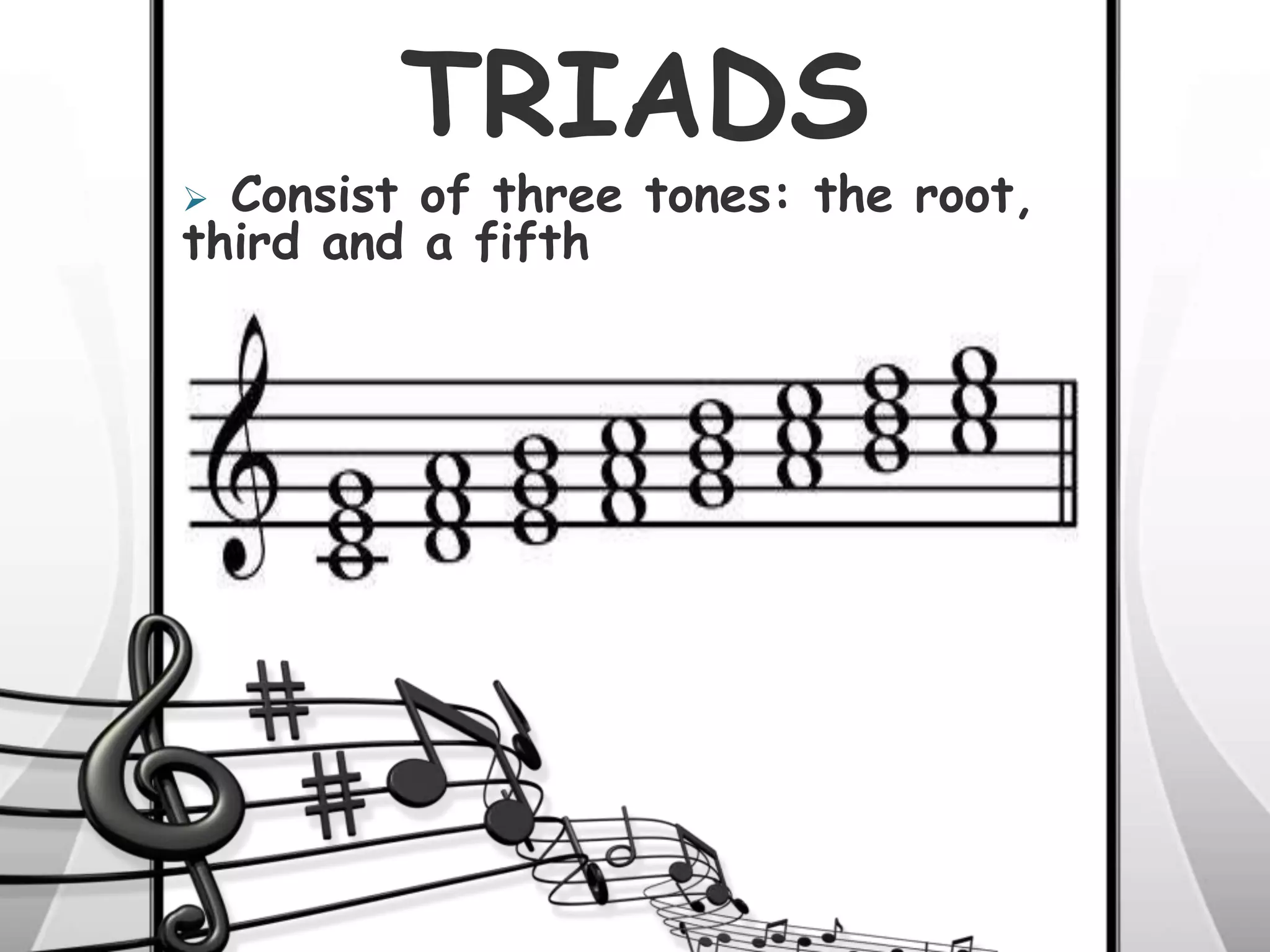
TRIADS
 Consist of three tones: the root,
third and a fifth
Fundamentals of music

Fundamentals of music

  • 1.
  • 2.
    RHYTHM Movement marked bythe regulated succession of strong and weak elements, or of opposite or different conditions.  from the Greek word “rhythmos” meaning any regular recurring motion
  • 3.
    PARTS OF RHYTHM is a unit of time that is felt and sensed  is a pulse of a time BEAT
  • 4.
  • 5.
    THREE PRINCIPLES OFBEAT ACTIVITIES Keep the beat even and steady keeping the beat takes considerable coordination keeping the beat that physical movement be a part of the activity
  • 6.
    PARTS OF RHYTHM is an emphasis placed on a particular note  they can be strong and weak ACCENT
  • 7.
    METER  meter isnatural grouping of beats  It is indicated by bar lines which divide the measure into successive units of two(duple), three(triple), four(quadruple), and so forth. > taken from the Greek word “metron” which means measure
  • 8.
    SIMPLE METER - isa division of time where fundamental pulses subdivide into groups of two, four, eight, etc..
  • 9.
    COMPOUND METER Is asubdivision in which the fundamental pulses subdivide into groups of three, six, twelve, etc.
  • 10.
  • 11.
    POLYMETER - Is adouble meter to indicate the two meters are combined or there is constant change from one meter to the other back and both
  • 12.
  • 13.
    TIME SIGNATURE - twonumbers at the beginning of every composition
  • 14.
    Indicate the valueor duration of each kind of note in each of the different time signatures NOTES 2 4 3 4 4 4 2 2 6 8
  • 15.
    Indicate the valueor duration of each kind of note in each of the different time signatures NOTES 2 4 3 4 4 4 2 2 6 8 4 2 3 3 1½ 6 2 2 2 1 4 1½ 1½ 1½ ¾ 3 1 1 1 ½ 2 ¾ ¾ ¾ 3/8 1½ ½ ½ ½ ¼ 1
  • 16.
    RHYTHMIC PATTERN -is thedivision of beats into patterns of sound.
  • 17.
    ACTIVITY A. CREATE ARAP/ SHORT POEM AND PERFORM WITH A SIMPLE BEAT. B. SING A FOLK SONG AND MAKE SIMPLE DANCE STEPS. C. PERFORM AN ETHNIC DANCE USING MATERIALS FROM THE NATURE AS INSTRUMENT.
  • 18.
    PITCH Is the highnessor lowness of tone which is determined by the number of vibration per second The length of time the tone last DURATION MELODY > Is a succession of related single tones expressing an idea.
  • 19.
    PARTS OF MELODY A.DIRECTION OR MOVEMENT
  • 20.
    CHROMATIC SCALE  Hastwelve steps and is formed entirely of half steps.  Has eight steps and is composed of whole steps and half steps DIATONIC SCALE B. SCALES A succession of consecutive tones in a certain arrangement of whole and half steps generally embracing eight degrees
  • 21.
  • 22.
    . 1. C –D 2. E – F 3. F#- G 4. B – C 5. Eb – D 6. G# -A# 7. C# -D 8. Gb –Ab 9. F – G 10. D - E Identify the steps of the following tones
  • 23.
    ANSWER 1. C –D DIATONIC 2. E – F CHROMATIC 3. F#- G CHROMATIC 4. B – C CHROMATIC 5. Eb – D CHROMATIC 6. G# -A# DIATONIC 7. C# -D CHROMATIC 8. Gb –Ab DIATONIC 9. F – G DIATONIC 10. D - E DIATONIC
  • 24.
    ENHARMONIC TONES > notesthat have the same pitch but different names
  • 25.
    Find the enharmonictones of the following: 1. D# 6. E# 2. F 7. Ab 3. Gb 8. G 4. C 9. A 5. B 10. C#
  • 26.
    1. D#- Eb 2.F - E# 3. Gb – F# 4. C - B# 5. B - Cb 6. E# - F 7. Ab – G# 8. G – F# 9. A – G# 10. C# - Db ANSWER:
  • 27.
    KEY SIGNATURES  isa series of sharp or flat symbols placed at the beginning of the staff
  • 28.
    THE MAJOR KEY(SHARPS)
  • 29.
    MAJOR KEY (SHARPS) KEYNO. OF SHARPS SHARP NOTES C 0 G 1 F# D 2 F#, C# A 3 F#, C#, G# E 4 F#, C#, G#, D# B 5 F#, C#, G#, D#, A# F# 6 F#, C#, G#, D#, A#, E# C# 7 F#, C#, G#, D#, A#, E#, B#
  • 30.
  • 31.
    THE MAJOR KEY(FLATS) KEY NO.OF FLATS FLAT NOTES C 0 F 1 Bb Bb 2 Bb, Eb Eb 3 Bb, Eb, Ab Ab 4 Bb, Eb, Ab, Db Db 5 Bb, Eb, Ab, Db, Gb Gb 6 Bb, Eb, Ab, Db, Gb, Cb Cb 7 Bb, Eb, Ab, Db, Gb, Cb, Fb
  • 32.
    Identify the keysignatures.
  • 33.
    THE MINOR KEYS KEY SIGNATURE ADDED SHARPS MAJORKEYS MINOR KEYS F# G Major E minor C# D Major B minor D# A Major F# minor G# E Major C# minor A# B Major G# minor E# F# Major D# minor B# C# Major A# minor
  • 34.
    THE MINOR KEYS KEY SIGNATURE ADDED FLATS MAJORKEY MINOR KEY Bb F D Eb B G Ab E C Db A F Gb D Bb Cb G Eb Fb C Ab
  • 36.
    Identify the keysignatures of the following
  • 37.
  • 38.
    TEMPO Commonly used termsto indicate tempo 1. Largo – very slow 2. Adagio – slow 3. Andante – walking pace 4. Allegro – fast 5. Allegretto – not so fast and lively 6. Presto – very fast  Is the speed of the composition
  • 39.
    7.Accelerando – graduallybecoming faster 8.Ritardando – gradually becoming slower 9.Meno Mosso – lessen the speed 10. Moderato – slower than allegretto but faster than andante. 11. Vivace – lively and vivid
  • 41.
    DYNAMICS DYNAMIC MARKS TERMSMEANING p Piano Soft pp Pianissimo Very soft mp Mezzo forte Half soft f Forte loud ff Fortissimo Very loud mf Mezzo piano Half loud crescendo Gradually becoming louder decrescendo Gradually becoming softer  Degree of loudness or softness
  • 42.
    FORM 1. TONE –smallest unit of a composition 2. FIGURE – the smallest characteristic group of tones 3. PHRASE – is a succession of tones 4. SECTION – combination of periods  Structure or framework of a composition
  • 44.
    KINDS OF FORM 1.UNITARY/STROPHIC > a short composition containing only one principal idea 2. BINARY > has two different melodic ideas. A and B 3. TERNARY > has two basic ideas and ends with the repetition of the first idea
  • 45.
    SITSIRITSIT A. Sitsiritsit alibangbang,salaguinto’tsalagubang Ang babae sa lansangan kung gumiri’y parang tandang B. Mama mama namamangka, pasakayin yaring bata Pagdating sa maynila, ipagpalit ng manika C. Ale ale namamayong, pasukubin yaring sanggol Pagdating sa Malabong, ipagpalit ng bagoong
  • 46.
    Leron,Leron,sinta buko ng papaya Daladala’y buslo sisidlan ng bunga Pagdating sa dulo’y nabali ang sanga, Kapos kapalaran humanap ng iba. Halika na Neneng,tayo’y manampalok Dalhin mo ang buslo,sisidlan ng hinog Pagdating sa dulo’y uunda- undayog Kumapit ka Neneng, baka ka mahulog. Halika na Neneng at tayo’y magsimba At iyong isuot ang baro mo’t saya Ang baro mo’t sayang pagkaganda-ganda Kay ganda ng kulay — berde, puti, pula. Ako’y ibigin mo, lalaking matapang Ang baril ko’y pito, ang sundang ko’y siyam Ang lalakarin ko’y parte ng dinulang Isang pinggang pansit ang aking kalaban. LERON-LERON SINTA
  • 47.
    TIMBRE A. INSTRUMENTS 1. SymphonyOrchestra  is a large instrumental ensemble that contains sections of string, brass, woodwind, and percussion instruments.  character of the tone produced
  • 48.
  • 49.
    RONDALLA >is an ensembleof stringed instruments played with the plectrum or pick
  • 50.
    FEMALE VOICE 1. SOPRANO– highest female voice 2. ALTO – the lowest female voice 1. TENOR – highest adult male voice 2. BASS – the lowest male voice MALE VOICES B. VOICE CLASSIFICATION OF VOICES
  • 51.
    Classify the voiceof the following singers.
  • 52.
    TEXTURE A. MONOPHONIC –a single melody without accompaniment or any added part Example: Chant A. HOMOPHONIC – is a melody which has a supporting set of chords for accompaniment.  Is the relationship of melodies (horizontal) and harmonic (vertical elements of music
  • 53.
    TEXTURE 3. POLYPHONIC -has two or more melodies without supporting chords. Example: Round example: DONA NOBIS PACEM > Partner Song
  • 54.
    LERON – LERONSINTA Leron, Leron, sinta Buko ng papaya Dala dala’y buslo Sisidlan ng bunga Pagdating sa dulo’y Nabali ang sanga, Kapos kapalaran Humanap ng iba.
  • 55.
    VISAYAN Ako kini siAngi, Ang opisyo ko'y panahi; Adlaw ug gabii Kanunay ako nagtahi. Bisan nako'g unsaon, Wala'y kuwartang matigum, Kayang akong pagpanahi Igora's panginabuhi. Angi is my name Dressmaking is my trade All day long till evening My poor hands are always sewing No matter how hard I work Not a penny can I save Alas, I can earn only Just enough for food and rent ENGLISH ACO KINI SI ANGGI
  • 56.
    HARMONY Is the simultaneoussounding of a group of tones with the tones of a melody  based upon the fact that certain degrees of scale sounds good to ear when played together.
  • 57.
    HARMONY CHORDS –tonal combinations TWOKINDS OF CHORDS 1. CONCHORDS – combinations which sounds good 2. DISCHORDS OR DISSONANCE - combinations which do not sound pleasing to the ears.
  • 58.
    TRIADS  Consist ofthree tones: the root, third and a fifth