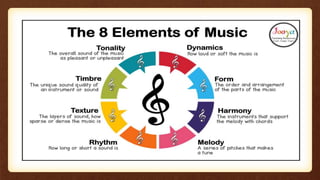
RHYTHM AND TIMBRE
PRESENTED BY: FATIMA S. LARA
RHYTHM
-Is the most basic element of music,
because music can do without the other
elements but cannot exist without rhythm.
Music played, or sung brings out a regular
rhythmic pattern or pulsation which we call
beats. Beats are grouped in a measure that
contains units of four, three, or two beats
called a meter.
RHYTHM
RHYTHM
Is found in all the arts:
Music
Dance
Poetry
Theater
RHYTHM Elements
-Meter -beat -duration -tempo
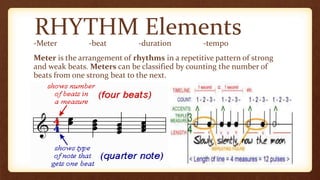
Meter is the arrangement of rhythms in a repetitive pattern of strong
and weak beats. Meters can be classified by counting the number of
beats from one strong beat to the next.
RHYTHM Elements
-Meter -beat -duration -tempo
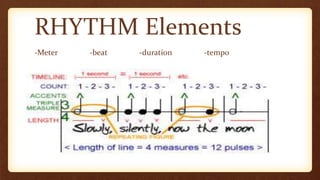
Beats are the regular movements that you did.
Durations- of the sounds
Tempo- rate of beat
RHYTHM Elements
-Meter -beat -duration -tempo
RHYTHM
Did you move your
arms regularly while
saying “tick-tock”?
Here are some objects commonly found around
us. Try to imagine the sound that they make,
then move regularly to their sound by clapping
or tapping six times.
Church Bell
Leaking Faucet
Tap!!!
Tap!!!
Tap!!!
Let’s all sing
“Hickory, Dickory Dock”…
Try to observe the sticks drawn below the words of this song. The sticks show the beats. Clap your
hands once for each beat wile singing the song.
Hickory, dickory dock ― ― ― ―
│ │ │ │
The mouse ran up the clock ― ― ― ―
│ │ │ │
The clock struck “one”, the mouse ran down
│ │ │ │
Hickory, dickory dock. (tick tock)
│ │ │ │
Did you feel the
beat while clapping
it?
So what are the Beats, and
what is Rhythm?
 Beats are the regular movements that you did.
 Music usually moves in a steady beat. We can move in
different ways on the beat of music. We can clap, tap,
walk, step, and do other movements to feel the beat.
 The movement that we do to the beat of music is called
rhythm.
RHYTHM TERMS
Rhythm Terms
• Rhythm - The term "rhythm" has more than one meaning. It can mean the basic,
repetitive pulse of the music, or a rhythmic pattern that is repeated throughout the
music (as in "feel the rhythm"). It can also refer to the pattern in time of a single
small group of notes (as in "play this rhythm for me").
• Beat - Beat also has more than one meaning, but always refers to music with a
steady pulse. It may refer to the pulse itself. On the beat or on the downbeat refer
to the moment when the pulse is strongest. On the beat is in between pulses, and
the upbeat is exactly halfway between pulses. Beat may also refer to a specific
repetitive rhythmic pattern that maintains the pulse. Note that once a strong
feeling of having a beat is established, it is not necessary for something to happen
on every beat; a beat can still be "felt" even if it is not specifically heard.
Rhythm Terms
• Measure or bar - Beats are grouped into measures or bars. The first beat is usually
the strongest, and in most music, most of the bars have the same number of beats.
This sets up an underlying pattern in the pulse of the music: for example, strong-
weak-strong-weak-strong weak, or strong-weak-weak-strong-weak-weak.
• Rhythm Section - The rhythm section of a band is the group of instruments that
usually provide the background rhythm and chords. The rhythm section almost
always includes a percussionist (usually on a drum set) and a bass player (usually
playing a plucked string bass of some kind). It may also include a piano and/or
other keyboard players, more percussionists, and one or more guitar players or
other strummed or plucked strings. Vocalists, wind instruments, and bowed
strings are usually not part of the rhythm section.
• Syncopation - Syncopation occurs when a strong note happens either on a weak
beat or on the beat.
Why Is Rhythm Important in Music?
Rhythm functions as the propulsive engine of a piece of
music, and it gives a composition structure. Most musical
ensembles contain a rhythm section responsible for providing
the rhythmic backbone for the entire group. Drums,
percussion, bass, guitar, piano, and synthesizer may all be
considered rhythm instruments, depending on the context.
However, all members of a music group bear responsibility for
their own rhythmic performances and play the musical beats
and rhythmic patterns indicated by the piece's composer.
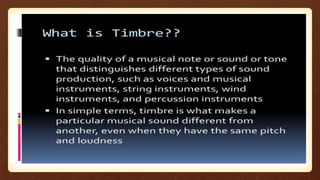
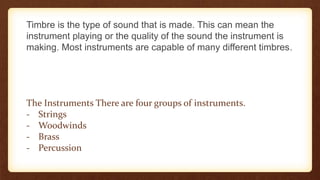
Timbre is the type of sound that is made. This can mean the
instrument playing or the quality of the sound the instrument is
making. Most instruments are capable of many different timbres.
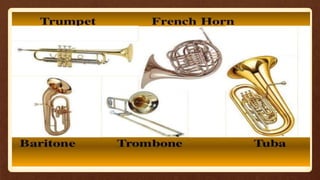
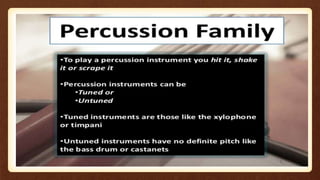
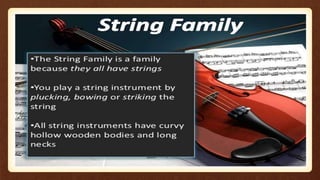
The Instruments There are four groups of instruments.
- Strings
- Woodwinds
- Brass
- Percussion
Add a Slide Title - 2
Add a Slide Title - 4
Add a Slide Title - 5

Rhythm and timbre

  • 1.
    RHYTHM AND TIMBRE PRESENTEDBY: FATIMA S. LARA
  • 3.
    RHYTHM -Is the mostbasic element of music, because music can do without the other elements but cannot exist without rhythm. Music played, or sung brings out a regular rhythmic pattern or pulsation which we call beats. Beats are grouped in a measure that contains units of four, three, or two beats called a meter.
  • 5.
  • 6.
    RHYTHM Is found inall the arts: Music Dance Poetry Theater
  • 7.
    RHYTHM Elements -Meter -beat-duration -tempo Meter is the arrangement of rhythms in a repetitive pattern of strong and weak beats. Meters can be classified by counting the number of beats from one strong beat to the next.
  • 8.
    RHYTHM Elements -Meter -beat-duration -tempo Beats are the regular movements that you did. Durations- of the sounds Tempo- rate of beat
  • 9.
  • 10.
  • 12.
    Did you moveyour arms regularly while saying “tick-tock”?
  • 13.
    Here are someobjects commonly found around us. Try to imagine the sound that they make, then move regularly to their sound by clapping or tapping six times. Church Bell
  • 14.
  • 15.
    Let’s all sing “Hickory,Dickory Dock”… Try to observe the sticks drawn below the words of this song. The sticks show the beats. Clap your hands once for each beat wile singing the song. Hickory, dickory dock ― ― ― ― │ │ │ │ The mouse ran up the clock ― ― ― ― │ │ │ │ The clock struck “one”, the mouse ran down │ │ │ │ Hickory, dickory dock. (tick tock) │ │ │ │
  • 16.
    Did you feelthe beat while clapping it?
  • 17.
    So what arethe Beats, and what is Rhythm?  Beats are the regular movements that you did.  Music usually moves in a steady beat. We can move in different ways on the beat of music. We can clap, tap, walk, step, and do other movements to feel the beat.  The movement that we do to the beat of music is called rhythm.
  • 18.
  • 19.
    Rhythm Terms • Rhythm- The term "rhythm" has more than one meaning. It can mean the basic, repetitive pulse of the music, or a rhythmic pattern that is repeated throughout the music (as in "feel the rhythm"). It can also refer to the pattern in time of a single small group of notes (as in "play this rhythm for me"). • Beat - Beat also has more than one meaning, but always refers to music with a steady pulse. It may refer to the pulse itself. On the beat or on the downbeat refer to the moment when the pulse is strongest. On the beat is in between pulses, and the upbeat is exactly halfway between pulses. Beat may also refer to a specific repetitive rhythmic pattern that maintains the pulse. Note that once a strong feeling of having a beat is established, it is not necessary for something to happen on every beat; a beat can still be "felt" even if it is not specifically heard.
  • 20.
    Rhythm Terms • Measureor bar - Beats are grouped into measures or bars. The first beat is usually the strongest, and in most music, most of the bars have the same number of beats. This sets up an underlying pattern in the pulse of the music: for example, strong- weak-strong-weak-strong weak, or strong-weak-weak-strong-weak-weak. • Rhythm Section - The rhythm section of a band is the group of instruments that usually provide the background rhythm and chords. The rhythm section almost always includes a percussionist (usually on a drum set) and a bass player (usually playing a plucked string bass of some kind). It may also include a piano and/or other keyboard players, more percussionists, and one or more guitar players or other strummed or plucked strings. Vocalists, wind instruments, and bowed strings are usually not part of the rhythm section. • Syncopation - Syncopation occurs when a strong note happens either on a weak beat or on the beat.
  • 21.
    Why Is RhythmImportant in Music? Rhythm functions as the propulsive engine of a piece of music, and it gives a composition structure. Most musical ensembles contain a rhythm section responsible for providing the rhythmic backbone for the entire group. Drums, percussion, bass, guitar, piano, and synthesizer may all be considered rhythm instruments, depending on the context. However, all members of a music group bear responsibility for their own rhythmic performances and play the musical beats and rhythmic patterns indicated by the piece's composer.
  • 34.
    Timbre is thetype of sound that is made. This can mean the instrument playing or the quality of the sound the instrument is making. Most instruments are capable of many different timbres. The Instruments There are four groups of instruments. - Strings - Woodwinds - Brass - Percussion
  • 44.
    Add a SlideTitle - 2
  • 45.
    Add a SlideTitle - 4
  • 46.
    Add a SlideTitle - 5