Appearance
Dress To Express
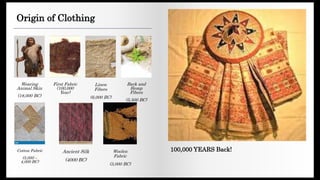
Origin of Clothing
100,000 YEARS Back!
Wearing
Animal Skin
(18,000 BC)
First Fabric
(100,000
Year)
Linen
Fibers
(6,000 BC)
Bark and
Hemp
Fibers
(5,500 BC)
Cotton Fabric
(5,000 –
4,000 BC)
Ancient Silk
(4000 BC)
Woolen
Fabric
(3,000 BC)
Theories Of Clothing
Immodesty Theory : Immodesty
theory or attraction has explained
that individuals may have
first preferred clothing in order to
attract the attention, rather than to
conceal, the human body.
Projection Theory : This
theory suggests that
clothes protect humans
from the elements,
animals or even
supernatural forces.
Adornment Theory
: This theory refers to
the decorative nature of
clothes and other forms
of appearances;
modifications for
purposes of display,
attraction or aesthetic
expression.
Modesty Theory : It
suggests that people first
wore clothing to cover or
conceal the 'private'
parts of the human body.
The modesty theory is
based on the idea that
morality is dependent
upon modesty, as
expressed through the
concealment of the
human body.
PURPOSE / NEED FOR
CLOTHING
Individual’s Choice
It’s hard to be nice if you don’t feel comfortable
Protection
Safety
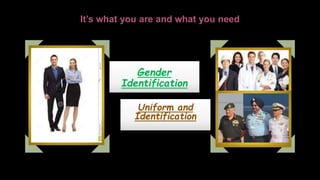
It’s what you are and what you need
Gender
Identification
Uniform and
Identification
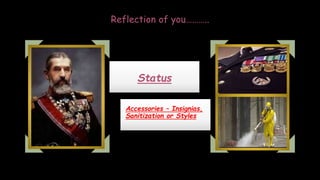
Reflection of you………..
Status
Accessories – Insignias,
Sanitization or Styles
From “Express” to “Impress”
Tradition
Decoration
Appearance
Dress how you want to be addressed
Introduction
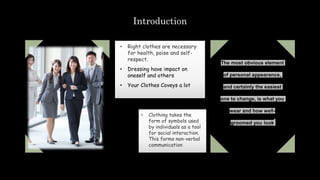
• Right clothes are necessary
for health, poise and self-
respect.
• Dressing have impact on
oneself and others
• Your Clothes Coveys a lot
• Clothing takes the
form of symbols used
by individuals as a tool
for social interaction.
This forms non-verbal
communication
The most obvious element
of personal appearance,
and certainly the easiest
one to change, is what you
wear and how well-
groomed you look
Clothing Elements
The Plastics of Cloth design……
How To Influence Those Around You
With Color
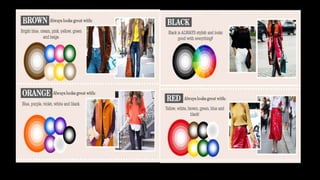
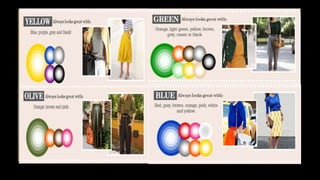
Influencing people around you with color is easier than one
might imagine. So if you excel in other variables such as the
cut of your suit, the fabric, texture, weave, pattern, and
accessories, you can wield color like a weapon at the workplace.
Cloth-Color
Science
THE COLORS YOU WEAR
SAY A LOT ABOUT
YOU…………………
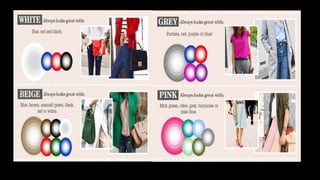
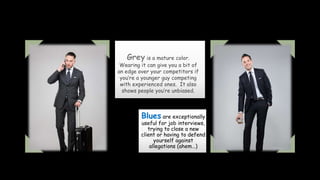
Grey is a mature color.
Wearing it can give you a bit of
an edge over your competitors if
you’re a younger guy competing
with experienced ones. It also
shows people you’re unbiased.
Blues are exceptionally
useful for job interviews,
trying to close a new
client or having to defend
yourself against
allegations (ahem…)
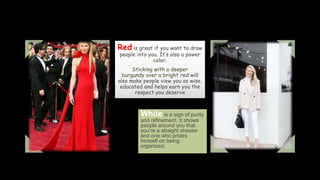
Red is great if you want to draw
people into you. It’s also a power
color.
Sticking with a deeper
burgundy over a bright red will
also make people view you as wise,
educated and helps earn you the
respect you deserve
White is a sign of purity
and refinement. It shows
people around you that
you’re a straight shooter
and one who prides
himself on being
organized.
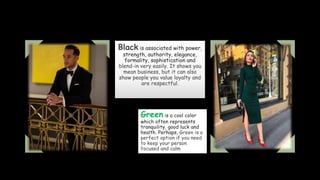
Black is associated with power,
strength, authority, elegance,
formality, sophistication and
blend-in very easily. It shows you
mean business, but it can also
show people you value loyalty and
are respectful.
Green is a cool color
which often represents
tranquility, good luck and
health. Perhaps, Green is a
perfect option if you need
to keep your person
focused and calm
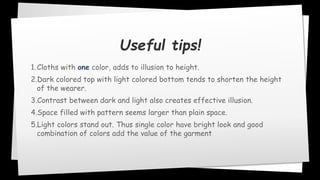
Useful tips!
1.Cloths with one color, adds to illusion to height.
2.Dark colored top with light colored bottom tends to shorten the height
of the wearer.
3.Contrast between dark and light also creates effective illusion.
4.Space filled with pattern seems larger than plain space.
5.Light colors stand out. Thus single color have bright look and good
combination of colors add the value of the garment
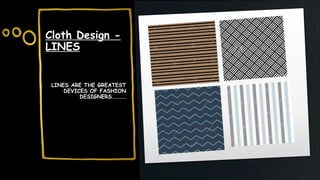
Cloth Design -
LINES
LINES ARE THE GREATEST
DEVICES OF FASHION
DESIGNERS…………
LINES
Line has different aspects including direction, thickness, sharpness of
edge and length. It provides the visual dimensions of length and width.
When lines combine, space is enclosed, forms and shapes are defined.
Lines offered a path of vision for the eyes when wearing an outfit, it
leads the observer’s eye.
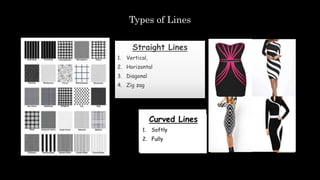
Types of Lines
Straight Lines
1. Vertical,
2. Horizontal
3. Diagonal
4. Zig zag
Curved Lines
1. Softly
2. Fully
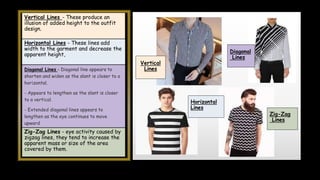
Vertical Lines - These produce an
illusion of added height to the outfit
design.
Horizontal Lines - These lines add
width to the garment and decrease the
apparent height,
Diagonal Lines - Diagonal line appears to
shorten and widen as the slant is closer to a
horizontal.
- Appears to lengthen as the slant is closer
to a vertical.
- Extended diagonal lines appears to
lengthen as the eye continues to move
upward
Zig-Zag Lines - eye activity caused by
zigzag lines, they tend to increase the
apparent mass or size of the area
covered by them.
Vertical
Lines
Diagonal
Lines
Horizontal
Lines
Zig-Zag
Lines
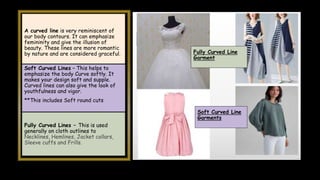
A curved line is very reminiscent of
our body contours. It can emphasize
femininity and give the illusion of
beauty. These lines are more romantic
by nature and are considered graceful.
Soft Curved Lines – This helps to
emphasize the body Curve softly. It
makes your design soft and supple.
Curved lines can also give the look of
youthfulness and vigor.
**This includes Soft round cuts
Fully Curved Lines – This is used
generally on cloth outlines to
Necklines, Hemlines, Jacket collars,
Sleeve cuffs and Frills.
Vertical Lines
Fully Curved Line
Garment
Soft Curved Line
Garments
Cloth Design -
Texture
HOW IT FEELS AND WHAT
IT REFLECTS…….....
Texture
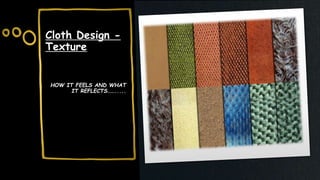
• Each fabric holds a statement on its own
• Texture refers to the physical surface of a piece of cloth. Sometimes it has a visible unevenness
and sometimes it appears completely smooth. Texture can - but doesn't always - affect how the
color and pattern of the garment look."
• Texture also affects how the color is going to come out in the fabric and the pattern of the weaving
look.
• Then comes the most important thing about texture: comfort. No one likes to wear a piece of fabric
that’s rough or scratchy.
• Laboratory research ha confirmed that fabric and texture can evoke emotions.
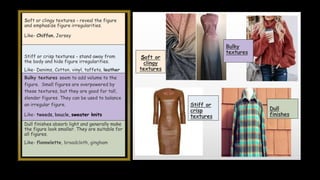
Soft or clingy textures - reveal the figure
and emphasize figure irregularities.
Like- Chiffon, Jersey
Stiff or crisp textures - stand away from
the body and hide figure irregularities.
Like- Denims, Cotton, vinyl, taffeta, leather
Bulky textures seem to add volume to the
figure. Small figures are overpowered by
these textures, but they are good for tall,
slender figures. They can be used to balance
an irregular figure.
Like- tweeds, boucle, sweater knits
Dull finishes absorb light and generally make
the figure look smaller. They are suitable for
all figures.
Like- flannelette, broadcloth, gingham
Soft or
clingy
textures
Bulky
textures
Dull
finishes
Stiff or
crisp
textures
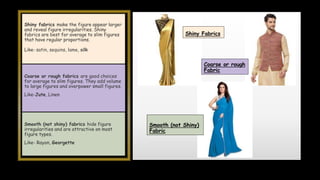
Shiny fabrics make the figure appear larger
and reveal figure irregularities. Shiny
fabrics are best for average to slim figures
that have regular proportions.
Like- satin, sequins, lame, silk
Coarse or rough fabrics are good choices
for average to slim figures. They add volume
to large figures and overpower small figures.
Like-Jute, Linen
Smooth (not shiny) fabrics hide figure
irregularities and are attractive on most
figure types.
Like- Rayon, Georgette
Shiny Fabrics
Coarse or rough
Fabric
Smooth (not Shiny)
Fabric
Clothing Myths
Break it……..
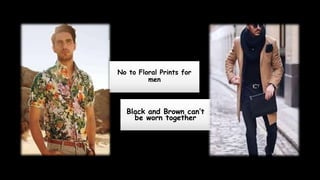
No to Floral Prints for
men
Black and Brown can’t
be worn together
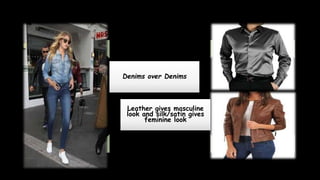
Denims over Denims
Leather gives masculine
look and silk/satin gives
feminine look
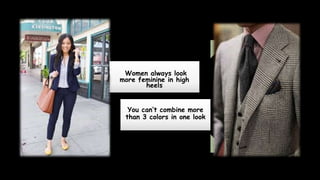
Women always look
more feminine in high
heels
You can’t combine more
than 3 colors in one look
Clothing and Apparel

Clothing and Apparel

  • 1.
  • 2.
    Origin of Clothing 100,000YEARS Back! Wearing Animal Skin (18,000 BC) First Fabric (100,000 Year) Linen Fibers (6,000 BC) Bark and Hemp Fibers (5,500 BC) Cotton Fabric (5,000 – 4,000 BC) Ancient Silk (4000 BC) Woolen Fabric (3,000 BC)
  • 3.
    Theories Of Clothing ImmodestyTheory : Immodesty theory or attraction has explained that individuals may have first preferred clothing in order to attract the attention, rather than to conceal, the human body. Projection Theory : This theory suggests that clothes protect humans from the elements, animals or even supernatural forces. Adornment Theory : This theory refers to the decorative nature of clothes and other forms of appearances; modifications for purposes of display, attraction or aesthetic expression. Modesty Theory : It suggests that people first wore clothing to cover or conceal the 'private' parts of the human body. The modesty theory is based on the idea that morality is dependent upon modesty, as expressed through the concealment of the human body.
  • 4.
    PURPOSE / NEEDFOR CLOTHING Individual’s Choice
  • 5.
    It’s hard tobe nice if you don’t feel comfortable Protection Safety
  • 6.
    It’s what youare and what you need Gender Identification Uniform and Identification
  • 7.
    Reflection of you……….. Status Accessories– Insignias, Sanitization or Styles
  • 8.
    From “Express” to“Impress” Tradition Decoration
  • 9.
    Appearance Dress how youwant to be addressed
  • 10.
    Introduction • Right clothesare necessary for health, poise and self- respect. • Dressing have impact on oneself and others • Your Clothes Coveys a lot • Clothing takes the form of symbols used by individuals as a tool for social interaction. This forms non-verbal communication The most obvious element of personal appearance, and certainly the easiest one to change, is what you wear and how well- groomed you look
  • 14.
    Clothing Elements The Plasticsof Cloth design……
  • 15.
    How To InfluenceThose Around You With Color Influencing people around you with color is easier than one might imagine. So if you excel in other variables such as the cut of your suit, the fabric, texture, weave, pattern, and accessories, you can wield color like a weapon at the workplace.
  • 16.
    Cloth-Color Science THE COLORS YOUWEAR SAY A LOT ABOUT YOU…………………
  • 17.
    Grey is amature color. Wearing it can give you a bit of an edge over your competitors if you’re a younger guy competing with experienced ones. It also shows people you’re unbiased. Blues are exceptionally useful for job interviews, trying to close a new client or having to defend yourself against allegations (ahem…)
  • 18.
    Red is greatif you want to draw people into you. It’s also a power color. Sticking with a deeper burgundy over a bright red will also make people view you as wise, educated and helps earn you the respect you deserve White is a sign of purity and refinement. It shows people around you that you’re a straight shooter and one who prides himself on being organized.
  • 19.
    Black is associatedwith power, strength, authority, elegance, formality, sophistication and blend-in very easily. It shows you mean business, but it can also show people you value loyalty and are respectful. Green is a cool color which often represents tranquility, good luck and health. Perhaps, Green is a perfect option if you need to keep your person focused and calm
  • 20.
    Useful tips! 1.Cloths withone color, adds to illusion to height. 2.Dark colored top with light colored bottom tends to shorten the height of the wearer. 3.Contrast between dark and light also creates effective illusion. 4.Space filled with pattern seems larger than plain space. 5.Light colors stand out. Thus single color have bright look and good combination of colors add the value of the garment
  • 21.
    Cloth Design - LINES LINESARE THE GREATEST DEVICES OF FASHION DESIGNERS…………
  • 22.
    LINES Line has differentaspects including direction, thickness, sharpness of edge and length. It provides the visual dimensions of length and width. When lines combine, space is enclosed, forms and shapes are defined. Lines offered a path of vision for the eyes when wearing an outfit, it leads the observer’s eye.
  • 23.
    Types of Lines StraightLines 1. Vertical, 2. Horizontal 3. Diagonal 4. Zig zag Curved Lines 1. Softly 2. Fully
  • 24.
    Vertical Lines -These produce an illusion of added height to the outfit design. Horizontal Lines - These lines add width to the garment and decrease the apparent height, Diagonal Lines - Diagonal line appears to shorten and widen as the slant is closer to a horizontal. - Appears to lengthen as the slant is closer to a vertical. - Extended diagonal lines appears to lengthen as the eye continues to move upward Zig-Zag Lines - eye activity caused by zigzag lines, they tend to increase the apparent mass or size of the area covered by them. Vertical Lines Diagonal Lines Horizontal Lines Zig-Zag Lines
  • 25.
    A curved lineis very reminiscent of our body contours. It can emphasize femininity and give the illusion of beauty. These lines are more romantic by nature and are considered graceful. Soft Curved Lines – This helps to emphasize the body Curve softly. It makes your design soft and supple. Curved lines can also give the look of youthfulness and vigor. **This includes Soft round cuts Fully Curved Lines – This is used generally on cloth outlines to Necklines, Hemlines, Jacket collars, Sleeve cuffs and Frills. Vertical Lines Fully Curved Line Garment Soft Curved Line Garments
  • 26.
    Cloth Design - Texture HOWIT FEELS AND WHAT IT REFLECTS…….....
  • 27.
    Texture • Each fabricholds a statement on its own • Texture refers to the physical surface of a piece of cloth. Sometimes it has a visible unevenness and sometimes it appears completely smooth. Texture can - but doesn't always - affect how the color and pattern of the garment look." • Texture also affects how the color is going to come out in the fabric and the pattern of the weaving look. • Then comes the most important thing about texture: comfort. No one likes to wear a piece of fabric that’s rough or scratchy. • Laboratory research ha confirmed that fabric and texture can evoke emotions.
  • 28.
    Soft or clingytextures - reveal the figure and emphasize figure irregularities. Like- Chiffon, Jersey Stiff or crisp textures - stand away from the body and hide figure irregularities. Like- Denims, Cotton, vinyl, taffeta, leather Bulky textures seem to add volume to the figure. Small figures are overpowered by these textures, but they are good for tall, slender figures. They can be used to balance an irregular figure. Like- tweeds, boucle, sweater knits Dull finishes absorb light and generally make the figure look smaller. They are suitable for all figures. Like- flannelette, broadcloth, gingham Soft or clingy textures Bulky textures Dull finishes Stiff or crisp textures
  • 29.
    Shiny fabrics makethe figure appear larger and reveal figure irregularities. Shiny fabrics are best for average to slim figures that have regular proportions. Like- satin, sequins, lame, silk Coarse or rough fabrics are good choices for average to slim figures. They add volume to large figures and overpower small figures. Like-Jute, Linen Smooth (not shiny) fabrics hide figure irregularities and are attractive on most figure types. Like- Rayon, Georgette Shiny Fabrics Coarse or rough Fabric Smooth (not Shiny) Fabric
  • 30.
  • 31.
    No to FloralPrints for men Black and Brown can’t be worn together
  • 32.
    Denims over Denims Leathergives masculine look and silk/satin gives feminine look
  • 33.
    Women always look morefeminine in high heels You can’t combine more than 3 colors in one look