Schools: Go Global and
Prepare Students for Success

   Asia Society’s Partnership for Global Learning Webinar
                    September 27, 2012             Series


                         Brandon Wiley
         Director, International Studies Schools Network
                       Twitter: @bwileyone                  1
Our Goals Today
1.) Global Competence –
   What is it and why does it matter?

2.) System Level Structures/Practices –
   What can schools do to promote global competence?

3.) Examples in Action/Tools to Assist You –
   Denver Center for International Studies (Denver, CO)
   International School of the Americas (San Antonio, TX)

                                                            2
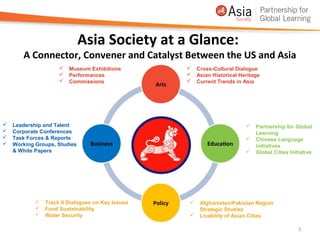
Asia Society at a Glance:
       A Connector, Convener and Catalyst Between the US and Asia
                        Museum Exhibitions           Cross-Cultural Dialogue
                        Performances                 Asian Historical Heritage
                        Commissions                  Current Trends in Asia


   Leadership and Talent                                                    Partnership for Global
   Corporate Conferences                                                     Learning
   Task Forces & Reports                                                    Chinese Language
   Working Groups, Studies                                                   initiatives
    & White Papers                                                           Global Cities Initiative


               Track II Dialogues on Key Issues       Afghanistan/Pakistan Region
               Food Sustainability                     Strategic Studies
               Water Security                         Livability of Asian Cities

                                                                                                3
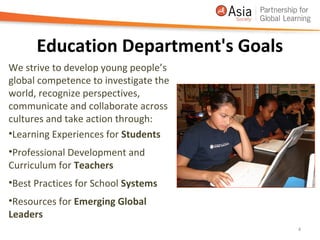
Education Department's Goals
We strive to develop young people’s
global competence to investigate the
world, recognize perspectives,
communicate and collaborate across
cultures and take action through:
•Learning Experiences for Students
•Professional Development and
Curriculum for Teachers
•Best Practices for School Systems
•Resources for Emerging Global
Leaders
                                       4
The Challenge
• Achievement gap – the inability of schools
  to effectively educate all low income and
  underserved minority students;
• Opportunity gap – the need for every
  student to develop the knowledge, skills
  and dispositions required for success in the
  21st century global economy dominated by
  the rise of Asia.
                                                 5
A Changing World Demands
      Changing Skills


                           6
The Next Economy is
A Science and Knowledge Economy
-need scientific and technological literacy
A Resource-Challenged Economy
-need critical thinking about sustainable economies and resources
A Globally Interdependent Economy
-global competence is a core competence
A Demographically Diverse Economy
-requires cross-cultural leadership skills
An Innovation-Driven Economy
-requires students who can learn how to learn and adapt to rapid
change                                                              7
Globalization of the Economy
• Globalization is driving demand for an
  internationally competent workforce
   – One in five jobs is tied to international trade
   – Most future business growth will be in
     overseas markets


                                                   8
Global Issues, Local Solutions
 Human Security and Citizenship
   Our challenges are international challenges: global health,
    global warming, energy/water, terrorism
   Our security is intertwined with our understanding of other
    cultures
   Increasing diversity in our schools and workplaces require
    increased understanding of other cultures
 Education
   Growing global talent pool – U.S. now 18th in the world in HS
    graduation rates
   Only 50% of U.S. high school students study a foreign
    language, and less in lower grades                              9
In the 21st Century Students Will Be:
 Selling to the world
 Buying from the world
 Working for international companies
 Managing diverse employees
 Competing with people on the other side of the world for jobs
  and markets
 Working with people all over the world in joint ventures and
  global work teams
 Solving global problems such as AIDS, avian flu,
  environmental problems, and resolving conflicts
                                          ARE THEY READY?
                                                              10
How Do We Define Global
           Competence?
• Content Knowledge Matters
• Global Knowledge, Skills, and Disposition
  – Investigate the World
  – Recognize Perspectives
  – Communicate Ideas
  – Take Action
                                              11
Implementation

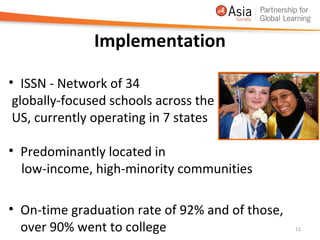
• ISSN - Network of 34
 globally-focused schools across the
 US, currently operating in 7 states

• Predominantly located in
  low-income, high-minority communities

• On-time graduation rate of 92% and of those,
  over 90% went to college                       12
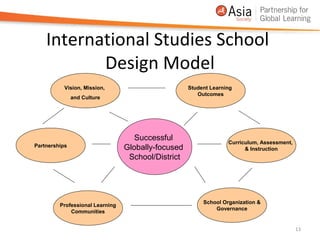
International Studies School
           Design Model
           Vision, Mission,                         Student Learning
                                                       Outcomes
               and Culture


                                    Successful                    Curriculum, Assessment,
Partnerships                     Globally-focused                       & Instruction
                                  School/District


                                                         School Organization &
         Professional Learning
                                                             Governance
             Communities


                                                                                            13
Elements of a Globally-Focused
            School or Classroom
• Creating a global vision and culture
• Recruiting and preparing globally competent
  teachers
• Transforming curriculum and instruction by
  integrating international content; student-centered
  pedagogy
• Emphasizing language proficiency
• Expanding student learning experiences through
  technology, international travel and partnerships,
  internationally service learning and internships   14
What Would You See
            in These Schools?
•   Project-based, performance assessment approach
•   Real-world, out-of-school learning
•   High-quality world language program
•   Emphasis on diversity as an asset
•   New and traditional literacies
•   Technology
•   Service Learning
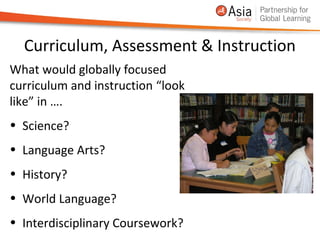
Curriculum, Assessment & Instruction
What would globally focused
curriculum and instruction “look
like” in ….
• Science?
• Language Arts?
• History?
• World Language?
• Interdisciplinary Coursework?
Take our SAGE advice…
Student choice
Authentic Context
Global Significance
Exhibition to an Audience

                             17
Tools to Assist You
Educating for Global Competence
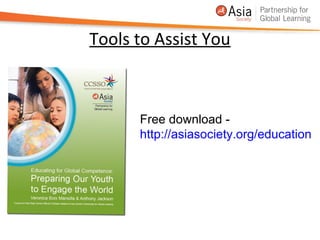
Tools to Assist You


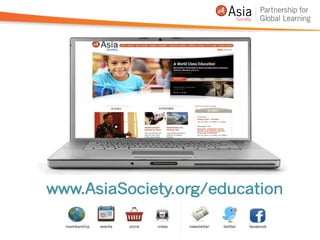
      Free download -
      http://asiasociety.org/education
Tools to Assist You
Educating for Global Competence

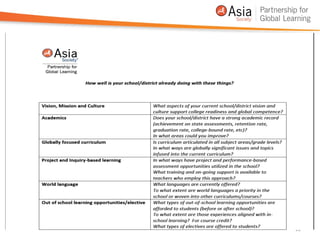
Strategic Planning Questions based on ISSN Design
22
Tools to Assist You
Educating for Global Competence

Strategic Planning Questions based on ISSN Design

Networking with Schools/Districts

Free web-based resources/ webinar series
24
25
Final Thoughts

   Lead your education communities in developing a deep understanding of the
     importance of global competence for the success of every student and in
        considering what a school’s mission should be in the 21st century.
                                          ·
Create opportunities for your schools to systematically investigate how addressing
   matters of global significance can become a mainstay of a school’s culture—
reflected in its structures, practices, and relationships with people and institutions
                                  outside the school.
                                            ·
   Pilot new and strengthen existing approaches to promote global competence,
 from new course offerings in world languages and other internationally focused
content to globally focused service learning and internships to international travel
           and virtual exchange opportunities for students and teachers.
                                           ·
    Feature best practices stemming from your schools and communities.
 Create conditions for interested stakeholders (teachers, administrators, parents,
  businesses) to reflect about the opportunities embedded in best practices and
            what can be done to support them and expand their reach.                26

Schools: Go Global and Prepare Students for Success

  • 1.
    Schools: Go Globaland Prepare Students for Success Asia Society’s Partnership for Global Learning Webinar September 27, 2012 Series Brandon Wiley Director, International Studies Schools Network Twitter: @bwileyone 1
  • 2.
    Our Goals Today 1.)Global Competence – What is it and why does it matter? 2.) System Level Structures/Practices – What can schools do to promote global competence? 3.) Examples in Action/Tools to Assist You – Denver Center for International Studies (Denver, CO) International School of the Americas (San Antonio, TX) 2
  • 3.
    Asia Society ata Glance: A Connector, Convener and Catalyst Between the US and Asia  Museum Exhibitions  Cross-Cultural Dialogue  Performances  Asian Historical Heritage  Commissions  Current Trends in Asia  Leadership and Talent  Partnership for Global  Corporate Conferences Learning  Task Forces & Reports  Chinese Language  Working Groups, Studies initiatives & White Papers  Global Cities Initiative  Track II Dialogues on Key Issues  Afghanistan/Pakistan Region  Food Sustainability Strategic Studies  Water Security  Livability of Asian Cities 3
  • 4.
    Education Department's Goals Westrive to develop young people’s global competence to investigate the world, recognize perspectives, communicate and collaborate across cultures and take action through: •Learning Experiences for Students •Professional Development and Curriculum for Teachers •Best Practices for School Systems •Resources for Emerging Global Leaders 4
  • 5.
    The Challenge • Achievementgap – the inability of schools to effectively educate all low income and underserved minority students; • Opportunity gap – the need for every student to develop the knowledge, skills and dispositions required for success in the 21st century global economy dominated by the rise of Asia. 5
  • 6.
    A Changing WorldDemands Changing Skills 6
  • 7.
    The Next Economyis A Science and Knowledge Economy -need scientific and technological literacy A Resource-Challenged Economy -need critical thinking about sustainable economies and resources A Globally Interdependent Economy -global competence is a core competence A Demographically Diverse Economy -requires cross-cultural leadership skills An Innovation-Driven Economy -requires students who can learn how to learn and adapt to rapid change 7
  • 8.
    Globalization of theEconomy • Globalization is driving demand for an internationally competent workforce – One in five jobs is tied to international trade – Most future business growth will be in overseas markets 8
  • 9.
    Global Issues, LocalSolutions  Human Security and Citizenship  Our challenges are international challenges: global health, global warming, energy/water, terrorism  Our security is intertwined with our understanding of other cultures  Increasing diversity in our schools and workplaces require increased understanding of other cultures  Education  Growing global talent pool – U.S. now 18th in the world in HS graduation rates  Only 50% of U.S. high school students study a foreign language, and less in lower grades 9
  • 10.
    In the 21stCentury Students Will Be:  Selling to the world  Buying from the world  Working for international companies  Managing diverse employees  Competing with people on the other side of the world for jobs and markets  Working with people all over the world in joint ventures and global work teams  Solving global problems such as AIDS, avian flu, environmental problems, and resolving conflicts ARE THEY READY? 10
  • 11.
    How Do WeDefine Global Competence? • Content Knowledge Matters • Global Knowledge, Skills, and Disposition – Investigate the World – Recognize Perspectives – Communicate Ideas – Take Action 11
  • 12.
    Implementation • ISSN -Network of 34 globally-focused schools across the US, currently operating in 7 states • Predominantly located in low-income, high-minority communities • On-time graduation rate of 92% and of those, over 90% went to college 12
  • 13.
    International Studies School Design Model Vision, Mission, Student Learning Outcomes and Culture Successful Curriculum, Assessment, Partnerships Globally-focused & Instruction School/District School Organization & Professional Learning Governance Communities 13
  • 14.
    Elements of aGlobally-Focused School or Classroom • Creating a global vision and culture • Recruiting and preparing globally competent teachers • Transforming curriculum and instruction by integrating international content; student-centered pedagogy • Emphasizing language proficiency • Expanding student learning experiences through technology, international travel and partnerships, internationally service learning and internships 14
  • 15.
    What Would YouSee in These Schools? • Project-based, performance assessment approach • Real-world, out-of-school learning • High-quality world language program • Emphasis on diversity as an asset • New and traditional literacies • Technology • Service Learning
  • 16.
    Curriculum, Assessment &Instruction What would globally focused curriculum and instruction “look like” in …. • Science? • Language Arts? • History? • World Language? • Interdisciplinary Coursework?
  • 17.
    Take our SAGEadvice… Student choice Authentic Context Global Significance Exhibition to an Audience 17
  • 19.
    Tools to AssistYou Educating for Global Competence
  • 20.
    Tools to AssistYou Free download - http://asiasociety.org/education
  • 21.
    Tools to AssistYou Educating for Global Competence Strategic Planning Questions based on ISSN Design
  • 22.
  • 23.
    Tools to AssistYou Educating for Global Competence Strategic Planning Questions based on ISSN Design Networking with Schools/Districts Free web-based resources/ webinar series
  • 24.
  • 25.
  • 26.
    Final Thoughts Lead your education communities in developing a deep understanding of the importance of global competence for the success of every student and in considering what a school’s mission should be in the 21st century. · Create opportunities for your schools to systematically investigate how addressing matters of global significance can become a mainstay of a school’s culture— reflected in its structures, practices, and relationships with people and institutions outside the school. · Pilot new and strengthen existing approaches to promote global competence, from new course offerings in world languages and other internationally focused content to globally focused service learning and internships to international travel and virtual exchange opportunities for students and teachers. · Feature best practices stemming from your schools and communities. Create conditions for interested stakeholders (teachers, administrators, parents, businesses) to reflect about the opportunities embedded in best practices and what can be done to support them and expand their reach. 26

Editor's Notes

  • #6 Businesses, communities, and families are demanding that students graduate both ready for college and globally competent. Asia Society ’s education agenda helps schools, afterschool, and extended learning time programs meet both demands.