
Dr.	
  James	
  Bentley	
  
Professor	
  Department	
  of	
  Obstetrics	
  and	
  Gynecology	
  
Dalhousie	
  University	
  
Halifax	
  NS	


Thanks:	
  
Dr	
  N	
  VanEyk	
  
Assistant	
  Professor	
  Dalhousie	
  University	
  
Speaker	
  Disclosure:	


— No	
  conflicts	
  to	
  disclose	
  
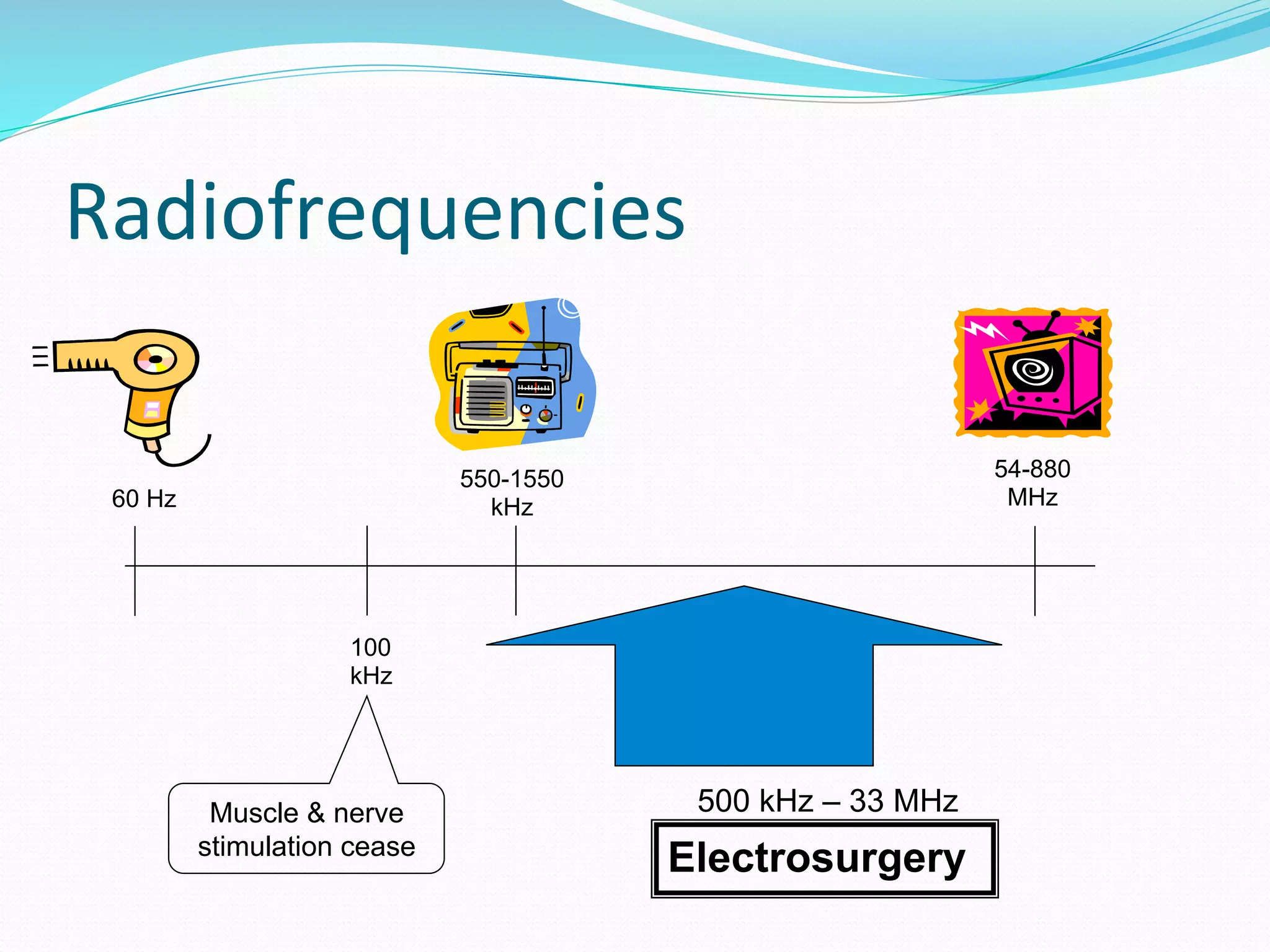
Radiofrequencies	
  
60 Hz
100
kHz
550-1550
kHz
54-880
MHz
500 kHz – 33 MHz
Electrosurgery
Muscle & nerve
stimulation cease
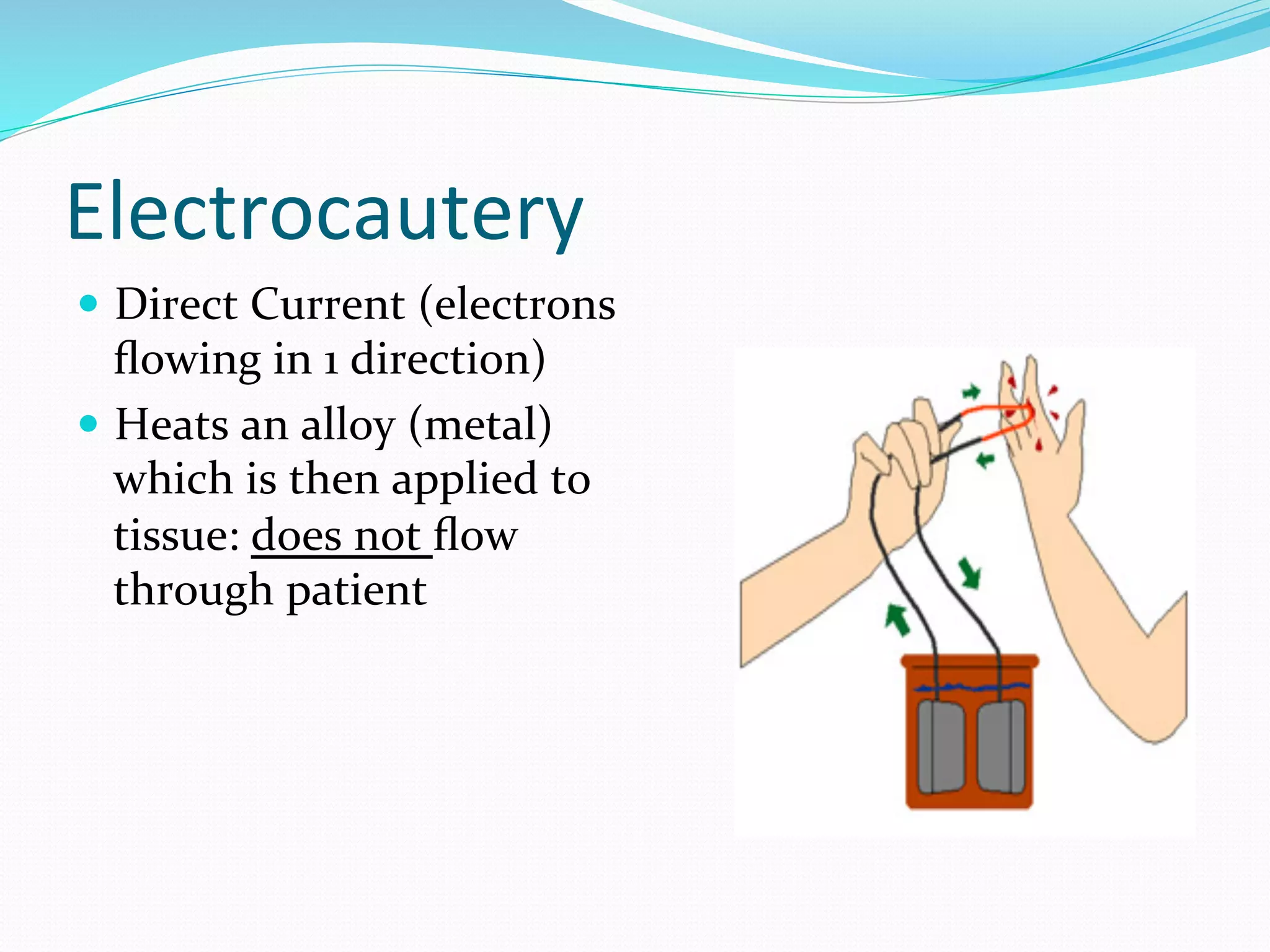
Electrocautery	
  
—  Direct	
  Current	
  (electrons	
  
flowing	
  in	
  1	
  direction)	
  
—  Heats	
  an	
  alloy	
  (metal)	
  
which	
  is	
  then	
  applied	
  to	
  
tissue:	
  does	
  not	
  flow	
  
through	
  patient	
  
Electrosurgery	
  History	


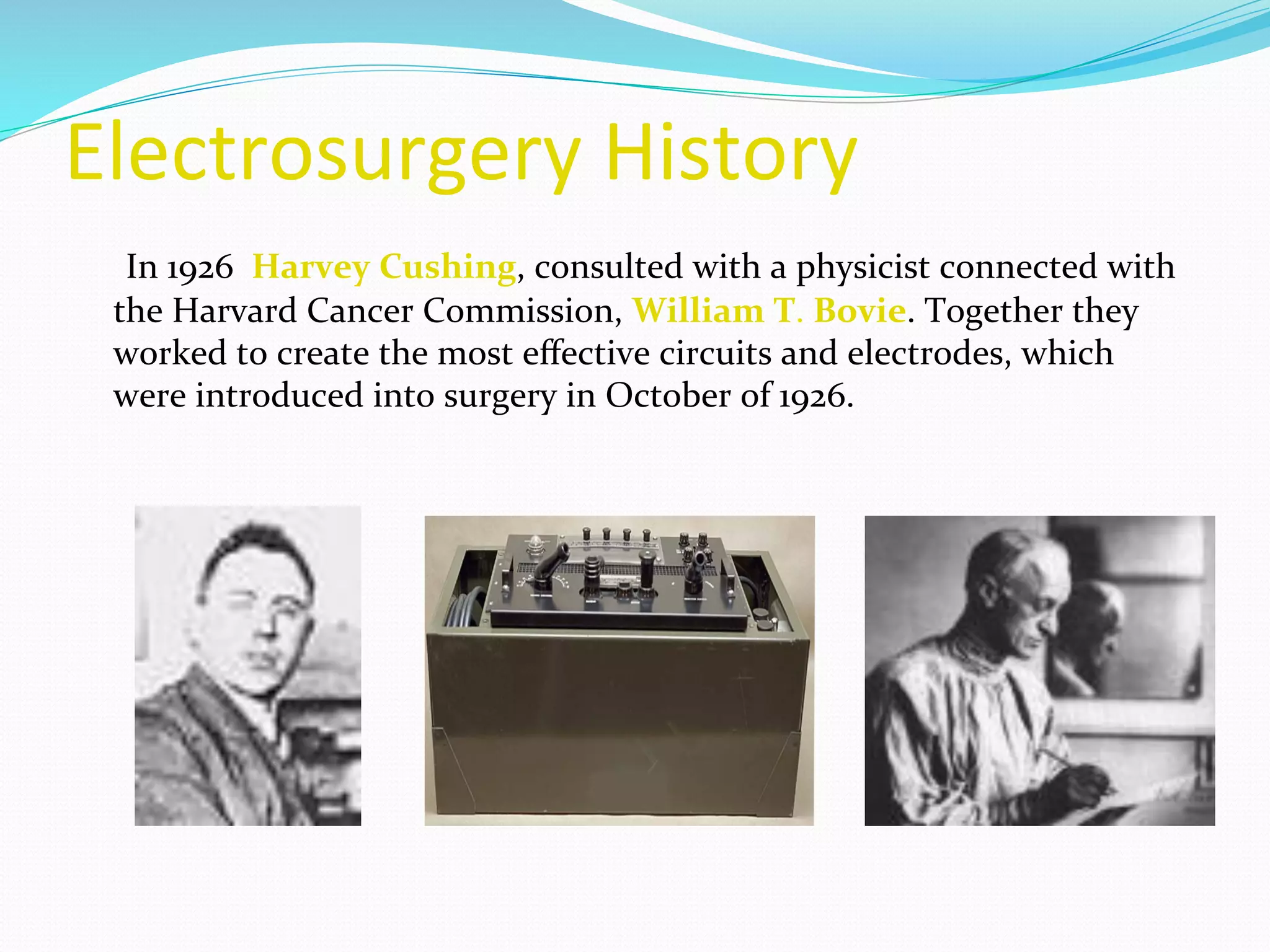
  In	
  1926	
  	
  Harvey	
  Cushing,	
  consulted	
  with	
  a	
  physicist	
  connected	
  with	
  
the	
  Harvard	
  Cancer	
  Commission,	
  William	
  T.	
  Bovie.	
  Together	
  they	
  
worked	
  to	
  create	
  the	
  most	
  effective	
  circuits	
  and	
  electrodes,	
  which	
  
were	
  introduced	
  into	
  surgery	
  in	
  October	
  of	
  1926.	
  	
  
Electrosurgery	
  Evolu;on	


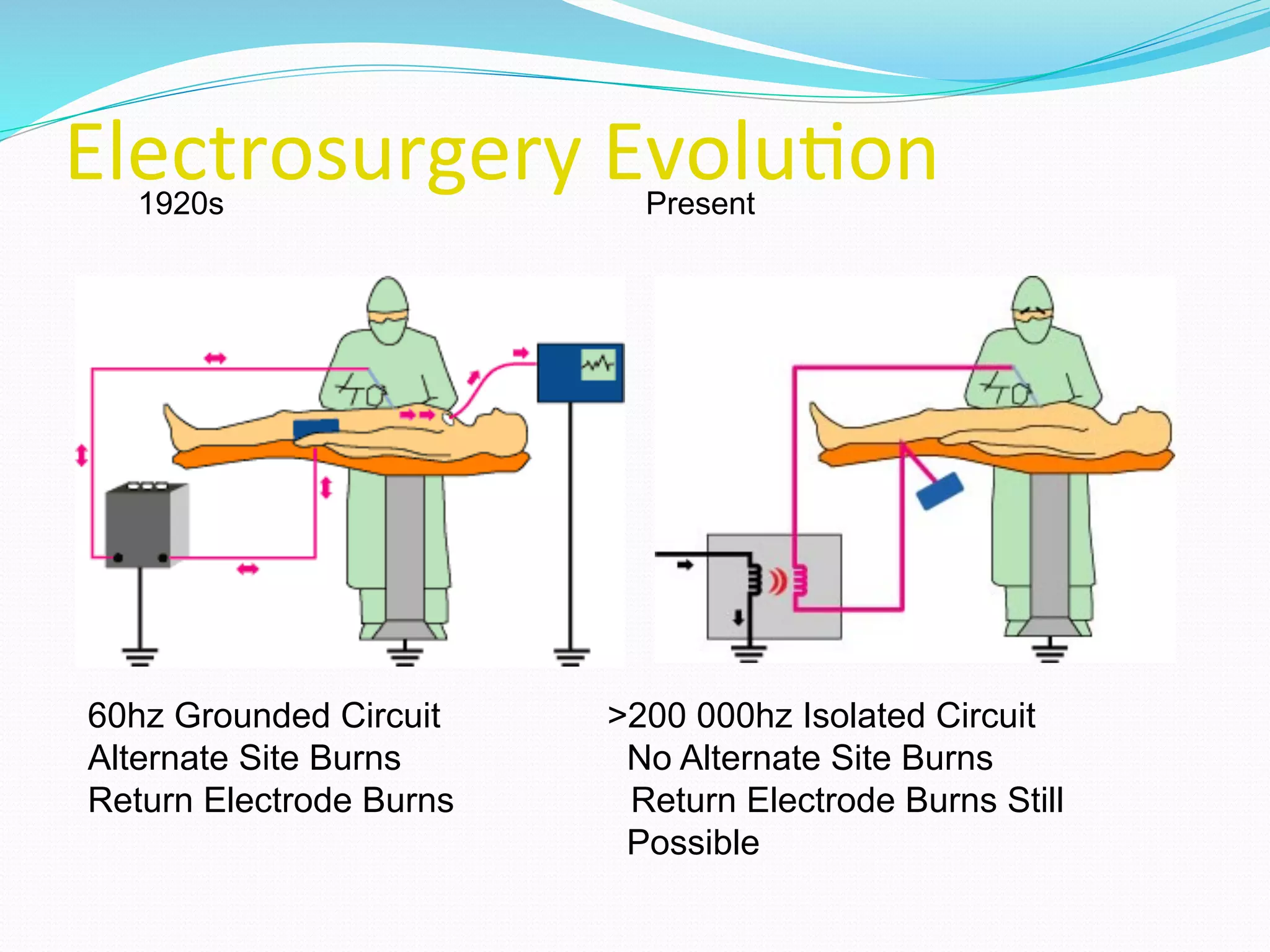
1920s Present
60hz Grounded Circuit >200 000hz Isolated Circuit
Alternate Site Burns No Alternate Site Burns
Return Electrode Burns Return Electrode Burns Still
Possible
Electrosurgery	
  
—  High	
  frequency	
  
—  Alternating	
  Current	
  
—  Current	
  enters	
  patient s	
  
body	
  as	
  part	
  of	
  the	
  circuit	
  
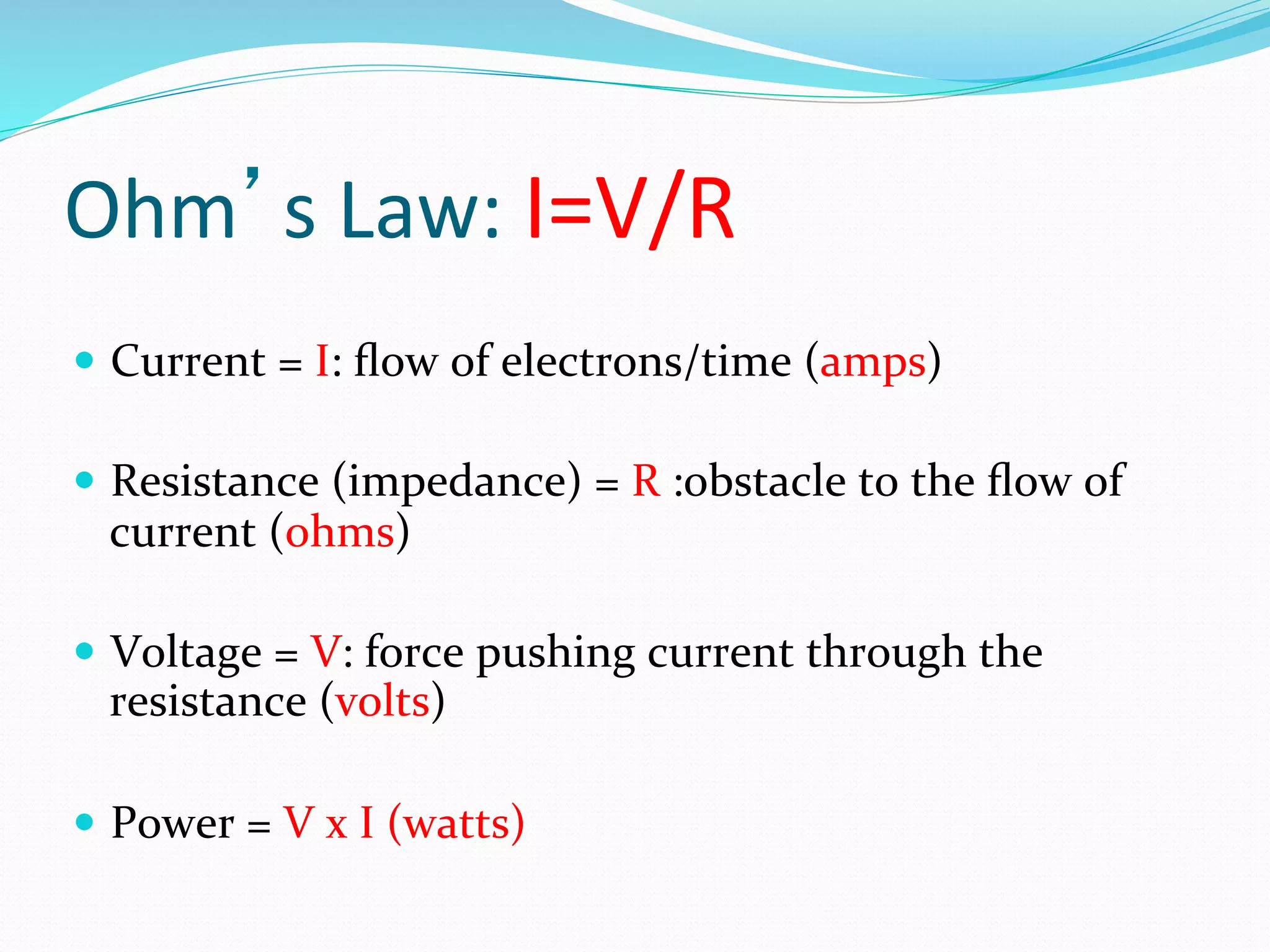
Ohm s	
  Law:	
  I=V/R	
  
—  Current	
  =	
  I:	
  flow	
  of	
  electrons/time	
  (amps)	
  
—  Resistance	
  (impedance)	
  =	
  R	
  :obstacle	
  to	
  the	
  flow	
  of	
  
current	
  (ohms)	
  
—  Voltage	
  =	
  V:	
  force	
  pushing	
  current	
  through	
  the	
  
resistance	
  (volts)	
  
—  Power	
  =	
  V	
  x	
  I	
  (watts)	
  
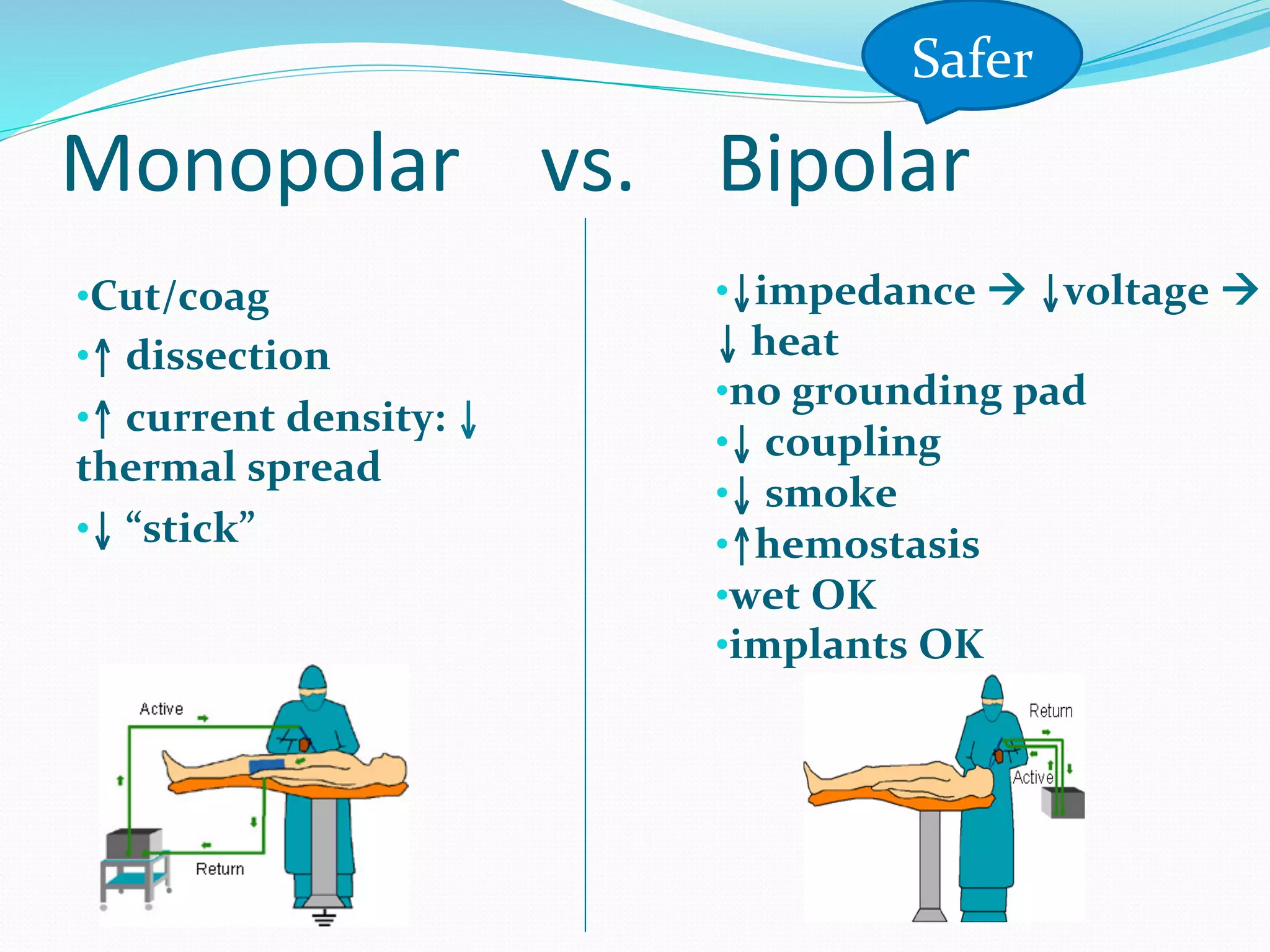
Monopolar	


  vs.	


  Bipolar	
  
• Cut/coag	
  
• ↑	
  dissection	
  
• ↑	
  current	
  density:	
  ↓	
  
thermal	
  spread	
  
• ↓	
  “stick”	
  
• ↓impedance	
  à	
  ↓voltage	
  à	
  
↓	
  heat	
  	
  
• no	
  grounding	
  pad	
  
• ↓	
  coupling	
  
• ↓	
  smoke	
  
• ↑hemostasis	
  
• wet	
  OK	
  
• implants	
  OK	
  
Safer	
  
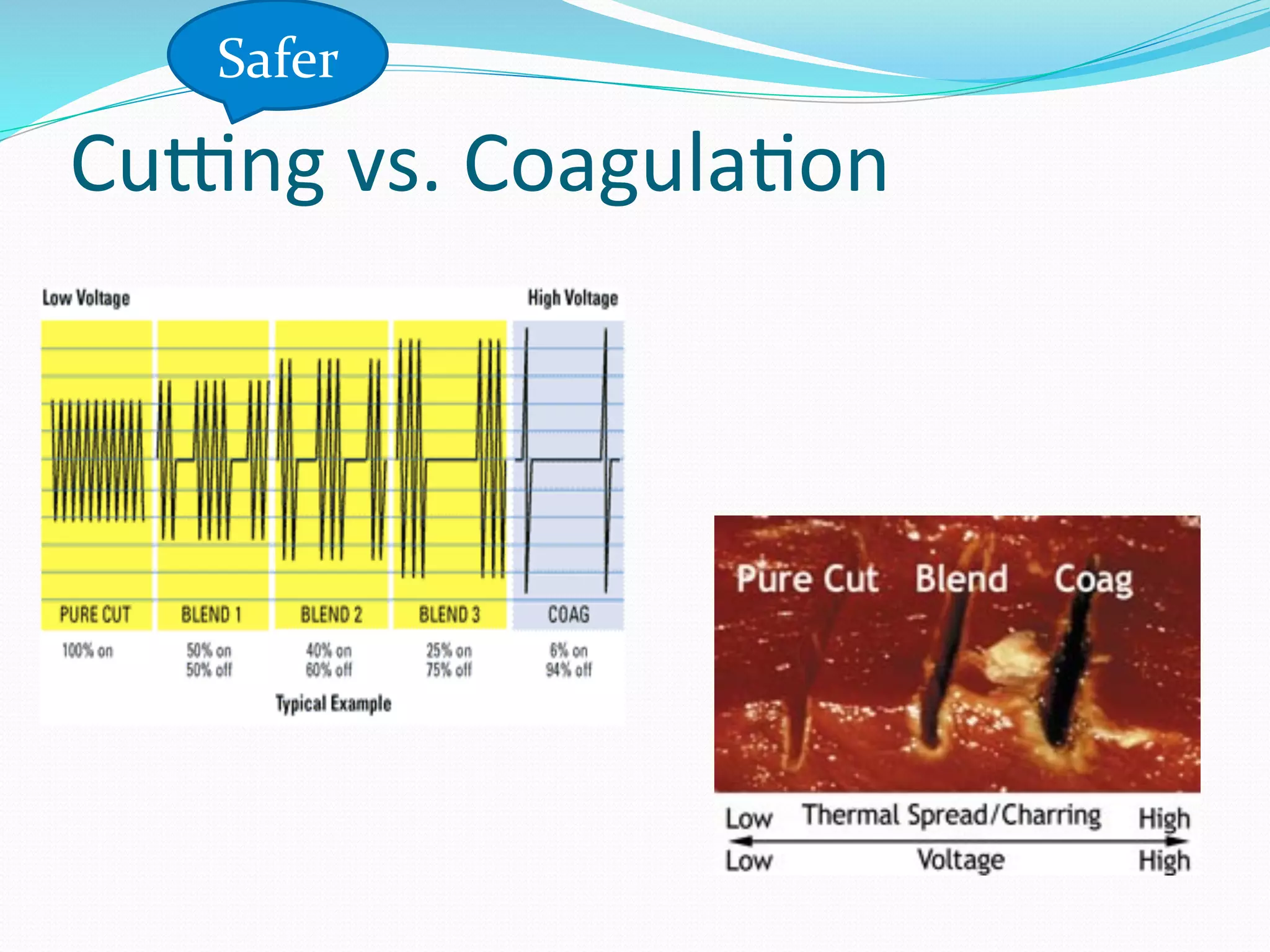
CuIng	
  vs.	
  Coagula;on	
  
Safer	
  
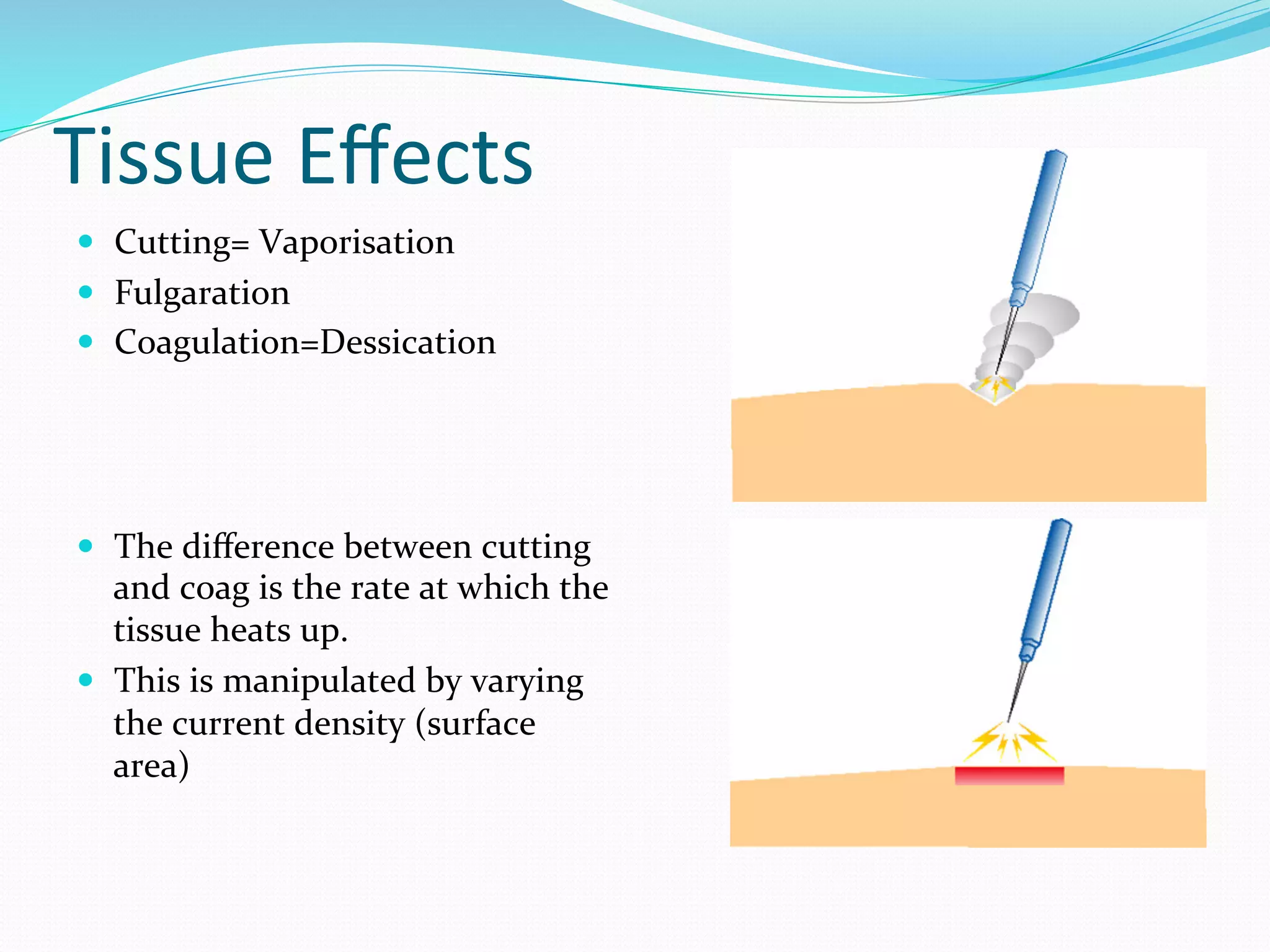
Tissue	
  Effects	
  
—  Cutting=	
  Vaporisation	
  
—  Fulgaration	
  
—  Coagulation=Dessication	
  
—  The	
  difference	
  between	
  cutting	
  
and	
  coag	
  is	
  the	
  rate	
  at	
  which	
  the	
  
tissue	
  heats	
  up.	
  
—  This	
  is	
  manipulated	
  by	
  varying	
  
the	
  current	
  density	
  (surface	
  
area)	
  
Complica;ons:	
  Direct	
  Coupling	
  
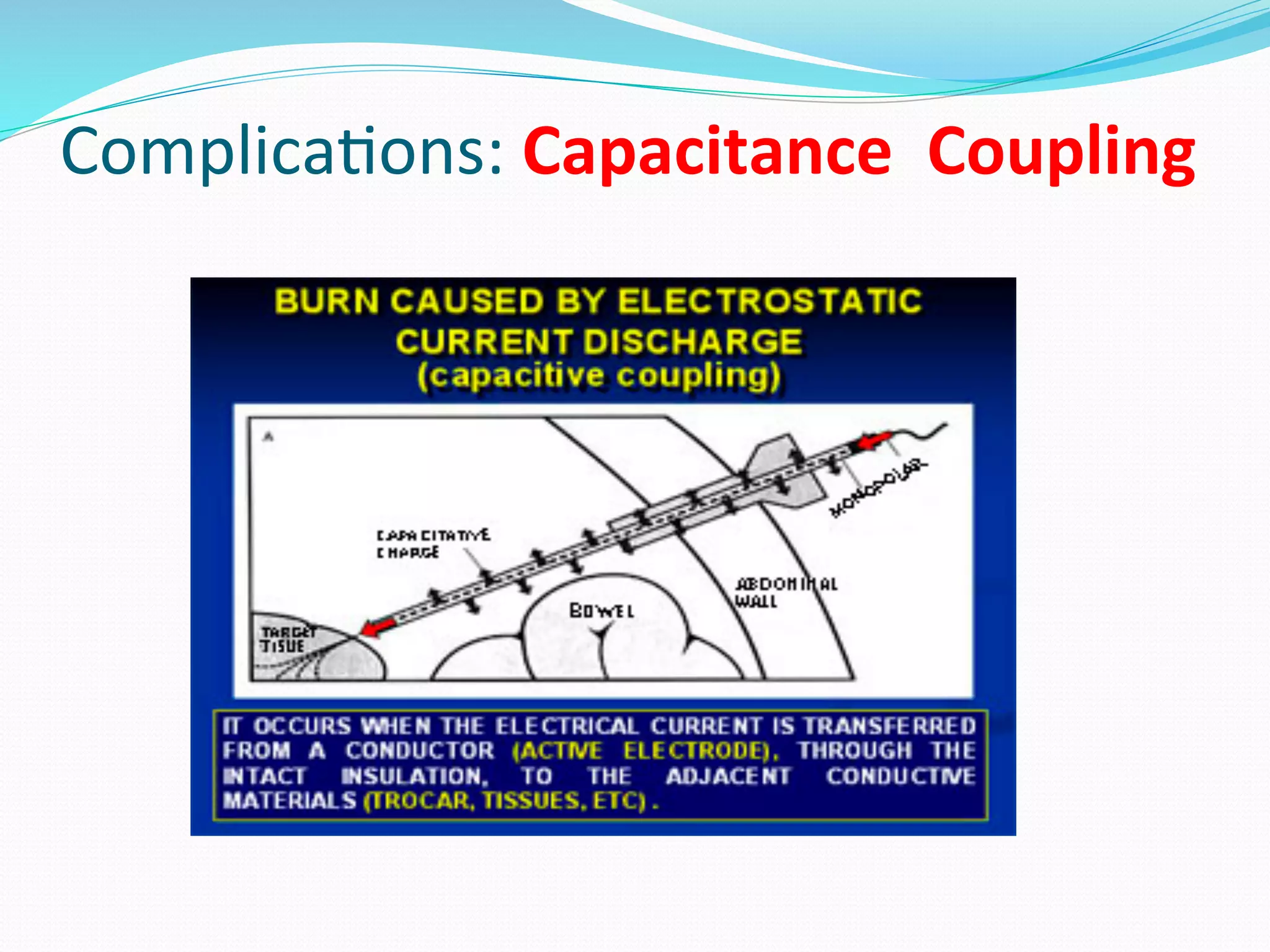
Complica;ons:	
  Capacitance	
  	
  Coupling	
  
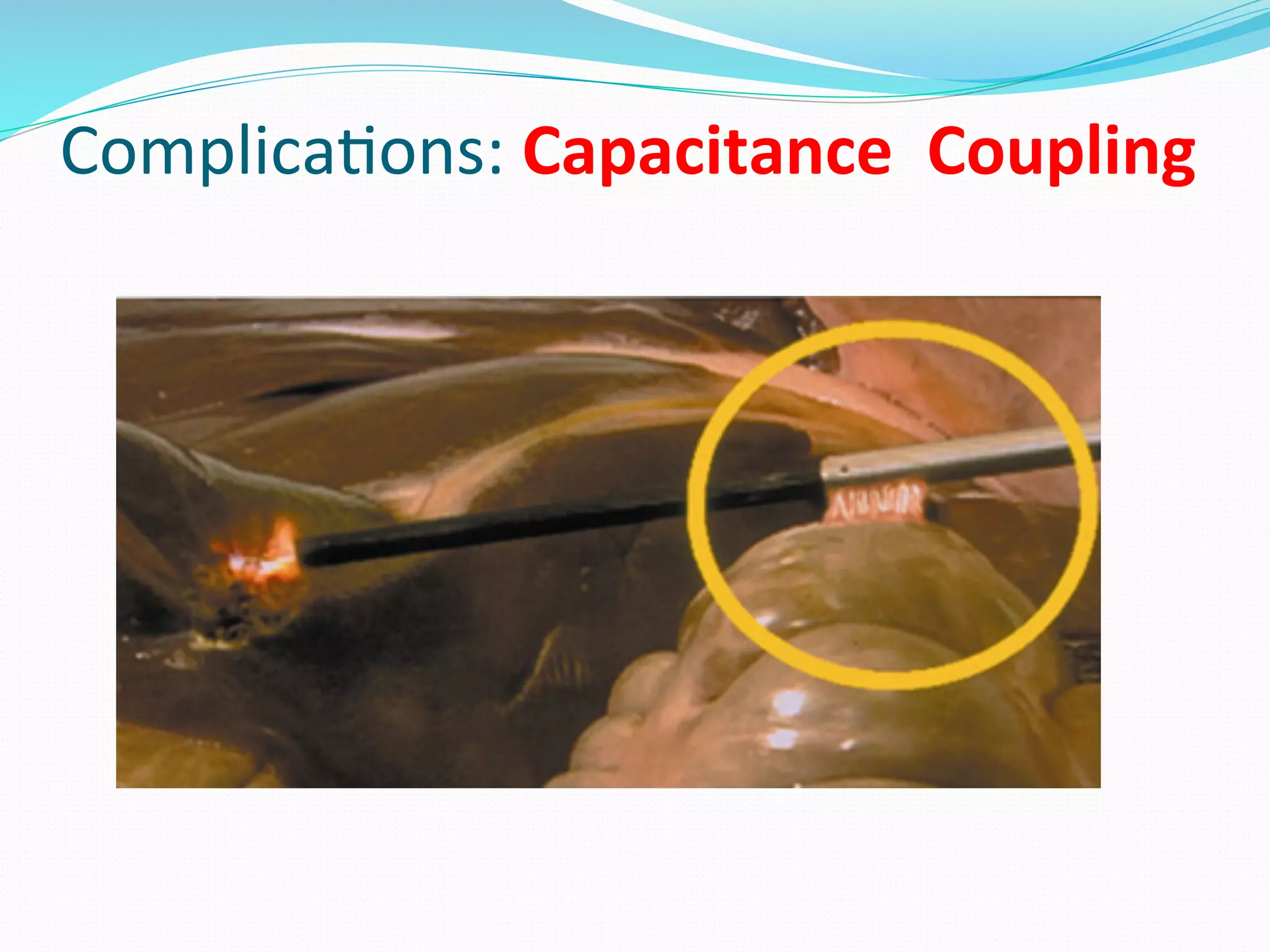
Complica;ons:	
  Capacitance	
  	
  Coupling	
  
Complica;ons:	
  Insula2on	
  Failure	
  
Energy	
  Sources:	
  The	
  New	
  Genera;on	
  
— Higher	
  Current,	
  Less	
  voltage	
  
— Less	
  thermal	
  spread	
  
—  Plug	
  &	
  Play 	
  :	
  output	
  &	
  power	
  preset	
  
— Impedance	
  feedback	
  &	
  adjustments	
  
— Grasp,	
  dissect,	
  coagulate	
  &	
  transect	
  with	
  one	
  
instrument	
  
— Disposable:	
  safer,	
  more	
  efficient	
  but	
  ↑$	
  
Energy	
  Sources:	
  Op;ons	
  
—  Advanced	
  Bipolar	
  Devices	
  
—  Gyrus	
  ACMI	
  (Olympus)	
  
—  Enseal	
  (Ethicon	
  Endo-­‐Surgery)	
  
—  Ligasure	
  (Covidien)	
  
—  Ultrasonic	
  Shears	
  
—  Harmonic	
  Scalpel	
  (Ethicon	
  Endo-­‐Surgery)	
  
Vessel Sealing
Devices
Gyrus	
  ACMI	
  
— PK	
  (plasma	
  kinetic)	
  energy	
  delivered	
  in	
  a	
  
series	
  of	
  pulses	
  (VPC	
  =	
  vapor	
  pulse	
  
coagulation)	
  à	
  boil	
  fluid	
  in	
  tissue	
  à	
  steam	
  
creates	
  vapor	
  pockets	
  which	
  coalesce	
  to	
  
form	
  vapor	
  zones	


— High	
  resistance	
  within	
  zone,	
  low	
  at	
  
periphery	
  à	
  highest	
  current	
  density	
  at	
  
edges	
  where	
  tissue	
  moist/not	
  coagulated	
  
Gyrus	
  ACMI	
  
— Pulse/cool	
  off	
  period	
  cools	
  instrument	
  à	
  
reduces	
  drying	
  and	
  electrode	
  sticking	
  
— Pulses	
  repeated	
  until	
  tissues	
  don t	
  absorb	
  
fluid	
  =	
  uniformly	
  coagulated	
  à	
  audible	
  and	
  
visual	
  impedance	
  end	
  point	
  indicators	
  
— Vessel	
  sealing	
  capacity	
  
Gyrus:	
  PKS	
  laparoscopy	
  instruments	
  
—  Cutting	
  Forceps	
  
—  L-­‐Hook	


—  Plasma	
  J-­‐Hook	
  
—  PlasmaSORD™	
  Bipolar	
  Morcellator	
  
—  PlasmaSpatula®:	
  coag	
  with	
  one	
  surface,	
  rotate	
  90	
  
degrees	
  and	
  cut	
  
Enseal	
  
— Adjusts	
  energy	
  simultaneously	
  to	
  various	
  tissue	
  
types	
  in	
  a	
  tissue	
  bundle	
  (each	
  with	
  own	
  
impedance	
  characteristics)	
  
— Proprietary	
  electrode	
  with	
  millions	
  of	
  nanometer	
  
sized	
  conductive	
  particles	
  embedded	
  in	
  a	
  
temperature	
  sensitive	
  material	
  ( Smart	
  electrode	
  
technology );	
  each	
  particle-­‐discrete	
  thermostatic	
  
switch	
  
— To	
  keep	
  temperature	
  from	
  rising	
  dangerously	
  –
each	
  particle	
  interrupts	
  current	
  flow	
  to	
  a	
  specific	
  
tissue	
  region.	
  	
  When	
  temperature	
  dips	
  below	
  
optimal	
  fusion	
  level,	
  particle	
  turns	
  back	
  on;	
  temp	
  
maintained	
  ~	
  1000	
  C	
  
Enseal	
  
— Process	
  continues	
  until	
  entire	
  tissue	
  segment	
  is	
  
uniformly	
  fused	
  without	
  charring	
  or	
  sticking	
  
— Less	
  heat	
  required-­‐tissue	
  volume	
  reduced	
  by	
  
compression;	
  limits	
  lateral	
  thermal	
  spread	
  
— 	
  Vessel	
  walls	
  fused	
  by	
  compression,	
  protein	
  
denaturation,	
  then	
  renaturation	
  
— up	
  to	
  7mm	
  vessel	
  diameter	
  
— withstand	
  up	
  to	
  7	
  x	
  systolic	
  pressure	
  	
  
Enseal	
  
—  Enseal	
  Trio	
  Tissue	
  
Sealing	
  Device	
  
Ligasure	
  
—  Electrosurgical	
  Collagen	
  Welding :	
  Combination	
  of	
  
pressure	
  and	
  energy;	
  denature	
  collagen	
  and	
  elastin	
  to	
  
reform	
  a	
  permanent	
  seal;	
  hydrothermal	
  rupture	
  of	
  
hydrogen	
  cross	
  links	
  by	
  elevating	
  to	
  60-­‐95	
  ºC	
  
—  Cooling	
  allows	
  renaturation	
  of	
  entangled	
  unwound	
  
collagen	
  strands;	
  high	
  uniform	
  mechanical	
  compression	
  
increases	
  entanglement/recrosslinking	
  upon	
  thermal	
  
relaxation	
  
—  Permanently	
  fuses	
  vessels	
  and	
  tissue	
  bundles	
  without	
  
dissection	
  or	
  isolation	
  
Ligasure	
  Vessel	
  Sealing	
  
Ligasure	
  
— Average	
  seal	
  cycle	
  is	
  2	
  to	
  4	
  seconds*	
  	
  
—  up	
  to	
  7	
  mm	
  vessel	
  diameter	
  
—  withstand	
  up	
  to	
  3	
  x	
  systolic	
  blood	
  pressure	
  
— Impedance	
  feedback	
  –	
  adjusts	
  energy	
  output	
  
based	
  on	
  real	
  time	
  measurements	
  of	
  tissue	
  
impedance	
  3333	
  times/second	
  
—  Feedback-­‐controlled	
  response	
  system	
  automatically	
  
discontinues	
  energy	
  delivery	
  when	
  the	
  seal	
  cycle	
  is	
  
complete	
  
Ligasure:	
  Laparoscopic	
  Instruments	
  
—  LigaSure	
  Advance™	
  Pistol	
  Grip1	
  
—  LigaSure™	
  5	
  mm:	
  blunt2	
  
—  LigaSure	
  Advance™	
  
—  LigaSure™	
  V:	
  dolphin3	
  
—  LigaSure	
  Atlas™	
  
—  LigaSure™	
  Lap:	
  Maryland	
  
*Advance:	
  monopolar	
  tip	
  
1	
  
2	
  
3	
  
Ultrasonic	
  Shears	
  
Piezoelectric	
  ceramic	
  
discs	
  convert	
  electrical	
  
energy	
  into	
  mechanical	
  
vibrations	
  	
  
• Lysis	
  hydrogen	
  bonds	
  
• Denature	
  proteins	
  
• Steam	
  formation	
  
• Cavitational	
  fragmentation	
  à	
  
tissue	
  falls	
  apart	
  =	
  cutting	
  
Harmonic	
  Scalpel	
  
— Amount	
  of	
  blade	
  excursion	
  modifies	
  tissue	
  effect;	
  
cutting	
  speed	
  increases	
  with	
  higher	
  settings	
  (1	
  -­‐	
  5)	
  
— No	
  electrical	
  energy	
  à	
  no	
  risks	
  coupling	
  
— No	
  smoke	
  (steam	
  only)	
  
— Minimal	
  lateral	
  thermal	
  spread	
  
— Small	
  –	
  medium	
  vessels:	
  up	
  to	
  5mm	
  
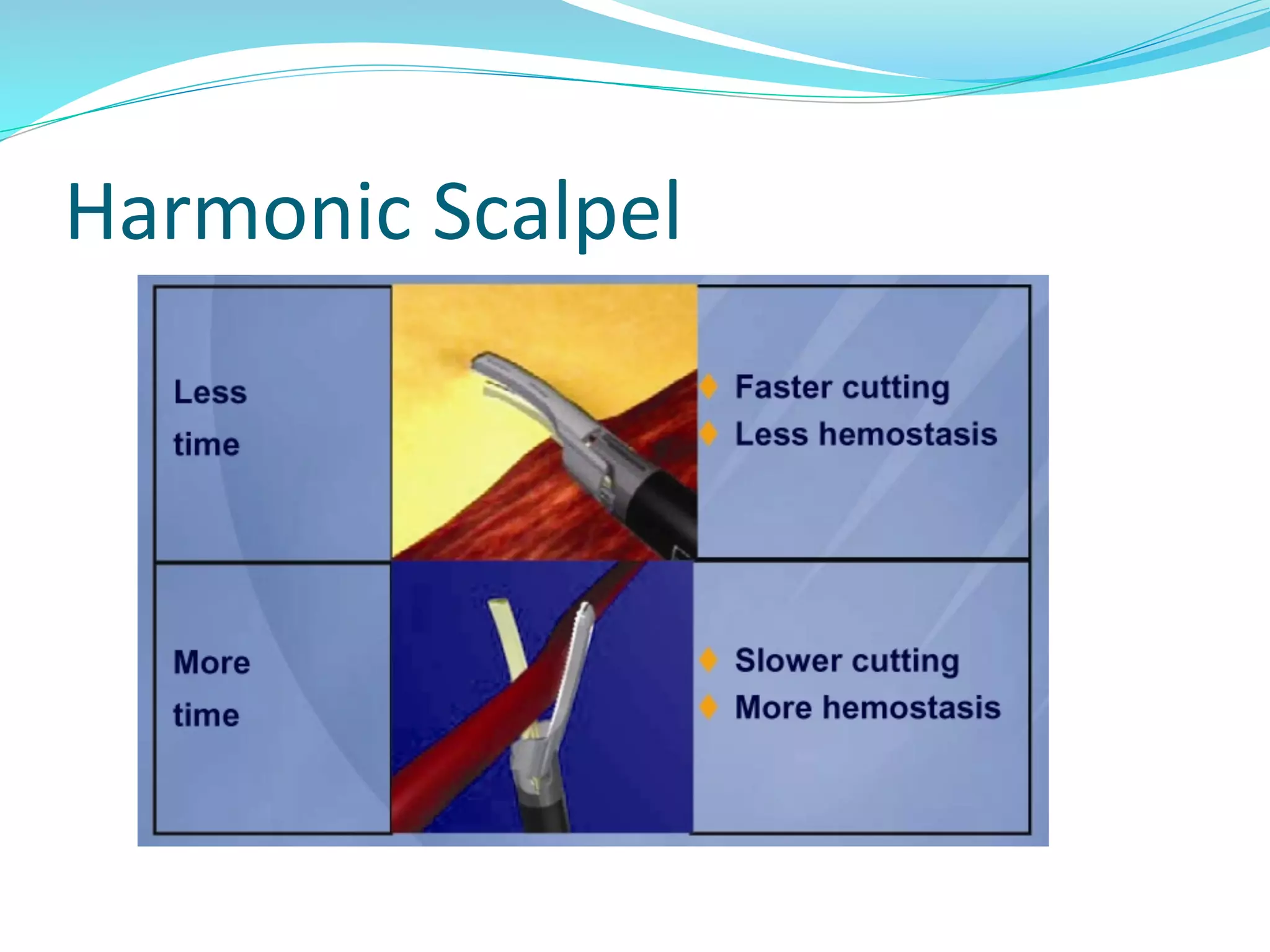
Harmonic	
  Scalpel	
  
—  ACE	
  curved	
  Shears	
  
—  Coagulating	
  Shears	
  
—  Dissecting	
  Hook	
  
Harmonic	
  Scalpel	
  
How	
  do	
  we	
  decide??	
  
Comparison:	
  Mean	
  Burst	
  Pressure	
  
Newcomb et al. Comparison of blood vessel sealing among new
electrosurgical and ultrasonic devices. Surg Endosc 2009; 23 (1):90–96
Comparison:	
  Mean	
  Seal	
  Time	
  
Surg Endosc 2009; 23 (1):90–96
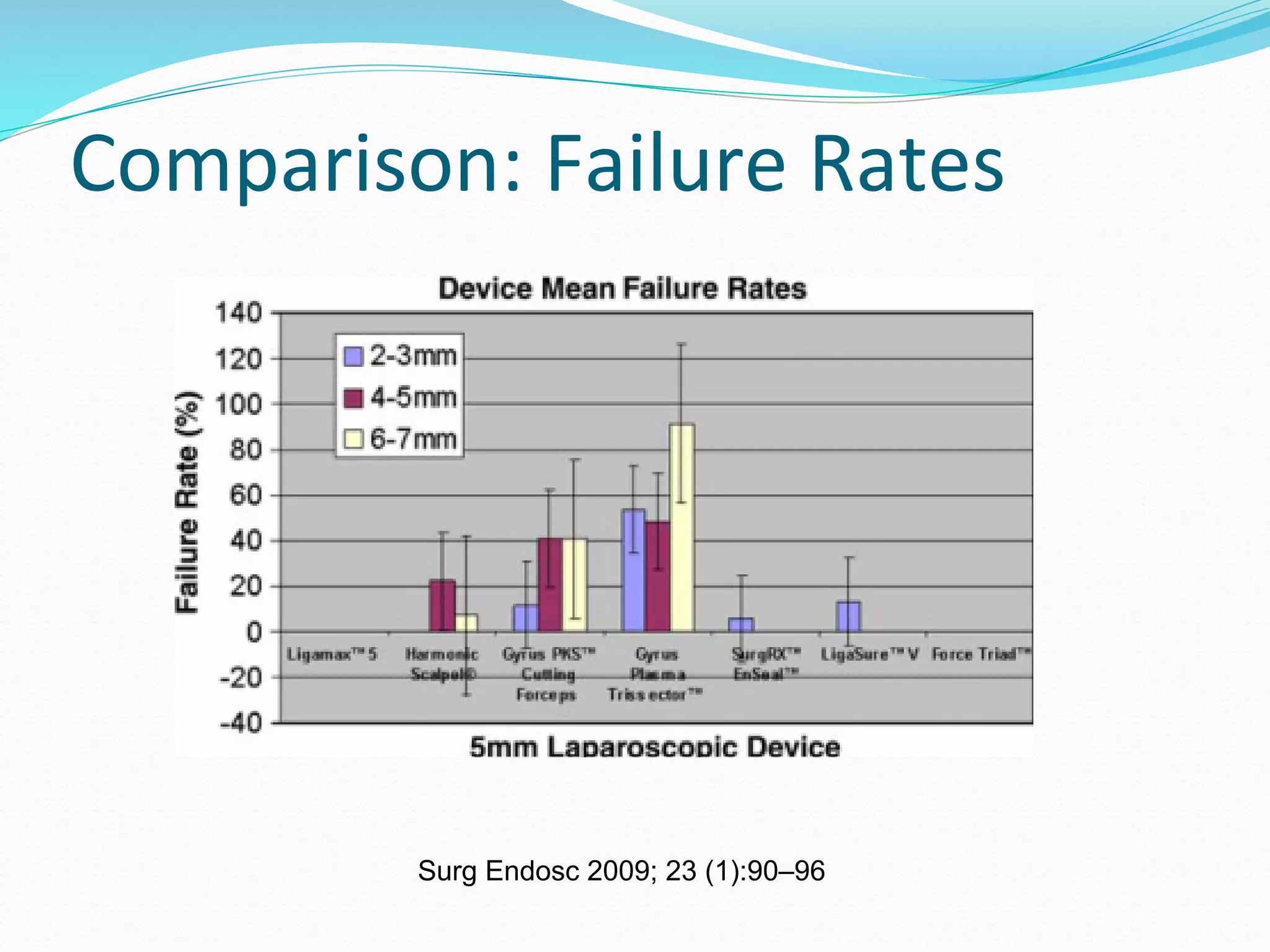
Comparison:	
  Failure	
  Rates	
  
Surg Endosc 2009; 23 (1):90–96
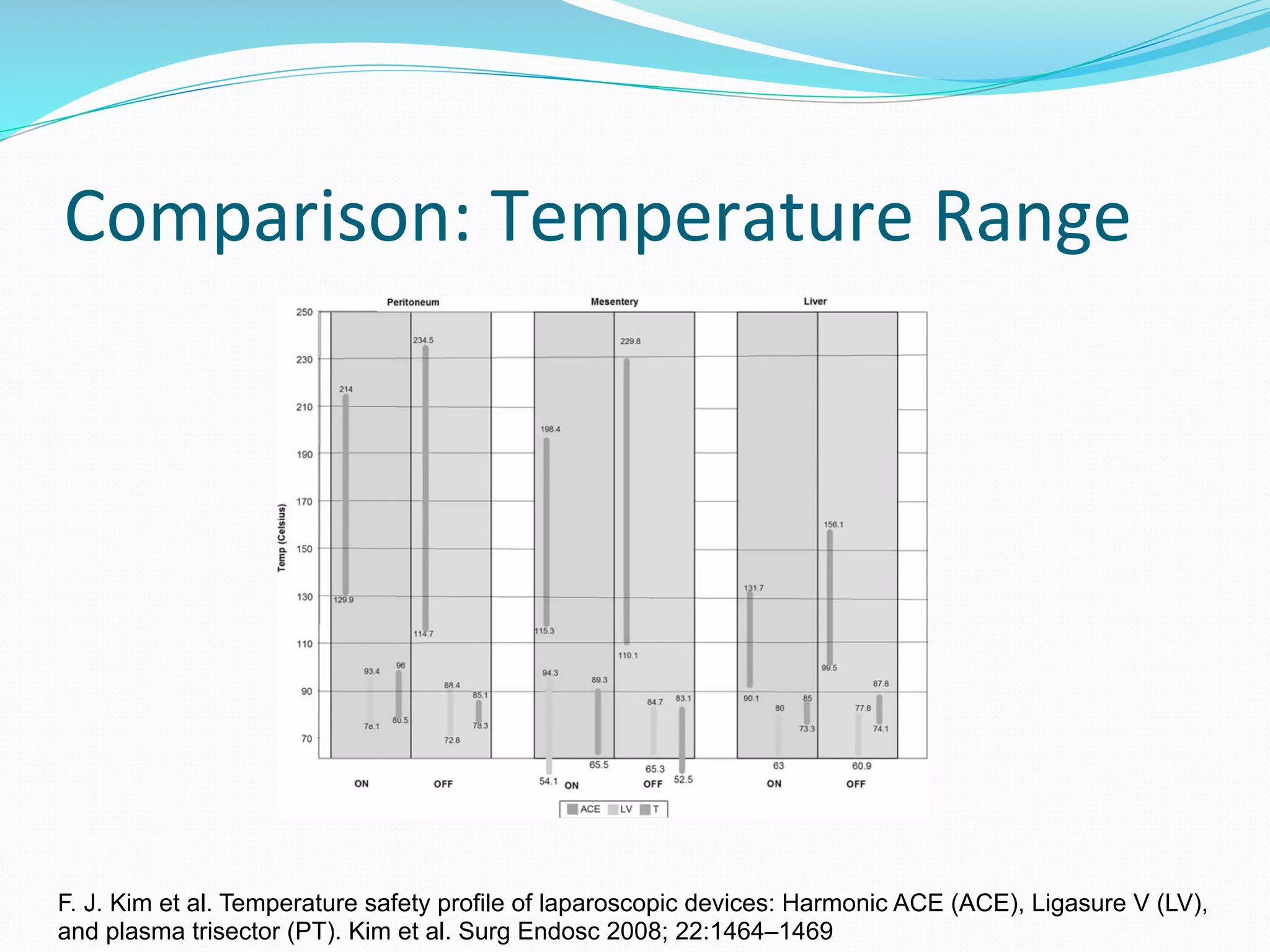
Comparison:	
  Temperature	
  Range	
  
F. J. Kim et al. Temperature safety profile of laparoscopic devices: Harmonic ACE (ACE), Ligasure V (LV),
and plasma trisector (PT). Kim et al. Surg Endosc 2008; 22:1464–1469
Comparison:	
  Cool	
  Time	
  
Surg Endosc 2008; 22:1464–1469
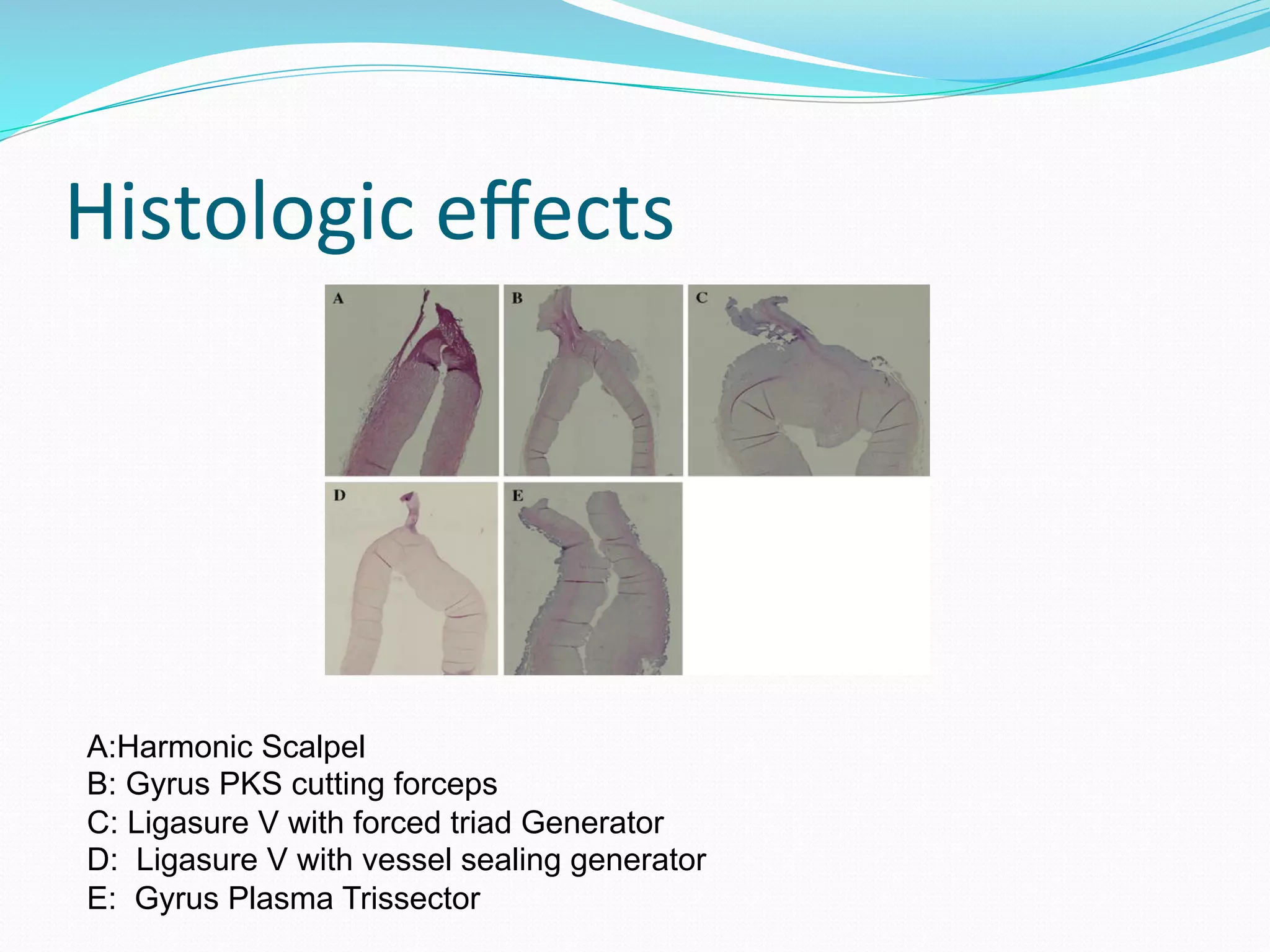
Histologic	
  effects	
  
A:Harmonic Scalpel
B: Gyrus PKS cutting forceps
C: Ligasure V with forced triad Generator
D: Ligasure V with vessel sealing generator
E: Gyrus Plasma Trissector
What	
  do	
  you	
  want/not	
  want?	
  
— Tissue	
  Handling	
  
— Grasper,	
  Elevator	
  
— Dissector	
  
— Vessel	
  Sealing	
  
— Hemostasis	
  
— Handpiece	
  
expandability	
  
— Tissue	
  Products	
  
— Plume,	
  Smoke,	
  
Steam	
  
— Heat	
  
— Carbon,	
  Stick	
  
— Response	
  to	
  fat	
  
— Response	
  to	
  tension	
  
What	
  do	
  you	
  want/not	
  want?	
  
— Handpiece	
  
— Activation:	
  hand	
  vs.	
  foot	
  pedal	
  
— Blade	
  activation:	
  on	
  closing	
  vs.	
  separate	
  trigger	
  
vs.	
   none 	
  
— Rotational	
  tip/shaft	
  
— Jaw	
  design:	
  shape,	
  length,	
  width	
  
— Size:	
  5mm,	
  10mm	
  
— Cost	
  
Summary	
  
— Electrosurgical	
  Principles:	
  
—  Use	
  lowest	
  voltage	
  possible	
  for	
  the	
  shortest	
  time	
  
possible	
  
—  Bipolar	
  safer	
  than	
  monopolar	
  
—  If	
  monopolar,	
  cut	
  safer	
  than	
  coag	
  
— Advanced	
  Electrosurgical	
  Instruments	
  
—  Understand	
  their	
  mechanisms	
  of	
  action	
  
—  Assess	
  what	
  you	
  need	
  them	
  to	
  do	
  
—  Trial	
  them:	
  look,	
  hold,	
  use	
  
—  Cost	
  feasibility	
  

Energy sources jb

  • 1.
      Dr.  James  Bentley   Professor  Department  of  Obstetrics  and  Gynecology   Dalhousie  University   Halifax  NS     Thanks:   Dr  N  VanEyk   Assistant  Professor  Dalhousie  University  
  • 2.
    Speaker  Disclosure:     — No  conflicts  to  disclose  
  • 3.
    Radiofrequencies   60 Hz 100 kHz 550-1550 kHz 54-880 MHz 500kHz – 33 MHz Electrosurgery Muscle & nerve stimulation cease
  • 4.
    Electrocautery   —  Direct  Current  (electrons   flowing  in  1  direction)   —  Heats  an  alloy  (metal)   which  is  then  applied  to   tissue:  does  not  flow   through  patient  
  • 5.
    Electrosurgery  History          In  1926    Harvey  Cushing,  consulted  with  a  physicist  connected  with   the  Harvard  Cancer  Commission,  William  T.  Bovie.  Together  they   worked  to  create  the  most  effective  circuits  and  electrodes,  which   were  introduced  into  surgery  in  October  of  1926.    
  • 6.
    Electrosurgery  Evolu;on       1920s Present 60hz Grounded Circuit >200 000hz Isolated Circuit Alternate Site Burns No Alternate Site Burns Return Electrode Burns Return Electrode Burns Still Possible
  • 7.
    Electrosurgery   —  High  frequency   —  Alternating  Current   —  Current  enters  patient s   body  as  part  of  the  circuit  
  • 8.
    Ohm s  Law:  I=V/R   —  Current  =  I:  flow  of  electrons/time  (amps)   —  Resistance  (impedance)  =  R  :obstacle  to  the  flow  of   current  (ohms)   —  Voltage  =  V:  force  pushing  current  through  the   resistance  (volts)   —  Power  =  V  x  I  (watts)  
  • 9.
    Monopolar        vs.        Bipolar   • Cut/coag   • ↑  dissection   • ↑  current  density:  ↓   thermal  spread   • ↓  “stick”   • ↓impedance  à  ↓voltage  à   ↓  heat     • no  grounding  pad   • ↓  coupling   • ↓  smoke   • ↑hemostasis   • wet  OK   • implants  OK   Safer  
  • 10.
  • 11.
    Tissue  Effects   — Cutting=  Vaporisation   —  Fulgaration   —  Coagulation=Dessication   —  The  difference  between  cutting   and  coag  is  the  rate  at  which  the   tissue  heats  up.   —  This  is  manipulated  by  varying   the  current  density  (surface   area)  
  • 12.
  • 13.
  • 14.
  • 15.
  • 16.
    Energy  Sources:  The  New  Genera;on   — Higher  Current,  Less  voltage   — Less  thermal  spread   —  Plug  &  Play  :  output  &  power  preset   — Impedance  feedback  &  adjustments   — Grasp,  dissect,  coagulate  &  transect  with  one   instrument   — Disposable:  safer,  more  efficient  but  ↑$  
  • 17.
    Energy  Sources:  Op;ons   —  Advanced  Bipolar  Devices   —  Gyrus  ACMI  (Olympus)   —  Enseal  (Ethicon  Endo-­‐Surgery)   —  Ligasure  (Covidien)   —  Ultrasonic  Shears   —  Harmonic  Scalpel  (Ethicon  Endo-­‐Surgery)   Vessel Sealing Devices
  • 18.
    Gyrus  ACMI   — PK  (plasma  kinetic)  energy  delivered  in  a   series  of  pulses  (VPC  =  vapor  pulse   coagulation)  à  boil  fluid  in  tissue  à  steam   creates  vapor  pockets  which  coalesce  to   form  vapor  zones     — High  resistance  within  zone,  low  at   periphery  à  highest  current  density  at   edges  where  tissue  moist/not  coagulated  
  • 19.
    Gyrus  ACMI   — Pulse/cool  off  period  cools  instrument  à   reduces  drying  and  electrode  sticking   — Pulses  repeated  until  tissues  don t  absorb   fluid  =  uniformly  coagulated  à  audible  and   visual  impedance  end  point  indicators   — Vessel  sealing  capacity  
  • 20.
    Gyrus:  PKS  laparoscopy  instruments   —  Cutting  Forceps   —  L-­‐Hook       —  Plasma  J-­‐Hook   —  PlasmaSORD™  Bipolar  Morcellator   —  PlasmaSpatula®:  coag  with  one  surface,  rotate  90   degrees  and  cut  
  • 21.
    Enseal   — Adjusts  energy  simultaneously  to  various  tissue   types  in  a  tissue  bundle  (each  with  own   impedance  characteristics)   — Proprietary  electrode  with  millions  of  nanometer   sized  conductive  particles  embedded  in  a   temperature  sensitive  material  ( Smart  electrode   technology );  each  particle-­‐discrete  thermostatic   switch   — To  keep  temperature  from  rising  dangerously  – each  particle  interrupts  current  flow  to  a  specific   tissue  region.    When  temperature  dips  below   optimal  fusion  level,  particle  turns  back  on;  temp   maintained  ~  1000  C  
  • 22.
    Enseal   — Process  continues  until  entire  tissue  segment  is   uniformly  fused  without  charring  or  sticking   — Less  heat  required-­‐tissue  volume  reduced  by   compression;  limits  lateral  thermal  spread   —   Vessel  walls  fused  by  compression,  protein   denaturation,  then  renaturation   — up  to  7mm  vessel  diameter   — withstand  up  to  7  x  systolic  pressure    
  • 23.
    Enseal   —  Enseal  Trio  Tissue   Sealing  Device  
  • 24.
    Ligasure   —  Electrosurgical  Collagen  Welding :  Combination  of   pressure  and  energy;  denature  collagen  and  elastin  to   reform  a  permanent  seal;  hydrothermal  rupture  of   hydrogen  cross  links  by  elevating  to  60-­‐95  ºC   —  Cooling  allows  renaturation  of  entangled  unwound   collagen  strands;  high  uniform  mechanical  compression   increases  entanglement/recrosslinking  upon  thermal   relaxation   —  Permanently  fuses  vessels  and  tissue  bundles  without   dissection  or  isolation  
  • 25.
  • 26.
    Ligasure   — Average  seal  cycle  is  2  to  4  seconds*     —  up  to  7  mm  vessel  diameter   —  withstand  up  to  3  x  systolic  blood  pressure   — Impedance  feedback  –  adjusts  energy  output   based  on  real  time  measurements  of  tissue   impedance  3333  times/second   —  Feedback-­‐controlled  response  system  automatically   discontinues  energy  delivery  when  the  seal  cycle  is   complete  
  • 27.
    Ligasure:  Laparoscopic  Instruments   —  LigaSure  Advance™  Pistol  Grip1   —  LigaSure™  5  mm:  blunt2   —  LigaSure  Advance™   —  LigaSure™  V:  dolphin3   —  LigaSure  Atlas™   —  LigaSure™  Lap:  Maryland   *Advance:  monopolar  tip   1   2   3  
  • 28.
    Ultrasonic  Shears   Piezoelectric  ceramic   discs  convert  electrical   energy  into  mechanical   vibrations     • Lysis  hydrogen  bonds   • Denature  proteins   • Steam  formation   • Cavitational  fragmentation  à   tissue  falls  apart  =  cutting  
  • 29.
    Harmonic  Scalpel   — Amount  of  blade  excursion  modifies  tissue  effect;   cutting  speed  increases  with  higher  settings  (1  -­‐  5)   — No  electrical  energy  à  no  risks  coupling   — No  smoke  (steam  only)   — Minimal  lateral  thermal  spread   — Small  –  medium  vessels:  up  to  5mm  
  • 30.
    Harmonic  Scalpel   — ACE  curved  Shears   —  Coagulating  Shears   —  Dissecting  Hook  
  • 31.
  • 32.
    How  do  we  decide??  
  • 33.
    Comparison:  Mean  Burst  Pressure   Newcomb et al. Comparison of blood vessel sealing among new electrosurgical and ultrasonic devices. Surg Endosc 2009; 23 (1):90–96
  • 34.
    Comparison:  Mean  Seal  Time   Surg Endosc 2009; 23 (1):90–96
  • 35.
    Comparison:  Failure  Rates   Surg Endosc 2009; 23 (1):90–96
  • 36.
    Comparison:  Temperature  Range   F. J. Kim et al. Temperature safety profile of laparoscopic devices: Harmonic ACE (ACE), Ligasure V (LV), and plasma trisector (PT). Kim et al. Surg Endosc 2008; 22:1464–1469
  • 37.
    Comparison:  Cool  Time   Surg Endosc 2008; 22:1464–1469
  • 38.
    Histologic  effects   A:HarmonicScalpel B: Gyrus PKS cutting forceps C: Ligasure V with forced triad Generator D: Ligasure V with vessel sealing generator E: Gyrus Plasma Trissector
  • 39.
    What  do  you  want/not  want?   — Tissue  Handling   — Grasper,  Elevator   — Dissector   — Vessel  Sealing   — Hemostasis   — Handpiece   expandability   — Tissue  Products   — Plume,  Smoke,   Steam   — Heat   — Carbon,  Stick   — Response  to  fat   — Response  to  tension  
  • 40.
    What  do  you  want/not  want?   — Handpiece   — Activation:  hand  vs.  foot  pedal   — Blade  activation:  on  closing  vs.  separate  trigger   vs.   none   — Rotational  tip/shaft   — Jaw  design:  shape,  length,  width   — Size:  5mm,  10mm   — Cost  
  • 41.
    Summary   — Electrosurgical  Principles:   —  Use  lowest  voltage  possible  for  the  shortest  time   possible   —  Bipolar  safer  than  monopolar   —  If  monopolar,  cut  safer  than  coag   — Advanced  Electrosurgical  Instruments   —  Understand  their  mechanisms  of  action   —  Assess  what  you  need  them  to  do   —  Trial  them:  look,  hold,  use   —  Cost  feasibility