ENERGY SOURCES IN SURGERY
Dr. Ankur
HISTORY OF ENERGY SOURCES
HISTORY LESSON
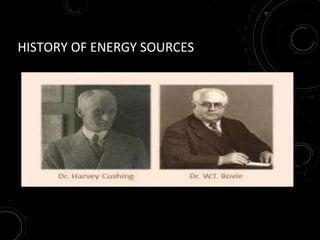
• The first electrosurgical unit was developed in 1926 by Dr.
Harvey Cushing (a neurosurgeon) and Dr. William Bovie, a
Harvard physicist
• Since then the name “Bovie” has been associated with
electrosurgical unit.
BASIC FORMS OF ENERGY
4 forms –
1. Electrical
2. Ultrasonic
3. Argon Beam
4. Laser
ELECTROCAUTERY AND ELECTROSURGERY
• The terms electrocautery and electrosurgery are frequently
used interchangeably; but these terms define two distinctly
different modalities.
• In electrocautery, Only the heated wire comes in contact with
tissue.
• In electrosurgery, the patient is included in the circuit and
current enters the patient’s body to vaporize or coagulate
tissue.
TEMPERATURE VS TISSUE EFFECTS
45 degree C: collagen uncoils, reversible
60 degree C: irreversible protein denaturation,
coagulation necrosis
80 degree C: drying and shrinkage of tissues
90-100 degree C: vaporization
125degree C: complete oxidation carbon residue &
eschar formation
ELECTROSURGERY
• CUT
• COAGULATE
• DISSECT
• FULGURATE
• ABLATE
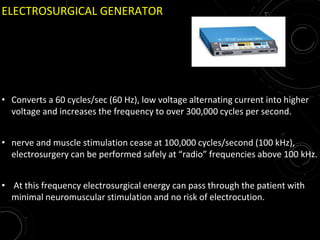
ELECTROSURGICAL GENERATOR
• Converts a 60 cycles/sec (60 Hz), low voltage alternating current into higher
voltage and increases the frequency to over 300,000 cycles per second.
• nerve and muscle stimulation cease at 100,000 cycles/second (100 kHz),
electrosurgery can be performed safely at “radio” frequencies above 100 kHz.
• At this frequency electrosurgical energy can pass through the patient with
minimal neuromuscular stimulation and no risk of electrocution.
SYSTEM COMPONENTS:
1. Generator (electrosurgical unit)
2. Inactive dispersive electrode (grounding pad)
3. Active electrode (“Bovie” pencil)
TYPES OF ESU UNITS
• Monopolar
• Bipolar
(Some ESU units have both monopolar & bipolar capability)
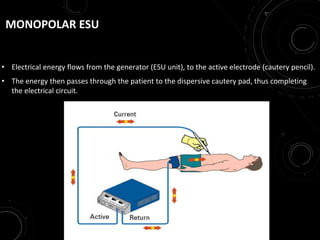
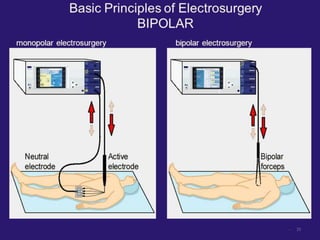
MONOPOLAR ESU
• Electrical energy flows from the generator (ESU unit), to the active electrode (cautery pencil).
• The energy then passes through the patient to the dispersive cautery pad, thus completing
the electrical circuit.
MONOPOLAR ELECTROSURGERY
• Most commonly used electrosurgical modality.
• Produce variety of tissue effects depending on waveform.
a) Cutting.
b) Coagulation and fulgration.
c) Dessication
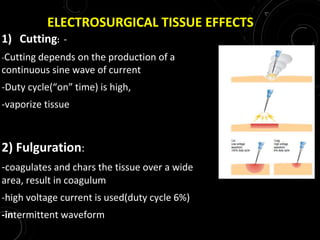
ELECTROSURGICAL TISSUE EFFECTS
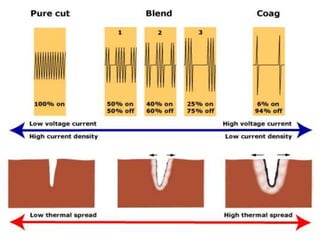
1) Cutting: -
-Cutting depends on the production of a
continuous sine wave of current
-Duty cycle(“on” time) is high,
-vaporize tissue
2) Fulguration:
-coagulates and chars the tissue over a wide
area, result in coagulum
-high voltage current is used(duty cycle 6%)
-intermittent waveform
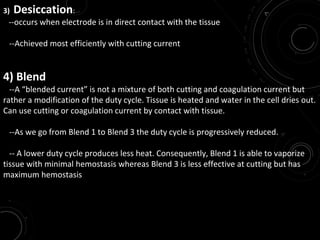
3) Desiccation:
--occurs when electrode is in direct contact with the tissue
--Achieved most efficiently with cutting current
4) Blend
--A “blended current” is not a mixture of both cutting and coagulation current but
rather a modification of the duty cycle. Tissue is heated and water in the cell dries out.
Can use cutting or coagulation current by contact with tissue.
--As we go from Blend 1 to Blend 3 the duty cycle is progressively reduced.
-- A lower duty cycle produces less heat. Consequently, Blend 1 is able to vaporize
tissue with minimal hemostasis whereas Blend 3 is less effective at cutting but has
maximum hemostasis
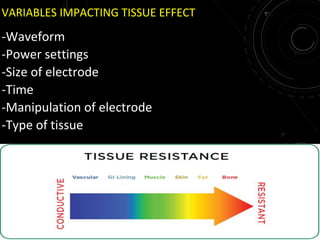
VARIABLES IMPACTING TISSUE EFFECT
-Waveform
-Power settings
-Size of electrode
-Time
-Manipulation of electrode
-Type of tissue
MONOPOLAR
• ADVANTAGES
• Ease of use
• Cutting and coagulation currents
• Dissecting capability.
• DISADVANTAGES
• Larger volume of tissue injured.
• Interferes with electrical implants.
• Requires ground pad.
BIPOLAR ELECTROSURGERY
• active and return electrodes are in the same surgical
instrument
• The electrical current is confined to the tissue between the
tines of The bipolar forceps
• Only the tissue grasped is included in circuit.
• Better hemostasis
• Less thermal injury
• ADVANTAGES.
• Small volume of tissue injured.
• No patient return electrode.
• Safe with electrical implants.
• Effective in wet fields.
• Decreased thermal injury to surrounding tissues
• Decreased risk of capacitive coupling injuries
DISADVANTAGES
• More skill required.
• Coagulation only.
• No dissecting capability
BEST GROUNDING PAD SITE
• Over a well-vascularized muscle mass
• Avoid placing grounding pad over bony prominences, hairy
sites, scar tissue,excess adipose tissue
PLACING GROUNDING PAD
• Grounding pad should be placed so that the entire surface of the pad is in
uniform contact with the pad site
• Avoid any tenting or gaps where parts of the pad are not in contact with the
patient
SAFETY CONSIDERATIONS DURING MIS
Direct Coupling
• Occurs when the active electrode touches another metal instrument.
• The electrical current flows from one to the other and then proceeds to tissue
resulting in unintended burn.
• So, do not activate the generator while the active electrode is touching a metal
object or not in vision.
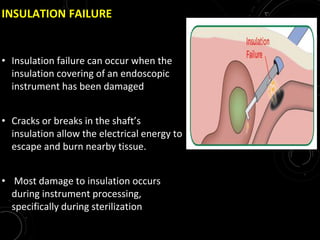
INSULATION FAILURE
• Insulation failure can occur when the
insulation covering of an endoscopic
instrument has been damaged
• Cracks or breaks in the shaft’s
insulation allow the electrical energy to
escape and burn nearby tissue.
• Most damage to insulation occurs
during instrument processing,
specifically during sterilization
CAPACITIVE COUPLING
• Capacitive coupling is electric current that is established in tissue or in metal
instrument running parallel but not directly in contact with the active electrode.
• Hybrid cannula are worst , metal part will create a capacitor but plastic collar will
prevent the current from dissipating through abd wall. This current may exit to some
adjacent tissue, result in significant injury
• Use the lowest power setting.
• Keep the electrode eschar free
• Use larger diameter trocars and smaller diameter electrodes
PATIENT RETURN ELECTRODE MONITORING TECHNOLOGY
• -Protects patient from pad site burn
• -Monitor impedance at the patient/pad interface
• -System deactivates if impedance is high
• -Such electrode can be identified by its split appearance i.e. two
separate areas and a special plug with center pin.
ACTIVE ELECTRODE MONITORING SYSTEM
• Shielded and monitor instruments continuously and direct stray
energy, away from the patient via a protective shield.
• When insulation failure occurs or capacitively coupled energy
reaches dangerous levels, the electrosurgical unit (ESU) shuts
down automatically and sounds alarm
• AEM system detects even the smallest full thickness insulation
breaks on Laparoscopic instruments, virtually eliminating
accidental burns and reducing the possibility of patient injury.
RECOMMENDATIONS TO AVOID ELECTROSURGICAL COMPLICATIONS
IN MIS
• Inspect insulation carefully
• Use lowest possible power settings
• Use a low voltage waveform(cut)
• Use brief intermittent activation vs prolonged activation
• Do not activate in open circuit
• Do not activate in close proximity or direct contact with other instrument
• Use bipolar electrosurgery when appropriate
• metal canula system as the safest choice.
• Active electrode monitoring system.
NEWER ENERGY SOURCES
• Advanced Bipolar devices.
• Gyrus ACMI (Olympus)
• Enseal (Ethicon Endo-Surgery)
• Ligasure (covidien)
• Ultrasonic scalpel
• Harmonic ACE( Ethicon Endo-Surgery)
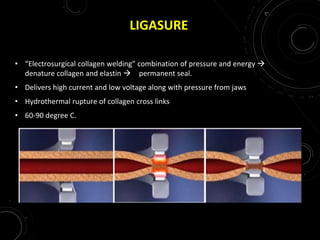
LIGASURE
• “Electrosurgical collagen welding” combination of pressure and energy 
denature collagen and elastin  permanent seal.
• Delivers high current and low voltage along with pressure from jaws
• Hydrothermal rupture of collagen cross links
• 60-90 degree C.
• Average seal cycle is 2-4 sec.
• Seal can withstand upto 3 times SBP.
• Can ligate vessels upto 7 mm.
• Lateral thermal spread : 2mm
• Energy delivery cycle: computer algorithm adjust current and
voltage based on real time measures of tissue impedence.
• Feedback controlled response system-- senses that tissue
response is complete and stops the seal cycle.
•.
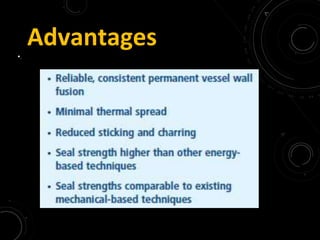
Advantages
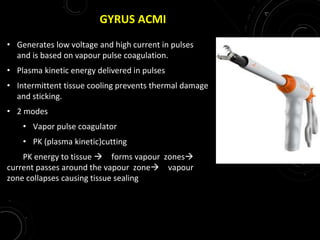
GYRUS ACMI
• Generates low voltage and high current in pulses
and is based on vapour pulse coagulation.
• Plasma kinetic energy delivered in pulses
• Intermittent tissue cooling prevents thermal damage
and sticking.
• 2 modes
• Vapor pulse coagulator
• PK (plasma kinetic)cutting
PK energy to tissue  forms vapour zones
current passes around the vapour zone vapour
zone collapses causing tissue sealing
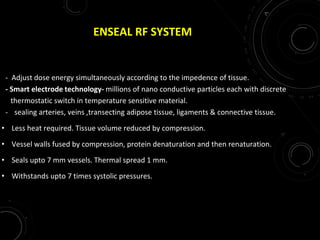
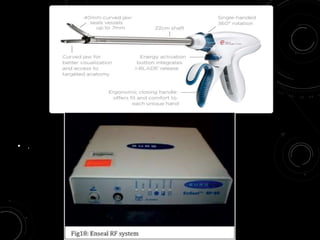
ENSEAL RF SYSTEM
- Adjust dose energy simultaneously according to the impedence of tissue.
- Smart electrode technology- millions of nano conductive particles each with discrete
thermostatic switch in temperature sensitive material.
- sealing arteries, veins ,transecting adipose tissue, ligaments & connective tissue.
• Less heat required. Tissue volume reduced by compression.
• Vessel walls fused by compression, protein denaturation and then renaturation.
• Seals upto 7 mm vessels. Thermal spread 1 mm.
• Withstands upto 7 times systolic pressures.
• .
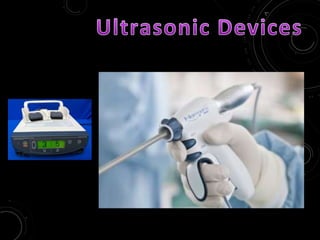
ULTRASONIC DEVICES
• Use high frequency vibrations
• Harmonic – for delivering precise energy for better vessel
sealing capabilities
- upto 7mm vessels
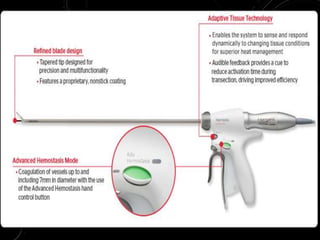
• Harmonic Scalpel – Vessel sealing & transecting capabilities
• Work at 55KHz
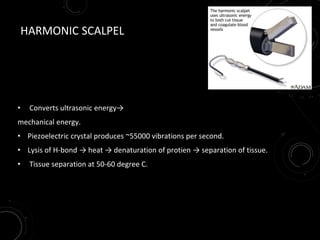
HARMONIC SCALPEL
• Converts ultrasonic energy→
mechanical energy.
• Piezoelectric crystal produces ~55000 vibrations per second.
• Lysis of H-bond → heat → denaturation of protien → separation of tissue.
• Tissue separation at 50-60 degree C.
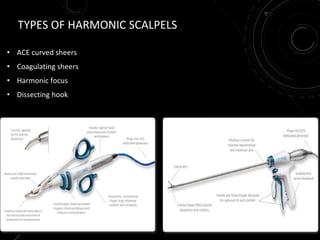
TYPES OF HARMONIC SCALPELS
• ACE curved sheers
• Coagulating sheers
• Harmonic focus
• Dissecting hook
ADVANTAGES OF HARMONIC SCALPEL
• Minimal thermal spread.
• No dessication or charring of tissue.
• No risk of electrical injury
• No smoke.
---Clipless lap cholecystectomy uses a harmonic scalpel.
DISADVANTAGES OF HARMONIC SCALPEL
• Inability to coagulate vessels greater than 5mm.
• Operator dependence of settings of the blade according to tissue.
• Increased cost.
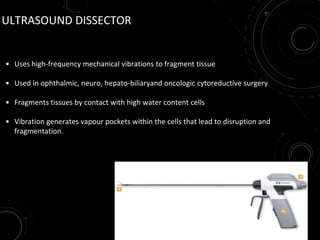
ULTRASOUND DISSECTOR
• Uses high-frequency mechanical vibrations to fragment tissue
• Used in ophthalmic, neuro, hepato-biliaryand oncologic cytoreductive surgery
• Fragments tissues by contact with high water content cells
• Vibration generates vapour pockets within the cells that lead to disruption and
fragmentation.
ULTRASONIC KNIFE
• Produces vibrations at 55.5KHz at the tip of the blade via a hand piece transducer
• The moving blade couples with the tissue resulting in breakage of protein hydrogen
bonds and thus protein coagulum forms.
• Can perform cutting and heamostasis with minimal damage
• Limited lateral spread and thermal injury
• No electrical energy transferred to patients
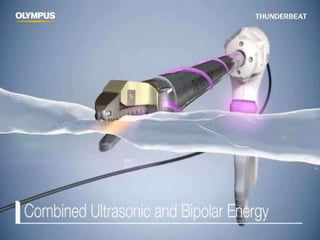
THUNDERBEAT
• THUNDERBEAT -- both bipolar and ultrasonic energies
• Ultrasonic energy: for cut
• Bipolar energy: for vessel seal
ADVANTAGES
-RELIABLE 7 MM VESSEL SEALING.
-MINIMAL THERMAL SPREAD.
-FASTEST IN-ITS-CLASS CUTTING.
-IMPROVED VISIBILITY.
-FINE DISSECTION.
-ALWAYS AVAILABLE BIPOLAR ENERGY FOR HEMOSTASIS
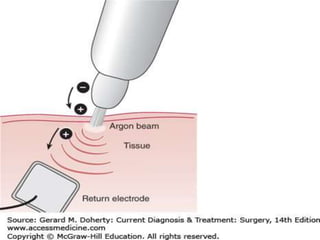
ARGON BEAM COAGULATION
Uses coaxial flow of argon gas to conduct monopolar current to the target
tissue.
Principle:
argon is an inert gas i.e easily ionised by electric current, when ionised
argon gas becomes far more conductive. And current arcs along the
pathway of ionised gas which is heavier than both O2 and nitrogen.
ADVANTAGES
COAGULATION WITHOUT DIRECT CONTACT OF ELECTRODE.
LESS SMOKE AND LESS ODOR.
LESS TISSUE DAMAGE.
DISADVANTAGES
CANNOT PRODUCE CUTTING EFFECT.
OVERHEAT.
USES
• Wide area of tissue
• Dissecting very vascular organs
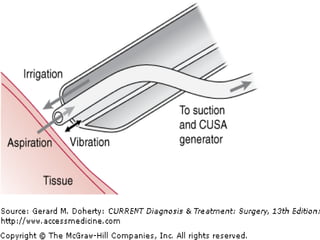
CAVITRON ULTRASONIC SURGICAL ASPIRATOR (CUSA)
-work on many of the same principles as ultrasonic scalpels.
-CUSA is a dissecting device that uses ultrasonic frequencies at 23 kHz or
36 kHz.
-Used in liver surgery and neurosurgery
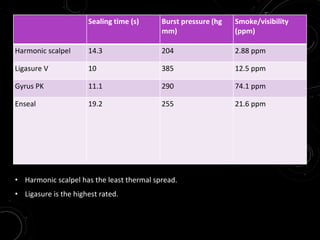
• Harmonic scalpel has the least thermal spread.
• Ligasure is the highest rated.
Sealing time (s) Burst pressure (hg
mm)
Smoke/visibility
(ppm)
Harmonic scalpel 14.3 204 2.88 ppm
Ligasure V 10 385 12.5 ppm
Gyrus PK 11.1 290 74.1 ppm
Enseal 19.2 255 21.6 ppm
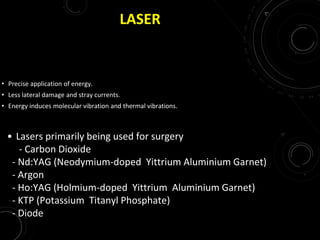
LASER
• Precise application of energy.
• Less lateral damage and stray currents.
• Energy induces molecular vibration and thermal vibrations.
• Lasers primarily being used for surgery
- Carbon Dioxide
- Nd:YAG (Neodymium-doped Yittrium Aluminium Garnet)
- Argon
- Ho:YAG (Holmium-doped Yittrium Aluminium Garnet)
- KTP (Potassium Titanyl Phosphate)
- Diode
EFFECTS
• PHOTOCHEMICAL EFFECT AKA PHOTODYNAMIC THERAPY
• PHOTOABLATIVE EFFECT
• PHOTOTHERMAL EFFECT
• PHOTOMECHANICAL EFFECT
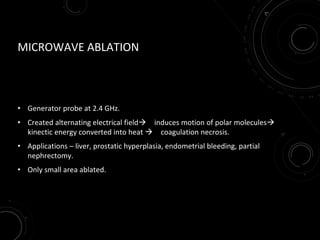
MICROWAVE ABLATION
• Generator probe at 2.4 GHz.
• Created alternating electrical field induces motion of polar molecules
kinectic energy converted into heat  coagulation necrosis.
• Applications – liver, prostatic hyperplasia, endometrial bleeding, partial
nephrectomy.
• Only small area ablated.
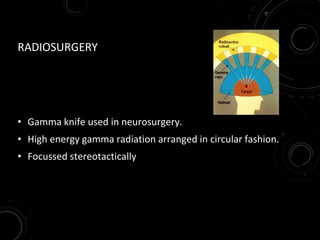
RADIOSURGERY
• Gamma knife used in neurosurgery.
• High energy gamma radiation arranged in circular fashion.
• Focussed stereotactically
SPECIAL CONSIDERATIONS: PATIENTS
WITH--
• Implanted pacemaker
• Implanted automatic defibrillator
• Cochlear Implant
• Implanted Bone Growth Stimulator
• Body Jewellery.
• Offender monitoring ankle bracelets
• Orthopedic implants (total hips, etc)
THANK YOU

Energy sources in surgery

  • 1.
    ENERGY SOURCES INSURGERY Dr. Ankur
  • 2.
  • 3.
    HISTORY LESSON • Thefirst electrosurgical unit was developed in 1926 by Dr. Harvey Cushing (a neurosurgeon) and Dr. William Bovie, a Harvard physicist • Since then the name “Bovie” has been associated with electrosurgical unit.
  • 4.
    BASIC FORMS OFENERGY 4 forms – 1. Electrical 2. Ultrasonic 3. Argon Beam 4. Laser
  • 5.
    ELECTROCAUTERY AND ELECTROSURGERY •The terms electrocautery and electrosurgery are frequently used interchangeably; but these terms define two distinctly different modalities. • In electrocautery, Only the heated wire comes in contact with tissue. • In electrosurgery, the patient is included in the circuit and current enters the patient’s body to vaporize or coagulate tissue.
  • 6.
    TEMPERATURE VS TISSUEEFFECTS 45 degree C: collagen uncoils, reversible 60 degree C: irreversible protein denaturation, coagulation necrosis 80 degree C: drying and shrinkage of tissues 90-100 degree C: vaporization 125degree C: complete oxidation carbon residue & eschar formation
  • 7.
    ELECTROSURGERY • CUT • COAGULATE •DISSECT • FULGURATE • ABLATE
  • 8.
    ELECTROSURGICAL GENERATOR • Convertsa 60 cycles/sec (60 Hz), low voltage alternating current into higher voltage and increases the frequency to over 300,000 cycles per second. • nerve and muscle stimulation cease at 100,000 cycles/second (100 kHz), electrosurgery can be performed safely at “radio” frequencies above 100 kHz. • At this frequency electrosurgical energy can pass through the patient with minimal neuromuscular stimulation and no risk of electrocution.
  • 9.
    SYSTEM COMPONENTS: 1. Generator(electrosurgical unit) 2. Inactive dispersive electrode (grounding pad) 3. Active electrode (“Bovie” pencil)
  • 10.
    TYPES OF ESUUNITS • Monopolar • Bipolar (Some ESU units have both monopolar & bipolar capability)
  • 11.
    MONOPOLAR ESU • Electricalenergy flows from the generator (ESU unit), to the active electrode (cautery pencil). • The energy then passes through the patient to the dispersive cautery pad, thus completing the electrical circuit.
  • 12.
    MONOPOLAR ELECTROSURGERY • Mostcommonly used electrosurgical modality. • Produce variety of tissue effects depending on waveform. a) Cutting. b) Coagulation and fulgration. c) Dessication
  • 13.
    ELECTROSURGICAL TISSUE EFFECTS 1)Cutting: - -Cutting depends on the production of a continuous sine wave of current -Duty cycle(“on” time) is high, -vaporize tissue 2) Fulguration: -coagulates and chars the tissue over a wide area, result in coagulum -high voltage current is used(duty cycle 6%) -intermittent waveform
  • 14.
    3) Desiccation: --occurs whenelectrode is in direct contact with the tissue --Achieved most efficiently with cutting current 4) Blend --A “blended current” is not a mixture of both cutting and coagulation current but rather a modification of the duty cycle. Tissue is heated and water in the cell dries out. Can use cutting or coagulation current by contact with tissue. --As we go from Blend 1 to Blend 3 the duty cycle is progressively reduced. -- A lower duty cycle produces less heat. Consequently, Blend 1 is able to vaporize tissue with minimal hemostasis whereas Blend 3 is less effective at cutting but has maximum hemostasis
  • 16.
    VARIABLES IMPACTING TISSUEEFFECT -Waveform -Power settings -Size of electrode -Time -Manipulation of electrode -Type of tissue
  • 17.
    MONOPOLAR • ADVANTAGES • Easeof use • Cutting and coagulation currents • Dissecting capability. • DISADVANTAGES • Larger volume of tissue injured. • Interferes with electrical implants. • Requires ground pad.
  • 18.
    BIPOLAR ELECTROSURGERY • activeand return electrodes are in the same surgical instrument • The electrical current is confined to the tissue between the tines of The bipolar forceps • Only the tissue grasped is included in circuit. • Better hemostasis • Less thermal injury
  • 19.
    • ADVANTAGES. • Smallvolume of tissue injured. • No patient return electrode. • Safe with electrical implants. • Effective in wet fields. • Decreased thermal injury to surrounding tissues • Decreased risk of capacitive coupling injuries
  • 20.
    DISADVANTAGES • More skillrequired. • Coagulation only. • No dissecting capability
  • 22.
    BEST GROUNDING PADSITE • Over a well-vascularized muscle mass • Avoid placing grounding pad over bony prominences, hairy sites, scar tissue,excess adipose tissue
  • 23.
    PLACING GROUNDING PAD •Grounding pad should be placed so that the entire surface of the pad is in uniform contact with the pad site • Avoid any tenting or gaps where parts of the pad are not in contact with the patient
  • 24.
    SAFETY CONSIDERATIONS DURINGMIS Direct Coupling • Occurs when the active electrode touches another metal instrument. • The electrical current flows from one to the other and then proceeds to tissue resulting in unintended burn. • So, do not activate the generator while the active electrode is touching a metal object or not in vision.
  • 25.
    INSULATION FAILURE • Insulationfailure can occur when the insulation covering of an endoscopic instrument has been damaged • Cracks or breaks in the shaft’s insulation allow the electrical energy to escape and burn nearby tissue. • Most damage to insulation occurs during instrument processing, specifically during sterilization
  • 26.
    CAPACITIVE COUPLING • Capacitivecoupling is electric current that is established in tissue or in metal instrument running parallel but not directly in contact with the active electrode. • Hybrid cannula are worst , metal part will create a capacitor but plastic collar will prevent the current from dissipating through abd wall. This current may exit to some adjacent tissue, result in significant injury • Use the lowest power setting. • Keep the electrode eschar free • Use larger diameter trocars and smaller diameter electrodes
  • 27.
    PATIENT RETURN ELECTRODEMONITORING TECHNOLOGY • -Protects patient from pad site burn • -Monitor impedance at the patient/pad interface • -System deactivates if impedance is high • -Such electrode can be identified by its split appearance i.e. two separate areas and a special plug with center pin.
  • 28.
    ACTIVE ELECTRODE MONITORINGSYSTEM • Shielded and monitor instruments continuously and direct stray energy, away from the patient via a protective shield. • When insulation failure occurs or capacitively coupled energy reaches dangerous levels, the electrosurgical unit (ESU) shuts down automatically and sounds alarm • AEM system detects even the smallest full thickness insulation breaks on Laparoscopic instruments, virtually eliminating accidental burns and reducing the possibility of patient injury.
  • 29.
    RECOMMENDATIONS TO AVOIDELECTROSURGICAL COMPLICATIONS IN MIS • Inspect insulation carefully • Use lowest possible power settings • Use a low voltage waveform(cut) • Use brief intermittent activation vs prolonged activation • Do not activate in open circuit • Do not activate in close proximity or direct contact with other instrument • Use bipolar electrosurgery when appropriate • metal canula system as the safest choice. • Active electrode monitoring system.
  • 30.
  • 31.
    NEWER ENERGY SOURCES •Advanced Bipolar devices. • Gyrus ACMI (Olympus) • Enseal (Ethicon Endo-Surgery) • Ligasure (covidien) • Ultrasonic scalpel • Harmonic ACE( Ethicon Endo-Surgery)
  • 32.
    LIGASURE • “Electrosurgical collagenwelding” combination of pressure and energy  denature collagen and elastin  permanent seal. • Delivers high current and low voltage along with pressure from jaws • Hydrothermal rupture of collagen cross links • 60-90 degree C.
  • 33.
    • Average sealcycle is 2-4 sec. • Seal can withstand upto 3 times SBP. • Can ligate vessels upto 7 mm. • Lateral thermal spread : 2mm • Energy delivery cycle: computer algorithm adjust current and voltage based on real time measures of tissue impedence. • Feedback controlled response system-- senses that tissue response is complete and stops the seal cycle.
  • 34.
  • 35.
    GYRUS ACMI • Generateslow voltage and high current in pulses and is based on vapour pulse coagulation. • Plasma kinetic energy delivered in pulses • Intermittent tissue cooling prevents thermal damage and sticking. • 2 modes • Vapor pulse coagulator • PK (plasma kinetic)cutting PK energy to tissue  forms vapour zones current passes around the vapour zone vapour zone collapses causing tissue sealing
  • 36.
    ENSEAL RF SYSTEM -Adjust dose energy simultaneously according to the impedence of tissue. - Smart electrode technology- millions of nano conductive particles each with discrete thermostatic switch in temperature sensitive material. - sealing arteries, veins ,transecting adipose tissue, ligaments & connective tissue. • Less heat required. Tissue volume reduced by compression. • Vessel walls fused by compression, protein denaturation and then renaturation. • Seals upto 7 mm vessels. Thermal spread 1 mm. • Withstands upto 7 times systolic pressures.
  • 37.
  • 39.
    ULTRASONIC DEVICES • Usehigh frequency vibrations • Harmonic – for delivering precise energy for better vessel sealing capabilities - upto 7mm vessels • Harmonic Scalpel – Vessel sealing & transecting capabilities • Work at 55KHz
  • 40.
    HARMONIC SCALPEL • Convertsultrasonic energy→ mechanical energy. • Piezoelectric crystal produces ~55000 vibrations per second. • Lysis of H-bond → heat → denaturation of protien → separation of tissue. • Tissue separation at 50-60 degree C.
  • 41.
    TYPES OF HARMONICSCALPELS • ACE curved sheers • Coagulating sheers • Harmonic focus • Dissecting hook
  • 42.
    ADVANTAGES OF HARMONICSCALPEL • Minimal thermal spread. • No dessication or charring of tissue. • No risk of electrical injury • No smoke. ---Clipless lap cholecystectomy uses a harmonic scalpel.
  • 43.
    DISADVANTAGES OF HARMONICSCALPEL • Inability to coagulate vessels greater than 5mm. • Operator dependence of settings of the blade according to tissue. • Increased cost.
  • 45.
    ULTRASOUND DISSECTOR • Useshigh-frequency mechanical vibrations to fragment tissue • Used in ophthalmic, neuro, hepato-biliaryand oncologic cytoreductive surgery • Fragments tissues by contact with high water content cells • Vibration generates vapour pockets within the cells that lead to disruption and fragmentation.
  • 46.
    ULTRASONIC KNIFE • Producesvibrations at 55.5KHz at the tip of the blade via a hand piece transducer • The moving blade couples with the tissue resulting in breakage of protein hydrogen bonds and thus protein coagulum forms. • Can perform cutting and heamostasis with minimal damage • Limited lateral spread and thermal injury • No electrical energy transferred to patients
  • 48.
    THUNDERBEAT • THUNDERBEAT --both bipolar and ultrasonic energies • Ultrasonic energy: for cut • Bipolar energy: for vessel seal
  • 49.
    ADVANTAGES -RELIABLE 7 MMVESSEL SEALING. -MINIMAL THERMAL SPREAD. -FASTEST IN-ITS-CLASS CUTTING. -IMPROVED VISIBILITY. -FINE DISSECTION. -ALWAYS AVAILABLE BIPOLAR ENERGY FOR HEMOSTASIS
  • 51.
    ARGON BEAM COAGULATION Usescoaxial flow of argon gas to conduct monopolar current to the target tissue. Principle: argon is an inert gas i.e easily ionised by electric current, when ionised argon gas becomes far more conductive. And current arcs along the pathway of ionised gas which is heavier than both O2 and nitrogen.
  • 52.
    ADVANTAGES COAGULATION WITHOUT DIRECTCONTACT OF ELECTRODE. LESS SMOKE AND LESS ODOR. LESS TISSUE DAMAGE. DISADVANTAGES CANNOT PRODUCE CUTTING EFFECT. OVERHEAT.
  • 53.
    USES • Wide areaof tissue • Dissecting very vascular organs
  • 55.
    CAVITRON ULTRASONIC SURGICALASPIRATOR (CUSA) -work on many of the same principles as ultrasonic scalpels. -CUSA is a dissecting device that uses ultrasonic frequencies at 23 kHz or 36 kHz. -Used in liver surgery and neurosurgery
  • 57.
    • Harmonic scalpelhas the least thermal spread. • Ligasure is the highest rated. Sealing time (s) Burst pressure (hg mm) Smoke/visibility (ppm) Harmonic scalpel 14.3 204 2.88 ppm Ligasure V 10 385 12.5 ppm Gyrus PK 11.1 290 74.1 ppm Enseal 19.2 255 21.6 ppm
  • 58.
    LASER • Precise applicationof energy. • Less lateral damage and stray currents. • Energy induces molecular vibration and thermal vibrations. • Lasers primarily being used for surgery - Carbon Dioxide - Nd:YAG (Neodymium-doped Yittrium Aluminium Garnet) - Argon - Ho:YAG (Holmium-doped Yittrium Aluminium Garnet) - KTP (Potassium Titanyl Phosphate) - Diode
  • 59.
    EFFECTS • PHOTOCHEMICAL EFFECTAKA PHOTODYNAMIC THERAPY • PHOTOABLATIVE EFFECT • PHOTOTHERMAL EFFECT • PHOTOMECHANICAL EFFECT
  • 60.
    MICROWAVE ABLATION • Generatorprobe at 2.4 GHz. • Created alternating electrical field induces motion of polar molecules kinectic energy converted into heat  coagulation necrosis. • Applications – liver, prostatic hyperplasia, endometrial bleeding, partial nephrectomy. • Only small area ablated.
  • 61.
    RADIOSURGERY • Gamma knifeused in neurosurgery. • High energy gamma radiation arranged in circular fashion. • Focussed stereotactically
  • 62.
    SPECIAL CONSIDERATIONS: PATIENTS WITH-- •Implanted pacemaker • Implanted automatic defibrillator • Cochlear Implant • Implanted Bone Growth Stimulator • Body Jewellery. • Offender monitoring ankle bracelets • Orthopedic implants (total hips, etc)
  • 63.

Editor's Notes

  • #3 Thanks to harvey and bovie, we have moved
  • #6 -Electrocautery refers to DC(electrons flowing in one direction) whereas Electrosurgery uses AC. -Electrocautery is a closed circuit DC device in which current is passed through a high resistance wire The resistance causes heating wire. This hot wire used to coagulate tissue. primarily applied for microsurgery, such as ophthalmologic procedures, where a very small amount of heat will produce the desired effect. No current passed through body -electrosurgery uses high-frequency (radiofrequency) electromagnetic waves to produce a localized heating of tissues, leading to localized tissue destruction.
  • #8 The effect produced (cutting vs coagulation) depends on how this energy is supplied.
  • #9 The current that powers the electrosurgical generator is supplied at a frequency of 60 Hz. This type of electromagnetic energy can indeed cause very strong (potentially lethal) neuromuscular stimulation, making it unsuitable for use in its pure form. Muscle and nerve stimulation, however, ceases at around 100 kHz. Current with a frequency above this threshold can be delivered safely, without the risk of electrocution. The outputs of electrosurgical generators deliver current with a frequency greater than 200 kHz. Current at this frequency is known as radiofrequency (RF); it is in the same portion of the spectrum as radio transmitters.
  • #11 Technically speaking both monopolar and bipolar nergies are bipolar as there is always an active electrode and a passive electrode.
  • #14 -cut High duty cycle”—means, once the current is applied, the current is actively flowing during the entire application. -the tip of the electrode is held just slightly off the surface of the tissue. The flow of the high-frequency current through the resistance of the patient’s tissue at a very small site produces intense heat, vaporizing water and exploding the cells in the immediate vicinity of the current. -fulgerate electrode is not brought into contact with the tissues, following activation, the current arcs through the air to the target.
  • #15 -dessication reduces the concentration of the current, less heat is generated, and no cutting action occurs. A relatively low power setting is used. Desiccation is achieved most efficiently with the cutting current. The cells dry out and form a coagulum rather than vaporize and explode. ----It is possible to cut with the coagulation current and, conversely, to coagulate with the cutting current. It may be necessary to adjust power settings and electrode size to achieve the desired surgical effect
  • #16  Only variable that determine vaporization or coagulation is rate of heat High heat, more rapidly : vaporization Low heat, more slowly : coagulum
  • #19 Most of modern bipolar units employ cutting waveform because it is a lower voltage waveform allowing hemostasis to be established without unnecessary charring.
  • #26 . Heating with subsequent cooling causes insulation to shrink and then expand. During this process cracks and breaks can occur. -- by lowering the concentration of current of current used preferably cutting current
  • #27 Cutting current is mainly useful in MIS . Decreased capacitive coupling and reduced insulation failure.
  • #31 Now finding vast arrary of energy sources to cut, coagulate and dissect
  • #32 All have vessel sealing property
  • #36 -Creates a plasma vapor pocket around the active electrode; -In the PK output mode, the RF energy is used to create an electrical arc into the tissue located between the electrodes of the Gyrus ACMI PK instrument. This provides the tissue the tissue cutting through the vaporization
  • #53 NO ESCHAR FORMATION
  • #56 -This high-frequency vibration produces heat, which is reduced via a closed, recirculating cooling-water system. This system maintains the temperature of the tip at approximately 40°C. -This instrument is most useful when removing purportedly “non-resectable” brain and spine tumors. With a gentle wand-like motion, the CUSA enables a “layer by layer” surgical excision without affecting vital structures - Utilizes a hollow titanium tip that vibrates along its longitudinal axis, fragmentation of susceptible tissue occurs while concurrently lavaging and aspirating material from the surgical site. (No coagulation or cutting, only tissues gets fragmented) -In general surgery, its primary application is in liver resection, where it can disrupt parenchyma while leaving major vasculature and the biliary ducts intact
  • #58 In a vessel energy was applied until the generator signaled cycle completion, and the tissue was transected and released. Vessels were examined for leak integrity. the LS has the highest burst pressure and fastest sealing time and was the highest rated overall. The HS produced the lowest thermal spread and smoke but had the lowest mean burst pressure. The Gyrus pk had the highest smoke production, and variable burst pressures. Despite employing nanotechnology, the EnSeal device was the slowest and had variable burst pressures.
  • #60 Photodynamic therapy is used in palliation of oesophagial and bronchial carcinoma and ablation of mucosal cancers of Gastrointestinal tract and urinary bladder. Used in eye surgeries like band keratoplast, and endartectomy of peripheral blood vessels. this property is used for endoscopic control of bleeding e.g. Bleeding peptic ulcers, oesophagial varices used in intraluminal lithotripsy.