Strength-
Duration(S-D)
CURVE
Aakanksha Bajpai
Assistant Professor
School Of Health Sciences
S-D curve
 Strength duration curve is a graph between electrical stimuli of
different intensities and recording the time needed by each stimulus
to start the response.
 S-D curve should be plotted after 20th day of injury/lesion.
Purpose
 Is to know whether the stimulated muscle is innervated,
denervated or partially denervated.
Instrumentation & parameters
 The apparatus used for plotting S-D Curve supplies rectangular impulses
of different duration.
 Impulse with duration of 0.01, 0.03, 0.1, 0.3, 10, 30, 100, 300 ms are
required.
 The stimulator may be of either the constant current or constant voltage
type.
 The constant current stimulator was thought to produce the more accurate
result but constant voltage stimulator is rather more comfortable for
patient.
Method
 The patient must be warm, fully supported and in sufficient light.
 The indifferent electrode may be applied over some convenient area
usually on the midline of the body or the origin of the muscle group.
 Active electrode placed over fleshy part of muscle. (Sometime two
small electrode may be used, one over each end of muscle belly).
 Current is applied using the longest stimulation first and increased
until a minimal contraction is obtained.
 Intensity of current (or voltage) is noted and impulse is shortened. This
procedure is repeated with each stimulation in turn, the intensity of
current being increased as required.
 A minimal contraction is used, as this make it easy to detect any change
in strength, and electrode should be placed in same point over the muscle
throughout the test.
 The S-D Curve is plotted from the result of the test, and although it will
be further to the left with constant voltage than with the constant current
stimulator.
 The shape of the curve is the essential feature.
Normal innervation
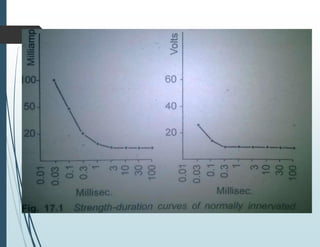
 The S-D Curve is of this typical shape because the impulses of longer
duration all produce a response with same strength of stimulus,
irrespective of their duration, while those of shorter duration, require an
increase in the strength of the stimulus each time the duration is
reduced.
 The point at which the curve begin to rise is variable, but is usually at a
duration of impulse of 1 ms with constant current and 0.1 ms with
constant voltage stimulator.
Complete denervation
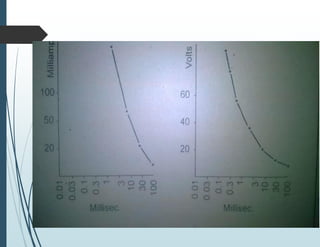
 S-D Curve of complete denervation is when duration of impulse is 100
ms or less, the strength of the stimulus must be increased each time the
duration the duration is reduced and no response is obtained to the
impulse of very short duration.
 So the curve rises steeply and is further to the right than of normally
innervated muscle.
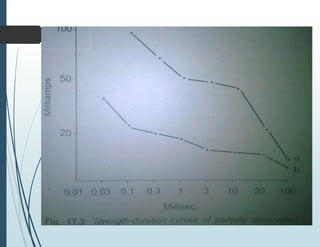
Partial denervation
 S-D Curve of partial denervation is the impulses of longer duration
can stimulate both innervated and denervated muscle fibers, so a
contraction is obtained with a stimulus of low intensity.
 As impulse are shortened, the denervation fibers responds less readily,
a stronger stimulus is required to produce a perceptible contraction and
the curve rises steeply like that of denervated muscle.
 With the impulses of shorter durations, the innervated fibers responds
to a weaker stimulus than that required for the denervated fibers.
 Kink in S-D Curve is seen at the point where two section meet.
 The shape of curve indicates the proportion of denervation.
 A kink appears in the curve and as reinnervation progresses.
 Progressive denervation is indicated by the appearance of a kink,
increase in the slope and shift of the curve to the right.
Rheobase
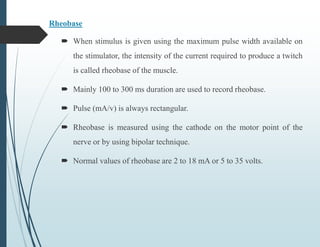
 When stimulus is given using the maximum pulse width available on
the stimulator, the intensity of the current required to produce a twitch
is called rheobase of the muscle.
 Mainly 100 to 300 ms duration are used to record rheobase.
 Pulse (mA/v) is always rectangular.
 Rheobase is measured using the cathode on the motor point of the
nerve or by using bipolar technique.
 Normal values of rheobase are 2 to 18 mA or 5 to 35 volts.
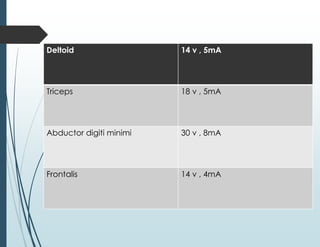
Deltoid 14 v , 5mA
Triceps 18 v , 5mA
Abductor digiti minimi 30 v , 8mA
Frontalis 14 v , 4mA
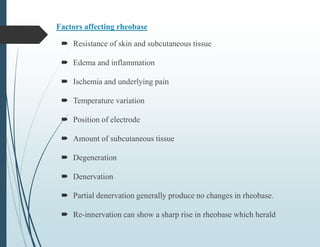
Factors affecting rheobase
 Resistance of skin and subcutaneous tissue
 Edema and inflammation
 Ischemia and underlying pain
 Temperature variation
 Position of electrode
 Amount of subcutaneous tissue
 Degeneration
 Denervation
 Partial denervation generally produce no changes in rheobase.
 Re-innervation can show a sharp rise in rheobase which herald
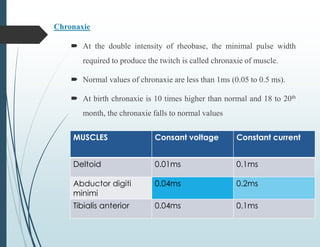
Chronaxie
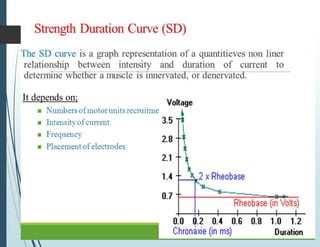
 At the double intensity of rheobase, the minimal pulse width
required to produce the twitch is called chronaxie of muscle.
 Normal values of chronaxie are less than 1ms (0.05 to 0.5 ms).
 At birth chronaxie is 10 times higher than normal and 18 to 20th
month, the chronaxie falls to normal values
MUSCLES Consant voltage Constant current
Deltoid 0.01ms 0.1ms
Abductor digiti
minimi
0.04ms 0.2ms
Tibialis anterior 0.04ms 0.1ms
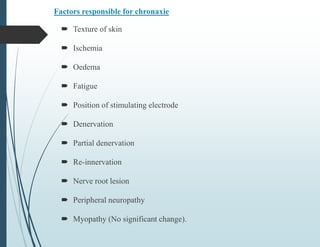
Factors responsible for chronaxie
 Texture of skin
 Ischemia
 Oedema
 Fatigue
 Position of stimulating electrode
 Denervation
 Partial denervation
 Re-innervation
 Nerve root lesion
 Peripheral neuropathy
 Myopathy (No significant change).
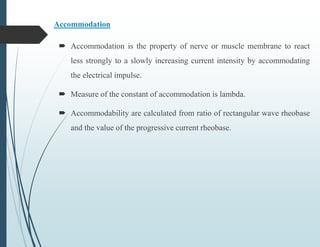
Accommodation
 Accommodation is the property of nerve or muscle membrane to react
less strongly to a slowly increasing current intensity by accommodating
the electrical impulse.
 Measure of the constant of accommodation is lambda.
 Accommodability are calculated from ratio of rectangular wave rheobase
and the value of the progressive current rheobase.
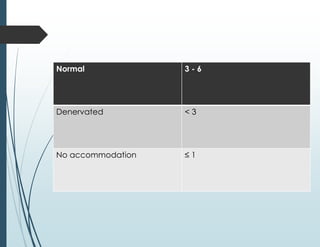
Normal 3 - 6
Denervated < 3
No accommodation ≤ 1
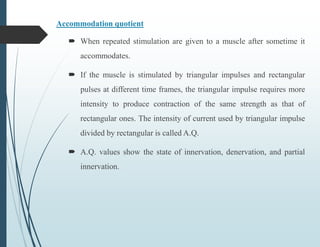
Accommodation quotient
 When repeated stimulation are given to a muscle after sometime it
accommodates.
 If the muscle is stimulated by triangular impulses and rectangular
pulses at different time frames, the triangular impulse requires more
intensity to produce contraction of the same strength as that of
rectangular ones. The intensity of current used by triangular impulse
divided by rectangular is called A.Q.
 A.Q. values show the state of innervation, denervation, and partial
innervation.
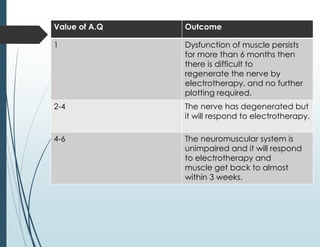
Value of A.Q Outcome
1 Dysfunction of muscle persists
for more than 6 months then
there is difficult to
regenerate the nerve by
electrotherapy, and no further
plotting required.
2-4 The nerve has degenerated but
it will respond to electrotherapy.
4-6 The neuromuscular system is
unimpaired and it will respond
to electrotherapy and
muscle get back to almost
within 3 weeks.
Advantages
 It is simple, reliable and cheaper.
 Indicate proportion of denervation.
 Less time consuming.
Disadvantages
 In large muscles, only proportion of fibers may respond hence
picture is not clearly shown.
 It’s a qualitative rather than quantitative method of testing
innervation.
 It won’t point out the site of lesion.
THANK YOU

Electro-Physiological-Assessment-SD-Curve.pdf

  • 1.
  • 2.
    S-D curve  Strengthduration curve is a graph between electrical stimuli of different intensities and recording the time needed by each stimulus to start the response.  S-D curve should be plotted after 20th day of injury/lesion.
  • 3.
    Purpose  Is toknow whether the stimulated muscle is innervated, denervated or partially denervated.
  • 4.
    Instrumentation & parameters The apparatus used for plotting S-D Curve supplies rectangular impulses of different duration.  Impulse with duration of 0.01, 0.03, 0.1, 0.3, 10, 30, 100, 300 ms are required.  The stimulator may be of either the constant current or constant voltage type.  The constant current stimulator was thought to produce the more accurate result but constant voltage stimulator is rather more comfortable for patient.
  • 6.
    Method  The patientmust be warm, fully supported and in sufficient light.  The indifferent electrode may be applied over some convenient area usually on the midline of the body or the origin of the muscle group.  Active electrode placed over fleshy part of muscle. (Sometime two small electrode may be used, one over each end of muscle belly).  Current is applied using the longest stimulation first and increased until a minimal contraction is obtained.
  • 7.
     Intensity ofcurrent (or voltage) is noted and impulse is shortened. This procedure is repeated with each stimulation in turn, the intensity of current being increased as required.  A minimal contraction is used, as this make it easy to detect any change in strength, and electrode should be placed in same point over the muscle throughout the test.  The S-D Curve is plotted from the result of the test, and although it will be further to the left with constant voltage than with the constant current stimulator.  The shape of the curve is the essential feature.
  • 8.
    Normal innervation  TheS-D Curve is of this typical shape because the impulses of longer duration all produce a response with same strength of stimulus, irrespective of their duration, while those of shorter duration, require an increase in the strength of the stimulus each time the duration is reduced.  The point at which the curve begin to rise is variable, but is usually at a duration of impulse of 1 ms with constant current and 0.1 ms with constant voltage stimulator.
  • 10.
    Complete denervation  S-DCurve of complete denervation is when duration of impulse is 100 ms or less, the strength of the stimulus must be increased each time the duration the duration is reduced and no response is obtained to the impulse of very short duration.  So the curve rises steeply and is further to the right than of normally innervated muscle.
  • 12.
    Partial denervation  S-DCurve of partial denervation is the impulses of longer duration can stimulate both innervated and denervated muscle fibers, so a contraction is obtained with a stimulus of low intensity.  As impulse are shortened, the denervation fibers responds less readily, a stronger stimulus is required to produce a perceptible contraction and the curve rises steeply like that of denervated muscle.  With the impulses of shorter durations, the innervated fibers responds to a weaker stimulus than that required for the denervated fibers.
  • 13.
     Kink inS-D Curve is seen at the point where two section meet.  The shape of curve indicates the proportion of denervation.  A kink appears in the curve and as reinnervation progresses.  Progressive denervation is indicated by the appearance of a kink, increase in the slope and shift of the curve to the right.
  • 15.
    Rheobase  When stimulusis given using the maximum pulse width available on the stimulator, the intensity of the current required to produce a twitch is called rheobase of the muscle.  Mainly 100 to 300 ms duration are used to record rheobase.  Pulse (mA/v) is always rectangular.  Rheobase is measured using the cathode on the motor point of the nerve or by using bipolar technique.  Normal values of rheobase are 2 to 18 mA or 5 to 35 volts.
  • 16.
    Deltoid 14 v, 5mA Triceps 18 v , 5mA Abductor digiti minimi 30 v , 8mA Frontalis 14 v , 4mA
  • 17.
    Factors affecting rheobase Resistance of skin and subcutaneous tissue  Edema and inflammation  Ischemia and underlying pain  Temperature variation  Position of electrode  Amount of subcutaneous tissue  Degeneration  Denervation  Partial denervation generally produce no changes in rheobase.  Re-innervation can show a sharp rise in rheobase which herald
  • 18.
    Chronaxie  At thedouble intensity of rheobase, the minimal pulse width required to produce the twitch is called chronaxie of muscle.  Normal values of chronaxie are less than 1ms (0.05 to 0.5 ms).  At birth chronaxie is 10 times higher than normal and 18 to 20th month, the chronaxie falls to normal values MUSCLES Consant voltage Constant current Deltoid 0.01ms 0.1ms Abductor digiti minimi 0.04ms 0.2ms Tibialis anterior 0.04ms 0.1ms
  • 19.
    Factors responsible forchronaxie  Texture of skin  Ischemia  Oedema  Fatigue  Position of stimulating electrode  Denervation  Partial denervation  Re-innervation  Nerve root lesion  Peripheral neuropathy  Myopathy (No significant change).
  • 20.
    Accommodation  Accommodation isthe property of nerve or muscle membrane to react less strongly to a slowly increasing current intensity by accommodating the electrical impulse.  Measure of the constant of accommodation is lambda.  Accommodability are calculated from ratio of rectangular wave rheobase and the value of the progressive current rheobase.
  • 21.
    Normal 3 -6 Denervated < 3 No accommodation ≤ 1
  • 22.
    Accommodation quotient  Whenrepeated stimulation are given to a muscle after sometime it accommodates.  If the muscle is stimulated by triangular impulses and rectangular pulses at different time frames, the triangular impulse requires more intensity to produce contraction of the same strength as that of rectangular ones. The intensity of current used by triangular impulse divided by rectangular is called A.Q.  A.Q. values show the state of innervation, denervation, and partial innervation.
  • 23.
    Value of A.QOutcome 1 Dysfunction of muscle persists for more than 6 months then there is difficult to regenerate the nerve by electrotherapy, and no further plotting required. 2-4 The nerve has degenerated but it will respond to electrotherapy. 4-6 The neuromuscular system is unimpaired and it will respond to electrotherapy and muscle get back to almost within 3 weeks.
  • 24.
    Advantages  It issimple, reliable and cheaper.  Indicate proportion of denervation.  Less time consuming.
  • 25.
    Disadvantages  In largemuscles, only proportion of fibers may respond hence picture is not clearly shown.  It’s a qualitative rather than quantitative method of testing innervation.  It won’t point out the site of lesion.
  • 26.