DR NILESH KATE
MBBS,MD
PROFESSOR
DEPT. OF PHYSIOLOGY
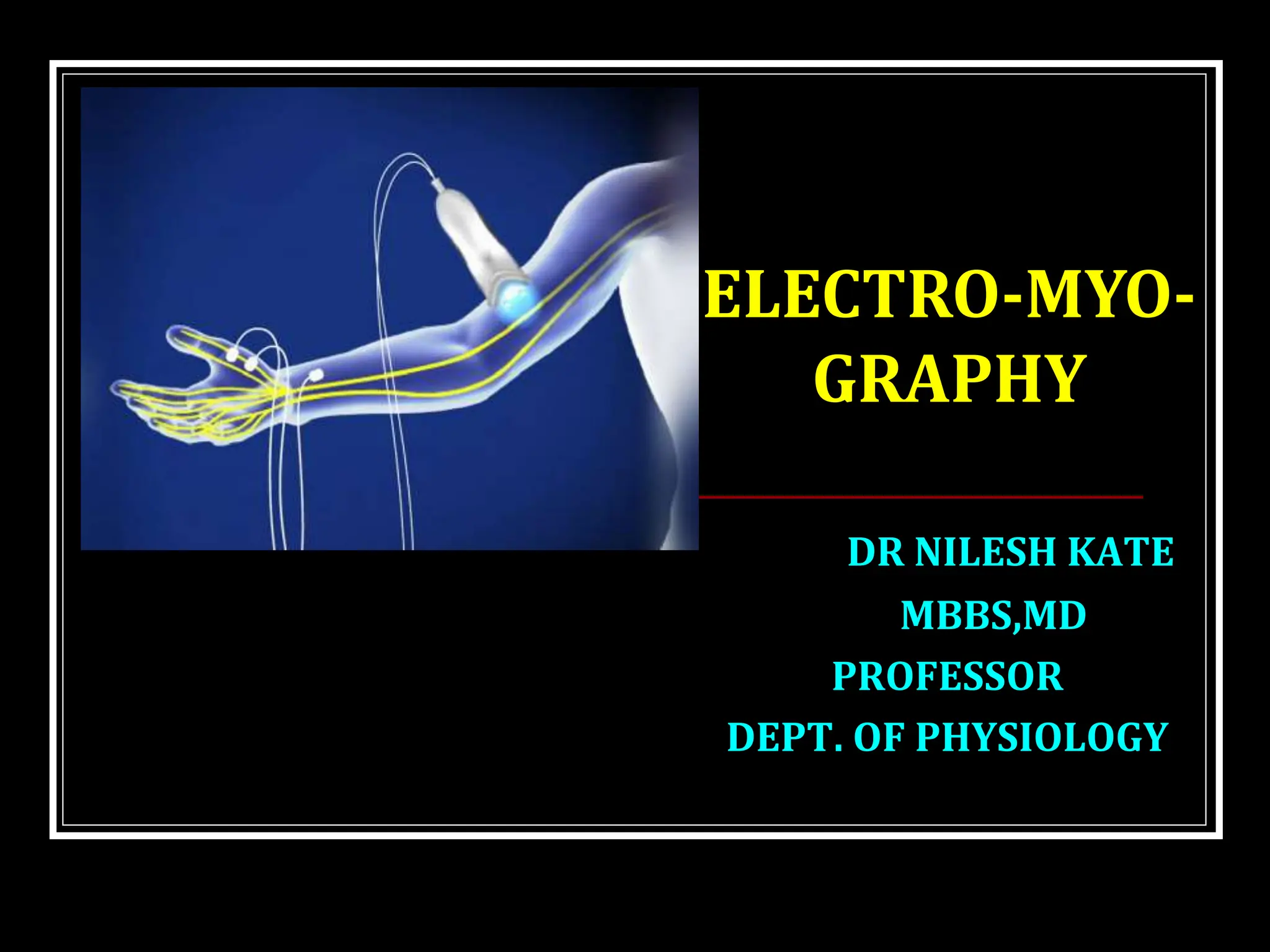
ELECTRO-MYO-
GRAPHY
Objectives.
 Def – Electromyography, electromyograph,
electromyogram
 How it is done
 Applications
 Abnormal patterns.
Tuesday, December 6, 2022
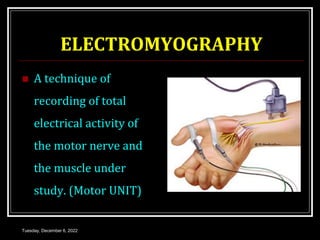
ELECTROMYOGRAPHY
 A technique of
recording of total
electrical activity of
the motor nerve and
the muscle under
study. (Motor UNIT)
Tuesday, December 6, 2022
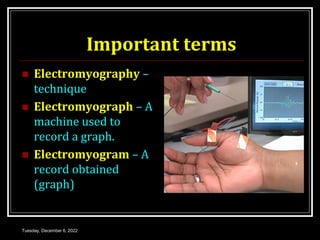
Important terms
 Electromyography –
technique
 Electromyograph – A
machine used to
record a graph.
 Electromyogram – A
record obtained
(graph)
Tuesday, December 6, 2022
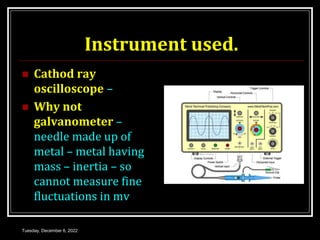
Instrument used.
 Cathod ray
oscilloscope –
 Why not
galvanometer –
needle made up of
metal – metal having
mass – inertia – so
cannot measure fine
fluctuations in mv
Tuesday, December 6, 2022
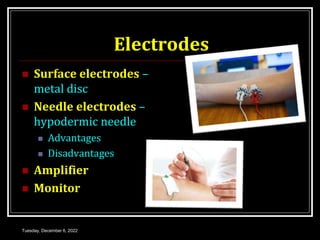
Electrodes
 Surface electrodes –
metal disc
 Needle electrodes –
hypodermic needle
 Advantages
 Disadvantages
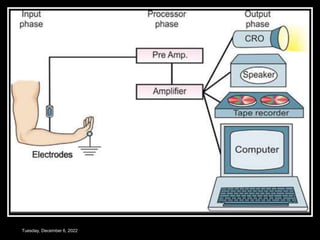
 Amplifier
 Monitor
Tuesday, December 6, 2022
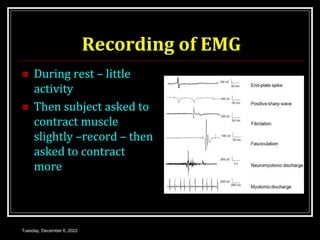
Recording of EMG
 During rest – little
activity
 Then subject asked to
contract muscle
slightly –record – then
asked to contract
more
Tuesday, December 6, 2022
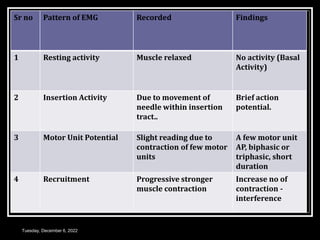
Sr no Pattern of EMG Recorded Findings
1 Resting activity Muscle relaxed No activity (Basal
Activity)
2 Insertion Activity Due to movement of
needle within insertion
tract..
Brief action
potential.
3 Motor Unit Potential Slight reading due to
contraction of few motor
units
A few motor unit
AP, biphasic or
triphasic, short
duration
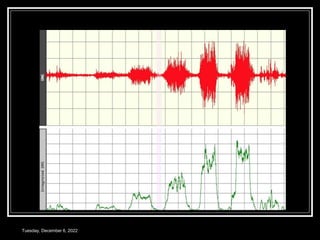
4 Recruitment Progressive stronger
muscle contraction
Increase no of
contraction -
interference
Tuesday, December 6, 2022
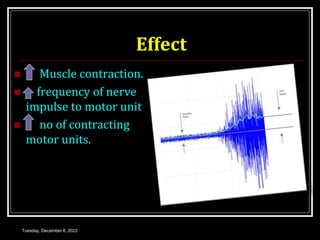
Effect
 Muscle contraction.
 frequency of nerve
impulse to motor unit
 no of contracting
motor units.
Tuesday, December 6, 2022
Motor units
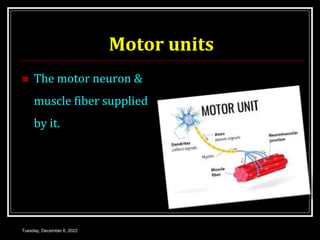
 The motor neuron &
muscle fiber supplied
by it.
Tuesday, December 6, 2022
Motor units
 Back muscle
 Each nerve fiber
supplies many muscle
fibers (100-200)
 Gross movements
 Extraocular muscles
 Each nerve fiber
supplies few muscle
fibers (3-6)
 Fine movements..
Tuesday, December 6, 2022
Types of muscle contractions
 Muscle fasciculations
 Visible to naked eye
 Only seen in
neurogenic disease
 Muscle fibrillations
 Not visible to naked eye
 Seen in neurogenic &
myogenic disease..
 So………to find out
fibrillations we perform
EMG……
Tuesday, December 6, 2022
NORMAL EMG
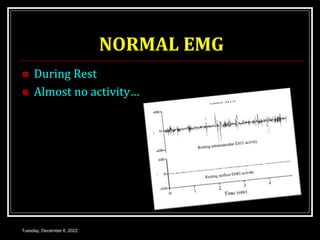
 During Rest
 Almost no activity…
Tuesday, December 6, 2022
NORMAL EMG
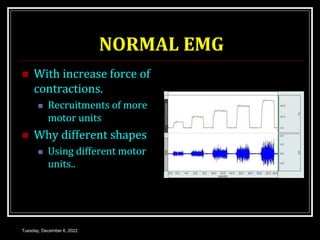
 With increase force of
contractions.
 Recruitments of more
motor units
 Why different shapes
 Using different motor
units..
Tuesday, December 6, 2022
NORMAL EMG
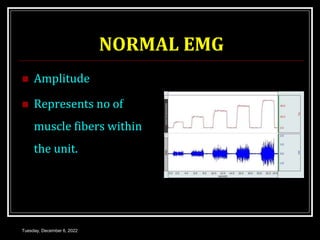
 Amplitude
 Represents no of
muscle fibers within
the unit.
Tuesday, December 6, 2022
Normal EMG
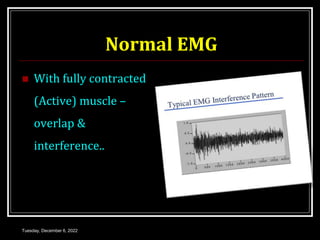
 With fully contracted
(Active) muscle –
overlap &
interference..
Tuesday, December 6, 2022
Motor unit potential
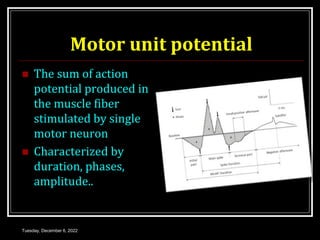
 The sum of action
potential produced in
the muscle fiber
stimulated by single
motor neuron
 Characterized by
duration, phases,
amplitude..
Tuesday, December 6, 2022
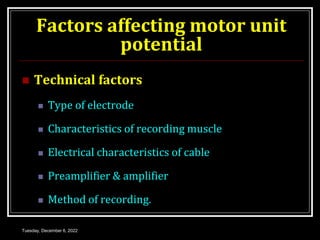
Factors affecting motor unit
potential
 Technical factors
 Type of electrode
 Characteristics of recording muscle
 Electrical characteristics of cable
 Preamplifier & amplifier
 Method of recording.
Tuesday, December 6, 2022
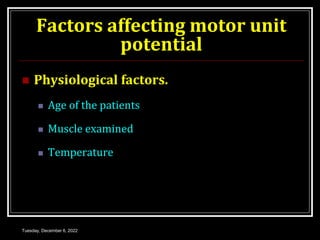
Factors affecting motor unit
potential
 Physiological factors.
 Age of the patients
 Muscle examined
 Temperature
Tuesday, December 6, 2022
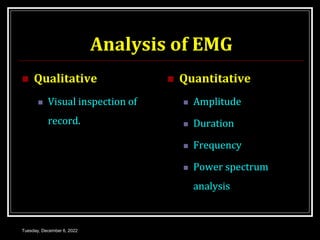
Analysis of EMG
 Qualitative
 Visual inspection of
record.
 Quantitative
 Amplitude
 Duration
 Frequency
 Power spectrum
analysis
Tuesday, December 6, 2022
Clinical
application of
EMG
Tuesday, December 6, 2022
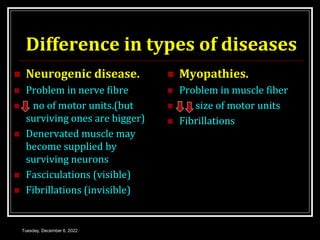
Difference in types of diseases
 Neurogenic disease.
 Problem in nerve fibre
 no of motor units.(but
surviving ones are bigger)
 Denervated muscle may
become supplied by
surviving neurons
 Fasciculations (visible)
 Fibrillations (invisible)
 Myopathies.
 Problem in muscle fiber
 size of motor units
 Fibrillations
Tuesday, December 6, 2022
EMG IN
DIFFERENT
DISEASES.
Tuesday, December 6, 2022
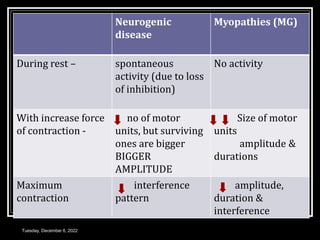
Neurogenic
disease
Myopathies (MG)
During rest – spontaneous
activity (due to loss
of inhibition)
No activity
With increase force
of contraction -
no of motor
units, but surviving
ones are bigger
BIGGER
AMPLITUDE
Size of motor
units
amplitude &
durations
Maximum
contraction
interference
pattern
amplitude,
duration &
interference
Tuesday, December 6, 2022
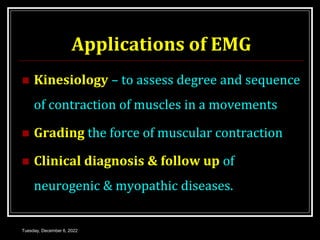
Applications of EMG
 Kinesiology – to assess degree and sequence
of contraction of muscles in a movements
 Grading the force of muscular contraction
 Clinical diagnosis & follow up of
neurogenic & myopathic diseases.
Tuesday, December 6, 2022
Thank
You

emg-221206124218-eb820e93.pdf

  • 1.
    DR NILESH KATE MBBS,MD PROFESSOR DEPT.OF PHYSIOLOGY ELECTRO-MYO- GRAPHY
  • 2.
    Objectives.  Def –Electromyography, electromyograph, electromyogram  How it is done  Applications  Abnormal patterns. Tuesday, December 6, 2022
  • 3.
    ELECTROMYOGRAPHY  A techniqueof recording of total electrical activity of the motor nerve and the muscle under study. (Motor UNIT) Tuesday, December 6, 2022
  • 4.
    Important terms  Electromyography– technique  Electromyograph – A machine used to record a graph.  Electromyogram – A record obtained (graph) Tuesday, December 6, 2022
  • 5.
    Instrument used.  Cathodray oscilloscope –  Why not galvanometer – needle made up of metal – metal having mass – inertia – so cannot measure fine fluctuations in mv Tuesday, December 6, 2022
  • 6.
    Electrodes  Surface electrodes– metal disc  Needle electrodes – hypodermic needle  Advantages  Disadvantages  Amplifier  Monitor Tuesday, December 6, 2022
  • 7.
  • 8.
    Recording of EMG During rest – little activity  Then subject asked to contract muscle slightly –record – then asked to contract more Tuesday, December 6, 2022
  • 9.
    Tuesday, December 6,2022 Sr no Pattern of EMG Recorded Findings 1 Resting activity Muscle relaxed No activity (Basal Activity) 2 Insertion Activity Due to movement of needle within insertion tract.. Brief action potential. 3 Motor Unit Potential Slight reading due to contraction of few motor units A few motor unit AP, biphasic or triphasic, short duration 4 Recruitment Progressive stronger muscle contraction Increase no of contraction - interference
  • 10.
  • 11.
    Effect  Muscle contraction. frequency of nerve impulse to motor unit  no of contracting motor units. Tuesday, December 6, 2022
  • 12.
    Motor units  Themotor neuron & muscle fiber supplied by it. Tuesday, December 6, 2022
  • 13.
    Motor units  Backmuscle  Each nerve fiber supplies many muscle fibers (100-200)  Gross movements  Extraocular muscles  Each nerve fiber supplies few muscle fibers (3-6)  Fine movements.. Tuesday, December 6, 2022
  • 14.
    Types of musclecontractions  Muscle fasciculations  Visible to naked eye  Only seen in neurogenic disease  Muscle fibrillations  Not visible to naked eye  Seen in neurogenic & myogenic disease..  So………to find out fibrillations we perform EMG…… Tuesday, December 6, 2022
  • 15.
    NORMAL EMG  DuringRest  Almost no activity… Tuesday, December 6, 2022
  • 16.
    NORMAL EMG  Withincrease force of contractions.  Recruitments of more motor units  Why different shapes  Using different motor units.. Tuesday, December 6, 2022
  • 17.
    NORMAL EMG  Amplitude Represents no of muscle fibers within the unit. Tuesday, December 6, 2022
  • 18.
    Normal EMG  Withfully contracted (Active) muscle – overlap & interference.. Tuesday, December 6, 2022
  • 19.
    Motor unit potential The sum of action potential produced in the muscle fiber stimulated by single motor neuron  Characterized by duration, phases, amplitude.. Tuesday, December 6, 2022
  • 20.
    Factors affecting motorunit potential  Technical factors  Type of electrode  Characteristics of recording muscle  Electrical characteristics of cable  Preamplifier & amplifier  Method of recording. Tuesday, December 6, 2022
  • 21.
    Factors affecting motorunit potential  Physiological factors.  Age of the patients  Muscle examined  Temperature Tuesday, December 6, 2022
  • 22.
    Analysis of EMG Qualitative  Visual inspection of record.  Quantitative  Amplitude  Duration  Frequency  Power spectrum analysis Tuesday, December 6, 2022
  • 23.
  • 24.
    Difference in typesof diseases  Neurogenic disease.  Problem in nerve fibre  no of motor units.(but surviving ones are bigger)  Denervated muscle may become supplied by surviving neurons  Fasciculations (visible)  Fibrillations (invisible)  Myopathies.  Problem in muscle fiber  size of motor units  Fibrillations Tuesday, December 6, 2022
  • 25.
  • 26.
    Neurogenic disease Myopathies (MG) During rest– spontaneous activity (due to loss of inhibition) No activity With increase force of contraction - no of motor units, but surviving ones are bigger BIGGER AMPLITUDE Size of motor units amplitude & durations Maximum contraction interference pattern amplitude, duration & interference Tuesday, December 6, 2022
  • 27.
    Applications of EMG Kinesiology – to assess degree and sequence of contraction of muscles in a movements  Grading the force of muscular contraction  Clinical diagnosis & follow up of neurogenic & myopathic diseases. Tuesday, December 6, 2022
  • 28.