What is E-waste?
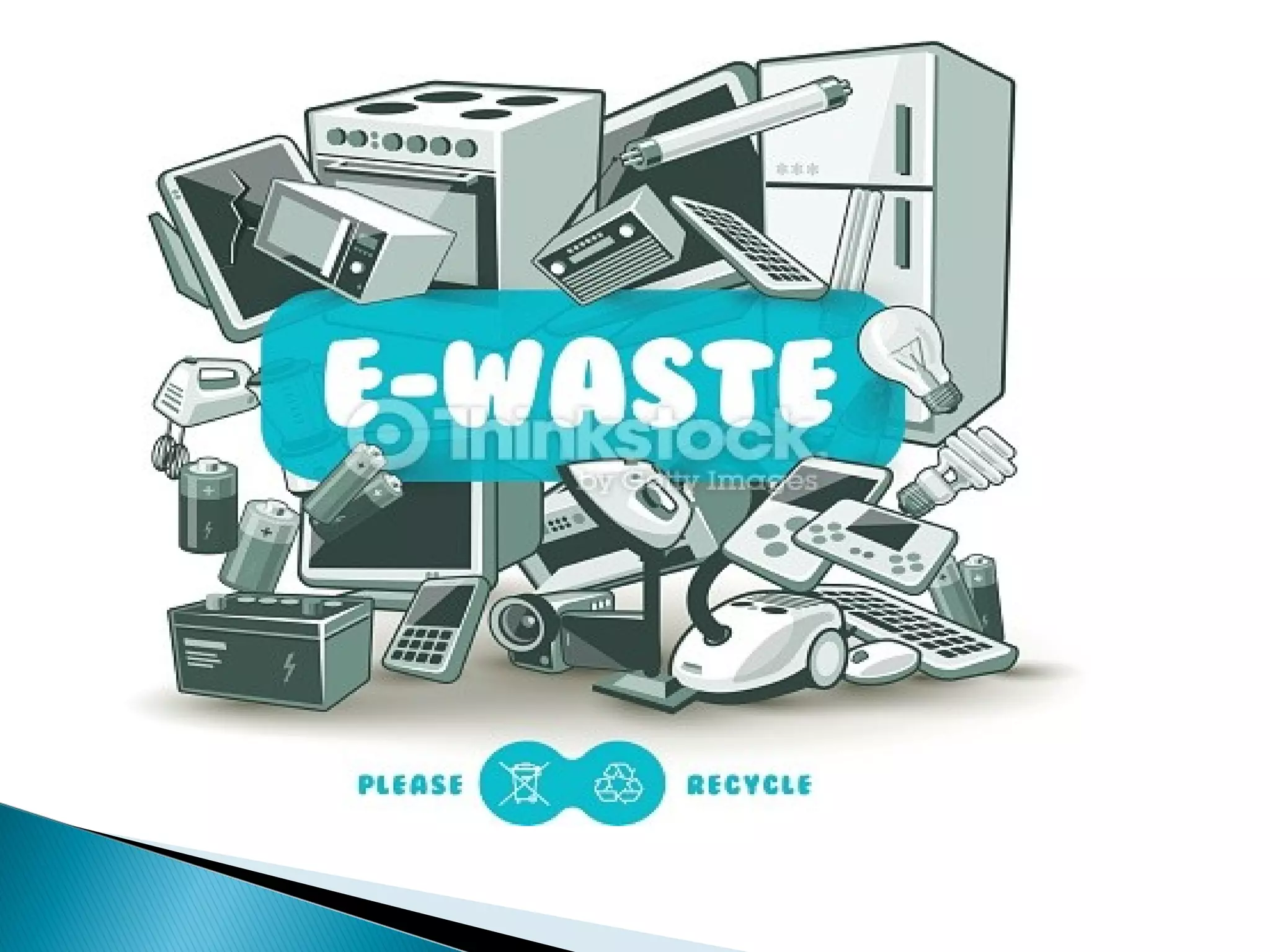
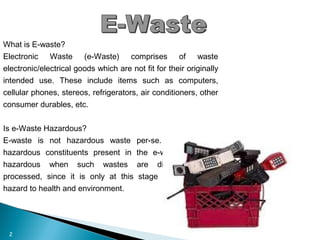
Electronic Waste (e-Waste) comprises of waste
electronic/electrical goods which are not fit for their originally
intended use. These include items such as computers,
cellular phones, stereos, refrigerators, air conditioners, other
consumer durables, etc.
Is e-Waste Hazardous?
E-waste is not hazardous waste per-se. However, the
hazardous constituents present in the e-waste render it
hazardous when such wastes are dismantled and
processed, since it is only at this stage that they pose
hazard to health and environment.
2
3
COMPONENTS CONSTITUENTS
Printed circuit boards Lead & cadmium
Cathode ray tubes (CRTs) Lead oxide & Cadmium
Switches & flat screen monitors Mercury
Computer batteries Cadmium
Capacitors and transformers Poly Chlorinated Bi-phenyls (PCB)
Printed circuit boards, plastic Brominated Flame Retardant
casings cable
Cable insulation/coating Poly Vinyl Chloride (PVC)
4
 Information and telecom fastest growing industry verticals
 PC sales crossed 7.3 million units in 2007-08 growing 16%;
installed base of over 25 million units
 Consumer electronics market growing at 13-15% annually ; 120
million installed base of TVS
 Cellular subscriber up by 96.86% over last year; Indtalled
base to cross 300 million by 2010
5 5
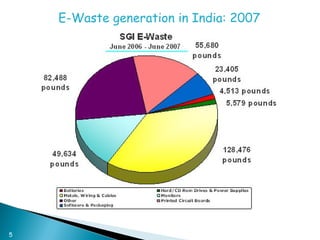
E-Waste generation in India: 2007
6
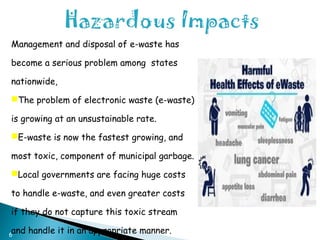
Management and disposal of e-waste has
become a serious problem among states
nationwide,
The problem of electronic waste (e-waste)
is growing at an unsustainable rate.
E-waste is now the fastest growing, and
most toxic, component of municipal garbage.
Local governments are facing huge costs
to handle e-waste, and even greater costs
if they do not capture this toxic stream
and handle it in an appropriate manner.
7
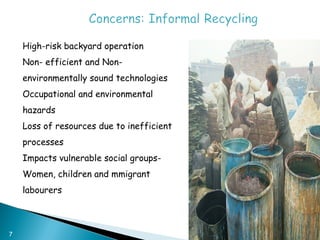
 High-risk backyard operation
 Non- efficient and Non-
environmentally sound technologies
 Occupational and environmental
hazards
 Loss of resources due to inefficient
processes
 Impacts vulnerable social groups-
Women, children and mmigrant
labourers
8
 Various legislations cover different aspects of e-waste
 The hazardous waste (management and handling ) rules, 1998 as
amended in 2008 for Toxic content – registration mandatory for
recyclers
 Municipal Solid Waste Management & Handling Rules for non-Toxic
content
 Basel convention for regulating transboundary movement
 Foreign Trade policy restricts import of second-hand computers and
does not permit import of e-waste
 ‘Guidelines’ by Central Pollution Control Board ( 2008)
 E-waste management has been largely achieved
through reuse and refurbishing.
 Preventing waste in the first place is the preferred
management option.
 Make use of take back programs.
 The least preferred option is to landfill electronic
waste. This should only come as a last option but
care to consult with state regulations on disposal
of any hazardous waste
9
E-Waste ManagementE-Waste Management
10
11
12

E waste

  • 2.
    What is E-waste? ElectronicWaste (e-Waste) comprises of waste electronic/electrical goods which are not fit for their originally intended use. These include items such as computers, cellular phones, stereos, refrigerators, air conditioners, other consumer durables, etc. Is e-Waste Hazardous? E-waste is not hazardous waste per-se. However, the hazardous constituents present in the e-waste render it hazardous when such wastes are dismantled and processed, since it is only at this stage that they pose hazard to health and environment. 2
  • 3.
    3 COMPONENTS CONSTITUENTS Printed circuitboards Lead & cadmium Cathode ray tubes (CRTs) Lead oxide & Cadmium Switches & flat screen monitors Mercury Computer batteries Cadmium Capacitors and transformers Poly Chlorinated Bi-phenyls (PCB) Printed circuit boards, plastic Brominated Flame Retardant casings cable Cable insulation/coating Poly Vinyl Chloride (PVC)
  • 4.
    4  Information andtelecom fastest growing industry verticals  PC sales crossed 7.3 million units in 2007-08 growing 16%; installed base of over 25 million units  Consumer electronics market growing at 13-15% annually ; 120 million installed base of TVS  Cellular subscriber up by 96.86% over last year; Indtalled base to cross 300 million by 2010
  • 5.
    5 5 E-Waste generationin India: 2007
  • 6.
    6 Management and disposalof e-waste has become a serious problem among states nationwide, The problem of electronic waste (e-waste) is growing at an unsustainable rate. E-waste is now the fastest growing, and most toxic, component of municipal garbage. Local governments are facing huge costs to handle e-waste, and even greater costs if they do not capture this toxic stream and handle it in an appropriate manner.
  • 7.
    7  High-risk backyardoperation  Non- efficient and Non- environmentally sound technologies  Occupational and environmental hazards  Loss of resources due to inefficient processes  Impacts vulnerable social groups- Women, children and mmigrant labourers
  • 8.
    8  Various legislationscover different aspects of e-waste  The hazardous waste (management and handling ) rules, 1998 as amended in 2008 for Toxic content – registration mandatory for recyclers  Municipal Solid Waste Management & Handling Rules for non-Toxic content  Basel convention for regulating transboundary movement  Foreign Trade policy restricts import of second-hand computers and does not permit import of e-waste  ‘Guidelines’ by Central Pollution Control Board ( 2008)
  • 9.
     E-waste managementhas been largely achieved through reuse and refurbishing.  Preventing waste in the first place is the preferred management option.  Make use of take back programs.  The least preferred option is to landfill electronic waste. This should only come as a last option but care to consult with state regulations on disposal of any hazardous waste 9 E-Waste ManagementE-Waste Management
  • 10.
  • 11.
  • 12.