BY
A.MANIKANTA(11621A0401)
B.PRABHU KIRAN(11621A0407)
OUTLINE
 Introduction
 Components list
 Block diagram
 Description
 Microcontroller 8051
 Principle of operation
 Advantages and Disadvantages
 Conclusion
INTRODUCTION
 Traditionally, a voting machine has been defined by the
mechanism the system uses to cast votes and categorized by the
location where the system tabulates the votes. With
advancement in technology EVM came into picture.
 It ensures flawless voting and thus has become more
widespread.Retains all the characteristics of voting while
making it more expedient.
 Certain systems may be more or less accessible to all voters, or
not accessible to those voters with certain of disabilities. They
can also have an effect on the public's ability to oversee
elections types.
COMPONENTS LIST
 Micro controller 8051(AT89C51)
 LED
 LCD(16*2Alphanumaric)
 Power supply
 Control switches
Contd….
 Buzzer
 Connecting wires
 PCB or bread board
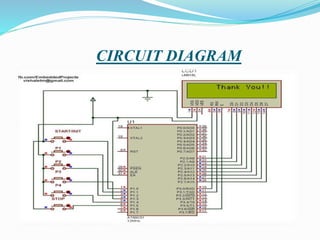
CIRCUIT DIAGRAM
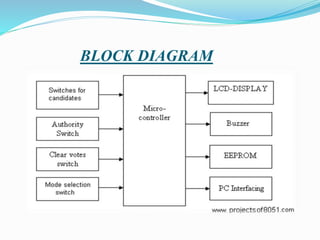
BLOCK DIAGRAM
DESCRIPTION
 The electronic voting machine consists of four blocks
 Microcontroller
 Control switches
 LCD display
 Input keys
MICROCONTROLLER 8051
 Microcontroller 8051 is designed in 1980’s by Intel.
 It is a computer on chip type.
 It is 40 pin dip type ic.
 It is designed for performing special type operation to do
specific jobs.
Contd…….
 It has four sets of i/o pins which can be used both input and
output operations.
 It contains four ports.
 Each port contains 8 pins.
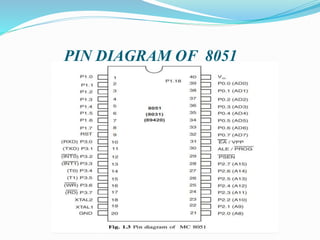
 The pin configuration is shown below
PIN DIAGRAM OF 8051
Contd…..
 Pins 1-8:it is said to be port 1 and it is used for input/output
operations.
 Pin 9 is a reset pin.
 Pins 10-17: it is port 3 is also used for input/output operations
but specially it has alternate operations
1. Pin 10(RXD): - Serial asynchronous communication input or
Serial synchronous communication output.
Contd…..
1. Pin 11(TXD): Serial asynchronous communication output or
Serial synchronous communication clock output.
2. Pin 12(INT 0):Interrupt 0 input.
3. Pin 13(INT 1);Interrupt 1 input.
4. Pin 14(T0):Counter 0 clock input.
5. Pin 15(T1):Counter 1 clock input.
6. Pin 16(WR): Write to external (additional) RAM.
7. Pin 17(RD):Read from external RAM.
 Pin 18 to 19(X1,X2):Internal oscillator.
Contd….
 Pin 20(GND):Ground
 Pin 21-28(port 2): I/P or O/P port when no external memory is
used. In case external memory is used, the higher address byte.
 Pin 29 (PSEN): Program Store Enable. If external ROM is used
for storing program then a logic zero (0) appears on it every
time the microcontroller reads a byte from memory
 Pin 30 (ALE): Address Latch Enable
Contd…
 Pin 31 (EA): Enable Access. To use program from an ext.
memory(Logic zero), to use program from both int. as well as
ext. memory (logic 1).
 Pin 32-39 (port 0): -I/P or O/P when ALE is low and lower
order address byte when ALE is high.
 Pin 40(Vcc): +5v power supply.
LCD 2*16
 The Serial LCDs are very functional, liquid crystal displays
that can be easily interfaced to and controlled by a
microcontroller using an I/O pin.
 This device can be connected to a PC serial port using a
MAX232 line driver. The circuit isn't supported by us.
 The LCD displays provide basic text wrapping so that your text
looks correct on the display.
 Full control over all of their advanced LCD features allows you
to move the cursor anywhere on the display with a single
instruction and turn the display on and off in any configuration
LCD
16*2
display
PRINCIPLE OF OPERATION
 Power on: When supply is turned on WHITE LED glows.
VOTING MODE
-toggle switch on VCC
When toggle switch is in voting mode
“Voting mode” is displayed followed by
“Please vote”. After a vote being given,
“Please wait for authority switch” is
displayed and again enable for voting
after Control switch being pressed by
the voting Authority.
COUNTING MODE
-toggle switch on GND.
Counting Mode: When toggle switch is in
counting mode “Counting mode” in
displayed on the screen, and total number
of votes to respective candidate can be
displayed on the screen
Contd….
 Clear mode: Press clear switch when all entries are required to
be erased. Clear switch should be pressed before voting
procedure.
 Buzzer indication: Pressing of key in voting mode is indicated
by a buzzer sound.
 Controller switch: This switch is provided for enabling the
keypad in voting mode.
 This Switch is under the control of voting authority.
ADAVANTAGES
 It is economical.
 Less manpower required.
 Time conscious, as less time required for voting & counting.
 Avoids invalid voting.

 Saves transportation cost due to its compact size.
 Convenient on the part of voter.
DISADVANTAGES
 Security issues and unequal internet access.
 We have to use external chip to store the votes.
 We have provide continuous power supply,
Conclusion
 This approach allows for the easy development and
deployment of applications. For quite some time, voting
equipment vendors have maintained that their systems are
secure, and that the closed-source nature makes them even
more secure.
 In fact, we believe that an open process would result in more
careful development, as more scientists, software engineers,
political activists, and others who value their democracy would
be paying attention to the quality of the software that is used
for their elections.
REFRENCES
 www.ieee.com
 The 8051 Microcontroller and Embedded Systems by Mazidi
 www.microcontrollerprojects00.blogspot.in
THANKING YOU

Electronic voting machine

  • 1.
  • 2.
    OUTLINE  Introduction  Componentslist  Block diagram  Description  Microcontroller 8051  Principle of operation  Advantages and Disadvantages  Conclusion
  • 3.
    INTRODUCTION  Traditionally, avoting machine has been defined by the mechanism the system uses to cast votes and categorized by the location where the system tabulates the votes. With advancement in technology EVM came into picture.  It ensures flawless voting and thus has become more widespread.Retains all the characteristics of voting while making it more expedient.  Certain systems may be more or less accessible to all voters, or not accessible to those voters with certain of disabilities. They can also have an effect on the public's ability to oversee elections types.
  • 4.
    COMPONENTS LIST  Microcontroller 8051(AT89C51)  LED  LCD(16*2Alphanumaric)  Power supply  Control switches
  • 5.
    Contd….  Buzzer  Connectingwires  PCB or bread board
  • 6.
  • 7.
  • 8.
    DESCRIPTION  The electronicvoting machine consists of four blocks  Microcontroller  Control switches  LCD display  Input keys
  • 9.
    MICROCONTROLLER 8051  Microcontroller8051 is designed in 1980’s by Intel.  It is a computer on chip type.  It is 40 pin dip type ic.  It is designed for performing special type operation to do specific jobs.
  • 10.
    Contd…….  It hasfour sets of i/o pins which can be used both input and output operations.  It contains four ports.  Each port contains 8 pins.  The pin configuration is shown below
  • 11.
  • 12.
    Contd…..  Pins 1-8:itis said to be port 1 and it is used for input/output operations.  Pin 9 is a reset pin.  Pins 10-17: it is port 3 is also used for input/output operations but specially it has alternate operations 1. Pin 10(RXD): - Serial asynchronous communication input or Serial synchronous communication output.
  • 13.
    Contd….. 1. Pin 11(TXD):Serial asynchronous communication output or Serial synchronous communication clock output. 2. Pin 12(INT 0):Interrupt 0 input. 3. Pin 13(INT 1);Interrupt 1 input. 4. Pin 14(T0):Counter 0 clock input. 5. Pin 15(T1):Counter 1 clock input. 6. Pin 16(WR): Write to external (additional) RAM. 7. Pin 17(RD):Read from external RAM.  Pin 18 to 19(X1,X2):Internal oscillator.
  • 14.
    Contd….  Pin 20(GND):Ground Pin 21-28(port 2): I/P or O/P port when no external memory is used. In case external memory is used, the higher address byte.  Pin 29 (PSEN): Program Store Enable. If external ROM is used for storing program then a logic zero (0) appears on it every time the microcontroller reads a byte from memory  Pin 30 (ALE): Address Latch Enable
  • 15.
    Contd…  Pin 31(EA): Enable Access. To use program from an ext. memory(Logic zero), to use program from both int. as well as ext. memory (logic 1).  Pin 32-39 (port 0): -I/P or O/P when ALE is low and lower order address byte when ALE is high.  Pin 40(Vcc): +5v power supply.
  • 16.
    LCD 2*16  TheSerial LCDs are very functional, liquid crystal displays that can be easily interfaced to and controlled by a microcontroller using an I/O pin.  This device can be connected to a PC serial port using a MAX232 line driver. The circuit isn't supported by us.  The LCD displays provide basic text wrapping so that your text looks correct on the display.  Full control over all of their advanced LCD features allows you to move the cursor anywhere on the display with a single instruction and turn the display on and off in any configuration
  • 17.
  • 18.
    PRINCIPLE OF OPERATION Power on: When supply is turned on WHITE LED glows. VOTING MODE -toggle switch on VCC When toggle switch is in voting mode “Voting mode” is displayed followed by “Please vote”. After a vote being given, “Please wait for authority switch” is displayed and again enable for voting after Control switch being pressed by the voting Authority. COUNTING MODE -toggle switch on GND. Counting Mode: When toggle switch is in counting mode “Counting mode” in displayed on the screen, and total number of votes to respective candidate can be displayed on the screen
  • 19.
    Contd….  Clear mode:Press clear switch when all entries are required to be erased. Clear switch should be pressed before voting procedure.  Buzzer indication: Pressing of key in voting mode is indicated by a buzzer sound.  Controller switch: This switch is provided for enabling the keypad in voting mode.  This Switch is under the control of voting authority.
  • 20.
    ADAVANTAGES  It iseconomical.  Less manpower required.  Time conscious, as less time required for voting & counting.  Avoids invalid voting.   Saves transportation cost due to its compact size.  Convenient on the part of voter.
  • 21.
    DISADVANTAGES  Security issuesand unequal internet access.  We have to use external chip to store the votes.  We have provide continuous power supply,
  • 22.
    Conclusion  This approachallows for the easy development and deployment of applications. For quite some time, voting equipment vendors have maintained that their systems are secure, and that the closed-source nature makes them even more secure.  In fact, we believe that an open process would result in more careful development, as more scientists, software engineers, political activists, and others who value their democracy would be paying attention to the quality of the software that is used for their elections.
  • 23.
    REFRENCES  www.ieee.com  The8051 Microcontroller and Embedded Systems by Mazidi  www.microcontrollerprojects00.blogspot.in
  • 24.