Electronic Security Issues for
Schools
Presented by:
Joanne Rinardo
Partner
Deutsch Kerrigan
jrinardo@deutschkerrigan.com
504 593 0616
Why Data Integrity Has Become
Important to Schools
• More technology use in the education sector
• New privacy and compliance challenges
• More collection of student data
• Outside contractors
• Online courses
Protection of Pupil Rights
Amendment (PPRA)
Applies to programs of:
▫ State Educational Agency (SEA)
▫ Local Educational Agency (LEA)
▫ Or other recipient of funds under any program
funded by the U.S. Department of Education
Governs Administering to Student
• Any survey
• Analysis
• Evaluation in certain
areas
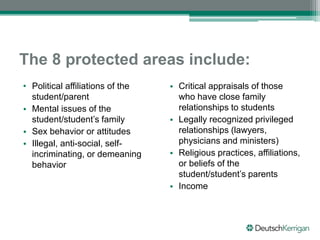
The 8 protected areas include:
• Political affiliations of the
student/parent
• Mental issues of the
student/student’s family
• Sex behavior or attitudes
• Illegal, anti-social, self-
incriminating, or demeaning
behavior
• Critical appraisals of those
who have close family
relationships to students
• Legally recognized privileged
relationships (lawyers,
physicians and ministers)
• Religious practices, affiliations,
or beliefs of the
student/student’s parents
• Income
PPRA also addresses
• Marketing surveys/areas of student privacy;
• Parental access to information; and
• Administration of certain physical examinations
to minors
Third Party Providers
• Written consent before sharing PII not always
required
What Information is Protected?
• Depends on the circumstances.
• FERPA protects student profile information
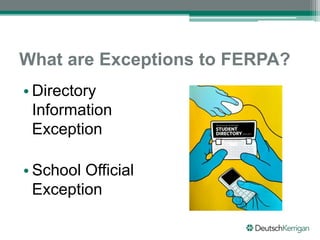
What are Exceptions to FERPA?
• Directory
Information
Exception
• School Official
Exception
Directory Information Exception
• For PII disclosed in the school’s annual notice
as Directory Information
• No other limitations on other uses of data
School Official Exception
• For TPP delivery of education services to the
student.
• Remember:
▫ For service that school would use own
employees;
▫ School maintains data used by TPP;
▫ For a legitimate education interest;
▫ Data not used for unauthorized purposes; and
▫ Consider a written contract regarding use
restrictions
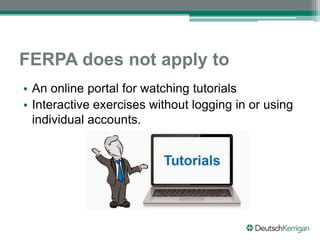
FERPA does not apply to
• An online portal for watching tutorials
• Interactive exercises without logging in or using
individual accounts.
Pieces of information that provide
meaning and context to data collected,
or contextual information
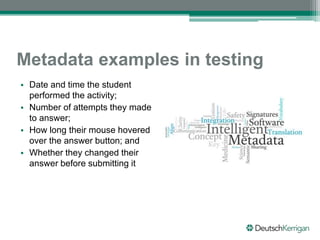
Metadata examples in testing
• Date and time the student
performed the activity;
• Number of attempts they made
to answer;
• How long their mouse hovered
over the answer button; and
• Whether they changed their
answer before submitting it
Metadata Not Usually Protected
• If stripped of all their direct and in direct
identifiers
• Can be disseminated to TPPs
• School name/geographic information can be
indirect identifiers
Best Practices to Protect Data
• Know what
information is being
collected or shared,
• By whom, and
• For what purposes
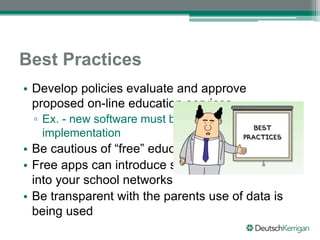
Best Practices
• Develop policies evaluate and approve
proposed on-line education services.
▫ Ex. - new software must be reviewed before
implementation
• Be cautious of “free” educational services
• Free apps can introduce security vulnerabilities
into your school networks
• Be transparent with the parents use of data is
being used
Retention Requirements
• FERPA has no requirement for physical or
electronic record retention
• School districts establish their own policy and
procedures
• Common standard is 5-7 years after
student leaves
• Some schools just retain transcripts
Individuals with Disabilities
Education Act, (“IDEA”)
• Public agencies must inform parents when any PII is
no longer needed
• Parents may request it be destroyed
• Defined as the “physical destruction or removal of
personal identifiers from information so that the
information is no longer personally identifiable”
• Must inform parents before student records are
destroyed
• Must inform parents they can request destruction
once child leaves
• Parents can request that their child’s record be
amended
Title IX
• Keep compliance
information for
seven years
• Applies to
electronic data as
well
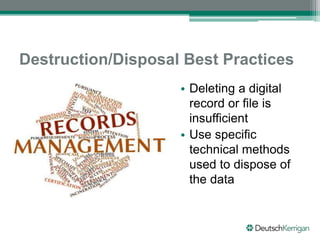
Destruction/Disposal Best Practices
• Deleting a digital
record or file is
insufficient
• Use specific
technical methods
used to dispose of
the data
Electronic Management Systems
(“EMS”)
• Allows school to have rules as to who can
access certain documents;
• Can be updated as regulations change;
• Easier to move data to long-term storage media;
and
• Provides transaction trail
Defining Custodial of Records
• Each school should have an official records
custodian,
• Even if records not under his/her personal
control
• Often Principal or Asst. Principal
• Goal - To prevent the unauthorized access to
student records.
FERPA Applies to All Records
• Not just those records kept in the student’s file
• Security cameras in school and on busses
• Electronic records
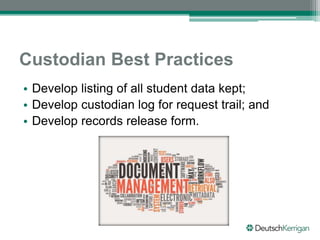
Custodian Best Practices
• Develop listing of all student data kept;
• Develop custodian log for request trail; and
• Develop records release form.
Extracted Data
• Data that originally resided in the Student
Records System
• Now also resides in a special file
Best Practices for
Extracted Data
• PII must be de-identified whenever there is
public reporting;
• Mask of data sufficiently so individual students
not identified from extracted data;
• Use only for legitimate educational purposes;
• Abide by security and information release
requirements;
• Never release updated extract data as school
data
Internal Emails May Be Educational
Records
• If E-mails are maintained by school and
• Are “directly related” to a student
• Unless falls in one of the six “carve-outs”
• E-mail to, from, or about student may be
education record
Courts have ruled inconsistently
• S.A. v. Tulane County Office
of Ed., (CA)
• President and Trustees of
Bates College v.
Congregation Beth Abraham
et al., (ME)
• Williams v. District Bd. of
Trustees of Edison
Community College, FL,
S.A. v. Tulane County Office of Ed.,
(CA)
• Only printed emails part of records under IDEA
• Others had been deleted; thus, not maintained
President and Trustees of Bates
College v. Congregation Beth
Abraham et al., (ME)
• Email about complaints, part of the student’s
records
• Even though generated outside normal
academic activities
• Court noted FERPA does not limit the definition
of “other materials.”
Williams v. District Bd. of Trustees of
Edison Community College, FL,
• Was sending students’ grades via the internet
violated FERPA
• Florida Commission on Human Relations found
no violation
• Make sure there are sufficient protections
regarding access
Release of E-Mail Addresses
• FERPA protection if not included in Directory
Information
• Proper notice of that fact has been given.
Artisita Records v. Does 1-: ,
• Students’ Media Access Control (MAC)
addresses Directory Information.
Fonovisa v. Does 1-14,
• MAC not was Directory Information, but not
education record and could be shared
Warner Bros. Records v. Does 1-14,
• FERPA allows release of e-mail addresses,
contained in the student’s records if
subpoenaed.
UMG Recordings, Inc. v. Doe,
• Name, address, telephone number, e-mail
address and MAC address is contained in
educational records
• Which triggered notification requirements of
FERPA.
• Court: information “detailing how a student uses
the Internet, when they use it, and what they do
on it” is protected under FERPA.
Louisiana Law
• La. Rev. Stat. § 17:81(Q):
• Public school must develop policies electronic
communication by an employee at a school to a
student enrolled at that school
• To protect student
• And school if violation by employee
Facebook
• Can have educational applications
• Communicate about projects;
• Make assignment interactive; and
• Create learning group
Caution
• Do not use to post grades or information that
educational record; and
• Use safeguards to keep others from accessing
the information.
Other Social Communications
• Anti-fraternization
prohibitions would
extend to on-line
communications.
• Laws banning such
communication
• Issue of
constitutional right to
free speech.
Why not to “friend”
student
• Can undercut professional
relationship;
• Opens teacher to misuse of
social media by the student;
• Can be abused by the
teacher or misinterpreted by
the student; and
• Can be seen as invasion of
privacy
Other Considerations
• Adult students v. Minor students
• Former Students v. Current Students v. Future
Students
• Privacy Settings

Electronic Security Issues for Schools

  • 1.
    Electronic Security Issuesfor Schools Presented by: Joanne Rinardo Partner Deutsch Kerrigan jrinardo@deutschkerrigan.com 504 593 0616
  • 2.
    Why Data IntegrityHas Become Important to Schools • More technology use in the education sector • New privacy and compliance challenges • More collection of student data • Outside contractors • Online courses
  • 3.
    Protection of PupilRights Amendment (PPRA) Applies to programs of: ▫ State Educational Agency (SEA) ▫ Local Educational Agency (LEA) ▫ Or other recipient of funds under any program funded by the U.S. Department of Education
  • 4.
    Governs Administering toStudent • Any survey • Analysis • Evaluation in certain areas
  • 5.
    The 8 protectedareas include: • Political affiliations of the student/parent • Mental issues of the student/student’s family • Sex behavior or attitudes • Illegal, anti-social, self- incriminating, or demeaning behavior • Critical appraisals of those who have close family relationships to students • Legally recognized privileged relationships (lawyers, physicians and ministers) • Religious practices, affiliations, or beliefs of the student/student’s parents • Income
  • 6.
    PPRA also addresses •Marketing surveys/areas of student privacy; • Parental access to information; and • Administration of certain physical examinations to minors
  • 7.
    Third Party Providers •Written consent before sharing PII not always required
  • 8.
    What Information isProtected? • Depends on the circumstances. • FERPA protects student profile information
  • 9.
    What are Exceptionsto FERPA? • Directory Information Exception • School Official Exception
  • 10.
    Directory Information Exception •For PII disclosed in the school’s annual notice as Directory Information • No other limitations on other uses of data
  • 11.
    School Official Exception •For TPP delivery of education services to the student. • Remember: ▫ For service that school would use own employees; ▫ School maintains data used by TPP; ▫ For a legitimate education interest; ▫ Data not used for unauthorized purposes; and ▫ Consider a written contract regarding use restrictions
  • 12.
    FERPA does notapply to • An online portal for watching tutorials • Interactive exercises without logging in or using individual accounts.
  • 13.
    Pieces of informationthat provide meaning and context to data collected, or contextual information
  • 14.
    Metadata examples intesting • Date and time the student performed the activity; • Number of attempts they made to answer; • How long their mouse hovered over the answer button; and • Whether they changed their answer before submitting it
  • 15.
    Metadata Not UsuallyProtected • If stripped of all their direct and in direct identifiers • Can be disseminated to TPPs • School name/geographic information can be indirect identifiers
  • 16.
    Best Practices toProtect Data • Know what information is being collected or shared, • By whom, and • For what purposes
  • 17.
    Best Practices • Developpolicies evaluate and approve proposed on-line education services. ▫ Ex. - new software must be reviewed before implementation • Be cautious of “free” educational services • Free apps can introduce security vulnerabilities into your school networks • Be transparent with the parents use of data is being used
  • 18.
    Retention Requirements • FERPAhas no requirement for physical or electronic record retention • School districts establish their own policy and procedures • Common standard is 5-7 years after student leaves • Some schools just retain transcripts
  • 19.
    Individuals with Disabilities EducationAct, (“IDEA”) • Public agencies must inform parents when any PII is no longer needed • Parents may request it be destroyed • Defined as the “physical destruction or removal of personal identifiers from information so that the information is no longer personally identifiable” • Must inform parents before student records are destroyed • Must inform parents they can request destruction once child leaves • Parents can request that their child’s record be amended
  • 20.
    Title IX • Keepcompliance information for seven years • Applies to electronic data as well
  • 21.
    Destruction/Disposal Best Practices •Deleting a digital record or file is insufficient • Use specific technical methods used to dispose of the data
  • 22.
    Electronic Management Systems (“EMS”) •Allows school to have rules as to who can access certain documents; • Can be updated as regulations change; • Easier to move data to long-term storage media; and • Provides transaction trail
  • 23.
    Defining Custodial ofRecords • Each school should have an official records custodian, • Even if records not under his/her personal control • Often Principal or Asst. Principal • Goal - To prevent the unauthorized access to student records.
  • 24.
    FERPA Applies toAll Records • Not just those records kept in the student’s file • Security cameras in school and on busses • Electronic records
  • 25.
    Custodian Best Practices •Develop listing of all student data kept; • Develop custodian log for request trail; and • Develop records release form.
  • 26.
    Extracted Data • Datathat originally resided in the Student Records System • Now also resides in a special file
  • 27.
    Best Practices for ExtractedData • PII must be de-identified whenever there is public reporting; • Mask of data sufficiently so individual students not identified from extracted data; • Use only for legitimate educational purposes; • Abide by security and information release requirements; • Never release updated extract data as school data
  • 28.
    Internal Emails MayBe Educational Records • If E-mails are maintained by school and • Are “directly related” to a student • Unless falls in one of the six “carve-outs” • E-mail to, from, or about student may be education record
  • 29.
    Courts have ruledinconsistently • S.A. v. Tulane County Office of Ed., (CA) • President and Trustees of Bates College v. Congregation Beth Abraham et al., (ME) • Williams v. District Bd. of Trustees of Edison Community College, FL,
  • 30.
    S.A. v. TulaneCounty Office of Ed., (CA) • Only printed emails part of records under IDEA • Others had been deleted; thus, not maintained
  • 31.
    President and Trusteesof Bates College v. Congregation Beth Abraham et al., (ME) • Email about complaints, part of the student’s records • Even though generated outside normal academic activities • Court noted FERPA does not limit the definition of “other materials.”
  • 32.
    Williams v. DistrictBd. of Trustees of Edison Community College, FL, • Was sending students’ grades via the internet violated FERPA • Florida Commission on Human Relations found no violation • Make sure there are sufficient protections regarding access
  • 33.
    Release of E-MailAddresses • FERPA protection if not included in Directory Information • Proper notice of that fact has been given.
  • 35.
    Artisita Records v.Does 1-: , • Students’ Media Access Control (MAC) addresses Directory Information.
  • 36.
    Fonovisa v. Does1-14, • MAC not was Directory Information, but not education record and could be shared
  • 37.
    Warner Bros. Recordsv. Does 1-14, • FERPA allows release of e-mail addresses, contained in the student’s records if subpoenaed.
  • 38.
    UMG Recordings, Inc.v. Doe, • Name, address, telephone number, e-mail address and MAC address is contained in educational records • Which triggered notification requirements of FERPA. • Court: information “detailing how a student uses the Internet, when they use it, and what they do on it” is protected under FERPA.
  • 39.
    Louisiana Law • La.Rev. Stat. § 17:81(Q): • Public school must develop policies electronic communication by an employee at a school to a student enrolled at that school • To protect student • And school if violation by employee
  • 40.
    Facebook • Can haveeducational applications • Communicate about projects; • Make assignment interactive; and • Create learning group
  • 41.
    Caution • Do notuse to post grades or information that educational record; and • Use safeguards to keep others from accessing the information.
  • 42.
    Other Social Communications •Anti-fraternization prohibitions would extend to on-line communications. • Laws banning such communication • Issue of constitutional right to free speech.
  • 43.
    Why not to“friend” student • Can undercut professional relationship; • Opens teacher to misuse of social media by the student; • Can be abused by the teacher or misinterpreted by the student; and • Can be seen as invasion of privacy
  • 44.
    Other Considerations • Adultstudents v. Minor students • Former Students v. Current Students v. Future Students • Privacy Settings