Demystifying Student
Data Privacy
© 2015 Hobsons
Linnette Attai, President of PlayWell, LLC and Privacy
Advisor to Hobsons
2
About Us
• Linnette Attai
- President, PlayWell, LLC
Compliance consulting
Privacy, safety, advertising, marketing,
content
Education and entertainment sectors
- Data Privacy Advisor to Hobsons
• Hobsons:
- Creating solutions to maximize student
success and institutional effectiveness to
create the world-changers of tomorrow
- Supporting over 7.3 million students across
over 8,400 schools worldwide
- Measure our achievements by those of our
clients
3
About Us
4
Agenda
• Why is student data privacy so complicated?
• Creating your school compliance program
• Assessing new technologies
• Q&A – use the “chat window” to submit your
questions
Why is student data privacy so
complicated?
5
6
Benefits of Technology
• Enhancing student learning and success
- Identifying strengths and learning styles
- Delivering personalized learning
- Supporting at-risk students
- Providing opportunities for accomplishment
and creativity
- College and career planning and preparation
• Management and efficiency
- Record-keeping for students and staff
- Data analysis
- Vendor and contract management
- Operations management
7
Benefits of Technology
8
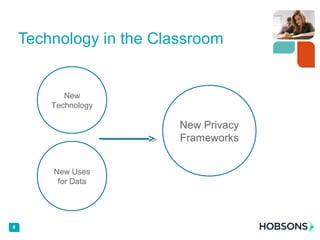
Technology in the Classroom
New
Technology
New Uses
for Data
New Privacy
Frameworks
• Data privacy and security as separate but related
terms:
- Privacy: collection, use, handling and sharing
or transfer of data
- Security: protective measures applied to
prevent unauthorized access, and to preserve
the integrity of the data
9
Privacy vs. Security
• Existing federal regulation:
- FERPA, PPRA, CIPA, COPPA
• Existing state regulation
• Emerging federal and state regulation
10
Regulatory Climate
• Applies to all schools that receive federal funds
• Protects privacy of student education records
• Provides parents and eligible students (ages 18+)
with access to education records
- Rights to review and request amendment or
correction
11
Family Educational Rights and
Privacy Act (FERPA)
• Education records: directly related to a student
and maintained by an educational agency
− Must obtain consent from parent or eligible
student prior to release of student education
records
FERPA
12
• Exceptions for obtaining prior consent for release
of education records
−School officials with legitimate educational interest;
−Other schools to which a student is transferring;
−Specified officials for audits or evaluations;
−Appropriate parties in connection with financial aid;
−Organizations conducting certain studies on behalf of a school;
−Accrediting organizations;
−To comply with a judicial order or subpoena;
−Certain officials in cases of health and safety emergencies;
−State and local authorities, within a juvenile justice system, in
accordance with certain state law.
FERPA
13
• School official:
− Contractor to whom a school or institution has
outsourced institutional services or functions
− Must be performing an institutional service or function
for which the agency would otherwise use employees
− Must be under the direct control of the agency or
institution with respect to the use and maintenance of
education records
FERPA
14
• Sets requirements around notice prior to
disclosure of directory information
• Requires annual notice to parents of FERPA
rights
15
FERPA
• Provides rights to parents of minor students
around collection of sensitive information through
surveys, analysis or evaluations
• Requires consent prior to collection of “protected”
information
• Opt out rights for certain surveys, physical exams
and information disclosure for marketing
purposes
16
Protection of Pupil Rights
Amendment (PPRA)
• Requires schools to establish policies for
collection, disclosure or use of personal
information about students for commercial
purposes
PPRA
17
• Applies to schools or libraries that receive
discounts for Internet access or internal
connections via E-rate
• Requires:
- Blocking or filtering of certain images
- Internet safety policy that includes monitoring
online activities of minors
- Education for minors about appropriate online
behavior
18
Children’s Internet Protection Act
(CIPA)
• Applies to operators:
- of commercial websites and online services
directed to children under 13
- with actual knowledge that they are collecting
personal information from children under 13
• Requires clear, comprehensive privacy policy
• Maintain reasonable data security and deletion
measures
19
Children’s Online Privacy
Protection Act (COPPA)
• Provide parents with notice, choice and consent
prior to collecting personal information
• Allows schools to consent to collection of
personal information in certain circumstances:
- Collection is only for use and benefit of the
school
- No other commercial purposes
• Operator may rely on the contract to indicate
consent20
COPPA
• 2014: 110 student data privacy bills introduced
across 36 states  28 new laws
• 2015 to date: 128 state bills introduced, along
with new federal regulation
21
State Regulation
• California legislation
• Applies to operators of websites, online services
designed, marketed and used primarily for K-12
school purposes
• Restricts use of data from minors for certain
marketing or advertising practices
22
Student Online Personal
Information Privacy Act (SOPIPA)
• Prohibits targeted advertising and sale of student
information
• Limits disclosure of “covered” information
• Requires reasonable security, appropriate to the
nature of the covered information
• If requested by a school or district, must delete a
student’s covered information under the school or
district’s control
SOPIPA
23
• Different nomenclature and definitions of
protected data:
- Education records
- Directory information
- Protected information
- Personal information
- Covered information
• Prior consent vs. opt out
• Marketing restrictions
Navigating the Terrain
24
• Control of the data
• Transparency
• Notice and choice
• Acceptable educational use cases
• Reasonable security measures
Common Threads
25
• Responsible for navigating regulatory matrix
• Stewards of district and community norms
• Community relations and communication plans
• Incident response management
26
Voice of Schools
Creating your school compliance
program
27
• Identify compliance risks and gaps
• Address existing issues
• Create policies and practices to minimize risks
• Establish communications and incident response
plans
• Educate employees, parents and students on
privacy rights and responsibilities
Program Goals
28
• Technology audit and assessment
- What technology is currently used to support
school operations?
 Data management platforms
 Support services
- What technology is used in the classroom?
 Devices
 Websites
 Apps
29
Where to Begin?
29
• Assemble stakeholders
• Assess current technology use
• Assess resources and infrastructure
• Identify existing capabilities and talent
30
Next Steps
• Identify gaps and needs:
- Policies, technology, infrastructure, security,
bandwidth, communications, training
• Consider impacts:
- Financial, personnel, logistics, time, pedagogy
• Create your goals
Planning Process
31
• Device use
• Data privacy and security
• App and website compliance assessment
• Social media use
• Data disclosure circumstances
• Incident response plans
32
Policy Development
• Notices to parents and students
- Acceptable use policy
- Rules and responsibilities
- Incident report procedures
• Policy and technology updates
• Post-incident information
Communications Plans
33
• Educate teams and implement policies and
processes
• Inform parents and establish plans for ongoing
community outreach
34
Transparency and Engagement
Assessing new technologies
35
• Create assessment and compliance processes
for adding new technology at the district, school
and classroom levels
- Identify stakeholders
- Map out review process
 Who is involved?
 What will be reviewed?
 How will it be reviewed?
 Are additional resources needed?
36
Establish a Review Process
• Privacy policies
• Terms of use
• Contract terms
• Questions for vendors
37
Compliance Review Process
• What data is collected and why?
• Who has access and for what purposes?
• What are the security protocols?
• How can the school access the data to respond to
a request from a parent?
• What happens to the data when the agreement
ends?
Understanding the Technology
38
• What is the process for integrating the technology
into your school?
• How will the vendor support implementation?
• How much time is needed to be operational?
• What are the costs?
• What support is provided after implementation?
• What are the recommendations and resources for
training?
39
Going Beyond Compliance
• What were the goals of bringing the technology
into the school?
- Measure and assess the impacts
- Use the results to inform the process for the
future
40
Examining the Results
• Use the chat function to submit your questions
• We will send the list of questions and answers to
attendees after the webinar
41
Q & A
• US Department of Education
- http://www.ed.gov/
• Privacy Technical Assistance Center (PTAC)
- http://ptac.ed.gov/
• Consortium for School Networking (CoSN):
- http://www.cosn.org/focus-areas/leadership-vision/protectin
• Future of Privacy Forum FERPA|SHERPA:
- http://ferpasherpa.org/
42
Additional Resources
• For more information and to review this webinar
again, please visit the events page at:
www.hobsons.com/education-trends/events
43
Thanks for Attending!

Demystifying Student Data Privacy

  • 1.
    Demystifying Student Data Privacy ©2015 Hobsons Linnette Attai, President of PlayWell, LLC and Privacy Advisor to Hobsons
  • 2.
    2 About Us • LinnetteAttai - President, PlayWell, LLC Compliance consulting Privacy, safety, advertising, marketing, content Education and entertainment sectors - Data Privacy Advisor to Hobsons
  • 3.
    • Hobsons: - Creatingsolutions to maximize student success and institutional effectiveness to create the world-changers of tomorrow - Supporting over 7.3 million students across over 8,400 schools worldwide - Measure our achievements by those of our clients 3 About Us
  • 4.
    4 Agenda • Why isstudent data privacy so complicated? • Creating your school compliance program • Assessing new technologies • Q&A – use the “chat window” to submit your questions
  • 5.
    Why is studentdata privacy so complicated? 5
  • 6.
    6 Benefits of Technology •Enhancing student learning and success - Identifying strengths and learning styles - Delivering personalized learning - Supporting at-risk students - Providing opportunities for accomplishment and creativity - College and career planning and preparation
  • 7.
    • Management andefficiency - Record-keeping for students and staff - Data analysis - Vendor and contract management - Operations management 7 Benefits of Technology
  • 8.
    8 Technology in theClassroom New Technology New Uses for Data New Privacy Frameworks
  • 9.
    • Data privacyand security as separate but related terms: - Privacy: collection, use, handling and sharing or transfer of data - Security: protective measures applied to prevent unauthorized access, and to preserve the integrity of the data 9 Privacy vs. Security
  • 10.
    • Existing federalregulation: - FERPA, PPRA, CIPA, COPPA • Existing state regulation • Emerging federal and state regulation 10 Regulatory Climate
  • 11.
    • Applies toall schools that receive federal funds • Protects privacy of student education records • Provides parents and eligible students (ages 18+) with access to education records - Rights to review and request amendment or correction 11 Family Educational Rights and Privacy Act (FERPA)
  • 12.
    • Education records:directly related to a student and maintained by an educational agency − Must obtain consent from parent or eligible student prior to release of student education records FERPA 12
  • 13.
    • Exceptions forobtaining prior consent for release of education records −School officials with legitimate educational interest; −Other schools to which a student is transferring; −Specified officials for audits or evaluations; −Appropriate parties in connection with financial aid; −Organizations conducting certain studies on behalf of a school; −Accrediting organizations; −To comply with a judicial order or subpoena; −Certain officials in cases of health and safety emergencies; −State and local authorities, within a juvenile justice system, in accordance with certain state law. FERPA 13
  • 14.
    • School official: −Contractor to whom a school or institution has outsourced institutional services or functions − Must be performing an institutional service or function for which the agency would otherwise use employees − Must be under the direct control of the agency or institution with respect to the use and maintenance of education records FERPA 14
  • 15.
    • Sets requirementsaround notice prior to disclosure of directory information • Requires annual notice to parents of FERPA rights 15 FERPA
  • 16.
    • Provides rightsto parents of minor students around collection of sensitive information through surveys, analysis or evaluations • Requires consent prior to collection of “protected” information • Opt out rights for certain surveys, physical exams and information disclosure for marketing purposes 16 Protection of Pupil Rights Amendment (PPRA)
  • 17.
    • Requires schoolsto establish policies for collection, disclosure or use of personal information about students for commercial purposes PPRA 17
  • 18.
    • Applies toschools or libraries that receive discounts for Internet access or internal connections via E-rate • Requires: - Blocking or filtering of certain images - Internet safety policy that includes monitoring online activities of minors - Education for minors about appropriate online behavior 18 Children’s Internet Protection Act (CIPA)
  • 19.
    • Applies tooperators: - of commercial websites and online services directed to children under 13 - with actual knowledge that they are collecting personal information from children under 13 • Requires clear, comprehensive privacy policy • Maintain reasonable data security and deletion measures 19 Children’s Online Privacy Protection Act (COPPA)
  • 20.
    • Provide parentswith notice, choice and consent prior to collecting personal information • Allows schools to consent to collection of personal information in certain circumstances: - Collection is only for use and benefit of the school - No other commercial purposes • Operator may rely on the contract to indicate consent20 COPPA
  • 21.
    • 2014: 110student data privacy bills introduced across 36 states  28 new laws • 2015 to date: 128 state bills introduced, along with new federal regulation 21 State Regulation
  • 22.
    • California legislation •Applies to operators of websites, online services designed, marketed and used primarily for K-12 school purposes • Restricts use of data from minors for certain marketing or advertising practices 22 Student Online Personal Information Privacy Act (SOPIPA)
  • 23.
    • Prohibits targetedadvertising and sale of student information • Limits disclosure of “covered” information • Requires reasonable security, appropriate to the nature of the covered information • If requested by a school or district, must delete a student’s covered information under the school or district’s control SOPIPA 23
  • 24.
    • Different nomenclatureand definitions of protected data: - Education records - Directory information - Protected information - Personal information - Covered information • Prior consent vs. opt out • Marketing restrictions Navigating the Terrain 24
  • 25.
    • Control ofthe data • Transparency • Notice and choice • Acceptable educational use cases • Reasonable security measures Common Threads 25
  • 26.
    • Responsible fornavigating regulatory matrix • Stewards of district and community norms • Community relations and communication plans • Incident response management 26 Voice of Schools
  • 27.
    Creating your schoolcompliance program 27
  • 28.
    • Identify compliancerisks and gaps • Address existing issues • Create policies and practices to minimize risks • Establish communications and incident response plans • Educate employees, parents and students on privacy rights and responsibilities Program Goals 28
  • 29.
    • Technology auditand assessment - What technology is currently used to support school operations?  Data management platforms  Support services - What technology is used in the classroom?  Devices  Websites  Apps 29 Where to Begin? 29
  • 30.
    • Assemble stakeholders •Assess current technology use • Assess resources and infrastructure • Identify existing capabilities and talent 30 Next Steps
  • 31.
    • Identify gapsand needs: - Policies, technology, infrastructure, security, bandwidth, communications, training • Consider impacts: - Financial, personnel, logistics, time, pedagogy • Create your goals Planning Process 31
  • 32.
    • Device use •Data privacy and security • App and website compliance assessment • Social media use • Data disclosure circumstances • Incident response plans 32 Policy Development
  • 33.
    • Notices toparents and students - Acceptable use policy - Rules and responsibilities - Incident report procedures • Policy and technology updates • Post-incident information Communications Plans 33
  • 34.
    • Educate teamsand implement policies and processes • Inform parents and establish plans for ongoing community outreach 34 Transparency and Engagement
  • 35.
  • 36.
    • Create assessmentand compliance processes for adding new technology at the district, school and classroom levels - Identify stakeholders - Map out review process  Who is involved?  What will be reviewed?  How will it be reviewed?  Are additional resources needed? 36 Establish a Review Process
  • 37.
    • Privacy policies •Terms of use • Contract terms • Questions for vendors 37 Compliance Review Process
  • 38.
    • What datais collected and why? • Who has access and for what purposes? • What are the security protocols? • How can the school access the data to respond to a request from a parent? • What happens to the data when the agreement ends? Understanding the Technology 38
  • 39.
    • What isthe process for integrating the technology into your school? • How will the vendor support implementation? • How much time is needed to be operational? • What are the costs? • What support is provided after implementation? • What are the recommendations and resources for training? 39 Going Beyond Compliance
  • 40.
    • What werethe goals of bringing the technology into the school? - Measure and assess the impacts - Use the results to inform the process for the future 40 Examining the Results
  • 41.
    • Use thechat function to submit your questions • We will send the list of questions and answers to attendees after the webinar 41 Q & A
  • 42.
    • US Departmentof Education - http://www.ed.gov/ • Privacy Technical Assistance Center (PTAC) - http://ptac.ed.gov/ • Consortium for School Networking (CoSN): - http://www.cosn.org/focus-areas/leadership-vision/protectin • Future of Privacy Forum FERPA|SHERPA: - http://ferpasherpa.org/ 42 Additional Resources
  • 43.
    • For moreinformation and to review this webinar again, please visit the events page at: www.hobsons.com/education-trends/events 43 Thanks for Attending!

Editor's Notes

  • #3 Su will introduce Linnette and give a brief bio.
  • #4 Su will overview Hobsons and will remind the audience that we will accept questions via the chat function for the webinar.
  • #5 Probably cleaner if Su does this slide and then Linnette takes over and runs with it after that.
  • #44 Su will do this slide